Patterns, Variants,
Artifacts, and Pitfalls in Conventional
Radionuclide Bone Imaging and SPECT/CT
Gopinath Gnanasegaran, MD,* Gary Cook, MD, FRCR,†
Kathryn Adamson, MSc,* and
Ignac Fogelman, MD*
Bone scintigraphy is one of the most common investigations performed in nuclear
medicine and is used routinely in the evaluation of patients with cancer for suspected
bone metastases and in various benign musculoskeletal conditions. Innovations in
equipment design and other advances, such as single-photon emission computed
tomography (SPECT), positron emission tomography, positron emission tomography/
computed tomography (CT), and SPECT/CT have been incorporated into the investiga-
tion of various musculoskeletal diseases. Bone scans frequently show high sensitivity
but specificity, which is variable or limited. Some of the limited specificity can be
partially addressed by a thorough knowledge and experience of normal variants and
common patterns to avoid misinterpretation. In this review, we discuss the common
patterns, variants, artifacts, and pitfalls in conventional radionuclide planar, SPECT,
and hybrid bone (SPECT/CT) imaging.
Semin Nucl Med 39:380-395 © 2009 Elsevier Inc. All rights reserved.
Radionuclide bone scintigraphy is used as a routine
screening test for suspected bone metastases in a number
of cancers and for the investigation of many benign muscu-
loskeletal conditions because of its sensitivity, low cost, avail-
ability, and the ability to scan the entire skeleton.1,2
In recent years technetium-99m (99mTc)-labeled diphos-
phonates have become the most widely used radiophar-
maceuticals [particularly 99mTc methylene diphosphonate
(99mTc-MDP)].1,2 Bone scans have high sensitivity, but spec-
ificity is frequently variable or limited. Therefore, to increase
the specificity of bone scan interpretation, it is important to
reduce misinterpretation with a comprehensive knowledge
and experience of normal variants and the other patterns,
which may mimic metastases or other musculoskeletal pa-
thology.1-6 A relevant clinical history and other patient infor-
mation may also help avoid misinterpretation. In this review,
we discuss the common patterns, variants, artifacts, and pit-
falls in radionuclide planar, single-photon emission com-
puted tomography (SPECT), and hybrid bone imaging
(SPECT/computed tomography [CT]).
Scintigraphic Techniques
and Instrumentation:
Planar, SPECT, SPECT/CT
Previously, 99mTc-MDP bone scans were acquired as multiple
spot views of the skeleton but modern multiheaded gamma
cameras allow high-resolution, whole-body images of the en-
tire skeleton to be obtained in a short acquisition time. They
also have additional features, such as SPECT, allowing in-
creased sensitivity for lesion detection and 3-dimensional
localization of abnormalities, which aids specificity.1,4-6 Cur-
rently, hybrid technology, such as SPECT/CT provides accu-
rate localization and characterization of equivocal lesions
seen on the bone scan.
SPECT Tracers and
Mechanisms of Uptake
The tracer 99mTc-MDP is the most widely used bone agent,
providing excellent contrast between normal and diseased
*Department of Nuclear Medicine, Guy’s and St Thomas’ Hospital, NHS
Foundation Trust, London, United Kingdom.
†Department of Nuclear Medicine and PET, The Royal Marsden Hospital
NHS Foundation Trust, Surrey, United Kingdom.
Address reprint requests to Gopinath Gnanasegaran, MD, Department of
Nuclear Medicine, St Thomas’ Hospital, Guy’s and St Thomas’ Hospital
NHS Foundation Trust, Lambeth Palace Road, London SE1 7EH, United
Kingdom. E-mail: gopinath.gnanasegaran@gstt.nhs.uk
380 0001-2998/09/$-see front matter © 2009 Elsevier Inc. All rights reserved.
doi:10.1053/j.semnuclmed.2009.07.003
bone. 99mTc-MDP excretion is primarily renal and 70% of the
administered dose is eliminated by 6 hours.1-6 In general,
uptake of the tracer depends on local blood flow, osteoblastic
activity and extraction efficiency. Although the actual mech-
anism of uptake is still not completely understood, diphos-
phonates are probably adsorbed onto the hydroxyapatite
crystals on the mineralizing bone surfaces.1,6,7
Bone scans are generally obtained between 2 and 4 hours
after injection but in patients with significantly impaired
renal function the scans may be performed later to allow
better clearance of extra cellular fluid (ECF) and vascular
activity.1,5-7
Scintigraphic Patterns:
Planar, SPECT, and SPECT/CT
The limited specificity of radionuclide bone scintigraphy is
partly due to accumulation of 99mTc-MDP in normal struc-
tures or benign processes.1-3,5,6 A normal bone scan will show
a higher concentration of activity in parts of the skeleton, for
example, the spine (trabecular bone with large mineralizing
bone surface), compared with the shafts of long bones (that
are predominantly cortical bone).1-6 Renal activity, urinary
bladder activity, and minimal soft-tissue activity are also nor-
mally present. To obtain optimum contrast in all areas of the
skeleton, such a variation in activity may necessitate viewing
images at different intensity settings.1-6 Of course, increased
uptake of radiotracer on a bone scan is not specific for bone
metastases, but by studying the pattern and distribution of
lesions, it is often possible to infer the etiology of abnormal-
ities without requiring further correlative imaging, although
a number of cases will remain indeterminate.1,4-6
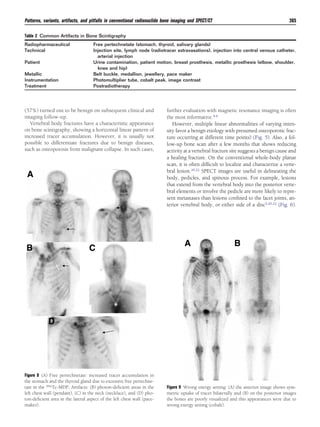
The appearance of a lesion itself may aid interpretation. A
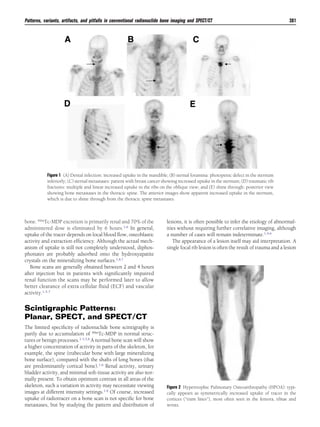
single focal rib lesion is often the result of trauma and a lesion
Figure 1 (A) Dental infection: increased uptake in the mandible; (B) sternal foramina: photopenic defect in the sternum
inferiorly; (C) sternal metastases: patient with breast cancer showing increased uptake in the sternum; (D) traumatic rib
fractures: multiple and linear increased uptake in the ribs on the oblique view; and (E) shine through: posterior view
showing bone metastases in the thoracic spine. The anterior images show apparent increased uptake in the sternum,
which is due to shine through from the thoracic spine metastases.
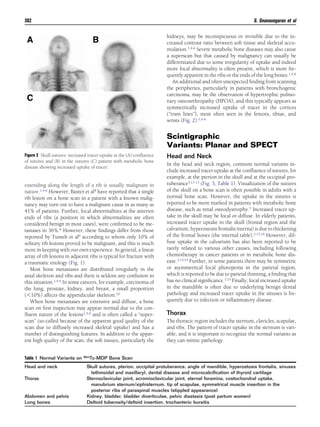
Figure 2 Hypertrophic Pulmonary Osteoarthropathy (HPOA): typi-
cally appears as symmetrically increased uptake of tracer in the
cortices (“tram lines”), most often seen in the femora, tibiae and
wrists.
Patterns, variants, artifacts, and pitfalls in conventional radionuclide bone imaging and SPECT/CT 381
extending along the length of a rib is usually malignant in
nature.1,4-6 However, Baxter et al8 have reported that a single
rib lesion on a bone scan in a patient with a known malig-
nancy may turn out to have a malignant cause in as many as
41% of patients. Further, focal abnormalities at the anterior
ends of ribs (a position in which abnormalities are often
considered benign in most cases), were confirmed to be me-
tastases in 36%.8 However, these findings differ from those
reported by Tumeh et al9 according to whom only 10% of
solitary rib lesions proved to be malignant, and this is much
more in keeping with our own experience. In general, a linear
array of rib lesions in adjacent ribs is typical for fracture with
a traumatic etiology (Fig. 1).
Most bone metastases are distributed irregularly in the
axial skeleton and ribs and there is seldom any confusion in
this situation.1,4-6 In some cancers, for example, carcinoma of
the lung, prostate, kidney, and breast, a small proportion
(Ͻ10%) affects the appendicular skeleton.10
When bone metastases are extensive and diffuse, a bone
scan on first inspection may appear normal due to the con-
fluent nature of the lesions1,4-6 and is often called a “super-
scan” (so-called because of the apparent good quality of the
scan due to diffusely increased skeletal uptake) and has a
number of distinguishing features. In addition to the appar-
ent high quality of the scan, the soft tissues, particularly the
kidneys, may be inconspicuous or invisible due to the in-
creased contrast ratio between soft tissue and skeletal accu-
mulation.1,4-6 Severe metabolic bone diseases may also cause
a superscan but that caused by malignancy can usually be
differentiated due to some irregularity of uptake and indeed
more focal abnormality is often present, which is more fre-
quently apparent in the ribs or the ends of the long bones.1,4-6
An additional and often unexpected finding from scanning
the peripheries, particularly in patients with bronchogenic
carcinoma, may be the observation of hypertrophic pulmo-
nary osteoarthropathy (HPOA), and this typically appears as
symmetrically increased uptake of tracer in the cortices
(“tram lines”), most often seen in the femora, tibiae, and
wrists (Fig. 2).1,4-6
Scintigraphic
Variants: Planar and SPECT
Head and Neck
In the head and neck region, common normal variants in-
clude increased tracer uptake at the confluence of sutures, for
example, at the pterion in the skull and at the occipital pro-
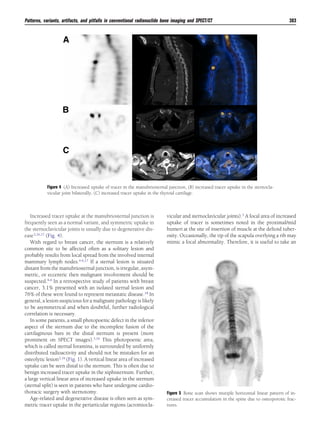
tuberance3,11-13 (Fig. 3, Table 1). Visualization of the sutures
of the skull on a bone scan is often possible in adults with a
normal bone scan. However, the uptake in the sutures is
reported to be more marked in patients with metabolic bone
disease, such as renal osteodystrophy.3 Increased tracer up-
take in the skull may be focal or diffuse. In elderly patients,
increased tracer uptake in the skull (frontal region and the
calvarium, hyperostosis frontalis interna) is due to thickening
of the frontal bones (the internal table).3,13,14 However, dif-
fuse uptake in the calvarium has also been reported to be
rarely related to various other causes, including following
chemotherapy in cancer patients or in metabolic bone dis-
ease.3,13,14 Further, in some patients there may be symmetric
or asymmetrical focal photopenia in the parietal region,
which is reported to be due to parietal thinning, a finding that
has no clinical significance.3,15 Finally, focal increased uptake
in the mandible is often due to underlying benign dental
pathology and increased tracer uptake in the sinuses is fre-
quently due to infection or inflammatory disease.
Thorax
The thoracic region includes the sternum, clavicles, scapulae,
and ribs. The pattern of tracer uptake in the sternum is vari-
able, and it is important to recognize the normal variants as
they can mimic pathology.
Figure 3 Skull sutures: increased tracer uptake at the (A) confluence
of sutures and (B) in the sutures (C) patient with metabolic bone
disease showing increased uptake of tracer.
Table 1 Normal Variants on 99mTc-MDP Bone Scan
Head and neck Skull sutures, pterion, occipital protuberance, angle of mandible, hyperostosis frontalis, sinuses
(ethmoidal and maxillary), dental disease and microcalcification of thyroid cartilage
Thorax Sternoclavicular joint, acromioclavicular joint, sternal foramina, costochondral uptake,
manubrium sternum/xiphisternum, tip of scapulae, symmetrical muscle insertion in the
posterior ribs of paraspinal muscles (stippled appearance)
Abdomen and pelvis Kidney, bladder, bladder diverticulae, pelvic diastasis (post partum women)
Long bones Deltoid tuberosity/deltoid insertion, trochanteric bursitis
382 G. Gnanasegaran et al
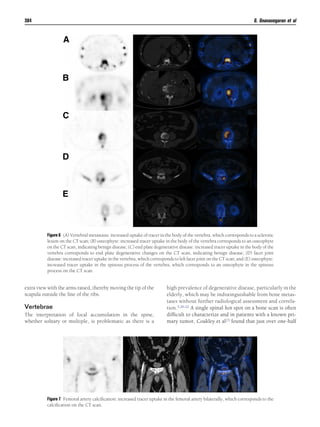
Increased tracer uptake at the manubriosternal junction is
frequently seen as a normal variant, and symmetric uptake in
the sternoclavicular joints is usually due to degenerative dis-
ease3,16,17 (Fig. 4).
With regard to breast cancer, the sternum is a relatively
common site to be affected often as a solitary lesion and
probably results from local spread from the involved internal
mammary lymph nodes.4-6,17 If a sternal lesion is situated
distant from the manubriosternal junction, is irregular, asym-
metric, or eccentric then malignant involvement should be
suspected.4-6 In a retrospective study of patients with breast
cancer, 3.1% presented with an isolated sternal lesion and
76% of these were found to represent metastatic disease.18 In
general, a lesion suspicious for a malignant pathology is likely
to be asymmetrical and when doubtful, further radiological
correlation is necessary.
In some patients, a small photopoenic defect in the inferior
aspect of the sternum due to the incomplete fusion of the
cartilaginous bars in the distal sternum is present (more
prominent on SPECT images).3,19 This photopoenic area,
which is called sternal foramina, is surrounded by uniformly
distributed radioactivity and should not be mistaken for an
osteolytic lesion3,19 (Fig. 1). A vertical linear area of increased
uptake can be seen distal to the sternum. This is often due to
benign increased tracer uptake in the xiphisternum. Further,
a large vertical linear area of increased uptake in the sternum
(sternal split) is seen in patients who have undergone cardio-
thoracic surgery with sternotomy.
Age-related and degenerative disease is often seen as sym-
metric tracer uptake in the periarticular regions (acromiocla-
vicular and sternoclavicular joints).3 A focal area of increased
uptake of tracer is sometimes noted in the proximal/mid
humeri at the site of insertion of muscle at the deltoid tuber-
osity. Occasionally, the tip of the scapula overlying a rib may
mimic a focal abnormality. Therefore, it is useful to take an
Figure 5 Bone scan shows mutiple horizontal linear pattern of in-
creased tracer accumulation in the spine due to osteoporotic frac-
tures.
Figure 4 (A) Increased uptake of tracer in the manubriosternal junction, (B) increased tracer uptake in the sternocla-
vicular joint bilaterally, (C) increased tracer uptake in the thyroid cartilage.
Patterns, variants, artifacts, and pitfalls in conventional radionuclide bone imaging and SPECT/CT 383
extra view with the arms raised, thereby moving the tip of the
scapula outside the line of the ribs.
Vertebrae
The interpretation of focal accumulation in the spine,
whether solitary or multiple, is problematic as there is a
high prevalence of degenerative disease, particularly in the
elderly, which may be indistinguishable from bone metas-
tases without further radiological assessment and correla-
tion.5,20-22 A single spinal hot spot on a bone scan is often
difficult to characterize and in patients with a known pri-
mary tumor, Coakley et al23 found that just over one-half
Figure 6 (A) Vertebral metastasis: increased uptake of tracer in the body of the vertebra, which corresponds to a sclerotic
lesion on the CT scan; (B) osteophyte: increased tracer uptake in the body of the vertebra corresponds to an osteophyte
on the CT scan, indicating benign disease; (C) end plate degenerative disease: increased tracer uptake in the body of the
vertebra corresponds to end plate degenerative changes on the CT scan, indicating benign disease; (D) facet joint
disease: increased tracer uptake in the vertebra, which corresponds to left facet joint on the CT scan; and (E) osteophyte:
increased tracer uptake in the spinous process of the vertebra, which corresponds to an osteophyte in the spinous
process on the CT scan.
Figure 7 Femoral artery calcification: increased tracer uptake in the femoral artery bilaterally, which corresponds to the
calcification on the CT scan.
384 G. Gnanasegaran et al
(57%) turned out to be benign on subsequent clinical and
imaging follow-up.
Vertebral body fractures have a characteristic appearance
on bone scintigraphy, showing a horizontal linear pattern of
increased tracer accumulation. However, it is usually not
possible to differentiate fractures due to benign diseases,
such as osteoporosis from malignant collapse. In such cases,
further evaluation with magnetic resonance imaging is often
the most informative.4-6
However, multiple linear abnormalities of varying inten-
sity favor a benign etiology with presumed osteoporotic frac-
ture occurring at different time points) (Fig. 5). Also, a fol-
low-up bone scan after a few months that shows reducing
activity at a vertebral fracture site suggests a benign cause and
a healing fracture. On the conventional whole-body planar
scan, it is often difficult to localize and characterize a verte-
bral lesion.20-22 SPECT images are useful in delineating the
body, pedicles, and spinous process. For example, lesions
that extend from the vertebral body into the posterior verte-
bral elements or involve the pedicle are more likely to repre-
sent metastases than lesions confined to the facet joints, an-
terior vertebral body, or either side of a disc5,20-22 (Fig. 6).
Figure 8 (A) Free pertechnetate: increased tracer accumulation in
the stomach and the thyroid gland due to excessive free pertechne-
tate in the 99mTc-MDP; Artifacts: (B) photon-deficient areas in the
left chest wall (pendant), (C) in the neck (necklace), and (D) pho-
ton-deficient area in the lateral aspect of the left chest wall (pace-
maker).
Figure 9 Wrong energy setting: (A) the anterior image shows sym-
metric uptake of tracer bilaterally and (B) on the posterior images
the bones are poorly visualized and this appearances were due to
wrong energy setting (cobalt).
Table 2 Common Artifacts in Bone Scintigraphy
Radiopharmaceutical Free pertechnetate (stomach, thyroid, salivary glands)
Technical Injection site, lymph node (radiotracer extravasations), injection into central venous catheter,
arterial injection
Patient Urine contamination, patient motion, breast prosthesis, metallic prosthesis (elbow, shoulder,
knee and hip)
Metallic Belt buckle, medallion, jewellery, pace maker
Instrumentation Photomultiplier tube, cobalt peak, image contrast
Treatment Postradiotherapy
Patterns, variants, artifacts, and pitfalls in conventional radionuclide bone imaging and SPECT/CT 385
Table 3 Causes of Artifacts on CT44-53
Types of Artifacts Causes Outcome
Motion ● When object of interest is moved during the scan
● Voluntary: respiration, body movement (external)
and swallowing
● Involuntary: beating heart, peristalsis, coughing,
and sneezing
● Local blurring of contours as well as
disturbances in the whole image
Beam hardening ● The polychromatic nature of the x-ray beam as it
leaves the x-ray tube is attenuated differently,
depending on x-ray energy and object type. This
will preferentially eliminate lower-energy photons
from the beam
● Often seen as dark zones or streaks
between bone structures, particularly
in the vicinity of the base of the skull
Scattered radiation ● The design of the scanner (amount of collimation
in the detectors)
● Characteristics in the patient
● FOV size
● Reduces the accuracy of the image
reconstruction
Ring ● Poor calibration of detectors
● Drift in uniformity sensitivity of detectors
● Intensely bright or dark circular ring
within the image
Partial volume effects ● Structures that only extend partially into the slice
● When anatomy changes quickly, and the scan
uses a slice thickness which is too wide
● Dark and light streak artifacts
Sampling ● Partial-volume effects that occur in the scan plane ● Streaking at transitions with high
contrast, for example, bone or metal
Truncation ● In some scanning angles, not all the object is
within the FOV
● Hyperdense areas seen adjacent to
the section outside the FOV
Table 4 Causes of Artifacts on SPECT/CT44-53
Types of
Artifacts Causes Outcome
Misregistration ● Poor calibration of the relative position of the
modalities’ isocenters,
● Change in the isocenter due to couch
movement or sagging
● Change in the SPECT center of rotation for
example with heavy high energy collimators
● Patient movement (voluntary or involuntary)
● Misregistration artifacts will be most apparent at
the boundaries of organs/structures
● Localisation becomes confused
● Misapplication of attenuation correction data
may over or under correct the SPECT data and
so mimic the appearance of uptake defects or
an underlying pathology
Respiration ● Patient continues with normal shallow
respiration during the CT and SPECT
● Patient holds breath for CT but breaths for
SPECT
● CT movement artifacts around the diaphragm,
but the overall position and shape of the
internal organs will better match that of the
averaged respiration position of the SPECT scan
● Positional differences between SPECT and CT
in the lungs, heart and around the diaphragm
Truncation ● The FOV is too small or the patient too large
● Patient arms extend outside selected FOV.
(Likely if patient can not raise arms out of
FOV for the duration of a SPECT/CT scan)
● Hyperdense areas on CT seen adjacent to the
section outside the FOV
● Streaking artifacts
Highly attenuating
foreign bodies
● Metal pins, joints and/or fillings
● Contrast agents
● Low photon count areas of the projections, and
their associated higher noise, cause major
streaking and an inaccurate attenuation
coefficient measurement
CT noise ● Large patient
● Low dose CT settings
● Low photon count leading to noise which is
amplified during reconstruction
● Errors in the defining CT number
● Potential loss of visibility of smaller details
Thick CT slices ● Limitations of the equipment
● Incorrect reconstruction parameters
● Stair step slices in the craniocaudal direction
386 G. Gnanasegaran et al
There is no doubt that SPECT improves lesion detection in the
posterior elements of the vertebra, but its superiority for charac-
terizingthepathologyinthebodyofthevertebraislessevident22
and SPECT/CT is likely to show incremental benefit.
Long Bones and Knees
In the long bones, focal areas of increased tracer uptake are
often seen at the sites of repeated stress (eg, the site of the
patella tendon insertion at the tibial tuberosity). Increased
tracer uptake in the patellae (hot patella sign) is a common
finding on the bone scan and may be seen in association with
a wide variety of disorders. However, this “sign” cannot be
considered of diagnostic value,24 as although often due to
degenerative disease, other causes, such as Paget disease and
osteomyelitis have been reported in isolated cases.3,24,25
In the elderly, calcification of the arteries (most commonly
involving the femoral arteries), can be seen on the bone scan3
(Fig. 7), although the clinical significance of this finding is
unknown.
Abdomen and Pelvis
Bladder and renal collecting system activity are usually seen
routinely on the bone scan and patients should void before
scanning. In post-partum females, increased stress reaction/
pelvic diastases can lead to increased tracer uptake in the
pubic symphysis and possibly the sacroiliac joints.3 Asym-
metrical uptake in the ischium/ischial tuberosity should be
interpreted with some caution in patients with prostate can-
cer as focal increased uptake could represent a bone metas-
tasis or could have a benign explanation, such as muscle
origin injury (semitendinosus, semimembranosus and long
head of biceps femoris muscle-hamstring group). In most
cases, radiological correlation can be useful, particularly if
magnetic resonance imaging is already being performed to
assess the prostate gland and it is possible that SPECT/CT will
help clarify this type of problem.
Pitfalls in
Radionuclide Bone Scintigraphy
Aggressive or purely lytic metastases may not generate a vis-
ible osteoblastic response and may appear as a purely cold
lesion that is difficult to identify on a routine whole-body
bone scan, a phenomenon that most commonly occurs in
malignancies, such as myeloma,1,4-6 and it is generally ac-
cepted that the bone scan is not an ideal technique for eval-
uation of patients with myeloma.26
Radionuclide bone scintigraphy is often useful in the as-
sessment of treatment response. However, if the bone scan is
performed very soon after treatment, it may be difficult to
distinguish a flare response from tumor progression.4-6,27-30
The flare response is a well-recognized phenomenon on the
bone scan and shows a transient increase in tracer uptake in
responding metastases due to a local osteoblastic reaction in
bone in the early months after therapy (chemotherapy/hor-
mone therapy) for breast and prostate cancer,4,27-30 and pre-
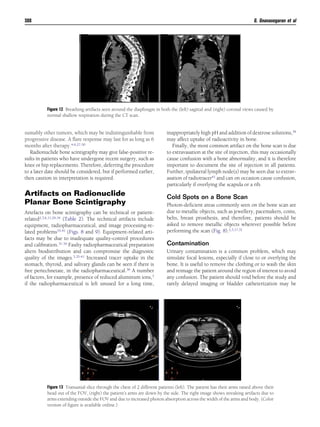
Figure 10 SPECT/CT misalignment; (left) the transaxial and (right) the sagittal view due to the hand relaxing between
the CT and SPECT image.
Figure 11 SPECT/CT misalignment in the ribs due to breathing movements; (left) the transaxial and (right) the sagittal
view. The misregistration artifacts will be most apparent and disruptive at the boundaries of moving organs.
Patterns, variants, artifacts, and pitfalls in conventional radionuclide bone imaging and SPECT/CT 387
sumably other tumors, which may be indistinguishable from
progressive disease. A flare response may last for as long as 6
months after therapy.4-6,27-30
Radionuclide bone scintigraphy may give false-positive re-
sults in patients who have undergone recent surgery, such as
knee or hip replacements. Therefore, deferring the procedure
to a later date should be considered, but if performed earlier,
then caution in interpretation is required.
Artifacts on Radionuclide
Planar Bone Scintigraphy
Artefacts on bone scintigraphy can be technical or patient-
related2,3,6,11,29-34 (Table 2). The technical artifacts include
equipment, radiopharmaceutical, and image processing-re-
lated problems35-41 (Figs. 8 and 9). Equipment-related arti-
facts may be due to inadequate quality-control procedures
and calibration.31-34 Faulty radiopharmaceutical preparation
alters biodistribution and can compromise the diagnostic
quality of the images.3,35-41 Increased tracer uptake in the
stomach, thyroid, and salivary glands can be seen if there is
free pertechnetate, in the radiopharmaceutical.36 A number
of factors, for example, presence of reduced aluminum ions,3
if the radiopharmaceutical is left unused for a long time,
inappropriately high pH and addition of dextrose solutions,39
may affect uptake of radioactivity in bone.
Finally, the most common artifact on the bone scan is due
to extravasation at the site of injection, this may occasionally
cause confusion with a bone abnormality, and it is therefore
important to document the site of injection in all patients.
Further, ipsilateral lymph node(s) may be seen due to extrav-
asation of radiotracer41 and can on occasion cause confusion,
particularly if overlying the scapula or a rib.
Cold Spots on a Bone Scan
Photon-deficient areas commonly seen on the bone scan are
due to metallic objects, such as jewellery, pacemakers, coins,
belts, breast prosthesis, and therefore, patients should be
asked to remove metallic objects wherever possible before
performing the scan (Fig. 8).2,3,17,31
Contamination
Urinary contamination is a common problem, which may
simulate focal lesions, especially if close to or overlying the
bone. It is useful to remove the clothing or to wash the skin
and reimage the patient around the region of interest to avoid
any confusion. The patient should void before the study and
rarely delayed imaging or bladder catheterization may be
Figure 12 Breathing artifacts seen around the diaphragm in both the (left) sagittal and (right) coronal views caused by
normal shallow respiration during the CT scan.
Figure 13 Transaxial slice through the chest of 2 different patients (left). The patient has their arms raised above their
head out of the FOV, (right) the patient’s arms are down by the side. The right image shows streaking artifacts due to
arms extending outside the FOV and due to increased photon absorption across the width of the arms and body. (Color
version of figure is available online.)
388 G. Gnanasegaran et al
required. Further, radioactive urine in the bladder is a fre-
quent cause of artifact in patients evaluated with SPECT for
pelvic metastases (prostate cancer) or low-back pain. In-
creased radioactive urine in the bladder can cause streak
artifacts on the reconstructed images and overlap bony struc-
tures.3,42,43 Further, intense tracer retention in the bladder is
reported to cause pixel overload, resulting in a relatively cold
area close to the region of interest of the femoral heads with
consequent difficulty in interpretation.3,42,43
Artifacts on SPECT-CT Images
SPECT-only artifacts and conventional CT–only artifacts are
widely reported,44-53 but artifacts occurring from the combi-
nation of modified CT scan and SPECT are less well known.
The CT component of SPECT/CT can be used for both
localization and for attenuation correction. Both require ac-
curate coregistration between modalities but attenuation cor-
rection also relies upon the CT numbers being an accurate
measure of the attenuation coefficient at a known CT energy.
This premise fails where beam hardening changes the measured
energy-dependent CT attenuation coefficient, where a low pho-
ton count leads to high noise in the CT number, and of course,
where there are CT artifacts. Any change in the patient’s posi-
tion, orientation, or physiological status between the CT scan
and SPECT scan can lead to misregistration problems. Because
conventional CT scanning protocols usually need to be modi-
fied for SPECT/CT use, there are further opportunities for the
introduction of artifacts (Tables 3 and 4).
The most common SPECT/CT artifacts are discussed in
further detail further in the text.
SPECT/CT Misregistration
Dedicated SPECT/CT systems can more accurately fuse the
SPECT and CT images. However, exact coregistration can be
lost either by poor calibration of the relative position of the
modalities’ isocenters, or by a change in the isocenter due to
couch movement or sagging, or by a change in the SPECT
center of rotation, for example, with heavy high-energy col-
limators. Movement of or within the patient can also intro-
duce misregistration. The patient movement may be de-
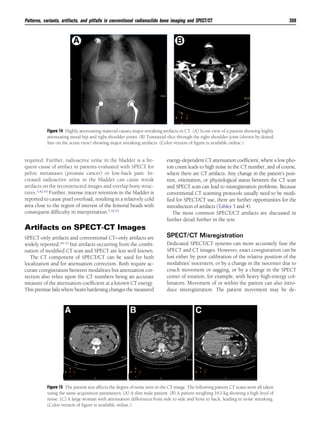
Figure 14 Highly attenuating material causes major streaking artifacts in CT. (A) Scout view of a patient showing highly
attenuating metal hip and right shoulder joints. (B) Transaxial slice through the right shoulder-joint (shown by dotted
line on the scout view) showing major streaking artifacts. (Color version of figure is available online.)
Figure 15 The patient size affects the degree of noise seen in the CT image. The following patient CT scans were all taken
using the same acquisition parameters: (A) A slim male patient. (B) A patient weighing 163-kg showing a high level of
noise. (C) A large woman with attenuation differences from side to side and front to back, leading to noise streaking.
(Color version of figure is available online.)
Patterns, variants, artifacts, and pitfalls in conventional radionuclide bone imaging and SPECT/CT 389
scribed as voluntary or involuntary. Voluntary movements
include deliberate or accidental movement of the patient’s
position often occurring as the patient relaxes between the
CT and the SPECT scan (Fig. 10) and can be minimized by
good patient preparation before the scan, keeping the patient
as comfortable and well supported as possible, and keeping
scan times as short as possible. Involuntary movements relate
to respiration (discussed further), cardiac motion, bowel
movement, or a change in size and position of the bladder. It
is at the boundaries of moving organs where the misregistra-
tion artifacts will be most apparent and disruptive (Fig. 11).
Localization becomes confused and the misapplication of at-
tenuation correction data may over- or undercorrect the
SPECT data and so mimic the appearance of uptake defects or
an underlying pathology.
Although modern SPECT/CT systems have software to
manually move one dataset relative to the other, this is usu-
ally limited to a simple pixel shift applied to the entire data-
set, which is not ideal and can introduce an additional level of
uncertainty when interpreting the scan.
Respiration During SPECT/CT
Conventional CT scanning is fast enough to be performed
during a single breath-hold, whereas a SPECT scan usually
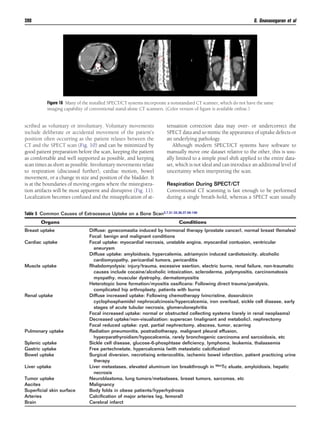
Figure 16 Many of the installed SPECT/CT systems incorporate a nonstandard CT scanner, which do not have the same
imaging capability of conventional stand-alone CT scanners. (Color version of figure is available online.)
Table 5 Common Causes of Extraosseus Uptake on a Bone Scan3,7,31-33,36,37,56-106
Organs Conditions
Breast uptake Diffuse: gynecomastia induced by hormonal therapy (prostate cancer), normal breast (females)
Focal: benign and malignant conditions
Cardiac uptake Focal uptake: myocardial necrosis, unstable angina, myocardial contusion, ventricular
aneurysm
Diffuse uptake: amyloidosis, hypercalemia, adriamycin induced cardiotoxicity, alcoholic
cardiomyopathy, pericardial tumors, pericarditis
Muscle uptake Rhabdomyolysis: injury/trauma, excessive exertion, electric burns, renal failure, non-traumatic
causes include cocaine/alcoholic intoxication, scleroderma, polymyositis, carcinomatosis
myopathy, muscular dystrophy, dermatomyositis
Heterotopic bone formation/myositis ossificans: Following direct trauma/paralysis,
complicated hip arthroplasty, patients with burns
Renal uptake Diffuse increased uptake: Following chemotherapy (vincristine, doxorubicin
cyclophosphamide) nephrocalcinosis/hypercalcemia, iron overload, sickle cell disease, early
stages of acute tubular necrosis, glomerulonephritis
Focal increased uptake: normal or obstructed collecting systems (rarely in renal neoplasms)
Decreased uptake/non-visualization: superscan (malignant and metabolic), nephrectomy
Focal reduced uptake: cyst, partial nephrectomy, abscess, tumor, scarring
Pulmonary uptake Radiation pneumonitis, postradiotherapy, malignant pleural effusion,
hyperparathyroidism/hypocalcemia, rarely bronchogenic carcinoma and sarcoidosis, etc
Splenic uptake Sickle cell disease, glucose-6-phosphtase deficiency, lymphoma, leukemia, thalassemia
Gastric uptake Free pertechnetate, hypercalcemia (with metastatic calcification)
Bowel uptake Surgical diversion, necrotising enterocolitis, ischemic bowel infarction, patient practicing urine
therapy
Liver uptake Liver metastases, elevated aluminum ion breakthrough in 99mTc eluate, amyloidosis, hepatic
necrosis
Tumor uptake Neuroblastoma, lung tumors/metastases, breast tumors, sarcomas, etc
Ascites Malignancy
Superficial skin surface Body folds in obese patients/hyperhydrosis
Arteries Calcification of major arteries (eg, femoral)
Brain Cerebral infarct
390 G. Gnanasegaran et al
lasts approximately 20 minutes. Acquiring the CT at just 1
specific phase of respiration leads to differences particularly
in the appearance and position of the diaphragm and the
periphery and base of the lungs and so creates a problem of
local misregistration. If a patient continues with normal shal-
low respiration during the CT, there may be some additional
CT movement-related artifacts around the diaphragm (Fig.
12), but the overall position and shape of the internal organs
would better match that of the averaged respiration position
of the SPECT scan.
Arms Up or Down?
In conventional CT scans, the arms are kept out of the field of
view (FOV), either raised for body CT or down by the pa-
tient’s side for head and neck CT. If a patient has a CT with
their arms in the scanned FOV then truncation artifacts, such
as streaking may be seen due to the arms extending outside
the reconstructed FOV. Streak artifacts may also be seen due
to the increased photon absorption across the width of the
arms and body (Fig. 13).
New iterative reconstruction techniques are becoming avail-
able to compensate for truncation of the arms or even the torso
of larger patients. Although relatively successful, these do not
currentlyrecreatethemissingdatawithoutsomedegreeoferror.
Highly Attenuating (Metal)
Foreign Bodies or Contrast Agents
It is not uncommon to see metal pins, joints, or even fillings
in patients undergoing bone SPECT/CT. The exact amount
and distribution of the metal within the patient will deter-
mine how significant the image artifacts will be. Any highly
attenuating material causes reconstruction problems in CT
with low photon count areas of the projections, and associ-
ated higher noise, causing major streaking (Fig. 14) and an
inaccurate attenuation coefficient measurement. Corrections
can often be applied to reduce the appearance of such arti-
facts in CT, but these still fail to correctly represent the atten-
uation coefficient, which may be needed for the attenuation
correction of the SPECT data.
Figure 17 Malignant pleural effusion: increased tracer uptake in the
right lung in a patient with renal cancer.
Figure 18 Kidney: (A) Retention of tracer in the left kidney indicating obstruction, (B) dilated calyceal system bilaterally,
(C) increased uptake in the kidneys following chemotherapy, and (D) increased uptake in the kidneys and spleen in a
patient with sickle cell disease.
Patterns, variants, artifacts, and pitfalls in conventional radionuclide bone imaging and SPECT/CT 391
Patient Size and CT Noise
Low photon count leads to noise in each projection and this
noise is amplified during reconstruction. Noise not only
means errors in the CT number but also, through its recon-
struction, can lead to a loss of visibility of smaller details. Any cause of noise, such as high patient attenuation or subop-
timal CT acquisition parameters (too thin slices, too sharp
reconstruction filter, or too low a current) will therefore
lead to artifacts. SPECT/CT localization and SPECT/CT
attenuation correction is usually performed with a much
lower CT current than with conventional CT and so the
likelihood and severity of noise is greater. The patient will
also affect the degree of noise as larger patients mean
higher overall attenuation (Fig. 15). The attenuation dif-
ferences from side to side and front to back can again lead
to noise streaking.
On modern CT scanners, it is possible to make use of
automatic mA adjustment available to correctly adjust for
patient size and anatomy.
Limitations of the CT Scanner
Many of the installed SPECT-CT systems incorporate a non-
standard CT scanner, which does not have the same imaging
capability of conventional stand-alone CT scanners. Their
acquisition and reconstruction parameters are more limited,
and generally produce CT images with a thicker slice (Fig.
16) acquired over a much longer time than for a modern
multislice CT scanner. This can lead to more CT artifacts,
such as movement-related artifacts, CT partial volume, or
stair stepping in which the anatomy changes markedly in the
craniocaudal direction. Thicker CT slices may better match
the poorer resolution of the SPECT scan but the overall error
in attenuation corrected SPECT/CT is a combination of the
errors in the SPECT and CT data.
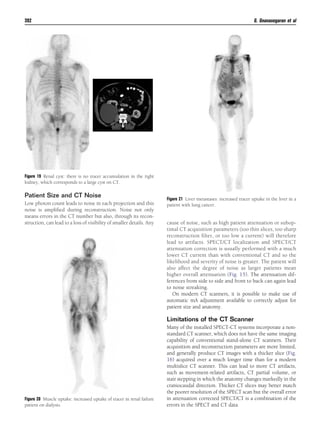
Figure 19 Renal cyst: there is no tracer accumulation in the right
kidney, which corresponds to a large cyst on CT.
Figure 20 Muscle uptake: increased uptake of tracer in renal failure
patient on dialysis.
Figure 21 Liver metastases: increased tracer uptake in the liver in a
patient with lung cancer.
392 G. Gnanasegaran et al
Artifacts, which produce or mimic increased tracer uptake
or hotspots, can possibly be identified and investigated by
viewing the (uncorrected) SPECT and CT images separately
as well as the fused SPECT/CT images. However, artifacts that
obscure the appearance of true defects may lead to a false-
negative diagnosis.
Some of the artifacts discussed above can be minimized or
partially removed with various software corrections supplied
by manufacturers of individual SPECT/CT systems. How-
ever, the most important factors to consider in avoiding im-
age artifacts are good patient preparation, careful patient
positioning, and adequate support and comfort, and the op-
timum selection of scan protocol parameters.
Extraosseus Uptake on Bone Scintigraphy
A bone scan is used for evaluating the skeletal system; how-
ever, we often see tracer uptake in the soft tissues3,26,27,31-35
and recognition of such findings may be of diagnostic value
in some cases. In general, the mechanisms of uptake in soft
tissue are reported to be similar to those for bones. The re-
ported mechanisms include (a) local tissue necrosis or dam-
age leading to increased calcium deposition in the tissue, (b)
hyperemia, (c) altered capillary permeability, (d) adsorption
onto tissue calcium, (e) presence of iron deposits, and (f)
binding to enzyme receptors or denatured proteins.3,54,55 In-
creased tracer uptake in the soft tissue is reported to occur in
a variety of diseases (both local and systemic) Table 556-106
(Figs. 17-21).
Conclusions
Bone scintigraphy is one of the most common investigations
performed in nuclear medicine and is used as a routine
screening test for suspected bone metastases and in various
benign musculoskeletal conditions.
To increase the specificity of bone scan interpretation it is
necessary to have a knowledge of normal variants and pat-
terns of abnormality to minimize misinterpretation.
References
1. Gnanasegaran G, Cook GJ, Fogelman I: Musculoskeletal system, in
Biersack HJ, Freeman LM (eds): Nuclear Medicine Concise. New
York, Springer, 2007
2. O’Connor MK, Brown ML, Hung JC, et al: The art of bone scintigra-
phy: Technical aspects. J Nucl Med 32:2332-2341, 1991
3. Storey G, Murray IPC: Bone scintigraphy: The procedure and inter-
pretation, in Ell PJ, Gambhir SS: Nuclear Medicine in Clinical Diag-
nosis and Treatment, Vol I. Churchill Livingstone, Elsevier, New
York, 2004, pp 593-622
4. Cook GJ, Fogelman I: The role of nuclear medicine in monitoring
treatment in skeletal malignancy. Semin Nucl Med 31:206-211, 2001
5. Cook GJ, Fogelman I: Skeletal metastases from breast cancer: Imaging
with nuclear medicine. Semin Nucl Med 29:69-79, 1999
6. O’Sullivan JM, Cook GJ: A review of the efficacy of bone scanning in
prostate and breast cancer. Q J Nucl Med 46:152-159, 2002
7. Love C, Din AS, Tomas MB, et al: Radionuclide bone imaging: An
illustrative review. Radiographics 23:341-358, 2003
8. Baxter AD, Coakley FV, Finlay DB, et al: The aetiology of solitary hot
spots in the ribs on planar bone scans. Nucl Med Commun 16:834-
837, 1995
9. Tumeh SS, Beadle G, Kaplan WD: Clinical significance of solitary rib
lesions in patients with extraskeletal malignancy. J Nucl Med 26:
1140-1143, 1985
10. Tofe AJ, Francis MD, Harvey WJ: Correlation of neoplasms with inci-
dence and localisation of skeletal metastases. An analysis of 1355
diphosphonate bone scans. J Nucl Med 16:986-989, 1975
11. Gates GF, Dore EK: Detection of craniosynostosis by bone scanning.
Radiology 115:665-671, 1975
12. Paterson DC: Myositis ossificans circumscripta: Report of four cases
without history of injury. Bone Joint Surg J Br 52:296-301, 1970
13. Harbert J, Desai R: Small calvarial bone scan foci—Normal variations.
J Nucl Med 26:1144-1148, 1985
14. Senda K, Itoh S: Evaluation of diffusely high uptake by the Calvaria in
bone scintigraphy. Ann Nucl Med 1:23-26, 1987
15. Rao BK, Lieberman LM: Parietal thinning: A cause for photopenia on
bone scan. Clin Nucl Med 5:313, 1980
16. Fink-Bennett DM, Shapiro EE: The Angle of Louis. A potential pitfall
(“Louie’s Hot Spot”) in bone scan interpretation. Clin Nucl Med
9:352-354, 1984
17. Fogelman I, Maisey M: An Atlas of Clinical Nuclear Medicine (ed 1).
London, Dunitz Ltd, 1988
18. Kwai AH, Stomper PC, Kaplan WD: Clinical significance of isolated
scintigraphic sternal lesions in patients with breast cancer. J Nucl Med
29:324-328, 1988
19. McCormick WF, Sternal: Foramena in man. Am J Forensic Med
Pathol 2:249-252, 1981
20. Delpassand ES, Garcia JR, Bhadkamkar V, et al: Value of SPECT im-
aging of the thoracolumbar spine in cancer patients. Clin Nucl Med
20:1047-1051, 1995
21. Bushnell DL, Kahn D, Huston B, et al: Utility of SPECT imaging for
determination of vertebral metastases in patients with known primary
tumors. Skeletal Radiol 24:13-16, 1995
22. Han LJ, Au-Yong TK, Tong WCM, et al: Comparison of bone SPECT
and planar imaging in the detection of vertebral metastases in patients
with back pain. Eur J Nucl Med 25:635-638, 1998
23. Coakley FV, Jones AR, Finlay DB, et al: The aetiology and distinguish-
ing features of solitary spinal hot spots on planar bone scans. Clin
Radiol 50:327-330, 1995
24. Fogelman I, McKillop JH, Gray HW: The “hot patella” sign: Is it of any
clinical significance? Concise communication. J Nucl Med 24:312-
315, 1983
25. Kipper MS, Alazraki NP, Feiglin DH: The “hot” patella. Clin Nucl Med
7:28-32, 1982
26. D’Sa S, Abildgaard N, Tighe J, et al: Guidelines for the use of imaging
in the management of myeloma. Br J Haematol 137:49-63, 2007
27. Johns WD, Garrick MB, Kaplan WD: Leuprolide therapy for prostate
cancer. An association with scintigraphic flare on bone scan. Clin Nucl
Med 15:485-487, 1990
28. Haywood JL, Carbone PP, Heuson JC, et al: Assessment of response to
therapy in advanced breast cancer. Eur J Cancer 13:89-94, 1977
29. Citrin DL: Problems and limitations of bone scanning with Tc99m
phosphates. Clin Radiol 28:97-105, 1977
30. Schneider JA, Divgi CR, Scott AM, et al: Flare on bone scintigraphy
following Taxol chemotherapy for metastatic breast cancer. J Nucl
Med 35:1748-1752, 1994
31. Loutfi I, Collier BD, Mohammed AM: Nonosseous abnormalities on
bone scans. J Nucl Med Technol 31:149-153, 2003
32. Kaye J, Hayward M: Soft tissue uptake on 99mTc methylene diphos-
phonate bone scan imaging: Pictorial review. Australas Radiol 46:13-
21, 2002
33. Gentili A, Miron SD, Bellon EM: Nonosseous accumulation of bone-
seeking radiopharmaceuticals. Radiographics 10:871-881, 1990
34. Gentili A, Miron SD, Adler LP: Review of some common artifacts in
nuclear medicine. Clin Nucl Med 19:138-143, 1994
35. McAfee JC, Singh A, Roskopf M, et al: Experimental drug-induced
changes in renal function and biodistribution of Tc99m MDP. Invest
Radiol 18:470-478, 1983
36. Hung JC, Ponto JA, Hammes RJ: Radiopharmaceutical-related pitfalls
and artifacts. Semin Nucl Med 26:208-255, 1996
Patterns, variants, artifacts, and pitfalls in conventional radionuclide bone imaging and SPECT/CT 393
37. Wilson MA, Pollack MJ: Gastric visualization and image quality in
radionuclide bone scanning: Concise communication. J Nucl Med
22:518-521, 1981
38. Chaudhuri TK: The effect of aluminum and pH on altered body dis-
tribution of Tc99m EHDP. Int J Nucl Med Biol 3:37, 1976
39. Al-Enizi E, Kazem N, Owunwanne A, et al: Dextrose solutions yield
radiopharmaceutical impurities: The “sweet” scans. J Nucl Med Tech-
nol 31:33-36, 2003
40. Kessler JR, Wells RG, Sty JR: Skeletal scintigraphy: Radiographic arti-
facts. Clin Nucl Med 17:511-512, 1992
41. Dogan A, Rezai K: Incidental lymph node visualisation on bone scan
due to subcutaneous infiltration of Tc99m MDP. Clin Nucl Med 18:
208-209, 1993
42. O’Connor MK, Kelly BJ: Evaluation of techniques for the elimination
of Hot” bladder artifacts in SPECT of the pelvis. J Nucl Med 31:1872-
1875, 1990
43. Bunker SR, Handmaker H, Torre DM, et al: Pixel overflow artifacts in
SPECT evaluation of the skeleton. Radiology 174:229-232, 1990
44. Ogawa K: Image distortion and correction in single photon emission
CT. Ann Nucl Med 18:171-185, 2004
45. O’Connor MK: Instrument- and computer-related problems and arti-
facts in nuclear medicine. Semin Nucl Med 26:256-277, 1996
46. Forstrom LA, Dunn WL, O’Connor MK, et al: Technical pitfalls in
image acquisition, processing, and display. Semin Nucl Med 26:278-
294, 1996
47. Howarth DM, Forstrom LA, O’Connor MK, et al: Patient-related pit-
falls and artifacts in nuclear medicine imaging. Semin Nucl Med 26:
295-307, 1996
48. Kalendar WA: Computed Tomography (ed 2). Erlangen, Germany,
Publicis Corporate Publishing, 2005
49. Popilock R, Sandrasagaren K, Harris L, et al: Artifact recognition for
the nuclear technologist. J Nucl Med Technol 36:79-81, 2008
50. Barrett JF, Keat N: Artefacts in CT: Recognition and avoidance. Radio-
graphics 24:1679-1691, 2004
51. Wilting JE, Timmer J: Artefacts in spiral-CT images and their relation
to pitch and subject morphology. Eur Radiol 9:316-322, 1999
52. Fleischmann D, Rubin GD, Paik DS, et al: Stair-step artifacts with
single versus multiple detector-row helical CT. Radiology 216:185-
196, 2000
53. Silver MD, Taguchi K, Hein IA, et al: Windmill artefact in multislice
CT. Proc SPIE 5032:1918-1927, 2003
54. Zimmer AM, Isitman AT, Holmes RA: Enzymatic inhibition of diphos-
phonate: A proposed mechanism of tissue uptake. J Nucl Med 16:352-
356, 1975
55. Peller P, Ho V, Kransdorf M: Extraosseous Tc99m MDP uptake: A
pathophysiological approach. Radiographics 13:715-734, 1993
56. Duong R, Volarich D, Fernandez-Ulloa M, et al: Tc99m MDP bone
scan artefact: Abdominal soft tissue uptake secondary to subcutane-
ous heparin injection. Clin Nucl Med 9:47, 1984
57. Nizami MA, Gerntholtz T, Swanepoel CR: The role of bone scanning
in the detection of metastatic calcification: A case report. Clin Nucl
Med 25:407-409, 2000
58. Low RD, Hicks RJ, Gill G, et al: Tc99m MDP uptake in a cerebral
infarct. Clin Nucl Med 17:968-970, 1992
59. Padhy AK, Gopinath PG, Amini AC: Myocardial, pulmonary, dia-
phragmatic, gastric, splenic, and renal uptake oft c-99m MDP in pa-
tients with persistent, severe hypercalcemia. Clin Nucleus Med 15:
648-649, 1990
60. Coolens J, Devos P, De Roo M: Diffuse pulmonary uptake of Tc99m
bone imaging agents: Case report and survey. Eur J Nucl Med 11:36-
42, 1985
61. Maloof J, Hurst J, Gupta N: Diffuse pulmonary uptake of Tc99m MDP
in sarcoidosis. Clin Nucl Med 21:77-79, 1996
62. Siegel ME, Walker WJ Jr, Campbell JL: Accumulation of 99mTc-
diphosphonate in malignant pleural effusions. J Nucl Med 16:883-
885, 1975
63. Vanhecke W, Merckx E, De Roo M, et al: Soft tissue uptake on Tc99m
MDP bone scan after cardioversion. Clin Nucl Med 14:923, 1989
64. Lee VW, Caldarone AG, Falk RH, et al: Amyloidosis of heart and liver:
Comparison of Tc99m pyrophosphate and Tc99m methylene diphos-
phonate for detection. Radiology 148:239-242, 1983
65. Atkins HL, Oster ZH: Myocardial uptake of a bone tracer associated
with hypercalcemia. Clin Nucl Med 9:613-615, 1984
66. Ali A, Turner DA, Rosenbush SW, et al: Bone scintigram in cardiac
amyloidosis: A case report. Clin Nucl Med 6:105-108, 1981
67. Piccolo S, Lastoria S, Mainolfi C, et al: Technetium-99m-methylene
diphosphonate scintimammography to image primary breast cancer.
J Nucl Med 36:718-724, 1995
68. Swayne LC: Bone imaging in unusually massive breast carcinoma with
chest wall invasion. Clin Nucl Med 16:593-594, 1991
69. Harvey JA, Fondriest JE, Smith MM: Densely calcified breast mass.
Invest Radiol 29:516-518, 1994
70. Vieras F, Boyd CM: Diagnostic value of renal imaging incidental to
bone scintigraphy with Tc99m phosphate compounds. J Nucl Med
16:1109-1114, 1975
71. Biello DR, Coleman RE, Stanley RJ: Correlation of renal images on
bone scan and intravenous pyelogram. AJR Am J Roentgenol 127:633-
636, 1976
72. Wulfeck DW, Sakow NK, Senler S: Detection of recurrent renal cell
carcinoma by three-phase bone scan. Clin Nucl Med 18:441-443,
1993
73. Bernard M, Hayward M, Hayward C: Evaluation of intense renal pa-
renchymal activity (“Hot Kidneys”) on bone scintigraphy. Clin Nucl
Med 15:254-256, 1990
74. Gentili A, Miron SD, Adler LP, et al: Incidental detection of urinary
tract abnormalities with skeletal scintigraphy. Radiographics 11:571-
579, 1991
75. Straub WH, Slasky BS: Accumulation of bone scanning agent in a
communicating renal cortical cyst. Clin Nucl Med 7:378, 1982
76. Kim SE, Kim DY, Lee DS, et al: Absent or faint renal uptake on bone
scan. Etiology and significance in metastatic bone disease. Clin Nucl
Med 16:545-549, 1991
77. Buxton-Thomas MS, Wraight EP: High renal activity on bone scinti-
grams: A sign of hypercalcaemia? Br J Radiol 56:911-914, 1983
78. Koizumi K, Tonami N, Hisada K: Diffusely increased Tc99m-MDP
uptake in both kidneys. Clin Nucl Med 6:362-365, 1981
79. Lutrin CL, Goris ML: Pyrophosphate retention by previously irradi-
ated renal tissue. Radiology 133:207-209, 1979
80. Trackler RT, Chinn RYW: Amphotericin B therapy: A cause of in-
creased renal uptake of Tc99m MDP. Clin Nuci Med 7:293, 1982
81. Sugimura K, Narabayashi I, Yamazaki K, et al: Bone scintigraphic
findings in 2 cases of myositis ossificans progressiva [Kaku Igaku
Japanese]. J Nucl Med 20:875-879, 1983
82. Chew FS, Hudson TM, Enneking WF: Radionuclide imaging of soft
tissue neoplasms. Semin Nucl Med 11:266-276, 1981
83. Maurer A, Paczolt E, Myers A: Diagnosis of traumatic myositis intrin-
sic muscles of the hand by the use of three-phase skeletal scintigraphy.
Clin Nucl Med 15:535-538, 1990
84. Sud A, Wilson M, Mountz J: Unusual clinical presentation and scin-
tigraphic pattern in myositis ossificans. Clin Nucl Med 17:198-199,
1991
85. Abdel-Dayem H: Tc99m-MDP uptake in rhabdomyolysis. Clin Nucl
Med 6:130, 1981
86. Buchpiguel CA, Roizemblatt S, Pastor EH, et al: Cardiac and skeletal
muscle scintigraphy in dermato- and polymyositis: Clinical implica-
tions. Eur J Nucl Med 23:199-203, 1996
87. Pape HC, Lehmann U, van Griensven M, et al: Heterotopic ossifica-
tions in patients after severe blunt trauma with and without head
trauma: Incidence and patterns of distribution. J Orthop Trauma 15:
229-237, 2001
88. Lafforgue P, Siles S, Daumen-Legre V, et al: An unexpected, benign
cause of increased muscular uptake at bone scintigraphy. Clin Exp
Rheumatol 12:309-311, 1994
89. Romyn AM, Bushnell DL, Freeman ML, et al: Visualization of meta-
static liver disease on technetium-99m bone scintigraphy. Clin Nucl
Med 12:264-267, 1987
394 G. Gnanasegaran et al
90. Sherkow L, Ryo U, Fabich D, et al: Visualisation of the liver, gallblad-
der and intestine on bone scintigraphy. Clin Nucl Med 9:440-443,
1984
91. Adalet I, Kocak M, Oguz H, et al: Incidental visualisation of hepatic
hemangiomas during Tc99m (v) DMSA, Tl-201 and Tc99m MDP
imaging. Clin Nucl Med 20:1106-1107, 1995
92. Connolly LP, Bloom DA, Kozakewich H, et al: Localization of Tc99m
MDP in neuroblastoma metastases to the liver and lung. Clin Nucl
Med 21:629-633, 1996
93. Silberstein EB, DeLong S, Cline J: Tc99m diphosphonate and sulfur
colloid uptake by the spleen in sickle cell disease: Interrelationship
and clinical correlates. J Nucl Med 25:1300-1303, 1984
94. Hansen S, Stadalnik RC: Liver uptake of 99mTc-pyrophosphate. Se-
min Nucl Med 12:89-91, 1982
95. Morrison SC, Adler LP: Bone imaging agent uptake with hepatoblas-
toma. Clin Nucl Med 17:680, 1992
96. Solanki HP, Chertow BS: Dramatic improvement of soft tissue uptake
of liver metastases on bone imaging. Clin Nucl Med 19:346-347, 1994
97. Dhekne RD: Splenic concentration of bone imaging agents in func-
tional asplenia. Clin Nucl Med 6:313-317, 1981
98. Dravid VS, Heyman S: Splenic uptake on bone scanning in autoim-
mune hemolytic anemia. Clin Nucl Med 15:584, 1990
99. Meyer M, McClaughry P: Reversible Tc99m diphosphonate uptake in
gastric tissue associated with malignancy related hypercalcemia. Clin
Nucl Med 20:767-769, 1995
100. Duong R, Volarich D, Fernandez-Ulloa M, et al: Tc99m MDP bone
scan artefact: Abdominal soft tissue uptake secondary to subcutane-
ous heparin injection. Clin Nucl Med 9:47, 1984
101. Gordon L, Schabel SI, Holland RD, et al: Technetium-99m methylene
diphosphonate accumulation in ascitic fluid due to neoplasm. Radi-
ology 139:699-702, 1981
102. Choy D, Murray IP: Metastatic visceral calcification identified by bone
scanning. Skeletal Radiol 5:151-159, 1980
103. Yang KT, Lin TS: Visualization of a supradiaphragmatic stomach in a
patient with esophagogastrectomy who practiced urine therapy dur-
ing bone scan. Clin Nucl Med 26:1042, 2001
104. Kosuda S, Katagiri S, Ka WJ, et al: Demonstration of the ascending
colon on Tc99m MDP skeletal imaging: Pitfall in bone scanning by a
faith cure of drinking urine. Clin Nucl Med 25:1040-1041, 2000
105. Adams KJ, Shuler SE, Witherspoon LR, et al: A retrospective analysis
of renal abnormalities detected on bone scans. Clin Nucl Med 5:1-7,
1980
106. Reddy PS, Merrick MV: Skeletal scintigraphy in carcinoma of the
kidney. Br J Urol 55:171-173, 1983
Patterns, variants, artifacts, and pitfalls in conventional radionuclide bone imaging and SPECT/CT 395

Gamma osea variantes (2)

  • 1.
    Patterns, Variants, Artifacts, andPitfalls in Conventional Radionuclide Bone Imaging and SPECT/CT Gopinath Gnanasegaran, MD,* Gary Cook, MD, FRCR,† Kathryn Adamson, MSc,* and Ignac Fogelman, MD* Bone scintigraphy is one of the most common investigations performed in nuclear medicine and is used routinely in the evaluation of patients with cancer for suspected bone metastases and in various benign musculoskeletal conditions. Innovations in equipment design and other advances, such as single-photon emission computed tomography (SPECT), positron emission tomography, positron emission tomography/ computed tomography (CT), and SPECT/CT have been incorporated into the investiga- tion of various musculoskeletal diseases. Bone scans frequently show high sensitivity but specificity, which is variable or limited. Some of the limited specificity can be partially addressed by a thorough knowledge and experience of normal variants and common patterns to avoid misinterpretation. In this review, we discuss the common patterns, variants, artifacts, and pitfalls in conventional radionuclide planar, SPECT, and hybrid bone (SPECT/CT) imaging. Semin Nucl Med 39:380-395 © 2009 Elsevier Inc. All rights reserved. Radionuclide bone scintigraphy is used as a routine screening test for suspected bone metastases in a number of cancers and for the investigation of many benign muscu- loskeletal conditions because of its sensitivity, low cost, avail- ability, and the ability to scan the entire skeleton.1,2 In recent years technetium-99m (99mTc)-labeled diphos- phonates have become the most widely used radiophar- maceuticals [particularly 99mTc methylene diphosphonate (99mTc-MDP)].1,2 Bone scans have high sensitivity, but spec- ificity is frequently variable or limited. Therefore, to increase the specificity of bone scan interpretation, it is important to reduce misinterpretation with a comprehensive knowledge and experience of normal variants and the other patterns, which may mimic metastases or other musculoskeletal pa- thology.1-6 A relevant clinical history and other patient infor- mation may also help avoid misinterpretation. In this review, we discuss the common patterns, variants, artifacts, and pit- falls in radionuclide planar, single-photon emission com- puted tomography (SPECT), and hybrid bone imaging (SPECT/computed tomography [CT]). Scintigraphic Techniques and Instrumentation: Planar, SPECT, SPECT/CT Previously, 99mTc-MDP bone scans were acquired as multiple spot views of the skeleton but modern multiheaded gamma cameras allow high-resolution, whole-body images of the en- tire skeleton to be obtained in a short acquisition time. They also have additional features, such as SPECT, allowing in- creased sensitivity for lesion detection and 3-dimensional localization of abnormalities, which aids specificity.1,4-6 Cur- rently, hybrid technology, such as SPECT/CT provides accu- rate localization and characterization of equivocal lesions seen on the bone scan. SPECT Tracers and Mechanisms of Uptake The tracer 99mTc-MDP is the most widely used bone agent, providing excellent contrast between normal and diseased *Department of Nuclear Medicine, Guy’s and St Thomas’ Hospital, NHS Foundation Trust, London, United Kingdom. †Department of Nuclear Medicine and PET, The Royal Marsden Hospital NHS Foundation Trust, Surrey, United Kingdom. Address reprint requests to Gopinath Gnanasegaran, MD, Department of Nuclear Medicine, St Thomas’ Hospital, Guy’s and St Thomas’ Hospital NHS Foundation Trust, Lambeth Palace Road, London SE1 7EH, United Kingdom. E-mail: gopinath.gnanasegaran@gstt.nhs.uk 380 0001-2998/09/$-see front matter © 2009 Elsevier Inc. All rights reserved. doi:10.1053/j.semnuclmed.2009.07.003
  • 2.
    bone. 99mTc-MDP excretionis primarily renal and 70% of the administered dose is eliminated by 6 hours.1-6 In general, uptake of the tracer depends on local blood flow, osteoblastic activity and extraction efficiency. Although the actual mech- anism of uptake is still not completely understood, diphos- phonates are probably adsorbed onto the hydroxyapatite crystals on the mineralizing bone surfaces.1,6,7 Bone scans are generally obtained between 2 and 4 hours after injection but in patients with significantly impaired renal function the scans may be performed later to allow better clearance of extra cellular fluid (ECF) and vascular activity.1,5-7 Scintigraphic Patterns: Planar, SPECT, and SPECT/CT The limited specificity of radionuclide bone scintigraphy is partly due to accumulation of 99mTc-MDP in normal struc- tures or benign processes.1-3,5,6 A normal bone scan will show a higher concentration of activity in parts of the skeleton, for example, the spine (trabecular bone with large mineralizing bone surface), compared with the shafts of long bones (that are predominantly cortical bone).1-6 Renal activity, urinary bladder activity, and minimal soft-tissue activity are also nor- mally present. To obtain optimum contrast in all areas of the skeleton, such a variation in activity may necessitate viewing images at different intensity settings.1-6 Of course, increased uptake of radiotracer on a bone scan is not specific for bone metastases, but by studying the pattern and distribution of lesions, it is often possible to infer the etiology of abnormal- ities without requiring further correlative imaging, although a number of cases will remain indeterminate.1,4-6 The appearance of a lesion itself may aid interpretation. A single focal rib lesion is often the result of trauma and a lesion Figure 1 (A) Dental infection: increased uptake in the mandible; (B) sternal foramina: photopenic defect in the sternum inferiorly; (C) sternal metastases: patient with breast cancer showing increased uptake in the sternum; (D) traumatic rib fractures: multiple and linear increased uptake in the ribs on the oblique view; and (E) shine through: posterior view showing bone metastases in the thoracic spine. The anterior images show apparent increased uptake in the sternum, which is due to shine through from the thoracic spine metastases. Figure 2 Hypertrophic Pulmonary Osteoarthropathy (HPOA): typi- cally appears as symmetrically increased uptake of tracer in the cortices (“tram lines”), most often seen in the femora, tibiae and wrists. Patterns, variants, artifacts, and pitfalls in conventional radionuclide bone imaging and SPECT/CT 381
  • 3.
    extending along thelength of a rib is usually malignant in nature.1,4-6 However, Baxter et al8 have reported that a single rib lesion on a bone scan in a patient with a known malig- nancy may turn out to have a malignant cause in as many as 41% of patients. Further, focal abnormalities at the anterior ends of ribs (a position in which abnormalities are often considered benign in most cases), were confirmed to be me- tastases in 36%.8 However, these findings differ from those reported by Tumeh et al9 according to whom only 10% of solitary rib lesions proved to be malignant, and this is much more in keeping with our own experience. In general, a linear array of rib lesions in adjacent ribs is typical for fracture with a traumatic etiology (Fig. 1). Most bone metastases are distributed irregularly in the axial skeleton and ribs and there is seldom any confusion in this situation.1,4-6 In some cancers, for example, carcinoma of the lung, prostate, kidney, and breast, a small proportion (Ͻ10%) affects the appendicular skeleton.10 When bone metastases are extensive and diffuse, a bone scan on first inspection may appear normal due to the con- fluent nature of the lesions1,4-6 and is often called a “super- scan” (so-called because of the apparent good quality of the scan due to diffusely increased skeletal uptake) and has a number of distinguishing features. In addition to the appar- ent high quality of the scan, the soft tissues, particularly the kidneys, may be inconspicuous or invisible due to the in- creased contrast ratio between soft tissue and skeletal accu- mulation.1,4-6 Severe metabolic bone diseases may also cause a superscan but that caused by malignancy can usually be differentiated due to some irregularity of uptake and indeed more focal abnormality is often present, which is more fre- quently apparent in the ribs or the ends of the long bones.1,4-6 An additional and often unexpected finding from scanning the peripheries, particularly in patients with bronchogenic carcinoma, may be the observation of hypertrophic pulmo- nary osteoarthropathy (HPOA), and this typically appears as symmetrically increased uptake of tracer in the cortices (“tram lines”), most often seen in the femora, tibiae, and wrists (Fig. 2).1,4-6 Scintigraphic Variants: Planar and SPECT Head and Neck In the head and neck region, common normal variants in- clude increased tracer uptake at the confluence of sutures, for example, at the pterion in the skull and at the occipital pro- tuberance3,11-13 (Fig. 3, Table 1). Visualization of the sutures of the skull on a bone scan is often possible in adults with a normal bone scan. However, the uptake in the sutures is reported to be more marked in patients with metabolic bone disease, such as renal osteodystrophy.3 Increased tracer up- take in the skull may be focal or diffuse. In elderly patients, increased tracer uptake in the skull (frontal region and the calvarium, hyperostosis frontalis interna) is due to thickening of the frontal bones (the internal table).3,13,14 However, dif- fuse uptake in the calvarium has also been reported to be rarely related to various other causes, including following chemotherapy in cancer patients or in metabolic bone dis- ease.3,13,14 Further, in some patients there may be symmetric or asymmetrical focal photopenia in the parietal region, which is reported to be due to parietal thinning, a finding that has no clinical significance.3,15 Finally, focal increased uptake in the mandible is often due to underlying benign dental pathology and increased tracer uptake in the sinuses is fre- quently due to infection or inflammatory disease. Thorax The thoracic region includes the sternum, clavicles, scapulae, and ribs. The pattern of tracer uptake in the sternum is vari- able, and it is important to recognize the normal variants as they can mimic pathology. Figure 3 Skull sutures: increased tracer uptake at the (A) confluence of sutures and (B) in the sutures (C) patient with metabolic bone disease showing increased uptake of tracer. Table 1 Normal Variants on 99mTc-MDP Bone Scan Head and neck Skull sutures, pterion, occipital protuberance, angle of mandible, hyperostosis frontalis, sinuses (ethmoidal and maxillary), dental disease and microcalcification of thyroid cartilage Thorax Sternoclavicular joint, acromioclavicular joint, sternal foramina, costochondral uptake, manubrium sternum/xiphisternum, tip of scapulae, symmetrical muscle insertion in the posterior ribs of paraspinal muscles (stippled appearance) Abdomen and pelvis Kidney, bladder, bladder diverticulae, pelvic diastasis (post partum women) Long bones Deltoid tuberosity/deltoid insertion, trochanteric bursitis 382 G. Gnanasegaran et al
  • 4.
    Increased tracer uptakeat the manubriosternal junction is frequently seen as a normal variant, and symmetric uptake in the sternoclavicular joints is usually due to degenerative dis- ease3,16,17 (Fig. 4). With regard to breast cancer, the sternum is a relatively common site to be affected often as a solitary lesion and probably results from local spread from the involved internal mammary lymph nodes.4-6,17 If a sternal lesion is situated distant from the manubriosternal junction, is irregular, asym- metric, or eccentric then malignant involvement should be suspected.4-6 In a retrospective study of patients with breast cancer, 3.1% presented with an isolated sternal lesion and 76% of these were found to represent metastatic disease.18 In general, a lesion suspicious for a malignant pathology is likely to be asymmetrical and when doubtful, further radiological correlation is necessary. In some patients, a small photopoenic defect in the inferior aspect of the sternum due to the incomplete fusion of the cartilaginous bars in the distal sternum is present (more prominent on SPECT images).3,19 This photopoenic area, which is called sternal foramina, is surrounded by uniformly distributed radioactivity and should not be mistaken for an osteolytic lesion3,19 (Fig. 1). A vertical linear area of increased uptake can be seen distal to the sternum. This is often due to benign increased tracer uptake in the xiphisternum. Further, a large vertical linear area of increased uptake in the sternum (sternal split) is seen in patients who have undergone cardio- thoracic surgery with sternotomy. Age-related and degenerative disease is often seen as sym- metric tracer uptake in the periarticular regions (acromiocla- vicular and sternoclavicular joints).3 A focal area of increased uptake of tracer is sometimes noted in the proximal/mid humeri at the site of insertion of muscle at the deltoid tuber- osity. Occasionally, the tip of the scapula overlying a rib may mimic a focal abnormality. Therefore, it is useful to take an Figure 5 Bone scan shows mutiple horizontal linear pattern of in- creased tracer accumulation in the spine due to osteoporotic frac- tures. Figure 4 (A) Increased uptake of tracer in the manubriosternal junction, (B) increased tracer uptake in the sternocla- vicular joint bilaterally, (C) increased tracer uptake in the thyroid cartilage. Patterns, variants, artifacts, and pitfalls in conventional radionuclide bone imaging and SPECT/CT 383
  • 5.
    extra view withthe arms raised, thereby moving the tip of the scapula outside the line of the ribs. Vertebrae The interpretation of focal accumulation in the spine, whether solitary or multiple, is problematic as there is a high prevalence of degenerative disease, particularly in the elderly, which may be indistinguishable from bone metas- tases without further radiological assessment and correla- tion.5,20-22 A single spinal hot spot on a bone scan is often difficult to characterize and in patients with a known pri- mary tumor, Coakley et al23 found that just over one-half Figure 6 (A) Vertebral metastasis: increased uptake of tracer in the body of the vertebra, which corresponds to a sclerotic lesion on the CT scan; (B) osteophyte: increased tracer uptake in the body of the vertebra corresponds to an osteophyte on the CT scan, indicating benign disease; (C) end plate degenerative disease: increased tracer uptake in the body of the vertebra corresponds to end plate degenerative changes on the CT scan, indicating benign disease; (D) facet joint disease: increased tracer uptake in the vertebra, which corresponds to left facet joint on the CT scan; and (E) osteophyte: increased tracer uptake in the spinous process of the vertebra, which corresponds to an osteophyte in the spinous process on the CT scan. Figure 7 Femoral artery calcification: increased tracer uptake in the femoral artery bilaterally, which corresponds to the calcification on the CT scan. 384 G. Gnanasegaran et al
  • 6.
    (57%) turned outto be benign on subsequent clinical and imaging follow-up. Vertebral body fractures have a characteristic appearance on bone scintigraphy, showing a horizontal linear pattern of increased tracer accumulation. However, it is usually not possible to differentiate fractures due to benign diseases, such as osteoporosis from malignant collapse. In such cases, further evaluation with magnetic resonance imaging is often the most informative.4-6 However, multiple linear abnormalities of varying inten- sity favor a benign etiology with presumed osteoporotic frac- ture occurring at different time points) (Fig. 5). Also, a fol- low-up bone scan after a few months that shows reducing activity at a vertebral fracture site suggests a benign cause and a healing fracture. On the conventional whole-body planar scan, it is often difficult to localize and characterize a verte- bral lesion.20-22 SPECT images are useful in delineating the body, pedicles, and spinous process. For example, lesions that extend from the vertebral body into the posterior verte- bral elements or involve the pedicle are more likely to repre- sent metastases than lesions confined to the facet joints, an- terior vertebral body, or either side of a disc5,20-22 (Fig. 6). Figure 8 (A) Free pertechnetate: increased tracer accumulation in the stomach and the thyroid gland due to excessive free pertechne- tate in the 99mTc-MDP; Artifacts: (B) photon-deficient areas in the left chest wall (pendant), (C) in the neck (necklace), and (D) pho- ton-deficient area in the lateral aspect of the left chest wall (pace- maker). Figure 9 Wrong energy setting: (A) the anterior image shows sym- metric uptake of tracer bilaterally and (B) on the posterior images the bones are poorly visualized and this appearances were due to wrong energy setting (cobalt). Table 2 Common Artifacts in Bone Scintigraphy Radiopharmaceutical Free pertechnetate (stomach, thyroid, salivary glands) Technical Injection site, lymph node (radiotracer extravasations), injection into central venous catheter, arterial injection Patient Urine contamination, patient motion, breast prosthesis, metallic prosthesis (elbow, shoulder, knee and hip) Metallic Belt buckle, medallion, jewellery, pace maker Instrumentation Photomultiplier tube, cobalt peak, image contrast Treatment Postradiotherapy Patterns, variants, artifacts, and pitfalls in conventional radionuclide bone imaging and SPECT/CT 385
  • 7.
    Table 3 Causesof Artifacts on CT44-53 Types of Artifacts Causes Outcome Motion ● When object of interest is moved during the scan ● Voluntary: respiration, body movement (external) and swallowing ● Involuntary: beating heart, peristalsis, coughing, and sneezing ● Local blurring of contours as well as disturbances in the whole image Beam hardening ● The polychromatic nature of the x-ray beam as it leaves the x-ray tube is attenuated differently, depending on x-ray energy and object type. This will preferentially eliminate lower-energy photons from the beam ● Often seen as dark zones or streaks between bone structures, particularly in the vicinity of the base of the skull Scattered radiation ● The design of the scanner (amount of collimation in the detectors) ● Characteristics in the patient ● FOV size ● Reduces the accuracy of the image reconstruction Ring ● Poor calibration of detectors ● Drift in uniformity sensitivity of detectors ● Intensely bright or dark circular ring within the image Partial volume effects ● Structures that only extend partially into the slice ● When anatomy changes quickly, and the scan uses a slice thickness which is too wide ● Dark and light streak artifacts Sampling ● Partial-volume effects that occur in the scan plane ● Streaking at transitions with high contrast, for example, bone or metal Truncation ● In some scanning angles, not all the object is within the FOV ● Hyperdense areas seen adjacent to the section outside the FOV Table 4 Causes of Artifacts on SPECT/CT44-53 Types of Artifacts Causes Outcome Misregistration ● Poor calibration of the relative position of the modalities’ isocenters, ● Change in the isocenter due to couch movement or sagging ● Change in the SPECT center of rotation for example with heavy high energy collimators ● Patient movement (voluntary or involuntary) ● Misregistration artifacts will be most apparent at the boundaries of organs/structures ● Localisation becomes confused ● Misapplication of attenuation correction data may over or under correct the SPECT data and so mimic the appearance of uptake defects or an underlying pathology Respiration ● Patient continues with normal shallow respiration during the CT and SPECT ● Patient holds breath for CT but breaths for SPECT ● CT movement artifacts around the diaphragm, but the overall position and shape of the internal organs will better match that of the averaged respiration position of the SPECT scan ● Positional differences between SPECT and CT in the lungs, heart and around the diaphragm Truncation ● The FOV is too small or the patient too large ● Patient arms extend outside selected FOV. (Likely if patient can not raise arms out of FOV for the duration of a SPECT/CT scan) ● Hyperdense areas on CT seen adjacent to the section outside the FOV ● Streaking artifacts Highly attenuating foreign bodies ● Metal pins, joints and/or fillings ● Contrast agents ● Low photon count areas of the projections, and their associated higher noise, cause major streaking and an inaccurate attenuation coefficient measurement CT noise ● Large patient ● Low dose CT settings ● Low photon count leading to noise which is amplified during reconstruction ● Errors in the defining CT number ● Potential loss of visibility of smaller details Thick CT slices ● Limitations of the equipment ● Incorrect reconstruction parameters ● Stair step slices in the craniocaudal direction 386 G. Gnanasegaran et al
  • 8.
    There is nodoubt that SPECT improves lesion detection in the posterior elements of the vertebra, but its superiority for charac- terizingthepathologyinthebodyofthevertebraislessevident22 and SPECT/CT is likely to show incremental benefit. Long Bones and Knees In the long bones, focal areas of increased tracer uptake are often seen at the sites of repeated stress (eg, the site of the patella tendon insertion at the tibial tuberosity). Increased tracer uptake in the patellae (hot patella sign) is a common finding on the bone scan and may be seen in association with a wide variety of disorders. However, this “sign” cannot be considered of diagnostic value,24 as although often due to degenerative disease, other causes, such as Paget disease and osteomyelitis have been reported in isolated cases.3,24,25 In the elderly, calcification of the arteries (most commonly involving the femoral arteries), can be seen on the bone scan3 (Fig. 7), although the clinical significance of this finding is unknown. Abdomen and Pelvis Bladder and renal collecting system activity are usually seen routinely on the bone scan and patients should void before scanning. In post-partum females, increased stress reaction/ pelvic diastases can lead to increased tracer uptake in the pubic symphysis and possibly the sacroiliac joints.3 Asym- metrical uptake in the ischium/ischial tuberosity should be interpreted with some caution in patients with prostate can- cer as focal increased uptake could represent a bone metas- tasis or could have a benign explanation, such as muscle origin injury (semitendinosus, semimembranosus and long head of biceps femoris muscle-hamstring group). In most cases, radiological correlation can be useful, particularly if magnetic resonance imaging is already being performed to assess the prostate gland and it is possible that SPECT/CT will help clarify this type of problem. Pitfalls in Radionuclide Bone Scintigraphy Aggressive or purely lytic metastases may not generate a vis- ible osteoblastic response and may appear as a purely cold lesion that is difficult to identify on a routine whole-body bone scan, a phenomenon that most commonly occurs in malignancies, such as myeloma,1,4-6 and it is generally ac- cepted that the bone scan is not an ideal technique for eval- uation of patients with myeloma.26 Radionuclide bone scintigraphy is often useful in the as- sessment of treatment response. However, if the bone scan is performed very soon after treatment, it may be difficult to distinguish a flare response from tumor progression.4-6,27-30 The flare response is a well-recognized phenomenon on the bone scan and shows a transient increase in tracer uptake in responding metastases due to a local osteoblastic reaction in bone in the early months after therapy (chemotherapy/hor- mone therapy) for breast and prostate cancer,4,27-30 and pre- Figure 10 SPECT/CT misalignment; (left) the transaxial and (right) the sagittal view due to the hand relaxing between the CT and SPECT image. Figure 11 SPECT/CT misalignment in the ribs due to breathing movements; (left) the transaxial and (right) the sagittal view. The misregistration artifacts will be most apparent and disruptive at the boundaries of moving organs. Patterns, variants, artifacts, and pitfalls in conventional radionuclide bone imaging and SPECT/CT 387
  • 9.
    sumably other tumors,which may be indistinguishable from progressive disease. A flare response may last for as long as 6 months after therapy.4-6,27-30 Radionuclide bone scintigraphy may give false-positive re- sults in patients who have undergone recent surgery, such as knee or hip replacements. Therefore, deferring the procedure to a later date should be considered, but if performed earlier, then caution in interpretation is required. Artifacts on Radionuclide Planar Bone Scintigraphy Artefacts on bone scintigraphy can be technical or patient- related2,3,6,11,29-34 (Table 2). The technical artifacts include equipment, radiopharmaceutical, and image processing-re- lated problems35-41 (Figs. 8 and 9). Equipment-related arti- facts may be due to inadequate quality-control procedures and calibration.31-34 Faulty radiopharmaceutical preparation alters biodistribution and can compromise the diagnostic quality of the images.3,35-41 Increased tracer uptake in the stomach, thyroid, and salivary glands can be seen if there is free pertechnetate, in the radiopharmaceutical.36 A number of factors, for example, presence of reduced aluminum ions,3 if the radiopharmaceutical is left unused for a long time, inappropriately high pH and addition of dextrose solutions,39 may affect uptake of radioactivity in bone. Finally, the most common artifact on the bone scan is due to extravasation at the site of injection, this may occasionally cause confusion with a bone abnormality, and it is therefore important to document the site of injection in all patients. Further, ipsilateral lymph node(s) may be seen due to extrav- asation of radiotracer41 and can on occasion cause confusion, particularly if overlying the scapula or a rib. Cold Spots on a Bone Scan Photon-deficient areas commonly seen on the bone scan are due to metallic objects, such as jewellery, pacemakers, coins, belts, breast prosthesis, and therefore, patients should be asked to remove metallic objects wherever possible before performing the scan (Fig. 8).2,3,17,31 Contamination Urinary contamination is a common problem, which may simulate focal lesions, especially if close to or overlying the bone. It is useful to remove the clothing or to wash the skin and reimage the patient around the region of interest to avoid any confusion. The patient should void before the study and rarely delayed imaging or bladder catheterization may be Figure 12 Breathing artifacts seen around the diaphragm in both the (left) sagittal and (right) coronal views caused by normal shallow respiration during the CT scan. Figure 13 Transaxial slice through the chest of 2 different patients (left). The patient has their arms raised above their head out of the FOV, (right) the patient’s arms are down by the side. The right image shows streaking artifacts due to arms extending outside the FOV and due to increased photon absorption across the width of the arms and body. (Color version of figure is available online.) 388 G. Gnanasegaran et al
  • 10.
    required. Further, radioactiveurine in the bladder is a fre- quent cause of artifact in patients evaluated with SPECT for pelvic metastases (prostate cancer) or low-back pain. In- creased radioactive urine in the bladder can cause streak artifacts on the reconstructed images and overlap bony struc- tures.3,42,43 Further, intense tracer retention in the bladder is reported to cause pixel overload, resulting in a relatively cold area close to the region of interest of the femoral heads with consequent difficulty in interpretation.3,42,43 Artifacts on SPECT-CT Images SPECT-only artifacts and conventional CT–only artifacts are widely reported,44-53 but artifacts occurring from the combi- nation of modified CT scan and SPECT are less well known. The CT component of SPECT/CT can be used for both localization and for attenuation correction. Both require ac- curate coregistration between modalities but attenuation cor- rection also relies upon the CT numbers being an accurate measure of the attenuation coefficient at a known CT energy. This premise fails where beam hardening changes the measured energy-dependent CT attenuation coefficient, where a low pho- ton count leads to high noise in the CT number, and of course, where there are CT artifacts. Any change in the patient’s posi- tion, orientation, or physiological status between the CT scan and SPECT scan can lead to misregistration problems. Because conventional CT scanning protocols usually need to be modi- fied for SPECT/CT use, there are further opportunities for the introduction of artifacts (Tables 3 and 4). The most common SPECT/CT artifacts are discussed in further detail further in the text. SPECT/CT Misregistration Dedicated SPECT/CT systems can more accurately fuse the SPECT and CT images. However, exact coregistration can be lost either by poor calibration of the relative position of the modalities’ isocenters, or by a change in the isocenter due to couch movement or sagging, or by a change in the SPECT center of rotation, for example, with heavy high-energy col- limators. Movement of or within the patient can also intro- duce misregistration. The patient movement may be de- Figure 14 Highly attenuating material causes major streaking artifacts in CT. (A) Scout view of a patient showing highly attenuating metal hip and right shoulder joints. (B) Transaxial slice through the right shoulder-joint (shown by dotted line on the scout view) showing major streaking artifacts. (Color version of figure is available online.) Figure 15 The patient size affects the degree of noise seen in the CT image. The following patient CT scans were all taken using the same acquisition parameters: (A) A slim male patient. (B) A patient weighing 163-kg showing a high level of noise. (C) A large woman with attenuation differences from side to side and front to back, leading to noise streaking. (Color version of figure is available online.) Patterns, variants, artifacts, and pitfalls in conventional radionuclide bone imaging and SPECT/CT 389
  • 11.
    scribed as voluntaryor involuntary. Voluntary movements include deliberate or accidental movement of the patient’s position often occurring as the patient relaxes between the CT and the SPECT scan (Fig. 10) and can be minimized by good patient preparation before the scan, keeping the patient as comfortable and well supported as possible, and keeping scan times as short as possible. Involuntary movements relate to respiration (discussed further), cardiac motion, bowel movement, or a change in size and position of the bladder. It is at the boundaries of moving organs where the misregistra- tion artifacts will be most apparent and disruptive (Fig. 11). Localization becomes confused and the misapplication of at- tenuation correction data may over- or undercorrect the SPECT data and so mimic the appearance of uptake defects or an underlying pathology. Although modern SPECT/CT systems have software to manually move one dataset relative to the other, this is usu- ally limited to a simple pixel shift applied to the entire data- set, which is not ideal and can introduce an additional level of uncertainty when interpreting the scan. Respiration During SPECT/CT Conventional CT scanning is fast enough to be performed during a single breath-hold, whereas a SPECT scan usually Figure 16 Many of the installed SPECT/CT systems incorporate a nonstandard CT scanner, which do not have the same imaging capability of conventional stand-alone CT scanners. (Color version of figure is available online.) Table 5 Common Causes of Extraosseus Uptake on a Bone Scan3,7,31-33,36,37,56-106 Organs Conditions Breast uptake Diffuse: gynecomastia induced by hormonal therapy (prostate cancer), normal breast (females) Focal: benign and malignant conditions Cardiac uptake Focal uptake: myocardial necrosis, unstable angina, myocardial contusion, ventricular aneurysm Diffuse uptake: amyloidosis, hypercalemia, adriamycin induced cardiotoxicity, alcoholic cardiomyopathy, pericardial tumors, pericarditis Muscle uptake Rhabdomyolysis: injury/trauma, excessive exertion, electric burns, renal failure, non-traumatic causes include cocaine/alcoholic intoxication, scleroderma, polymyositis, carcinomatosis myopathy, muscular dystrophy, dermatomyositis Heterotopic bone formation/myositis ossificans: Following direct trauma/paralysis, complicated hip arthroplasty, patients with burns Renal uptake Diffuse increased uptake: Following chemotherapy (vincristine, doxorubicin cyclophosphamide) nephrocalcinosis/hypercalcemia, iron overload, sickle cell disease, early stages of acute tubular necrosis, glomerulonephritis Focal increased uptake: normal or obstructed collecting systems (rarely in renal neoplasms) Decreased uptake/non-visualization: superscan (malignant and metabolic), nephrectomy Focal reduced uptake: cyst, partial nephrectomy, abscess, tumor, scarring Pulmonary uptake Radiation pneumonitis, postradiotherapy, malignant pleural effusion, hyperparathyroidism/hypocalcemia, rarely bronchogenic carcinoma and sarcoidosis, etc Splenic uptake Sickle cell disease, glucose-6-phosphtase deficiency, lymphoma, leukemia, thalassemia Gastric uptake Free pertechnetate, hypercalcemia (with metastatic calcification) Bowel uptake Surgical diversion, necrotising enterocolitis, ischemic bowel infarction, patient practicing urine therapy Liver uptake Liver metastases, elevated aluminum ion breakthrough in 99mTc eluate, amyloidosis, hepatic necrosis Tumor uptake Neuroblastoma, lung tumors/metastases, breast tumors, sarcomas, etc Ascites Malignancy Superficial skin surface Body folds in obese patients/hyperhydrosis Arteries Calcification of major arteries (eg, femoral) Brain Cerebral infarct 390 G. Gnanasegaran et al
  • 12.
    lasts approximately 20minutes. Acquiring the CT at just 1 specific phase of respiration leads to differences particularly in the appearance and position of the diaphragm and the periphery and base of the lungs and so creates a problem of local misregistration. If a patient continues with normal shal- low respiration during the CT, there may be some additional CT movement-related artifacts around the diaphragm (Fig. 12), but the overall position and shape of the internal organs would better match that of the averaged respiration position of the SPECT scan. Arms Up or Down? In conventional CT scans, the arms are kept out of the field of view (FOV), either raised for body CT or down by the pa- tient’s side for head and neck CT. If a patient has a CT with their arms in the scanned FOV then truncation artifacts, such as streaking may be seen due to the arms extending outside the reconstructed FOV. Streak artifacts may also be seen due to the increased photon absorption across the width of the arms and body (Fig. 13). New iterative reconstruction techniques are becoming avail- able to compensate for truncation of the arms or even the torso of larger patients. Although relatively successful, these do not currentlyrecreatethemissingdatawithoutsomedegreeoferror. Highly Attenuating (Metal) Foreign Bodies or Contrast Agents It is not uncommon to see metal pins, joints, or even fillings in patients undergoing bone SPECT/CT. The exact amount and distribution of the metal within the patient will deter- mine how significant the image artifacts will be. Any highly attenuating material causes reconstruction problems in CT with low photon count areas of the projections, and associ- ated higher noise, causing major streaking (Fig. 14) and an inaccurate attenuation coefficient measurement. Corrections can often be applied to reduce the appearance of such arti- facts in CT, but these still fail to correctly represent the atten- uation coefficient, which may be needed for the attenuation correction of the SPECT data. Figure 17 Malignant pleural effusion: increased tracer uptake in the right lung in a patient with renal cancer. Figure 18 Kidney: (A) Retention of tracer in the left kidney indicating obstruction, (B) dilated calyceal system bilaterally, (C) increased uptake in the kidneys following chemotherapy, and (D) increased uptake in the kidneys and spleen in a patient with sickle cell disease. Patterns, variants, artifacts, and pitfalls in conventional radionuclide bone imaging and SPECT/CT 391
  • 13.
    Patient Size andCT Noise Low photon count leads to noise in each projection and this noise is amplified during reconstruction. Noise not only means errors in the CT number but also, through its recon- struction, can lead to a loss of visibility of smaller details. Any cause of noise, such as high patient attenuation or subop- timal CT acquisition parameters (too thin slices, too sharp reconstruction filter, or too low a current) will therefore lead to artifacts. SPECT/CT localization and SPECT/CT attenuation correction is usually performed with a much lower CT current than with conventional CT and so the likelihood and severity of noise is greater. The patient will also affect the degree of noise as larger patients mean higher overall attenuation (Fig. 15). The attenuation dif- ferences from side to side and front to back can again lead to noise streaking. On modern CT scanners, it is possible to make use of automatic mA adjustment available to correctly adjust for patient size and anatomy. Limitations of the CT Scanner Many of the installed SPECT-CT systems incorporate a non- standard CT scanner, which does not have the same imaging capability of conventional stand-alone CT scanners. Their acquisition and reconstruction parameters are more limited, and generally produce CT images with a thicker slice (Fig. 16) acquired over a much longer time than for a modern multislice CT scanner. This can lead to more CT artifacts, such as movement-related artifacts, CT partial volume, or stair stepping in which the anatomy changes markedly in the craniocaudal direction. Thicker CT slices may better match the poorer resolution of the SPECT scan but the overall error in attenuation corrected SPECT/CT is a combination of the errors in the SPECT and CT data. Figure 19 Renal cyst: there is no tracer accumulation in the right kidney, which corresponds to a large cyst on CT. Figure 20 Muscle uptake: increased uptake of tracer in renal failure patient on dialysis. Figure 21 Liver metastases: increased tracer uptake in the liver in a patient with lung cancer. 392 G. Gnanasegaran et al
  • 14.
    Artifacts, which produceor mimic increased tracer uptake or hotspots, can possibly be identified and investigated by viewing the (uncorrected) SPECT and CT images separately as well as the fused SPECT/CT images. However, artifacts that obscure the appearance of true defects may lead to a false- negative diagnosis. Some of the artifacts discussed above can be minimized or partially removed with various software corrections supplied by manufacturers of individual SPECT/CT systems. How- ever, the most important factors to consider in avoiding im- age artifacts are good patient preparation, careful patient positioning, and adequate support and comfort, and the op- timum selection of scan protocol parameters. Extraosseus Uptake on Bone Scintigraphy A bone scan is used for evaluating the skeletal system; how- ever, we often see tracer uptake in the soft tissues3,26,27,31-35 and recognition of such findings may be of diagnostic value in some cases. In general, the mechanisms of uptake in soft tissue are reported to be similar to those for bones. The re- ported mechanisms include (a) local tissue necrosis or dam- age leading to increased calcium deposition in the tissue, (b) hyperemia, (c) altered capillary permeability, (d) adsorption onto tissue calcium, (e) presence of iron deposits, and (f) binding to enzyme receptors or denatured proteins.3,54,55 In- creased tracer uptake in the soft tissue is reported to occur in a variety of diseases (both local and systemic) Table 556-106 (Figs. 17-21). Conclusions Bone scintigraphy is one of the most common investigations performed in nuclear medicine and is used as a routine screening test for suspected bone metastases and in various benign musculoskeletal conditions. To increase the specificity of bone scan interpretation it is necessary to have a knowledge of normal variants and pat- terns of abnormality to minimize misinterpretation. References 1. Gnanasegaran G, Cook GJ, Fogelman I: Musculoskeletal system, in Biersack HJ, Freeman LM (eds): Nuclear Medicine Concise. New York, Springer, 2007 2. O’Connor MK, Brown ML, Hung JC, et al: The art of bone scintigra- phy: Technical aspects. J Nucl Med 32:2332-2341, 1991 3. Storey G, Murray IPC: Bone scintigraphy: The procedure and inter- pretation, in Ell PJ, Gambhir SS: Nuclear Medicine in Clinical Diag- nosis and Treatment, Vol I. Churchill Livingstone, Elsevier, New York, 2004, pp 593-622 4. Cook GJ, Fogelman I: The role of nuclear medicine in monitoring treatment in skeletal malignancy. Semin Nucl Med 31:206-211, 2001 5. Cook GJ, Fogelman I: Skeletal metastases from breast cancer: Imaging with nuclear medicine. Semin Nucl Med 29:69-79, 1999 6. O’Sullivan JM, Cook GJ: A review of the efficacy of bone scanning in prostate and breast cancer. Q J Nucl Med 46:152-159, 2002 7. Love C, Din AS, Tomas MB, et al: Radionuclide bone imaging: An illustrative review. Radiographics 23:341-358, 2003 8. Baxter AD, Coakley FV, Finlay DB, et al: The aetiology of solitary hot spots in the ribs on planar bone scans. Nucl Med Commun 16:834- 837, 1995 9. Tumeh SS, Beadle G, Kaplan WD: Clinical significance of solitary rib lesions in patients with extraskeletal malignancy. J Nucl Med 26: 1140-1143, 1985 10. Tofe AJ, Francis MD, Harvey WJ: Correlation of neoplasms with inci- dence and localisation of skeletal metastases. An analysis of 1355 diphosphonate bone scans. J Nucl Med 16:986-989, 1975 11. Gates GF, Dore EK: Detection of craniosynostosis by bone scanning. Radiology 115:665-671, 1975 12. Paterson DC: Myositis ossificans circumscripta: Report of four cases without history of injury. Bone Joint Surg J Br 52:296-301, 1970 13. Harbert J, Desai R: Small calvarial bone scan foci—Normal variations. J Nucl Med 26:1144-1148, 1985 14. Senda K, Itoh S: Evaluation of diffusely high uptake by the Calvaria in bone scintigraphy. Ann Nucl Med 1:23-26, 1987 15. Rao BK, Lieberman LM: Parietal thinning: A cause for photopenia on bone scan. Clin Nucl Med 5:313, 1980 16. Fink-Bennett DM, Shapiro EE: The Angle of Louis. A potential pitfall (“Louie’s Hot Spot”) in bone scan interpretation. Clin Nucl Med 9:352-354, 1984 17. Fogelman I, Maisey M: An Atlas of Clinical Nuclear Medicine (ed 1). London, Dunitz Ltd, 1988 18. Kwai AH, Stomper PC, Kaplan WD: Clinical significance of isolated scintigraphic sternal lesions in patients with breast cancer. J Nucl Med 29:324-328, 1988 19. McCormick WF, Sternal: Foramena in man. Am J Forensic Med Pathol 2:249-252, 1981 20. Delpassand ES, Garcia JR, Bhadkamkar V, et al: Value of SPECT im- aging of the thoracolumbar spine in cancer patients. Clin Nucl Med 20:1047-1051, 1995 21. Bushnell DL, Kahn D, Huston B, et al: Utility of SPECT imaging for determination of vertebral metastases in patients with known primary tumors. Skeletal Radiol 24:13-16, 1995 22. Han LJ, Au-Yong TK, Tong WCM, et al: Comparison of bone SPECT and planar imaging in the detection of vertebral metastases in patients with back pain. Eur J Nucl Med 25:635-638, 1998 23. Coakley FV, Jones AR, Finlay DB, et al: The aetiology and distinguish- ing features of solitary spinal hot spots on planar bone scans. Clin Radiol 50:327-330, 1995 24. Fogelman I, McKillop JH, Gray HW: The “hot patella” sign: Is it of any clinical significance? Concise communication. J Nucl Med 24:312- 315, 1983 25. Kipper MS, Alazraki NP, Feiglin DH: The “hot” patella. Clin Nucl Med 7:28-32, 1982 26. D’Sa S, Abildgaard N, Tighe J, et al: Guidelines for the use of imaging in the management of myeloma. Br J Haematol 137:49-63, 2007 27. Johns WD, Garrick MB, Kaplan WD: Leuprolide therapy for prostate cancer. An association with scintigraphic flare on bone scan. Clin Nucl Med 15:485-487, 1990 28. Haywood JL, Carbone PP, Heuson JC, et al: Assessment of response to therapy in advanced breast cancer. Eur J Cancer 13:89-94, 1977 29. Citrin DL: Problems and limitations of bone scanning with Tc99m phosphates. Clin Radiol 28:97-105, 1977 30. Schneider JA, Divgi CR, Scott AM, et al: Flare on bone scintigraphy following Taxol chemotherapy for metastatic breast cancer. J Nucl Med 35:1748-1752, 1994 31. Loutfi I, Collier BD, Mohammed AM: Nonosseous abnormalities on bone scans. J Nucl Med Technol 31:149-153, 2003 32. Kaye J, Hayward M: Soft tissue uptake on 99mTc methylene diphos- phonate bone scan imaging: Pictorial review. Australas Radiol 46:13- 21, 2002 33. Gentili A, Miron SD, Bellon EM: Nonosseous accumulation of bone- seeking radiopharmaceuticals. Radiographics 10:871-881, 1990 34. Gentili A, Miron SD, Adler LP: Review of some common artifacts in nuclear medicine. Clin Nucl Med 19:138-143, 1994 35. McAfee JC, Singh A, Roskopf M, et al: Experimental drug-induced changes in renal function and biodistribution of Tc99m MDP. Invest Radiol 18:470-478, 1983 36. Hung JC, Ponto JA, Hammes RJ: Radiopharmaceutical-related pitfalls and artifacts. Semin Nucl Med 26:208-255, 1996 Patterns, variants, artifacts, and pitfalls in conventional radionuclide bone imaging and SPECT/CT 393
  • 15.
    37. Wilson MA,Pollack MJ: Gastric visualization and image quality in radionuclide bone scanning: Concise communication. J Nucl Med 22:518-521, 1981 38. Chaudhuri TK: The effect of aluminum and pH on altered body dis- tribution of Tc99m EHDP. Int J Nucl Med Biol 3:37, 1976 39. Al-Enizi E, Kazem N, Owunwanne A, et al: Dextrose solutions yield radiopharmaceutical impurities: The “sweet” scans. J Nucl Med Tech- nol 31:33-36, 2003 40. Kessler JR, Wells RG, Sty JR: Skeletal scintigraphy: Radiographic arti- facts. Clin Nucl Med 17:511-512, 1992 41. Dogan A, Rezai K: Incidental lymph node visualisation on bone scan due to subcutaneous infiltration of Tc99m MDP. Clin Nucl Med 18: 208-209, 1993 42. O’Connor MK, Kelly BJ: Evaluation of techniques for the elimination of Hot” bladder artifacts in SPECT of the pelvis. J Nucl Med 31:1872- 1875, 1990 43. Bunker SR, Handmaker H, Torre DM, et al: Pixel overflow artifacts in SPECT evaluation of the skeleton. Radiology 174:229-232, 1990 44. Ogawa K: Image distortion and correction in single photon emission CT. Ann Nucl Med 18:171-185, 2004 45. O’Connor MK: Instrument- and computer-related problems and arti- facts in nuclear medicine. Semin Nucl Med 26:256-277, 1996 46. Forstrom LA, Dunn WL, O’Connor MK, et al: Technical pitfalls in image acquisition, processing, and display. Semin Nucl Med 26:278- 294, 1996 47. Howarth DM, Forstrom LA, O’Connor MK, et al: Patient-related pit- falls and artifacts in nuclear medicine imaging. Semin Nucl Med 26: 295-307, 1996 48. Kalendar WA: Computed Tomography (ed 2). Erlangen, Germany, Publicis Corporate Publishing, 2005 49. Popilock R, Sandrasagaren K, Harris L, et al: Artifact recognition for the nuclear technologist. J Nucl Med Technol 36:79-81, 2008 50. Barrett JF, Keat N: Artefacts in CT: Recognition and avoidance. Radio- graphics 24:1679-1691, 2004 51. Wilting JE, Timmer J: Artefacts in spiral-CT images and their relation to pitch and subject morphology. Eur Radiol 9:316-322, 1999 52. Fleischmann D, Rubin GD, Paik DS, et al: Stair-step artifacts with single versus multiple detector-row helical CT. Radiology 216:185- 196, 2000 53. Silver MD, Taguchi K, Hein IA, et al: Windmill artefact in multislice CT. Proc SPIE 5032:1918-1927, 2003 54. Zimmer AM, Isitman AT, Holmes RA: Enzymatic inhibition of diphos- phonate: A proposed mechanism of tissue uptake. J Nucl Med 16:352- 356, 1975 55. Peller P, Ho V, Kransdorf M: Extraosseous Tc99m MDP uptake: A pathophysiological approach. Radiographics 13:715-734, 1993 56. Duong R, Volarich D, Fernandez-Ulloa M, et al: Tc99m MDP bone scan artefact: Abdominal soft tissue uptake secondary to subcutane- ous heparin injection. Clin Nucl Med 9:47, 1984 57. Nizami MA, Gerntholtz T, Swanepoel CR: The role of bone scanning in the detection of metastatic calcification: A case report. Clin Nucl Med 25:407-409, 2000 58. Low RD, Hicks RJ, Gill G, et al: Tc99m MDP uptake in a cerebral infarct. Clin Nucl Med 17:968-970, 1992 59. Padhy AK, Gopinath PG, Amini AC: Myocardial, pulmonary, dia- phragmatic, gastric, splenic, and renal uptake oft c-99m MDP in pa- tients with persistent, severe hypercalcemia. Clin Nucleus Med 15: 648-649, 1990 60. Coolens J, Devos P, De Roo M: Diffuse pulmonary uptake of Tc99m bone imaging agents: Case report and survey. Eur J Nucl Med 11:36- 42, 1985 61. Maloof J, Hurst J, Gupta N: Diffuse pulmonary uptake of Tc99m MDP in sarcoidosis. Clin Nucl Med 21:77-79, 1996 62. Siegel ME, Walker WJ Jr, Campbell JL: Accumulation of 99mTc- diphosphonate in malignant pleural effusions. J Nucl Med 16:883- 885, 1975 63. Vanhecke W, Merckx E, De Roo M, et al: Soft tissue uptake on Tc99m MDP bone scan after cardioversion. Clin Nucl Med 14:923, 1989 64. Lee VW, Caldarone AG, Falk RH, et al: Amyloidosis of heart and liver: Comparison of Tc99m pyrophosphate and Tc99m methylene diphos- phonate for detection. Radiology 148:239-242, 1983 65. Atkins HL, Oster ZH: Myocardial uptake of a bone tracer associated with hypercalcemia. Clin Nucl Med 9:613-615, 1984 66. Ali A, Turner DA, Rosenbush SW, et al: Bone scintigram in cardiac amyloidosis: A case report. Clin Nucl Med 6:105-108, 1981 67. Piccolo S, Lastoria S, Mainolfi C, et al: Technetium-99m-methylene diphosphonate scintimammography to image primary breast cancer. J Nucl Med 36:718-724, 1995 68. Swayne LC: Bone imaging in unusually massive breast carcinoma with chest wall invasion. Clin Nucl Med 16:593-594, 1991 69. Harvey JA, Fondriest JE, Smith MM: Densely calcified breast mass. Invest Radiol 29:516-518, 1994 70. Vieras F, Boyd CM: Diagnostic value of renal imaging incidental to bone scintigraphy with Tc99m phosphate compounds. J Nucl Med 16:1109-1114, 1975 71. Biello DR, Coleman RE, Stanley RJ: Correlation of renal images on bone scan and intravenous pyelogram. AJR Am J Roentgenol 127:633- 636, 1976 72. Wulfeck DW, Sakow NK, Senler S: Detection of recurrent renal cell carcinoma by three-phase bone scan. Clin Nucl Med 18:441-443, 1993 73. Bernard M, Hayward M, Hayward C: Evaluation of intense renal pa- renchymal activity (“Hot Kidneys”) on bone scintigraphy. Clin Nucl Med 15:254-256, 1990 74. Gentili A, Miron SD, Adler LP, et al: Incidental detection of urinary tract abnormalities with skeletal scintigraphy. Radiographics 11:571- 579, 1991 75. Straub WH, Slasky BS: Accumulation of bone scanning agent in a communicating renal cortical cyst. Clin Nucl Med 7:378, 1982 76. Kim SE, Kim DY, Lee DS, et al: Absent or faint renal uptake on bone scan. Etiology and significance in metastatic bone disease. Clin Nucl Med 16:545-549, 1991 77. Buxton-Thomas MS, Wraight EP: High renal activity on bone scinti- grams: A sign of hypercalcaemia? Br J Radiol 56:911-914, 1983 78. Koizumi K, Tonami N, Hisada K: Diffusely increased Tc99m-MDP uptake in both kidneys. Clin Nucl Med 6:362-365, 1981 79. Lutrin CL, Goris ML: Pyrophosphate retention by previously irradi- ated renal tissue. Radiology 133:207-209, 1979 80. Trackler RT, Chinn RYW: Amphotericin B therapy: A cause of in- creased renal uptake of Tc99m MDP. Clin Nuci Med 7:293, 1982 81. Sugimura K, Narabayashi I, Yamazaki K, et al: Bone scintigraphic findings in 2 cases of myositis ossificans progressiva [Kaku Igaku Japanese]. J Nucl Med 20:875-879, 1983 82. Chew FS, Hudson TM, Enneking WF: Radionuclide imaging of soft tissue neoplasms. Semin Nucl Med 11:266-276, 1981 83. Maurer A, Paczolt E, Myers A: Diagnosis of traumatic myositis intrin- sic muscles of the hand by the use of three-phase skeletal scintigraphy. Clin Nucl Med 15:535-538, 1990 84. Sud A, Wilson M, Mountz J: Unusual clinical presentation and scin- tigraphic pattern in myositis ossificans. Clin Nucl Med 17:198-199, 1991 85. Abdel-Dayem H: Tc99m-MDP uptake in rhabdomyolysis. Clin Nucl Med 6:130, 1981 86. Buchpiguel CA, Roizemblatt S, Pastor EH, et al: Cardiac and skeletal muscle scintigraphy in dermato- and polymyositis: Clinical implica- tions. Eur J Nucl Med 23:199-203, 1996 87. Pape HC, Lehmann U, van Griensven M, et al: Heterotopic ossifica- tions in patients after severe blunt trauma with and without head trauma: Incidence and patterns of distribution. J Orthop Trauma 15: 229-237, 2001 88. Lafforgue P, Siles S, Daumen-Legre V, et al: An unexpected, benign cause of increased muscular uptake at bone scintigraphy. Clin Exp Rheumatol 12:309-311, 1994 89. Romyn AM, Bushnell DL, Freeman ML, et al: Visualization of meta- static liver disease on technetium-99m bone scintigraphy. Clin Nucl Med 12:264-267, 1987 394 G. Gnanasegaran et al
  • 16.
    90. Sherkow L,Ryo U, Fabich D, et al: Visualisation of the liver, gallblad- der and intestine on bone scintigraphy. Clin Nucl Med 9:440-443, 1984 91. Adalet I, Kocak M, Oguz H, et al: Incidental visualisation of hepatic hemangiomas during Tc99m (v) DMSA, Tl-201 and Tc99m MDP imaging. Clin Nucl Med 20:1106-1107, 1995 92. Connolly LP, Bloom DA, Kozakewich H, et al: Localization of Tc99m MDP in neuroblastoma metastases to the liver and lung. Clin Nucl Med 21:629-633, 1996 93. Silberstein EB, DeLong S, Cline J: Tc99m diphosphonate and sulfur colloid uptake by the spleen in sickle cell disease: Interrelationship and clinical correlates. J Nucl Med 25:1300-1303, 1984 94. Hansen S, Stadalnik RC: Liver uptake of 99mTc-pyrophosphate. Se- min Nucl Med 12:89-91, 1982 95. Morrison SC, Adler LP: Bone imaging agent uptake with hepatoblas- toma. Clin Nucl Med 17:680, 1992 96. Solanki HP, Chertow BS: Dramatic improvement of soft tissue uptake of liver metastases on bone imaging. Clin Nucl Med 19:346-347, 1994 97. Dhekne RD: Splenic concentration of bone imaging agents in func- tional asplenia. Clin Nucl Med 6:313-317, 1981 98. Dravid VS, Heyman S: Splenic uptake on bone scanning in autoim- mune hemolytic anemia. Clin Nucl Med 15:584, 1990 99. Meyer M, McClaughry P: Reversible Tc99m diphosphonate uptake in gastric tissue associated with malignancy related hypercalcemia. Clin Nucl Med 20:767-769, 1995 100. Duong R, Volarich D, Fernandez-Ulloa M, et al: Tc99m MDP bone scan artefact: Abdominal soft tissue uptake secondary to subcutane- ous heparin injection. Clin Nucl Med 9:47, 1984 101. Gordon L, Schabel SI, Holland RD, et al: Technetium-99m methylene diphosphonate accumulation in ascitic fluid due to neoplasm. Radi- ology 139:699-702, 1981 102. Choy D, Murray IP: Metastatic visceral calcification identified by bone scanning. Skeletal Radiol 5:151-159, 1980 103. Yang KT, Lin TS: Visualization of a supradiaphragmatic stomach in a patient with esophagogastrectomy who practiced urine therapy dur- ing bone scan. Clin Nucl Med 26:1042, 2001 104. Kosuda S, Katagiri S, Ka WJ, et al: Demonstration of the ascending colon on Tc99m MDP skeletal imaging: Pitfall in bone scanning by a faith cure of drinking urine. Clin Nucl Med 25:1040-1041, 2000 105. Adams KJ, Shuler SE, Witherspoon LR, et al: A retrospective analysis of renal abnormalities detected on bone scans. Clin Nucl Med 5:1-7, 1980 106. Reddy PS, Merrick MV: Skeletal scintigraphy in carcinoma of the kidney. Br J Urol 55:171-173, 1983 Patterns, variants, artifacts, and pitfalls in conventional radionuclide bone imaging and SPECT/CT 395