Skeletal System
Functions of
the Skeletal
System
1. Movement: Skeletal
system provides points of
attachment for muscles.
Your legs and arms move
when the muscles pull on
the bones.
2. Support: The backbone
is the main support center
for the upper body. It
holds your head up and
protects your spinal cord.
3. Protection: The bones
of your skull protect your
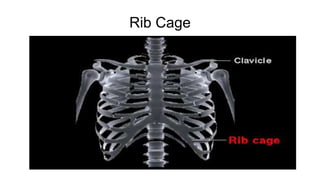
brain. Your ribs protect
your lungs and heart from
injury.
4. Makes Blood: Red and
white blood cells are
formed by tissue called
marrow, which is in the
center of the bone.
5. Storage: Bones store
minerals, such as calcium
and phosphorus, for use
by the body
Two Major Skeletal
System Parts
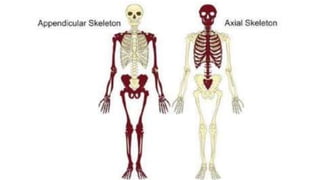
►Axial Skeleton: The
axial skeleton includes the
skull, spine, ribs and
sternum.
►Appendicular Skeleton:
The appendicular skeleton
includes the appendages
of the body, which are the
shoulders, arms, hips, and
legs.
What are the
Basic Bone
Shapes?
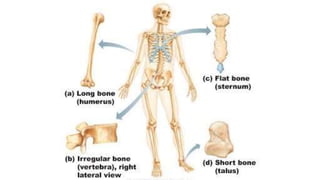
►Four basic bone shapes:
1. Long- arms, legs and
fingers
2. Short- wrist and ankles
3. Flat- skull and sternum
4. Irregular- spine
What is the
Structure of
Bone?
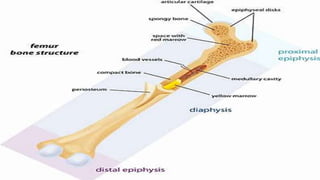
►Typical Four Layers:
–Periosteum: Covers
Bones
–Compact Bone: Lies
beneath the periosteum
–Spongy Bone: Lies
beneath the compact
bone
–Bone Marrow: Fills the
gaps between the
spongy bone
What is the Structure of
Bone?
► Typical Four Layers:
– Periosteum: Covers
Bones
– Compact Bone: Lies
beneath the
periosteum
– Spongy Bone: Lies
beneath the compact
bone
– Bone Marrow: Fills the
gaps between the
spongy bone
What is the
Structure of Bone?
Bones are complex living
structures that undergo
growth and development.
–Beneath the outer
membrane is a layer of
compact bone (hard
Bones are complex living
structures that undergo
growth and development.
Beneath the outer
membrane is a layer of
compact bone (hard and
dense, but not solid – it is
filled with holes and has
small canals for blood
vessels and nerves).
Inside the compact bone
is a layer of spongy
bone.
It has many small
spaces, is light weight,
but strong.
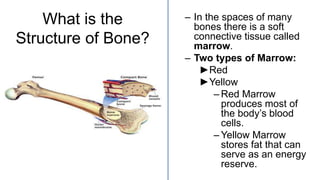
What is the
Structure of Bone?
– In the spaces of many
bones there is a soft
connective tissue called
marrow.
– Two types of Marrow:
►Red
►Yellow
– Red Marrow
produces most of
the body’s blood
cells.
– Yellow Marrow
stores fat that can
serve as an energy
reserve.
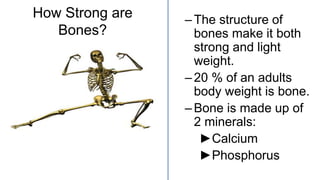
How Strong are
Bones?
– The structure of
bones make it both
strong and light
weight.
– 20 % of an adults
body weight is bone.
– Bone is made up of
2 minerals:
►Calcium
►Phosphorus
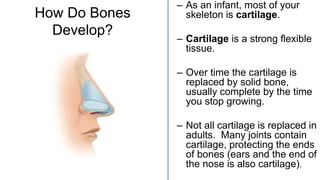
How Do Bones
Develop?
– As an infant, most of your
skeleton is cartilage.
– Cartilage is a strong flexible
tissue.
– Over time the cartilage is
replaced by solid bone,
usually complete by the time
you stop growing.
– Not all cartilage is replaced in
adults. Many joints contain
cartilage, protecting the ends
of bones (ears and the end of
the nose is also cartilage).
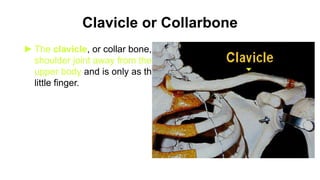
Clavicle or Collarbone
► The clavicle, or collar bone, holds the
shoulder joint away from the rest of the
upper body and is only as thick as your
little finger.
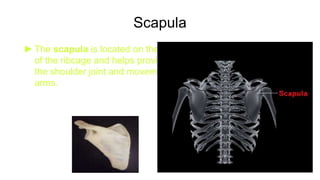
Scapula
► The scapula is located on the back side
of the ribcage and helps provide part of
the shoulder joint and movement for the
arms.
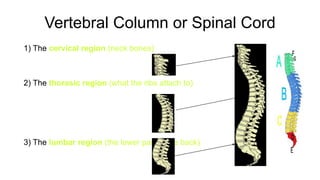
Vertebral Column or Spinal Cord
1) The cervical region (neck bones)
2) The thorasic region (what the ribs attach to)
3) The lumbar region (the lower part of the back)
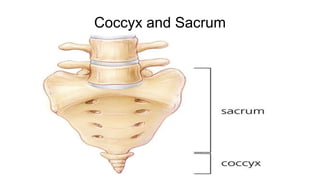
Coccyx and Sacrum
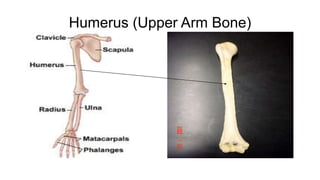
Humerus (Upper Arm Bone)
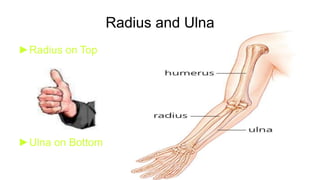
Radius and Ulna
►Radius on Top
►Ulna on Bottom
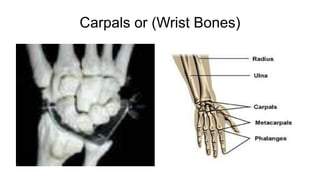
Carpals or (Wrist Bones)
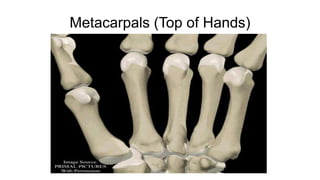
Metacarpals (Top of Hands)
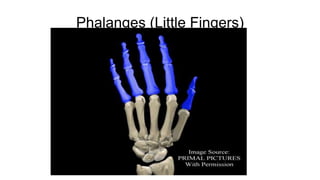
Phalanges (Little Fingers)
Rib Cage
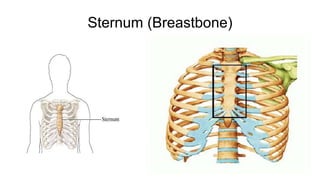
Sternum (Breastbone)
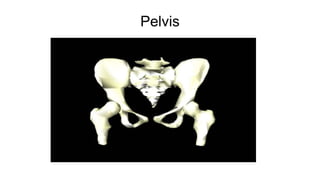
Pelvis
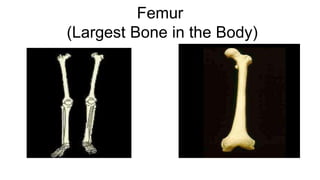
Femur
(Largest Bone in the Body)
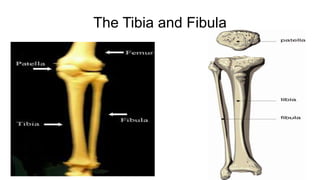
The Tibia and Fibula
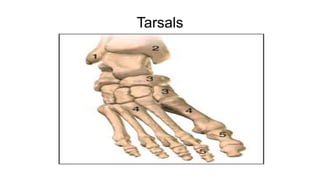
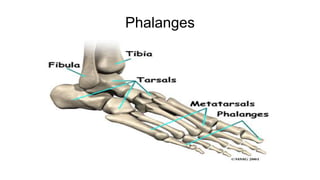
Tarsals
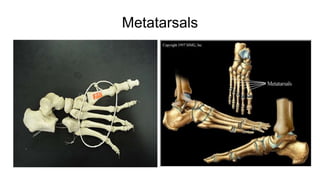
Metatarsals
Phalanges
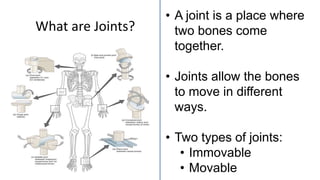
What are Joints?
• A joint is a place where
two bones come
together.
• Joints allow the bones
to move in different
ways.
• Two types of joints:
• Immovable
• Movable
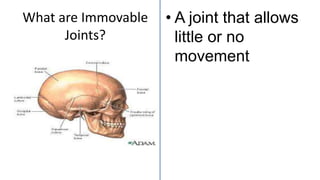
What are Immovable
Joints?
• A joint that allows
little or no
movement
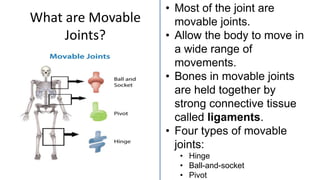
What are Movable
Joints?
• Most of the joint are
movable joints.
• Allow the body to move in
a wide range of
movements.
• Bones in movable joints
are held together by
strong connective tissue
called ligaments.
• Four types of movable
joints:
• Hinge
• Ball-and-socket
• Pivot
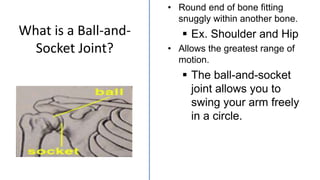
What is a Ball-and-
Socket Joint?
• Round end of bone fitting
snuggly within another bone.
 Ex. Shoulder and Hip
• Allows the greatest range of
motion.
 The ball-and-socket
joint allows you to
swing your arm freely
in a circle.
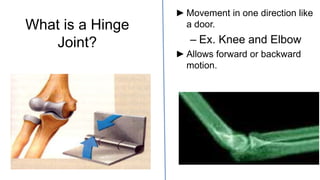
What is a Hinge
Joint?
► Movement in one direction like
a door.
– Ex. Knee and Elbow
► Allows forward or backward
motion.
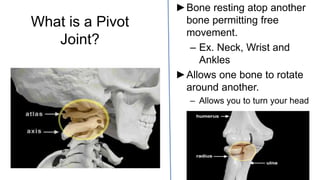
What is a Pivot
Joint?
►Bone resting atop another
bone permitting free
movement.
– Ex. Neck, Wrist and
Ankles
►Allows one bone to rotate
around another.
– Allows you to turn your head
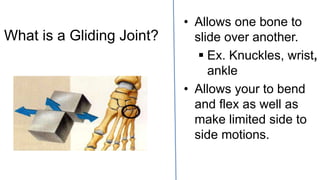
What is a Gliding Joint?
• Allows one bone to
slide over another.
 Ex. Knuckles, wrist,
ankle
• Allows your to bend
and flex as well as
make limited side to
side motions.
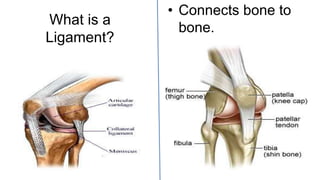
What is a
Ligament?
• Connects bone to
bone.
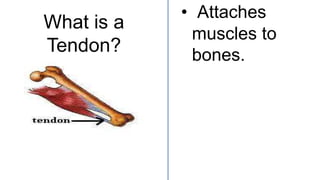
What is a
Tendon?
• Attaches
muscles to
bones.

Aaaaaa a skeletal system

  • 1.
  • 2.
  • 3.
    1. Movement: Skeletal systemprovides points of attachment for muscles. Your legs and arms move when the muscles pull on the bones.
  • 4.
    2. Support: Thebackbone is the main support center for the upper body. It holds your head up and protects your spinal cord.
  • 5.
    3. Protection: Thebones of your skull protect your brain. Your ribs protect your lungs and heart from injury.
  • 6.
    4. Makes Blood:Red and white blood cells are formed by tissue called marrow, which is in the center of the bone.
  • 7.
    5. Storage: Bonesstore minerals, such as calcium and phosphorus, for use by the body
  • 8.
  • 9.
    ►Axial Skeleton: The axialskeleton includes the skull, spine, ribs and sternum.
  • 10.
    ►Appendicular Skeleton: The appendicularskeleton includes the appendages of the body, which are the shoulders, arms, hips, and legs.
  • 12.
    What are the BasicBone Shapes?
  • 13.
    ►Four basic boneshapes: 1. Long- arms, legs and fingers 2. Short- wrist and ankles 3. Flat- skull and sternum 4. Irregular- spine
  • 15.
  • 16.
    ►Typical Four Layers: –Periosteum:Covers Bones –Compact Bone: Lies beneath the periosteum
  • 17.
    –Spongy Bone: Lies beneaththe compact bone –Bone Marrow: Fills the gaps between the spongy bone
  • 18.
    What is theStructure of Bone? ► Typical Four Layers: – Periosteum: Covers Bones – Compact Bone: Lies beneath the periosteum – Spongy Bone: Lies beneath the compact bone – Bone Marrow: Fills the gaps between the spongy bone
  • 20.
  • 21.
    Bones are complexliving structures that undergo growth and development. –Beneath the outer membrane is a layer of compact bone (hard
  • 22.
    Bones are complexliving structures that undergo growth and development. Beneath the outer membrane is a layer of compact bone (hard and
  • 23.
    compact bone (hardand dense, but not solid – it is filled with holes and has small canals for blood vessels and nerves).
  • 24.
    Inside the compactbone is a layer of spongy bone. It has many small spaces, is light weight, but strong.
  • 25.
    What is the Structureof Bone? – In the spaces of many bones there is a soft connective tissue called marrow. – Two types of Marrow: ►Red ►Yellow – Red Marrow produces most of the body’s blood cells. – Yellow Marrow stores fat that can serve as an energy reserve.
  • 26.
    How Strong are Bones? –The structure of bones make it both strong and light weight. – 20 % of an adults body weight is bone. – Bone is made up of 2 minerals: ►Calcium ►Phosphorus
  • 27.
    How Do Bones Develop? –As an infant, most of your skeleton is cartilage. – Cartilage is a strong flexible tissue. – Over time the cartilage is replaced by solid bone, usually complete by the time you stop growing. – Not all cartilage is replaced in adults. Many joints contain cartilage, protecting the ends of bones (ears and the end of the nose is also cartilage).
  • 28.
    Clavicle or Collarbone ►The clavicle, or collar bone, holds the shoulder joint away from the rest of the upper body and is only as thick as your little finger.
  • 29.
    Scapula ► The scapulais located on the back side of the ribcage and helps provide part of the shoulder joint and movement for the arms.
  • 30.
    Vertebral Column orSpinal Cord 1) The cervical region (neck bones) 2) The thorasic region (what the ribs attach to) 3) The lumbar region (the lower part of the back)
  • 31.
  • 32.
  • 33.
    Radius and Ulna ►Radiuson Top ►Ulna on Bottom
  • 34.
  • 35.
  • 36.
  • 37.
  • 38.
  • 39.
  • 40.
  • 41.
  • 42.
  • 43.
  • 44.
  • 45.
    What are Joints? •A joint is a place where two bones come together. • Joints allow the bones to move in different ways. • Two types of joints: • Immovable • Movable
  • 46.
    What are Immovable Joints? •A joint that allows little or no movement
  • 47.
    What are Movable Joints? •Most of the joint are movable joints. • Allow the body to move in a wide range of movements. • Bones in movable joints are held together by strong connective tissue called ligaments. • Four types of movable joints: • Hinge • Ball-and-socket • Pivot
  • 48.
    What is aBall-and- Socket Joint? • Round end of bone fitting snuggly within another bone.  Ex. Shoulder and Hip • Allows the greatest range of motion.  The ball-and-socket joint allows you to swing your arm freely in a circle.
  • 49.
    What is aHinge Joint? ► Movement in one direction like a door. – Ex. Knee and Elbow ► Allows forward or backward motion.
  • 50.
    What is aPivot Joint? ►Bone resting atop another bone permitting free movement. – Ex. Neck, Wrist and Ankles ►Allows one bone to rotate around another. – Allows you to turn your head
  • 51.
    What is aGliding Joint? • Allows one bone to slide over another.  Ex. Knuckles, wrist, ankle • Allows your to bend and flex as well as make limited side to side motions.
  • 52.
    What is a Ligament? •Connects bone to bone.
  • 53.
    What is a Tendon? •Attaches muscles to bones.