BONE LOSS AND
PATTERNS OF BONE
DESTRUCTION
DR DEEPTHI CHERIAN
DEPT OF PERIODONTICS
INTRODUCTION
 Although periodontitis is an infectious disease of the
gingival tissue,changes that occur in bone are crucial
because the destruction of bone is responsible for tooth
loss.
 Height and density of the alveolar bone are normally
maintained by an equilibrium, regulated by local and
systemic influences ,between bone formation and
resorption.
 Resorption>formation-bone height and density reduced.
 Degree of bone loss not related with pocket depth or
ulceration on pocket wall or presence or absence of pus.
CAUSES OF BONE DESTRUCTION
 Bone destruction caused by the extension of gingival
inflammation.
 Bone destruction caused by trauma from occlusion
 Bone destruction caused by systemic disorder
BONE DESTRUCTION CAUSED BY GINGIVAL
INFLAMMATION
 Most common cause-Extension of inflammation from
the marginal ginigiva into supporting periodontal
tissues.
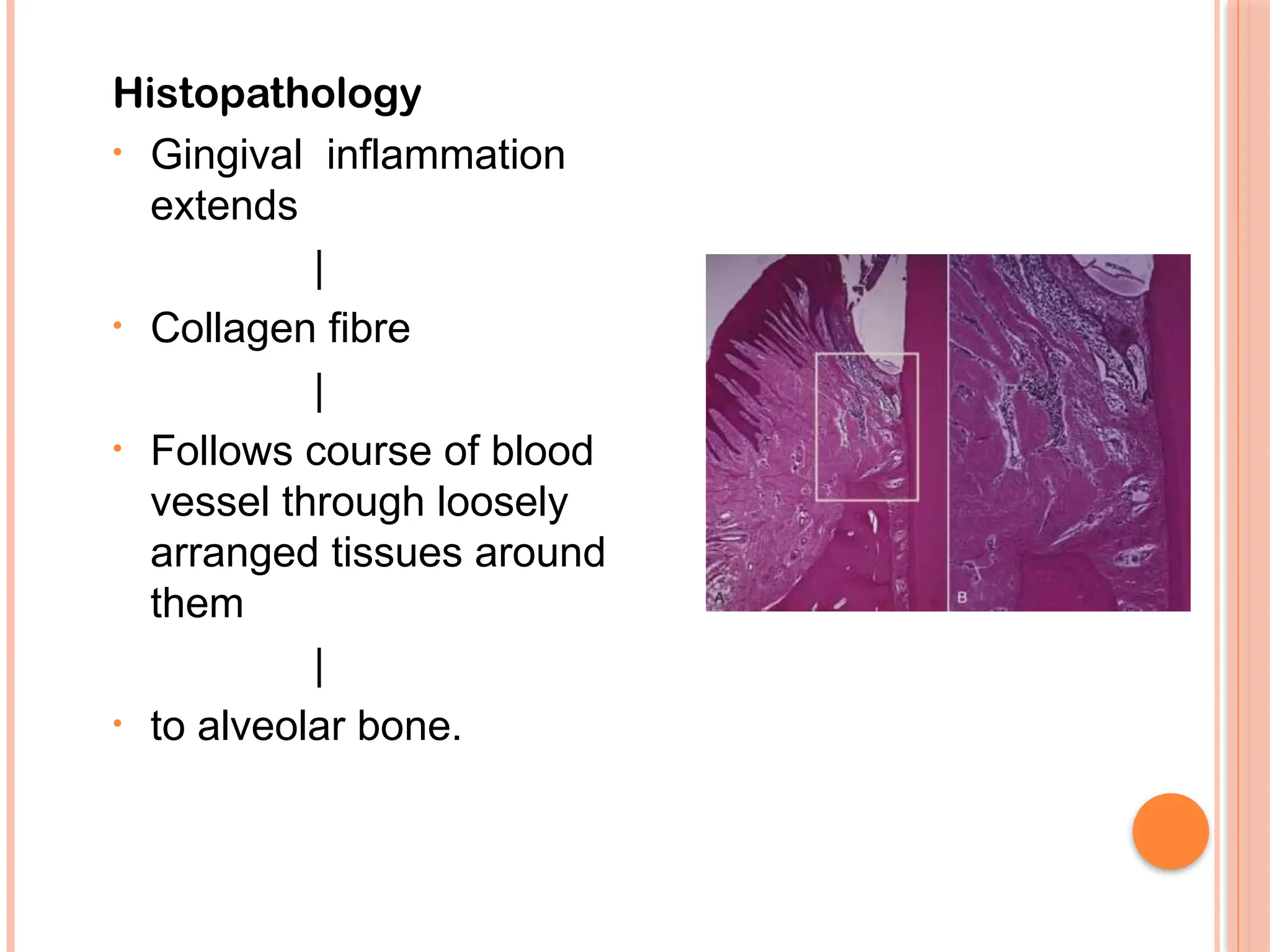
Histopathology
• Gingival inflammation
extends
|
• Collagen fibre
|
• Follows course of blood
vessel through loosely
arranged tissues around
them
|
• to alveolar bone.
Interproximally:
1) Gingiva -> bone
2) Bone -> PDL
3) Gingiva -> PDL
Facially & lingually
4) Gingiva -> outer
periosteum
5) Periosteum -> bone
6) Gingiva -> PDL
 RADIUS OF ACTION
BONE DESTRUCTION CAUSED BY
TRAUMA FROM OCCLUSION
 Periodontal response to the external force.
 TFO can occur in presence or absence of
inflammation.
 Absence -> osteoclasts
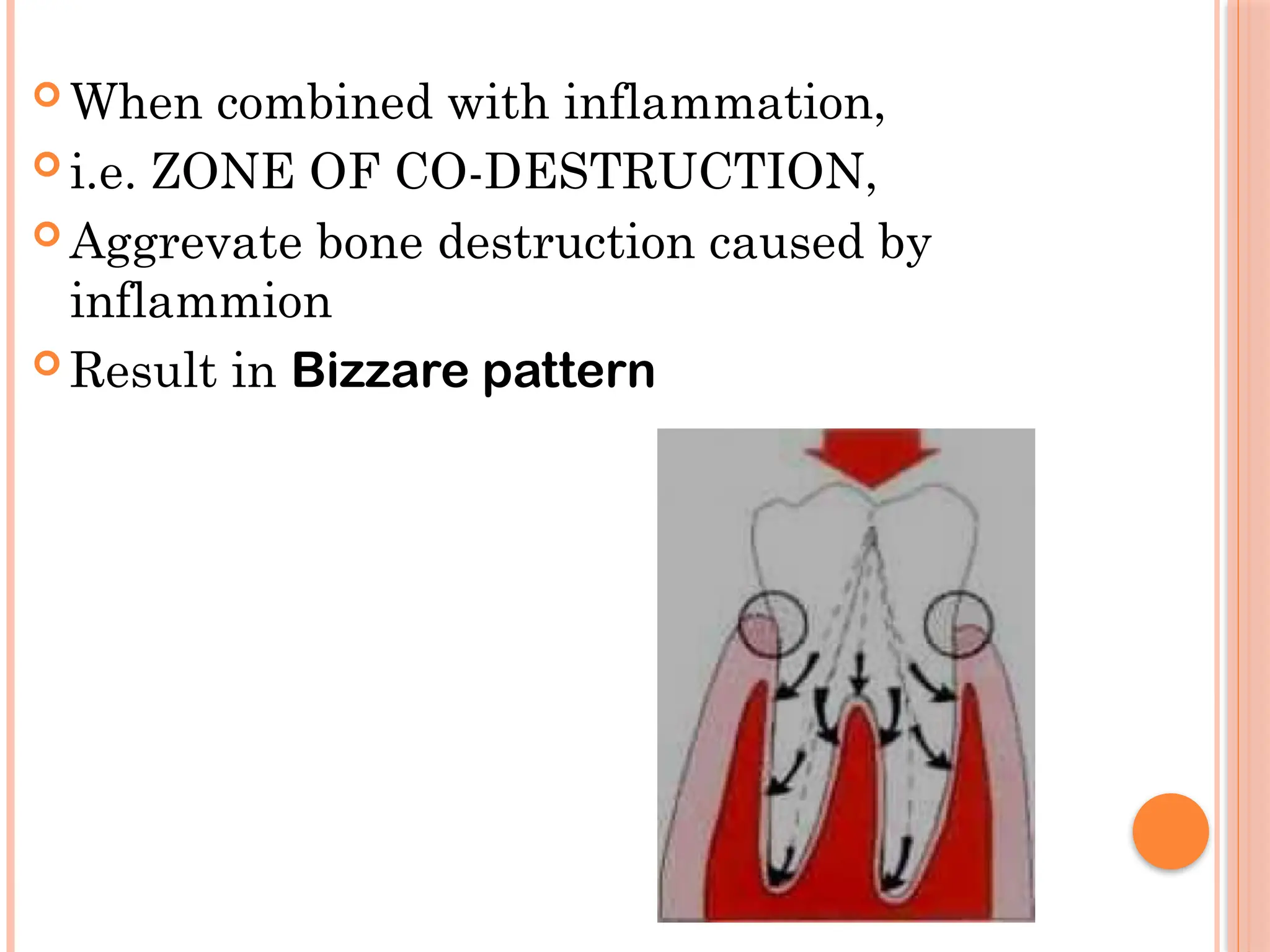
 When combined with inflammation,
 i.e. ZONE OF CO-DESTRUCTION,
 Aggrevate bone destruction caused by
inflammion
 Result in Bizzare pattern
BONE DESTRUCTION
CAUSED BY SYSTEMIC DISORDERS -
 Possible relationship between periodontal bone
loss and systemic disorders.
 OSTEOPOROSIS : loss of bone mineral content
and structural bone changes. Risk factors-
aging,smoking,etc
 •OSTEOPENIA : tooth mobility and tooth loss
 •Hyperparathyroidism, leukopenia
FACTORS DETERMINING BONE
MORPHOLOGY IN PERIODONTAL DISEASE-
 1)Normal variation of alveolar bone :
 a)thickness,width,crestal angulation of
interdental septa
 b)thickness of facial & lingual plates
 c)presence of fenestrations & dehiscences
 d)allignement of teeth
 e)root anatomy and position
Exostoses :
 a)overgrowth of bone
 b)they can occur as small or large nodules,
sharp ridges , spike-like projections.
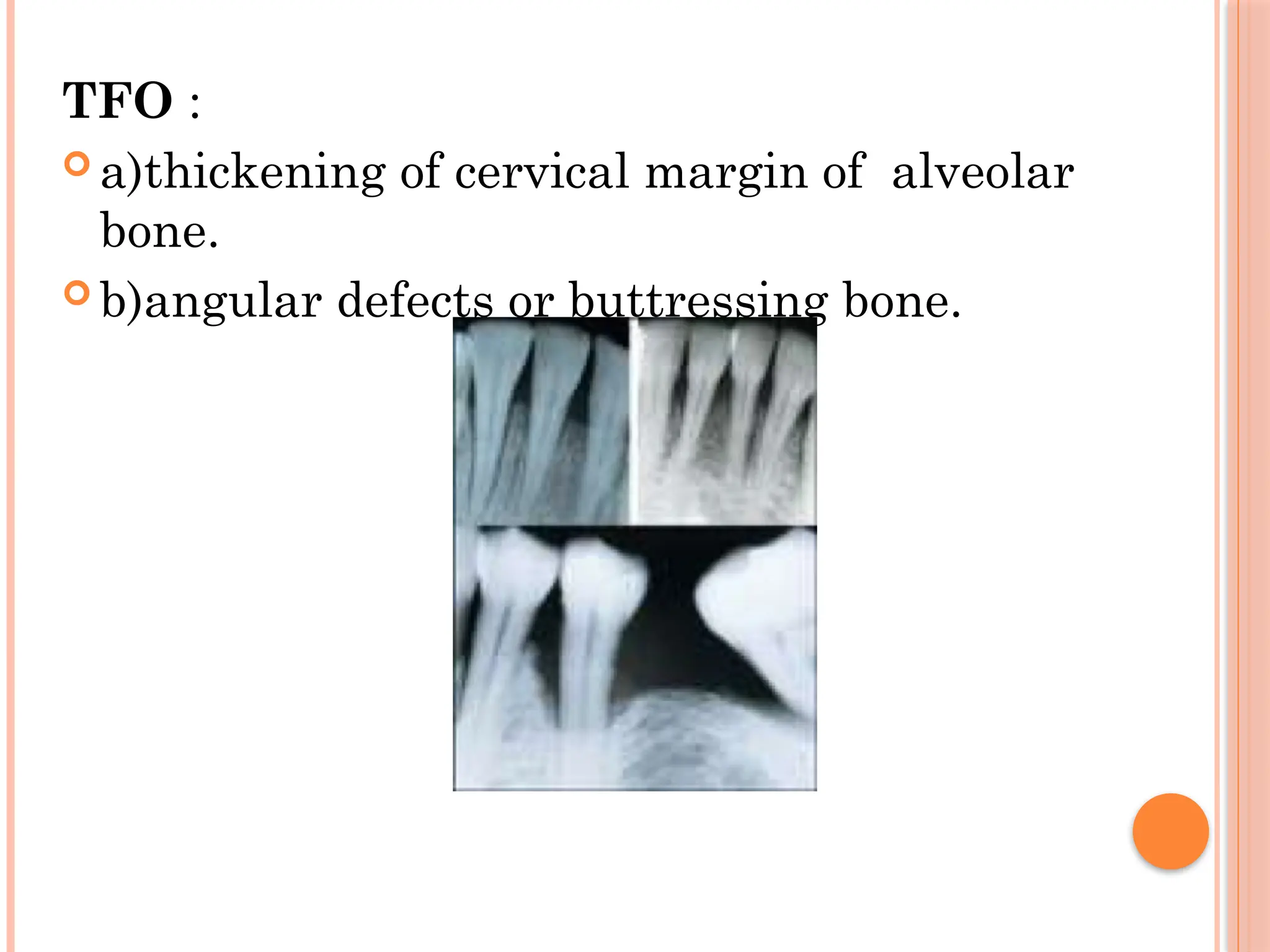
TFO :
 a)thickening of cervical margin of alveolar
bone.
 b)angular defects or buttressing bone.
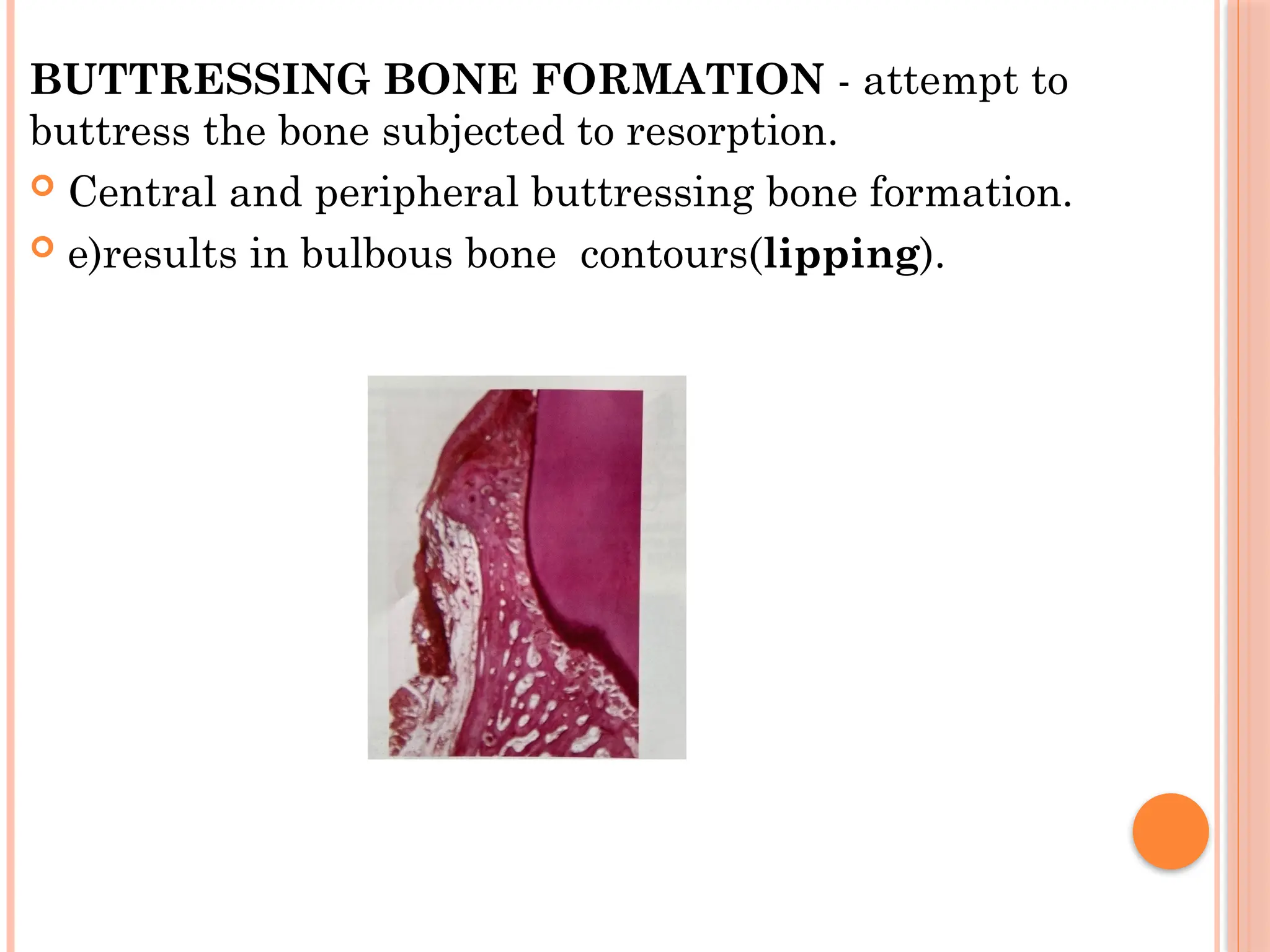
BUTTRESSING BONE FORMATION - attempt to
buttress the bone subjected to resorption.
 Central and peripheral buttressing bone formation.
 e)results in bulbous bone contours(lipping).
FOOD IMPACTION :
 a)interdental bone defects occur when there is
abnormal or absence of proximal contact.
 b)food impaction here , results in inverted bone
architecture.

AGGRESSIVE PERIODONTITIS :
 vertical or angular bone defects.
 Arc shaped
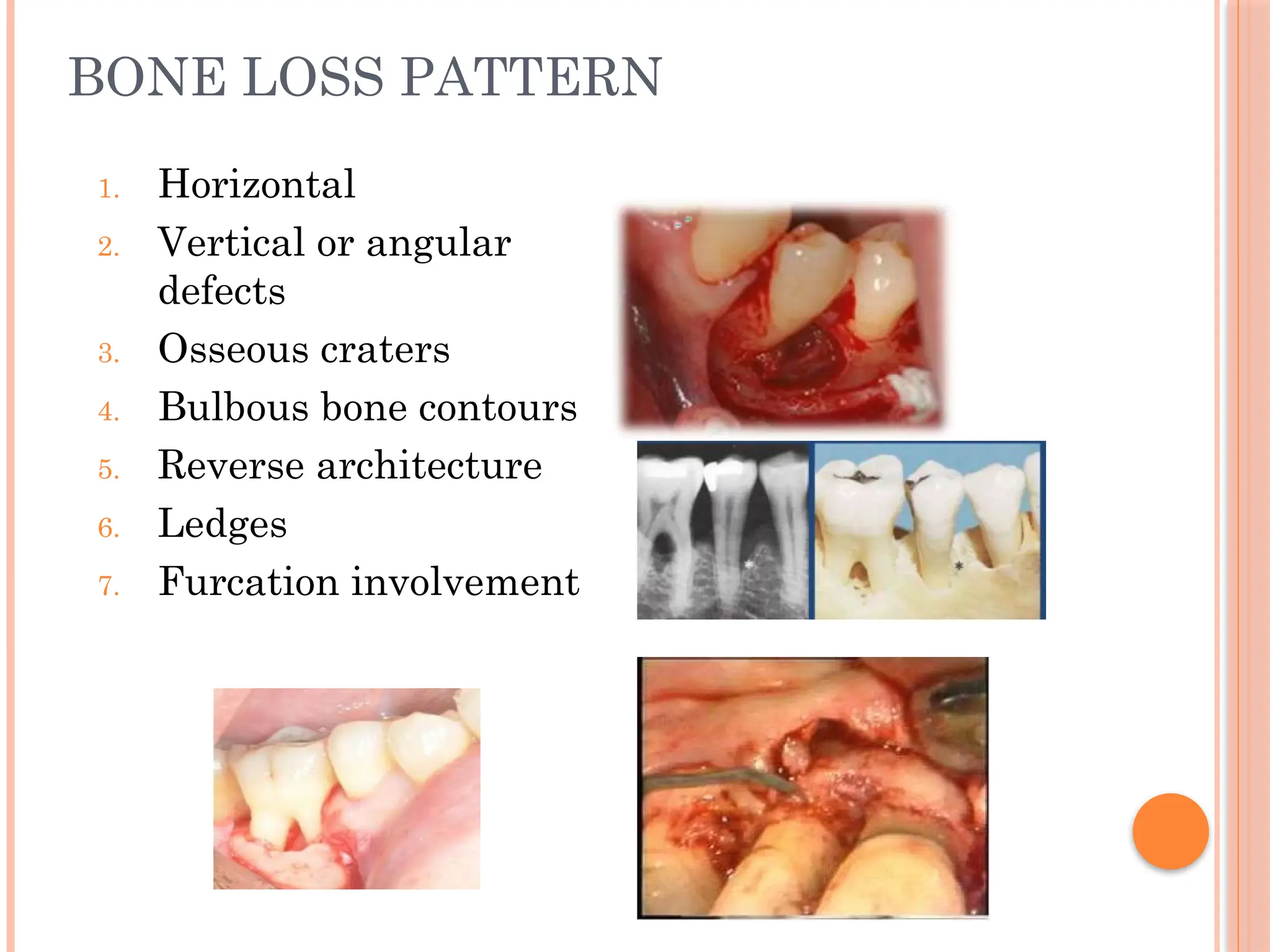
BONE LOSS PATTERN
1. Horizontal
2. Vertical or angular
defects
3. Osseous craters
4. Bulbous bone contours
5. Reverse architecture
6. Ledges
7. Furcation involvement
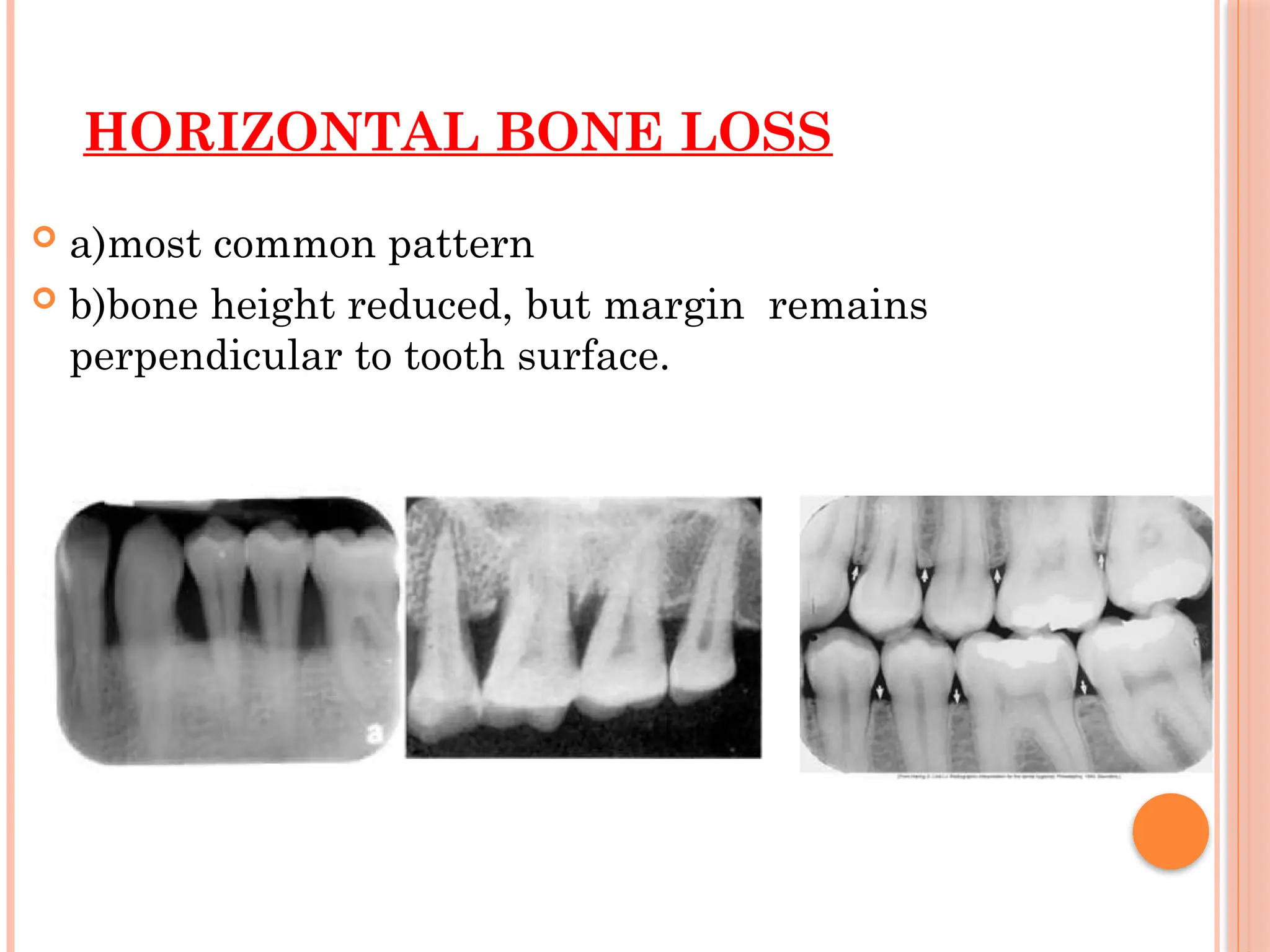
HORIZONTAL BONE LOSS
 a)most common pattern
 b)bone height reduced, but margin remains
perpendicular to tooth surface.
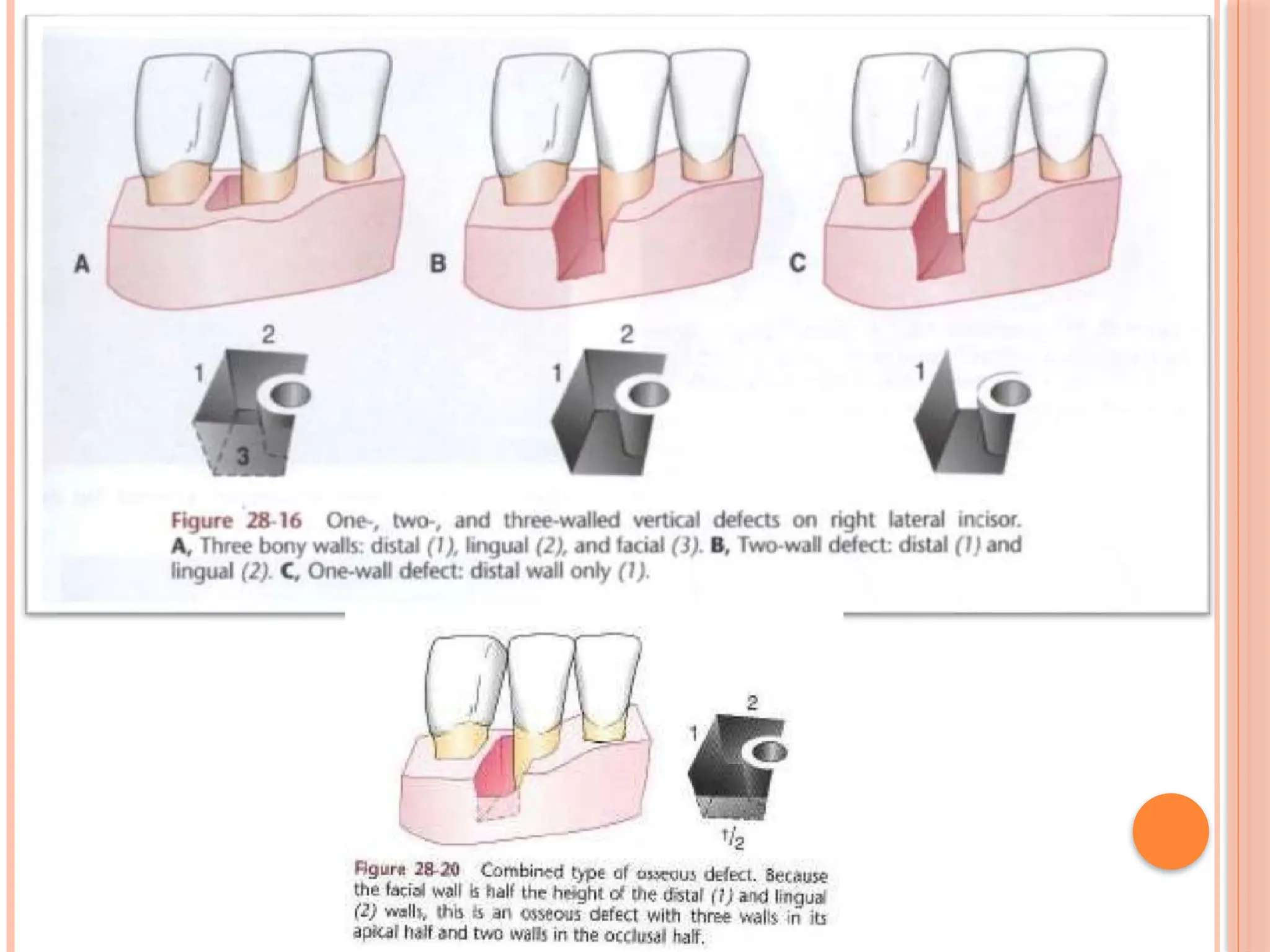
VERTICAL BONE LOSS
a)angular defects , occur in an oblique direction
leads to hollowed-out trough in the bone alongside
root.
b)Depending on number of walls present , angular
defects were classified by Goldman and Cohen
(1958) as,
 (i)Three osseous walls
 (ii)Two osseous walls
 (iii)One osseous wall
 (iiii)Combination
OSSEOUS CRATERS
 a)concavities in the crest of interdental bone confined
within faciolingal walls.
 b)Reasons :
(i)plaque accumulation and difficulty to clean.
(ii)normal concavity in lower molars
(iii)vascular patterns crest, a pathway for
inflammation
BULBOUS BONY CONTOURS :
 a)bony enlargement
 b)an adaptation to Exostoses
 c)adaptation to function or buttressing bone
formation.
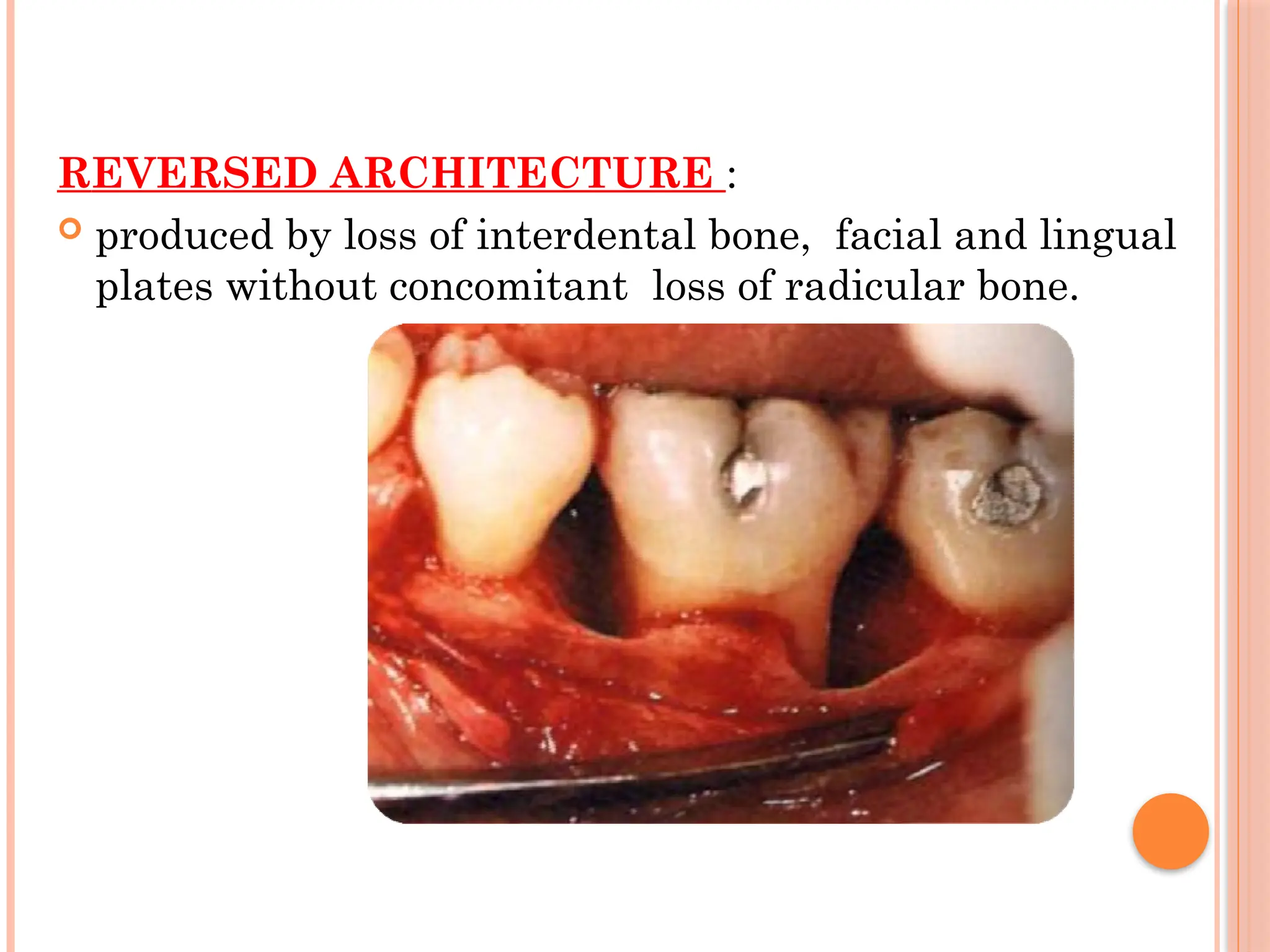
REVERSED ARCHITECTURE :
 produced by loss of interdental bone, facial and lingual
plates without concomitant loss of radicular bone.
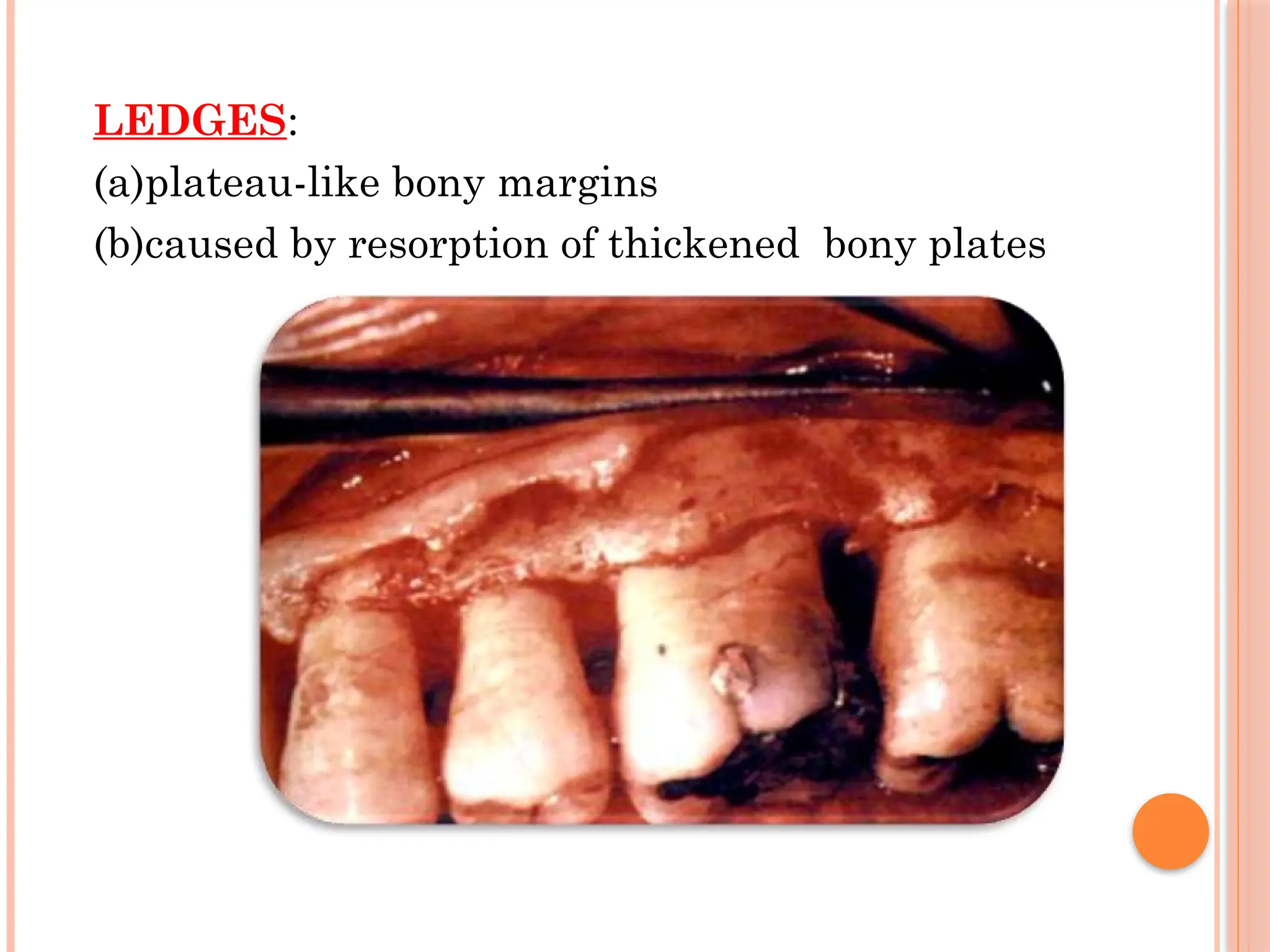
LEDGES:
(a)plateau-like bony margins
(b)caused by resorption of thickened bony plates
FURCATION INVOLVEMENT :
 Invasion of bifurcation or trifurcation of
multirooted teeth by periodontal disease.
Classification-
 (i)Grade 1 : incipient bone loss
 (ii)Grade 2 : partial bone loss
 (iii)Grade 3 : total bone loss with through and
through opening of furcation
 (iiii)Grade 4 : similar to grade 3,with gingival
recession exposing the furcation to view.
1) Patterns of bone destruction
2) Reverse architecture
3) Furcation involvement

Bone loss and pattern of bone destruction .pptx

  • 1.
    BONE LOSS AND PATTERNSOF BONE DESTRUCTION DR DEEPTHI CHERIAN DEPT OF PERIODONTICS
  • 2.
    INTRODUCTION  Although periodontitisis an infectious disease of the gingival tissue,changes that occur in bone are crucial because the destruction of bone is responsible for tooth loss.  Height and density of the alveolar bone are normally maintained by an equilibrium, regulated by local and systemic influences ,between bone formation and resorption.  Resorption>formation-bone height and density reduced.  Degree of bone loss not related with pocket depth or ulceration on pocket wall or presence or absence of pus.
  • 3.
    CAUSES OF BONEDESTRUCTION  Bone destruction caused by the extension of gingival inflammation.  Bone destruction caused by trauma from occlusion  Bone destruction caused by systemic disorder
  • 4.
    BONE DESTRUCTION CAUSEDBY GINGIVAL INFLAMMATION  Most common cause-Extension of inflammation from the marginal ginigiva into supporting periodontal tissues.
  • 5.
    Histopathology • Gingival inflammation extends | •Collagen fibre | • Follows course of blood vessel through loosely arranged tissues around them | • to alveolar bone.
  • 6.
    Interproximally: 1) Gingiva ->bone 2) Bone -> PDL 3) Gingiva -> PDL Facially & lingually 4) Gingiva -> outer periosteum 5) Periosteum -> bone 6) Gingiva -> PDL
  • 7.
  • 8.
    BONE DESTRUCTION CAUSEDBY TRAUMA FROM OCCLUSION  Periodontal response to the external force.  TFO can occur in presence or absence of inflammation.  Absence -> osteoclasts
  • 9.
     When combinedwith inflammation,  i.e. ZONE OF CO-DESTRUCTION,  Aggrevate bone destruction caused by inflammion  Result in Bizzare pattern
  • 10.
    BONE DESTRUCTION CAUSED BYSYSTEMIC DISORDERS -  Possible relationship between periodontal bone loss and systemic disorders.  OSTEOPOROSIS : loss of bone mineral content and structural bone changes. Risk factors- aging,smoking,etc  •OSTEOPENIA : tooth mobility and tooth loss  •Hyperparathyroidism, leukopenia
  • 11.
    FACTORS DETERMINING BONE MORPHOLOGYIN PERIODONTAL DISEASE-  1)Normal variation of alveolar bone :  a)thickness,width,crestal angulation of interdental septa  b)thickness of facial & lingual plates  c)presence of fenestrations & dehiscences  d)allignement of teeth  e)root anatomy and position
  • 12.
    Exostoses :  a)overgrowthof bone  b)they can occur as small or large nodules, sharp ridges , spike-like projections.
  • 13.
    TFO :  a)thickeningof cervical margin of alveolar bone.  b)angular defects or buttressing bone.
  • 14.
    BUTTRESSING BONE FORMATION- attempt to buttress the bone subjected to resorption.  Central and peripheral buttressing bone formation.  e)results in bulbous bone contours(lipping).
  • 15.
    FOOD IMPACTION : a)interdental bone defects occur when there is abnormal or absence of proximal contact.  b)food impaction here , results in inverted bone architecture.  AGGRESSIVE PERIODONTITIS :  vertical or angular bone defects.  Arc shaped
  • 16.
    BONE LOSS PATTERN 1.Horizontal 2. Vertical or angular defects 3. Osseous craters 4. Bulbous bone contours 5. Reverse architecture 6. Ledges 7. Furcation involvement
  • 17.
    HORIZONTAL BONE LOSS a)most common pattern  b)bone height reduced, but margin remains perpendicular to tooth surface.
  • 18.
    VERTICAL BONE LOSS a)angulardefects , occur in an oblique direction leads to hollowed-out trough in the bone alongside root. b)Depending on number of walls present , angular defects were classified by Goldman and Cohen (1958) as,  (i)Three osseous walls  (ii)Two osseous walls  (iii)One osseous wall  (iiii)Combination
  • 22.
    OSSEOUS CRATERS  a)concavitiesin the crest of interdental bone confined within faciolingal walls.  b)Reasons : (i)plaque accumulation and difficulty to clean. (ii)normal concavity in lower molars (iii)vascular patterns crest, a pathway for inflammation
  • 23.
    BULBOUS BONY CONTOURS:  a)bony enlargement  b)an adaptation to Exostoses  c)adaptation to function or buttressing bone formation.
  • 24.
    REVERSED ARCHITECTURE : produced by loss of interdental bone, facial and lingual plates without concomitant loss of radicular bone.
  • 25.
    LEDGES: (a)plateau-like bony margins (b)causedby resorption of thickened bony plates
  • 26.
    FURCATION INVOLVEMENT : Invasion of bifurcation or trifurcation of multirooted teeth by periodontal disease. Classification-  (i)Grade 1 : incipient bone loss  (ii)Grade 2 : partial bone loss  (iii)Grade 3 : total bone loss with through and through opening of furcation  (iiii)Grade 4 : similar to grade 3,with gingival recession exposing the furcation to view.
  • 29.
    1) Patterns ofbone destruction 2) Reverse architecture 3) Furcation involvement