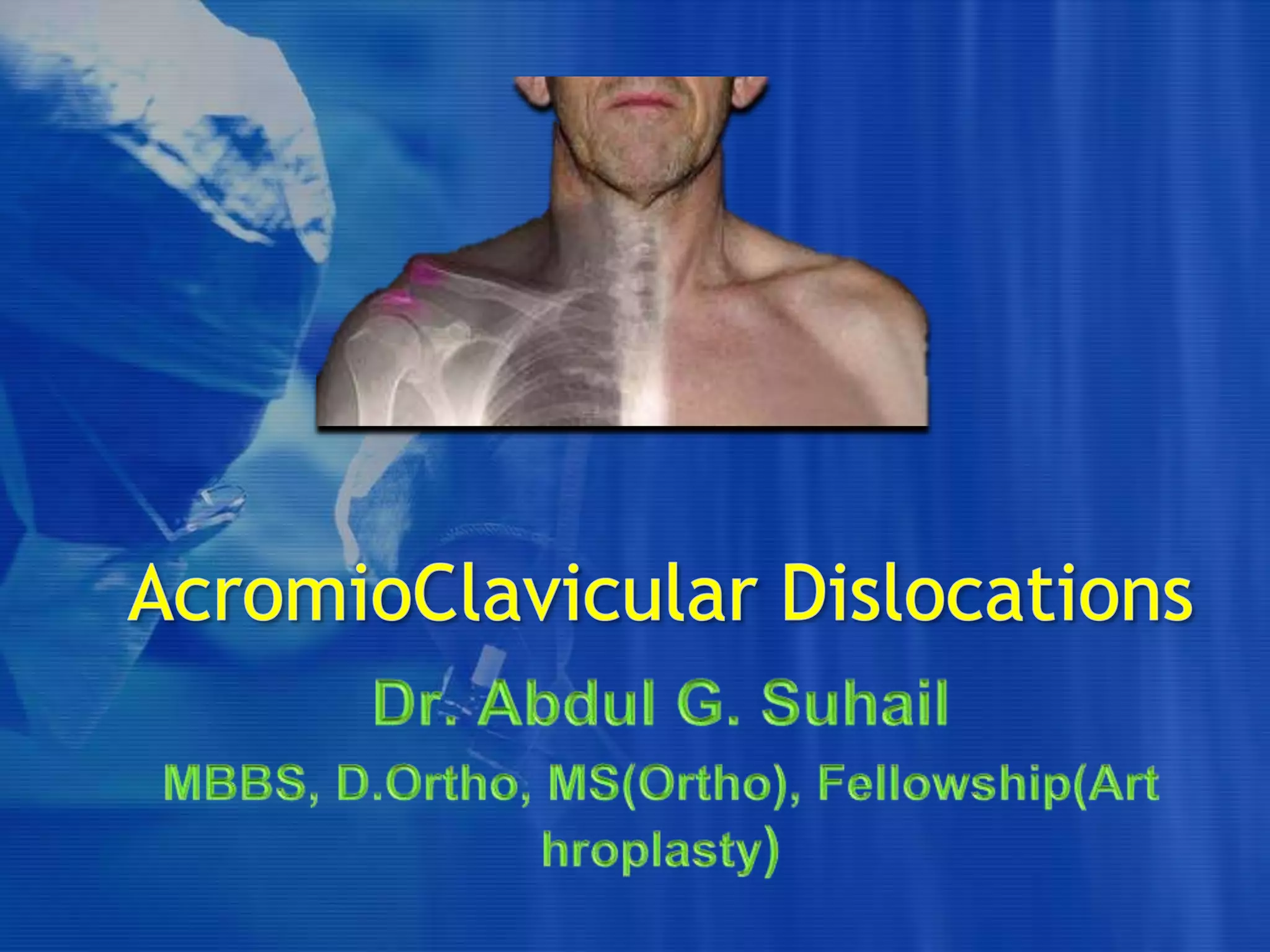
9% of shoulder girdle injuries
Generally occurs in males age 20-30
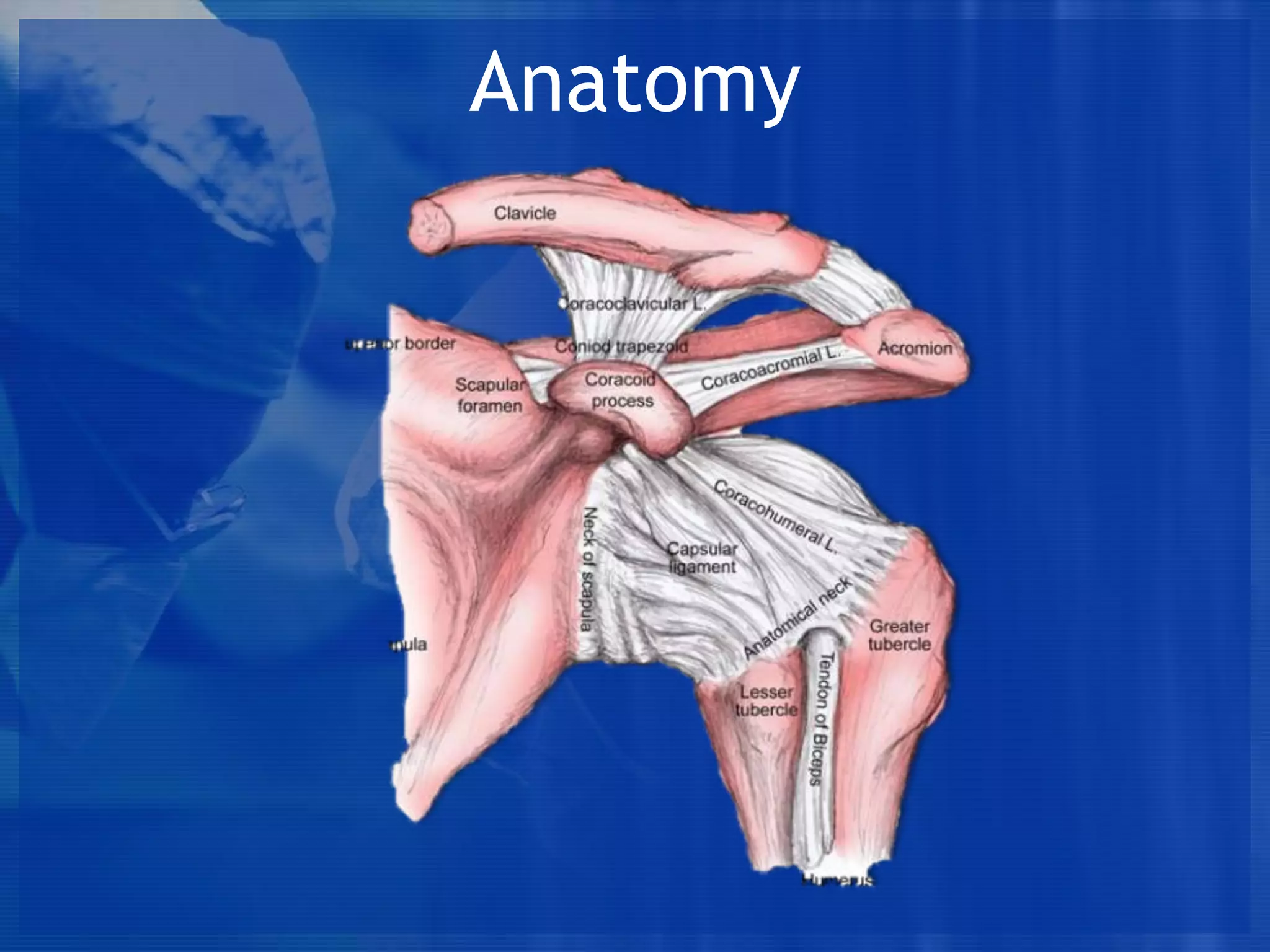
Anatomy
Classification
Allman and Tossy modified by Rockwood
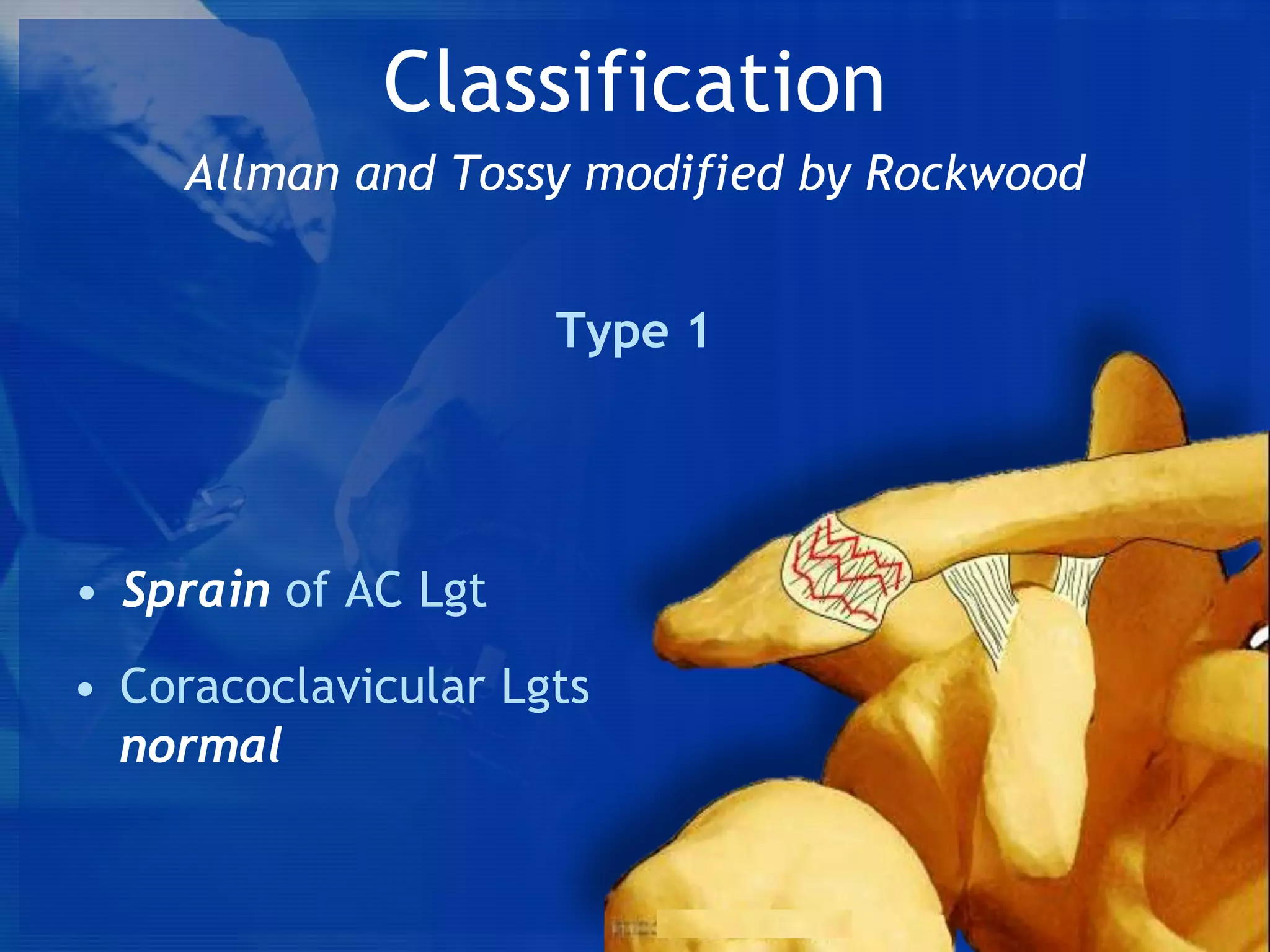
Type 1

• Sprain of AC Lgt
• Coracoclavicular Lgts
normal
Classification
Allman and Tossy modified by Rockwood
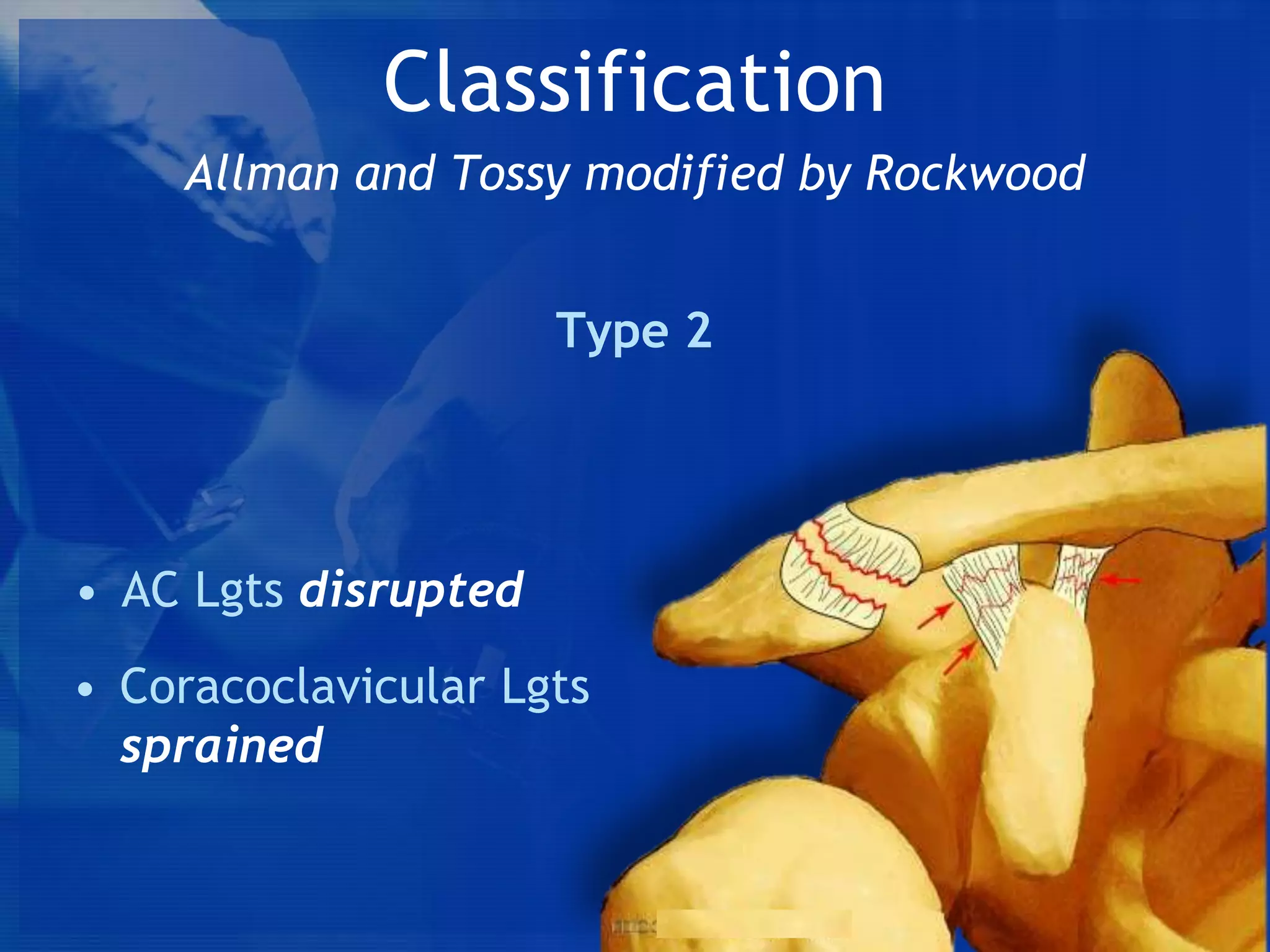
Type 2

• AC Lgts disrupted
• Coracoclavicular Lgts
sprained
Classification
Allman and Tossy modified by Rockwood
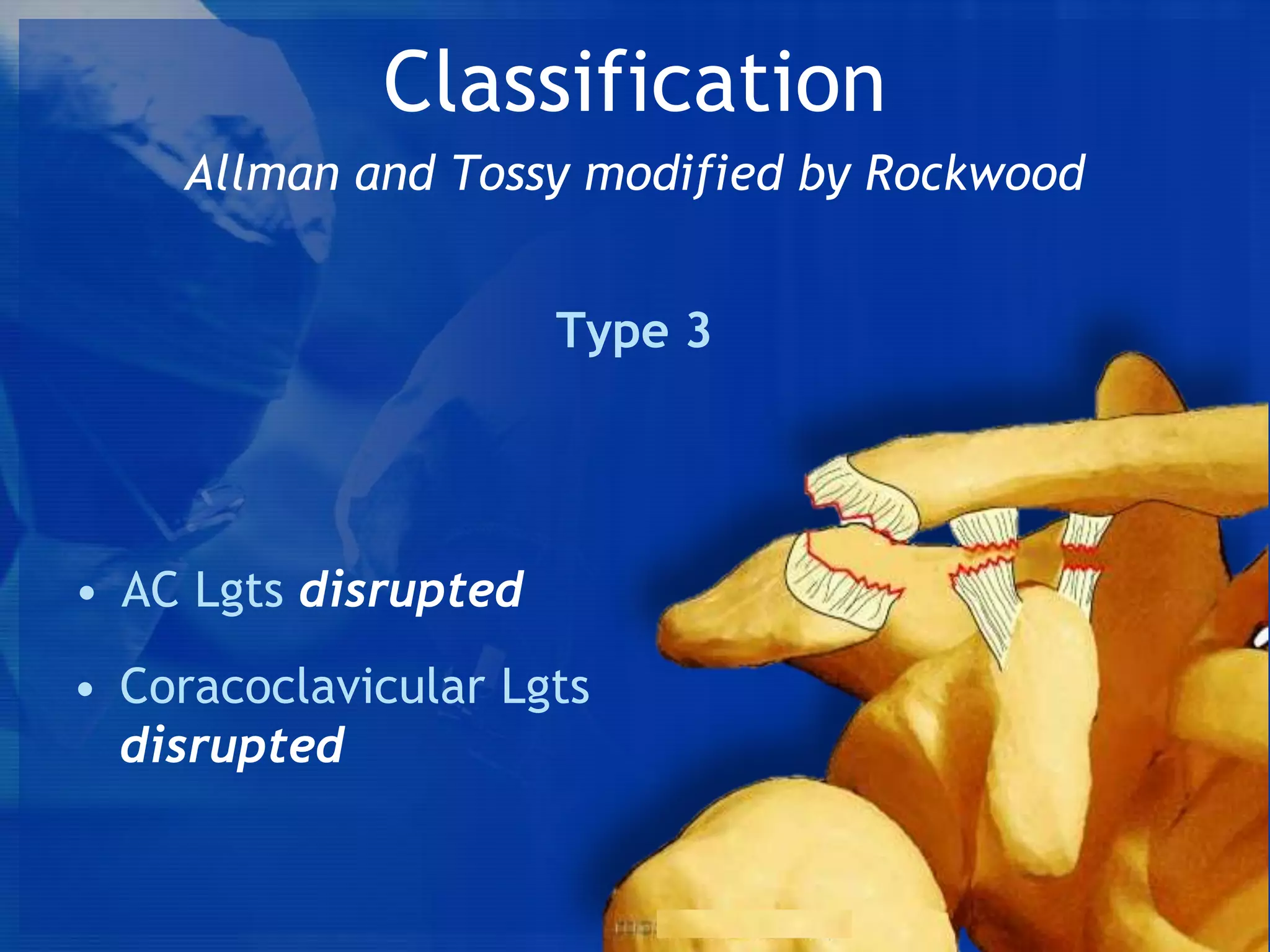
Type 3

• AC Lgts disrupted
• Coracoclavicular Lgts
disrupted
Classification
Allman and Tossy modified by Rockwood
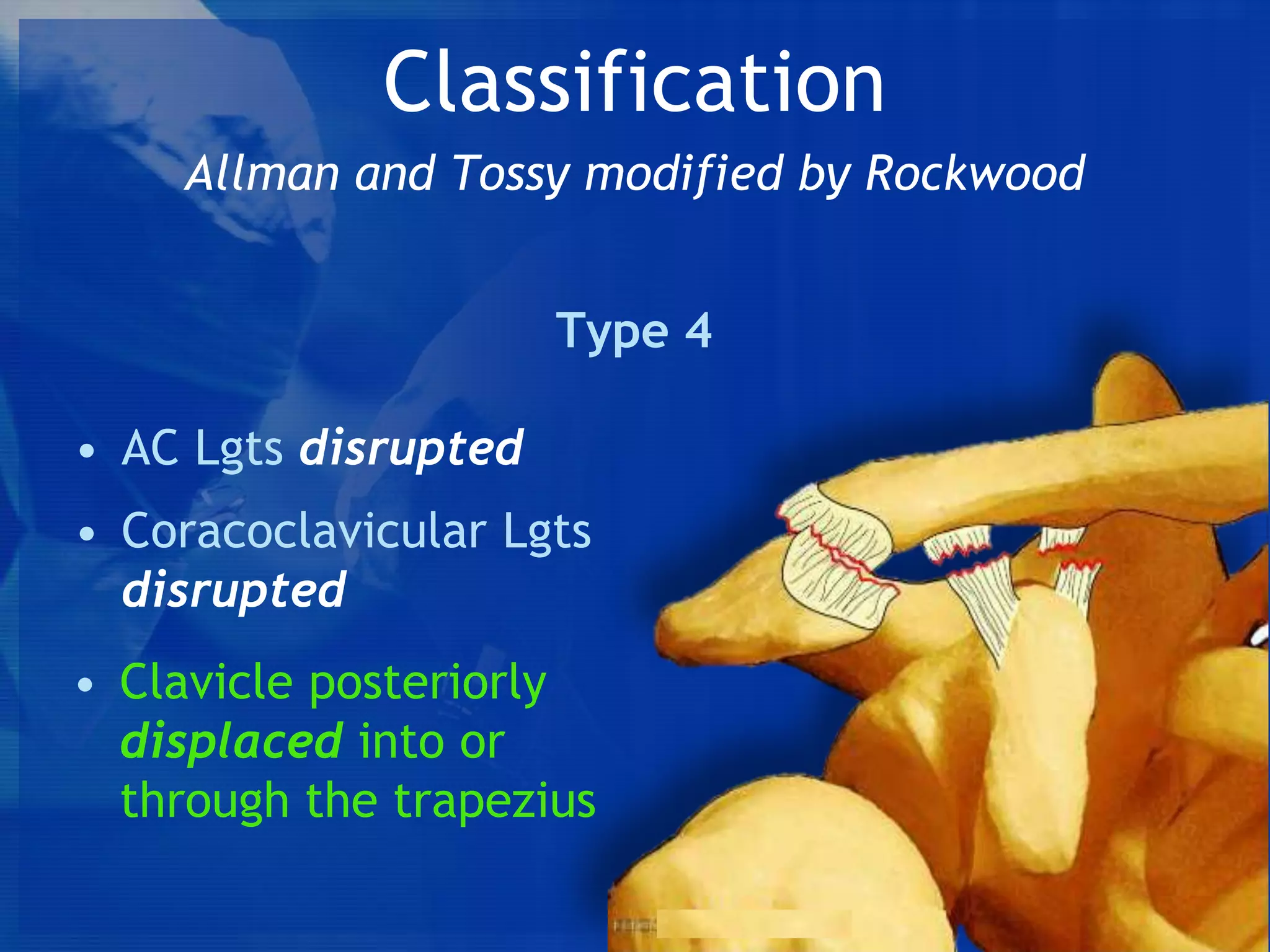
Type 4
• AC Lgts disrupted
• Coracoclavicular Lgts
disrupted
• Clavicle posteriorly
displaced into or
through the trapezius
Classification
Allman and Tossy modified by Rockwood
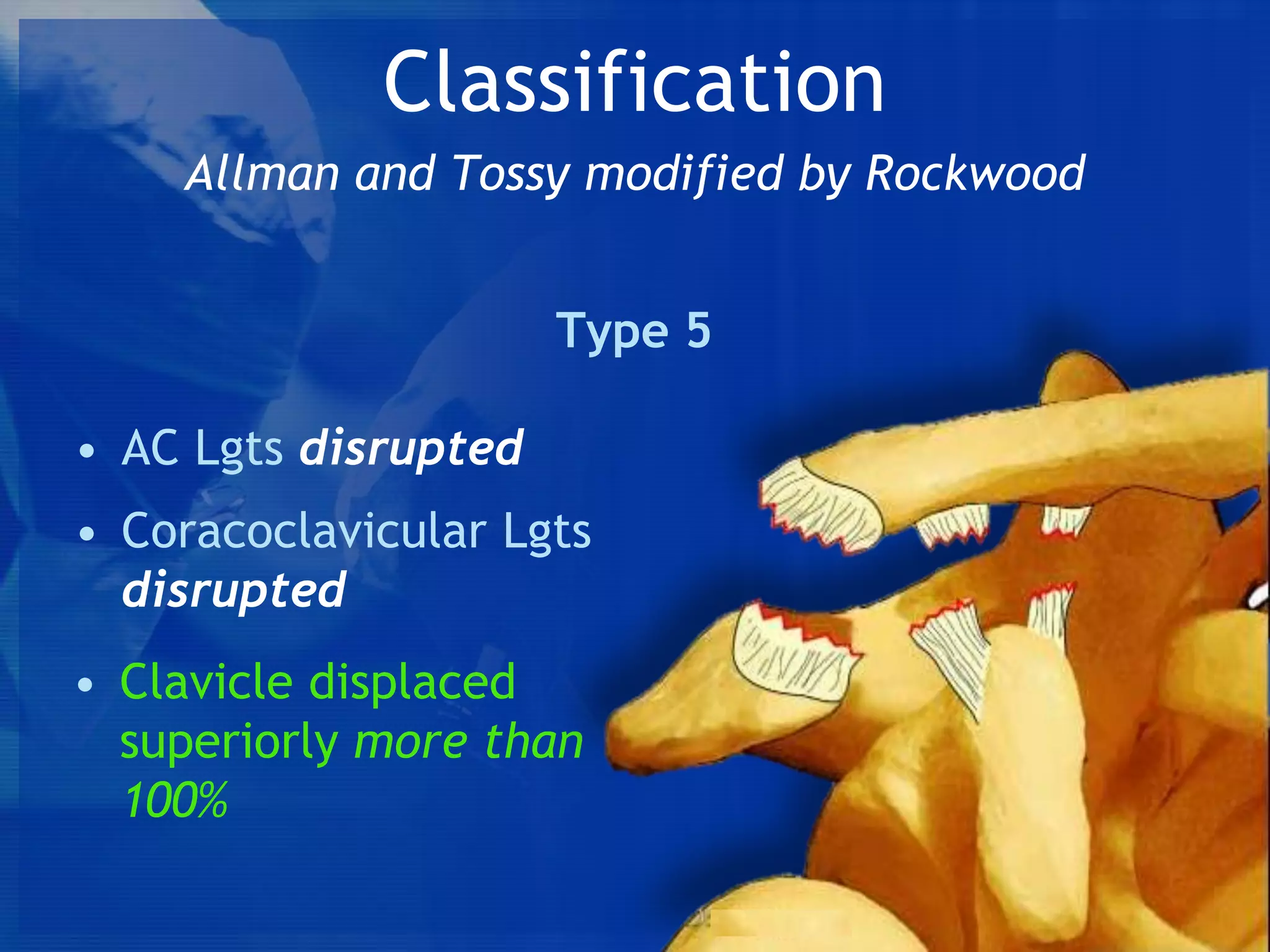
Type 5
• AC Lgts disrupted
• Coracoclavicular Lgts
disrupted
• Clavicle displaced
superiorly more than
100%
Classification
Allman and Tossy modified by Rockwood
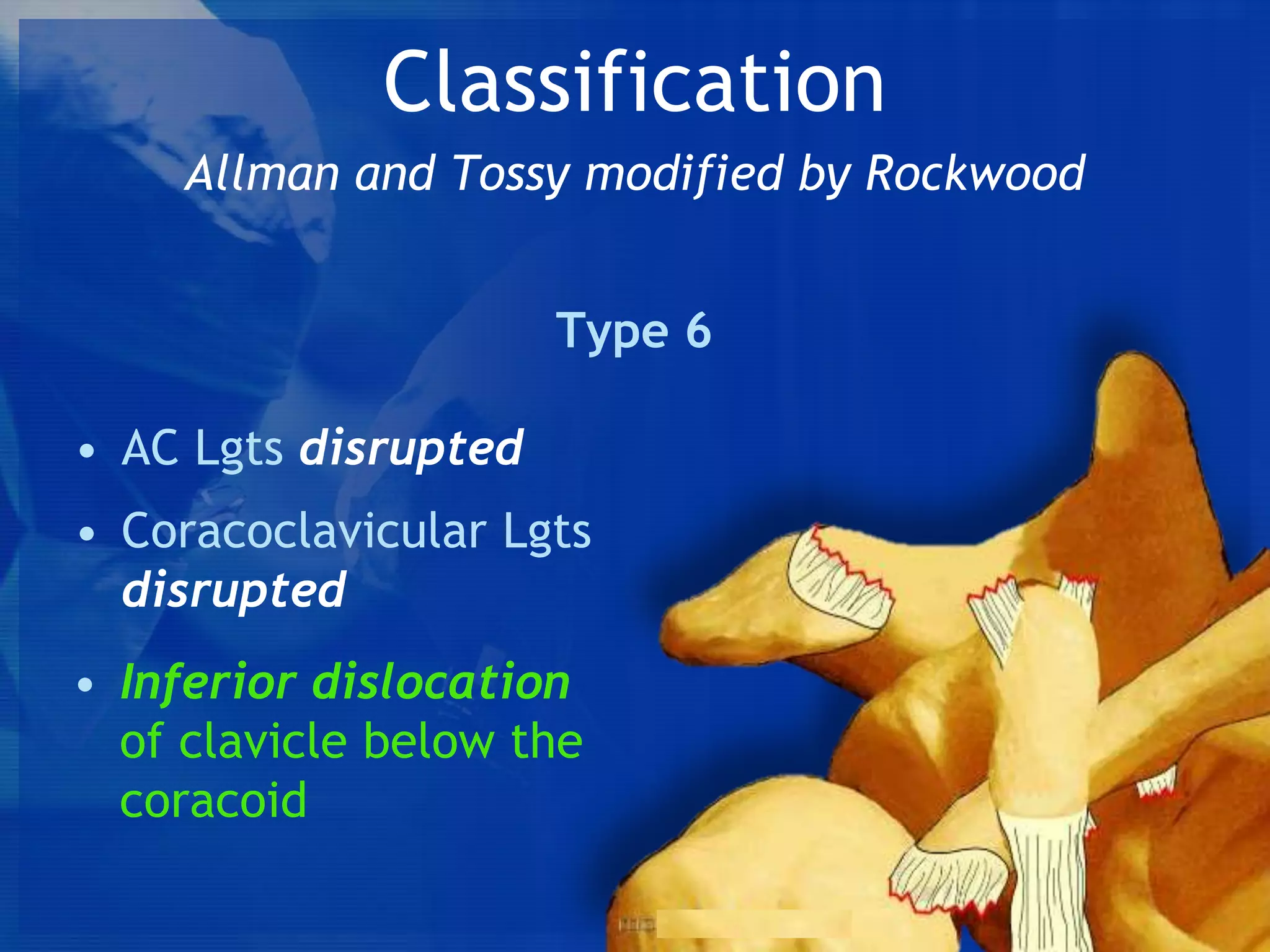
Type 6
• AC Lgts disrupted
• Coracoclavicular Lgts
disrupted
• Inferior dislocation
of clavicle below the
coracoid
Diagnosis
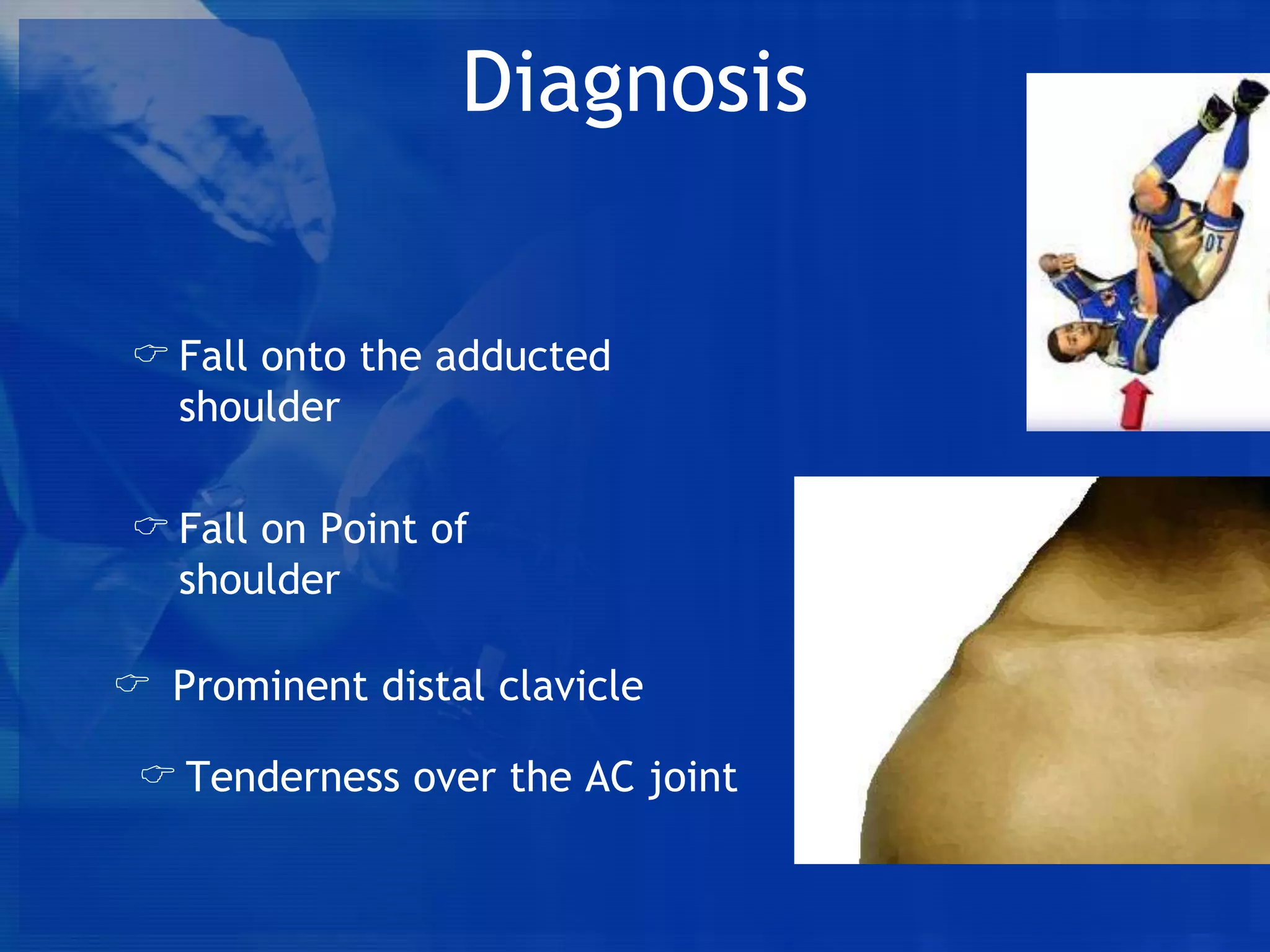
 Fall onto the adducted
shoulder
 Fall on Point of
shoulder
 Prominent distal clavicle
 Tenderness over the AC joint
Whiplash Injury shoulder
(Levy et al 2002)

• As a result of Whiplash mechanism in a car accident
• The injury originates from the whiplash movement of the
shoulder where the clavicle and the body are retained by
the seatbelt.
• AC Injuries are a common injury sustained
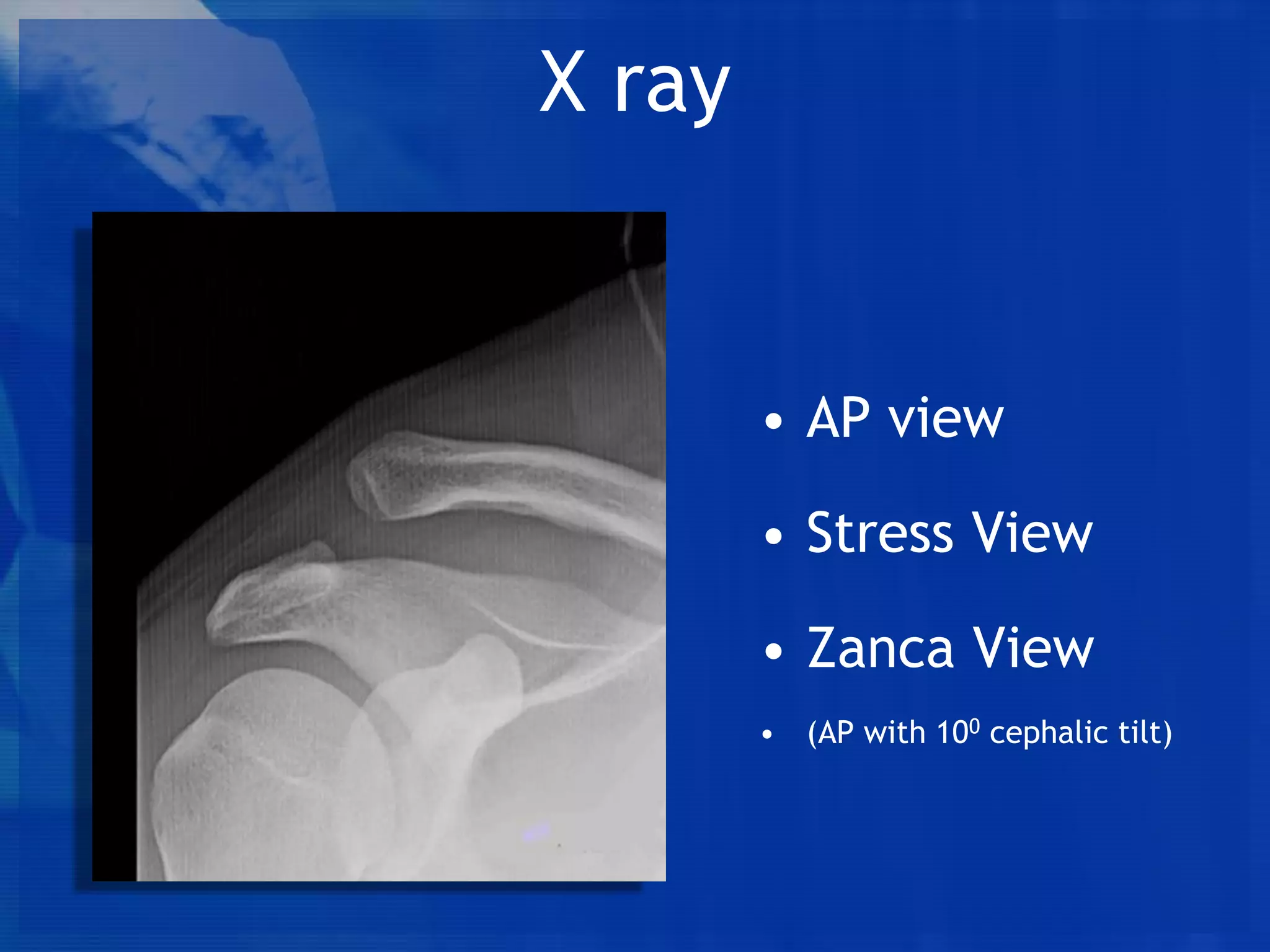
X ray

• AP view
• Stress View

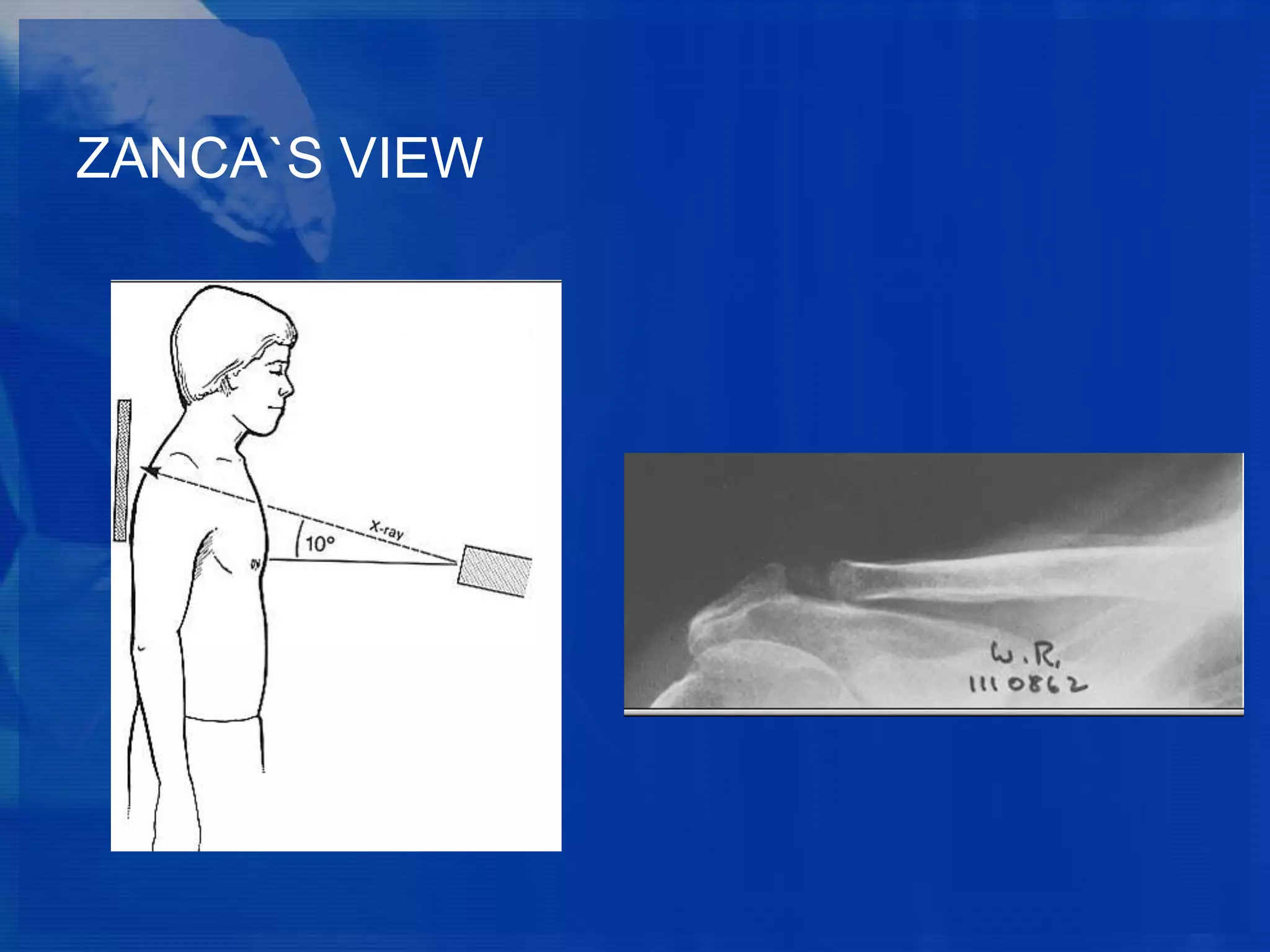
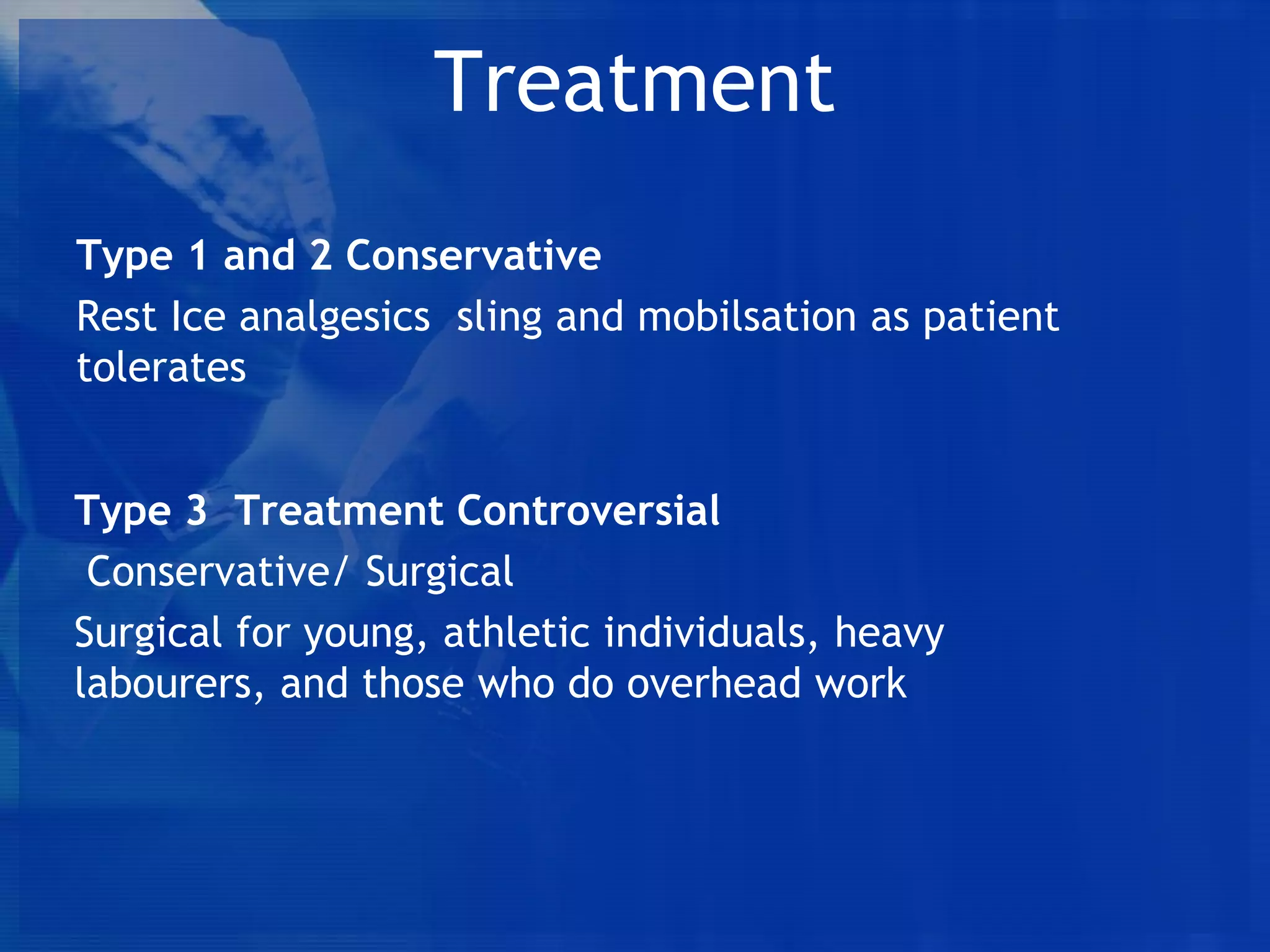
• Zanca View
• (AP with 100 cephalic tilt)
ZANCA`S VIEW
Treatment
Type 1 and 2 Conservative
Rest Ice analgesics sling and mobilsation as patient
tolerates
Type 3 Treatment Controversial
Conservative/ Surgical
Surgical for young, athletic individuals, heavy
labourers, and those who do overhead work
Acromioclavicular dislocation : Conservative or surgical
therapy : Controversies in Skeletal Trauma- CORR 1998
AM Phillips,Smart.Groom (1998)
Sugathan and Ronald Martin Dodenhoff (2012)

Overall, 88% of surgically treated patients and 87% of nonsurgically treated patients
had a satisfactory outcome. Complications most commonly listed were (surgically
treated versus nonsurgically treated): need for further surgery (59% versus
6%), infection (6% versus 1%), and deformity (3% versus 37%). Return to activity
was no quicker with surgery. Pain was not any more common without surgery. Range
of movement was more frequently normal or near normal without surgery (95%
versus 86% if surgically treated) and so was strength (92% versus 87%).

There does not seem to be any reason to recommend an operative procedure
to a patient with Type 3 injury based on the evidence currently available.
• Ceccarelli et al. reviewed the literature on the evidence
for management of Grade 3 (Allman) dislocations and
concluded:
“From the literature evaluation, clinical results seem
to be comparable between the operative and the
conservative treatments, but complications are more
evident in the surgery group.”
• There does not appear to be a clear association between
the degree of displacement and on-going symptoms and
disability of patient except cosmetic.
Surgery versus Sling for AC Joint
Dislocations
(AAOS Now December 2012 .Maureen Leahy)

• Study finds hook plate fixation is not superior to
nonsurgical treatment for acute injuries
• DASH scores better in non surgical group at 3 months
and 6 months and same at 1 year and 2 years.
Treatment Algorithm
Instructional Course Lecture, International Conference of Shoulder & Elbow
Surgery, Japan, 2013

• Acute injury (< 1week):
• Assess and diagnose.
• Sling and analgesia.
Surgery only if:
 Clavicle button-holed through trapezius;
 Locked clavicle;
 Neurovascular injury;
 Open injury
Review in three weeks
Treatment Algorithm
Instructional Course Lecture, International Conference of Shoulder & Elbow
Surgery, Japan, 2013

• 3 week review:
• Settling and improving – continue symptomatic
management and gradually reintroduce sports and
manual activities.
• Not coping – offer early surgical stabilisation
• Review 3 months
Treatment Algorithm
Instructional Course Lecture, International Conference of Shoulder & Elbow
Surgery, Japan, 2013

• 3 month review:
• Returned to sports and little symptoms – discharge

• Not coping – offer surgical stabilisation
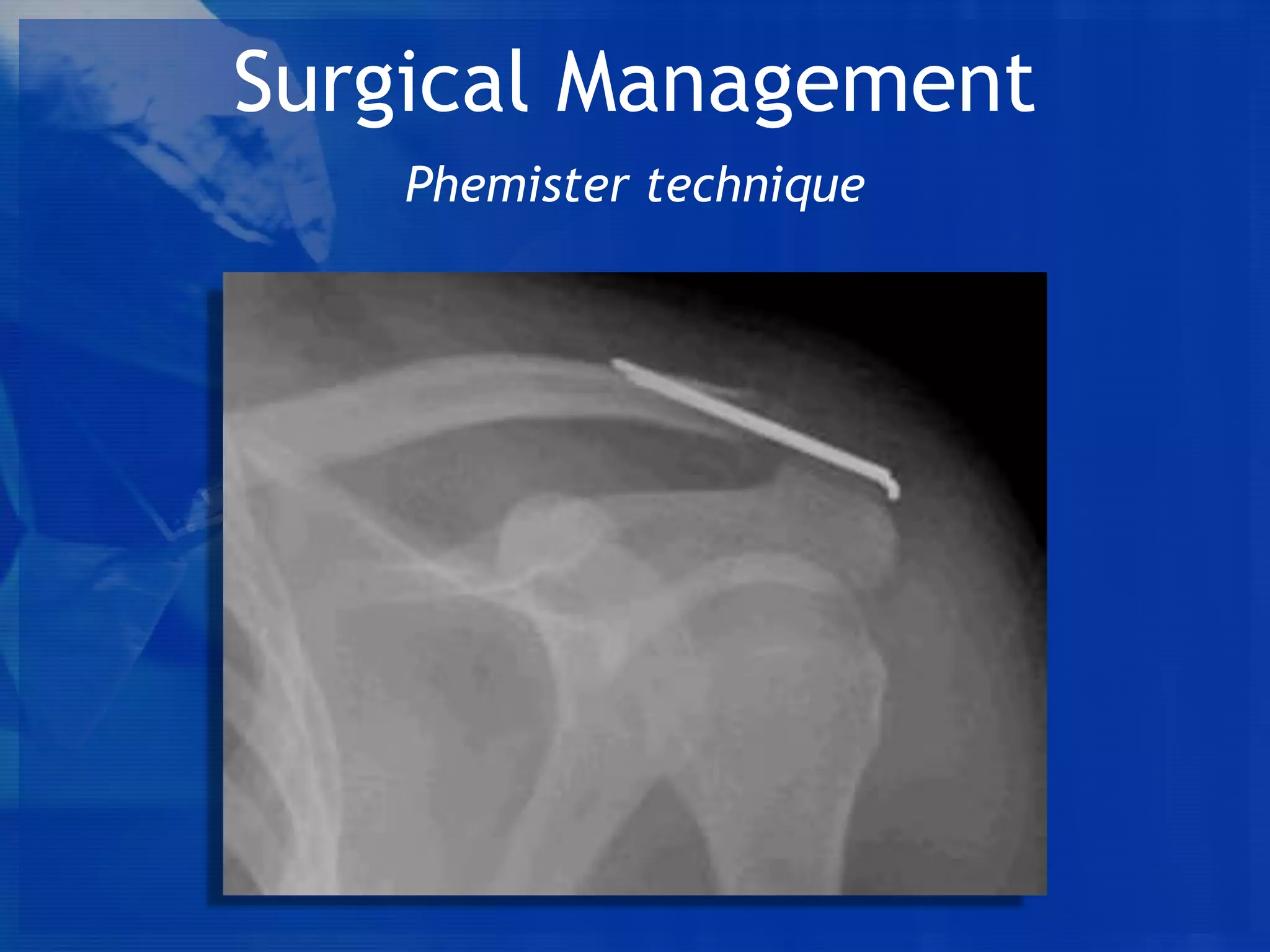
Surgical Management
Phemister technique
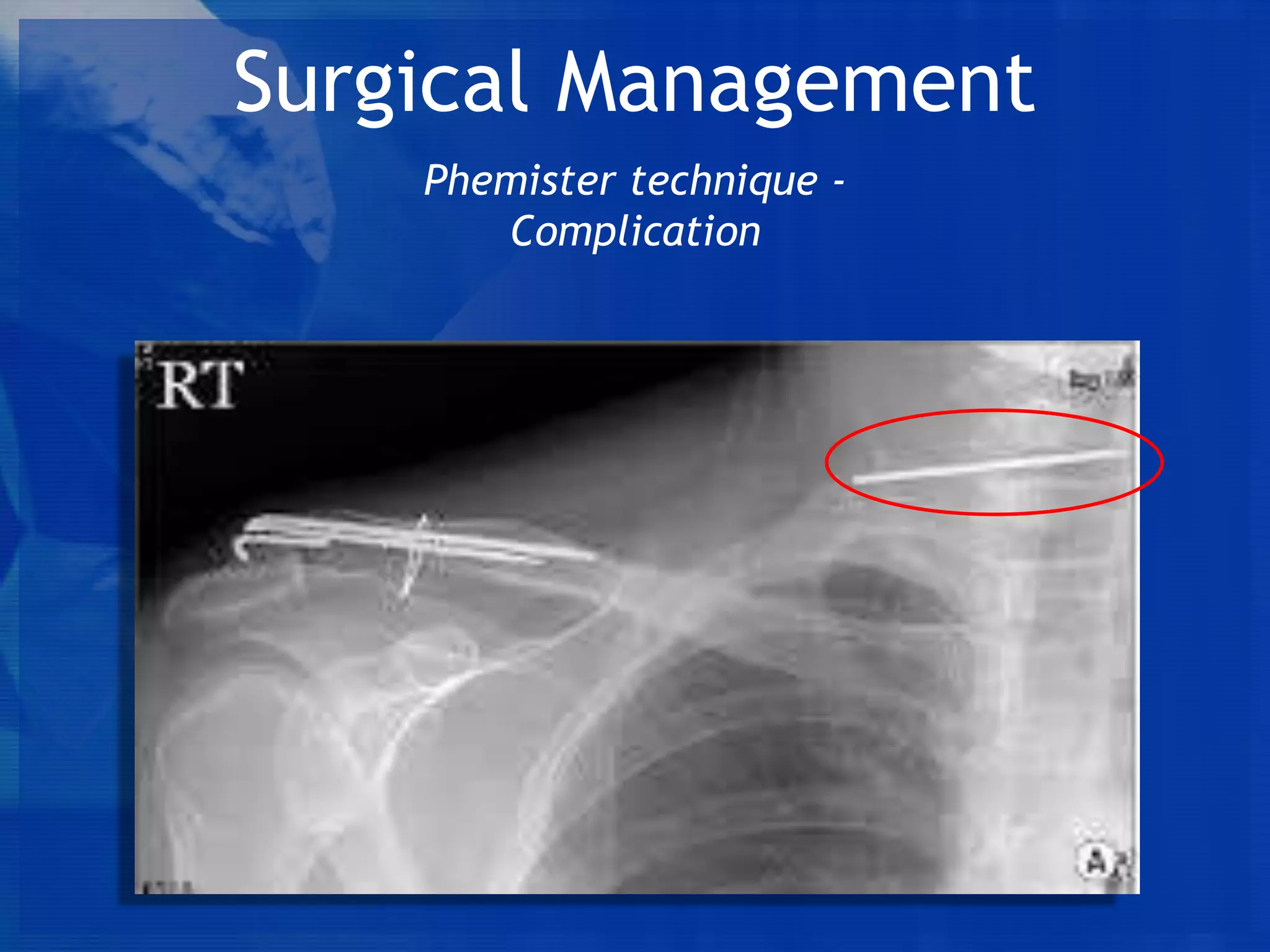
Surgical Management
Phemister technique Complication
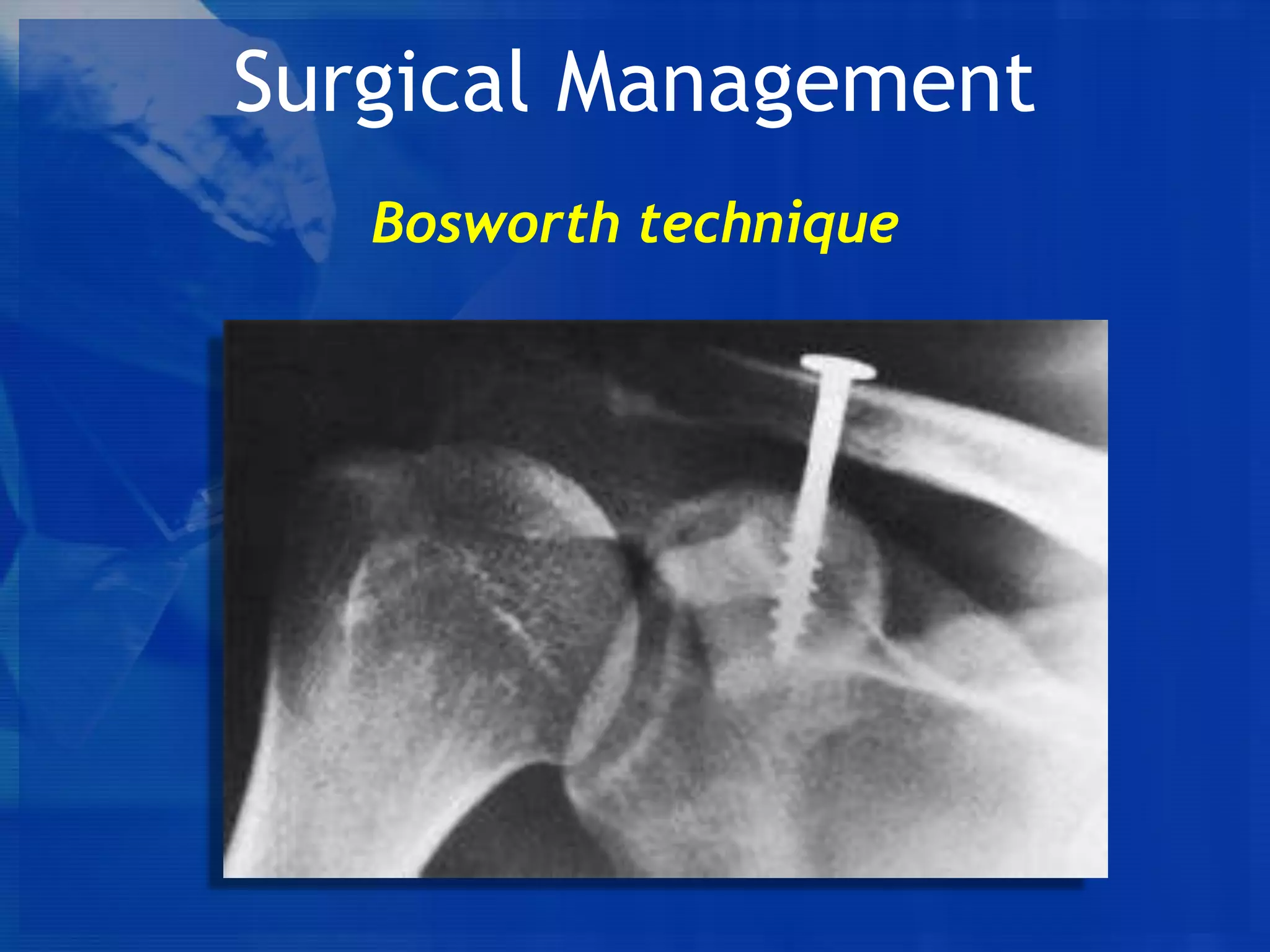
Surgical Management
Bosworth technique
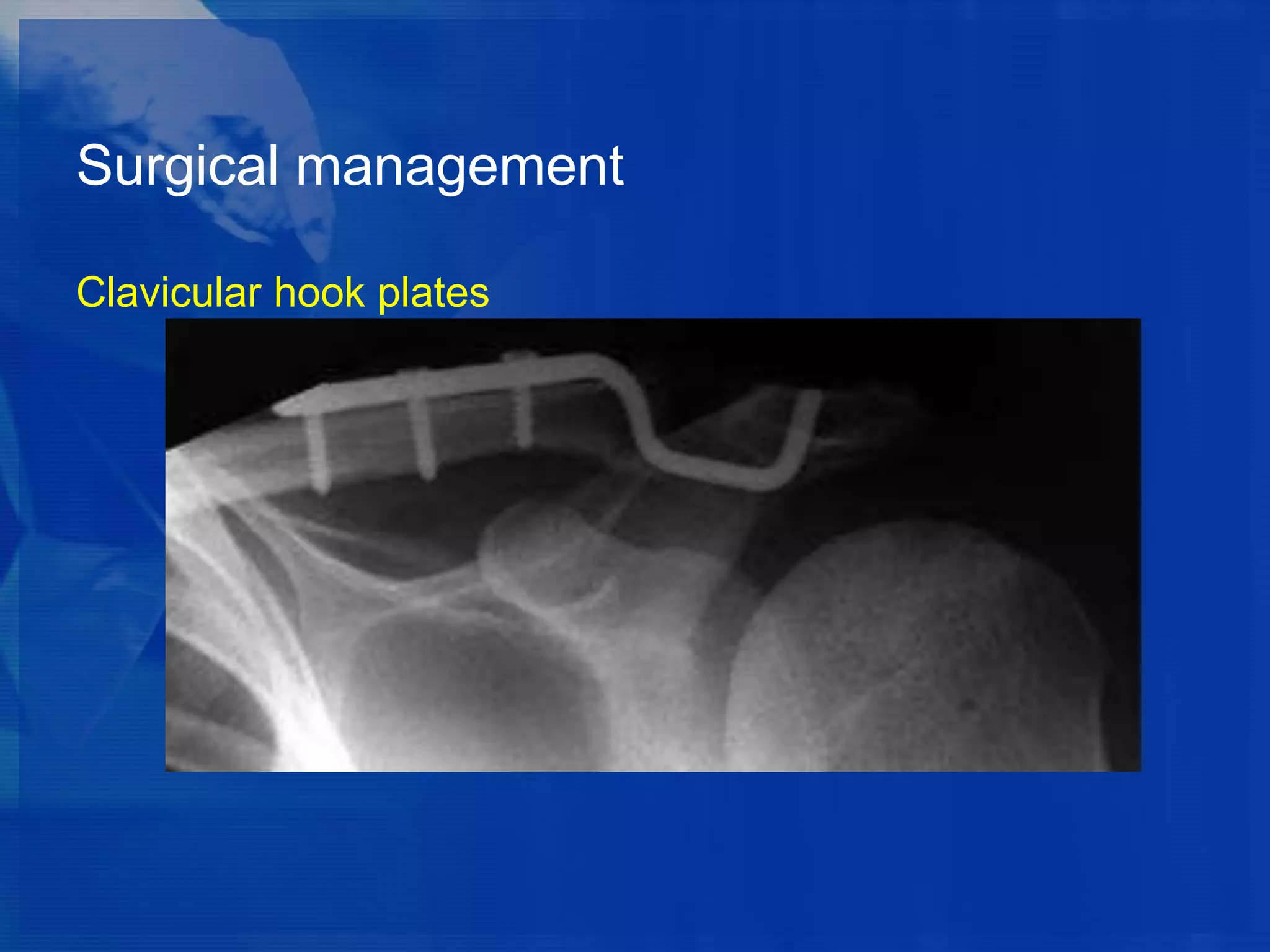
Surgical management
Clavicular hook plates
Surgical Management
Repair+Tightrope augmentation
Surgical Management
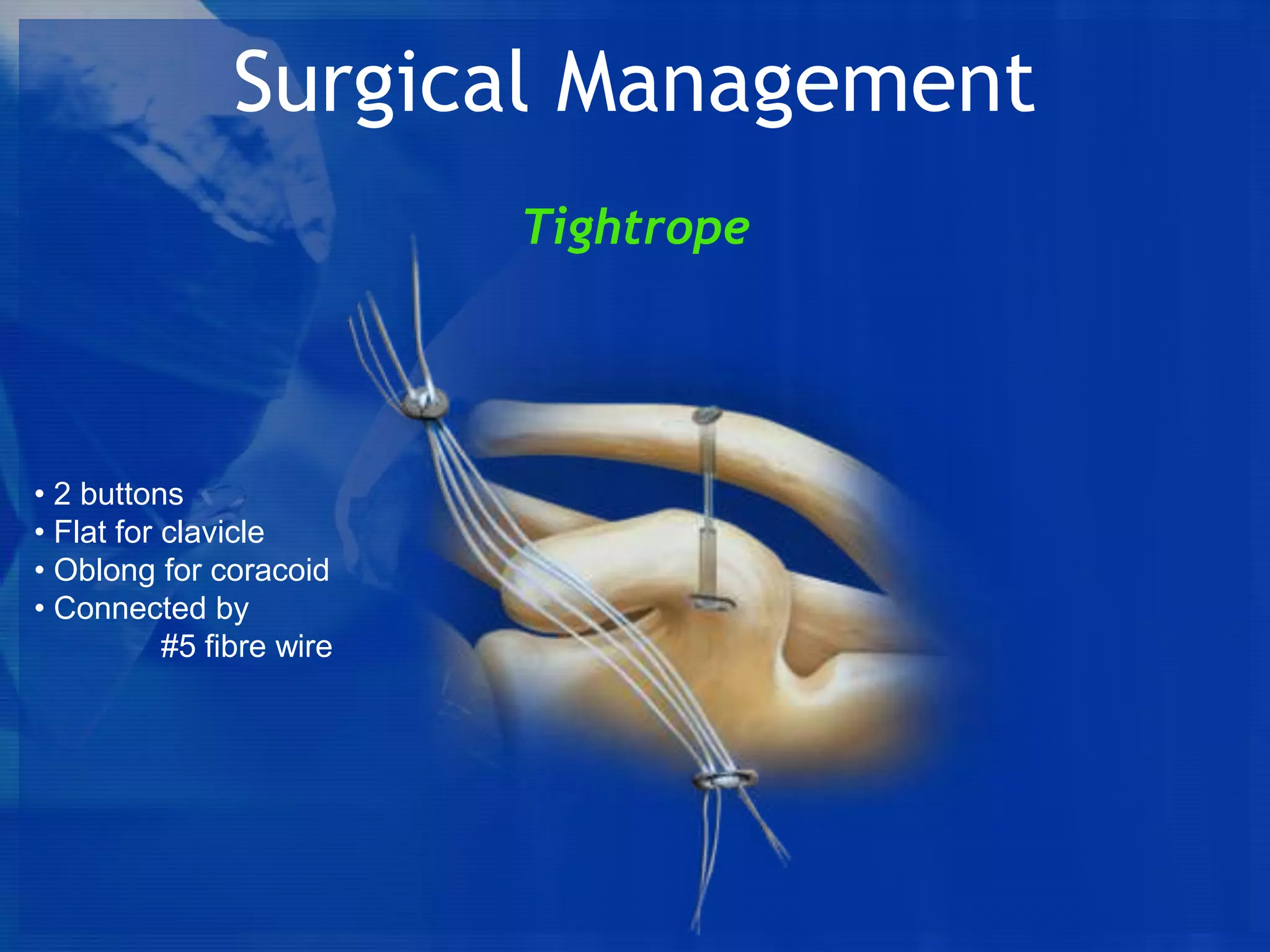
Tightrope

• 2 buttons
• Flat for clavicle
• Oblong for coracoid
• Connected by
#5 fibre wire
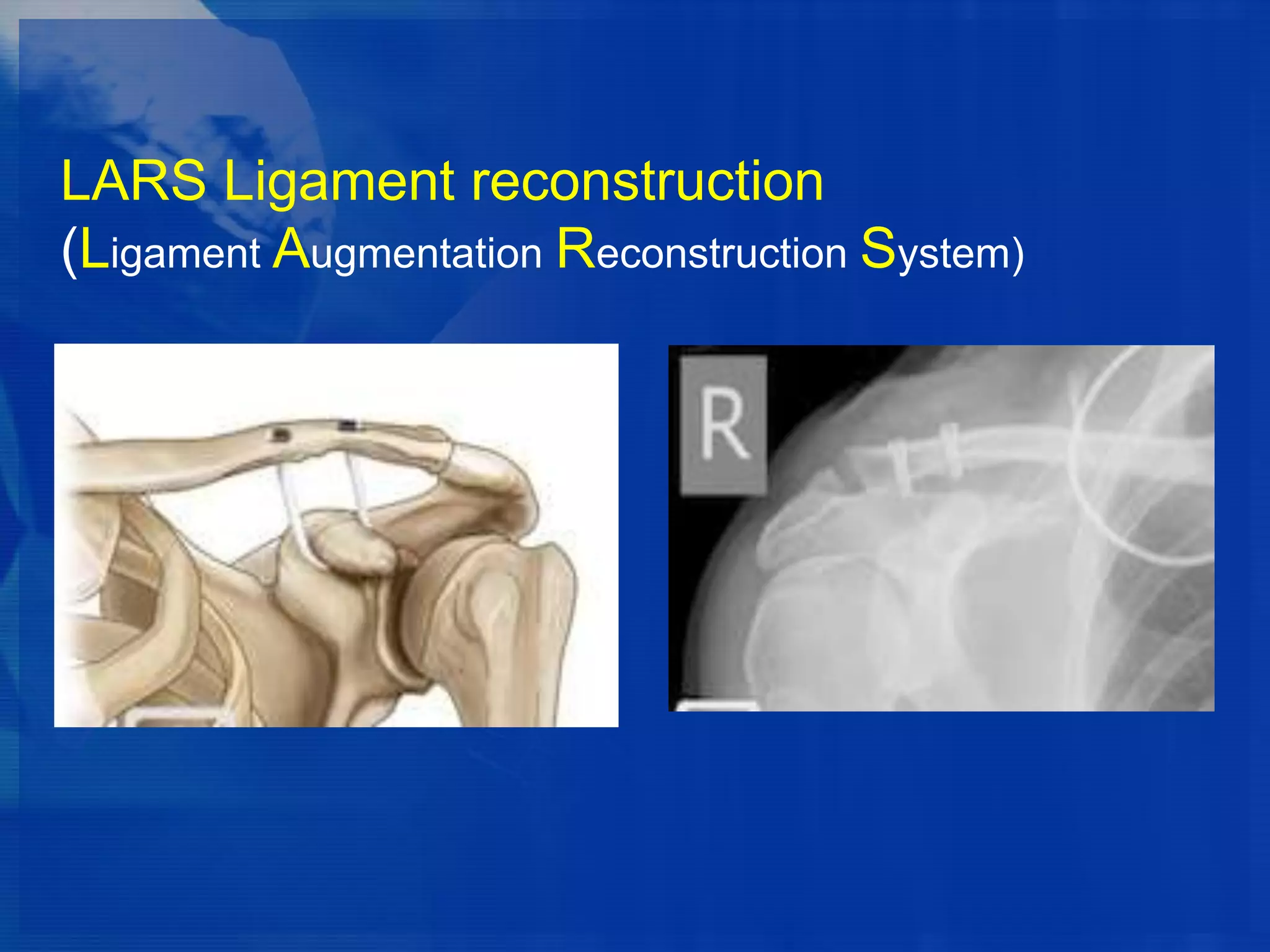
LARS Ligament reconstruction
(Ligament Augmentation Reconstruction System)
LARS Ligament
• Synthetic Ligament
• Made of polyethylene terephthalate
• Have longitudinal-running fibres that match the structure
of native human tissue. They therefore are able to act as
a scaffold for fibroblasts.
• Biopsies done on the LARS ligament have shown
complete cellular and connective tissue ingrowth, along
with the presence of some endothelial cells suggesting
vascularisation of the tissue
•

LARS ligament reproduces the anatomy and mechanics
of the torn coracoclavicular ligament
LARS Ligament reconstruction
(Ligament Augmentation Reconstruction System)
Surgilig reconstruction
• Surgilig is an artificial ligament
• It is made of double braided polyester with a patented
weave design which acts as a scaffold encouraging
tissue in-growth (predominantly scar tissue).
Surgilig reconstruction
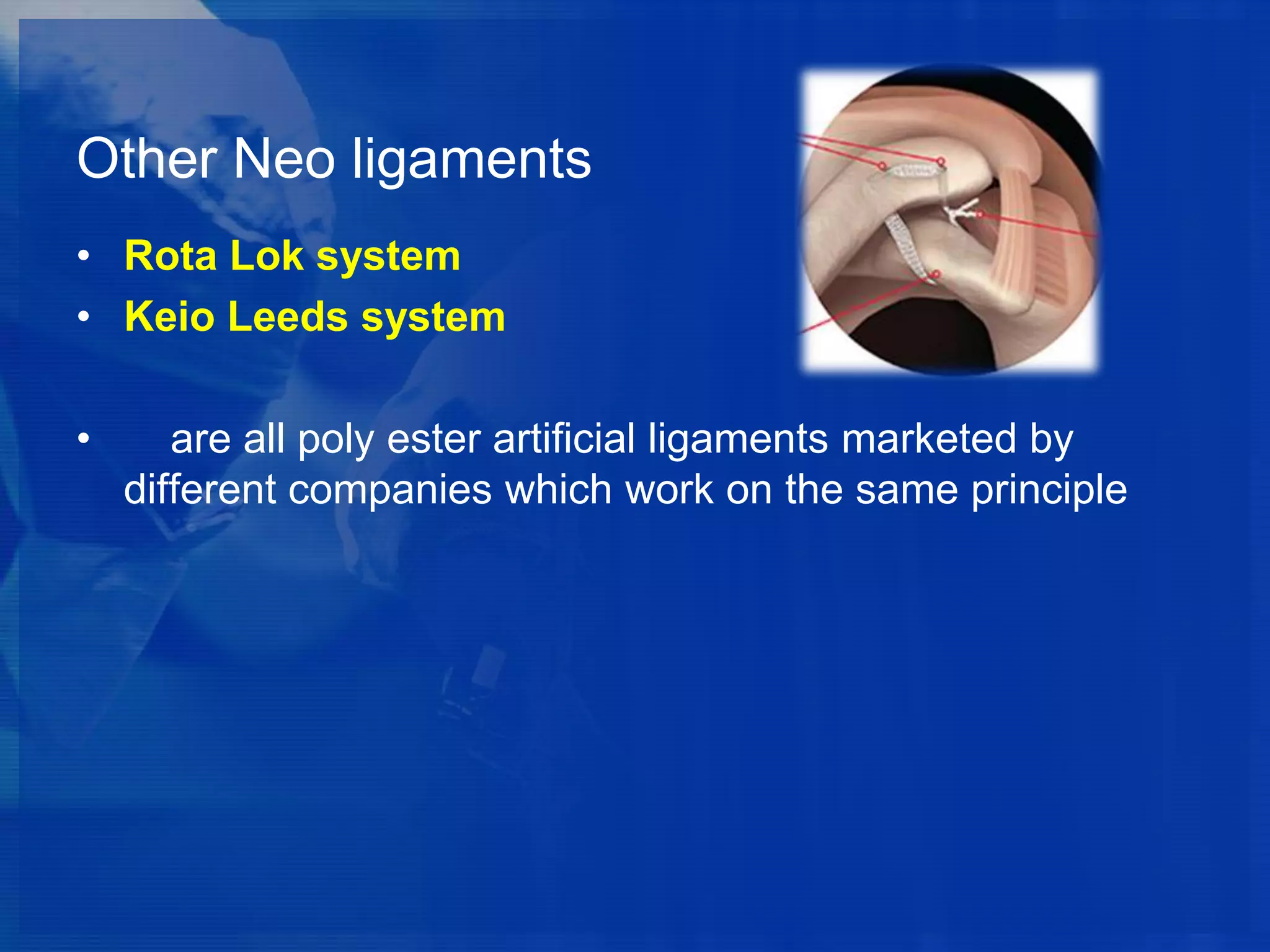
Other Neo ligaments
• Rota Lok system
• Keio Leeds system
•

are all poly ester artificial ligaments marketed by
different companies which work on the same principle
Reconstruction for neglected cases
Grafts used
Semitendinosis
Gracilis
Allografts
• This can be used as a single or double bundle to
reconstruct the coracoclavicular ligament.
Tight ropes used to augment the reconstruction.
Or
• synthetic ligaments like LARS or Surgilig can be
used for reconstruction
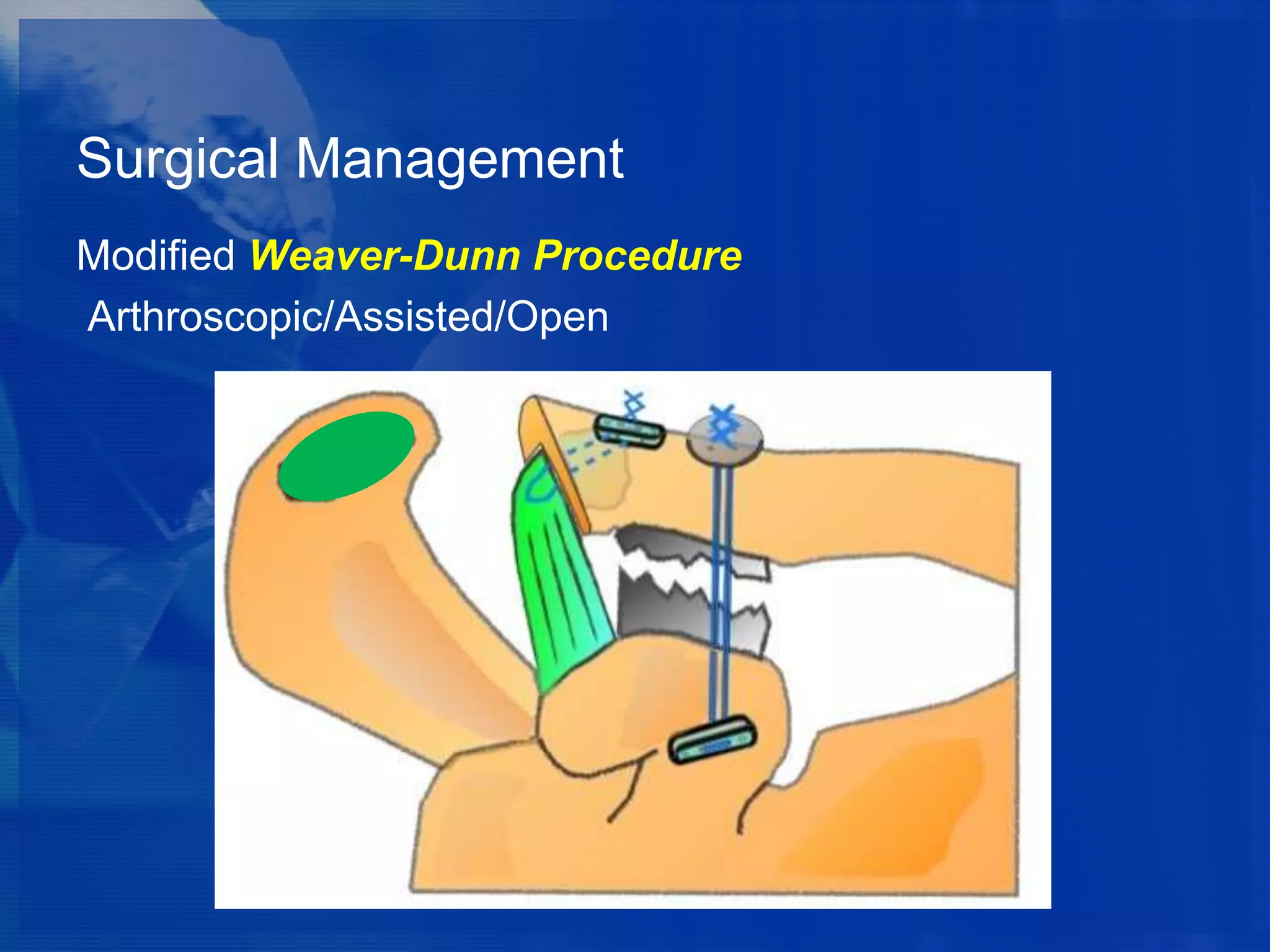
Surgical Management
Modified Weaver-Dunn Procedure
Arthroscopic/Assisted/Open
Complications of AC Joint
dislocations
‼ AC joint Arthritis
‼ Cosmetic
‼ Scapular Dyskinesia and SICK scapula syndrome

‼
‼
‼
‼
‼
‼

# Clavicle
# Coracoid
Implant Failure
Infection
Shoulder stiffness
Rotator cuff problems
SICK Scapula syndrome
•
•
•
•

S capular malposition
I nferomedial prominence of Scapula
C oracoid pain
K inesial abnormalities of scapula
Ac joint

Ac joint

  • 2.
    9% of shouldergirdle injuries Generally occurs in males age 20-30
  • 3.
  • 4.
    Classification Allman and Tossymodified by Rockwood Type 1 • Sprain of AC Lgt • Coracoclavicular Lgts normal
  • 5.
    Classification Allman and Tossymodified by Rockwood Type 2 • AC Lgts disrupted • Coracoclavicular Lgts sprained
  • 6.
    Classification Allman and Tossymodified by Rockwood Type 3 • AC Lgts disrupted • Coracoclavicular Lgts disrupted
  • 7.
    Classification Allman and Tossymodified by Rockwood Type 4 • AC Lgts disrupted • Coracoclavicular Lgts disrupted • Clavicle posteriorly displaced into or through the trapezius
  • 8.
    Classification Allman and Tossymodified by Rockwood Type 5 • AC Lgts disrupted • Coracoclavicular Lgts disrupted • Clavicle displaced superiorly more than 100%
  • 9.
    Classification Allman and Tossymodified by Rockwood Type 6 • AC Lgts disrupted • Coracoclavicular Lgts disrupted • Inferior dislocation of clavicle below the coracoid
  • 10.
    Diagnosis  Fall ontothe adducted shoulder  Fall on Point of shoulder  Prominent distal clavicle  Tenderness over the AC joint
  • 11.
    Whiplash Injury shoulder (Levyet al 2002) • As a result of Whiplash mechanism in a car accident • The injury originates from the whiplash movement of the shoulder where the clavicle and the body are retained by the seatbelt. • AC Injuries are a common injury sustained
  • 12.
    X ray • APview • Stress View • Zanca View • (AP with 100 cephalic tilt)
  • 13.
  • 14.
    Treatment Type 1 and2 Conservative Rest Ice analgesics sling and mobilsation as patient tolerates Type 3 Treatment Controversial Conservative/ Surgical Surgical for young, athletic individuals, heavy labourers, and those who do overhead work
  • 15.
    Acromioclavicular dislocation :Conservative or surgical therapy : Controversies in Skeletal Trauma- CORR 1998 AM Phillips,Smart.Groom (1998) Sugathan and Ronald Martin Dodenhoff (2012) Overall, 88% of surgically treated patients and 87% of nonsurgically treated patients had a satisfactory outcome. Complications most commonly listed were (surgically treated versus nonsurgically treated): need for further surgery (59% versus 6%), infection (6% versus 1%), and deformity (3% versus 37%). Return to activity was no quicker with surgery. Pain was not any more common without surgery. Range of movement was more frequently normal or near normal without surgery (95% versus 86% if surgically treated) and so was strength (92% versus 87%). There does not seem to be any reason to recommend an operative procedure to a patient with Type 3 injury based on the evidence currently available.
  • 16.
    • Ceccarelli etal. reviewed the literature on the evidence for management of Grade 3 (Allman) dislocations and concluded: “From the literature evaluation, clinical results seem to be comparable between the operative and the conservative treatments, but complications are more evident in the surgery group.” • There does not appear to be a clear association between the degree of displacement and on-going symptoms and disability of patient except cosmetic.
  • 17.
    Surgery versus Slingfor AC Joint Dislocations (AAOS Now December 2012 .Maureen Leahy) • Study finds hook plate fixation is not superior to nonsurgical treatment for acute injuries • DASH scores better in non surgical group at 3 months and 6 months and same at 1 year and 2 years.
  • 18.
    Treatment Algorithm Instructional CourseLecture, International Conference of Shoulder & Elbow Surgery, Japan, 2013 • Acute injury (< 1week): • Assess and diagnose. • Sling and analgesia. Surgery only if:  Clavicle button-holed through trapezius;  Locked clavicle;  Neurovascular injury;  Open injury Review in three weeks
  • 19.
    Treatment Algorithm Instructional CourseLecture, International Conference of Shoulder & Elbow Surgery, Japan, 2013 • 3 week review: • Settling and improving – continue symptomatic management and gradually reintroduce sports and manual activities. • Not coping – offer early surgical stabilisation • Review 3 months
  • 20.
    Treatment Algorithm Instructional CourseLecture, International Conference of Shoulder & Elbow Surgery, Japan, 2013 • 3 month review: • Returned to sports and little symptoms – discharge • Not coping – offer surgical stabilisation
  • 21.
  • 22.
  • 23.
  • 24.
  • 25.
  • 26.
    Surgical Management Tightrope • 2buttons • Flat for clavicle • Oblong for coracoid • Connected by #5 fibre wire
  • 27.
    LARS Ligament reconstruction (LigamentAugmentation Reconstruction System)
  • 28.
    LARS Ligament • SyntheticLigament • Made of polyethylene terephthalate • Have longitudinal-running fibres that match the structure of native human tissue. They therefore are able to act as a scaffold for fibroblasts. • Biopsies done on the LARS ligament have shown complete cellular and connective tissue ingrowth, along with the presence of some endothelial cells suggesting vascularisation of the tissue • LARS ligament reproduces the anatomy and mechanics of the torn coracoclavicular ligament
  • 29.
    LARS Ligament reconstruction (LigamentAugmentation Reconstruction System)
  • 30.
    Surgilig reconstruction • Surgiligis an artificial ligament • It is made of double braided polyester with a patented weave design which acts as a scaffold encouraging tissue in-growth (predominantly scar tissue).
  • 31.
  • 32.
    Other Neo ligaments •Rota Lok system • Keio Leeds system • are all poly ester artificial ligaments marketed by different companies which work on the same principle
  • 33.
    Reconstruction for neglectedcases Grafts used Semitendinosis Gracilis Allografts • This can be used as a single or double bundle to reconstruct the coracoclavicular ligament. Tight ropes used to augment the reconstruction. Or • synthetic ligaments like LARS or Surgilig can be used for reconstruction
  • 34.
    Surgical Management Modified Weaver-DunnProcedure Arthroscopic/Assisted/Open
  • 35.
    Complications of ACJoint dislocations ‼ AC joint Arthritis ‼ Cosmetic ‼ Scapular Dyskinesia and SICK scapula syndrome ‼ ‼ ‼ ‼ ‼ ‼ # Clavicle # Coracoid Implant Failure Infection Shoulder stiffness Rotator cuff problems
  • 36.
    SICK Scapula syndrome • • • • Scapular malposition I nferomedial prominence of Scapula C oracoid pain K inesial abnormalities of scapula