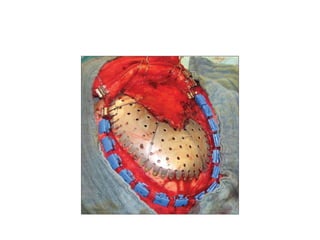
CRANIOPLASTY
Dr. Joe M Das
Senior Resident
•
•
•
•
•
•
•
•
•
•

History
Definition
Bone-graft integration
Indications and contraindications
Preservation of autografts
Critical size & anatomy of defect
Graft materials
Pediatric plasty
Complications
Future
HISTORY
PETRONIUS (1565)

GOLD PLATES

FALLOPIUS (1600)

BONE

MEEKEN (1670)

CANINE BONE

MACEWEN (1888 )

REIMPLANTATION

BURREL

BONE BUTTON

SEYDEL (1889)

TIBIA

MULLER (1890)

OUTER TABLE SKULL
HISTORY
WESTERMAN (1916)
BROWN (1917)

STERNUM
RIB

DAMBRIN (1919)
MACLENAN (1920)
FAGARASANU (1937)

CADAVER
SCAPULA
SPLIT RIB

VON HINTERSTOISSER
BOOTH
CORNIOLEY (1925)

CELLULOID
ALUMINIUM
PLATINUM

CARNEY
KLEINSCHMIDT (1940)

TANTALUM
METHYLMETHACRYLATE
• The first reported cranioplasty was probably that
of a Russian nobleman who, after receiving a
sword blow to the head, had the resultant defect
(and his health) restored with a piece of dog‘s
cranium (Van Meekeren, 1668).
• Subsequently, after he had been
excommunicated from the Russian church (which
could not accept the presence of animal bone on
a human skull), removal of the graft was
impossible due to bony union.
Definition
The restoration of a defect in the cranial bone
or correction of a deformity of the bone that
may happen after trauma as in depressed
fracture
Bone graft integration
• The dynamic nature of living bone was first
realised in 19th century.
• In 1893 the histological sequence of bone
replacement, ‘creeping substitution’
• Survival of a bone implantation graft depends
on the reaction of the surrounding tissue and
on functional contact between cancellous
bone and adjacent resident bone.
• 1st week → Capillaries from surrounding bone
diploe, dura and scalp infiltrate the transplant
bed.
• 2nd week → fibrous granulation tissue
proliferates and osteoplastic activity occurs.
• Osteoinduction –
– Primitive mesenchymal cells → Osteoprogenitor cells
→ Osteoblasts that are capable of forming newbone
to replace the necrotic bone which is gradually
absorbed
• Osteoconduction – Osteoprogenitor cells from
the surrounding tissue migrate into the 3-D
structure of bony and protein matrix.
• Auto- and allo-grafts have relied on
osteoconduction as the main principle of
cranioplasty.
• In osteoinduction, cells do not have to migrate
from the surrounding tissues but, probably with
the help of bone morphogenetic proteins, can be
produced in situ.
• Osteoactivity – Ability of the biomaterial to be
replaced with bone formation either through
osteoinduction / osteoconduction
• Osteoproductivity – The process whereby a
bioactive surface is colonised by osteogenic
stem cells from the defective environment as
a result of surgical intervention
AETIOLOGY OF THE CRANIAL DEFECT
•
•
•
•
•

Trauma
Decompressive craniectomy
Infection
Neoplasms
Congenital: Encephalocele,
meningoencephalocele, large parietal
foramina, aplasia cutis congenita, cranium
bifida, sphenoid wing defect
INDICATIONS
• Aesthetic / protective / discomfort
• Those prone for trauma - seizure disorder,
sports, military
• ? Local tenderness
• ? Post traumatic seizure
• Hemispheric collapse
• Children—asymmetric growth and cerebral
hernia
INDICATIONS
• GRANT AND NORCROSS (1939)
1.
2.
3.
4.
5.

Severe headache and syndrome of trephined
Epilepsy assumed to be due to defect
Danger of trauma
Unsightly defect
Pulsate unduly and painful
When to do it?
• 3-6 months after compound wounds
• 1 year after wound infection / if frontal sinus
is opened
• 3 months with autograft
• Wait for 1 year after craniectomy in a child
SYNDROME OF THE TREPHINED
• Yamura and Makino (1977) coined the term
“syndrome of the sunken skin flap” to describe
the neurological symptoms due to a
craniectomy defect
• Progressive contralateral hemiparesis, local
pain and postural headache with cognitive
and functional decline due to a skull defect
• Not affected by size or location of defect
• Early cranioplasty may improve the symptoms
SYNDROME OF THE TREPHINED
• Pathophysiology
– Stretching of the dura and underlying cortex due
to the atmospheric pressure
– Cicatrical changes occurring between the
cortex, dura and the skin exerting pressure on the
skull contents
– Impairment of the venous return due to the
atmospheric pressure acting on the region of skull
defect with a resultant increase in the local
external pressure
SYNDROME OF THE TREPHINED
• How does cranioplasty work?
– Increase in cerebrospinal fluid (CSF) and superior
sagittal sinus pressure, cerebral expansion,
increase in CSF motion after cranioplasty due to
an increase in cerebral arterial pulsations and
improvement in cerebral blood flow, cerebral
metabolism and cerebral vascular reserve capacity
have been demonstrated after cranioplasty.
CONTRAINDICATIONS
•
•
•
•
•

Hydrocephalus
Cerebral oedema
Infection
Compound wound
Contiguous functional sinus
IDEAL
•
•
•
•
•
•
•
•
•
•

Malleable
Easy to sterilize
Strong
Light-weight
Easily securable
Non ferro-magnetic
Inexpensive
Bio-compatible & chemically inert
Radiolucent
Readily available
Preservation of autografts
• In the interim - “hockey helmet”
• Boiling (Westermann – 1916)
• Alcohol / formalin / autoclaving  Bone resorption &
infection
• Bone flap in abominal wall (Kreider – 1920)  Another
operation, unsightly scar, no osteogenic potential
• The bone flap remains sterile in a −70°C freezer for
many months.
• Autoclaving of the bone (e.g., if contaminated by a
compound scalp wound before cranioplasty) 
reduce the viability of the graft.
• ETO sterilisation
Critical size of defect
• Bone defects > 2 cm on the cerebral convexity
and bone defects of glabrous frontal region
• No need for repair in
– Defects below the temporal & occipital muscles
– Very elderly
– Children < 6 yrs in whom dura is not damaged
– Parietal area defect < 5 cm2
Anatomy of the defect
Preparation of the cranial defect
• The surgical bed must be clean and free of debris
• Both surgical bed and overlying surgical flap must be
well-vascularised
• Incorporate the previous scar into repair
• Scars in hair-bearing areas, avoiding parallel ones
• Cranialise the sinus
• Pericranium brought up as second layer with pedicle
intact
• Bone edges freshened
• Meticulous hemostasis & gentle handling of soft
tissues
• Any foreign material that is used should be perforated
AUTO BONE GRAFT
• Wrap in blood soaked sponge for 4-6 hrs
• More than 6 hrs → 10 % serum / 90 % salt
solution at 3 C.
• Don’t expose to air for more than 30 min.
• Normal saline is toxic
• Avoid antibiotic soak
• Split bone graft – Outer & inner tables split
• RIB
– 3-4 times more resorption
– Contour deformity
– Difficult to stabilize

• ILIUM
– Post op pain
– Second operation site
– Difficult to contour

• TIBIA
– Small segments
– Difficult to contour
– # Tibia

• VASCULAR FLAP – IRRADIATED TISSUE
Cranioplasty after left decompressive hemicraniectomy for intractable
intracranial hypertension.
A. Preoperative CT scan demonstrating Lt skull defect
B. autologous bone flap secured to native skull with plating system
C. Postoperative computed tomographic scan
demonstrating cranioplasty
POLYMETHYL METHACRYLATE
•
•
•
•
•
•
•

Inert
Minimum reaction
Tight adherence
Not thermoconductive
MRI compatible
Prepare intra-operatively
Powder polymerised ester of acrylic acid + benzoyl
peroxide liquid monomer (2:1)
• A paste-like substance into a translucent material with
strength comparable to that of native bone
•
•
•
•

Exothermic – 1000°C
20 minutes
Mix in plastic bag
Evaporated monomer → Hypotension,
hypoxia, CV collapse, death
Cranioplasty after resection of right frontal meningioma with growth through the skull.
• A skull defect
• B methyl methacrylate sheet over skull defect
• C methyl methacrylate plated into skull defect.
• D Postoperative CT scan
Hydroxyl apatite
•
•
•
•
•
•

Tissue compatibility is high
Radiolucent
Readily available
Adhere to bone
Bioactive – Capable of osteoconduction
MRI signal void
Nova Bone (Porex Surgical)
• Synthetic bio-active glass particulate
• 45% silica dioxide + 45% sodium oxide + 5%
calcium + 5% phosphate
• Osteoproductive and osteoconductive
POROUS POLYETHYLENE
• For facial augmentation and to restore continuity
to craniofacial skeletal defects
• Straight chain aliphatic hydrocarbons
• Non toxic, inert and stable
• Ingrowth of bone and soft tissue rapid.
• Small and medium defects
• Pattern transferred to smooth surface.
• Cut with knife
• Soak in sterile saline at 180°F - to modify shape
• Secure using titanium screws.
TITANIUM
•
•
•
•
•
•
•

Non corrosive
Light weight
Fatigue resistant
Biocompatible
Thermal expansion similar to bone
Minimal fibrous encapsulation
Non allergic / radiolucent
TANTALUM
•
•
•
•

0.38 mm thick
Easy to reshape
Expensive
Radio opaque
OSTEOINDUCTIVE AGENTS
• Bone morphogenic protein
– Group of proteins extracted from the bone matrix
that stimulate bone growth
– Some are well-characterized biochemically and
produced by recombinant DNA techniques
– Wozney et al defined 7 BMPs
– BMP 2 to 7 are related by amino acid homology
and are members of TGF-β superfamily
• Combination of
TGF-β 1, Natural coral
skeleton and human
fibrin glue
• Rabbit skull
PAEDIATRIC PLASTY
•
•
•
•
•
•

Not in less than 3 yrs
Wait for 1 yr
Auto bone preferred
No alloplasty less than 8 yrs
No split graft in infants
Alloplasty – dislodges, retards growth
Methyl methacrylate
• At least 5mm thick except over temporal
region or in child.
• Antibiotics
• Scalp incision outside defect, never parallel to
previous scar.
• Avoid incising dura
• Reflect temporalis
Split skull
• Autograft of choice.
• Either totally removed and then split or only outer
table removed.
• Along margin of defect outer table removed to create
5mm shelf.
• Transfer to paper, avoid bone wax.
• Donor---full thickness skull excised.
Rib and ilium
• Sub periosteal excision of rib
• Alternate ribs (never take >2 adjacent ribs)
• Total length = A/W × 2
A - area of defect
W - width of rib
• Cut 4 mm longer than defect
Allogenic skull
•
•
•
•

Human skull plates
Demineralized powder
Skull discs
Resorption - 60 %
COMPLICATIONS
•
•
•
•
•
•

Infection 1-8 %
Granuloma, pneumatocele
Erode skin
Compression of brain and internal herniation
Fracture and injure brain
Donor site complications
Dead space morbidity
•
•
•
•
•
•

Following planned plasty
Children—obliterate spontaneously
Adults - uncertain
Microvascular free flap under plasty
Mass effect, prolonged surgery
Does not alter either external contour or protective
function
• Causes late infection
Infection
•
•
•
•
•

Auto
-0-4 %
Alloplasty
-4 %
MMA
-1-4 %
Avoidance - exclude connection with sinus
Management - Antibiotics
- Removal
Resorption
•
•
•
•

Frozen and autoclaved
Autoclaved
Fresh
Avoidance—
–
–
–
–

Use membranous bone
Avoid dessication
Avoid boiling/autoclaving
Stable fixation

- 7-24 %
- 10 %
- 0-5 %
Migration
• Less than 1 %
• Avoidance - wire/mesh scaffolding,
Rigid fixation
• Management - Refixation
Hematoma
• Avoidance – Hemostasis & Drain
• Management – explore and evacuate if large
FUTURE
•
•
•
•

Bone morphogenetic protein—BMP
Recombinant BMP-2 - trial
PDGF
EGF, IGF – chemotaxis
Cranioplasty

Cranioplasty

  • 1.
    CRANIOPLASTY Dr. Joe MDas Senior Resident
  • 2.
    • • • • • • • • • • History Definition Bone-graft integration Indications andcontraindications Preservation of autografts Critical size & anatomy of defect Graft materials Pediatric plasty Complications Future
  • 3.
    HISTORY PETRONIUS (1565) GOLD PLATES FALLOPIUS(1600) BONE MEEKEN (1670) CANINE BONE MACEWEN (1888 ) REIMPLANTATION BURREL BONE BUTTON SEYDEL (1889) TIBIA MULLER (1890) OUTER TABLE SKULL
  • 4.
    HISTORY WESTERMAN (1916) BROWN (1917) STERNUM RIB DAMBRIN(1919) MACLENAN (1920) FAGARASANU (1937) CADAVER SCAPULA SPLIT RIB VON HINTERSTOISSER BOOTH CORNIOLEY (1925) CELLULOID ALUMINIUM PLATINUM CARNEY KLEINSCHMIDT (1940) TANTALUM METHYLMETHACRYLATE
  • 7.
    • The firstreported cranioplasty was probably that of a Russian nobleman who, after receiving a sword blow to the head, had the resultant defect (and his health) restored with a piece of dog‘s cranium (Van Meekeren, 1668). • Subsequently, after he had been excommunicated from the Russian church (which could not accept the presence of animal bone on a human skull), removal of the graft was impossible due to bony union.
  • 9.
    Definition The restoration ofa defect in the cranial bone or correction of a deformity of the bone that may happen after trauma as in depressed fracture
  • 10.
    Bone graft integration •The dynamic nature of living bone was first realised in 19th century. • In 1893 the histological sequence of bone replacement, ‘creeping substitution’ • Survival of a bone implantation graft depends on the reaction of the surrounding tissue and on functional contact between cancellous bone and adjacent resident bone.
  • 11.
    • 1st week→ Capillaries from surrounding bone diploe, dura and scalp infiltrate the transplant bed. • 2nd week → fibrous granulation tissue proliferates and osteoplastic activity occurs. • Osteoinduction – – Primitive mesenchymal cells → Osteoprogenitor cells → Osteoblasts that are capable of forming newbone to replace the necrotic bone which is gradually absorbed
  • 12.
    • Osteoconduction –Osteoprogenitor cells from the surrounding tissue migrate into the 3-D structure of bony and protein matrix. • Auto- and allo-grafts have relied on osteoconduction as the main principle of cranioplasty. • In osteoinduction, cells do not have to migrate from the surrounding tissues but, probably with the help of bone morphogenetic proteins, can be produced in situ.
  • 13.
    • Osteoactivity –Ability of the biomaterial to be replaced with bone formation either through osteoinduction / osteoconduction • Osteoproductivity – The process whereby a bioactive surface is colonised by osteogenic stem cells from the defective environment as a result of surgical intervention
  • 15.
    AETIOLOGY OF THECRANIAL DEFECT • • • • • Trauma Decompressive craniectomy Infection Neoplasms Congenital: Encephalocele, meningoencephalocele, large parietal foramina, aplasia cutis congenita, cranium bifida, sphenoid wing defect
  • 16.
    INDICATIONS • Aesthetic /protective / discomfort • Those prone for trauma - seizure disorder, sports, military • ? Local tenderness • ? Post traumatic seizure • Hemispheric collapse • Children—asymmetric growth and cerebral hernia
  • 17.
    INDICATIONS • GRANT ANDNORCROSS (1939) 1. 2. 3. 4. 5. Severe headache and syndrome of trephined Epilepsy assumed to be due to defect Danger of trauma Unsightly defect Pulsate unduly and painful
  • 18.
    When to doit? • 3-6 months after compound wounds • 1 year after wound infection / if frontal sinus is opened • 3 months with autograft • Wait for 1 year after craniectomy in a child
  • 19.
    SYNDROME OF THETREPHINED • Yamura and Makino (1977) coined the term “syndrome of the sunken skin flap” to describe the neurological symptoms due to a craniectomy defect • Progressive contralateral hemiparesis, local pain and postural headache with cognitive and functional decline due to a skull defect • Not affected by size or location of defect • Early cranioplasty may improve the symptoms
  • 21.
    SYNDROME OF THETREPHINED • Pathophysiology – Stretching of the dura and underlying cortex due to the atmospheric pressure – Cicatrical changes occurring between the cortex, dura and the skin exerting pressure on the skull contents – Impairment of the venous return due to the atmospheric pressure acting on the region of skull defect with a resultant increase in the local external pressure
  • 22.
    SYNDROME OF THETREPHINED • How does cranioplasty work? – Increase in cerebrospinal fluid (CSF) and superior sagittal sinus pressure, cerebral expansion, increase in CSF motion after cranioplasty due to an increase in cerebral arterial pulsations and improvement in cerebral blood flow, cerebral metabolism and cerebral vascular reserve capacity have been demonstrated after cranioplasty.
  • 23.
  • 25.
    IDEAL • • • • • • • • • • Malleable Easy to sterilize Strong Light-weight Easilysecurable Non ferro-magnetic Inexpensive Bio-compatible & chemically inert Radiolucent Readily available
  • 26.
    Preservation of autografts •In the interim - “hockey helmet” • Boiling (Westermann – 1916) • Alcohol / formalin / autoclaving  Bone resorption & infection • Bone flap in abominal wall (Kreider – 1920)  Another operation, unsightly scar, no osteogenic potential • The bone flap remains sterile in a −70°C freezer for many months. • Autoclaving of the bone (e.g., if contaminated by a compound scalp wound before cranioplasty)  reduce the viability of the graft. • ETO sterilisation
  • 27.
    Critical size ofdefect • Bone defects > 2 cm on the cerebral convexity and bone defects of glabrous frontal region • No need for repair in – Defects below the temporal & occipital muscles – Very elderly – Children < 6 yrs in whom dura is not damaged – Parietal area defect < 5 cm2
  • 28.
  • 29.
    Preparation of thecranial defect • The surgical bed must be clean and free of debris • Both surgical bed and overlying surgical flap must be well-vascularised • Incorporate the previous scar into repair • Scars in hair-bearing areas, avoiding parallel ones • Cranialise the sinus • Pericranium brought up as second layer with pedicle intact • Bone edges freshened • Meticulous hemostasis & gentle handling of soft tissues • Any foreign material that is used should be perforated
  • 30.
    AUTO BONE GRAFT •Wrap in blood soaked sponge for 4-6 hrs • More than 6 hrs → 10 % serum / 90 % salt solution at 3 C. • Don’t expose to air for more than 30 min. • Normal saline is toxic • Avoid antibiotic soak • Split bone graft – Outer & inner tables split
  • 31.
    • RIB – 3-4times more resorption – Contour deformity – Difficult to stabilize • ILIUM – Post op pain – Second operation site – Difficult to contour • TIBIA – Small segments – Difficult to contour – # Tibia • VASCULAR FLAP – IRRADIATED TISSUE
  • 33.
    Cranioplasty after leftdecompressive hemicraniectomy for intractable intracranial hypertension. A. Preoperative CT scan demonstrating Lt skull defect B. autologous bone flap secured to native skull with plating system C. Postoperative computed tomographic scan demonstrating cranioplasty
  • 35.
    POLYMETHYL METHACRYLATE • • • • • • • Inert Minimum reaction Tightadherence Not thermoconductive MRI compatible Prepare intra-operatively Powder polymerised ester of acrylic acid + benzoyl peroxide liquid monomer (2:1) • A paste-like substance into a translucent material with strength comparable to that of native bone
  • 36.
    • • • • Exothermic – 1000°C 20minutes Mix in plastic bag Evaporated monomer → Hypotension, hypoxia, CV collapse, death
  • 38.
    Cranioplasty after resectionof right frontal meningioma with growth through the skull. • A skull defect • B methyl methacrylate sheet over skull defect • C methyl methacrylate plated into skull defect. • D Postoperative CT scan
  • 39.
    Hydroxyl apatite • • • • • • Tissue compatibilityis high Radiolucent Readily available Adhere to bone Bioactive – Capable of osteoconduction MRI signal void
  • 40.
    Nova Bone (PorexSurgical) • Synthetic bio-active glass particulate • 45% silica dioxide + 45% sodium oxide + 5% calcium + 5% phosphate • Osteoproductive and osteoconductive
  • 41.
    POROUS POLYETHYLENE • Forfacial augmentation and to restore continuity to craniofacial skeletal defects • Straight chain aliphatic hydrocarbons • Non toxic, inert and stable • Ingrowth of bone and soft tissue rapid. • Small and medium defects • Pattern transferred to smooth surface. • Cut with knife • Soak in sterile saline at 180°F - to modify shape • Secure using titanium screws.
  • 43.
    TITANIUM • • • • • • • Non corrosive Light weight Fatigueresistant Biocompatible Thermal expansion similar to bone Minimal fibrous encapsulation Non allergic / radiolucent
  • 47.
    TANTALUM • • • • 0.38 mm thick Easyto reshape Expensive Radio opaque
  • 49.
    OSTEOINDUCTIVE AGENTS • Bonemorphogenic protein – Group of proteins extracted from the bone matrix that stimulate bone growth – Some are well-characterized biochemically and produced by recombinant DNA techniques – Wozney et al defined 7 BMPs – BMP 2 to 7 are related by amino acid homology and are members of TGF-β superfamily
  • 50.
    • Combination of TGF-β1, Natural coral skeleton and human fibrin glue • Rabbit skull
  • 51.
    PAEDIATRIC PLASTY • • • • • • Not inless than 3 yrs Wait for 1 yr Auto bone preferred No alloplasty less than 8 yrs No split graft in infants Alloplasty – dislodges, retards growth
  • 52.
    Methyl methacrylate • Atleast 5mm thick except over temporal region or in child. • Antibiotics • Scalp incision outside defect, never parallel to previous scar. • Avoid incising dura • Reflect temporalis
  • 53.
    Split skull • Autograftof choice. • Either totally removed and then split or only outer table removed. • Along margin of defect outer table removed to create 5mm shelf. • Transfer to paper, avoid bone wax. • Donor---full thickness skull excised.
  • 54.
    Rib and ilium •Sub periosteal excision of rib • Alternate ribs (never take >2 adjacent ribs) • Total length = A/W × 2 A - area of defect W - width of rib • Cut 4 mm longer than defect
  • 55.
    Allogenic skull • • • • Human skullplates Demineralized powder Skull discs Resorption - 60 %
  • 56.
    COMPLICATIONS • • • • • • Infection 1-8 % Granuloma,pneumatocele Erode skin Compression of brain and internal herniation Fracture and injure brain Donor site complications
  • 57.
    Dead space morbidity • • • • • • Followingplanned plasty Children—obliterate spontaneously Adults - uncertain Microvascular free flap under plasty Mass effect, prolonged surgery Does not alter either external contour or protective function • Causes late infection
  • 58.
    Infection • • • • • Auto -0-4 % Alloplasty -4 % MMA -1-4% Avoidance - exclude connection with sinus Management - Antibiotics - Removal
  • 59.
    Resorption • • • • Frozen and autoclaved Autoclaved Fresh Avoidance— – – – – Usemembranous bone Avoid dessication Avoid boiling/autoclaving Stable fixation - 7-24 % - 10 % - 0-5 %
  • 60.
    Migration • Less than1 % • Avoidance - wire/mesh scaffolding, Rigid fixation • Management - Refixation
  • 61.
    Hematoma • Avoidance –Hemostasis & Drain • Management – explore and evacuate if large
  • 65.