Managing Bond Portfolio 
Presented By: 
Group 2 
Abhisek Pokhrel, 13124 
Srijana Shrestha, 13130 
Annapurna Sthapit, 13134 
11/26/2014 1
What is bond? 
• A long- term debt instrument under which 
the issuer owes the holders a debt and 
depending on the terms of the bond, is 
obliged to pay them interest and/or to 
repay the principal at a later date, termed 
the maturity date 
• Bond are sometimes called fixed income 
securities 
11/26/2014 2
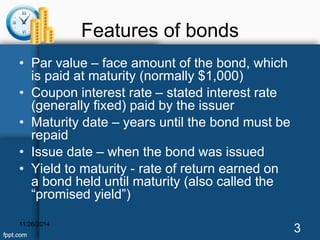
Features of bonds 
• Par value – face amount of the bond, which 
is paid at maturity (normally $1,000) 
• Coupon interest rate – stated interest rate 
(generally fixed) paid by the issuer 
• Maturity date – years until the bond must be 
repaid 
• Issue date – when the bond was issued 
• Yield to maturity - rate of return earned on 
a bond held until maturity (also called the 
“promised yield”) 
11/26/2014 3
Yield to maturity 
• The rate of return that an investor would earn if 
he bought the bond at its current market price 
and held it until maturity 
• Alternatively, it represents the discount rate 
which equates the discounted value of a bond's 
future cash flows to its current market price 
11/26/2014 4
Yield to call 
• The rate of return that an investor would earn if 
he bought a callable bond at its current market 
price and held it until the call date given that the 
bond was called on the call date 
11/26/2014 5
Types of bonds 
Treasury bonds and notes 
• A marketable government security with a 
fixed interest rate. Treasury notes 
maturities range up to 10 years, while 
treasury bonds maturities range from 10 to 
30 years. 
Corporate bonds 
• Like the government corporations borrow 
money by issuing bonds. 
11/26/2014 6
Contd…… 
Call Provisions on corporate bonds 
• Call provisions allows the issuer to 
repurchase the bond at a specified call price 
before the maturity date 
• For example: a company issues a bond with 
a high coupon rate when market interest are 
high , and when interest rate fall, the firm 
might like to retire the high coupon debt and 
issue new bonds at a lower coupon rate to 
reduce interest payments. This is called 
refunding. 
11/26/2014 7
Contd…… 
• Callable bonds typically come with a period of call protection. 
Such bonds are referred to as deferred callable bonds. 
Convertible bonds 
• Gives bondholders an option to exchange each bond for a 
specified number of shares of common stock of the firm 
Puttable bonds 
• Gives option to the bondholders to extend or retire the bond. 
• If the bonds coupon rate exceeds current market yields the 
bondholder will choose to extend 
• If the bonds coupon rate is too low it not extend instead reclaim 
principals and invest in current yields 
11/26/2014 8
Contd…… 
Floating rate bonds 
• Floating rate bonds make interest 
payments that are tiied to some measures 
of current market rates 
• For example the rate might be adjusted to 
the current T- bills rate plus 2% 
11/26/2014 9
Bond Pricing 
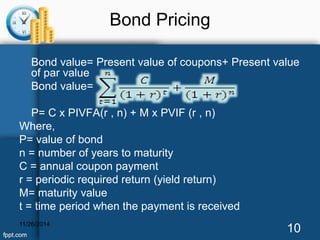
Bond value= Present value of coupons+ Present value 
of par value 
Bond value= 
P= C x PIVFA(r , n) + M x PVIF (r , n) 
Where, 
P= value of bond 
n = number of years to maturity 
C = annual coupon payment 
r = periodic required return (yield return) 
M= maturity value 
t = time period when the payment is received 
11/26/2014 10
Contd…… 
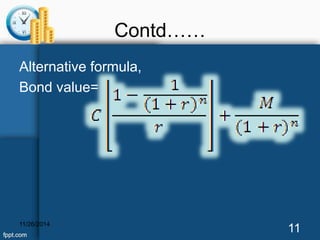
Alternative formula, 
Bond value= 
11/26/2014 11
Relationship Between Bond 
Prices and Yields 
Relationship Between Bond Prices and 
Yields 
• Bond prices are inversely related to interest rates 
(or yields) 
• A bond sells at par only if its coupon rate equals 
the required yield 
• A bond sells at a premium if its coupon rate is 
above the required yield 
• A bond sells at a discount if its coupon rate is 
below the required yield 
11/26/2014 12
Determinants of Bond safety 
• Coverage ratio 
Ratios of company earning to fixed costs, 
Example: times interest earned ratio 
Low or failing coverage ratio signals possible 
cash flow difficulties 
• Leverage ratio 
Example: Debt-to equity ratio 
Too high leverage ratio indicates excessive 
indebtedness, signals possible cash flow 
difficulties 
11/26/2014 13
Contd….. 
• Liquidity ratio 
Current ratio, quick ratio 
Indicates firms ability to pay bills coming due 
with most liquid assets 
• Profitability ratio 
Indicators of a firm’s financial health 
Examples: return on assets, return of equity 
• Cash flow to debt ratio 
Ratio of total cash flow to outstanding debt 
11/26/2014 14
Bond portfolio risk 
• Major risk: interest rate risk 
• Reinvestment Risk 
• Default Risk 
11/26/2014 15
Interest rate risk 
• a risk that arises for the bond owner from the 
fluctuation of interest rate 
• The sensitivity of risk depends on: 
The time to maturity 
Coupon rate 
• Others things remaining same, the longer the 
maturity of a bond, the higher will be its 
sensitivity to the interest rate changes 
• Similarly, the price of a bond with low coupon 
rate will be more sensitive to the interest rate 
changes 
11/26/2014 16
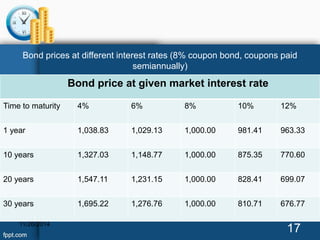
Bond prices at different interest rates (8% coupon bond, coupons paid 
semiannually) 
Bond price at given market interest rate 
Time to maturity 4% 6% 8% 10% 12% 
1 year 1,038.83 1,029.13 1,000.00 981.41 963.33 
10 years 1,327.03 1,148.77 1,000.00 875.35 770.60 
20 years 1,547.11 1,231.15 1,000.00 828.41 699.07 
30 years 1,695.22 1,276.76 1,000.00 810.71 676.77 
11/26/2014 17
Reinvestment risk 
• Risk that is concern that if r (interest rate) 
will fall, and future cash flows will have to 
be reinvested at lower rates, hence 
reducing income 
11/26/2014 18
Default risk 
• The possibility that a bond issuer will be 
unable to make interest or principal 
payments when they are due 
• If these payments are not made according 
to the agreements in the bond 
documentation, the issuer can default 
11/26/2014 19
Interest Rate Risk 
• As interest rates rise and fall, bondholders 
experience capital losses and gains which 
makes the fixed investment risky 
• Interest rate risk arises, as bond prices 
respond to interest rate fluctuations 
11/26/2014 20
Bond Pricing Relationships 
11/26/2014 21
Bond Pricing Relationships 
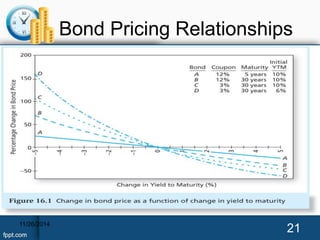
1. Bond prices and yields are inversely 
related 
2. An increase in a bond’s yield to maturity 
results in a smaller price change than a 
decrease of equal magnitude 
3. Long-term bonds tend to be more price 
sensitive than short-term bonds 
11/26/2014 22
Bond Pricing Relationships 
4. As maturity increases, price sensitivity increases 
at a decreasing rate 
5. Interest rate risk is inversely related to the bond’s 
coupon rate 
6. Price sensitivity is inversely related to the yield to 
maturity 
11/26/2014 23
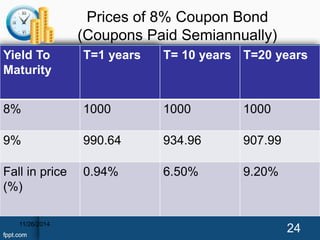
Prices of 8% Coupon Bond 
(Coupons Paid Semiannually) 
Yield To 
Maturity 
T=1 years T= 10 years T=20 years 
8% 1000 1000 1000 
9% 990.64 934.96 907.99 
Fall in price 
(%) 
0.94% 6.50% 9.20% 
11/26/2014 24
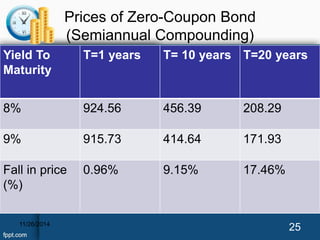
Prices of Zero-Coupon Bond 
(Semiannual Compounding) 
Yield To 
Maturity 
T=1 years T= 10 years T=20 years 
8% 924.56 456.39 208.29 
9% 915.73 414.64 171.93 
Fall in price 
(%) 
0.96% 9.15% 17.46% 
11/26/2014 25
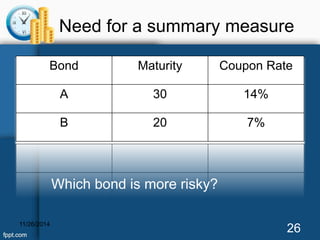
Need for a summary measure 
Bond Maturity Coupon Rate 
A 30 14% 
B 20 7% 
Which bond is more risky? 
11/26/2014 26
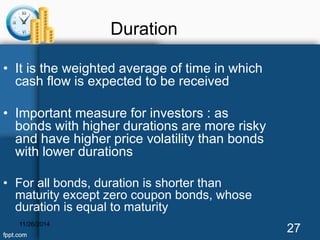
Duration 
• It is the weighted average of time in which 
cash flow is expected to be received 
• Important measure for investors : as 
bonds with higher durations are more risky 
and have higher price volatility than bonds 
with lower durations 
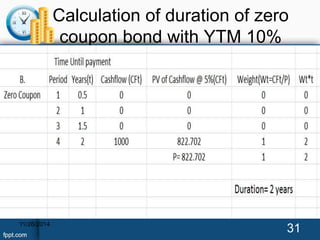
• For all bonds, duration is shorter than 
maturity except zero coupon bonds, whose 
duration is equal to maturity 
11/26/2014 27
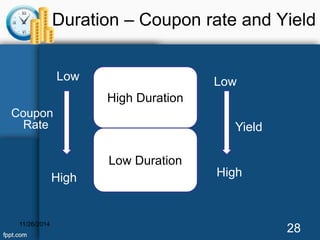
Duration – Coupon rate and Yield 
Coupon 
Rate 
Low Low 
High Duration 
Low Duration 
Yield 
High High 
11/26/2014 28
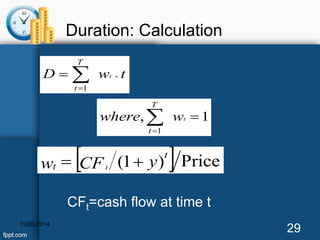
Duration: Calculation 
  
T 
  
D wt t 
where wt 
, 1 
 
1 
T 
t 
t 
 
1 
w  t CF (1  
y) t 
 Price 
t CFt=cash flow at time t 
11/26/2014 29
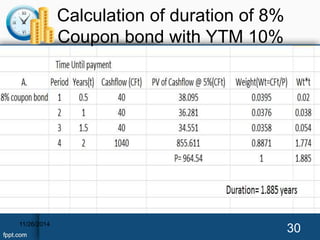
Calculation of duration of 8% 
Coupon bond with YTM 10% 
11/26/2014 30
Calculation of duration of zero 
coupon bond with YTM 10% 
11/26/2014 31
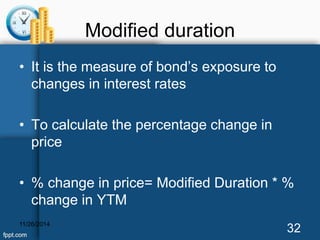
Modified duration 
• It is the measure of bond’s exposure to 
changes in interest rates 
• To calculate the percentage change in 
price 
• % change in price= Modified Duration * % 
change in YTM 
11/26/2014 32
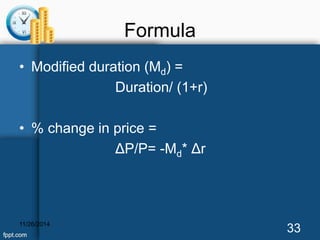
Formula 
• Modified duration (Md) = 
Duration/ (1+r) 
• % change in price = 
ΔP/P= -Md* Δr 
11/26/2014 33
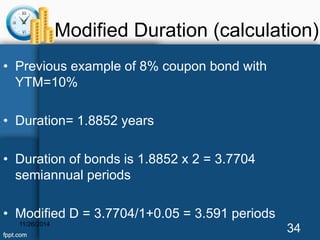
Modified Duration (calculation) 
• Previous example of 8% coupon bond with 
YTM=10% 
• Duration= 1.8852 years 
• Duration of bonds is 1.8852 x 2 = 3.7704 
semiannual periods 
• Modified D = 3.7704/1+0.05 = 3.591 periods 
11/26/2014 34
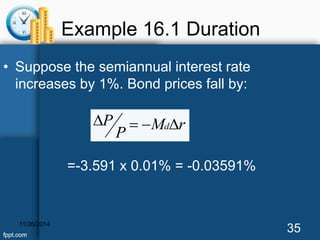
Example 16.1 Duration 
• Suppose the semiannual interest rate 
increases by 1%. Bond prices fall by: 
P    d 
M r 
P 
=-3.591 x 0.01% = -0.03591% 
11/26/2014 35
Rules for Duration 
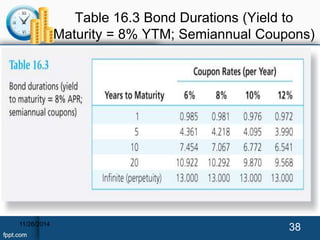
Rule 1 The duration of a zero-coupon bond equals 
its time to maturity 
Rule 2 Holding maturity constant, a bond’s duration 
is higher when the coupon rate is lower 
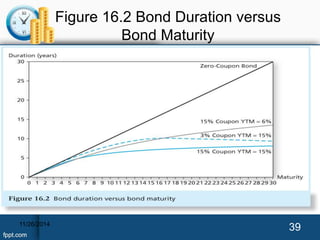
Rule 3 Holding the coupon rate constant, a bond’s 
duration generally increases with its time to 
maturity 
11/26/2014 36
Rules for Duration 
Rule 4 Holding other factors constant, 
the duration of a bond is higher when 
the bond’s yield to maturity is lower 
Rules 5 The duration of a level perpetuity 
is equal to: (1+y) / y 
11/26/2014 37
Table 16.3 Bond Durations (Yield to 
Maturity = 8% YTM; Semiannual Coupons) 
11/26/2014 38
Figure 16.2 Bond Duration versus 
Bond Maturity 
11/26/2014 39
Implications of duration 
• It allows bonds of different maturities and 
coupon rates to be directly compared 
• Construction of bond portfolio based on 
weighted average duration 
• Reduce interest rate risk by changing the 
overall value of duration i.e. by adding 
shorter maturities or higher coupon bonds 
11/26/2014 40
Limitation of duration 
• Duration assumes that relationship 
between change in interest rate and price 
is linear 
11/26/2014 41
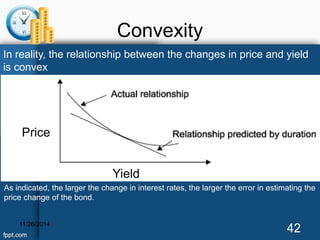
Convexity 
In reality, the relationship between the changes in price and yield 
is convex 
Price 
Yield 
As indicated, the larger the change in interest rates, the larger the error in estimating the 
price change of the bond. 
11/26/2014 42
Convexity contd.. 
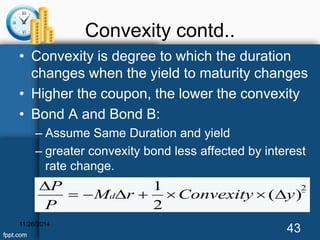
• Convexity is degree to which the duration 
changes when the yield to maturity changes 
• Higher the coupon, the lower the convexity 
• Bond A and Bond B: 
– Assume Same Duration and yield 
– greater convexity bond less affected by interest 
rate change. 
1 
M r Convexity y 
P 
11/26/2014 43 
 2 
( ) 
2 
P 
  d     

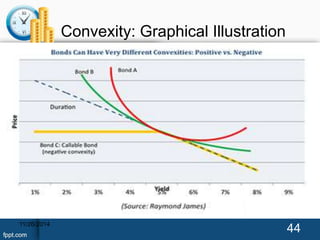
Convexity: Graphical Illustration 
11/26/2014 44
Conclusion 
• Duration and convexity allow investors to 
quantify the uncertainty of change in 
interest rate and are useful tools in the 
management of fixed-income portfolios 
11/26/2014 45
Bonds in Nepalese Context 
• Nepse has not seen transaction of any single bond unit since it 
began listing bonds 
• From fiscal year 2008-09 till 2011-12, NRB has issued Citizens 
Saving Bonds and Foreign Employment Bonds worth Rs 19.6 
billion -only Rs 2.75 million were subscribed (Source: Nepalsharemarket.com) 
• Mostly issued at par irrespective of the difference between 
market interest rate and bond coupon 
• Coupon rate fixed as per the trend or whatever institutions like 
• Corporates and the government bonds primarily absorbed by 
banks and financial institutions to maintain their Statutory 
Liquidity Ratio 
• Vast unawareness in the market 
11/26/2014 46
Examples: 
• Siddhartha Bank Limited Debenture 
– Coupon 8.5% issued in 2067 
– 7 years maturity 
• Nepal SBI Bank Ltd. Debenture 
– Coupon 7.9% issued in 2070 
– 10 years of maturity 
11/26/2014 47

Bond presentation

  • 1.
    Managing Bond Portfolio Presented By: Group 2 Abhisek Pokhrel, 13124 Srijana Shrestha, 13130 Annapurna Sthapit, 13134 11/26/2014 1
  • 2.
    What is bond? • A long- term debt instrument under which the issuer owes the holders a debt and depending on the terms of the bond, is obliged to pay them interest and/or to repay the principal at a later date, termed the maturity date • Bond are sometimes called fixed income securities 11/26/2014 2
  • 3.
    Features of bonds • Par value – face amount of the bond, which is paid at maturity (normally $1,000) • Coupon interest rate – stated interest rate (generally fixed) paid by the issuer • Maturity date – years until the bond must be repaid • Issue date – when the bond was issued • Yield to maturity - rate of return earned on a bond held until maturity (also called the “promised yield”) 11/26/2014 3
  • 4.
    Yield to maturity • The rate of return that an investor would earn if he bought the bond at its current market price and held it until maturity • Alternatively, it represents the discount rate which equates the discounted value of a bond's future cash flows to its current market price 11/26/2014 4
  • 5.
    Yield to call • The rate of return that an investor would earn if he bought a callable bond at its current market price and held it until the call date given that the bond was called on the call date 11/26/2014 5
  • 6.
    Types of bonds Treasury bonds and notes • A marketable government security with a fixed interest rate. Treasury notes maturities range up to 10 years, while treasury bonds maturities range from 10 to 30 years. Corporate bonds • Like the government corporations borrow money by issuing bonds. 11/26/2014 6
  • 7.
    Contd…… Call Provisionson corporate bonds • Call provisions allows the issuer to repurchase the bond at a specified call price before the maturity date • For example: a company issues a bond with a high coupon rate when market interest are high , and when interest rate fall, the firm might like to retire the high coupon debt and issue new bonds at a lower coupon rate to reduce interest payments. This is called refunding. 11/26/2014 7
  • 8.
    Contd…… • Callablebonds typically come with a period of call protection. Such bonds are referred to as deferred callable bonds. Convertible bonds • Gives bondholders an option to exchange each bond for a specified number of shares of common stock of the firm Puttable bonds • Gives option to the bondholders to extend or retire the bond. • If the bonds coupon rate exceeds current market yields the bondholder will choose to extend • If the bonds coupon rate is too low it not extend instead reclaim principals and invest in current yields 11/26/2014 8
  • 9.
    Contd…… Floating ratebonds • Floating rate bonds make interest payments that are tiied to some measures of current market rates • For example the rate might be adjusted to the current T- bills rate plus 2% 11/26/2014 9
  • 10.
    Bond Pricing Bondvalue= Present value of coupons+ Present value of par value Bond value= P= C x PIVFA(r , n) + M x PVIF (r , n) Where, P= value of bond n = number of years to maturity C = annual coupon payment r = periodic required return (yield return) M= maturity value t = time period when the payment is received 11/26/2014 10
  • 11.
    Contd…… Alternative formula, Bond value= 11/26/2014 11
  • 12.
    Relationship Between Bond Prices and Yields Relationship Between Bond Prices and Yields • Bond prices are inversely related to interest rates (or yields) • A bond sells at par only if its coupon rate equals the required yield • A bond sells at a premium if its coupon rate is above the required yield • A bond sells at a discount if its coupon rate is below the required yield 11/26/2014 12
  • 13.
    Determinants of Bondsafety • Coverage ratio Ratios of company earning to fixed costs, Example: times interest earned ratio Low or failing coverage ratio signals possible cash flow difficulties • Leverage ratio Example: Debt-to equity ratio Too high leverage ratio indicates excessive indebtedness, signals possible cash flow difficulties 11/26/2014 13
  • 14.
    Contd….. • Liquidityratio Current ratio, quick ratio Indicates firms ability to pay bills coming due with most liquid assets • Profitability ratio Indicators of a firm’s financial health Examples: return on assets, return of equity • Cash flow to debt ratio Ratio of total cash flow to outstanding debt 11/26/2014 14
  • 15.
    Bond portfolio risk • Major risk: interest rate risk • Reinvestment Risk • Default Risk 11/26/2014 15
  • 16.
    Interest rate risk • a risk that arises for the bond owner from the fluctuation of interest rate • The sensitivity of risk depends on: The time to maturity Coupon rate • Others things remaining same, the longer the maturity of a bond, the higher will be its sensitivity to the interest rate changes • Similarly, the price of a bond with low coupon rate will be more sensitive to the interest rate changes 11/26/2014 16
  • 17.
    Bond prices atdifferent interest rates (8% coupon bond, coupons paid semiannually) Bond price at given market interest rate Time to maturity 4% 6% 8% 10% 12% 1 year 1,038.83 1,029.13 1,000.00 981.41 963.33 10 years 1,327.03 1,148.77 1,000.00 875.35 770.60 20 years 1,547.11 1,231.15 1,000.00 828.41 699.07 30 years 1,695.22 1,276.76 1,000.00 810.71 676.77 11/26/2014 17
  • 18.
    Reinvestment risk •Risk that is concern that if r (interest rate) will fall, and future cash flows will have to be reinvested at lower rates, hence reducing income 11/26/2014 18
  • 19.
    Default risk •The possibility that a bond issuer will be unable to make interest or principal payments when they are due • If these payments are not made according to the agreements in the bond documentation, the issuer can default 11/26/2014 19
  • 20.
    Interest Rate Risk • As interest rates rise and fall, bondholders experience capital losses and gains which makes the fixed investment risky • Interest rate risk arises, as bond prices respond to interest rate fluctuations 11/26/2014 20
  • 21.
  • 22.
    Bond Pricing Relationships 1. Bond prices and yields are inversely related 2. An increase in a bond’s yield to maturity results in a smaller price change than a decrease of equal magnitude 3. Long-term bonds tend to be more price sensitive than short-term bonds 11/26/2014 22
  • 23.
    Bond Pricing Relationships 4. As maturity increases, price sensitivity increases at a decreasing rate 5. Interest rate risk is inversely related to the bond’s coupon rate 6. Price sensitivity is inversely related to the yield to maturity 11/26/2014 23
  • 24.
    Prices of 8%Coupon Bond (Coupons Paid Semiannually) Yield To Maturity T=1 years T= 10 years T=20 years 8% 1000 1000 1000 9% 990.64 934.96 907.99 Fall in price (%) 0.94% 6.50% 9.20% 11/26/2014 24
  • 25.
    Prices of Zero-CouponBond (Semiannual Compounding) Yield To Maturity T=1 years T= 10 years T=20 years 8% 924.56 456.39 208.29 9% 915.73 414.64 171.93 Fall in price (%) 0.96% 9.15% 17.46% 11/26/2014 25
  • 26.
    Need for asummary measure Bond Maturity Coupon Rate A 30 14% B 20 7% Which bond is more risky? 11/26/2014 26
  • 27.
    Duration • Itis the weighted average of time in which cash flow is expected to be received • Important measure for investors : as bonds with higher durations are more risky and have higher price volatility than bonds with lower durations • For all bonds, duration is shorter than maturity except zero coupon bonds, whose duration is equal to maturity 11/26/2014 27
  • 28.
    Duration – Couponrate and Yield Coupon Rate Low Low High Duration Low Duration Yield High High 11/26/2014 28
  • 29.
    Duration: Calculation  T   D wt t where wt , 1  1 T t t  1 w  t CF (1  y) t  Price t CFt=cash flow at time t 11/26/2014 29
  • 30.
    Calculation of durationof 8% Coupon bond with YTM 10% 11/26/2014 30
  • 31.
    Calculation of durationof zero coupon bond with YTM 10% 11/26/2014 31
  • 32.
    Modified duration •It is the measure of bond’s exposure to changes in interest rates • To calculate the percentage change in price • % change in price= Modified Duration * % change in YTM 11/26/2014 32
  • 33.
    Formula • Modifiedduration (Md) = Duration/ (1+r) • % change in price = ΔP/P= -Md* Δr 11/26/2014 33
  • 34.
    Modified Duration (calculation) • Previous example of 8% coupon bond with YTM=10% • Duration= 1.8852 years • Duration of bonds is 1.8852 x 2 = 3.7704 semiannual periods • Modified D = 3.7704/1+0.05 = 3.591 periods 11/26/2014 34
  • 35.
    Example 16.1 Duration • Suppose the semiannual interest rate increases by 1%. Bond prices fall by: P    d M r P =-3.591 x 0.01% = -0.03591% 11/26/2014 35
  • 36.
    Rules for Duration Rule 1 The duration of a zero-coupon bond equals its time to maturity Rule 2 Holding maturity constant, a bond’s duration is higher when the coupon rate is lower Rule 3 Holding the coupon rate constant, a bond’s duration generally increases with its time to maturity 11/26/2014 36
  • 37.
    Rules for Duration Rule 4 Holding other factors constant, the duration of a bond is higher when the bond’s yield to maturity is lower Rules 5 The duration of a level perpetuity is equal to: (1+y) / y 11/26/2014 37
  • 38.
    Table 16.3 BondDurations (Yield to Maturity = 8% YTM; Semiannual Coupons) 11/26/2014 38
  • 39.
    Figure 16.2 BondDuration versus Bond Maturity 11/26/2014 39
  • 40.
    Implications of duration • It allows bonds of different maturities and coupon rates to be directly compared • Construction of bond portfolio based on weighted average duration • Reduce interest rate risk by changing the overall value of duration i.e. by adding shorter maturities or higher coupon bonds 11/26/2014 40
  • 41.
    Limitation of duration • Duration assumes that relationship between change in interest rate and price is linear 11/26/2014 41
  • 42.
    Convexity In reality,the relationship between the changes in price and yield is convex Price Yield As indicated, the larger the change in interest rates, the larger the error in estimating the price change of the bond. 11/26/2014 42
  • 43.
    Convexity contd.. •Convexity is degree to which the duration changes when the yield to maturity changes • Higher the coupon, the lower the convexity • Bond A and Bond B: – Assume Same Duration and yield – greater convexity bond less affected by interest rate change. 1 M r Convexity y P 11/26/2014 43  2 ( ) 2 P   d     
  • 44.
  • 45.
    Conclusion • Durationand convexity allow investors to quantify the uncertainty of change in interest rate and are useful tools in the management of fixed-income portfolios 11/26/2014 45
  • 46.
    Bonds in NepaleseContext • Nepse has not seen transaction of any single bond unit since it began listing bonds • From fiscal year 2008-09 till 2011-12, NRB has issued Citizens Saving Bonds and Foreign Employment Bonds worth Rs 19.6 billion -only Rs 2.75 million were subscribed (Source: Nepalsharemarket.com) • Mostly issued at par irrespective of the difference between market interest rate and bond coupon • Coupon rate fixed as per the trend or whatever institutions like • Corporates and the government bonds primarily absorbed by banks and financial institutions to maintain their Statutory Liquidity Ratio • Vast unawareness in the market 11/26/2014 46
  • 47.
    Examples: • SiddharthaBank Limited Debenture – Coupon 8.5% issued in 2067 – 7 years maturity • Nepal SBI Bank Ltd. Debenture – Coupon 7.9% issued in 2070 – 10 years of maturity 11/26/2014 47