Types of Bonds Coupon bonds and zero coupon bonds Convertible and non-convertible bonds Infrastructure bonds RBI relief bonds Tax savings bonds Government bonds and corporate bonds Municipal bonds
Bond Characteristics A bond is described in terms of: Par value Coupon rate Liquidity Maturity date Callability Re-investment Risk
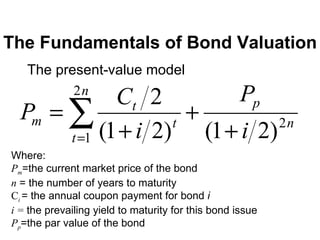
The Fundamentals of Bond Valuation The present-value model Where: P m =the current market price of the bond n  = the number of years to maturity C i   = the annual coupon payment for bond  i i =  the prevailing yield to maturity for this bond issue P p =the par value of the bond
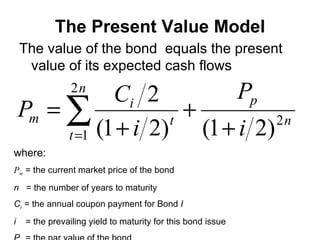
The Present Value Model The value of the bond  equals the present value of its expected cash flows where: P m  = the current market price of the bond n  = the number of years to maturity C i  = the annual coupon payment for Bond  I i  = the prevailing yield to maturity for this bond issue P p   = the par value of the bond
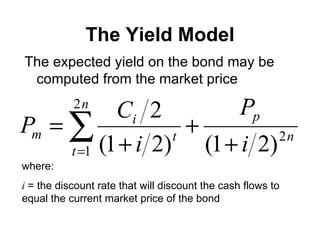
The Yield Model The expected yield on the bond may be computed from the market price where: i  = the discount rate that will discount the cash flows to equal the current market price of the bond
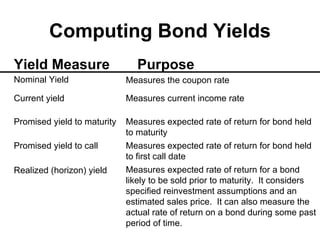
Computing Bond Yields Yield Measure   Purpose Nominal Yield Measures the coupon rate Current yield Measures current income rate Promised yield to maturity Measures expected rate of return for bond held to maturity Promised yield to call Measures expected rate of return for bond held to first call date Realized (horizon) yield Measures expected rate of return for a bond likely to be sold prior to maturity.  It considers specified reinvestment assumptions and an estimated sales price.  It can also measure the actual rate of return on a bond during some past period of time.
Nominal Yield Measures the coupon rate that a bond investor receives as a percent of the bond’s par value
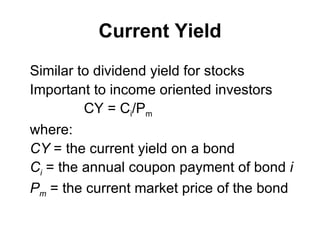
Current Yield Similar to dividend yield for stocks Important to income oriented investors CY = C i /P m   where:  CY  =  the current yield on a bond C i  =  the annual coupon payment of bond   i P m   =  the current market price of the bond
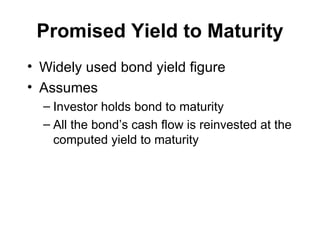
Promised Yield to Maturity Widely used bond yield figure Assumes Investor holds bond to maturity All the bond’s cash flow is reinvested at the computed yield to maturity
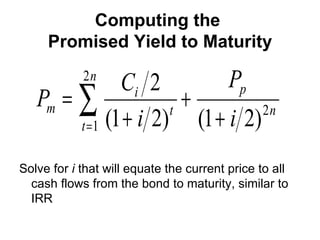
Computing the  Promised Yield to Maturity Solve for  i  that will equate the current price to all cash flows from the bond to maturity, similar to IRR
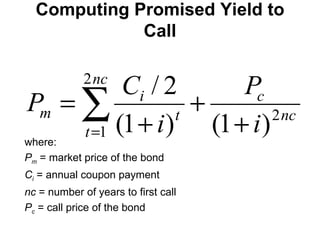
Computing Promised Yield to Call where: P m   = market price of the bond C i  = annual coupon payment nc  = number of years to first call P c  = call price of the bond
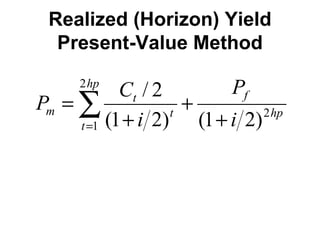
Realized (Horizon) Yield Present-Value Method
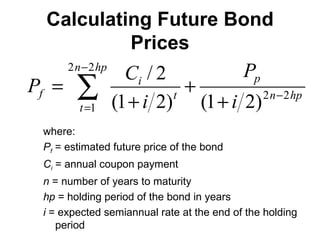
Calculating Future Bond Prices where: P f   = estimated future price of the bond C i  = annual coupon payment n  = number of years to maturity hp  = holding period of the bond in years i  = expected semiannual rate at the end of the holding period
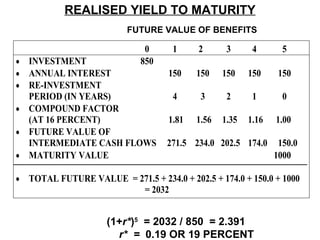
REALISED YIELD TO MATURITY FUTURE VALUE OF BENEFITS (1+ r* ) 5   = 2032 / 850  = 2.391   r*  =  0.19 OR 19 PERCENT
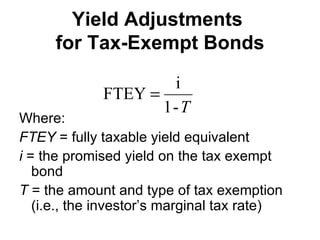
Yield Adjustments  for Tax-Exempt Bonds Where: FTEY  = fully taxable yield equivalent i  = the promised yield on the tax exempt bond T  = the amount and type of tax exemption (i.e., the investor’s marginal tax rate)
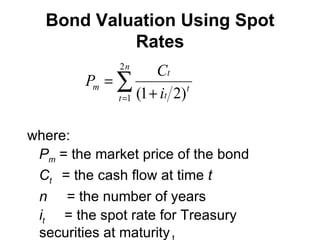
Bond Valuation Using Spot Rates where: P m   = the market price of the bond C t   = the cash flow at time  t n   = the number of years i t   = the spot rate for Treasury securities at maturity  t
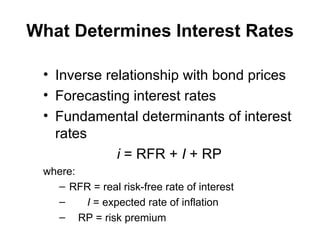
What Determines Interest Rates Inverse relationship with bond prices Forecasting interest rates Fundamental determinants of interest rates i  = RFR +  I  + RP  where: RFR = real risk-free rate of interest I  = expected rate of inflation RP = risk premium
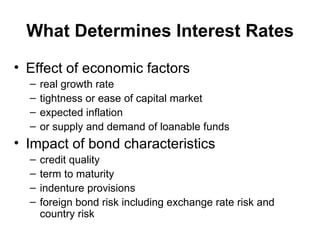
What Determines Interest Rates Effect of economic factors real growth rate tightness or ease of capital market expected inflation or supply and demand of loanable funds Impact of bond characteristics credit quality term to maturity indenture provisions foreign bond risk including exchange rate risk and country risk
Spot Rates and Forward Rates Creating the Theoretical Spot Rate Curve Calculating Forward Rates from the Spot Rate Curve
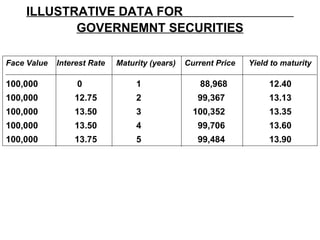
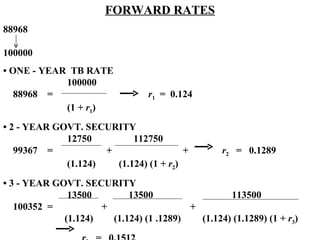
ILLUSTRATIVE DATA FOR  GOVERNEMNT SECURITIES Face Value  Interest Rate  Maturity (years)  Current Price  Yield to maturity 100,000   0  1  88,968   12.40 100,000   12.75  2   99,367   13.13 100,000   13.50  3   100,352   13.35 100,000   13.50  4   99,706   13.60 100,000   13.75  5   99,484   13.90  
FORWARD RATES 88968 100000 •  ONE - YEAR  TB RATE 100000   88968  =   r 1   =  0.124 (1 +  r 1 ) •  2 - YEAR GOVT. SECURITY 12750   112750   99367  =   +   +   r 2   =  0.1289   (1.124)   (1.124) (1 +  r 2 ) •  3 - YEAR GOVT. SECURITY 13500   13500   113500   100352  =  +   +    (1.124)   (1.124) (1 .1289)   (1.124) (1.1289) (1 +  r 3 )   r 3   =  0.1512
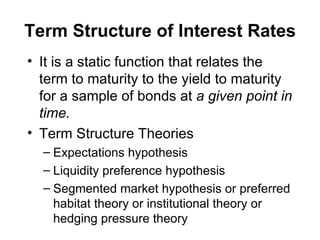
Term Structure of Interest Rates It is a static function that relates the term to maturity to the yield to maturity for a sample of bonds at  a given point in time. Term Structure Theories Expectations hypothesis Liquidity preference hypothesis Segmented market hypothesis or preferred habitat theory or institutional theory or hedging pressure theory
Expectations Hypothesis Any long-term interest rate simply represents the geometric mean of current and future one-year interest rates expected to prevail over the maturity of the issue
Liquidity Preference Theory Long-term securities should provide higher returns than short-term obligations because investors are willing to sacrifice some yields to invest in short-maturity obligations to avoid the higher price volatility of long-maturity bonds
Segmented-Market Hypothesis Different institutional investors have different maturity needs that lead them to confine their security selections to specific maturity segments
Trading Implications of the Term Structure Information on maturities can help you formulate yield expectations by simply observing the shape of the yield curve
Yield Spreads Segments: government bonds, agency bonds, and corporate bonds Sectors: prime-grade municipal bonds versus good-grade municipal bonds, AA utilities versus BBB utilities Coupons or seasoning within a segment or sector Maturities within a given market segment or sector
Yield Spreads Magnitudes and direction of yield spreads can change over time
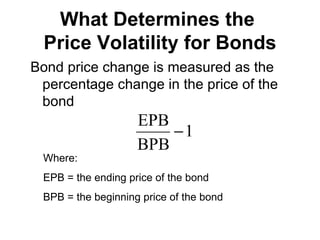
What Determines the  Price Volatility for Bonds Bond price change is measured as the percentage change in the price of the bond Where: EPB = the ending price of the bond BPB = the beginning price of the bond
What Determines the  Price Volatility for Bonds Four Factors 1. Par value 2. Coupon 3. Years to maturity 4. Prevailing market interest rate
What Determines the  Price Volatility for Bonds Five observed behaviors 1. Bond prices move inversely to bond yields (interest rates) 2. For a given change in yields, longer maturity bonds post larger price changes, thus bond price volatility is directly related to maturity 3. Price volatility increases at a diminishing rate as term to maturity increases 4. Higher coupon issues show smaller percentage price fluctuation for a given change in yield, thus bond price volatility is inversely related to coupon
What Determines the  Price Volatility for Bonds The maturity effect The coupon effect The yield level effect Some trading strategies
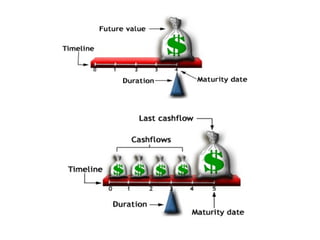
The Duration Measure Since price volatility of a bond varies inversely with its coupon and directly with its term to maturity, it is necessary to determine the best combination of these two variables to achieve your objective A composite measure considering both coupon and maturity would be beneficial Duration is defined as a bond’s price sensitivity to interest rate changes Higher the duration, greater is the sensitivity Number of years to recover the trust cost of a bond
The Duration Measure For instance, if the interest rate increases from 6% to 7%, the price of a bond with 5 years duration will move down by 5%, and that of 10 years duration by 10%....... so on. Variables that affect the duration are: Coupon Rate YTM Interest Rate changes
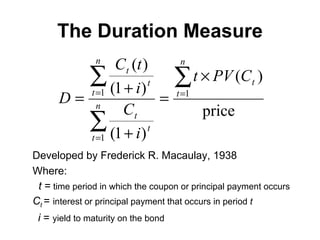
The Duration Measure Developed by Frederick R. Macaulay, 1938 Where: t  =  time period in which the coupon or principal payment occurs C t   =  interest or principal payment that occurs in period  t i  =  yield to maturity on the bond
 
Characteristics of Macaulay Duration Duration of a bond with coupons is always less than its term to maturity because duration gives weight to these interim payments A zero-coupon bond’s duration equals its maturity There is an inverse relationship between duration and coupon There is a positive relationship between term to maturity and duration, but duration increases at a decreasing rate with maturity There is an inverse relationship between YTM and duration
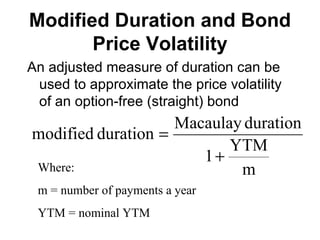
Modified Duration and Bond Price Volatility An adjusted measure of duration can be used to approximate the price volatility of an option-free (straight) bond Where: m = number of payments a year YTM = nominal YTM
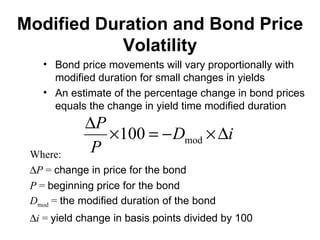
Modified Duration and Bond Price Volatility Bond price movements will vary proportionally with modified duration for small changes in yields An estimate of the percentage change in bond prices equals the change in yield time modified duration Where:  P  =  change in price for the bond P  =  beginning price for the bond D mod  =  the modified duration of the bond  i  =  yield change in basis points divided by 100

Bonds

  • 1.
    Types of BondsCoupon bonds and zero coupon bonds Convertible and non-convertible bonds Infrastructure bonds RBI relief bonds Tax savings bonds Government bonds and corporate bonds Municipal bonds
  • 2.
    Bond Characteristics Abond is described in terms of: Par value Coupon rate Liquidity Maturity date Callability Re-investment Risk
  • 3.
    The Fundamentals ofBond Valuation The present-value model Where: P m =the current market price of the bond n = the number of years to maturity C i = the annual coupon payment for bond i i = the prevailing yield to maturity for this bond issue P p =the par value of the bond
  • 4.
    The Present ValueModel The value of the bond equals the present value of its expected cash flows where: P m = the current market price of the bond n = the number of years to maturity C i = the annual coupon payment for Bond I i = the prevailing yield to maturity for this bond issue P p = the par value of the bond
  • 5.
    The Yield ModelThe expected yield on the bond may be computed from the market price where: i = the discount rate that will discount the cash flows to equal the current market price of the bond
  • 6.
    Computing Bond YieldsYield Measure Purpose Nominal Yield Measures the coupon rate Current yield Measures current income rate Promised yield to maturity Measures expected rate of return for bond held to maturity Promised yield to call Measures expected rate of return for bond held to first call date Realized (horizon) yield Measures expected rate of return for a bond likely to be sold prior to maturity. It considers specified reinvestment assumptions and an estimated sales price. It can also measure the actual rate of return on a bond during some past period of time.
  • 7.
    Nominal Yield Measuresthe coupon rate that a bond investor receives as a percent of the bond’s par value
  • 8.
    Current Yield Similarto dividend yield for stocks Important to income oriented investors CY = C i /P m where: CY = the current yield on a bond C i = the annual coupon payment of bond i P m = the current market price of the bond
  • 9.
    Promised Yield toMaturity Widely used bond yield figure Assumes Investor holds bond to maturity All the bond’s cash flow is reinvested at the computed yield to maturity
  • 10.
    Computing the Promised Yield to Maturity Solve for i that will equate the current price to all cash flows from the bond to maturity, similar to IRR
  • 11.
    Computing Promised Yieldto Call where: P m = market price of the bond C i = annual coupon payment nc = number of years to first call P c = call price of the bond
  • 12.
    Realized (Horizon) YieldPresent-Value Method
  • 13.
    Calculating Future BondPrices where: P f = estimated future price of the bond C i = annual coupon payment n = number of years to maturity hp = holding period of the bond in years i = expected semiannual rate at the end of the holding period
  • 14.
    REALISED YIELD TOMATURITY FUTURE VALUE OF BENEFITS (1+ r* ) 5 = 2032 / 850 = 2.391 r* = 0.19 OR 19 PERCENT
  • 15.
    Yield Adjustments for Tax-Exempt Bonds Where: FTEY = fully taxable yield equivalent i = the promised yield on the tax exempt bond T = the amount and type of tax exemption (i.e., the investor’s marginal tax rate)
  • 16.
    Bond Valuation UsingSpot Rates where: P m = the market price of the bond C t = the cash flow at time t n = the number of years i t = the spot rate for Treasury securities at maturity t
  • 17.
    What Determines InterestRates Inverse relationship with bond prices Forecasting interest rates Fundamental determinants of interest rates i = RFR + I + RP where: RFR = real risk-free rate of interest I = expected rate of inflation RP = risk premium
  • 18.
    What Determines InterestRates Effect of economic factors real growth rate tightness or ease of capital market expected inflation or supply and demand of loanable funds Impact of bond characteristics credit quality term to maturity indenture provisions foreign bond risk including exchange rate risk and country risk
  • 19.
    Spot Rates andForward Rates Creating the Theoretical Spot Rate Curve Calculating Forward Rates from the Spot Rate Curve
  • 20.
    ILLUSTRATIVE DATA FOR GOVERNEMNT SECURITIES Face Value Interest Rate Maturity (years) Current Price Yield to maturity 100,000 0 1 88,968 12.40 100,000 12.75 2 99,367 13.13 100,000 13.50 3 100,352 13.35 100,000 13.50 4 99,706 13.60 100,000 13.75 5 99,484 13.90  
  • 21.
    FORWARD RATES 88968100000 • ONE - YEAR TB RATE 100000 88968 = r 1 = 0.124 (1 + r 1 ) • 2 - YEAR GOVT. SECURITY 12750 112750 99367 = + + r 2 = 0.1289 (1.124) (1.124) (1 + r 2 ) • 3 - YEAR GOVT. SECURITY 13500 13500 113500 100352 = + + (1.124) (1.124) (1 .1289) (1.124) (1.1289) (1 + r 3 ) r 3 = 0.1512
  • 22.
    Term Structure ofInterest Rates It is a static function that relates the term to maturity to the yield to maturity for a sample of bonds at a given point in time. Term Structure Theories Expectations hypothesis Liquidity preference hypothesis Segmented market hypothesis or preferred habitat theory or institutional theory or hedging pressure theory
  • 23.
    Expectations Hypothesis Anylong-term interest rate simply represents the geometric mean of current and future one-year interest rates expected to prevail over the maturity of the issue
  • 24.
    Liquidity Preference TheoryLong-term securities should provide higher returns than short-term obligations because investors are willing to sacrifice some yields to invest in short-maturity obligations to avoid the higher price volatility of long-maturity bonds
  • 25.
    Segmented-Market Hypothesis Differentinstitutional investors have different maturity needs that lead them to confine their security selections to specific maturity segments
  • 26.
    Trading Implications ofthe Term Structure Information on maturities can help you formulate yield expectations by simply observing the shape of the yield curve
  • 27.
    Yield Spreads Segments:government bonds, agency bonds, and corporate bonds Sectors: prime-grade municipal bonds versus good-grade municipal bonds, AA utilities versus BBB utilities Coupons or seasoning within a segment or sector Maturities within a given market segment or sector
  • 28.
    Yield Spreads Magnitudesand direction of yield spreads can change over time
  • 29.
    What Determines the Price Volatility for Bonds Bond price change is measured as the percentage change in the price of the bond Where: EPB = the ending price of the bond BPB = the beginning price of the bond
  • 30.
    What Determines the Price Volatility for Bonds Four Factors 1. Par value 2. Coupon 3. Years to maturity 4. Prevailing market interest rate
  • 31.
    What Determines the Price Volatility for Bonds Five observed behaviors 1. Bond prices move inversely to bond yields (interest rates) 2. For a given change in yields, longer maturity bonds post larger price changes, thus bond price volatility is directly related to maturity 3. Price volatility increases at a diminishing rate as term to maturity increases 4. Higher coupon issues show smaller percentage price fluctuation for a given change in yield, thus bond price volatility is inversely related to coupon
  • 32.
    What Determines the Price Volatility for Bonds The maturity effect The coupon effect The yield level effect Some trading strategies
  • 33.
    The Duration MeasureSince price volatility of a bond varies inversely with its coupon and directly with its term to maturity, it is necessary to determine the best combination of these two variables to achieve your objective A composite measure considering both coupon and maturity would be beneficial Duration is defined as a bond’s price sensitivity to interest rate changes Higher the duration, greater is the sensitivity Number of years to recover the trust cost of a bond
  • 34.
    The Duration MeasureFor instance, if the interest rate increases from 6% to 7%, the price of a bond with 5 years duration will move down by 5%, and that of 10 years duration by 10%....... so on. Variables that affect the duration are: Coupon Rate YTM Interest Rate changes
  • 35.
    The Duration MeasureDeveloped by Frederick R. Macaulay, 1938 Where: t = time period in which the coupon or principal payment occurs C t = interest or principal payment that occurs in period t i = yield to maturity on the bond
  • 36.
  • 37.
    Characteristics of MacaulayDuration Duration of a bond with coupons is always less than its term to maturity because duration gives weight to these interim payments A zero-coupon bond’s duration equals its maturity There is an inverse relationship between duration and coupon There is a positive relationship between term to maturity and duration, but duration increases at a decreasing rate with maturity There is an inverse relationship between YTM and duration
  • 38.
    Modified Duration andBond Price Volatility An adjusted measure of duration can be used to approximate the price volatility of an option-free (straight) bond Where: m = number of payments a year YTM = nominal YTM
  • 39.
    Modified Duration andBond Price Volatility Bond price movements will vary proportionally with modified duration for small changes in yields An estimate of the percentage change in bond prices equals the change in yield time modified duration Where:  P = change in price for the bond P = beginning price for the bond D mod = the modified duration of the bond  i = yield change in basis points divided by 100