Bond 
 A bond is a contract that requires the borrower to pay an 
interest to the lender. 
 It is issued by the government or corporations. 
 The par value of the bond indicates the face value of the 
bond and the face value may be Rs. 1000, Rs.2000, Rs.5000 
and the like. 
 Most bonds offer fixed interest payments till the maturity. 
 The interest rates are known as the coupon rates and are 
paid quarterly, semiannually and annually.
Bond Risk 
 Interest Rate Risk : If the market interest rate moves up , 
the price of the bond declines and vice-versa. 
 Default Risk : The failure to pay the agreed value of the 
debt instrument by the issuer in full, on time or both. 
 Marketability Risk : Variations in return caused by 
difficulties in selling the bonds quickly without making a 
substantial price concession. 
 Callability Risk: The uncertainty in getting the return due 
to the issuers’ ability to call the bond at any time.
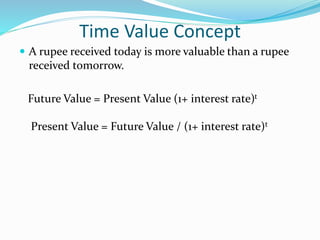
Time Value Concept 
 A rupee received today is more valuable than a rupee 
received tomorrow. 
Future Value = Present Value (1+ interest rate)t 
Present Value = Future Value / (1+ interest rate)t
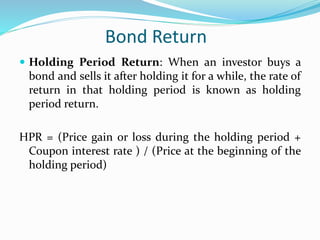
Bond Return 
 Holding Period Return: When an investor buys a 
bond and sells it after holding it for a while, the rate of 
return in that holding period is known as holding 
period return. 
HPR = (Price gain or loss during the holding period + 
Coupon interest rate ) / (Price at the beginning of the 
holding period)
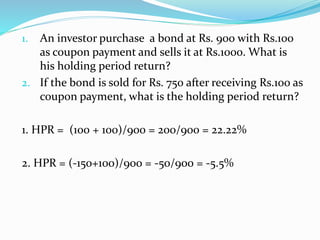
1. An investor purchase a bond at Rs. 900 with Rs.100 
as coupon payment and sells it at Rs.1000. What is 
his holding period return? 
2. If the bond is sold for Rs. 750 after receiving Rs.100 as 
coupon payment, what is the holding period return? 
1. HPR = (100 + 100)/900 = 200/900 = 22.22% 
2. HPR = (-150+100)/900 = -50/900 = -5.5%
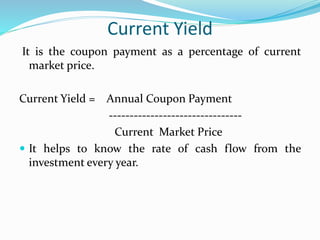
Current Yield 
It is the coupon payment as a percentage of current 
market price. 
Current Yield = Annual Coupon Payment 
-------------------------------- 
Current Market Price 
 It helps to know the rate of cash flow from the 
investment every year.
Yield To Maturity 
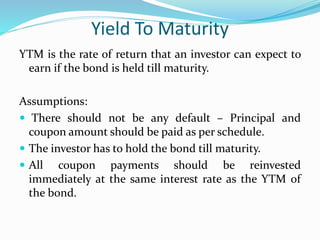
YTM is the rate of return that an investor can expect to 
earn if the bond is held till maturity. 
Assumptions: 
 There should not be any default – Principal and 
coupon amount should be paid as per schedule. 
 The investor has to hold the bond till maturity. 
 All coupon payments should be reinvested 
immediately at the same interest rate as the YTM of 
the bond.
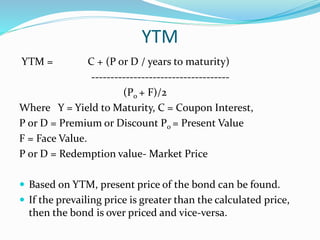
YTM 
YTM = C + (P or D / years to maturity) 
------------------------------------ 
(P0 + F)/2 
Where Y = Yield to Maturity, C = Coupon Interest, 
P or D = Premium or Discount P0 = Present Value 
F = Face Value. 
P or D = Redemption value- Market Price 
 Based on YTM, present price of the bond can be found. 
 If the prevailing price is greater than the calculated price, 
then the bond is over priced and vice-versa.
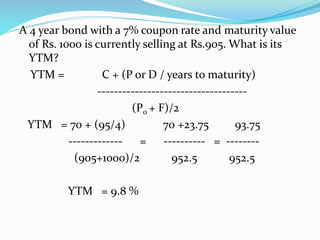
A 4 year bond with a 7% coupon rate and maturity value 
of Rs. 1000 is currently selling at Rs.905. What is its 
YTM? 
YTM = C + (P or D / years to maturity) 
------------------------------------ 
(P0 + F)/2 
YTM = 70 + (95/4) 70 +23.75 93.75 
------------- = ---------- = -------- 
(905+1000)/2 952.5 952.5 
YTM = 9.8 %
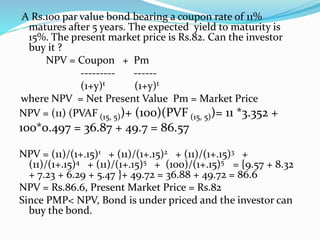
A Rs.100 par value bond bearing a coupon rate of 11% 
matures after 5 years. The expected yield to maturity is 
15%. The present market price is Rs.82. Can the investor 
buy it ? 
NPV = Coupon + Pm 
--------- ------ 
(1+y)t (1+y)t 
where NPV = Net Present Value Pm = Market Price 
NPV = (11) (PVAF (15, 5))+ (100)(PVF (15, 5))= 11 *3.352 + 
100*0.497 = 36.87 + 49.7 = 86.57 
NPV = (11)/(1+.15)1 + (11)/(1+.15)2 + (11)/(1+.15)3 + 
(11)/(1+.15)4 + (11)/(1+.15)5 + (100)/(1+.15)5 = {9.57 + 8.32 
+ 7.23 + 6.29 + 5.47 }+ 49.72 = 36.88 + 49.72 = 86.6 
NPV = Rs.86.6, Present Market Price = Rs.82 
Since PMP< NPV, Bond is under priced and the investor can 
buy the bond.
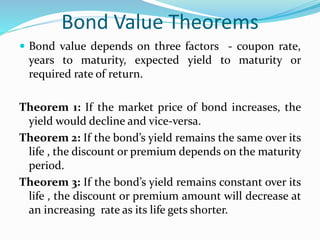
Bond Value Theorems 
 Bond value depends on three factors - coupon rate, 
years to maturity, expected yield to maturity or 
required rate of return. 
Theorem 1: If the market price of bond increases, the 
yield would decline and vice-versa. 
Theorem 2: If the bond’s yield remains the same over its 
life , the discount or premium depends on the maturity 
period. 
Theorem 3: If the bond’s yield remains constant over its 
life , the discount or premium amount will decrease at 
an increasing rate as its life gets shorter.
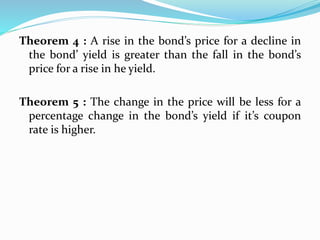
Theorem 4 : A rise in the bond’s price for a decline in 
the bond’ yield is greater than the fall in the bond’s 
price for a rise in he yield. 
Theorem 5 : The change in the price will be less for a 
percentage change in the bond’s yield if it’s coupon 
rate is higher.
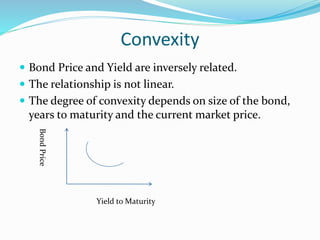
Convexity 
 Bond Price and Yield are inversely related. 
 The relationship is not linear. 
 The degree of convexity depends on size of the bond, 
years to maturity and the current market price. 
Yield to Maturity 
Bond Price
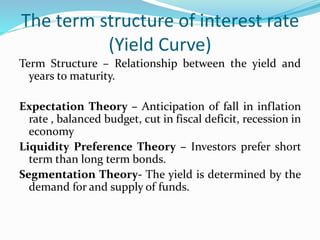
The term structure of interest rate 
(Yield Curve) 
Term Structure – Relationship between the yield and 
years to maturity. 
Expectation Theory – Anticipation of fall in inflation 
rate , balanced budget, cut in fiscal deficit, recession in 
economy 
Liquidity Preference Theory – Investors prefer short 
term than long term bonds. 
Segmentation Theory- The yield is determined by the 
demand for and supply of funds.
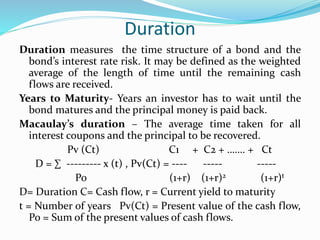
Duration 
Duration measures the time structure of a bond and the 
bond’s interest rate risk. It may be defined as the weighted 
average of the length of time until the remaining cash 
flows are received. 
Years to Maturity- Years an investor has to wait until the 
bond matures and the principal money is paid back. 
Macaulay’s duration – The average time taken for all 
interest coupons and the principal to be recovered. 
Pv (Ct) C1 + C2 + ……. + Ct 
D = Σ --------- x (t) , Pv(Ct) = ---- ----- ----- 
Po (1+r) (1+r)2 (1+r)t 
D= Duration C= Cash flow, r = Current yield to maturity 
t = Number of years Pv(Ct) = Present value of the cash flow, 
Po = Sum of the present values of cash flows.
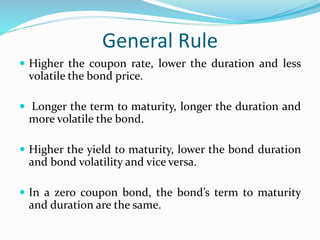
General Rule 
 Higher the coupon rate, lower the duration and less 
volatile the bond price. 
 Longer the term to maturity, longer the duration and 
more volatile the bond. 
 Higher the yield to maturity, lower the bond duration 
and bond volatility and vice versa. 
 In a zero coupon bond, the bond’s term to maturity 
and duration are the same.
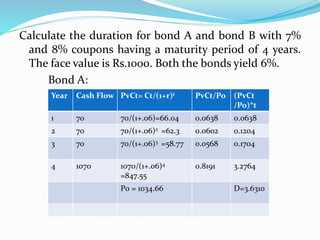
Calculate the duration for bond A and bond B with 7% 
and 8% coupons having a maturity period of 4 years. 
The face value is Rs.1000. Both the b0nds yield 6%. 
Bond A: 
Year Cash Flow PvCt= Ct/(1+r)t PvCt/Po (PvCt 
/Po)*t 
1 70 70/(1+.06)=66.04 0.0638 0.0638 
2 70 70/(1+.06)2 =62.3 0.0602 0.1204 
3 70 70/(1+.06)3 =58.77 0.0568 0.1704 
4 1070 1070/(1+.06)4 
=847.55 
0.8191 3.2764 
P0 = 1034.66 D=3.6310
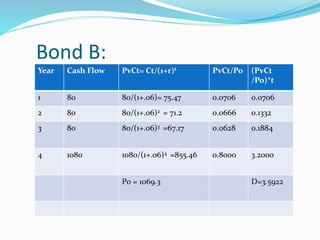
Bond B: 
Year Cash Flow PvCt= Ct/(1+r)t PvCt/Po (PvCt 
/Po)*t 
1 80 80/(1+.06)= 75.47 0.0706 0.0706 
2 80 80/(1+.06)2 = 71.2 0.0666 0.1332 
3 80 80/(1+.06)3 =67.17 0.0628 0.1884 
4 1080 1080/(1+.06)4 =855.46 0.8000 3.2000 
P0 = 1069.3 D=3.5922
 Modified Duration – It can be derived by making a 
small adjustments in Maculays’ duration. Modified 
duration is defined as Macaulay’s duration divided by 
(1+YTM). 
D* = D/ (1+YTM)

Security Analysis - Bond-Return_and_Valuation

  • 2.
    Bond  Abond is a contract that requires the borrower to pay an interest to the lender.  It is issued by the government or corporations.  The par value of the bond indicates the face value of the bond and the face value may be Rs. 1000, Rs.2000, Rs.5000 and the like.  Most bonds offer fixed interest payments till the maturity.  The interest rates are known as the coupon rates and are paid quarterly, semiannually and annually.
  • 3.
    Bond Risk Interest Rate Risk : If the market interest rate moves up , the price of the bond declines and vice-versa.  Default Risk : The failure to pay the agreed value of the debt instrument by the issuer in full, on time or both.  Marketability Risk : Variations in return caused by difficulties in selling the bonds quickly without making a substantial price concession.  Callability Risk: The uncertainty in getting the return due to the issuers’ ability to call the bond at any time.
  • 4.
    Time Value Concept  A rupee received today is more valuable than a rupee received tomorrow. Future Value = Present Value (1+ interest rate)t Present Value = Future Value / (1+ interest rate)t
  • 5.
    Bond Return Holding Period Return: When an investor buys a bond and sells it after holding it for a while, the rate of return in that holding period is known as holding period return. HPR = (Price gain or loss during the holding period + Coupon interest rate ) / (Price at the beginning of the holding period)
  • 6.
    1. An investorpurchase a bond at Rs. 900 with Rs.100 as coupon payment and sells it at Rs.1000. What is his holding period return? 2. If the bond is sold for Rs. 750 after receiving Rs.100 as coupon payment, what is the holding period return? 1. HPR = (100 + 100)/900 = 200/900 = 22.22% 2. HPR = (-150+100)/900 = -50/900 = -5.5%
  • 7.
    Current Yield Itis the coupon payment as a percentage of current market price. Current Yield = Annual Coupon Payment -------------------------------- Current Market Price  It helps to know the rate of cash flow from the investment every year.
  • 8.
    Yield To Maturity YTM is the rate of return that an investor can expect to earn if the bond is held till maturity. Assumptions:  There should not be any default – Principal and coupon amount should be paid as per schedule.  The investor has to hold the bond till maturity.  All coupon payments should be reinvested immediately at the same interest rate as the YTM of the bond.
  • 9.
    YTM YTM =C + (P or D / years to maturity) ------------------------------------ (P0 + F)/2 Where Y = Yield to Maturity, C = Coupon Interest, P or D = Premium or Discount P0 = Present Value F = Face Value. P or D = Redemption value- Market Price  Based on YTM, present price of the bond can be found.  If the prevailing price is greater than the calculated price, then the bond is over priced and vice-versa.
  • 10.
    A 4 yearbond with a 7% coupon rate and maturity value of Rs. 1000 is currently selling at Rs.905. What is its YTM? YTM = C + (P or D / years to maturity) ------------------------------------ (P0 + F)/2 YTM = 70 + (95/4) 70 +23.75 93.75 ------------- = ---------- = -------- (905+1000)/2 952.5 952.5 YTM = 9.8 %
  • 11.
    A Rs.100 parvalue bond bearing a coupon rate of 11% matures after 5 years. The expected yield to maturity is 15%. The present market price is Rs.82. Can the investor buy it ? NPV = Coupon + Pm --------- ------ (1+y)t (1+y)t where NPV = Net Present Value Pm = Market Price NPV = (11) (PVAF (15, 5))+ (100)(PVF (15, 5))= 11 *3.352 + 100*0.497 = 36.87 + 49.7 = 86.57 NPV = (11)/(1+.15)1 + (11)/(1+.15)2 + (11)/(1+.15)3 + (11)/(1+.15)4 + (11)/(1+.15)5 + (100)/(1+.15)5 = {9.57 + 8.32 + 7.23 + 6.29 + 5.47 }+ 49.72 = 36.88 + 49.72 = 86.6 NPV = Rs.86.6, Present Market Price = Rs.82 Since PMP< NPV, Bond is under priced and the investor can buy the bond.
  • 12.
    Bond Value Theorems  Bond value depends on three factors - coupon rate, years to maturity, expected yield to maturity or required rate of return. Theorem 1: If the market price of bond increases, the yield would decline and vice-versa. Theorem 2: If the bond’s yield remains the same over its life , the discount or premium depends on the maturity period. Theorem 3: If the bond’s yield remains constant over its life , the discount or premium amount will decrease at an increasing rate as its life gets shorter.
  • 13.
    Theorem 4 :A rise in the bond’s price for a decline in the bond’ yield is greater than the fall in the bond’s price for a rise in he yield. Theorem 5 : The change in the price will be less for a percentage change in the bond’s yield if it’s coupon rate is higher.
  • 14.
    Convexity  BondPrice and Yield are inversely related.  The relationship is not linear.  The degree of convexity depends on size of the bond, years to maturity and the current market price. Yield to Maturity Bond Price
  • 15.
    The term structureof interest rate (Yield Curve) Term Structure – Relationship between the yield and years to maturity. Expectation Theory – Anticipation of fall in inflation rate , balanced budget, cut in fiscal deficit, recession in economy Liquidity Preference Theory – Investors prefer short term than long term bonds. Segmentation Theory- The yield is determined by the demand for and supply of funds.
  • 16.
    Duration Duration measuresthe time structure of a bond and the bond’s interest rate risk. It may be defined as the weighted average of the length of time until the remaining cash flows are received. Years to Maturity- Years an investor has to wait until the bond matures and the principal money is paid back. Macaulay’s duration – The average time taken for all interest coupons and the principal to be recovered. Pv (Ct) C1 + C2 + ……. + Ct D = Σ --------- x (t) , Pv(Ct) = ---- ----- ----- Po (1+r) (1+r)2 (1+r)t D= Duration C= Cash flow, r = Current yield to maturity t = Number of years Pv(Ct) = Present value of the cash flow, Po = Sum of the present values of cash flows.
  • 17.
    General Rule Higher the coupon rate, lower the duration and less volatile the bond price.  Longer the term to maturity, longer the duration and more volatile the bond.  Higher the yield to maturity, lower the bond duration and bond volatility and vice versa.  In a zero coupon bond, the bond’s term to maturity and duration are the same.
  • 18.
    Calculate the durationfor bond A and bond B with 7% and 8% coupons having a maturity period of 4 years. The face value is Rs.1000. Both the b0nds yield 6%. Bond A: Year Cash Flow PvCt= Ct/(1+r)t PvCt/Po (PvCt /Po)*t 1 70 70/(1+.06)=66.04 0.0638 0.0638 2 70 70/(1+.06)2 =62.3 0.0602 0.1204 3 70 70/(1+.06)3 =58.77 0.0568 0.1704 4 1070 1070/(1+.06)4 =847.55 0.8191 3.2764 P0 = 1034.66 D=3.6310
  • 19.
    Bond B: YearCash Flow PvCt= Ct/(1+r)t PvCt/Po (PvCt /Po)*t 1 80 80/(1+.06)= 75.47 0.0706 0.0706 2 80 80/(1+.06)2 = 71.2 0.0666 0.1332 3 80 80/(1+.06)3 =67.17 0.0628 0.1884 4 1080 1080/(1+.06)4 =855.46 0.8000 3.2000 P0 = 1069.3 D=3.5922
  • 20.
     Modified Duration– It can be derived by making a small adjustments in Maculays’ duration. Modified duration is defined as Macaulay’s duration divided by (1+YTM). D* = D/ (1+YTM)