HAL, ACCESSORIES DIVISION, LUCKNOW 
SUMMER TRAINING REPORT 
on 
SUKHOI SU-30 MKI-FUEL SYSTEM 
MADE BY: 
ANKIT PRATAP SINGH 
(Roll no-1112240029) 
SRMCEM LUCKNOW 
(ME- 4th YEAR)
ABOUT HAL 
HAL came into existence on 1st October 1964. 
The Company was formed by the merger of Hindustan Aircraft 
Limited with Aeronautics India Limited and Aircraft 
Manufacturing Depot, Kanpur. The Company traces its roots 
to the pioneering efforts of an industrialist with extraordinary 
vision, the late Seth Walchand Hirachand, who set up 
Hindustan Aircraft Limited at Bangalore in association with 
the erstwhile princely State of Mysore in December1940.
The Government of India became a share holder in 
March 1941 and took over the Management in 1942. 
During the 1980s, HAL's operations saw a rapid 
increase which resulted in the development of new 
indigenous aircraft such as HAL Tejas and HAL 
Dhruv. HAL also developed an advanced version of 
the MiG-21, known as MiG-21 Bison, which 
increased its life-span by more than 20 years.
HAL has also obtained several multi-million dollar 
contracts from leading international aerospace firms such 
as Airbus, Boeing and Honeywell to manufacture aircraft 
spare parts and engiene.
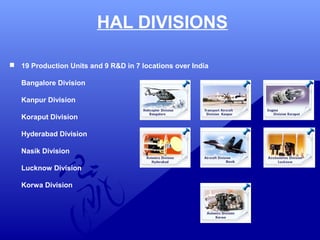
 19 Production Units and 9 R&D in 7 locations over India 
Bangalore Division 
Kanpur Division 
Koraput Division 
Hyderabad Division 
Nasik Division 
Lucknow Division 
Korwa Division 
HAL DIVISIONS
HAL SERVICES
ABOUT HAL,ACCESSORIES 
DIVISION LUCKNOW 
• Established in 1964. 
• Primary Objective - To manufacture systems and accessories 
for various aircrafts and engines and attain self sufficiency in 
this area. 
• Spread over an area of 94,000 sq m. 
• Division Manufactures – Accessories for Aircrafts like Avro, 
Dornier, Cheetah, Cheatak & Advanced Light Helicopters(ALH) 
& SU-30.
DIVISIONS OF HAL LUCKNOW 
LCA Division 
ALH Division 
Sukhoi Division 
Instrument Factory 
Accessories Division
SUKHOI SU-30 MKI 
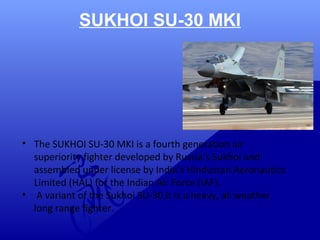
• The SUKHOI SU-30 MKI is a fourth generation air 
superiority fighter developed by Russia’s Sukhoi and 
assembled under license by India’s Hindustan Aeronautics 
Limited (HAL) for the Indian Air Force (IAF). 
• A variant of the Sukhoi SU-30,it is a heavy, all weather, 
long range fighter.
SPECIFICATIONS 
Crew: 2 
Length: 21.935 m 
Wingspan : 14.7 m 
Height: 6.36 m 
Wing area: 62.0 m² 
Empty weight: 17,700 kg 
Loaded weight: 24,900 kg 
Max takeoff weight: 38,800 kg 
Maximum speed: Mach 2.35(2,500 km/h) at 
11,000m. 
Range: 5,000 km with internal fuel tank.
FUEL SYSTEMS 
Purpose of an aircraft fuel system is: 
1. To store & deliver the proper amount of clean fuel at 
the correct pressure to the engine 
2. Fuel systems should provide positive and reliable 
fuel flow through all phases of flight such as 
o Changes in altitude 
o Violent maneuvers 
o Sudden acceleration and deceleration 
3. Fuel systems should also continuously monitor 
system operation such as: Fuel pressure , fuel 
flow warning signals , tank quantity.
FUEL TANKS 
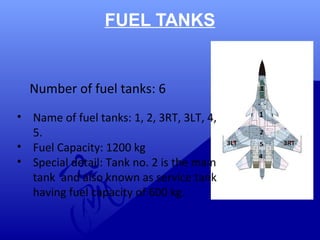
Number of fuel tanks: 6 
• Name of fuel tanks: 1, 2, 3RT, 3LT, 4, 
5. 
• Fuel Capacity: 1200 kg 
• Special detail: Tank no. 2 is the main 
tank and also known as service tank 
having fuel capacity of 600 kg. 
1
FUEL FLOW & METERING 
SYSTEM: STR7-51 
This system measures fuel quantity available in aircraft. 
This system performs following major function: 
Fuel flow metering: - This part computes total quantity of fuel 
available in aircraft & transmits to various airborne systems for display 
& recording. 
Fuel quantity gauging : - This part exclusively computes quantity of 
fuel available in service tank & transmits to various airborne systems 
for display & warning. 
Automatic control: - This part manages sequence of fuel flow to/from 
various tanks during refueling as well as during consumption.
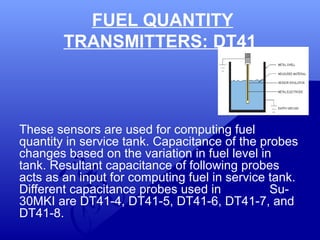
FUEL QUANTITY 
TRANSMITTERS: DT41 
These sensors are used for computing fuel 
quantity in service tank. Capacitance of the probes 
changes based on the variation in fuel level in 
tank. Resultant capacitance of following probes 
acts as an input for computing fuel in service tank. 
Different capacitance probes used in Su- 
30MKI are DT41-4, DT41-5, DT41-6, DT41-7, and 
DT41-8.
FUEL FLOW TRANSMITTERS: 
DRT2-2A 
These are impeller types of sensors which 
produces signal proportional to the rate of flow of 
fuel through it. 
Fuel consumed by aircraft is computed based on 
the signals provided by these sensors.
FUEL QUANTITY UNIT: BT3-4 
This instrument computes quantity of fuel in service tank 
based on signals from sensors which are fuel probes 
(DT41). It delivers computed information to following 
instruments: 
Digital light indicator(ITSS7-1) 
Refueling Control Panel(PKUZ&-2) 
Stand by Equipment(SBI) 
Complex Information Signaling System(KISS) 
It gives warning signal to pilot for residual fuel of 150 kg in main 
tank.
FUELING CONTROL PANEL: 
PKUZ7-2 
This instrument is a display device & is used on 
ground during refueling. It performs following 
functions: 
To display total fuel quantity 
To display fuel quantity of service tank 
To display actual fuel density
ELECTRONIC TRANSDUCER 
UNIT:BEP51-1 
This unit is main processing part of 
automatic control portion of STR7-51 
system. 
It manages fuel flow based on signals from 
sensors, magnetic operated level switches 
(DSMKs) fitted in various tanks. 
It also senses total residual fuel quantity & 
transmits the warning signal to pilot.
SEMICONDUCTOR RELAY 
CONTROL UNIT: BUPR21-1 
This is a part of automatic control portion of 
STR7-51 system. 
This instrument works as an amplifier & a 
switching device for the signals required for 
opening & closing of valve of various tanks 
of aircraft.
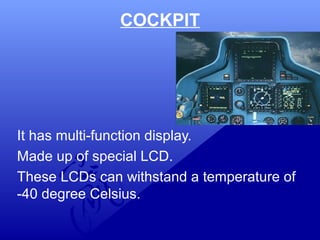
COCKPIT 
It has multi-function display. 
Made up of special LCD. 
These LCDs can withstand a temperature of 
-40 degree Celsius.
• It can absorb repeated violent impacts of landing 
on aircraft carriers. 
• The display is easily readable even in bright 
sunlight & dims enough for the pilot to read at 
night without losing night vision.
THANK YOU !!

hal

  • 1.
    HAL, ACCESSORIES DIVISION,LUCKNOW SUMMER TRAINING REPORT on SUKHOI SU-30 MKI-FUEL SYSTEM MADE BY: ANKIT PRATAP SINGH (Roll no-1112240029) SRMCEM LUCKNOW (ME- 4th YEAR)
  • 2.
    ABOUT HAL HALcame into existence on 1st October 1964. The Company was formed by the merger of Hindustan Aircraft Limited with Aeronautics India Limited and Aircraft Manufacturing Depot, Kanpur. The Company traces its roots to the pioneering efforts of an industrialist with extraordinary vision, the late Seth Walchand Hirachand, who set up Hindustan Aircraft Limited at Bangalore in association with the erstwhile princely State of Mysore in December1940.
  • 3.
    The Government ofIndia became a share holder in March 1941 and took over the Management in 1942. During the 1980s, HAL's operations saw a rapid increase which resulted in the development of new indigenous aircraft such as HAL Tejas and HAL Dhruv. HAL also developed an advanced version of the MiG-21, known as MiG-21 Bison, which increased its life-span by more than 20 years.
  • 4.
    HAL has alsoobtained several multi-million dollar contracts from leading international aerospace firms such as Airbus, Boeing and Honeywell to manufacture aircraft spare parts and engiene.
  • 5.
     19 ProductionUnits and 9 R&D in 7 locations over India Bangalore Division Kanpur Division Koraput Division Hyderabad Division Nasik Division Lucknow Division Korwa Division HAL DIVISIONS
  • 6.
  • 7.
    ABOUT HAL,ACCESSORIES DIVISIONLUCKNOW • Established in 1964. • Primary Objective - To manufacture systems and accessories for various aircrafts and engines and attain self sufficiency in this area. • Spread over an area of 94,000 sq m. • Division Manufactures – Accessories for Aircrafts like Avro, Dornier, Cheetah, Cheatak & Advanced Light Helicopters(ALH) & SU-30.
  • 8.
    DIVISIONS OF HALLUCKNOW LCA Division ALH Division Sukhoi Division Instrument Factory Accessories Division
  • 9.
    SUKHOI SU-30 MKI • The SUKHOI SU-30 MKI is a fourth generation air superiority fighter developed by Russia’s Sukhoi and assembled under license by India’s Hindustan Aeronautics Limited (HAL) for the Indian Air Force (IAF). • A variant of the Sukhoi SU-30,it is a heavy, all weather, long range fighter.
  • 10.
    SPECIFICATIONS Crew: 2 Length: 21.935 m Wingspan : 14.7 m Height: 6.36 m Wing area: 62.0 m² Empty weight: 17,700 kg Loaded weight: 24,900 kg Max takeoff weight: 38,800 kg Maximum speed: Mach 2.35(2,500 km/h) at 11,000m. Range: 5,000 km with internal fuel tank.
  • 11.
    FUEL SYSTEMS Purposeof an aircraft fuel system is: 1. To store & deliver the proper amount of clean fuel at the correct pressure to the engine 2. Fuel systems should provide positive and reliable fuel flow through all phases of flight such as o Changes in altitude o Violent maneuvers o Sudden acceleration and deceleration 3. Fuel systems should also continuously monitor system operation such as: Fuel pressure , fuel flow warning signals , tank quantity.
  • 12.
    FUEL TANKS Numberof fuel tanks: 6 • Name of fuel tanks: 1, 2, 3RT, 3LT, 4, 5. • Fuel Capacity: 1200 kg • Special detail: Tank no. 2 is the main tank and also known as service tank having fuel capacity of 600 kg. 1
  • 13.
    FUEL FLOW &METERING SYSTEM: STR7-51 This system measures fuel quantity available in aircraft. This system performs following major function: Fuel flow metering: - This part computes total quantity of fuel available in aircraft & transmits to various airborne systems for display & recording. Fuel quantity gauging : - This part exclusively computes quantity of fuel available in service tank & transmits to various airborne systems for display & warning. Automatic control: - This part manages sequence of fuel flow to/from various tanks during refueling as well as during consumption.
  • 14.
    FUEL QUANTITY TRANSMITTERS:DT41 These sensors are used for computing fuel quantity in service tank. Capacitance of the probes changes based on the variation in fuel level in tank. Resultant capacitance of following probes acts as an input for computing fuel in service tank. Different capacitance probes used in Su- 30MKI are DT41-4, DT41-5, DT41-6, DT41-7, and DT41-8.
  • 15.
    FUEL FLOW TRANSMITTERS: DRT2-2A These are impeller types of sensors which produces signal proportional to the rate of flow of fuel through it. Fuel consumed by aircraft is computed based on the signals provided by these sensors.
  • 16.
    FUEL QUANTITY UNIT:BT3-4 This instrument computes quantity of fuel in service tank based on signals from sensors which are fuel probes (DT41). It delivers computed information to following instruments: Digital light indicator(ITSS7-1) Refueling Control Panel(PKUZ&-2) Stand by Equipment(SBI) Complex Information Signaling System(KISS) It gives warning signal to pilot for residual fuel of 150 kg in main tank.
  • 17.
    FUELING CONTROL PANEL: PKUZ7-2 This instrument is a display device & is used on ground during refueling. It performs following functions: To display total fuel quantity To display fuel quantity of service tank To display actual fuel density
  • 18.
    ELECTRONIC TRANSDUCER UNIT:BEP51-1 This unit is main processing part of automatic control portion of STR7-51 system. It manages fuel flow based on signals from sensors, magnetic operated level switches (DSMKs) fitted in various tanks. It also senses total residual fuel quantity & transmits the warning signal to pilot.
  • 19.
    SEMICONDUCTOR RELAY CONTROLUNIT: BUPR21-1 This is a part of automatic control portion of STR7-51 system. This instrument works as an amplifier & a switching device for the signals required for opening & closing of valve of various tanks of aircraft.
  • 20.
    COCKPIT It hasmulti-function display. Made up of special LCD. These LCDs can withstand a temperature of -40 degree Celsius.
  • 21.
    • It canabsorb repeated violent impacts of landing on aircraft carriers. • The display is easily readable even in bright sunlight & dims enough for the pilot to read at night without losing night vision.
  • 22.