SUBMITTED TO:-
Mr. Ashish Mishra
DEPTT. OF MECH.
ENGG.
SUBMITTED BY:-
Shubhankar Shukla
1516140191
B.TECH. (ME) IV yr.
CONTENTS :
• INTRODUCTION
• TRAIN MAINTENANCE
• TYPES OF COACHES
• POWER SOURCE
• DECODING OF ENGINE
HISTORY OF INDIAN RAILWAYS
• The first railway proposal for India were made
in madras in 1832.
• India’s first passenger train hauled by three
steam locomotives( Sahib, Sindh, Sultan).
• It ran for 34 km with 400 people in 14 carriage
on broad gauge between Mumbai to Thane.
TRAIN MAINTENANCE
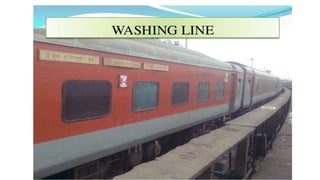
Washing line :-
after every 2500 km
Sick line :-
Schedule “A” maintenance- 1 month
Schedule “B” maintenance- 3 months
IOH- 9 months or 2,00,000 km
POH- 18 months or 4,00,000 km
Platform Train Duty:-
on starting & ending stations
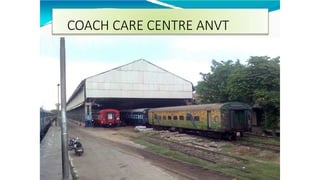
COACH CARE CENTRE ANVT
WORKS CARRIED IN WASHING LINE
Inspection
Cleaning& washing
Brake testing
Primary Maintenance
Secondary Maintenance
Pantry car provisions
Watering
Loading of linen
maintenance of AC & electrical circuits of coaches
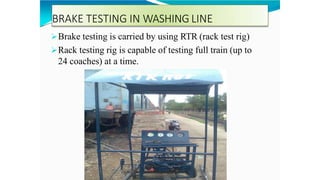
BRAKE TESTING IN WASHING LINE
Brake testing is carried by using RTR (rack test rig)
Rack testing rig is capable of testing full train (up to
24 coaches) at a time.
PRIMARY MAINTENANCE
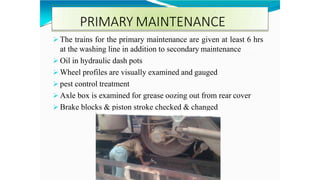
 The trains for the primary maintenance are given at least 6 hrs
at the washing line in addition to secondary maintenance
 Oil in hydraulic dash pots
 Wheel profiles are visually examined and gauged
 pest control treatment
 Axle box is examined for grease oozing out from rear cover
 Brake blocks & piston stroke checked & changed
SECONDARY MAINTENANCE
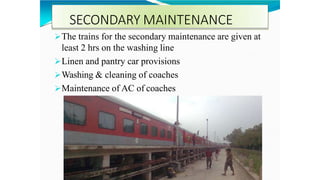
The trains for the secondary maintenance are given at
least 2 hrs on the washing line
Linen and pantry car provisions
Washing & cleaning of coaches
Maintenance of AC of coaches
SICK LINE
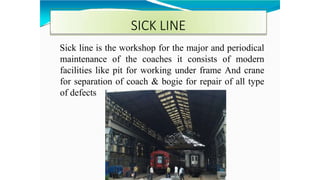
Sick line is the workshop for the major and periodical
maintenance of the coaches it consists of modern
facilities like pit for working under frame And crane
for separation of coach & bogie for repair of all type
of defects
COACH MAINTENANCE
In coach maintenance generally these work being done
1. testing/maintenance of air conditioner.
2. Maintenance of other electrical circuits like fan light
etc.
3. Buffer maintenance.
4. Brake testing by S.C.T.R. (single coach test ring)
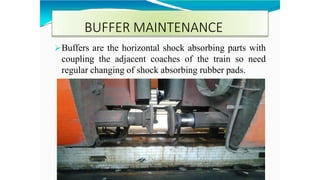
BUFFER MAINTENANCE
Buffers are the horizontal shock absorbing parts with
coupling the adjacent coaches of the train so need
regular changing of shock absorbing rubber pads.
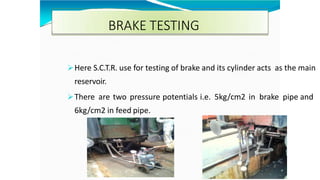
BRAKE TESTING
Here S.C.T.R. use for testing of brake and its cylinder acts as the main
reservoir.
There are two pressure potentials i.e. 5kg/cm2 in brake pipe and
6kg/cm2 in feed pipe.
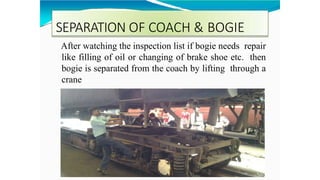
SEPARATION OF COACH & BOGIE
After watching the inspection list if bogie needs repair
like filling of oil or changing of brake shoe etc. then
bogie is separated from the coach by lifting through a
crane
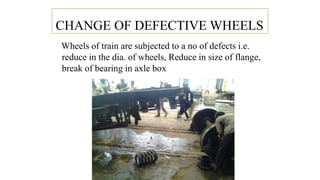
CHANGE OF DEFECTIVE WHEELS
Wheels of train are subjected to a no of defects i.e.
reduce in the dia. of wheels, Reduce in size of flange,
break of bearing in axle box
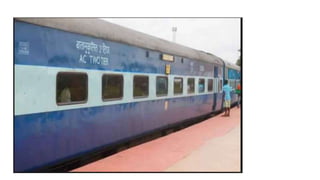
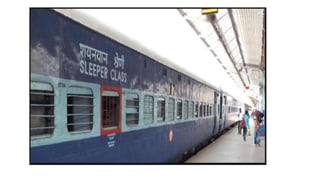
TYPES OF COACHES
1) ICF (Integrated coach factory).
2) LHB (Link Hoffmen Bush)
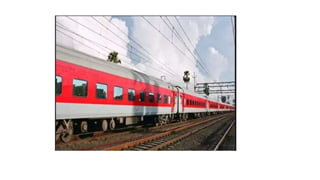
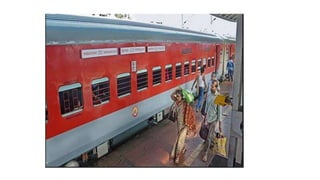
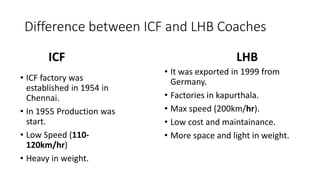
Difference between ICF and LHB Coaches
ICF
• ICF factory was
established in 1954 in
Chennai.
• In 1955 Production was
start.
• Low Speed (110-
120km/hr)
• Heavy in weight.
LHB
• It was exported in 1999 from
Germany.
• Factories in kapurthala.
• Max speed (200km/hr).
• Low cost and maintainance.
• More space and light in weight.
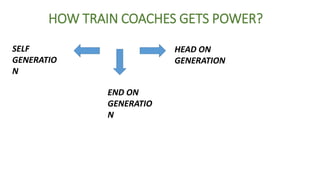
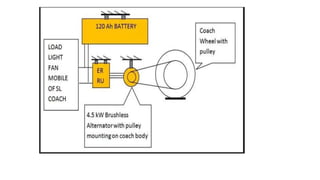
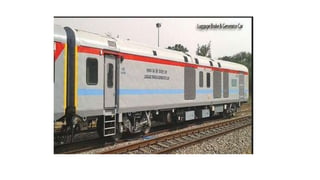
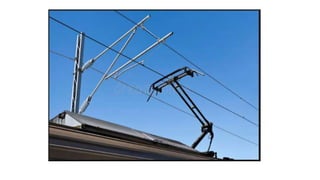
HOW TRAIN COACHES GETS POWER?
HEAD ON
GENERATION
SELF
GENERATIO
N
END ON
GENERATIO
N
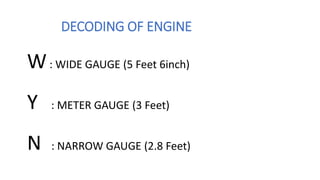
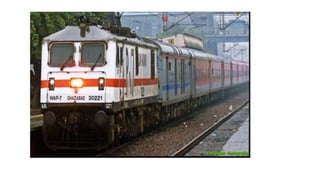
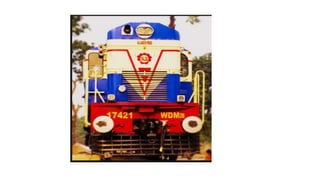
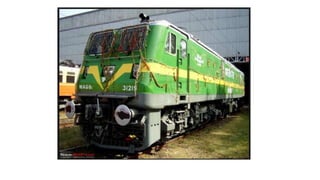
DECODING OF ENGINE
W: WIDE GAUGE (5 Feet 6inch)
Y : METER GAUGE (3 Feet)
N : NARROW GAUGE (2.8 Feet)
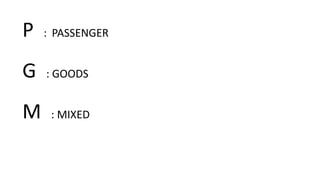
P : PASSENGER
G : GOODS
M : MIXED
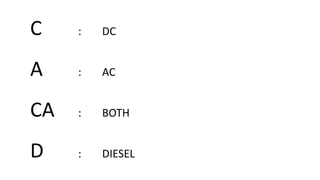
C : DC
A : AC
CA : BOTH
D : DIESEL
THANK YOU

INTERNSHIP AT INDIAN RAILWAYS

  • 1.
    SUBMITTED TO:- Mr. AshishMishra DEPTT. OF MECH. ENGG. SUBMITTED BY:- Shubhankar Shukla 1516140191 B.TECH. (ME) IV yr.
  • 2.
    CONTENTS : • INTRODUCTION •TRAIN MAINTENANCE • TYPES OF COACHES • POWER SOURCE • DECODING OF ENGINE
  • 3.
    HISTORY OF INDIANRAILWAYS • The first railway proposal for India were made in madras in 1832. • India’s first passenger train hauled by three steam locomotives( Sahib, Sindh, Sultan). • It ran for 34 km with 400 people in 14 carriage on broad gauge between Mumbai to Thane.
  • 4.
    TRAIN MAINTENANCE Washing line:- after every 2500 km Sick line :- Schedule “A” maintenance- 1 month Schedule “B” maintenance- 3 months IOH- 9 months or 2,00,000 km POH- 18 months or 4,00,000 km Platform Train Duty:- on starting & ending stations
  • 5.
  • 7.
    WORKS CARRIED INWASHING LINE Inspection Cleaning& washing Brake testing Primary Maintenance Secondary Maintenance Pantry car provisions Watering Loading of linen maintenance of AC & electrical circuits of coaches
  • 8.
    BRAKE TESTING INWASHING LINE Brake testing is carried by using RTR (rack test rig) Rack testing rig is capable of testing full train (up to 24 coaches) at a time.
  • 9.
    PRIMARY MAINTENANCE  Thetrains for the primary maintenance are given at least 6 hrs at the washing line in addition to secondary maintenance  Oil in hydraulic dash pots  Wheel profiles are visually examined and gauged  pest control treatment  Axle box is examined for grease oozing out from rear cover  Brake blocks & piston stroke checked & changed
  • 10.
    SECONDARY MAINTENANCE The trainsfor the secondary maintenance are given at least 2 hrs on the washing line Linen and pantry car provisions Washing & cleaning of coaches Maintenance of AC of coaches
  • 11.
    SICK LINE Sick lineis the workshop for the major and periodical maintenance of the coaches it consists of modern facilities like pit for working under frame And crane for separation of coach & bogie for repair of all type of defects
  • 12.
    COACH MAINTENANCE In coachmaintenance generally these work being done 1. testing/maintenance of air conditioner. 2. Maintenance of other electrical circuits like fan light etc. 3. Buffer maintenance. 4. Brake testing by S.C.T.R. (single coach test ring)
  • 13.
    BUFFER MAINTENANCE Buffers arethe horizontal shock absorbing parts with coupling the adjacent coaches of the train so need regular changing of shock absorbing rubber pads.
  • 14.
    BRAKE TESTING Here S.C.T.R.use for testing of brake and its cylinder acts as the main reservoir. There are two pressure potentials i.e. 5kg/cm2 in brake pipe and 6kg/cm2 in feed pipe.
  • 15.
    SEPARATION OF COACH& BOGIE After watching the inspection list if bogie needs repair like filling of oil or changing of brake shoe etc. then bogie is separated from the coach by lifting through a crane
  • 17.
    CHANGE OF DEFECTIVEWHEELS Wheels of train are subjected to a no of defects i.e. reduce in the dia. of wheels, Reduce in size of flange, break of bearing in axle box
  • 22.
    TYPES OF COACHES 1)ICF (Integrated coach factory). 2) LHB (Link Hoffmen Bush)
  • 27.
    Difference between ICFand LHB Coaches ICF • ICF factory was established in 1954 in Chennai. • In 1955 Production was start. • Low Speed (110- 120km/hr) • Heavy in weight. LHB • It was exported in 1999 from Germany. • Factories in kapurthala. • Max speed (200km/hr). • Low cost and maintainance. • More space and light in weight.
  • 28.
    HOW TRAIN COACHESGETS POWER? HEAD ON GENERATION SELF GENERATIO N END ON GENERATIO N
  • 33.
    DECODING OF ENGINE W:WIDE GAUGE (5 Feet 6inch) Y : METER GAUGE (3 Feet) N : NARROW GAUGE (2.8 Feet)
  • 34.
    P : PASSENGER G: GOODS M : MIXED
  • 35.
    C : DC A: AC CA : BOTH D : DIESEL
  • 39.