ANTHROPOMETRIC MEASUREMENTS
Presented by:
S.Aparna Selvam , 1st MPT
Moderators:
Vijay Sameul Raj , Assistant Professor
Kudhan Das Ukil , Assistant Professor
1
17-11-2021
CONTENTS
• Introduction
• Indications
• Techniques In Anthropometric Measurements
• References
2
17-11-2021
Introduction
Anthropometry is a branch of anthropology, techniques that are
noninvasive, universally applicable and are inexpensive .
The word “Anthropometry” is derived from the Greek word “Anthropo”
meaning “man” and the Greek word “Metron” meaning “measurement”
Anthropometric measurements are a series of quantitative measurements
of the muscle, bone, and adipose tissue used to assess the composition of
the body.
3
17-11-2021
Body composition is defined as the relative proportion of fat and fat free tissue
in the body
The core elements of anthropometry are height, weight, body mass index
(BMI), body circumferences (waist, hip, and limbs), and skinfold thickness.
These measurements are important because they can be used as a baseline for
physical fitness and to measure the progress of fitness, represent diagnostic
criteria for obesity, which significantly increases the risk for conditions such as
cardiovascular disease, hypertension, diabetes mellitus etc.
There is further utility as a measure of nutritional status in children and
pregnant women.
4
17-11-2021
Body Composition
 Body composition is defined as the relative proportion of fat and fat free
tissue in the body.
 Two basic components body fat mass and fat free body mass (FFM-also
called lean body mass , refers to all body components except fat . that is
water ,bone, organs, muscle ) are important partition to understand body
composition
17-11-2021 5
 Studies propose two models for describing body composition
 Multicomponent model of body composition
 Behnke’s reference man and woman model
17-11-2021 6
Multicomponent model of body composition
17-11-2021 7
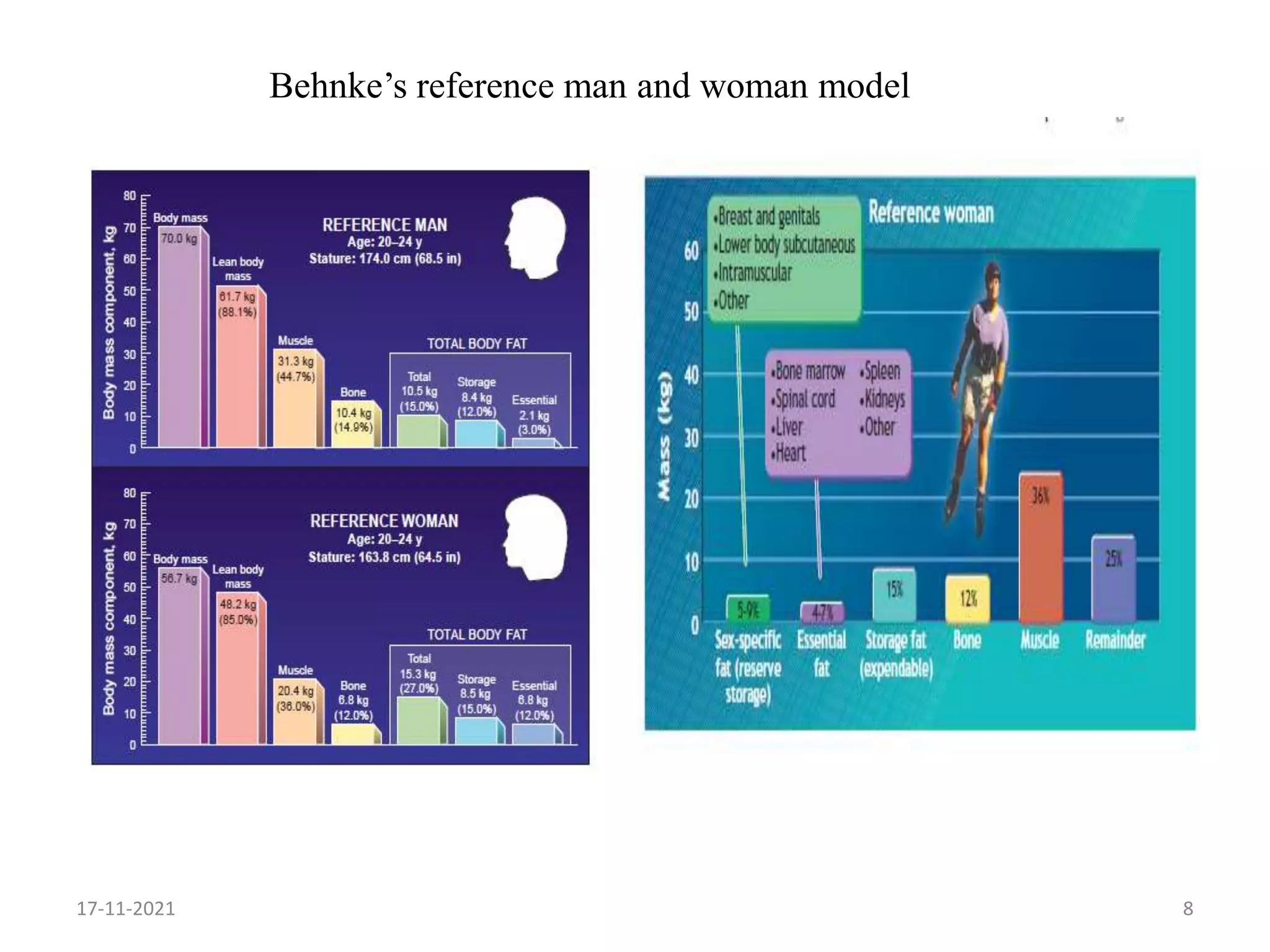
Behnke’s reference man and woman model
17-11-2021 8
 The model partitions body mass into lean body mass (LBM), muscle,
and bone, with total body fat subdivided into storage and essential fat
components.
 This model integrates the average physical dimensions from thousands
of individuals measured in large-scale civilian and military
anthropometric surveys with data from laboratory studies of detailed
tissue composition and structure.
17-11-2021 9
 According to this model, the reference man is taller and heavier, his
skeleton weighs more, and he possesses a larger muscle mass and lower
body fat content than the reference woman.
 In the reference model, total body fat exists in two storage sites or depots—
essential fat and storage fat.
 Essential fat consists of fat in the heart, lungs, liver, spleen, kidneys,
intestines, muscles, and lipid-rich tissues of the central nervous system and
bone marrow. Normal physiologic functioning requires this fat.
17-11-2021 10
 The storage fat depot includes fat (triacylglycerol) packed primarily in adipose
tissue. The adipose tissue energy reserve contains approximately 83% pure fat,
2% protein, and 15% water within its supporting structures. Storage fat includes
the visceral fatty tissues that protect the various internal organs within the
thoracic and abdominal cavities from trauma and the larger adipose tissue
volume deposited beneath the skin’s surface called subcutaneous fat.
17-11-2021 11
Indications
There are several possible indications for anthropometric measurements:
- In children, indications include stunting, wasting, and being underweight
- Mid-upper arm circumference (MUAC) is a viable measurement in children or
pregnant women as a marker of nutritional status.
- BMI is commonly employed index of nutritional status and used as a gauge of
malnutrition in children and adults.
- BMI is useful to identify obesity and the severity of obesity
- Anthropometric measurements are used in evaluation of fitness in athletes
12
17-11-2021
Methods to Assess Body Composition
Body composition assessment is necessary for various reasons , for instance in
knowing general growth and development ,health and fitness status and risk
factor stratification
Two general approaches determine the fat and fat-free components of the
human body.
 Direct measurement
 Indirect estimation
17-11-2021 13
Direct measurement
 Direct measurement usually are based on cadaver studies, direct
measurements are chemical method and dissection method
 In chemical method, a chemical solution literally dissolves the body into its
fat and nonfat (fat-free) components.
 Dissection direct assessment approach involves physical dissection of fat,
fat-free adipose tissue, muscle, and bone.
 Demerits : extensive time, meticulous attention to detail, and specialized
laboratory equipment and pose ethical questions and legal problems in
obtaining cadavers for research purposes
17-11-2021 14
Indirect estimation
There are various indirect measurement methods to assess body composition
 Hydrostatic Weighing
 Height and Weight
 Body mass index
 Waist hip Ratio
 Skinfold Thickness
 Girth Measurements –circumferences
 Total-Body Electrical Conductivity Or Impedance
17-11-2021 15
17-11-2021 16
 Other methods
 Dual-Energy X-Ray Absorptiometry
 Near-Infrared Interactance
 X-Ray
 Ultrasonography
 Computed Tomography
 Air Plethysmography
 Magnetic Resonance Imaging
 Hydrostatic Weighing
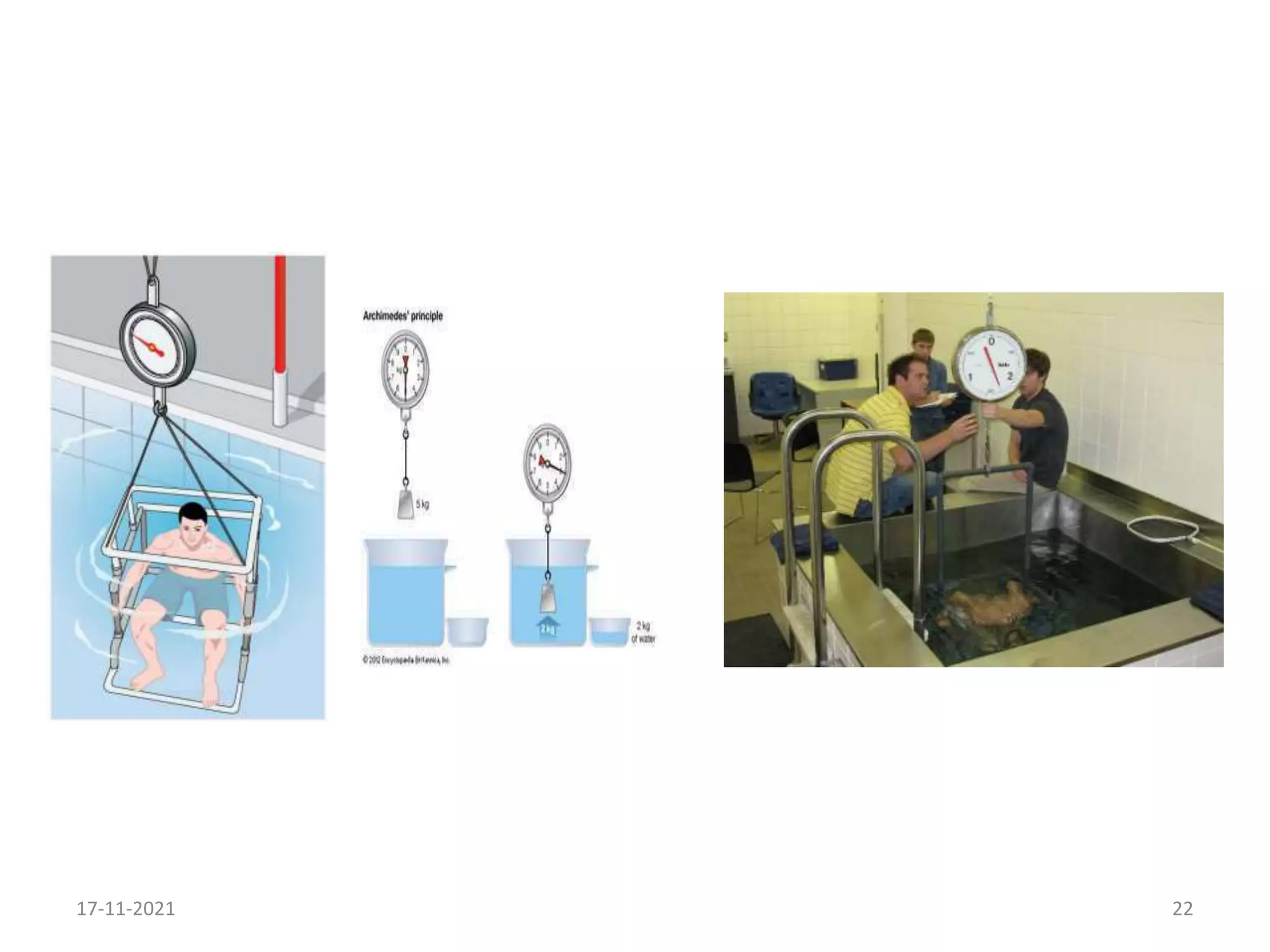
Hydrostatic weighing, also known as underwater weighing and hydro
densitometry, computes percentage body fat from body density. Underwater
weighing (UWW) is considered a criterion, or gold standard, method for
body composition analysis. This method uses Archimedes' principle that the
density of the body is equal to the mass of the body divided by its volume.
The density of the body can then be converted to percent body fat .In this
technique the body is divided into two components, fat mass (FM) and fat-
free mass (FFM).
17-11-2021 17
17-11-2021 18
For the UWW method, several variables must be known:
 Residual volume: the amount of air remaining in the lungs after full expiration;
this air will aid in buoyancy, potentially increasing the percent body fat.
 Density of the water: the density of the water varies with its temperature.
Buoyancy will decrease with warmer water temperatures.
 Trapped gas in gastrointestinal system: a constant of 100 mL is used for all
trapped gas in the gastrointestinal system; this gas will also aid buoyancy.
 Body weight in air (dry).
 Body weight fully submerged in water (wet).
17-11-2021 19
Procedure:
1. Subject should wear a bathing suit (nylon is best). The suit should not add to
buoyancy by trapping air.
2. The subject should be relatively clean of body oils and should have urinated
and defecated, if possible, before the procedure.
3. The subject should remove all jewelry.
4. Normal hydration of the subject is desirable. Women should not be tested
within 7 days on either side of menstruation. The subject should be 3 to 12
hours post absorptive.
17-11-2021 20
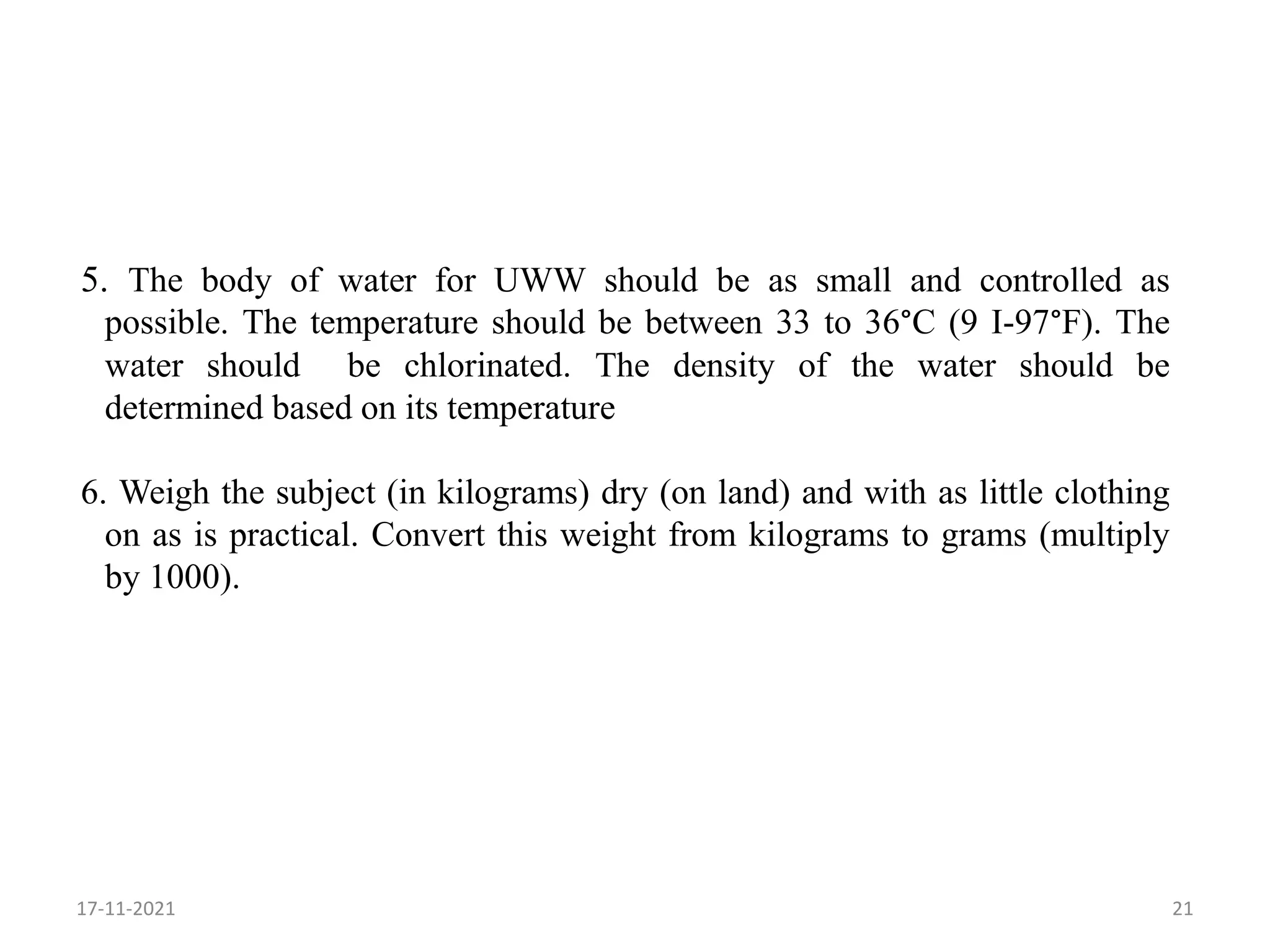
5. The body of water for UWW should be as small and controlled as
possible. The temperature should be between 33 to 36°C (9 I-97°F). The
water should be chlorinated. The density of the water should be
determined based on its temperature
6. Weigh the subject (in kilograms) dry (on land) and with as little clothing
on as is practical. Convert this weight from kilograms to grams (multiply
by 1000).
17-11-2021 21
17-11-2021 22
7. Calculate, or predict, their residual volume (RY) based upon their height
(cm) and age:
• Male RY (L): [0.019'-HT (cm)] + [0.0155' age (yrs)] -2.24
• Female RV (L): [0.032· HT (cm)] + [0.009' age (yrs)] -3.90
8. Convert this RV from liters to milliliters (multiply by 1000).
17-11-2021 23
9. Weigh the individual underwater several times (5-10). Each weighing
should be done after a deep, full expiration. The subject needs to be fully
submerged and at residual volume. The subject may have to stay submerged
for 5 to 10 seconds.
10. The greatest weight of the subject is used for the UWW or perhaps an
averaging of the two or three highest weights.
17-11-2021 24
Formula for UWW,
BD= WT in air (gm) /[WT in air (gm) -WT in water (gm) ] -[RV (mL)]
The density of the body is calculated and converted to percent body fat by
using either the Siri or Brozek equation
1. Siri equation: % Body Fat = 495/BD-450
2. Brozek equation: % Body Fat = 457/BD -414.2
17-11-2021 25
Height and Weight
• :Equipments required :
- Stadiometer
- Weighing machine ( Analog ,Digital , infant weight scale )
• Procedure ( practical )
• Note :
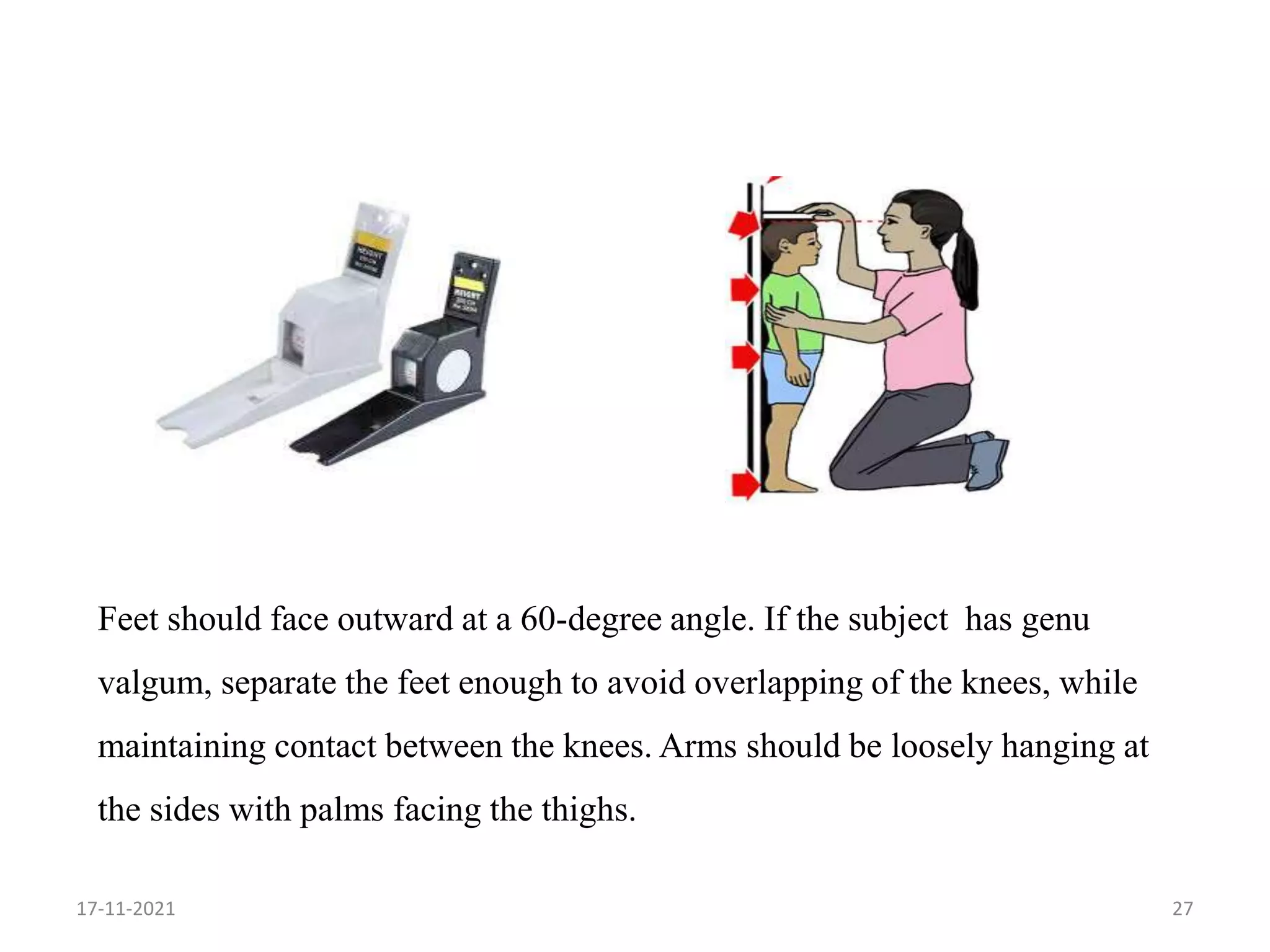
When measuring height, the subject should stand with his or her heels
together and weight evenly distributed. Subject positioning should be with
the shoulder blades, buttocks, and heels on the stadiometer's vertical
backboard. If not able to have all three points of contact on the vertical
backboard, the heels and buttocks must touch the vertical backboard.
26
17-11-2021
Feet should face outward at a 60-degree angle. If the subject has genu
valgum, separate the feet enough to avoid overlapping of the knees, while
maintaining contact between the knees. Arms should be loosely hanging at
the sides with palms facing the thighs.
27
17-11-2021
The horizontal bar of the stadiometer should be lowered until the hair is
compressed to the crown of the head. Remove any objects on the head or hair that
obstruct the bar from compressing the hair to the level of the crown of the
head.Record the height of the subject in centimeters or inches .
28
17-11-2021
When measuring weight the subject should be in minimum clothing as possible and
stand upright with head facing front on the weighing scale. Record the weight in
pounds or kilograms
29
17-11-2021
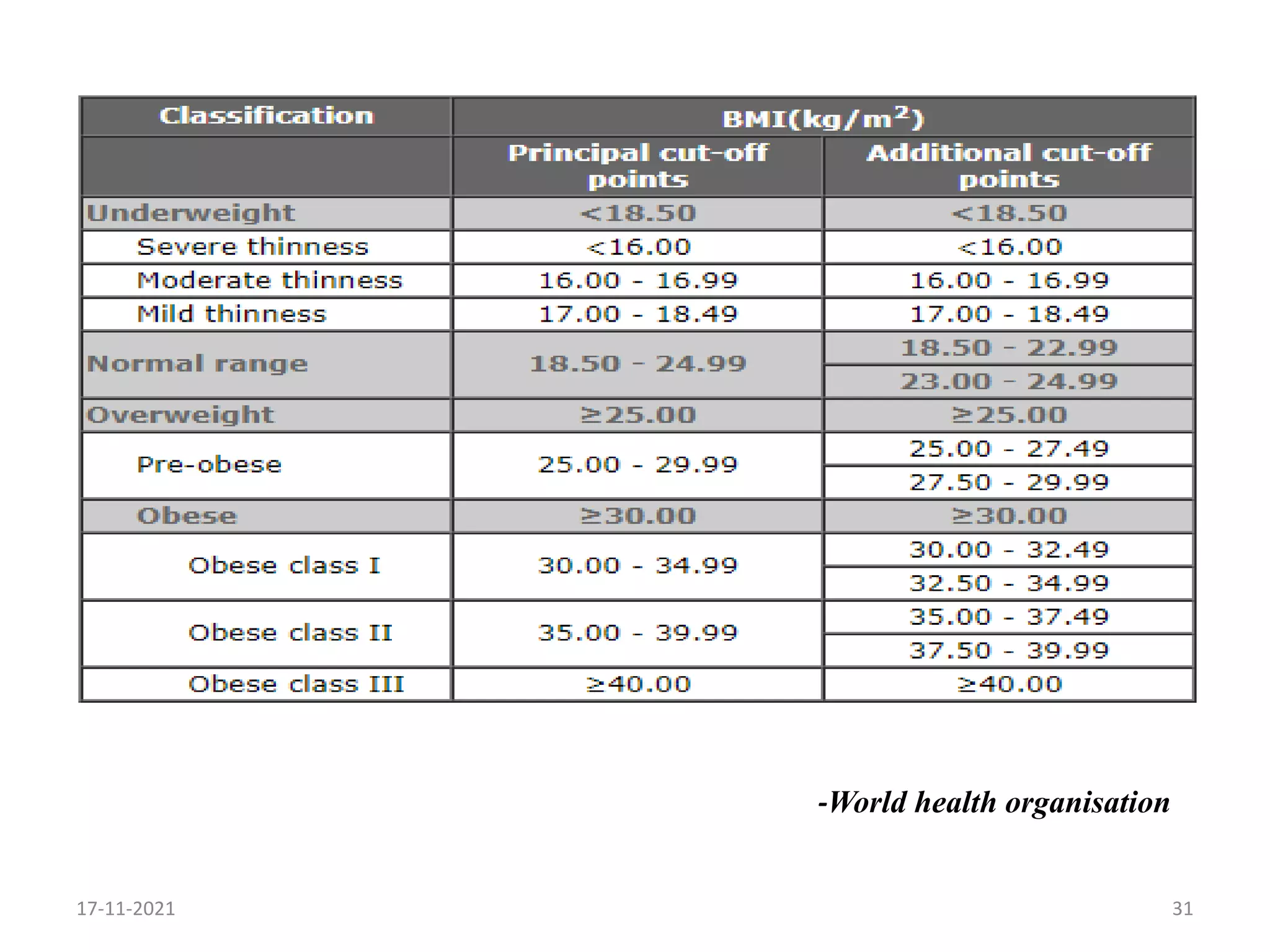
BMI – Body mass index (Quetelet’s index )
Body mass index also called the Quetelet’s index is used to assess weight
relative to height .
To calculate the relation formula is used
BMI = kg/m2
Where kg is subjects weight in kilograms and m2 is their height in metres
squared.
Equipment’s required - Weighing scale , Stadiometer
(ie)
BMI = WT (kgs)/ HT(m2)
30
17-11-2021
-World health organisation
31
17-11-2021
• Waist - Hip Ratio
The waist-to-hip ratio (WHR) is a comparison between the
circumference of the waist to the circumference of the hip. This
ratio represents the distribution of body weight, and body fat, on
an individual. The pattern of body weight distribution is
recognized as an important predictor of health risks of obesity.
Individuals with more weight or circumference on the trunk are at
increased risk of hypertension, type 2 diabetes, hyperlipidemia,
and CAD compared with individuals who are of equal weight but
have more of their weight distributed on the extremities
32
17-11-2021
33
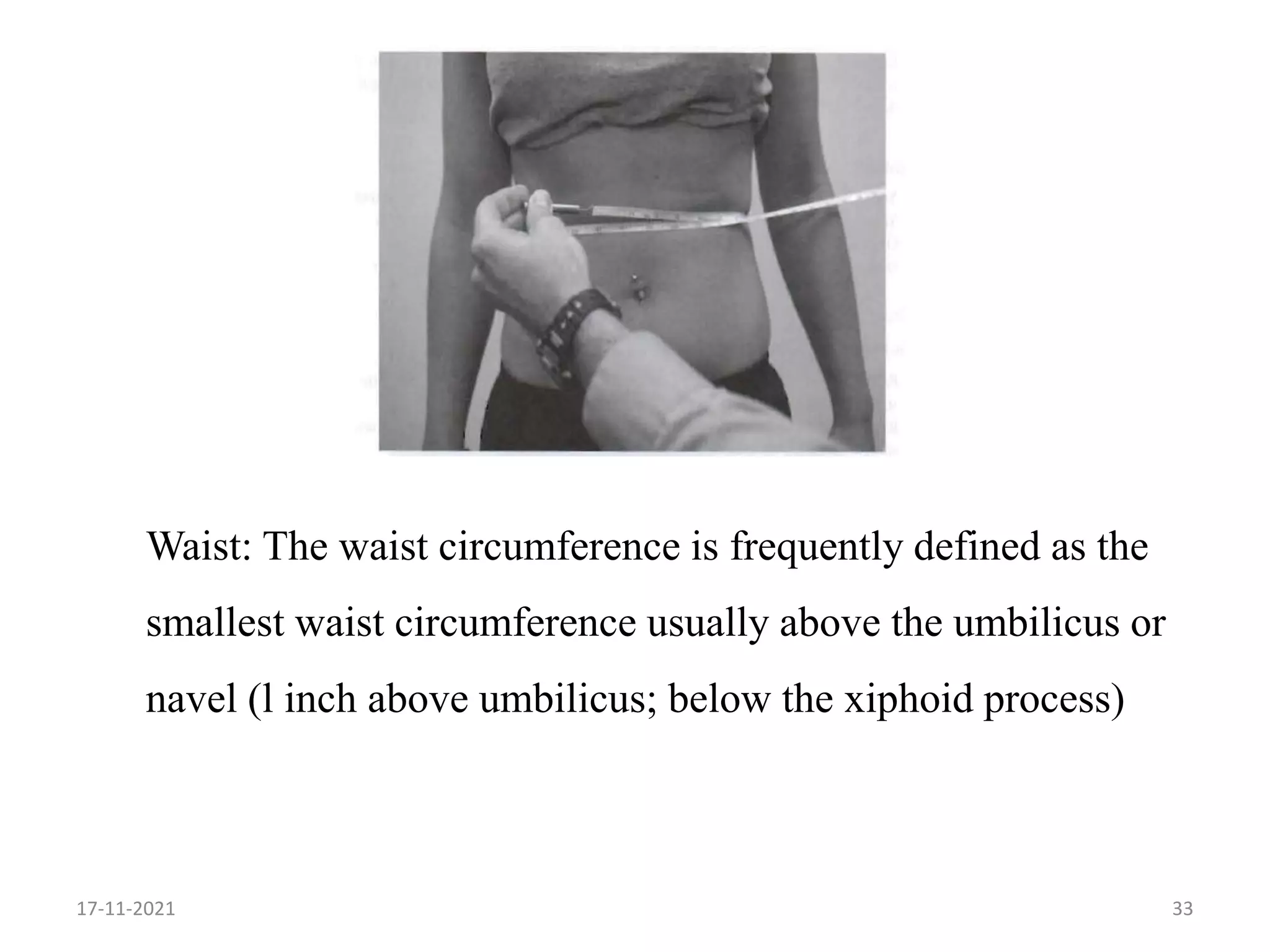
Waist: The waist circumference is frequently defined as the
smallest waist circumference usually above the umbilicus or
navel (l inch above umbilicus; below the xiphoid process)
17-11-2021
34
Hip: The hip circumference is defined as
the largest circumference around the
buttocks, above the gluteal fold (posterior
extension)
Equipment required: inch tape
Procedure: Subject should stand straight or
erect but relaxedApply the tape to the site
so it is taut but not tight. Avoid skin
compression or pinching of the skin
.
17-11-2021
35
17-11-2021
36
The WHR also may be expressed, or used
interchangeably, as the A:G ratio. The A:G
ratio stands for abdominal to gluteal ratio,
WHR is expressed as a ratio (there are no
units).
WHR = Waist Circumference /Hip
CircumferenceThewaist and hip
circumferences is measured in either
inches or centimeters
17-11-2021
 Skin Fold Measurement
The skinfold measurement test is one of the oldest and still most
common methods of determining a person's body
composition and body fat percentage.
A skinfold caliper is used to assess the skinfold thickness, so that a
prediction of the total amount of body fat can be made.
17-11-2021 37
This method is based on the hypothesis that the body fat is equally
distributed over the body and that the thickness of the skinfold is a
measure for subcutaneous fat This test estimates the percentage of
body fat by measuring skinfold thickness at specific locations on the
body.
The thickness of these folds is a measure of the fat under the skin,
also called subcutaneous adipose tissue. Skinfold thickness results
rely on formulas that convert these numbers into an estimate of a
person's percentage of body fat according to a person's age and
gender
17-11-2021 38
17-11-2021 39
Skin fold measurement are generally taken at specific sites on the right side
of the body. The tester pinches the skin at the location site and pulls the fold
of skin away from the underlying muscle so only the skin and fat tissue are
being held. Special skin fold calipers are then used to measure the skinfold
thickness in millimetres. Two measurements are recorded and averaged.
17-11-2021 40
The measurement sites vary depending upon the specific skinfold testing
protocol being used, but typically include the following seven locations on
the body:
1. Triceps - The back of the upper arm
2. Pectoral - The mid-chest, just forward of the armpit
3. Subscapular - Beneath the edge of the shoulder blade
4. Mid Axilla - Midline of the side of the torso
5. Abdomen - Next to the belly button
6. Suprailiac - Just above the iliac crest of the hip bone
7. Quadriceps - Middle of the upper thigh
17-11-2021 41
17-11-2021 42
Generalized Skinfold Equations :
Men -
 Seven-Site Formula (chest, mid axillary, triceps, subscapular, abdomen, supra iliac,
thigh)
Body Density = 1.112 -0.00043499 (sum of seven skinfolds + 0.00000055 (sum of
seven skinfolds) 2 -0.00028826 (age)
 Three-Site Formula (chest, abdomen, thigh)
Body Density = 1.10938 -0.0008267 (sum of three skinfolds) + 0.0000016 (sum of three
skinfolds) 2 -0.0002574 (age)
 Three-Site Formula (chest, triceps, subscapular)
Body Density = 1.1125025 -0.0013125 (sum of three skinfolds) + 0.0000055 (sum
of three skinfolds) 2 -0.000244 (age)
17-11-2021 43
Women -
 Seven-Site Formula (chest, midaxillary, triceps, subscapular, abdomen, suprailiac,
thigh)
Body Density = 1.097 -0.00046971 (sum of seven skinfolds) + 0.00000056 (sum of
seven skinfolds)2 -0.00012828 (age)
 Three-Site Formula (triceps, suprailiac, thigh)
Body Density = 1.099421 -0.0009929 (sum of three skinfolds) + 0.0000023 (sum of
three skinfolds) 2 -0.0001392 (age)
 Three-Site Formula (triceps, suprailiac, abdominal)
Body Density = 1.089733 -0.0009245 (sum of three skinfolds) + 0.0000025 (sum
of three skinfolds)2 -0.0000979 (age)
17-11-2021 44
 Circumference - Girth Measurements
Circumferences have been used for many years in the estimation of body
composition. Circumferences have the advantages of being easily learned,
quick to administer, and inexpensive in equipment needs, Circumferences,
also known as girths, can also be used to measure muscle girth size and,
therefore, quantify changes in muscle with specific training
17-11-2021 45
Procedure of extremities :
Read the circumference (girth) to the nearest half of a centimeter (5
mm). Apply the tape to the site so it is taut but not tight. Avoid skin
compression or pinching of the skin.
17-11-2021 46
The anatomical sites for circumference measurements are:
 Right forearm: maximum girth around the lower ann or forearm with
the right arm straight, extended in front of the body, and the palm up
17-11-2021 47
 Right upper arm or biceps: midpoint between shoulder and elbow with the
right arm straight, extended in front of body, and the palm up
17-11-2021 48
 Abdomen (waist): a horizontal line 1 inch above the umbilicus (navel) or
at the smallest circumference in this area (below the rib cage).
Measurement is taken at end of a normal expiration
17-11-2021 49
 Buttocks (hips or gluteal): the largest horizontal plane
around the buttocks. Subject should have their heels
together
17-11-2021 50
 Right thigh (proximal thigh): the upper right thigh, just below the buttocks
(gluteal fold) at the maximal circumference with the legs slightly apart
17-11-2021 51
 Right calf: the largest horizontal plane on the right calf, usually midway
between knee and ankle
17-11-2021 52
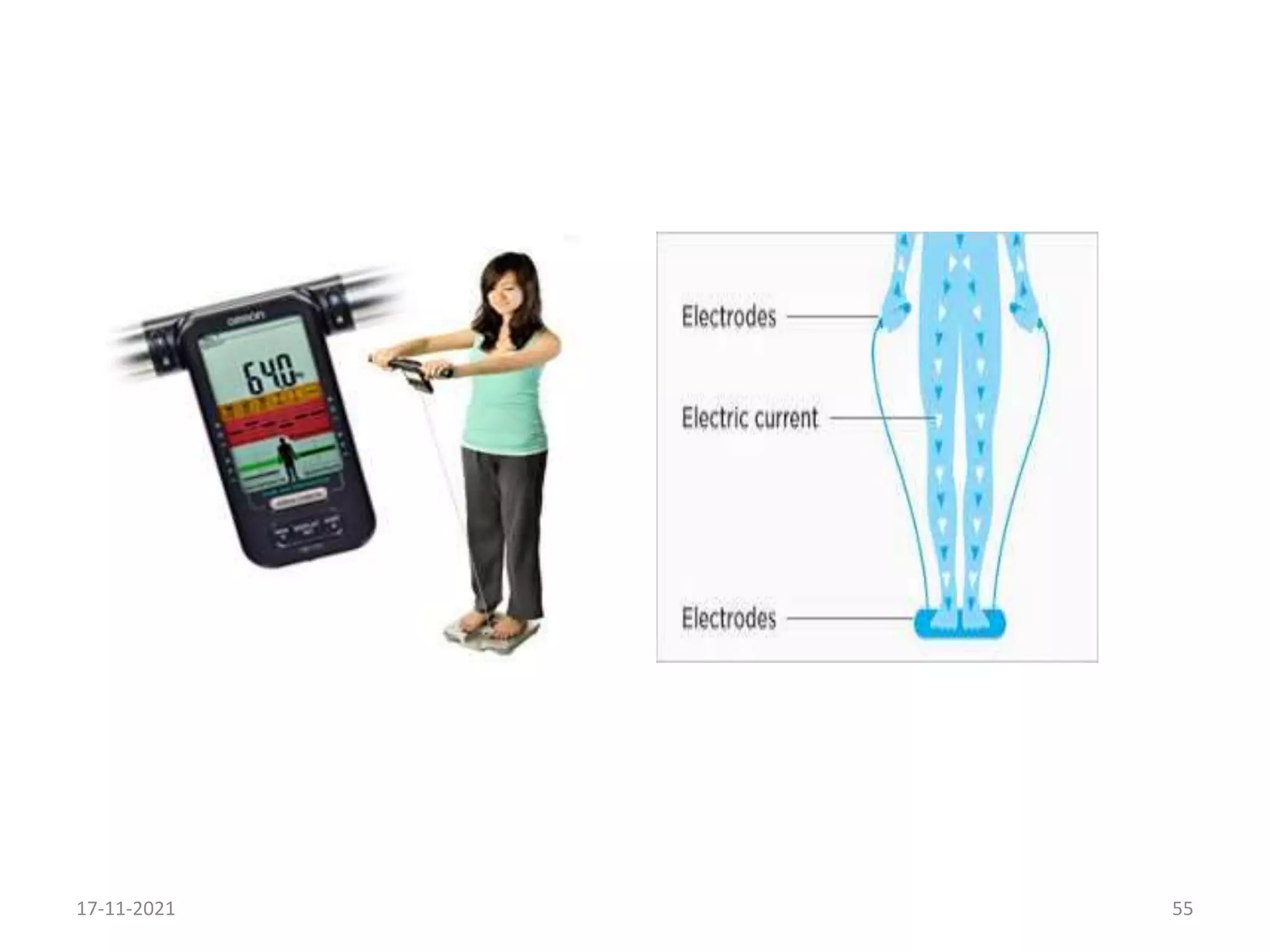
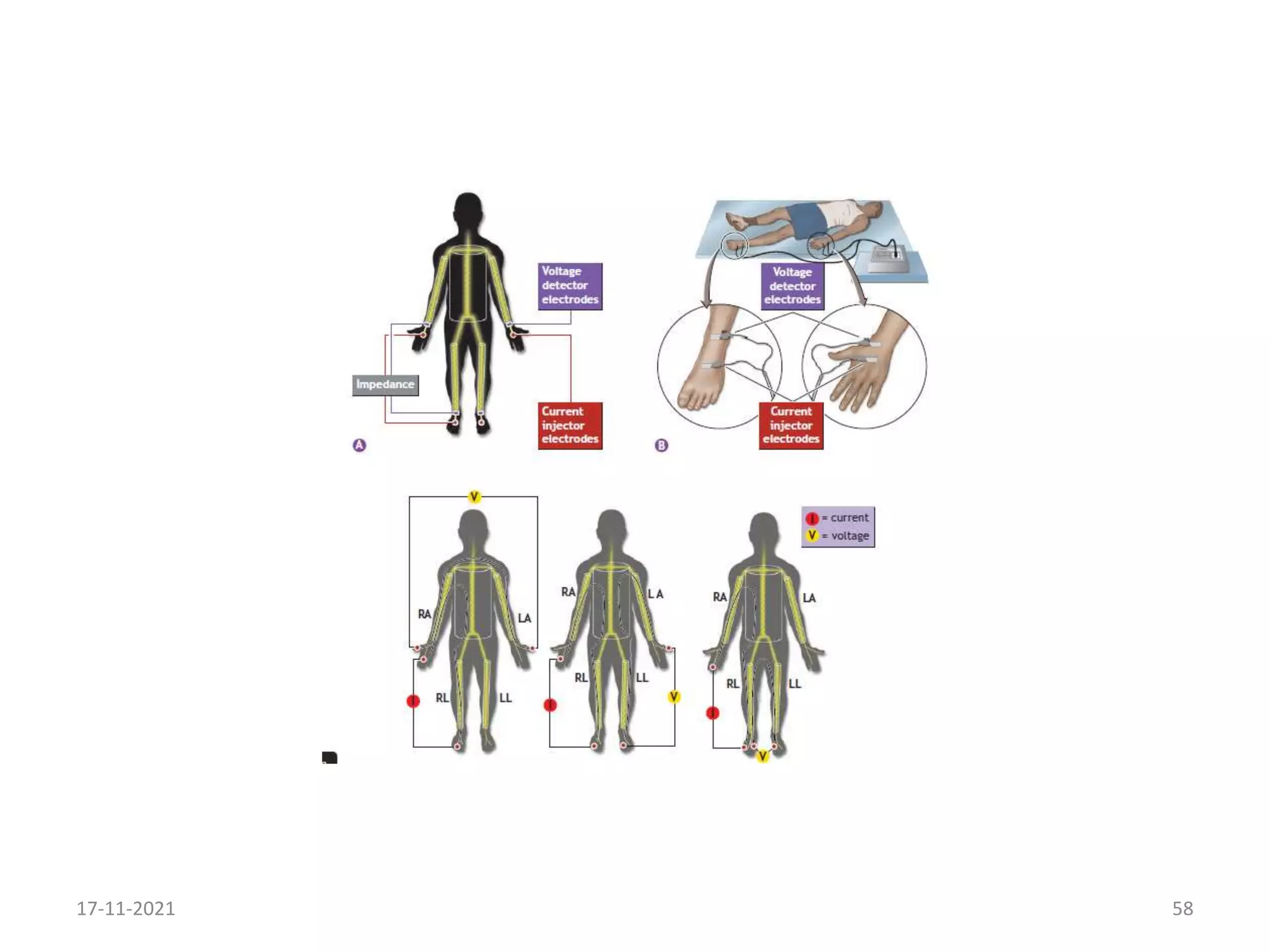
 Bioelectrical Impedance Analysis
Bioelectrical impedance analysis (BIA) is a non-invasive and easy-
to-administer method for assessing body composition. The basic
premise behind the procedure is that the volume of fat-free tissue in
the body will be proportional to the electrical conductivity of the
body.
BIA measures total body water and uses calculations for percent
body fat using some assumptions about hydration levels of
individuals and the exact water content of various tissues
17-11-2021 53
Precautions :
• No eating or drinking within 4 hours of the test.
• No exercise within 12 hours of the test.
• Urinate (or void) completely within 30 minutes of the test.
• No alcohol consumption in the previous 48 hours before the test.
• No diuretics in the 7 days before the test (unless prescribed by a
physician).
• Limited use of diuretic agents (i.e., caffeine, chocolate, etc.) before the
test.
17-11-2021 54
17-11-2021 55
Procedures for BIA :
1. Calibrate the BIA machine according to manufacturer's instructions.
2. Prepare the subject for the test by having them lie down on the table.
Have the subject remove all jewelry. The subject will need to remove the
right sock and shoe.
3. Do not allow the subject's 1egs or arms to touch each other.
17-11-2021 56
4.Wipe the right ankle/foot and right wrist/hand sites with an alcohol pad.
5.Place the four electrodes on the body anatomically:
Right wrist: midpoint on line bisecting ulna and radius styloid processes.
Right hand: on distal metacarpal (knuckle of index finger).
Right ankle: midpoint bisecting medial and lateral malleoli.
Right foot: on distal metatarsal (knuckle of big toe).
17-11-2021 57
17-11-2021 58
59
Summary of implication :
• Body composition is defined as the relative proportion of fat and fat free
tissue in the body. Studies propose two models for describing body
composition ,Multicomponent model of body composition ,Behnke’s
reference man and woman model
 Major differences in body size and composition between girls and boys do
not start to appear until late childhood and early adolescence.
 Until puberty, girls and boys do not differ significantly in most
measurements of body size and composition. At puberty, because of the
influences of estrogen and testosterone, body composition begins to
change markedly.
17-11-2021
60
 Testosterone increases bone formation and protein synthesis, leading to a
larger FFM. It also stimulates the production of erythropoietin, which
increases red blood cell production.
 Estrogen causes increased fat deposition in females, particularly in the
hips and thighs, and an increased rate of bone growth, such that bones in
females reach their final length earlier than in males.
• Two approaches directly assess body composition. In one technique, a
chemical solution literally dissolves the body into its fat and non fat (fat-
free) components. The other approach involves physical dissection of
fat, fat-free adipose tissue, muscle, and bone.
17-11-2021
61
• Common field methods to assess body composition use population-specific
prediction equations from relationships among selected skinfolds and girths
and body density and percentage body fat. These equations predict most
accurately with subjects similar to those who participated in the
equations’original derivation.
• BMI relates more closely to body fat and health risk than simply body
mass and stature; as with height–weight tables, BMI does not consider the
body’s proportionalcomposition.
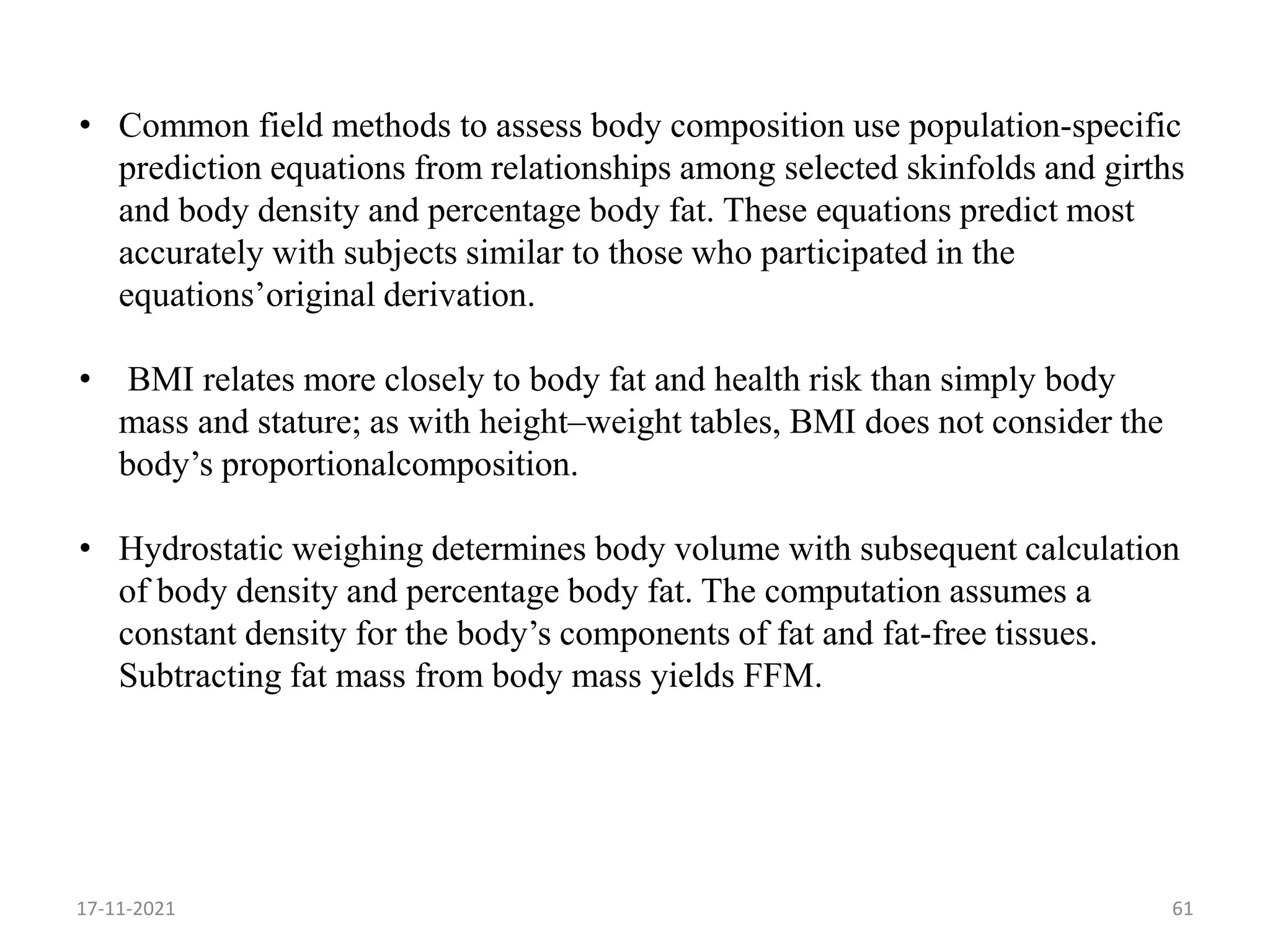
• Hydrostatic weighing determines body volume with subsequent calculation
of body density and percentage body fat. The computation assumes a
constant density for the body’s components of fat and fat-free tissues.
Subtracting fat mass from body mass yields FFM.
17-11-2021
62
• Waist girth provides a second dimension of obesity when assessing the
health-risk profile. Men and women with large waist circumferences
possess greater relative risk for cardiovascular disease, type 2 diabetes,
cancer, and cataracts than individuals with small waist circumferences
• The concept of BIA states that hydrated, fat-free body tissues and
extracellular water facilitate electrical flow better compared with fat tissue
because of the greater electrolyte content of the fat-free component.
Impedance to electric current flow relates directly to the body’s fat content.
17-11-2021
References
• Kaminsky L. ACSM's health-related physical fitness assessment manual.
2nd ed. Baltimore, MD: Wolters Kluwer Health/Lippincott Williams &
Wilkins
• Casadei K, Kiel. J. Anthropometric Measurement. 2019
• Haslegrave C. Bodyspace. Boca Raton, Fla.: CRC; 2004.
• Kenney, W., Wilmore, J. and Costill, D., 2020. Physiology Of Sport And
Exercise. Champaign, IL: Human Kinetics.
• McArdle, W., Katch, F. and Katch, V., n.d. Exercise Physiology.
• Plowman, S., 2017. Exercise Physiology For Health Fitness And
Performance. Lippincott Williams & Wilkins.
63
17-11-2021
64
17-11-2021

Anthropometric measurements

  • 1.
    ANTHROPOMETRIC MEASUREMENTS Presented by: S.AparnaSelvam , 1st MPT Moderators: Vijay Sameul Raj , Assistant Professor Kudhan Das Ukil , Assistant Professor 1 17-11-2021
  • 2.
    CONTENTS • Introduction • Indications •Techniques In Anthropometric Measurements • References 2 17-11-2021
  • 3.
    Introduction Anthropometry is abranch of anthropology, techniques that are noninvasive, universally applicable and are inexpensive . The word “Anthropometry” is derived from the Greek word “Anthropo” meaning “man” and the Greek word “Metron” meaning “measurement” Anthropometric measurements are a series of quantitative measurements of the muscle, bone, and adipose tissue used to assess the composition of the body. 3 17-11-2021
  • 4.
    Body composition isdefined as the relative proportion of fat and fat free tissue in the body The core elements of anthropometry are height, weight, body mass index (BMI), body circumferences (waist, hip, and limbs), and skinfold thickness. These measurements are important because they can be used as a baseline for physical fitness and to measure the progress of fitness, represent diagnostic criteria for obesity, which significantly increases the risk for conditions such as cardiovascular disease, hypertension, diabetes mellitus etc. There is further utility as a measure of nutritional status in children and pregnant women. 4 17-11-2021
  • 5.
    Body Composition  Bodycomposition is defined as the relative proportion of fat and fat free tissue in the body.  Two basic components body fat mass and fat free body mass (FFM-also called lean body mass , refers to all body components except fat . that is water ,bone, organs, muscle ) are important partition to understand body composition 17-11-2021 5
  • 6.
     Studies proposetwo models for describing body composition  Multicomponent model of body composition  Behnke’s reference man and woman model 17-11-2021 6
  • 7.
    Multicomponent model ofbody composition 17-11-2021 7
  • 8.
    Behnke’s reference manand woman model 17-11-2021 8
  • 9.
     The modelpartitions body mass into lean body mass (LBM), muscle, and bone, with total body fat subdivided into storage and essential fat components.  This model integrates the average physical dimensions from thousands of individuals measured in large-scale civilian and military anthropometric surveys with data from laboratory studies of detailed tissue composition and structure. 17-11-2021 9
  • 10.
     According tothis model, the reference man is taller and heavier, his skeleton weighs more, and he possesses a larger muscle mass and lower body fat content than the reference woman.  In the reference model, total body fat exists in two storage sites or depots— essential fat and storage fat.  Essential fat consists of fat in the heart, lungs, liver, spleen, kidneys, intestines, muscles, and lipid-rich tissues of the central nervous system and bone marrow. Normal physiologic functioning requires this fat. 17-11-2021 10
  • 11.
     The storagefat depot includes fat (triacylglycerol) packed primarily in adipose tissue. The adipose tissue energy reserve contains approximately 83% pure fat, 2% protein, and 15% water within its supporting structures. Storage fat includes the visceral fatty tissues that protect the various internal organs within the thoracic and abdominal cavities from trauma and the larger adipose tissue volume deposited beneath the skin’s surface called subcutaneous fat. 17-11-2021 11
  • 12.
    Indications There are severalpossible indications for anthropometric measurements: - In children, indications include stunting, wasting, and being underweight - Mid-upper arm circumference (MUAC) is a viable measurement in children or pregnant women as a marker of nutritional status. - BMI is commonly employed index of nutritional status and used as a gauge of malnutrition in children and adults. - BMI is useful to identify obesity and the severity of obesity - Anthropometric measurements are used in evaluation of fitness in athletes 12 17-11-2021
  • 13.
    Methods to AssessBody Composition Body composition assessment is necessary for various reasons , for instance in knowing general growth and development ,health and fitness status and risk factor stratification Two general approaches determine the fat and fat-free components of the human body.  Direct measurement  Indirect estimation 17-11-2021 13
  • 14.
    Direct measurement  Directmeasurement usually are based on cadaver studies, direct measurements are chemical method and dissection method  In chemical method, a chemical solution literally dissolves the body into its fat and nonfat (fat-free) components.  Dissection direct assessment approach involves physical dissection of fat, fat-free adipose tissue, muscle, and bone.  Demerits : extensive time, meticulous attention to detail, and specialized laboratory equipment and pose ethical questions and legal problems in obtaining cadavers for research purposes 17-11-2021 14
  • 15.
    Indirect estimation There arevarious indirect measurement methods to assess body composition  Hydrostatic Weighing  Height and Weight  Body mass index  Waist hip Ratio  Skinfold Thickness  Girth Measurements –circumferences  Total-Body Electrical Conductivity Or Impedance 17-11-2021 15
  • 16.
    17-11-2021 16  Othermethods  Dual-Energy X-Ray Absorptiometry  Near-Infrared Interactance  X-Ray  Ultrasonography  Computed Tomography  Air Plethysmography  Magnetic Resonance Imaging
  • 17.
     Hydrostatic Weighing Hydrostaticweighing, also known as underwater weighing and hydro densitometry, computes percentage body fat from body density. Underwater weighing (UWW) is considered a criterion, or gold standard, method for body composition analysis. This method uses Archimedes' principle that the density of the body is equal to the mass of the body divided by its volume. The density of the body can then be converted to percent body fat .In this technique the body is divided into two components, fat mass (FM) and fat- free mass (FFM). 17-11-2021 17
  • 18.
  • 19.
    For the UWWmethod, several variables must be known:  Residual volume: the amount of air remaining in the lungs after full expiration; this air will aid in buoyancy, potentially increasing the percent body fat.  Density of the water: the density of the water varies with its temperature. Buoyancy will decrease with warmer water temperatures.  Trapped gas in gastrointestinal system: a constant of 100 mL is used for all trapped gas in the gastrointestinal system; this gas will also aid buoyancy.  Body weight in air (dry).  Body weight fully submerged in water (wet). 17-11-2021 19
  • 20.
    Procedure: 1. Subject shouldwear a bathing suit (nylon is best). The suit should not add to buoyancy by trapping air. 2. The subject should be relatively clean of body oils and should have urinated and defecated, if possible, before the procedure. 3. The subject should remove all jewelry. 4. Normal hydration of the subject is desirable. Women should not be tested within 7 days on either side of menstruation. The subject should be 3 to 12 hours post absorptive. 17-11-2021 20
  • 21.
    5. The bodyof water for UWW should be as small and controlled as possible. The temperature should be between 33 to 36°C (9 I-97°F). The water should be chlorinated. The density of the water should be determined based on its temperature 6. Weigh the subject (in kilograms) dry (on land) and with as little clothing on as is practical. Convert this weight from kilograms to grams (multiply by 1000). 17-11-2021 21
  • 22.
  • 23.
    7. Calculate, orpredict, their residual volume (RY) based upon their height (cm) and age: • Male RY (L): [0.019'-HT (cm)] + [0.0155' age (yrs)] -2.24 • Female RV (L): [0.032· HT (cm)] + [0.009' age (yrs)] -3.90 8. Convert this RV from liters to milliliters (multiply by 1000). 17-11-2021 23
  • 24.
    9. Weigh theindividual underwater several times (5-10). Each weighing should be done after a deep, full expiration. The subject needs to be fully submerged and at residual volume. The subject may have to stay submerged for 5 to 10 seconds. 10. The greatest weight of the subject is used for the UWW or perhaps an averaging of the two or three highest weights. 17-11-2021 24
  • 25.
    Formula for UWW, BD=WT in air (gm) /[WT in air (gm) -WT in water (gm) ] -[RV (mL)] The density of the body is calculated and converted to percent body fat by using either the Siri or Brozek equation 1. Siri equation: % Body Fat = 495/BD-450 2. Brozek equation: % Body Fat = 457/BD -414.2 17-11-2021 25
  • 26.
    Height and Weight •:Equipments required : - Stadiometer - Weighing machine ( Analog ,Digital , infant weight scale ) • Procedure ( practical ) • Note : When measuring height, the subject should stand with his or her heels together and weight evenly distributed. Subject positioning should be with the shoulder blades, buttocks, and heels on the stadiometer's vertical backboard. If not able to have all three points of contact on the vertical backboard, the heels and buttocks must touch the vertical backboard. 26 17-11-2021
  • 27.
    Feet should faceoutward at a 60-degree angle. If the subject has genu valgum, separate the feet enough to avoid overlapping of the knees, while maintaining contact between the knees. Arms should be loosely hanging at the sides with palms facing the thighs. 27 17-11-2021
  • 28.
    The horizontal barof the stadiometer should be lowered until the hair is compressed to the crown of the head. Remove any objects on the head or hair that obstruct the bar from compressing the hair to the level of the crown of the head.Record the height of the subject in centimeters or inches . 28 17-11-2021
  • 29.
    When measuring weightthe subject should be in minimum clothing as possible and stand upright with head facing front on the weighing scale. Record the weight in pounds or kilograms 29 17-11-2021
  • 30.
    BMI – Bodymass index (Quetelet’s index ) Body mass index also called the Quetelet’s index is used to assess weight relative to height . To calculate the relation formula is used BMI = kg/m2 Where kg is subjects weight in kilograms and m2 is their height in metres squared. Equipment’s required - Weighing scale , Stadiometer (ie) BMI = WT (kgs)/ HT(m2) 30 17-11-2021
  • 31.
  • 32.
    • Waist -Hip Ratio The waist-to-hip ratio (WHR) is a comparison between the circumference of the waist to the circumference of the hip. This ratio represents the distribution of body weight, and body fat, on an individual. The pattern of body weight distribution is recognized as an important predictor of health risks of obesity. Individuals with more weight or circumference on the trunk are at increased risk of hypertension, type 2 diabetes, hyperlipidemia, and CAD compared with individuals who are of equal weight but have more of their weight distributed on the extremities 32 17-11-2021
  • 33.
    33 Waist: The waistcircumference is frequently defined as the smallest waist circumference usually above the umbilicus or navel (l inch above umbilicus; below the xiphoid process) 17-11-2021
  • 34.
    34 Hip: The hipcircumference is defined as the largest circumference around the buttocks, above the gluteal fold (posterior extension) Equipment required: inch tape Procedure: Subject should stand straight or erect but relaxedApply the tape to the site so it is taut but not tight. Avoid skin compression or pinching of the skin . 17-11-2021
  • 35.
  • 36.
    36 The WHR alsomay be expressed, or used interchangeably, as the A:G ratio. The A:G ratio stands for abdominal to gluteal ratio, WHR is expressed as a ratio (there are no units). WHR = Waist Circumference /Hip CircumferenceThewaist and hip circumferences is measured in either inches or centimeters 17-11-2021
  • 37.
     Skin FoldMeasurement The skinfold measurement test is one of the oldest and still most common methods of determining a person's body composition and body fat percentage. A skinfold caliper is used to assess the skinfold thickness, so that a prediction of the total amount of body fat can be made. 17-11-2021 37
  • 38.
    This method isbased on the hypothesis that the body fat is equally distributed over the body and that the thickness of the skinfold is a measure for subcutaneous fat This test estimates the percentage of body fat by measuring skinfold thickness at specific locations on the body. The thickness of these folds is a measure of the fat under the skin, also called subcutaneous adipose tissue. Skinfold thickness results rely on formulas that convert these numbers into an estimate of a person's percentage of body fat according to a person's age and gender 17-11-2021 38
  • 39.
  • 40.
    Skin fold measurementare generally taken at specific sites on the right side of the body. The tester pinches the skin at the location site and pulls the fold of skin away from the underlying muscle so only the skin and fat tissue are being held. Special skin fold calipers are then used to measure the skinfold thickness in millimetres. Two measurements are recorded and averaged. 17-11-2021 40
  • 41.
    The measurement sitesvary depending upon the specific skinfold testing protocol being used, but typically include the following seven locations on the body: 1. Triceps - The back of the upper arm 2. Pectoral - The mid-chest, just forward of the armpit 3. Subscapular - Beneath the edge of the shoulder blade 4. Mid Axilla - Midline of the side of the torso 5. Abdomen - Next to the belly button 6. Suprailiac - Just above the iliac crest of the hip bone 7. Quadriceps - Middle of the upper thigh 17-11-2021 41
  • 42.
  • 43.
    Generalized Skinfold Equations: Men -  Seven-Site Formula (chest, mid axillary, triceps, subscapular, abdomen, supra iliac, thigh) Body Density = 1.112 -0.00043499 (sum of seven skinfolds + 0.00000055 (sum of seven skinfolds) 2 -0.00028826 (age)  Three-Site Formula (chest, abdomen, thigh) Body Density = 1.10938 -0.0008267 (sum of three skinfolds) + 0.0000016 (sum of three skinfolds) 2 -0.0002574 (age)  Three-Site Formula (chest, triceps, subscapular) Body Density = 1.1125025 -0.0013125 (sum of three skinfolds) + 0.0000055 (sum of three skinfolds) 2 -0.000244 (age) 17-11-2021 43
  • 44.
    Women -  Seven-SiteFormula (chest, midaxillary, triceps, subscapular, abdomen, suprailiac, thigh) Body Density = 1.097 -0.00046971 (sum of seven skinfolds) + 0.00000056 (sum of seven skinfolds)2 -0.00012828 (age)  Three-Site Formula (triceps, suprailiac, thigh) Body Density = 1.099421 -0.0009929 (sum of three skinfolds) + 0.0000023 (sum of three skinfolds) 2 -0.0001392 (age)  Three-Site Formula (triceps, suprailiac, abdominal) Body Density = 1.089733 -0.0009245 (sum of three skinfolds) + 0.0000025 (sum of three skinfolds)2 -0.0000979 (age) 17-11-2021 44
  • 45.
     Circumference -Girth Measurements Circumferences have been used for many years in the estimation of body composition. Circumferences have the advantages of being easily learned, quick to administer, and inexpensive in equipment needs, Circumferences, also known as girths, can also be used to measure muscle girth size and, therefore, quantify changes in muscle with specific training 17-11-2021 45
  • 46.
    Procedure of extremities: Read the circumference (girth) to the nearest half of a centimeter (5 mm). Apply the tape to the site so it is taut but not tight. Avoid skin compression or pinching of the skin. 17-11-2021 46
  • 47.
    The anatomical sitesfor circumference measurements are:  Right forearm: maximum girth around the lower ann or forearm with the right arm straight, extended in front of the body, and the palm up 17-11-2021 47
  • 48.
     Right upperarm or biceps: midpoint between shoulder and elbow with the right arm straight, extended in front of body, and the palm up 17-11-2021 48
  • 49.
     Abdomen (waist):a horizontal line 1 inch above the umbilicus (navel) or at the smallest circumference in this area (below the rib cage). Measurement is taken at end of a normal expiration 17-11-2021 49
  • 50.
     Buttocks (hipsor gluteal): the largest horizontal plane around the buttocks. Subject should have their heels together 17-11-2021 50
  • 51.
     Right thigh(proximal thigh): the upper right thigh, just below the buttocks (gluteal fold) at the maximal circumference with the legs slightly apart 17-11-2021 51
  • 52.
     Right calf:the largest horizontal plane on the right calf, usually midway between knee and ankle 17-11-2021 52
  • 53.
     Bioelectrical ImpedanceAnalysis Bioelectrical impedance analysis (BIA) is a non-invasive and easy- to-administer method for assessing body composition. The basic premise behind the procedure is that the volume of fat-free tissue in the body will be proportional to the electrical conductivity of the body. BIA measures total body water and uses calculations for percent body fat using some assumptions about hydration levels of individuals and the exact water content of various tissues 17-11-2021 53
  • 54.
    Precautions : • Noeating or drinking within 4 hours of the test. • No exercise within 12 hours of the test. • Urinate (or void) completely within 30 minutes of the test. • No alcohol consumption in the previous 48 hours before the test. • No diuretics in the 7 days before the test (unless prescribed by a physician). • Limited use of diuretic agents (i.e., caffeine, chocolate, etc.) before the test. 17-11-2021 54
  • 55.
  • 56.
    Procedures for BIA: 1. Calibrate the BIA machine according to manufacturer's instructions. 2. Prepare the subject for the test by having them lie down on the table. Have the subject remove all jewelry. The subject will need to remove the right sock and shoe. 3. Do not allow the subject's 1egs or arms to touch each other. 17-11-2021 56
  • 57.
    4.Wipe the rightankle/foot and right wrist/hand sites with an alcohol pad. 5.Place the four electrodes on the body anatomically: Right wrist: midpoint on line bisecting ulna and radius styloid processes. Right hand: on distal metacarpal (knuckle of index finger). Right ankle: midpoint bisecting medial and lateral malleoli. Right foot: on distal metatarsal (knuckle of big toe). 17-11-2021 57
  • 58.
  • 59.
    59 Summary of implication: • Body composition is defined as the relative proportion of fat and fat free tissue in the body. Studies propose two models for describing body composition ,Multicomponent model of body composition ,Behnke’s reference man and woman model  Major differences in body size and composition between girls and boys do not start to appear until late childhood and early adolescence.  Until puberty, girls and boys do not differ significantly in most measurements of body size and composition. At puberty, because of the influences of estrogen and testosterone, body composition begins to change markedly. 17-11-2021
  • 60.
    60  Testosterone increasesbone formation and protein synthesis, leading to a larger FFM. It also stimulates the production of erythropoietin, which increases red blood cell production.  Estrogen causes increased fat deposition in females, particularly in the hips and thighs, and an increased rate of bone growth, such that bones in females reach their final length earlier than in males. • Two approaches directly assess body composition. In one technique, a chemical solution literally dissolves the body into its fat and non fat (fat- free) components. The other approach involves physical dissection of fat, fat-free adipose tissue, muscle, and bone. 17-11-2021
  • 61.
    61 • Common fieldmethods to assess body composition use population-specific prediction equations from relationships among selected skinfolds and girths and body density and percentage body fat. These equations predict most accurately with subjects similar to those who participated in the equations’original derivation. • BMI relates more closely to body fat and health risk than simply body mass and stature; as with height–weight tables, BMI does not consider the body’s proportionalcomposition. • Hydrostatic weighing determines body volume with subsequent calculation of body density and percentage body fat. The computation assumes a constant density for the body’s components of fat and fat-free tissues. Subtracting fat mass from body mass yields FFM. 17-11-2021
  • 62.
    62 • Waist girthprovides a second dimension of obesity when assessing the health-risk profile. Men and women with large waist circumferences possess greater relative risk for cardiovascular disease, type 2 diabetes, cancer, and cataracts than individuals with small waist circumferences • The concept of BIA states that hydrated, fat-free body tissues and extracellular water facilitate electrical flow better compared with fat tissue because of the greater electrolyte content of the fat-free component. Impedance to electric current flow relates directly to the body’s fat content. 17-11-2021
  • 63.
    References • Kaminsky L.ACSM's health-related physical fitness assessment manual. 2nd ed. Baltimore, MD: Wolters Kluwer Health/Lippincott Williams & Wilkins • Casadei K, Kiel. J. Anthropometric Measurement. 2019 • Haslegrave C. Bodyspace. Boca Raton, Fla.: CRC; 2004. • Kenney, W., Wilmore, J. and Costill, D., 2020. Physiology Of Sport And Exercise. Champaign, IL: Human Kinetics. • McArdle, W., Katch, F. and Katch, V., n.d. Exercise Physiology. • Plowman, S., 2017. Exercise Physiology For Health Fitness And Performance. Lippincott Williams & Wilkins. 63 17-11-2021
  • 64.