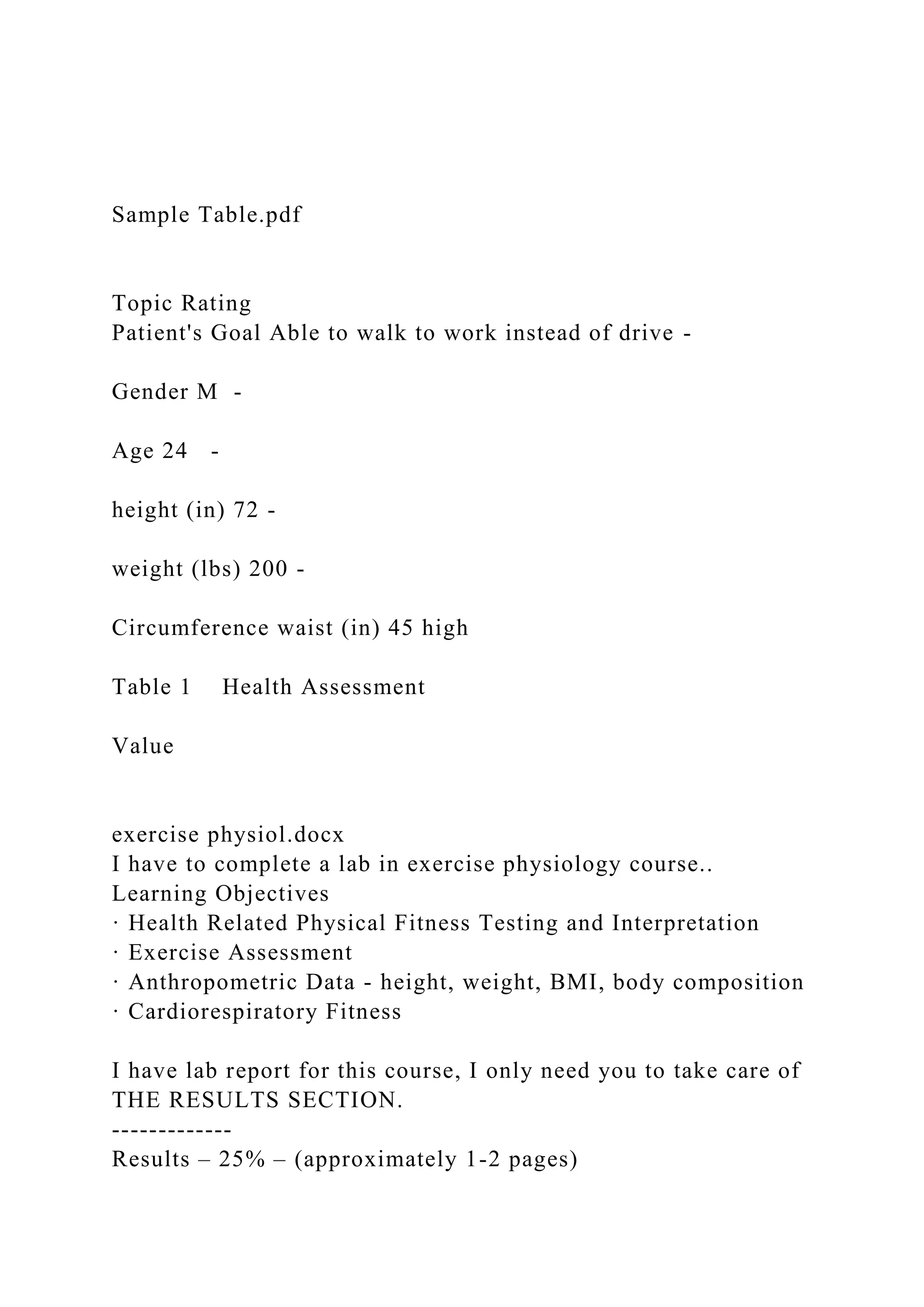
Sample Table.pdf
Topic Rating
Patient's Goal Able to walk to work instead of drive -
Gender M -
Age 24 -
height (in) 72 -
weight (lbs) 200 -
Circumference waist (in) 45 high
Table 1 Health Assessment
Value
exercise physiol.docx
I have to complete a lab in exercise physiology course..
Learning Objectives
· Health Related Physical Fitness Testing and Interpretation
· Exercise Assessment
· Anthropometric Data - height, weight, BMI, body composition
· Cardiorespiratory Fitness
I have lab report for this course, I only need you to take care of
THE RESULTS SECTION.
-------------
Results – 25% – (approximately 1-2 pages)
Present in a clear, concise, logical manner the results of the
data you are given and must calculate, compared to
norms listed in the texts and other resources you may select
depending on which of the three lab reports you are
completing. Present the information in tables only.
----------------------
in the attachments you will see all info needed about the lab
report and what you need to know about the results.
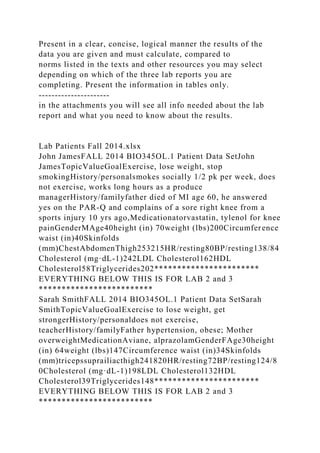
Lab Patients Fall 2014.xlsx
John JamesFALL 2014 BIO345OL.1 Patient Data SetJohn
JamesTopicValueGoalExercise, lose weight, stop
smokingHistory/personalsmokes socially 1/2 pk per week, does
not exercise, works long hours as a produce
managerHistory/familyfather died of MI age 60, he answered
yes on the PAR-Q and complains of a sore right knee from a
sports injury 10 yrs ago,Medicationatorvastatin, tylenol for knee
painGenderMAge40height (in) 70weight (lbs)200Circumference
waist (in)40Skinfolds
(mm)ChestAbdomenThigh253215HR/resting80BP/resting138/84
Cholesterol (mg·dL-1)242LDL Cholesterol162HDL
Cholesterol58Triglycerides202***********************
EVERYTHING BELOW THIS IS FOR LAB 2 and 3
*************************
Sarah SmithFALL 2014 BIO345OL.1 Patient Data SetSarah
SmithTopicValueGoalExercise to lose weight, get
strongerHistory/personaldoes not exercise,
teacherHistory/familyFather hypertension, obese; Mother
overweightMedicationAviane, alprazolamGenderFAge30height
(in) 64weight (lbs)147Circumference waist (in)34Skinfolds
(mm)tricepssuprailiacthigh241820HR/resting72BP/resting124/8
0Cholesterol (mg·dL-1)198LDL Cholesterol132HDL
Cholesterol39Triglycerides148***********************
EVERYTHING BELOW THIS IS FOR LAB 2 and 3
*************************
Larry LevineFALL 2014 BIO345OL.1 Patient Data SetLarry
LevineTopicValueGoalrun a 10k without
stoppingHistory/personalsoftware engineer, Gym exercise
3x/wk elliptical and weightsHistory/familyFather has Type II
Diabetes Mellitus; Mother overweight mild
hypertensionMedicationnoneGenderMAge30height (in)
69weight (lbs)172Circumference waist (in)39Skinfolds
(mm)ChestAbdomenThigh183022HR/resting78BP/resting124/82
Cholesterol (mg·dL-1)188LDL Cholesterol110HDL
Cholesterol43Triglycerides152***********************
EVERYTHING BELOW THIS IS FOR LAB 2 and 3
*************************
Alice AmesFALL 2014 BIO345OL.1 Patient Data SetAlice
AmesTopicValueGoalSet up a routine that she can do with her
job which involves travel, History/personalflight attendant,
sleeps in hotel often, difficulty recovering from work/travel,
difficulty sleeping, occasionally smokesHistory/familyParents
both with COPD MedicationLorezepam at bedtime, sumatriptan,
Lutera, GenderFAge42height (in) 65weight
(lbs)145Circumference waist (in)36Skinfolds
(mm)tricepssuprailiacthigh201922HR/resting80BP/resting130/8
2Cholesterol (mg·dL-1)222LDL Cholesterol135HDL
Cholesterol50Triglycerides134***********************
EVERYTHING BELOW THIS IS FOR LAB 2 and 3
*************************
Mike McCoyFALL 2014 BIO345OL.1 Patient Data SetMike
McCoyTopicValueGoalExercise to lose weight, get
strongerHistory/personalCar sales manager, high stress job,
occasionally gets dizziness due to vertigoHistory/familyfather
deceased with MI; Mother alive with hypertension, obese
Medication Paxil, Allegra, SimvastatinGenderMAge40height
(in) 71weight (lbs)220Circumference waist (in)41Skinfolds
(mm)ChestAbdomenThigh223820HR/resting88BP/resting140/92
Cleared by MD for exerciseCholesterol (mg·dL-1)220LDL
Cholesterol162HDL
Cholesterol45Triglycerides168***********************
EVERYTHING BELOW THIS IS FOR LAB 2 and 3
*************************
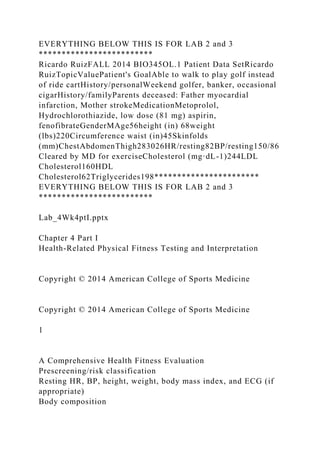
Ricardo RuizFALL 2014 BIO345OL.1 Patient Data SetRicardo
RuizTopicValuePatient's GoalAble to walk to play golf instead
of ride cartHistory/personalWeekend golfer, banker, occasional
cigarHistory/familyParents deceased: Father myocardial
infarction, Mother strokeMedicationMetoprolol,
Hydrochlorothiazide, low dose (81 mg) aspirin,
fenofibrateGenderMAge56height (in) 68weight
(lbs)220Circumference waist (in)45Skinfolds
(mm)ChestAbdomenThigh283026HR/resting82BP/resting150/86
Cleared by MD for exerciseCholesterol (mg·dL-1)244LDL
Cholesterol160HDL
Cholesterol62Triglycerides198***********************
EVERYTHING BELOW THIS IS FOR LAB 2 and 3
*************************
Lab_4Wk4ptI.pptx
Chapter 4 Part I
Health-Related Physical Fitness Testing and Interpretation
Copyright © 2014 American College of Sports Medicine
1
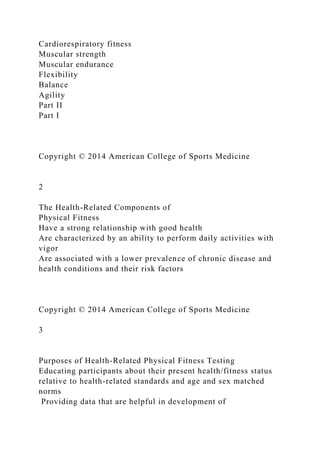
A Comprehensive Health Fitness Evaluation
Prescreening/risk classification
Resting HR, BP, height, weight, body mass index, and ECG (if
appropriate)
Body composition
Cardiorespiratory fitness
Muscular strength
Muscular endurance
Flexibility
Balance
Agility
Part II
Part I
Copyright © 2014 American College of Sports Medicine
2
The Health-Related Components of
Physical Fitness
Have a strong relationship with good health
Are characterized by an ability to perform daily activities with
vigor
Are associated with a lower prevalence of chronic disease and
health conditions and their risk factors
Copyright © 2014 American College of Sports Medicine
3
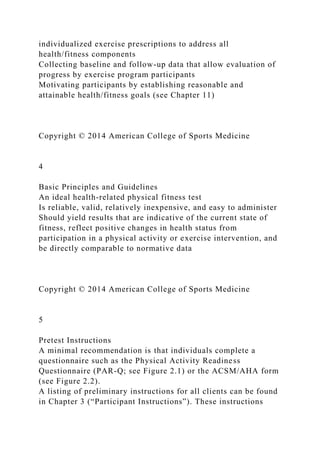
Purposes of Health-Related Physical Fitness Testing
Educating participants about their present health/fitness status
relative to health-related standards and age and sex matched
norms
Providing data that are helpful in development of
individualized exercise prescriptions to address all
health/fitness components
Collecting baseline and follow-up data that allow evaluation of
progress by exercise program participants
Motivating participants by establishing reasonable and
attainable health/fitness goals (see Chapter 11)
Copyright © 2014 American College of Sports Medicine
4
Basic Principles and Guidelines
An ideal health-related physical fitness test
Is reliable, valid, relatively inexpensive, and easy to administer
Should yield results that are indicative of the current state of
fitness, reflect positive changes in health status from
participation in a physical activity or exercise intervention, and
be directly comparable to normative data
Copyright © 2014 American College of Sports Medicine
5
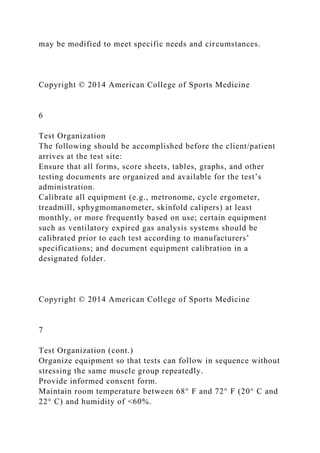
Pretest Instructions
A minimal recommendation is that individuals complete a
questionnaire such as the Physical Activity Readiness
Questionnaire (PAR-Q; see Figure 2.1) or the ACSM/AHA form
(see Figure 2.2).
A listing of preliminary instructions for all clients can be found
in Chapter 3 (“Participant Instructions”). These instructions
may be modified to meet specific needs and circumstances.
Copyright © 2014 American College of Sports Medicine
6
Test Organization
The following should be accomplished before the client/patient
arrives at the test site:
Ensure that all forms, score sheets, tables, graphs, and other
testing documents are organized and available for the test’s
administration.
Calibrate all equipment (e.g., metronome, cycle ergometer,
treadmill, sphygmomanometer, skinfold calipers) at least
monthly, or more frequently based on use; certain equipment
such as ventilatory expired gas analysis systems should be
calibrated prior to each test according to manufacturers’
specifications; and document equipment calibration in a
designated folder.
Copyright © 2014 American College of Sports Medicine
7
Test Organization (cont.)
Organize equipment so that tests can follow in sequence without
stressing the same muscle group repeatedly.
Provide informed consent form.
Maintain room temperature between 68° F and 72° F (20° C and
22° C) and humidity of <60%.
Copyright © 2014 American College of Sports Medicine
8
Test Organization (cont.)
Resting measurements should be obtained first:
Heart rate
Blood pressure
Height
Weight
Body composition
Copyright © 2014 American College of Sports Medicine
9
Test Organization (cont.)
Research has not established an optimal testing order for
multiple health-related components of fitness (i.e.,
cardiorespiratory [CR] endurance, muscular fitness, body
composition, and flexibility), but sufficient time should be
allowed for HR and BP to return to baseline between tests
conducted serially.
Because certain medications, such as β-blockers which lower
HR, will affect some physical fitness test results, use of these
medications should be noted.
Copyright © 2014 American College of Sports Medicine
10
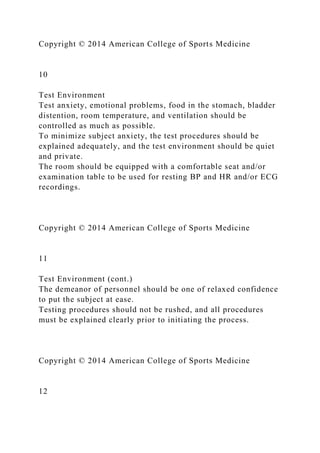
Test Environment
Test anxiety, emotional problems, food in the stomach, bladder
distention, room temperature, and ventilation should be
controlled as much as possible.
To minimize subject anxiety, the test procedures should be
explained adequately, and the test environment should be quiet
and private.
The room should be equipped with a comfortable seat and/or
examination table to be used for resting BP and HR and/or ECG
recordings.
Copyright © 2014 American College of Sports Medicine
11
Test Environment (cont.)
The demeanor of personnel should be one of relaxed confidence
to put the subject at ease.
Testing procedures should not be rushed, and all procedures
must be explained clearly prior to initiating the process.
Copyright © 2014 American College of Sports Medicine
12
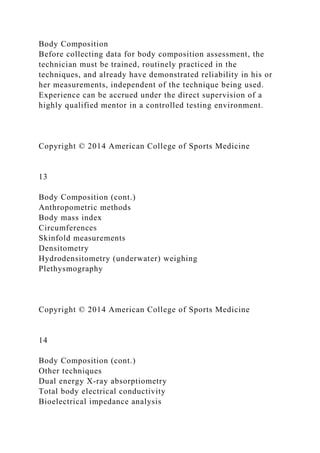
Body Composition
Before collecting data for body composition assessment, the
technician must be trained, routinely practiced in the
techniques, and already have demonstrated reliability in his or
her measurements, independent of the technique being used.
Experience can be accrued under the direct supervision of a
highly qualified mentor in a controlled testing environment.
Copyright © 2014 American College of Sports Medicine
13
Body Composition (cont.)
Anthropometric methods
Body mass index
Circumferences
Skinfold measurements
Densitometry
Hydrodensitometry (underwater) weighing
Plethysmography
Copyright © 2014 American College of Sports Medicine
14
Body Composition (cont.)
Other techniques
Dual energy X-ray absorptiometry
Total body electrical conductivity
Bioelectrical impedance analysis
Near-infrared interactance
Copyright © 2014 American College of Sports Medicine
15
Body Mass Index
The BMI is used to assess weight relative to height and is
calculated by dividing body weight in kilograms by height in
meters squared (kg · m−2)
For most individuals, obesity-related health problems increase
beyond a BMI of 25.0 kg · m−2, and the Expert Panel on the
Identification, Evaluation, and Treatment of Overweight and
Obesity in Adults defines a BMI of 25.0–29.9 kg · m−2 as
overweight and a BMI of ≥30.0 kg · m−2 as obese.
Copyright © 2014 American College of Sports Medicine
16
Copyright © 2014 American College of Sports Medicine
17
41. Gallagher D, Heymsfield SB, Heo M, Jebb SA, Murgatroyd
PR, Sakamoto Y. Healthy percentage body fat ranges: an
approach for developing guidelines based on body mass index.
Am J Clin Nutr. 2000;72(3):694–701.
Copyright © 2014 American College of Sports Medicine
18
Circumferences
The pattern of body fat distribution is recognized as an
important indicator of health and prognosis.
Android obesity that is characterized by more fat on the trunk
(abdominal fat) increases the risk of hypertension, metabolic
syndrome, Type 2 diabetes mellitus, dyslipidemia, CVD, and
premature death compared with individuals who demonstrate
gynoid or gynecoid obesity (fat distributed in the hip and
thigh).
Copyright © 2014 American College of Sports Medicine
19
Circumferences (cont.)
A cloth tape measure with a spring-loaded handle (Gulick tape
measure) reduces skin compression and improves consistency of
measurement.
Duplicate measurements are recommended at each site and
should be obtained in a rotational instead of a consecutive order
(take measurements of all sites being assessed and then repeat
the sequence).
The average of the two measures is used provided they do not
differ by more than 5mm.
Copyright © 2014 American College of Sports Medicine
20
Box 4.1 Standardized Description of Circumference Sites and
Procedures
Abdomen: With the subject standing upright and relaxed, a
horizontal measure taken at the height of the iliac crest, usually
at the level of the umbilicus.
Arm: With the subject standing erect and arms hanging freely at
the sides with hands facing the thigh, a horizontal measure
midway between the acromion and olecranon processes.
Buttocks/Hips: With the subject standing erect and feet
together, a horizontal measure is taken at the maximal
circumference of buttocks. This measure is used for the hip
measure in a waist/hip measure.
Calf: With the subject standing erect (feet apart ~20 cm), a
horizontal measure taken at the level of the maximum
circumference between the knee and the ankle, perpendicular to
the long axis.
Forearm: With the subject standing, arms hanging downward
but slightly away from the trunk and palms facing anteriorly, a
measure is taken perpendicular to the long axis at the maximal
circumference.
Copyright © 2014 American College of Sports Medicine
21
Box 4.1 Standardized Description of Circumference Sites and
Procedures (cont.)
Hips/Thigh: With the subject standing, legs slightly apart (~10
cm), a horizontal measure is taken at the maximal circumference
of the hip/proximal thigh, just below the gluteal fold.
Mid-Thigh: With the subject standing and one foot on a bench
so the knee is flexed at 90 degrees, a measure is taken midway
between the inguinal crease and the proximal border of the
patella, perpendicular to the long axis.
Waist: With the subject standing, arms at the sides, feet
together, and abdomen relaxed, a horizontal measure is taken at
the narrowest part of the torso (above the umbilicus and below
the xiphoid process). The National Obesity Task Force (NOTF)
suggests obtaining a horizontal measure directly above the iliac
crest as a method to enhance standardization. Unfortunately,
current formulae are not predicated on the NOTF suggested site.
Copyright © 2014 American College of Sports Medicine
22
Box 4.1 Standardized Description of Circumference Sites and
Procedures (cont.)
All measurements should be made with a flexible yet inelastic
tape measure.
The tape should be placed on the skin surface without
compressing the subcutaneous adipose tissue.
If a Gulick spring-loaded handle is used, the handle should be
extended to the same marking with each trial.
Take duplicate measures at each site and retest if duplicate
measurements are not within 5 mm.
Rotate through measurement sites or allow time for skin to
regain normal texture.
Modified from (18).
Procedures
Copyright © 2014 American College of Sports Medicine
23
Circumferences (cont.)
Waist-to-Hip Ratio (WHR)
The waist-to-hip ratio is the circumference of the waist (above
the iliac crest) divided by the circumference of the hips
(buttocks/hips measure) and has traditionally been used as a
simple method for assessing body fat distribution and
identifying individuals with higher and more detrimental
amounts of abdominal fat.
Health risk increases as WHR increases, and the standards for
risk vary with age and sex.
Copyright © 2014 American College of Sports Medicine
24
Circumferences (cont.)
Waist-to-Hip Ratio (cont.)
Health risk is very high for young men when WHR is >0.95 and
for young women when WHR is >0.86.
For individuals aged 60–69 yr, the WHR cutoff values are >1.03
for men and >0.90 for women for the same high-risk
classification as young adults.
Copyright © 2014 American College of Sports Medicine
25
Circumferences (cont.)
Waist Circumference
The waist circumference can be used alone as an indicator of
health risk because abdominal obesity is the primary issue.
The Expert Panel on the Identification, Evaluation, and
Treatment of Overweight and Obesity in Adults provides a
classification of disease risk based on both BMI and waist
circumference as shown in Table 4.1.
Copyright © 2014 American College of Sports Medicine
26
Circumferences (cont.)
Waist Circumference (cont.)
A newer risk stratification scheme for adults based on waist
circumference has been proposed (see Table 4.3).
Evidence indicates that all currently available waist
circumference measurement techniques are equally reliable and
effective in identifying individuals at increased health risk.
Copyright © 2014 American College of Sports Medicine
27
Measurement of waist circumference immediately above the
iliac crest, as proposed by National Institutes of Health
guidelines, may be the preferable circumference method to
assess health risk given the ease by which this anatomical
landmark is identified (25).
Measurement of Waist Circumference
(first unnumbered box on p. 67)
Copyright © 2014 American College of Sports Medicine
14. Bray GA. Don’t throw the baby out with the bath water. Am
J Clin Nutr. 2004;79(3):347–9.
Copyright © 2014 American College of Sports Medicine
29
Skinfold Measurements
Body composition determined from skinfold thickness
measurements correlates well (r = 0.70–0.90) with body
composition determined by hydrodensitometry.
The principle behind skinfold measurements is that the amount
of subcutaneous fat is proportional to the total amount of body
fat.
It is assumed that close to one-third of the total fat is located
subcutaneously.
Copyright © 2014 American College of Sports Medicine
30
Skinfold Measurements (cont.)
The exact proportion of subcutaneous to total fat varies with
sex, age, and race.
Regression equations used to convert sum of skinfolds to
percent body fat should consider these variables for greatest
accuracy.
Copyright © 2014 American College of Sports Medicine
31
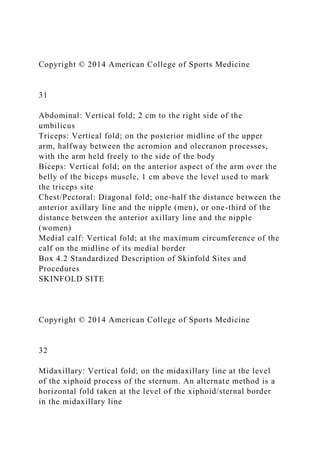
Abdominal: Vertical fold; 2 cm to the right side of the
umbilicus
Triceps: Vertical fold; on the posterior midline of the upper
arm, halfway between the acromion and olecranon processes,
with the arm held freely to the side of the body
Biceps: Vertical fold; on the anterior aspect of the arm over the
belly of the biceps muscle, 1 cm above the level used to mark
the triceps site
Chest/Pectoral: Diagonal fold; one-half the distance between the
anterior axillary line and the nipple (men), or one-third of the
distance between the anterior axillary line and the nipple
(women)
Medial calf: Vertical fold; at the maximum circumference of the
calf on the midline of its medial border
Box 4.2 Standardized Description of Skinfold Sites and
Procedures
SKINFOLD SITE
Copyright © 2014 American College of Sports Medicine
32
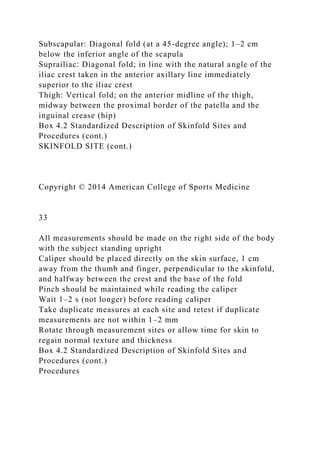
Midaxillary: Vertical fold; on the midaxillary line at the level
of the xiphoid process of the sternum. An alternate method is a
horizontal fold taken at the level of the xiphoid/sternal border
in the midaxillary line
Subscapular: Diagonal fold (at a 45-degree angle); 1–2 cm
below the inferior angle of the scapula
Suprailiac: Diagonal fold; in line with the natural angle of the
iliac crest taken in the anterior axillary line immediately
superior to the iliac crest
Thigh: Vertical fold; on the anterior midline of the thigh,
midway between the proximal border of the patella and the
inguinal crease (hip)
Box 4.2 Standardized Description of Skinfold Sites and
Procedures (cont.)
SKINFOLD SITE (cont.)
Copyright © 2014 American College of Sports Medicine
33
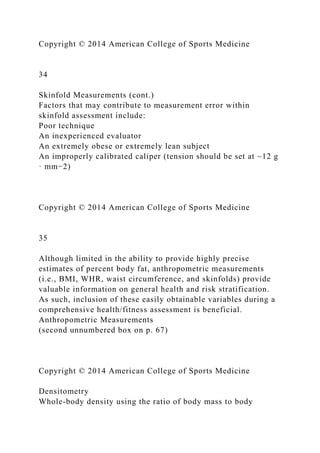
All measurements should be made on the right side of the body
with the subject standing upright
Caliper should be placed directly on the skin surface, 1 cm
away from the thumb and finger, perpendicular to the skinfold,
and halfway between the crest and the base of the fold
Pinch should be maintained while reading the caliper
Wait 1–2 s (not longer) before reading caliper
Take duplicate measures at each site and retest if duplicate
measurements are not within 1–2 mm
Rotate through measurement sites or allow time for skin to
regain normal texture and thickness
Box 4.2 Standardized Description of Skinfold Sites and
Procedures (cont.)
Procedures
Copyright © 2014 American College of Sports Medicine
34
Skinfold Measurements (cont.)
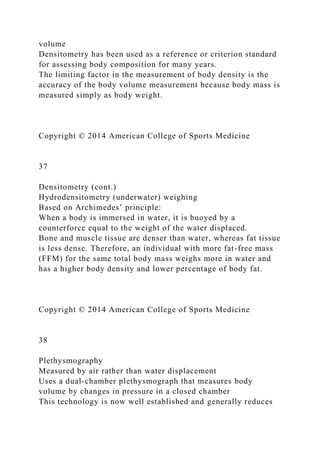
Factors that may contribute to measurement error within
skinfold assessment include:
Poor technique
An inexperienced evaluator
An extremely obese or extremely lean subject
An improperly calibrated caliper (tension should be set at ~12 g
· mm−2)
Copyright © 2014 American College of Sports Medicine
35
Although limited in the ability to provide highly precise
estimates of percent body fat, anthropometric measurements
(i.e., BMI, WHR, waist circumference, and skinfolds) provide
valuable information on general health and risk stratification.
As such, inclusion of these easily obtainable variables during a
comprehensive health/fitness assessment is beneficial.
Anthropometric Measurements
(second unnumbered box on p. 67)
Copyright © 2014 American College of Sports Medicine
Densitometry
Whole-body density using the ratio of body mass to body
volume
Densitometry has been used as a reference or criterion standard
for assessing body composition for many years.
The limiting factor in the measurement of body density is the
accuracy of the body volume measurement because body mass is
measured simply as body weight.
Copyright © 2014 American College of Sports Medicine
37
Densitometry (cont.)
Hydrodensitometry (underwater) weighing
Based on Archimedes’ principle:
When a body is immersed in water, it is buoyed by a
counterforce equal to the weight of the water displaced.
Bone and muscle tissue are denser than water, whereas fat tissue
is less dense. Therefore, an individual with more fat-free mass
(FFM) for the same total body mass weighs more in water and
has a higher body density and lower percentage of body fat.
Copyright © 2014 American College of Sports Medicine
38
Plethysmography
Measured by air rather than water displacement
Uses a dual-chamber plethysmograph that measures body
volume by changes in pressure in a closed chamber
This technology is now well established and generally reduces
the anxiety associated with the technique of hydrodensitometry
Copyright © 2014 American College of Sports Medicine
39
Other Techniques
Reliable and accurate body composition assessment techniques
include dual-energy X-ray absorptiometry (DEXA) and total
body electrical conductivity (TOBEC), but these techniques
have limited applicability in routine health/fitness testing
because of cost and the need for highly trained personnel.
Copyright © 2014 American College of Sports Medicine
40
Other Techniques (cont.)
Bioelectrical impedance analysis (BIA) and near-infrared
interactance are used as assessment techniques in routine
health/fitness testing. Generally, the accuracy of BIA is similar
to skinfolds, as long as stringent protocol adherence (e.g.,
assurance of normal hydration status) is followed, and the
equations programmed into the analyzer are valid and accurate
for the populations being tested.
Copyright © 2014 American College of Sports Medicine
Other Techniques (cont.)
The ability of BIA to provide an accurate assessment of percent
body fat in obese individuals may be limited secondary to
differences in body water distribution compared to those who
are in the normal weight range. Near-infrared interactance
requires additional research to substantiate the validity and
accuracy for body composition assessment.
Copyright © 2014 American College of Sports Medicine
Body Composition Norms
See Tables 4.5 and 4.6 on the next two slides.
Copyright © 2014 American College of Sports Medicine
43
Copyright © 2014 American College of Sports Medicine
44
Copyright © 2014 American College of Sports Medicine
45
Body Composition Norms (cont.)
A consensus opinion for an exact percent body fat value
associated with optimal health risk has yet to be defined.
A range of 10%–22% and 20%–32% for men and women,
respectively, has long been viewed as satisfactory for health.
More recent data support this range although age and race, in
addition to sex, impact what may be construed as a healthy
percent body fat.
Copyright © 2014 American College of Sports Medicine
46
Cardiorespiratory Fitness
Low levels of CR fitness have been associated with a markedly
increased risk of premature death from all causes and
specifically from cardiovascular disease
Increases in CR fitness are associated with a reduction in death
from all causes.
High levels of CR fitness are associated with higher levels of
habitual physical activity, which in turn are associated with
many health benefits.
The assessment of CR fitness is an important part of a primary
or secondary prevention and rehabilitative programs.
Copyright © 2014 American College of Sports Medicine
47
The Concept of Maximal Oxygen Uptake
Estimates of VO2max from the HR response to submaximal
exercise tests are based on these assumptions:
A steady state HR is obtained for each exercise work rate.
A linear relationship exists between HR and work rate.
The difference between actual and predicted maximal HR is
minimal.
.
.
Copyright © 2014 American College of Sports Medicine
48
The Concept of Maximal Oxygen Uptake (cont.)
Mechanical efficiency (i.e., VO2 at a given work rate) is the
same for everyone.
The subject is not on medications that alter HR, using high
quantities of caffeine, under large amounts of stress, ill, or in a
high temperature environment, all of which may alter HR.
.
.
Copyright © 2014 American College of Sports Medicine
49
Modes of Testing
Commonly used modes for exercise testing:
Field tests
Cycle ergometer tests
Treadmill tests
Step tests
Copyright © 2014 American College of Sports Medicine
50
Modes of Testing (cont.)
Field Tests
Cooper 12-min test
1.5-mi (2.4 km) test for time
Rockport One-Mile Fitness Walking Test
Copyright © 2014 American College of Sports Medicine
51
Modes of Testing (cont.)
Submaximal Exercise Tests
Cycle Ergometer Tests
Astrand-Rhyming Cycle Ergometer Test
YMCA Cycle Ergometer Test
Copyright © 2014 American College of Sports Medicine
52
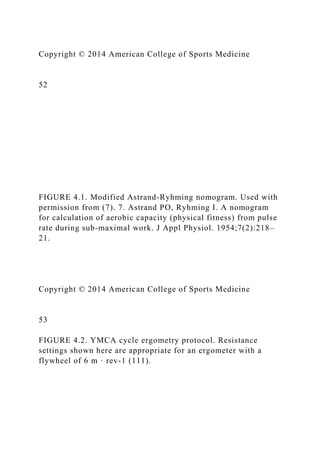
FIGURE 4.1. Modified Astrand-Ryhming nomogram. Used with
permission from (7). 7. Astrand PO, Ryhming I. A nomogram
for calculation of aerobic capacity (physical fitness) from pulse
rate during sub-maximal work. J Appl Physiol. 1954;7(2):218–
21.
Copyright © 2014 American College of Sports Medicine
53
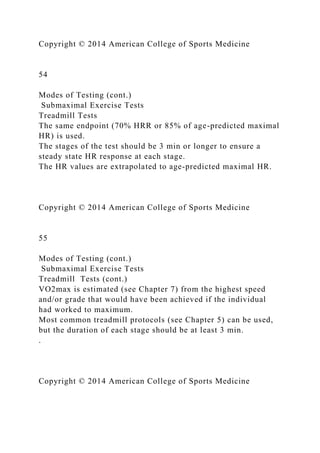
FIGURE 4.2. YMCA cycle ergometry protocol. Resistance
settings shown here are appropriate for an ergometer with a
flywheel of 6 m · rev-1 (111).
Copyright © 2014 American College of Sports Medicine
54
Modes of Testing (cont.)
Submaximal Exercise Tests
Treadmill Tests
The same endpoint (70% HRR or 85% of age-predicted maximal
HR) is used.
The stages of the test should be 3 min or longer to ensure a
steady state HR response at each stage.
The HR values are extrapolated to age-predicted maximal HR.
Copyright © 2014 American College of Sports Medicine
55
Modes of Testing (cont.)
Submaximal Exercise Tests
Treadmill Tests (cont.)
VO2max is estimated (see Chapter 7) from the highest speed
and/or grade that would have been achieved if the individual
had worked to maximum.
Most common treadmill protocols (see Chapter 5) can be used,
but the duration of each stage should be at least 3 min.
.
Copyright © 2014 American College of Sports Medicine
56
Modes of Testing (cont.)
Submaximal Exercise Tests
Step Tests
Astrand and Ryhming
Canadian Home Fitness Test
3-Minute YMCA Step Test
Copyright © 2014 American College of Sports Medicine
2nd paragraph on page 87 in “Step Tests” should be indented?
57
Cardiorespiratory Test Sequence
and Measures
A minimum of HR, BP, and subjective symptoms (RPE,
dyspnea, and angina) should be measured during exercise tests.
After the initial screening process, selected baseline
measurements should be obtained prior to the start of the
exercise test.
Copyright © 2014 American College of Sports Medicine
58
Cardiorespiratory Test Sequence
and Measures (cont.)
Heart Rate (HR)
HR can be determined using several techniques including radial
pulse palpation, auscultation with a stethoscope, or the use of
HR monitors.
The pulse palpation technique involves “feeling” the pulse by
placing the second and third fingers (index and middle fingers)
most typically over the radial artery.
For the auscultation method, the bell of the stethoscope should
be placed to the left of the sternum just above the level of the
nipple.
Copyright © 2014 American College of Sports Medicine
59
Cardiorespiratory Test Sequence
and Measures (cont.)
Blood Pressure (BP)
BP should be measured at heart level with the subject’s arm
relaxed and not grasping a handrail (treadmill) or handlebar
(cycle ergometer).
Systolic (SBP) and diastolic (DBP) BP measurements can be
used as indicators for stopping an exercise test.
Copyright © 2014 American College of Sports Medicine
60
Cardiorespiratory Test Sequence
and Measures (cont.)
Rating of Perceived Exertion (RPE)
RPE can be a valuable indicator for monitoring an individual’s
exercise tolerance.
Ratings can be influenced by psychological factors, mood
states, environmental conditions, exercise modes, and age
reducing its utility.
Currently, two RPE scales are widely used: (a) the original Borg
or category scale, which rates exercise intensity from 6 to 20
(see Table 4.7); and (b) the category-ratio scale of 0–10. Both
RPE scales are appropriate subjective tools.
Copyright © 2014 American College of Sports Medicine
61
Onset of angina or angina-like symptoms
Drop in SBP of ≥10 mm Hg with an increase in work rate or if
SBP decreases below the value obtained in the same position
prior to testing
Excessive rise in BP: systolic pressure >250 mm Hg and/or
diastolic pressure >115 mm Hg
Shortness of breath, wheezing, leg cramps, or claudication
Signs of poor perfusion: light-headedness, confusion, ataxia,
pallor, cyanosis, nausea, or cold and clammy skin
Failure of HR to increase with increased exercise intensity
Box 4.5 General Indications for Stopping an Exercise Testa
Copyright © 2014 American College of Sports Medicine
62
Noticeable change in heart rhythm by palpation or auscultation
Subject requests to stop
Physical or verbal manifestations of severe fatigue
Failure of the testing equipment
aAssumes that testing is nondiagnostic and is being performed
without direct physician involvement or ECG monitoring. For
clinical testing, Box 5.2 provides more definitive and specific
termination criteria.
BP, blood pressure; ECG, electrocardiogram; HR, heart rate;
SBP, systolic blood pressure.
Box 4.5 General Indications for Stopping an Exercise Testa
(cont.)
Copyright © 2014 American College of Sports Medicine
63
LabAssignment1.pdf
BIO345OL.1 Lab 1 Cigna
MCPHS University
College of Arts and Sciences
Exercise Physiology
Laboratory Report 1: 25%
Health Assessment
Overall Instructions
Lab reports must be typewritten and submitted in PDF format.
MS Word allows you to save your WORD document as
a PDF file. This allows the PDF document to be uploaded into
Blackboard. Type should be no less than 10-12 point
fonts and double-spaced. Margins should not be less than one
inch. Proof reading is important and points will be
deducted for incorrect formatting of the lab report, improper
spelling and incorrect grammar. Use the format
listed in the course syllabus and each lab report description
EXACTLY for all lab reports.
Completed reports must be submitted by each individual of each
group by week #4 Wednesday 9/24/14 by 9pm.
Laboratory Report 1 – Health Assessment
Purpose: To describe what this lab will accomplish. For this
section begin by providing a brief introduction paragraph
with citations and references in AMA format. Next, state the
purpose of the lab which is to perform a Health
Assessment of the individual assigned to you from the Lab
Patients Fall 2014 data set. Each data set will include
information such as patient’s goals, personal and family history,
medications, gender, height, weight, anthropometric
data, resting physiological data, and lipid profile. This lab will
also include calculated data listed below. Note: There is
no exercise testing data in lab report 1 but will be available for
subsequent labs.
Methods: Describe how the measurements and data presented in
the results are obtained. Patient information is
provided by interview. All other tests should be briefly
explained such as height, weight, waist circumference, skin
folds, resting physiological measurements and lipid profile. In
addition present a brief explanation with formulas as
necessary for determining calculated data: BMI, percent body
fat, estimated maximum HR and risk classification
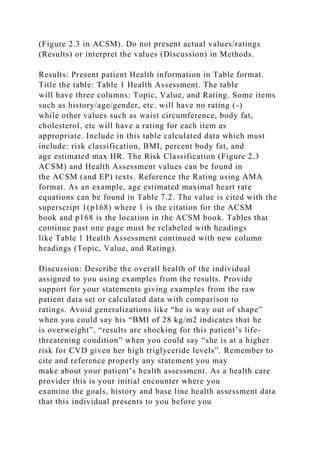
(Figure 2.3 in ACSM). Do not present actual values/ratings
(Results) or interpret the values (Discussion) in Methods.
Results: Present patient Health information in Table format.
Title the table: Table 1 Health Assessment. The table
will have three columns: Topic, Value, and Rating. Some items
such as history/age/gender, etc. will have no rating (-)
while other values such as waist circumference, body fat,
cholesterol, etc will have a rating for each item as
appropriate. Include in this table calculated data which must
include: risk classification, BMI, percent body fat, and
age estimated max HR. The Risk Classification (Figure 2.3
ACSM) and Health Assessment values can be found in
the ACSM (and EP) texts. Reference the Rating using AMA
format. As an example, age estimated maximal heart rate
equations can be found in Table 7.2. The value is cited with the
superscript 1(p168) where 1 is the citation for the ACSM
book and p168 is the location in the ACSM book. Tables that
continue past one page must be relabeled with headings
like Table 1 Health Assessment continued with new column
headings (Topic, Value, and Rating).
Discussion: Describe the overall health of the individual
assigned to you using examples from the results. Provide
support for your statements giving examples from the raw
patient data set or calculated data with comparison to
ratings. Avoid generalizations like “he is way out of shape”
when you could say his “BMI of 28 kg/m2 indicates that he
is overweight”, “results are shocking for this patient’s life-
threatening condition” when you could say “she is at a higher
risk for CVD given her high triglyceride levels”. Remember to
cite and reference properly any statement you may
make about your patient’s health assessment. As a health care
provider this is your initial encounter where you
examine the goals, history and base line health assessment data
that this individual presents to you before you
conduct any further exercise testing (Lab 2) or assign an
exercise prescription (Final Lab). Although diet is recognized
as important it is not the focus of this course so avoid any
dietary recommendations.
References: Cite and reference all resources you use to
complete this lab report using AMA format. A good lab report
cites and references more than just the assigned texts.
Laboratory Report Format
This is a GROUP report. Everyone in the group must submit the
same lab report so collaboration is important as only
one grade will be assigned to your entire group. Your grade is
not the quantity but the quality of information.

Sample Table.pdfTopic RatingPatients Goal Able to walk .docx

  • 1.
    Sample Table.pdf Topic Rating Patient'sGoal Able to walk to work instead of drive - Gender M - Age 24 - height (in) 72 - weight (lbs) 200 - Circumference waist (in) 45 high Table 1 Health Assessment Value exercise physiol.docx I have to complete a lab in exercise physiology course.. Learning Objectives · Health Related Physical Fitness Testing and Interpretation · Exercise Assessment · Anthropometric Data - height, weight, BMI, body composition · Cardiorespiratory Fitness I have lab report for this course, I only need you to take care of THE RESULTS SECTION. ------------- Results – 25% – (approximately 1-2 pages)
  • 2.
    Present in aclear, concise, logical manner the results of the data you are given and must calculate, compared to norms listed in the texts and other resources you may select depending on which of the three lab reports you are completing. Present the information in tables only. ---------------------- in the attachments you will see all info needed about the lab report and what you need to know about the results. Lab Patients Fall 2014.xlsx John JamesFALL 2014 BIO345OL.1 Patient Data SetJohn JamesTopicValueGoalExercise, lose weight, stop smokingHistory/personalsmokes socially 1/2 pk per week, does not exercise, works long hours as a produce managerHistory/familyfather died of MI age 60, he answered yes on the PAR-Q and complains of a sore right knee from a sports injury 10 yrs ago,Medicationatorvastatin, tylenol for knee painGenderMAge40height (in) 70weight (lbs)200Circumference waist (in)40Skinfolds (mm)ChestAbdomenThigh253215HR/resting80BP/resting138/84 Cholesterol (mg·dL-1)242LDL Cholesterol162HDL Cholesterol58Triglycerides202*********************** EVERYTHING BELOW THIS IS FOR LAB 2 and 3 ************************* Sarah SmithFALL 2014 BIO345OL.1 Patient Data SetSarah SmithTopicValueGoalExercise to lose weight, get strongerHistory/personaldoes not exercise, teacherHistory/familyFather hypertension, obese; Mother overweightMedicationAviane, alprazolamGenderFAge30height (in) 64weight (lbs)147Circumference waist (in)34Skinfolds (mm)tricepssuprailiacthigh241820HR/resting72BP/resting124/8 0Cholesterol (mg·dL-1)198LDL Cholesterol132HDL Cholesterol39Triglycerides148*********************** EVERYTHING BELOW THIS IS FOR LAB 2 and 3 *************************
  • 3.
    Larry LevineFALL 2014BIO345OL.1 Patient Data SetLarry LevineTopicValueGoalrun a 10k without stoppingHistory/personalsoftware engineer, Gym exercise 3x/wk elliptical and weightsHistory/familyFather has Type II Diabetes Mellitus; Mother overweight mild hypertensionMedicationnoneGenderMAge30height (in) 69weight (lbs)172Circumference waist (in)39Skinfolds (mm)ChestAbdomenThigh183022HR/resting78BP/resting124/82 Cholesterol (mg·dL-1)188LDL Cholesterol110HDL Cholesterol43Triglycerides152*********************** EVERYTHING BELOW THIS IS FOR LAB 2 and 3 ************************* Alice AmesFALL 2014 BIO345OL.1 Patient Data SetAlice AmesTopicValueGoalSet up a routine that she can do with her job which involves travel, History/personalflight attendant, sleeps in hotel often, difficulty recovering from work/travel, difficulty sleeping, occasionally smokesHistory/familyParents both with COPD MedicationLorezepam at bedtime, sumatriptan, Lutera, GenderFAge42height (in) 65weight (lbs)145Circumference waist (in)36Skinfolds (mm)tricepssuprailiacthigh201922HR/resting80BP/resting130/8 2Cholesterol (mg·dL-1)222LDL Cholesterol135HDL Cholesterol50Triglycerides134*********************** EVERYTHING BELOW THIS IS FOR LAB 2 and 3 ************************* Mike McCoyFALL 2014 BIO345OL.1 Patient Data SetMike McCoyTopicValueGoalExercise to lose weight, get strongerHistory/personalCar sales manager, high stress job, occasionally gets dizziness due to vertigoHistory/familyfather deceased with MI; Mother alive with hypertension, obese Medication Paxil, Allegra, SimvastatinGenderMAge40height (in) 71weight (lbs)220Circumference waist (in)41Skinfolds (mm)ChestAbdomenThigh223820HR/resting88BP/resting140/92 Cleared by MD for exerciseCholesterol (mg·dL-1)220LDL Cholesterol162HDL Cholesterol45Triglycerides168***********************
  • 4.
    EVERYTHING BELOW THISIS FOR LAB 2 and 3 ************************* Ricardo RuizFALL 2014 BIO345OL.1 Patient Data SetRicardo RuizTopicValuePatient's GoalAble to walk to play golf instead of ride cartHistory/personalWeekend golfer, banker, occasional cigarHistory/familyParents deceased: Father myocardial infarction, Mother strokeMedicationMetoprolol, Hydrochlorothiazide, low dose (81 mg) aspirin, fenofibrateGenderMAge56height (in) 68weight (lbs)220Circumference waist (in)45Skinfolds (mm)ChestAbdomenThigh283026HR/resting82BP/resting150/86 Cleared by MD for exerciseCholesterol (mg·dL-1)244LDL Cholesterol160HDL Cholesterol62Triglycerides198*********************** EVERYTHING BELOW THIS IS FOR LAB 2 and 3 ************************* Lab_4Wk4ptI.pptx Chapter 4 Part I Health-Related Physical Fitness Testing and Interpretation Copyright © 2014 American College of Sports Medicine Copyright © 2014 American College of Sports Medicine 1 A Comprehensive Health Fitness Evaluation Prescreening/risk classification Resting HR, BP, height, weight, body mass index, and ECG (if appropriate) Body composition
  • 5.
    Cardiorespiratory fitness Muscular strength Muscularendurance Flexibility Balance Agility Part II Part I Copyright © 2014 American College of Sports Medicine 2 The Health-Related Components of Physical Fitness Have a strong relationship with good health Are characterized by an ability to perform daily activities with vigor Are associated with a lower prevalence of chronic disease and health conditions and their risk factors Copyright © 2014 American College of Sports Medicine 3 Purposes of Health-Related Physical Fitness Testing Educating participants about their present health/fitness status relative to health-related standards and age and sex matched norms Providing data that are helpful in development of
  • 6.
    individualized exercise prescriptionsto address all health/fitness components Collecting baseline and follow-up data that allow evaluation of progress by exercise program participants Motivating participants by establishing reasonable and attainable health/fitness goals (see Chapter 11) Copyright © 2014 American College of Sports Medicine 4 Basic Principles and Guidelines An ideal health-related physical fitness test Is reliable, valid, relatively inexpensive, and easy to administer Should yield results that are indicative of the current state of fitness, reflect positive changes in health status from participation in a physical activity or exercise intervention, and be directly comparable to normative data Copyright © 2014 American College of Sports Medicine 5 Pretest Instructions A minimal recommendation is that individuals complete a questionnaire such as the Physical Activity Readiness Questionnaire (PAR-Q; see Figure 2.1) or the ACSM/AHA form (see Figure 2.2). A listing of preliminary instructions for all clients can be found in Chapter 3 (“Participant Instructions”). These instructions
  • 7.
    may be modifiedto meet specific needs and circumstances. Copyright © 2014 American College of Sports Medicine 6 Test Organization The following should be accomplished before the client/patient arrives at the test site: Ensure that all forms, score sheets, tables, graphs, and other testing documents are organized and available for the test’s administration. Calibrate all equipment (e.g., metronome, cycle ergometer, treadmill, sphygmomanometer, skinfold calipers) at least monthly, or more frequently based on use; certain equipment such as ventilatory expired gas analysis systems should be calibrated prior to each test according to manufacturers’ specifications; and document equipment calibration in a designated folder. Copyright © 2014 American College of Sports Medicine 7 Test Organization (cont.) Organize equipment so that tests can follow in sequence without stressing the same muscle group repeatedly. Provide informed consent form. Maintain room temperature between 68° F and 72° F (20° C and 22° C) and humidity of <60%.
  • 8.
    Copyright © 2014American College of Sports Medicine 8 Test Organization (cont.) Resting measurements should be obtained first: Heart rate Blood pressure Height Weight Body composition Copyright © 2014 American College of Sports Medicine 9 Test Organization (cont.) Research has not established an optimal testing order for multiple health-related components of fitness (i.e., cardiorespiratory [CR] endurance, muscular fitness, body composition, and flexibility), but sufficient time should be allowed for HR and BP to return to baseline between tests conducted serially. Because certain medications, such as β-blockers which lower HR, will affect some physical fitness test results, use of these medications should be noted.
  • 9.
    Copyright © 2014American College of Sports Medicine 10 Test Environment Test anxiety, emotional problems, food in the stomach, bladder distention, room temperature, and ventilation should be controlled as much as possible. To minimize subject anxiety, the test procedures should be explained adequately, and the test environment should be quiet and private. The room should be equipped with a comfortable seat and/or examination table to be used for resting BP and HR and/or ECG recordings. Copyright © 2014 American College of Sports Medicine 11 Test Environment (cont.) The demeanor of personnel should be one of relaxed confidence to put the subject at ease. Testing procedures should not be rushed, and all procedures must be explained clearly prior to initiating the process. Copyright © 2014 American College of Sports Medicine 12
  • 10.
    Body Composition Before collectingdata for body composition assessment, the technician must be trained, routinely practiced in the techniques, and already have demonstrated reliability in his or her measurements, independent of the technique being used. Experience can be accrued under the direct supervision of a highly qualified mentor in a controlled testing environment. Copyright © 2014 American College of Sports Medicine 13 Body Composition (cont.) Anthropometric methods Body mass index Circumferences Skinfold measurements Densitometry Hydrodensitometry (underwater) weighing Plethysmography Copyright © 2014 American College of Sports Medicine 14 Body Composition (cont.) Other techniques Dual energy X-ray absorptiometry Total body electrical conductivity Bioelectrical impedance analysis
  • 11.
    Near-infrared interactance Copyright ©2014 American College of Sports Medicine 15 Body Mass Index The BMI is used to assess weight relative to height and is calculated by dividing body weight in kilograms by height in meters squared (kg · m−2) For most individuals, obesity-related health problems increase beyond a BMI of 25.0 kg · m−2, and the Expert Panel on the Identification, Evaluation, and Treatment of Overweight and Obesity in Adults defines a BMI of 25.0–29.9 kg · m−2 as overweight and a BMI of ≥30.0 kg · m−2 as obese. Copyright © 2014 American College of Sports Medicine 16 Copyright © 2014 American College of Sports Medicine 17
  • 12.
    41. Gallagher D,Heymsfield SB, Heo M, Jebb SA, Murgatroyd PR, Sakamoto Y. Healthy percentage body fat ranges: an approach for developing guidelines based on body mass index. Am J Clin Nutr. 2000;72(3):694–701. Copyright © 2014 American College of Sports Medicine 18 Circumferences The pattern of body fat distribution is recognized as an important indicator of health and prognosis. Android obesity that is characterized by more fat on the trunk (abdominal fat) increases the risk of hypertension, metabolic syndrome, Type 2 diabetes mellitus, dyslipidemia, CVD, and premature death compared with individuals who demonstrate gynoid or gynecoid obesity (fat distributed in the hip and thigh). Copyright © 2014 American College of Sports Medicine 19
  • 13.
    Circumferences (cont.) A clothtape measure with a spring-loaded handle (Gulick tape measure) reduces skin compression and improves consistency of measurement. Duplicate measurements are recommended at each site and should be obtained in a rotational instead of a consecutive order (take measurements of all sites being assessed and then repeat the sequence). The average of the two measures is used provided they do not differ by more than 5mm. Copyright © 2014 American College of Sports Medicine 20 Box 4.1 Standardized Description of Circumference Sites and Procedures Abdomen: With the subject standing upright and relaxed, a horizontal measure taken at the height of the iliac crest, usually at the level of the umbilicus. Arm: With the subject standing erect and arms hanging freely at the sides with hands facing the thigh, a horizontal measure midway between the acromion and olecranon processes. Buttocks/Hips: With the subject standing erect and feet together, a horizontal measure is taken at the maximal circumference of buttocks. This measure is used for the hip measure in a waist/hip measure. Calf: With the subject standing erect (feet apart ~20 cm), a horizontal measure taken at the level of the maximum circumference between the knee and the ankle, perpendicular to the long axis. Forearm: With the subject standing, arms hanging downward but slightly away from the trunk and palms facing anteriorly, a
  • 14.
    measure is takenperpendicular to the long axis at the maximal circumference. Copyright © 2014 American College of Sports Medicine 21 Box 4.1 Standardized Description of Circumference Sites and Procedures (cont.) Hips/Thigh: With the subject standing, legs slightly apart (~10 cm), a horizontal measure is taken at the maximal circumference of the hip/proximal thigh, just below the gluteal fold. Mid-Thigh: With the subject standing and one foot on a bench so the knee is flexed at 90 degrees, a measure is taken midway between the inguinal crease and the proximal border of the patella, perpendicular to the long axis. Waist: With the subject standing, arms at the sides, feet together, and abdomen relaxed, a horizontal measure is taken at the narrowest part of the torso (above the umbilicus and below the xiphoid process). The National Obesity Task Force (NOTF) suggests obtaining a horizontal measure directly above the iliac crest as a method to enhance standardization. Unfortunately, current formulae are not predicated on the NOTF suggested site. Copyright © 2014 American College of Sports Medicine 22 Box 4.1 Standardized Description of Circumference Sites and Procedures (cont.)
  • 15.
    All measurements shouldbe made with a flexible yet inelastic tape measure. The tape should be placed on the skin surface without compressing the subcutaneous adipose tissue. If a Gulick spring-loaded handle is used, the handle should be extended to the same marking with each trial. Take duplicate measures at each site and retest if duplicate measurements are not within 5 mm. Rotate through measurement sites or allow time for skin to regain normal texture. Modified from (18). Procedures Copyright © 2014 American College of Sports Medicine 23 Circumferences (cont.) Waist-to-Hip Ratio (WHR) The waist-to-hip ratio is the circumference of the waist (above the iliac crest) divided by the circumference of the hips (buttocks/hips measure) and has traditionally been used as a simple method for assessing body fat distribution and identifying individuals with higher and more detrimental amounts of abdominal fat. Health risk increases as WHR increases, and the standards for risk vary with age and sex. Copyright © 2014 American College of Sports Medicine
  • 16.
    24 Circumferences (cont.) Waist-to-Hip Ratio(cont.) Health risk is very high for young men when WHR is >0.95 and for young women when WHR is >0.86. For individuals aged 60–69 yr, the WHR cutoff values are >1.03 for men and >0.90 for women for the same high-risk classification as young adults. Copyright © 2014 American College of Sports Medicine 25 Circumferences (cont.) Waist Circumference The waist circumference can be used alone as an indicator of health risk because abdominal obesity is the primary issue. The Expert Panel on the Identification, Evaluation, and Treatment of Overweight and Obesity in Adults provides a classification of disease risk based on both BMI and waist circumference as shown in Table 4.1. Copyright © 2014 American College of Sports Medicine 26 Circumferences (cont.) Waist Circumference (cont.)
  • 17.
    A newer riskstratification scheme for adults based on waist circumference has been proposed (see Table 4.3). Evidence indicates that all currently available waist circumference measurement techniques are equally reliable and effective in identifying individuals at increased health risk. Copyright © 2014 American College of Sports Medicine 27 Measurement of waist circumference immediately above the iliac crest, as proposed by National Institutes of Health guidelines, may be the preferable circumference method to assess health risk given the ease by which this anatomical landmark is identified (25). Measurement of Waist Circumference (first unnumbered box on p. 67) Copyright © 2014 American College of Sports Medicine
  • 18.
    14. Bray GA.Don’t throw the baby out with the bath water. Am J Clin Nutr. 2004;79(3):347–9. Copyright © 2014 American College of Sports Medicine 29 Skinfold Measurements Body composition determined from skinfold thickness measurements correlates well (r = 0.70–0.90) with body composition determined by hydrodensitometry. The principle behind skinfold measurements is that the amount of subcutaneous fat is proportional to the total amount of body fat. It is assumed that close to one-third of the total fat is located subcutaneously. Copyright © 2014 American College of Sports Medicine 30 Skinfold Measurements (cont.) The exact proportion of subcutaneous to total fat varies with sex, age, and race. Regression equations used to convert sum of skinfolds to percent body fat should consider these variables for greatest accuracy.
  • 19.
    Copyright © 2014American College of Sports Medicine 31 Abdominal: Vertical fold; 2 cm to the right side of the umbilicus Triceps: Vertical fold; on the posterior midline of the upper arm, halfway between the acromion and olecranon processes, with the arm held freely to the side of the body Biceps: Vertical fold; on the anterior aspect of the arm over the belly of the biceps muscle, 1 cm above the level used to mark the triceps site Chest/Pectoral: Diagonal fold; one-half the distance between the anterior axillary line and the nipple (men), or one-third of the distance between the anterior axillary line and the nipple (women) Medial calf: Vertical fold; at the maximum circumference of the calf on the midline of its medial border Box 4.2 Standardized Description of Skinfold Sites and Procedures SKINFOLD SITE Copyright © 2014 American College of Sports Medicine 32 Midaxillary: Vertical fold; on the midaxillary line at the level of the xiphoid process of the sternum. An alternate method is a horizontal fold taken at the level of the xiphoid/sternal border in the midaxillary line
  • 20.
    Subscapular: Diagonal fold(at a 45-degree angle); 1–2 cm below the inferior angle of the scapula Suprailiac: Diagonal fold; in line with the natural angle of the iliac crest taken in the anterior axillary line immediately superior to the iliac crest Thigh: Vertical fold; on the anterior midline of the thigh, midway between the proximal border of the patella and the inguinal crease (hip) Box 4.2 Standardized Description of Skinfold Sites and Procedures (cont.) SKINFOLD SITE (cont.) Copyright © 2014 American College of Sports Medicine 33 All measurements should be made on the right side of the body with the subject standing upright Caliper should be placed directly on the skin surface, 1 cm away from the thumb and finger, perpendicular to the skinfold, and halfway between the crest and the base of the fold Pinch should be maintained while reading the caliper Wait 1–2 s (not longer) before reading caliper Take duplicate measures at each site and retest if duplicate measurements are not within 1–2 mm Rotate through measurement sites or allow time for skin to regain normal texture and thickness Box 4.2 Standardized Description of Skinfold Sites and Procedures (cont.) Procedures
  • 21.
    Copyright © 2014American College of Sports Medicine 34 Skinfold Measurements (cont.) Factors that may contribute to measurement error within skinfold assessment include: Poor technique An inexperienced evaluator An extremely obese or extremely lean subject An improperly calibrated caliper (tension should be set at ~12 g · mm−2) Copyright © 2014 American College of Sports Medicine 35 Although limited in the ability to provide highly precise estimates of percent body fat, anthropometric measurements (i.e., BMI, WHR, waist circumference, and skinfolds) provide valuable information on general health and risk stratification. As such, inclusion of these easily obtainable variables during a comprehensive health/fitness assessment is beneficial. Anthropometric Measurements (second unnumbered box on p. 67) Copyright © 2014 American College of Sports Medicine Densitometry Whole-body density using the ratio of body mass to body
  • 22.
    volume Densitometry has beenused as a reference or criterion standard for assessing body composition for many years. The limiting factor in the measurement of body density is the accuracy of the body volume measurement because body mass is measured simply as body weight. Copyright © 2014 American College of Sports Medicine 37 Densitometry (cont.) Hydrodensitometry (underwater) weighing Based on Archimedes’ principle: When a body is immersed in water, it is buoyed by a counterforce equal to the weight of the water displaced. Bone and muscle tissue are denser than water, whereas fat tissue is less dense. Therefore, an individual with more fat-free mass (FFM) for the same total body mass weighs more in water and has a higher body density and lower percentage of body fat. Copyright © 2014 American College of Sports Medicine 38 Plethysmography Measured by air rather than water displacement Uses a dual-chamber plethysmograph that measures body volume by changes in pressure in a closed chamber This technology is now well established and generally reduces
  • 23.
    the anxiety associatedwith the technique of hydrodensitometry Copyright © 2014 American College of Sports Medicine 39 Other Techniques Reliable and accurate body composition assessment techniques include dual-energy X-ray absorptiometry (DEXA) and total body electrical conductivity (TOBEC), but these techniques have limited applicability in routine health/fitness testing because of cost and the need for highly trained personnel. Copyright © 2014 American College of Sports Medicine 40 Other Techniques (cont.) Bioelectrical impedance analysis (BIA) and near-infrared interactance are used as assessment techniques in routine health/fitness testing. Generally, the accuracy of BIA is similar to skinfolds, as long as stringent protocol adherence (e.g., assurance of normal hydration status) is followed, and the equations programmed into the analyzer are valid and accurate for the populations being tested. Copyright © 2014 American College of Sports Medicine
  • 24.
    Other Techniques (cont.) Theability of BIA to provide an accurate assessment of percent body fat in obese individuals may be limited secondary to differences in body water distribution compared to those who are in the normal weight range. Near-infrared interactance requires additional research to substantiate the validity and accuracy for body composition assessment. Copyright © 2014 American College of Sports Medicine Body Composition Norms See Tables 4.5 and 4.6 on the next two slides. Copyright © 2014 American College of Sports Medicine 43 Copyright © 2014 American College of Sports Medicine 44
  • 25.
    Copyright © 2014American College of Sports Medicine 45 Body Composition Norms (cont.) A consensus opinion for an exact percent body fat value associated with optimal health risk has yet to be defined. A range of 10%–22% and 20%–32% for men and women, respectively, has long been viewed as satisfactory for health. More recent data support this range although age and race, in addition to sex, impact what may be construed as a healthy percent body fat. Copyright © 2014 American College of Sports Medicine 46 Cardiorespiratory Fitness Low levels of CR fitness have been associated with a markedly increased risk of premature death from all causes and specifically from cardiovascular disease Increases in CR fitness are associated with a reduction in death from all causes. High levels of CR fitness are associated with higher levels of habitual physical activity, which in turn are associated with many health benefits. The assessment of CR fitness is an important part of a primary or secondary prevention and rehabilitative programs. Copyright © 2014 American College of Sports Medicine
  • 26.
    47 The Concept ofMaximal Oxygen Uptake Estimates of VO2max from the HR response to submaximal exercise tests are based on these assumptions: A steady state HR is obtained for each exercise work rate. A linear relationship exists between HR and work rate. The difference between actual and predicted maximal HR is minimal. . . Copyright © 2014 American College of Sports Medicine 48 The Concept of Maximal Oxygen Uptake (cont.) Mechanical efficiency (i.e., VO2 at a given work rate) is the same for everyone. The subject is not on medications that alter HR, using high quantities of caffeine, under large amounts of stress, ill, or in a high temperature environment, all of which may alter HR. . . Copyright © 2014 American College of Sports Medicine 49
  • 27.
    Modes of Testing Commonlyused modes for exercise testing: Field tests Cycle ergometer tests Treadmill tests Step tests Copyright © 2014 American College of Sports Medicine 50 Modes of Testing (cont.) Field Tests Cooper 12-min test 1.5-mi (2.4 km) test for time Rockport One-Mile Fitness Walking Test Copyright © 2014 American College of Sports Medicine 51 Modes of Testing (cont.) Submaximal Exercise Tests Cycle Ergometer Tests Astrand-Rhyming Cycle Ergometer Test YMCA Cycle Ergometer Test
  • 28.
    Copyright © 2014American College of Sports Medicine 52 FIGURE 4.1. Modified Astrand-Ryhming nomogram. Used with permission from (7). 7. Astrand PO, Ryhming I. A nomogram for calculation of aerobic capacity (physical fitness) from pulse rate during sub-maximal work. J Appl Physiol. 1954;7(2):218– 21. Copyright © 2014 American College of Sports Medicine 53 FIGURE 4.2. YMCA cycle ergometry protocol. Resistance settings shown here are appropriate for an ergometer with a flywheel of 6 m · rev-1 (111).
  • 29.
    Copyright © 2014American College of Sports Medicine 54 Modes of Testing (cont.) Submaximal Exercise Tests Treadmill Tests The same endpoint (70% HRR or 85% of age-predicted maximal HR) is used. The stages of the test should be 3 min or longer to ensure a steady state HR response at each stage. The HR values are extrapolated to age-predicted maximal HR. Copyright © 2014 American College of Sports Medicine 55 Modes of Testing (cont.) Submaximal Exercise Tests Treadmill Tests (cont.) VO2max is estimated (see Chapter 7) from the highest speed and/or grade that would have been achieved if the individual had worked to maximum. Most common treadmill protocols (see Chapter 5) can be used, but the duration of each stage should be at least 3 min. . Copyright © 2014 American College of Sports Medicine
  • 30.
    56 Modes of Testing(cont.) Submaximal Exercise Tests Step Tests Astrand and Ryhming Canadian Home Fitness Test 3-Minute YMCA Step Test Copyright © 2014 American College of Sports Medicine 2nd paragraph on page 87 in “Step Tests” should be indented? 57 Cardiorespiratory Test Sequence and Measures A minimum of HR, BP, and subjective symptoms (RPE, dyspnea, and angina) should be measured during exercise tests. After the initial screening process, selected baseline measurements should be obtained prior to the start of the exercise test. Copyright © 2014 American College of Sports Medicine 58 Cardiorespiratory Test Sequence and Measures (cont.) Heart Rate (HR) HR can be determined using several techniques including radial pulse palpation, auscultation with a stethoscope, or the use of
  • 31.
    HR monitors. The pulsepalpation technique involves “feeling” the pulse by placing the second and third fingers (index and middle fingers) most typically over the radial artery. For the auscultation method, the bell of the stethoscope should be placed to the left of the sternum just above the level of the nipple. Copyright © 2014 American College of Sports Medicine 59 Cardiorespiratory Test Sequence and Measures (cont.) Blood Pressure (BP) BP should be measured at heart level with the subject’s arm relaxed and not grasping a handrail (treadmill) or handlebar (cycle ergometer). Systolic (SBP) and diastolic (DBP) BP measurements can be used as indicators for stopping an exercise test. Copyright © 2014 American College of Sports Medicine 60 Cardiorespiratory Test Sequence and Measures (cont.) Rating of Perceived Exertion (RPE) RPE can be a valuable indicator for monitoring an individual’s exercise tolerance.
  • 32.
    Ratings can beinfluenced by psychological factors, mood states, environmental conditions, exercise modes, and age reducing its utility. Currently, two RPE scales are widely used: (a) the original Borg or category scale, which rates exercise intensity from 6 to 20 (see Table 4.7); and (b) the category-ratio scale of 0–10. Both RPE scales are appropriate subjective tools. Copyright © 2014 American College of Sports Medicine 61 Onset of angina or angina-like symptoms Drop in SBP of ≥10 mm Hg with an increase in work rate or if SBP decreases below the value obtained in the same position prior to testing Excessive rise in BP: systolic pressure >250 mm Hg and/or diastolic pressure >115 mm Hg Shortness of breath, wheezing, leg cramps, or claudication Signs of poor perfusion: light-headedness, confusion, ataxia, pallor, cyanosis, nausea, or cold and clammy skin Failure of HR to increase with increased exercise intensity Box 4.5 General Indications for Stopping an Exercise Testa Copyright © 2014 American College of Sports Medicine 62 Noticeable change in heart rhythm by palpation or auscultation Subject requests to stop
  • 33.
    Physical or verbalmanifestations of severe fatigue Failure of the testing equipment aAssumes that testing is nondiagnostic and is being performed without direct physician involvement or ECG monitoring. For clinical testing, Box 5.2 provides more definitive and specific termination criteria. BP, blood pressure; ECG, electrocardiogram; HR, heart rate; SBP, systolic blood pressure. Box 4.5 General Indications for Stopping an Exercise Testa (cont.) Copyright © 2014 American College of Sports Medicine 63 LabAssignment1.pdf BIO345OL.1 Lab 1 Cigna MCPHS University College of Arts and Sciences Exercise Physiology Laboratory Report 1: 25% Health Assessment Overall Instructions Lab reports must be typewritten and submitted in PDF format.
  • 34.
    MS Word allowsyou to save your WORD document as a PDF file. This allows the PDF document to be uploaded into Blackboard. Type should be no less than 10-12 point fonts and double-spaced. Margins should not be less than one inch. Proof reading is important and points will be deducted for incorrect formatting of the lab report, improper spelling and incorrect grammar. Use the format listed in the course syllabus and each lab report description EXACTLY for all lab reports. Completed reports must be submitted by each individual of each group by week #4 Wednesday 9/24/14 by 9pm. Laboratory Report 1 – Health Assessment Purpose: To describe what this lab will accomplish. For this section begin by providing a brief introduction paragraph with citations and references in AMA format. Next, state the purpose of the lab which is to perform a Health Assessment of the individual assigned to you from the Lab Patients Fall 2014 data set. Each data set will include information such as patient’s goals, personal and family history, medications, gender, height, weight, anthropometric data, resting physiological data, and lipid profile. This lab will also include calculated data listed below. Note: There is no exercise testing data in lab report 1 but will be available for subsequent labs. Methods: Describe how the measurements and data presented in the results are obtained. Patient information is provided by interview. All other tests should be briefly explained such as height, weight, waist circumference, skin folds, resting physiological measurements and lipid profile. In addition present a brief explanation with formulas as necessary for determining calculated data: BMI, percent body fat, estimated maximum HR and risk classification
  • 35.
    (Figure 2.3 inACSM). Do not present actual values/ratings (Results) or interpret the values (Discussion) in Methods. Results: Present patient Health information in Table format. Title the table: Table 1 Health Assessment. The table will have three columns: Topic, Value, and Rating. Some items such as history/age/gender, etc. will have no rating (-) while other values such as waist circumference, body fat, cholesterol, etc will have a rating for each item as appropriate. Include in this table calculated data which must include: risk classification, BMI, percent body fat, and age estimated max HR. The Risk Classification (Figure 2.3 ACSM) and Health Assessment values can be found in the ACSM (and EP) texts. Reference the Rating using AMA format. As an example, age estimated maximal heart rate equations can be found in Table 7.2. The value is cited with the superscript 1(p168) where 1 is the citation for the ACSM book and p168 is the location in the ACSM book. Tables that continue past one page must be relabeled with headings like Table 1 Health Assessment continued with new column headings (Topic, Value, and Rating). Discussion: Describe the overall health of the individual assigned to you using examples from the results. Provide support for your statements giving examples from the raw patient data set or calculated data with comparison to ratings. Avoid generalizations like “he is way out of shape” when you could say his “BMI of 28 kg/m2 indicates that he is overweight”, “results are shocking for this patient’s life- threatening condition” when you could say “she is at a higher risk for CVD given her high triglyceride levels”. Remember to cite and reference properly any statement you may make about your patient’s health assessment. As a health care provider this is your initial encounter where you examine the goals, history and base line health assessment data that this individual presents to you before you
  • 36.
    conduct any furtherexercise testing (Lab 2) or assign an exercise prescription (Final Lab). Although diet is recognized as important it is not the focus of this course so avoid any dietary recommendations. References: Cite and reference all resources you use to complete this lab report using AMA format. A good lab report cites and references more than just the assigned texts. Laboratory Report Format This is a GROUP report. Everyone in the group must submit the same lab report so collaboration is important as only one grade will be assigned to your entire group. Your grade is not the quantity but the quality of information.