BLURRED IMAGE
RECOGNITION
PRESENTED BY,
RAJESWARI PRAVIN KUMAR
B.E , M.TECH..
OBJECTIVES:
- The main objective of this project is to recognize the
blurred image
- Blurred image recognition is used for restorage
purpose
- Applicable in automatic target recognition &
tracking, character recognition, 3D scene analysis &
reconstruction.
EXISTING SYSTEM:
- Blurred image recognition by complex moment invariants, this
is existing system , blurred image was recognized by using the
complex moments .
- Complex moments are with respect to centrally symmetric
blur, this does not provide the recognition accuracy & also it is
sensitive to noise ,this is due to the fact that the polynomials are
not orthogonal.
PROPOSED SYSTEM:
- The proposed system is blurred image recognition by using
orthogonal moments .
- The orthogonal moments are better than the other types of
moments in terms of information redundancy & are most robust
to noise.
- The performance of the proposed descriptors is evaluated with
various point spread functions and different image noises.
- The proposed descriptors are more robust to noise & have better
discriminative power than the methods based on complex
moments
INTRODUCTION:
- One of the most frequent tasks in image processing is the
recognition of an image (or, more frequently, of an object on
the image) against images stored in a database.
- Whereas the images in the database are supposed to be ideal,
the acquired image represents the scene mostly in an
unsatisfactory manner.
- Because real imaging systems as well as imaging conditions are
imperfect, an observed image represents only a degraded
version of the original scene.
CONT…
- Blur is introduced into the captured image during the imaging
process by such factors as diffraction, lens aberration, wrong
focus, and atmospheric turbulence.
- The widely accepted standard linear model describes the
imaging process by a convolution of an unknown original (or
ideal) image f ( z , y ) with a space-invariant point spread
function (PSF) h(x, Y)
- where g(z,y) represents the observed image. The PSF
h ( z , y )describes the imaging system, and in our case, it is
supposed to be unknown.
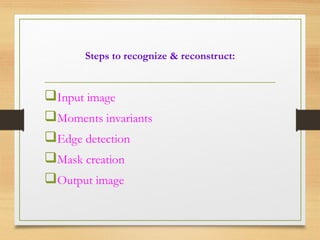
Steps to recognize & reconstruct:
Input image
Moments invariants
Edge detection
Mask creation
Output image
CONT..,
INPUT IMAGE:
- Image is captured through the camera , if that image is in
unsatisfactory manner means known as blurred image
- The images are affected because of the following factors,
1. Wrong focusing
2. Atmospheric turbulence
3. Lens aberration
Cont..,
- There are different types blurred images , some of
them are,
- Zoom Blur
- Motion Blur
- Atmospheric Blur
- Domain Shifting
- Threshold Blur
Cont..,
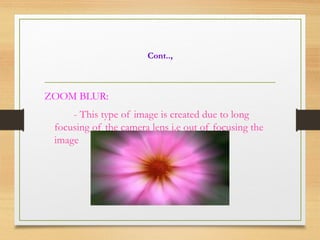
ZOOM BLUR:
- This type of image is created due to long
focusing of the camera lens i.e out of focusing the
image
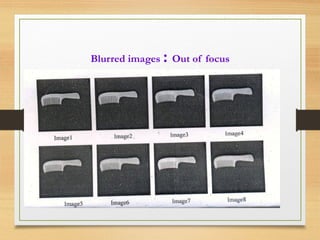
Blurred images : Out of focus
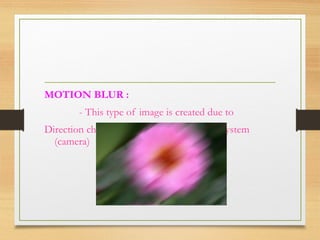
MOTION BLUR :
- This type of image is created due to
Direction change in the real image sensing system
(camera)
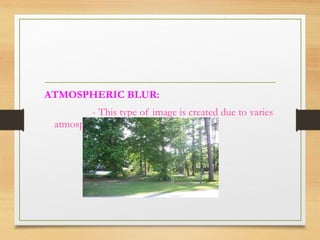
ATMOSPHERIC BLUR:
- This type of image is created due to varies
atmospheric changes
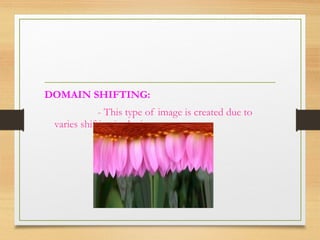
DOMAIN SHIFTING:
- This type of image is created due to
varies shifting in the image
ADD NOISE TO AN IMAGE:
- Varies noises are ,
- White Gaussian noise
- Salt & pepper noise
- Noises are added , because it only gives
recognization process.
- From that, define the filter co- efficient
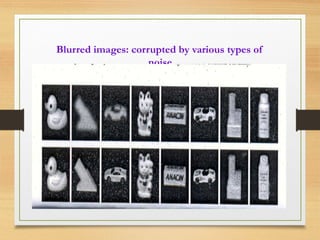
Blurred images: corrupted by various types of
noise
Cont..,
LEGENDRE MOMENTS:
- The blurred image is recognized by using the legendre
moments invariants
- Orthogonal moments are mainly used to recognize the
blurred image
- Orthogonal moments cover the whole image during the
recognization process
CONT..,
BLUR INVARIANTS:
- The blurred image is compared with the database , by using
the orthogonal moments
- Blur are some type of noises( gaussian noise with standard
deviation and salt & pepper noise)
- Here , calculate the point spread function for deblurring
the image i.e calculate the blur invariants
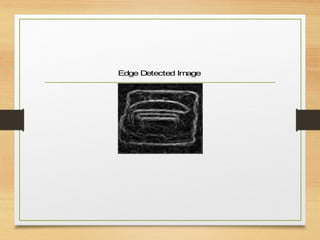
EDGE DETECTION:
- It function is mainly detect the edges of an
image
- Edges are used to reconstruct the image
MASK CREACTION :
- Mask Creation is based upon the PSF values i.e filter
values
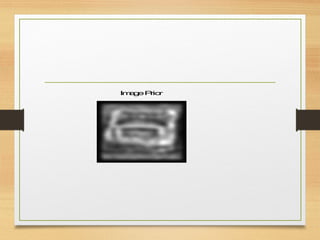
- Apply the convolution between the original image
with the image prior , from that deblur the image
Cont.,
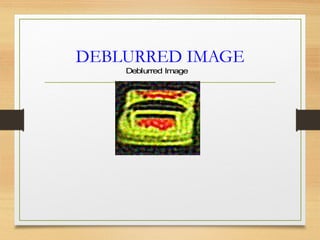
RECONSTRUCTED IMAGE:
- Finally , the original image is reconstructed by using this
moments invariants method
- This will provide the greatest accuracy compared with
the previous method
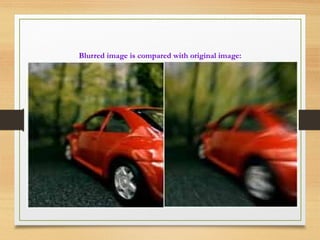
Blurred image is compared with original image:
SOFTWARE DETAILS:
- MATLAB 7.8
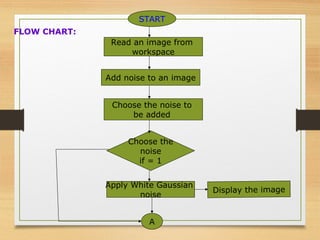
START
Read an image from
workspace
Add noise to an image
Choose the noise to
be added
Choose the
noise
if = 1
Apply White Gaussian
noise
Display the image
A
FLOW CHART:
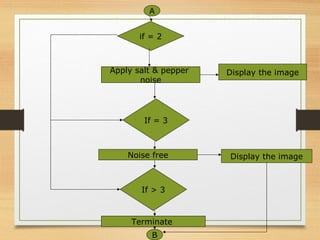
if = 2
Apply salt & pepper
noise
Display the image
If = 3
Noise free Display the image
If > 3
Terminate
B
A
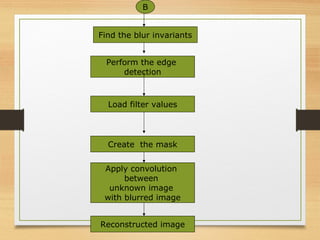
Find the blur invariants
Perform the edge
detection
Load filter values
Create the mask
Apply convolution
between
unknown image
with blurred image
Reconstructed image
B
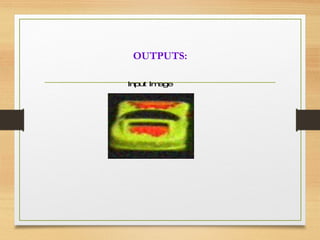
OUTPUTS:
Input Image
Edge Detected Image
ImagePrior
DEBLURRED IMAGE
Deblurred Image
APPLICATIONS:
- Image Security
- 3-D Scence analysis & reconstruction
- Automatic recognization & tracking
- Restorage purpose
THANK YOU

Blurred image recognization system

  • 1.
  • 2.
    OBJECTIVES: - The mainobjective of this project is to recognize the blurred image - Blurred image recognition is used for restorage purpose - Applicable in automatic target recognition & tracking, character recognition, 3D scene analysis & reconstruction.
  • 3.
    EXISTING SYSTEM: - Blurredimage recognition by complex moment invariants, this is existing system , blurred image was recognized by using the complex moments . - Complex moments are with respect to centrally symmetric blur, this does not provide the recognition accuracy & also it is sensitive to noise ,this is due to the fact that the polynomials are not orthogonal.
  • 4.
    PROPOSED SYSTEM: - Theproposed system is blurred image recognition by using orthogonal moments . - The orthogonal moments are better than the other types of moments in terms of information redundancy & are most robust to noise. - The performance of the proposed descriptors is evaluated with various point spread functions and different image noises. - The proposed descriptors are more robust to noise & have better discriminative power than the methods based on complex moments
  • 5.
    INTRODUCTION: - One ofthe most frequent tasks in image processing is the recognition of an image (or, more frequently, of an object on the image) against images stored in a database. - Whereas the images in the database are supposed to be ideal, the acquired image represents the scene mostly in an unsatisfactory manner. - Because real imaging systems as well as imaging conditions are imperfect, an observed image represents only a degraded version of the original scene.
  • 6.
    CONT… - Blur isintroduced into the captured image during the imaging process by such factors as diffraction, lens aberration, wrong focus, and atmospheric turbulence. - The widely accepted standard linear model describes the imaging process by a convolution of an unknown original (or ideal) image f ( z , y ) with a space-invariant point spread function (PSF) h(x, Y) - where g(z,y) represents the observed image. The PSF h ( z , y )describes the imaging system, and in our case, it is supposed to be unknown.
  • 7.
    Steps to recognize& reconstruct: Input image Moments invariants Edge detection Mask creation Output image
  • 8.
    CONT.., INPUT IMAGE: - Imageis captured through the camera , if that image is in unsatisfactory manner means known as blurred image - The images are affected because of the following factors, 1. Wrong focusing 2. Atmospheric turbulence 3. Lens aberration
  • 9.
    Cont.., - There aredifferent types blurred images , some of them are, - Zoom Blur - Motion Blur - Atmospheric Blur - Domain Shifting - Threshold Blur
  • 10.
    Cont.., ZOOM BLUR: - Thistype of image is created due to long focusing of the camera lens i.e out of focusing the image
  • 11.
    Blurred images :Out of focus
  • 12.
    MOTION BLUR : -This type of image is created due to Direction change in the real image sensing system (camera)
  • 13.
    ATMOSPHERIC BLUR: - Thistype of image is created due to varies atmospheric changes
  • 14.
    DOMAIN SHIFTING: - Thistype of image is created due to varies shifting in the image
  • 15.
    ADD NOISE TOAN IMAGE: - Varies noises are , - White Gaussian noise - Salt & pepper noise - Noises are added , because it only gives recognization process. - From that, define the filter co- efficient
  • 16.
    Blurred images: corruptedby various types of noise
  • 17.
    Cont.., LEGENDRE MOMENTS: - Theblurred image is recognized by using the legendre moments invariants - Orthogonal moments are mainly used to recognize the blurred image - Orthogonal moments cover the whole image during the recognization process
  • 18.
    CONT.., BLUR INVARIANTS: - Theblurred image is compared with the database , by using the orthogonal moments - Blur are some type of noises( gaussian noise with standard deviation and salt & pepper noise) - Here , calculate the point spread function for deblurring the image i.e calculate the blur invariants
  • 19.
    EDGE DETECTION: - Itfunction is mainly detect the edges of an image - Edges are used to reconstruct the image
  • 20.
    MASK CREACTION : -Mask Creation is based upon the PSF values i.e filter values - Apply the convolution between the original image with the image prior , from that deblur the image
  • 21.
    Cont., RECONSTRUCTED IMAGE: - Finally, the original image is reconstructed by using this moments invariants method - This will provide the greatest accuracy compared with the previous method
  • 22.
    Blurred image iscompared with original image:
  • 23.
  • 24.
    START Read an imagefrom workspace Add noise to an image Choose the noise to be added Choose the noise if = 1 Apply White Gaussian noise Display the image A FLOW CHART:
  • 25.
    if = 2 Applysalt & pepper noise Display the image If = 3 Noise free Display the image If > 3 Terminate B A
  • 26.
    Find the blurinvariants Perform the edge detection Load filter values Create the mask Apply convolution between unknown image with blurred image Reconstructed image B
  • 27.
  • 28.
  • 29.
  • 30.
  • 31.
    APPLICATIONS: - Image Security -3-D Scence analysis & reconstruction - Automatic recognization & tracking - Restorage purpose
  • 32.