Blue tongue
ABHIJITH SP
CVAS POOKODE
INTRODUCTION
• Infectious arthropod borne viral disease of cattle ,sheep and goats.
• Although sheep are most severely affected, cattle are the main mammal
reservoir of the virus and are critical in the disease epidemiology.
• The disease is non-contagious and is only transmitted by insect vectors
(midges of the Culicoides species).
• Bluetongue virus is a notifiable disease in many countries.
• Synonyms: Sore muzzle, Dancing Disease
24-09-2020ABHIJITH SP CVAS POOKODE 2
AETIOLOGY
• Reoviridae Family- Orbivirus genus- BTV.
• Genome consists of dsRNA, divided into 10-12 segments
• Cytoplasmic replication, with formation of large intracytoplasmic perinuclear
inclusion bodies.
• Nonenveloped, spherical virions.
• The BTV genome evolves rapidly via mutations.
• Orbi-Orbit or stoma region.
24-09-2020ABHIJITH SP CVAS POOKODE 3
SUSCEPTIBLE HOST
• BTV affects sheep, cattle, deer, goats and camelids (camels, llamas, alpacas,
guanaco and vicuña).
• Humans are not affected.
24-09-2020ABHIJITH SP CVAS POOKODE 4
TRANSMISSION
• Bluetongue is a noncontagious disease.
• Transplacental transmission occurs in cattle and sheep. Semen that contains
RBC or WBC infected with the virus may infect susceptible cattle.
• Culicoides spp. [biting midges, no-see-ums], especially Culicoides variipennis var
sonorensis, are the biological vectors.
• Culicoides spp. usually feed at dawn and dusk and they require standing water in
which to breed.
24-09-2020ABHIJITH SP CVAS POOKODE 5
INCUBATION PERIOD
• 6-10 days.
• Morbidity: Up to 80%; mortality: up to 50%.
24-09-2020ABHIJITH SP CVAS POOKODE 6
PATHOGENESIS
• Through biting of Culicoides, they gain access into blood vessels .
• They multiply in endothelial cells and WBC.
• They break the cell and comes out and create a gap in endothelium.
• So Protein rich fluid oozes out through that—Oedema
• Rbc moves out-Hemorrhage
• Followed by thrombosis and infarction.
24-09-2020ABHIJITH SP CVAS POOKODE 7
CLINICAL SIGNS
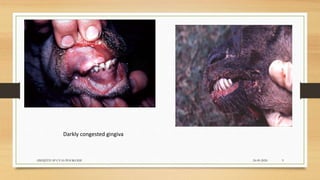
• Fever, ulcerated mouth, cyanosis of tongue [bluetongue], profuse salivation
and frothing, and nasal discharge [serous, later becoming mucopurulent].
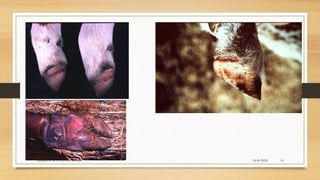
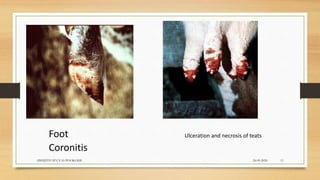
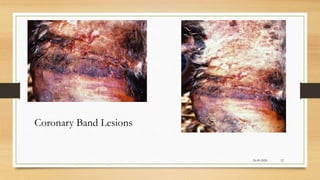
• Coronitis and laminitis resulting in lameness and recumbency.
• Fetal infection. Fetal death and/or abortion; CNS malformations such as
hydranencephaly; porencephaly, etc.
• Cyanosis of tongue-Thus the name Blue Tongue.
24-09-2020ABHIJITH SP CVAS POOKODE 8
24-09-2020ABHIJITH SP CVAS POOKODE 9
Darkly congested gingiva
24-09-2020ABHIJITH SP CVAS POOKODE 10
24-09-2020ABHIJITH SP CVAS POOKODE 11
Foot
Coronitis
Ulceration and necrosis of teats
24-09-2020
Coronary Band Lesions
12
24-09-2020ABHIJITH SP CVAS POOKODE 13
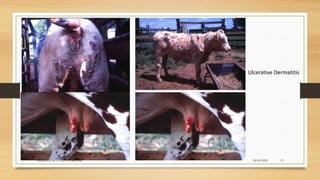
Ulcerative Dermatitis
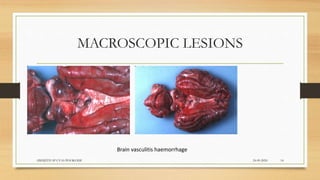
MACROSCOPIC LESIONS
24-09-2020ABHIJITH SP CVAS POOKODE 14
Brain vasculitis haemorrhage
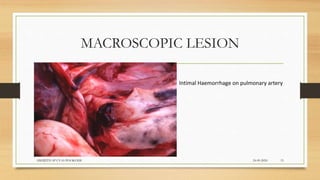
MACROSCOPIC LESION
24-09-2020ABHIJITH SP CVAS POOKODE 15
Intimal Haemorrhage on pulmonary artery
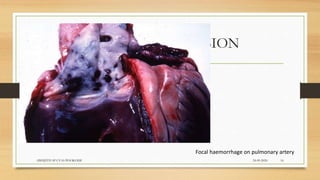
MACROSCOPIC LESION
24-09-2020ABHIJITH SP CVAS POOKODE 16
Focal haemorrhage on pulmonary artery
24-09-2020ABHIJITH SP CVAS POOKODE 17
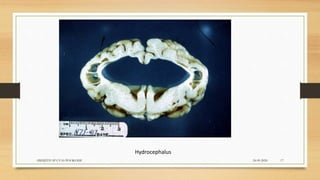
Hydrocephalus
24-09-2020ABHIJITH SP CVAS POOKODE 18
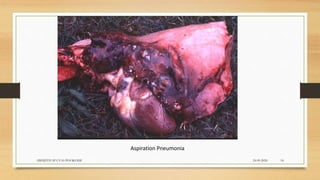
Aspiration Pneumonia
MICROSCOPIC LESIONS
24-09-2020ABHIJITH SP CVAS POOKODE 19
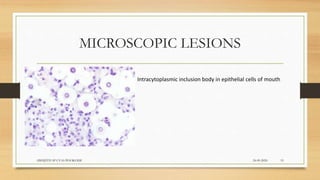
Intracytoplasmic inclusion body in epithelial cells of mouth
MICROSCOPIC LESIONS
24-09-2020ABHIJITH SP CVAS POOKODE 20
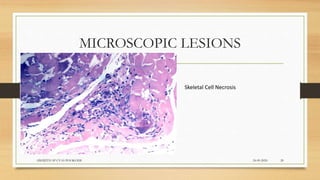
Skeletal Cell Necrosis
DIAGNOSIS
• Virus isolation. Heart blood [washed RBCs or buffy coat], spleen, liver, etc.
IV inoculation into 10- or 11-day-old chicken embryos or cell culture.
• Antigen and nucleic acid detection. ELISA, FAT, immunoperoxidase,
immune electron microscopy, PCR, etc.
• Seroconversion [acute and convalescent sera].
24-09-2020ABHIJITH SP CVAS POOKODE 21
PREVENTION AND CONTROL
• Bluetongue is a notifiable disease. Sheep should be put in barns at dusk [prime
Culicoides feeding period].
• Vaccination. Attenuated monovalent virus vaccines to serotypes 10, 11, and
17 are used in the United States.
• Attenuated vaccines should not be used in pregnant animals; or during the vector
season because the vectors may pick up the vaccine virus and transmit it to
other animals.
24-09-2020ABHIJITH SP CVAS POOKODE 22
24-09-2020ABHIJITH SP CVAS POOKODE 23
FACTS AND TIPS.
• Serotype of BTV-29.
• REO=Respiratory Enteric Orphan
• Immunity is serotype specific.
24-09-2020ABHIJITH SP CVAS POOKODE 24
THANK YOU

Blue tongue

  • 1.
  • 2.
    INTRODUCTION • Infectious arthropodborne viral disease of cattle ,sheep and goats. • Although sheep are most severely affected, cattle are the main mammal reservoir of the virus and are critical in the disease epidemiology. • The disease is non-contagious and is only transmitted by insect vectors (midges of the Culicoides species). • Bluetongue virus is a notifiable disease in many countries. • Synonyms: Sore muzzle, Dancing Disease 24-09-2020ABHIJITH SP CVAS POOKODE 2
  • 3.
    AETIOLOGY • Reoviridae Family-Orbivirus genus- BTV. • Genome consists of dsRNA, divided into 10-12 segments • Cytoplasmic replication, with formation of large intracytoplasmic perinuclear inclusion bodies. • Nonenveloped, spherical virions. • The BTV genome evolves rapidly via mutations. • Orbi-Orbit or stoma region. 24-09-2020ABHIJITH SP CVAS POOKODE 3
  • 4.
    SUSCEPTIBLE HOST • BTVaffects sheep, cattle, deer, goats and camelids (camels, llamas, alpacas, guanaco and vicuña). • Humans are not affected. 24-09-2020ABHIJITH SP CVAS POOKODE 4
  • 5.
    TRANSMISSION • Bluetongue isa noncontagious disease. • Transplacental transmission occurs in cattle and sheep. Semen that contains RBC or WBC infected with the virus may infect susceptible cattle. • Culicoides spp. [biting midges, no-see-ums], especially Culicoides variipennis var sonorensis, are the biological vectors. • Culicoides spp. usually feed at dawn and dusk and they require standing water in which to breed. 24-09-2020ABHIJITH SP CVAS POOKODE 5
  • 6.
    INCUBATION PERIOD • 6-10days. • Morbidity: Up to 80%; mortality: up to 50%. 24-09-2020ABHIJITH SP CVAS POOKODE 6
  • 7.
    PATHOGENESIS • Through bitingof Culicoides, they gain access into blood vessels . • They multiply in endothelial cells and WBC. • They break the cell and comes out and create a gap in endothelium. • So Protein rich fluid oozes out through that—Oedema • Rbc moves out-Hemorrhage • Followed by thrombosis and infarction. 24-09-2020ABHIJITH SP CVAS POOKODE 7
  • 8.
    CLINICAL SIGNS • Fever,ulcerated mouth, cyanosis of tongue [bluetongue], profuse salivation and frothing, and nasal discharge [serous, later becoming mucopurulent]. • Coronitis and laminitis resulting in lameness and recumbency. • Fetal infection. Fetal death and/or abortion; CNS malformations such as hydranencephaly; porencephaly, etc. • Cyanosis of tongue-Thus the name Blue Tongue. 24-09-2020ABHIJITH SP CVAS POOKODE 8
  • 9.
    24-09-2020ABHIJITH SP CVASPOOKODE 9 Darkly congested gingiva
  • 10.
  • 11.
    24-09-2020ABHIJITH SP CVASPOOKODE 11 Foot Coronitis Ulceration and necrosis of teats
  • 12.
  • 13.
    24-09-2020ABHIJITH SP CVASPOOKODE 13 Ulcerative Dermatitis
  • 14.
    MACROSCOPIC LESIONS 24-09-2020ABHIJITH SPCVAS POOKODE 14 Brain vasculitis haemorrhage
  • 15.
    MACROSCOPIC LESION 24-09-2020ABHIJITH SPCVAS POOKODE 15 Intimal Haemorrhage on pulmonary artery
  • 16.
    MACROSCOPIC LESION 24-09-2020ABHIJITH SPCVAS POOKODE 16 Focal haemorrhage on pulmonary artery
  • 17.
    24-09-2020ABHIJITH SP CVASPOOKODE 17 Hydrocephalus
  • 18.
    24-09-2020ABHIJITH SP CVASPOOKODE 18 Aspiration Pneumonia
  • 19.
    MICROSCOPIC LESIONS 24-09-2020ABHIJITH SPCVAS POOKODE 19 Intracytoplasmic inclusion body in epithelial cells of mouth
  • 20.
    MICROSCOPIC LESIONS 24-09-2020ABHIJITH SPCVAS POOKODE 20 Skeletal Cell Necrosis
  • 21.
    DIAGNOSIS • Virus isolation.Heart blood [washed RBCs or buffy coat], spleen, liver, etc. IV inoculation into 10- or 11-day-old chicken embryos or cell culture. • Antigen and nucleic acid detection. ELISA, FAT, immunoperoxidase, immune electron microscopy, PCR, etc. • Seroconversion [acute and convalescent sera]. 24-09-2020ABHIJITH SP CVAS POOKODE 21
  • 22.
    PREVENTION AND CONTROL •Bluetongue is a notifiable disease. Sheep should be put in barns at dusk [prime Culicoides feeding period]. • Vaccination. Attenuated monovalent virus vaccines to serotypes 10, 11, and 17 are used in the United States. • Attenuated vaccines should not be used in pregnant animals; or during the vector season because the vectors may pick up the vaccine virus and transmit it to other animals. 24-09-2020ABHIJITH SP CVAS POOKODE 22
  • 23.
  • 24.
    FACTS AND TIPS. •Serotype of BTV-29. • REO=Respiratory Enteric Orphan • Immunity is serotype specific. 24-09-2020ABHIJITH SP CVAS POOKODE 24
  • 25.