Basics Of ECG
- DR BIPIN A GOND
REGIONAL MEDICAL HEAD
WESTERN MUMBAI
9768009436
FR
Learning Modules
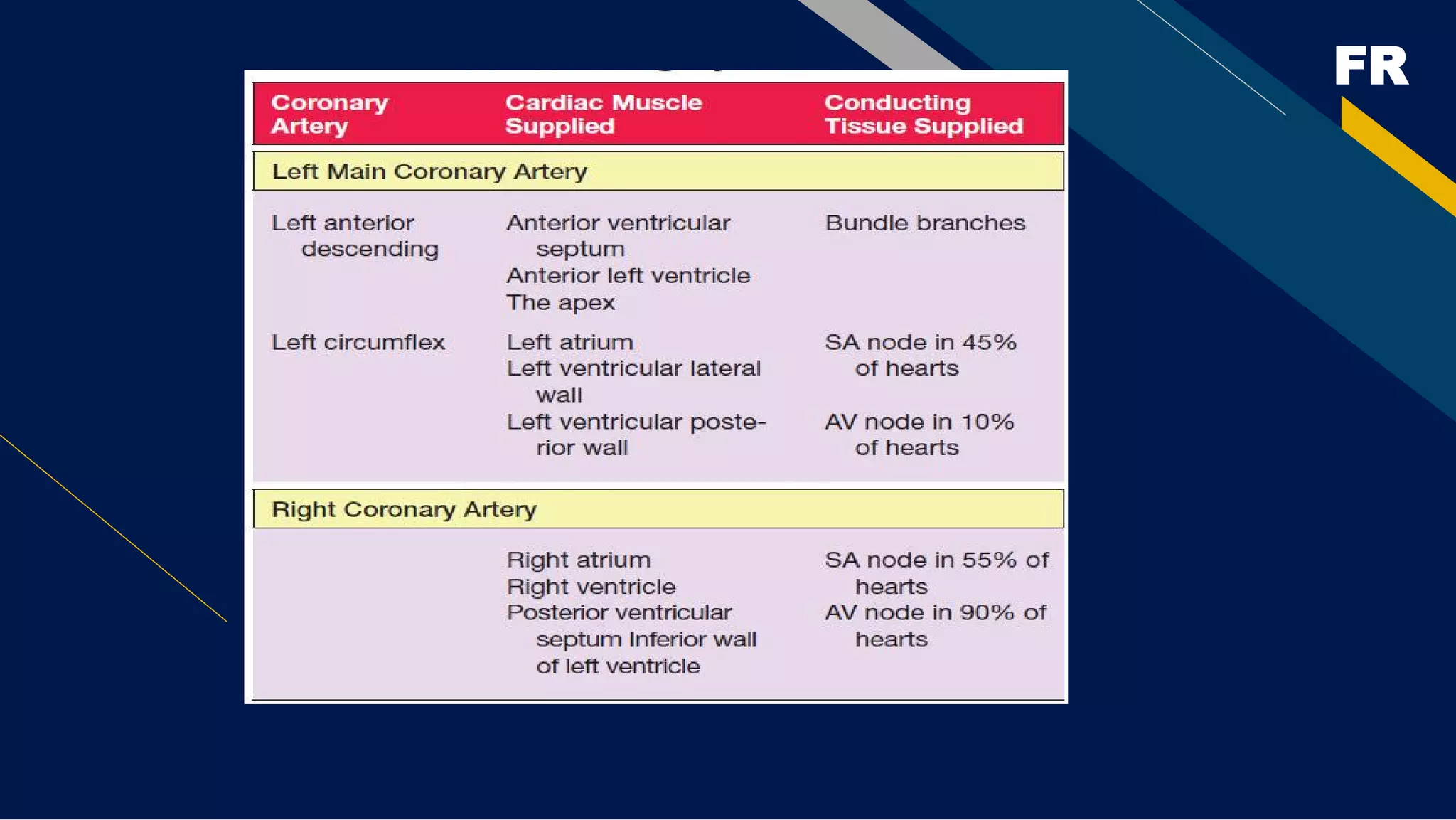
• Basic anatomy And physiology
• Basic Fundamenntal of ECG
• How to Analyze a Rhythm
• Normal Sinus Rhythm
• Heart Arrhythmias
• Diagnosing a Myocardial Infarction
• Advanced 12-Lead Interpretation
FR
Anatomy &
Physiology of heart
FR
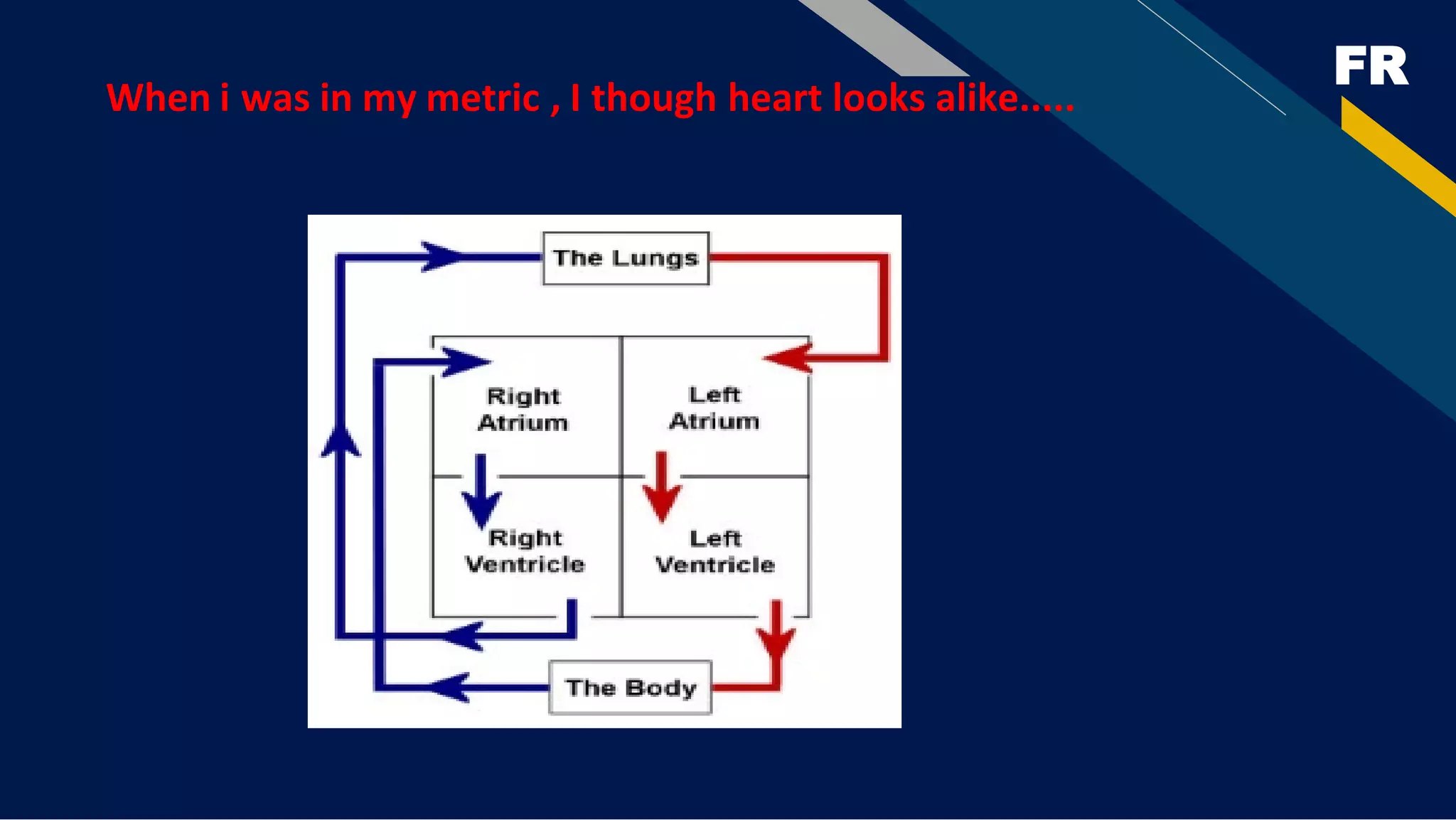
When i was in my metric , I though heart looks alike.....
FR
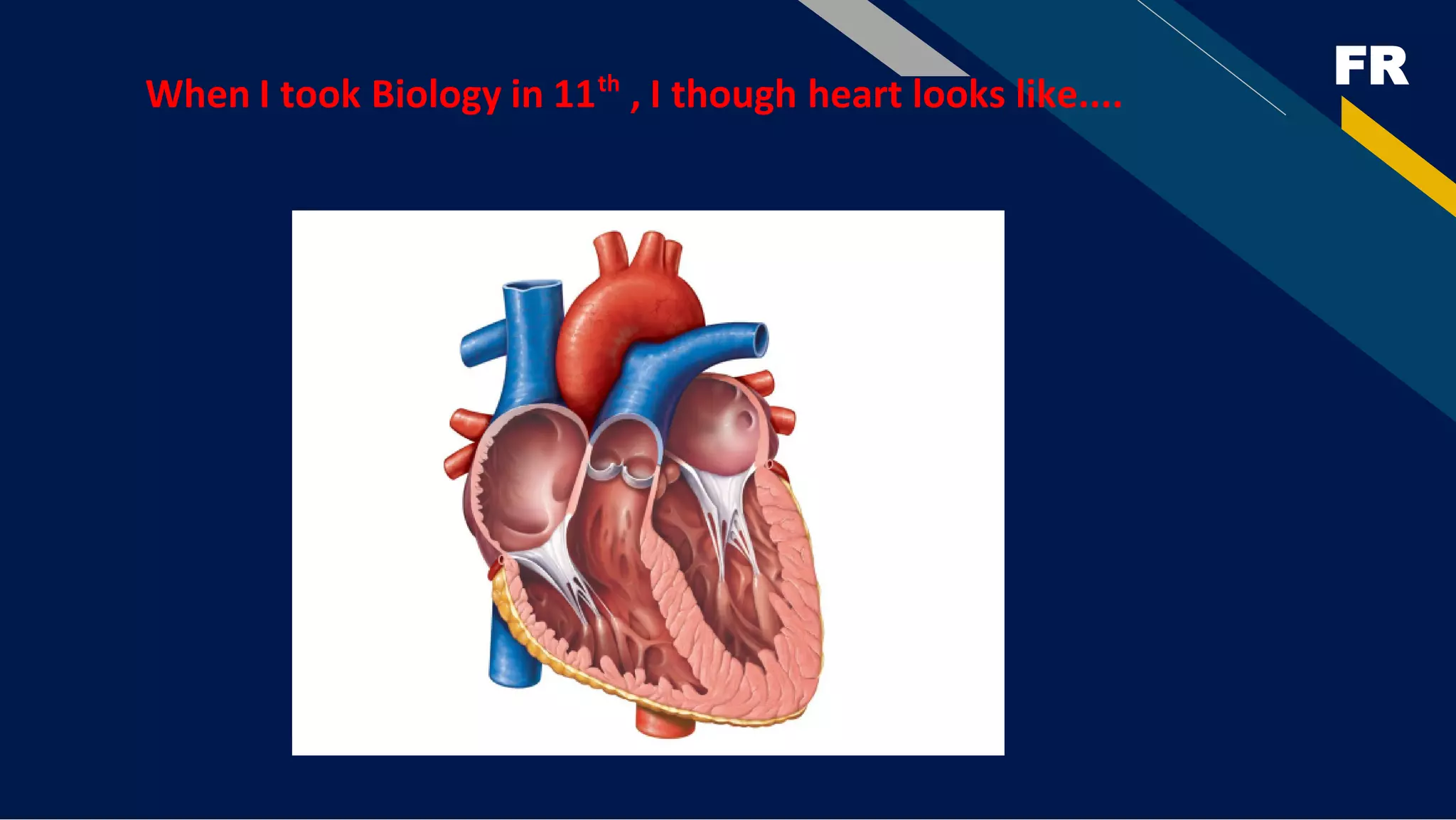
When I took Biology in 11th
, I though heart looks like....
FR
My Commerce friend still think that , Heart
looks like....
FR
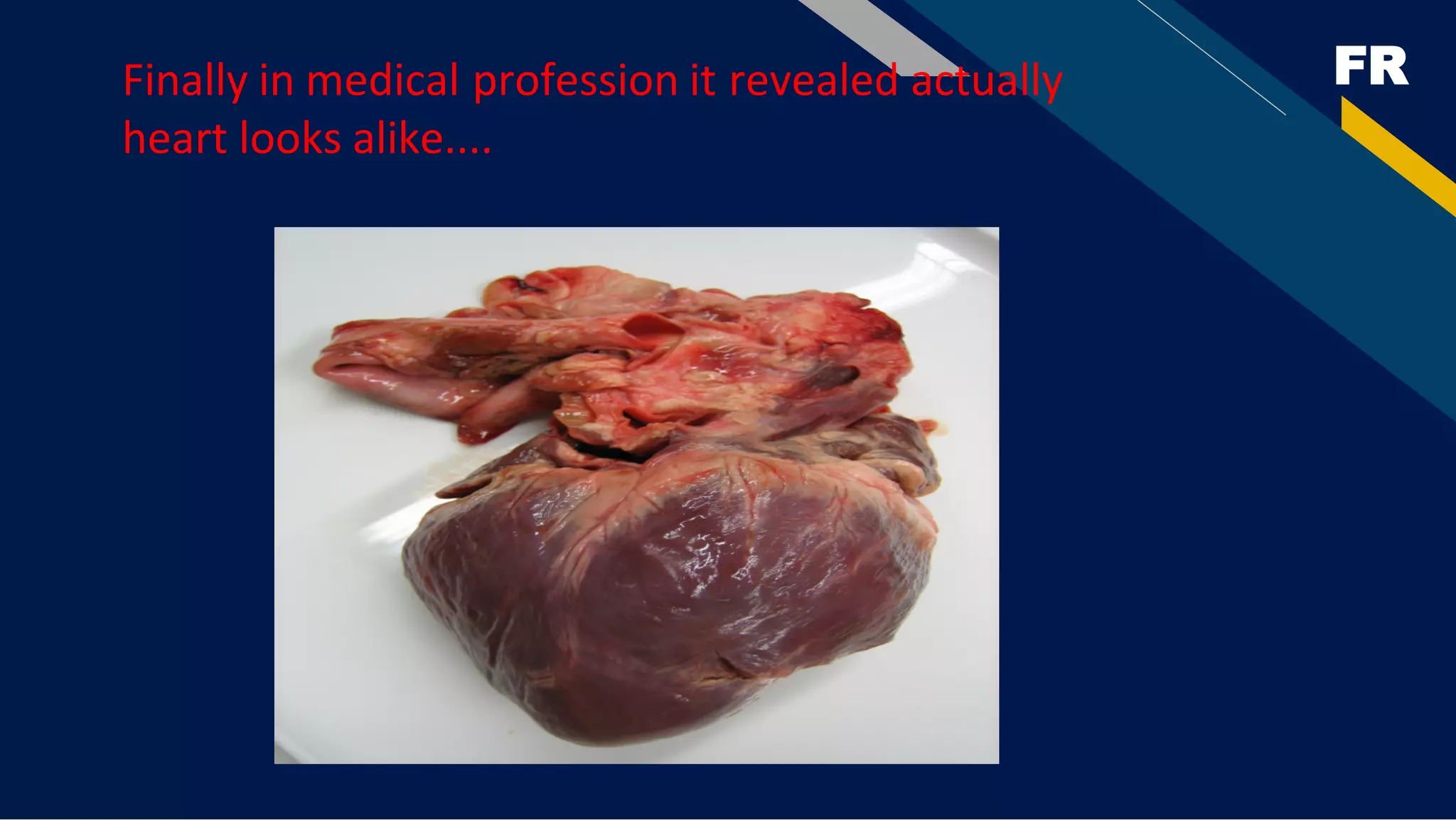
Finally in medical profession it revealed actually
heart looks alike....
FR
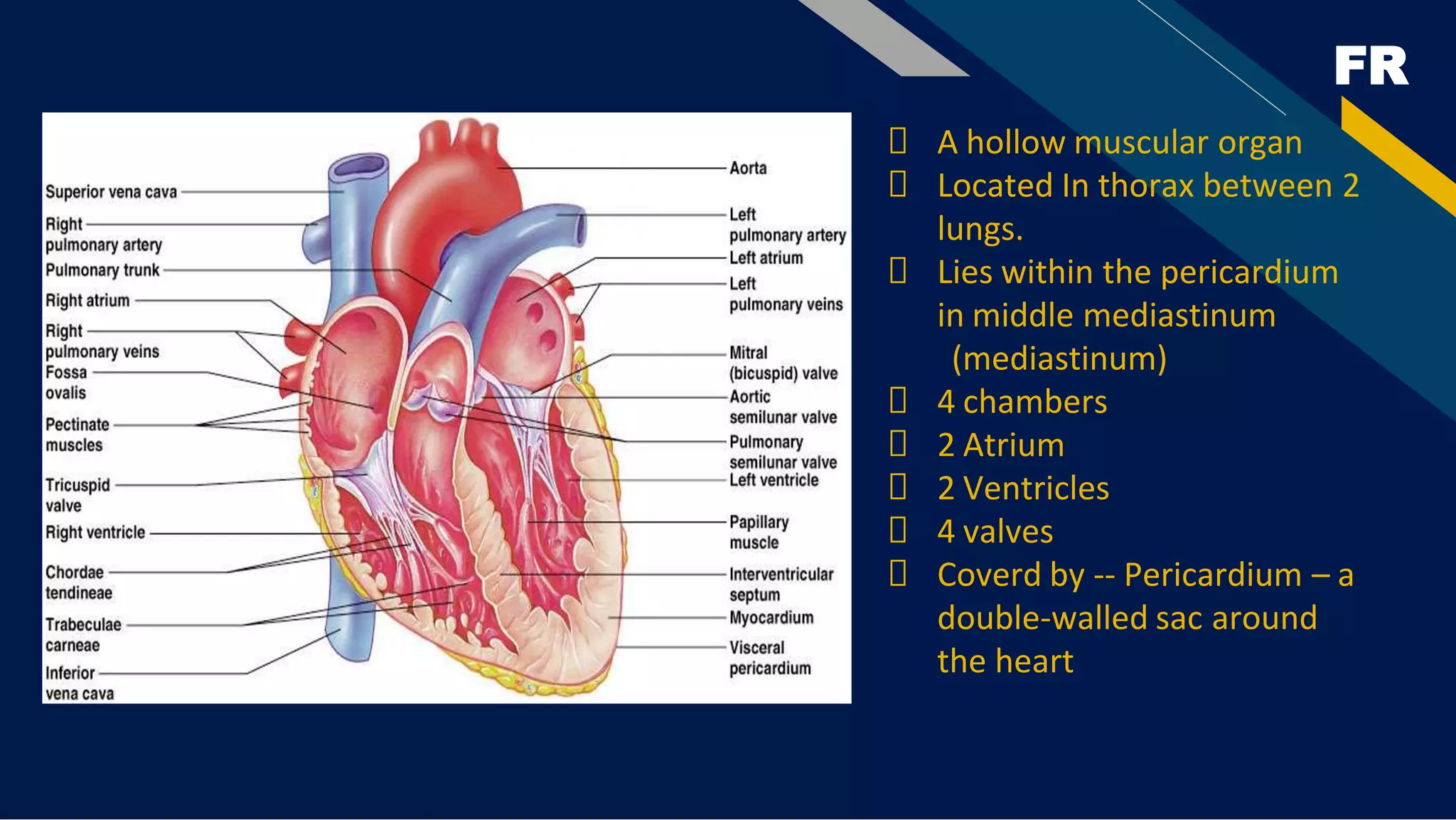
A hollow muscular organ
Located In thorax between 2
lungs.
Lies within the pericardium
in middle mediastinum
(mediastinum)
4 chambers
2 Atrium
2 Ventricles
4 valves
Coverd by -- Pericardium – a
double-walled sac around
the heart
FR
LAYERS OF THE HEART
WALL
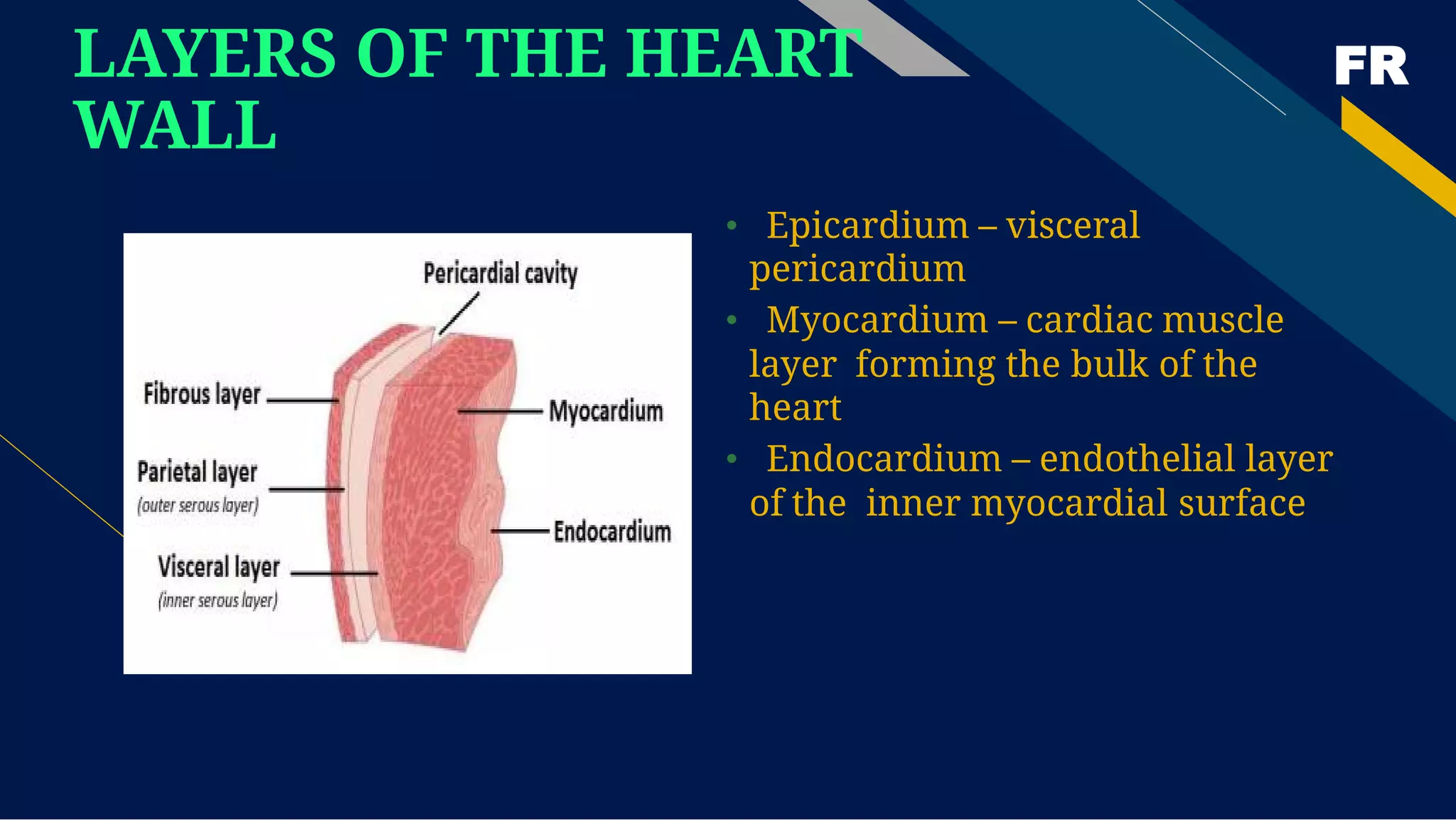
• Epicardium – visceral
pericardium
• Myocardium – cardiac muscle
layer forming the bulk of the
heart
• Endocardium – endothelial layer
of the inner myocardial surface
FR
FR
FR
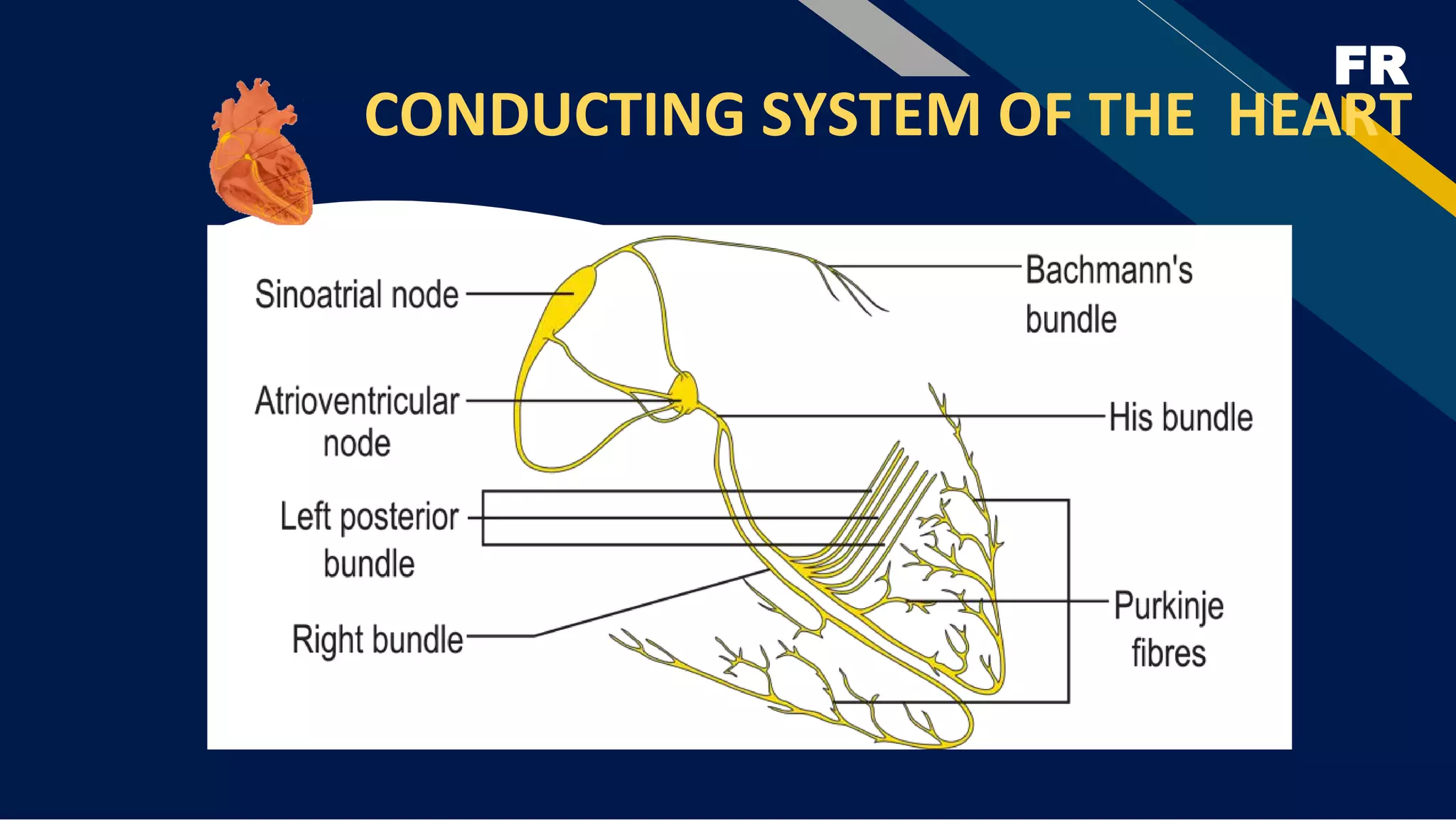
CONDUCTING SYSTEM OF THE HEART
FR
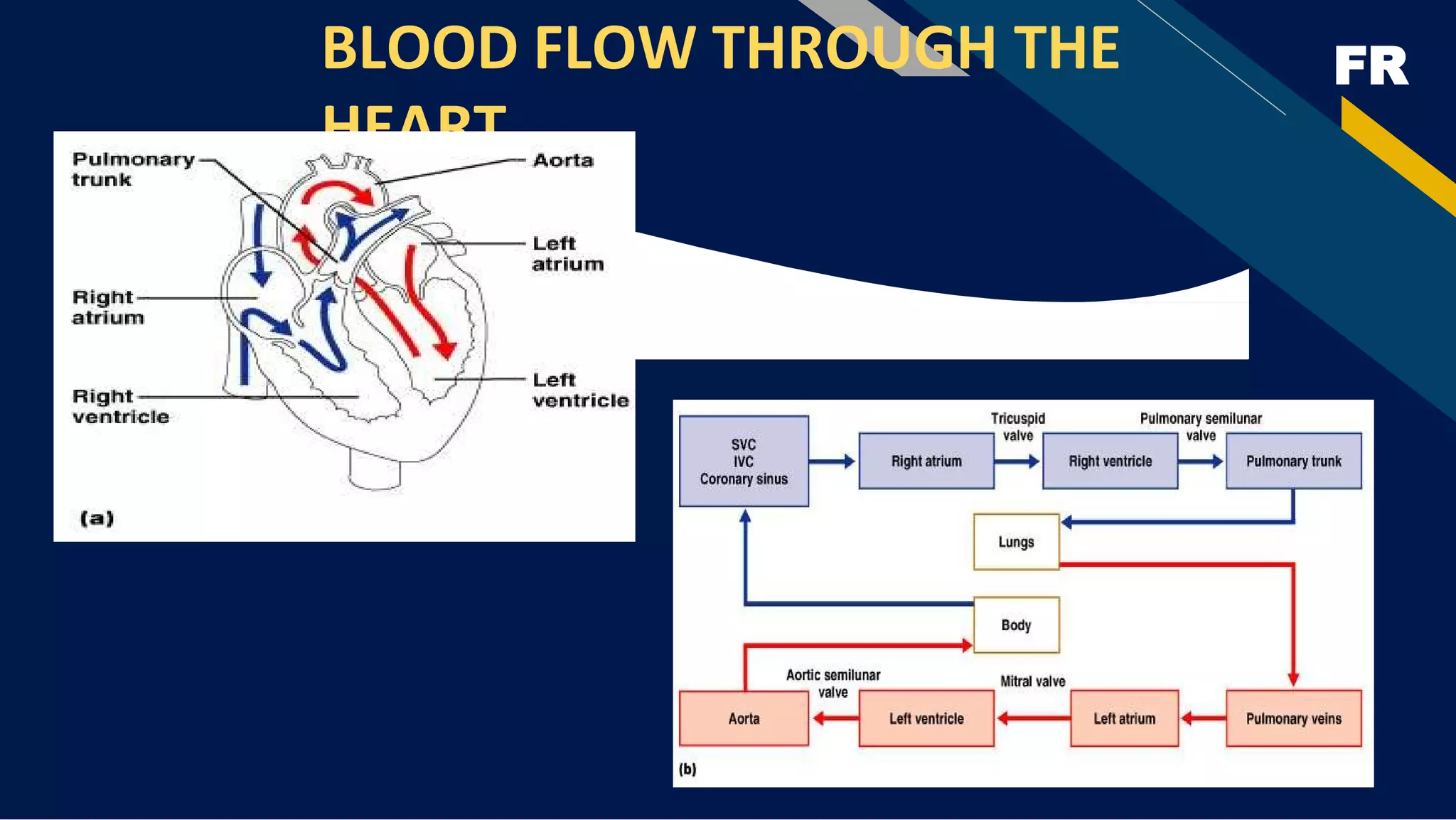
BLOOD FLOW THROUGH THE
HEART
FR
ECG
Electro Cardiography
Electro cardiograph
Electro cardiogram
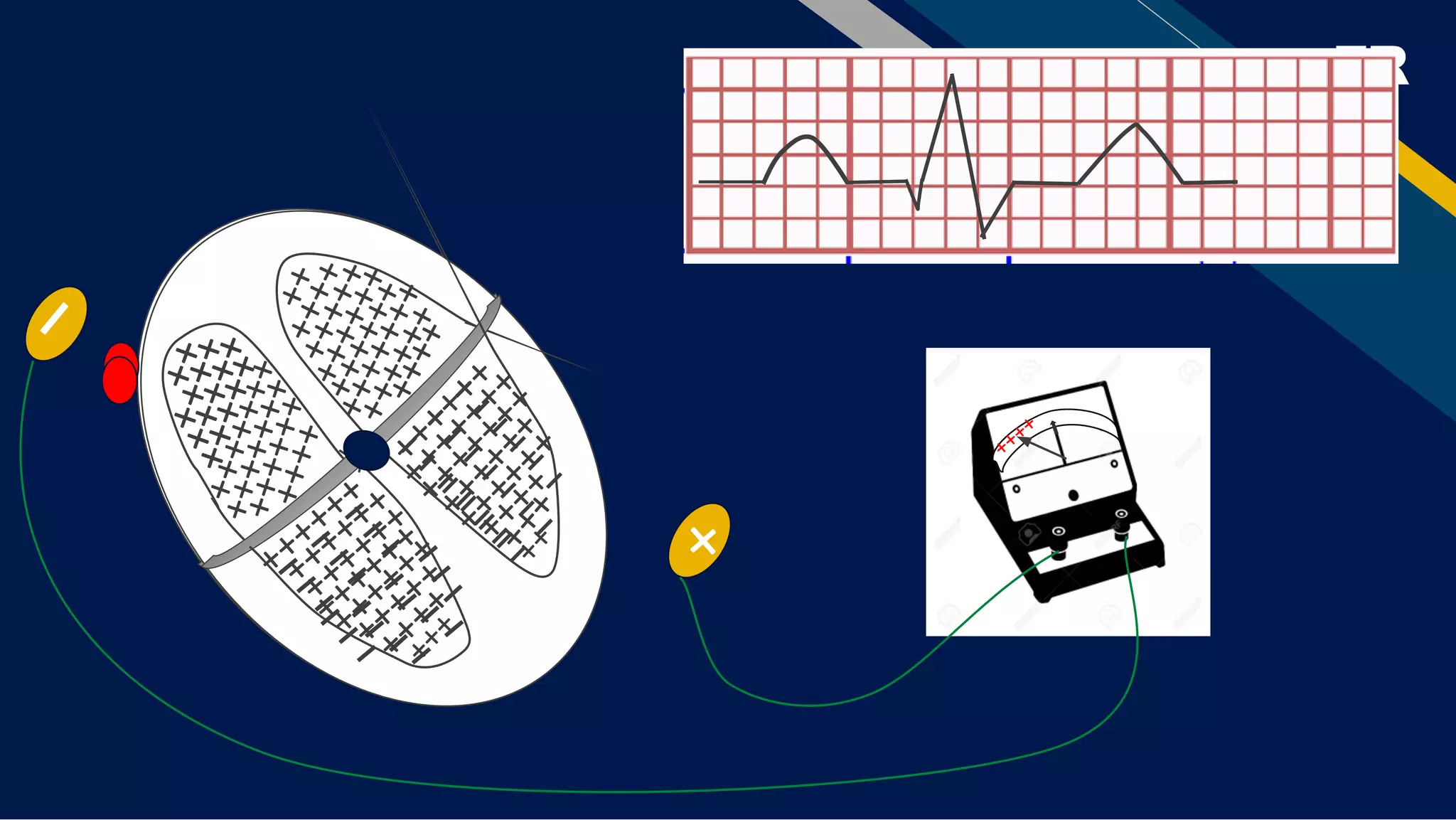
Electrical activity of presented graphycally.
Electrophysiology
of Heart
FR
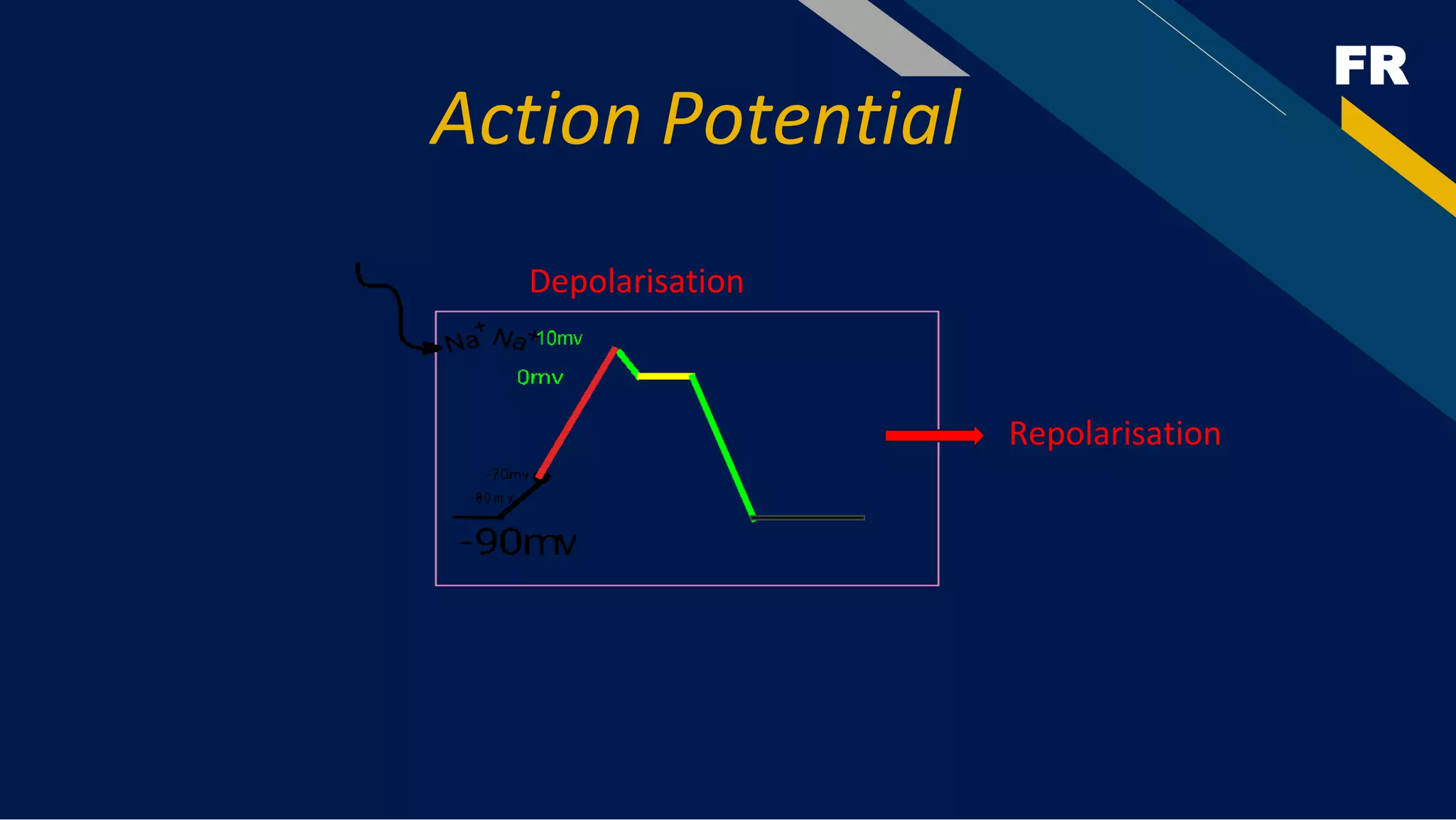
Depolarisation
Repolarisation
Action Potential
FR
+
+
+
+
+
+
+
+
+
+
+
+
+
+
+
+
+
+
+
+
+
+
−
+
+
+
+
+
+
++++
+
+
+
+
+
+
+
+
+
+
+
+
+
+
+
+
+
+
+
+
+
+
+
+
+
+
+
+
+
+
+
+
+
+
+
+
+
+
+
+
+
+
+
+
+
+
+
+
+
+
+
+
+
+
++++++
++++++
++++++
++++++
+
+
+
+
+
+
+
+
+
+
+
+
+
+
+
+
+
+
+
+
+
+
+
+
+
+
+
+
+
+
+
+
+
+
+
+
+
+
+
+
+
++++
++++++
+++++
+
+
+
+
+
+
+
+
+
+
+
+
+
+
+
+
+
+
+
+
+
+
+
+
+
+
+
+
+
+
+
+
+
+
+
+
+
+
+
+
+
+
+
+
+
+
+
+
+
+
+
+
+
+
+
+
+
+
+
+
+
+
+
+
+
+
+
+
+
+
+
+
+
+
+
+
+
+
+
+
+
+
+
+
+
+
+
+
+
++++++
+
+
+
+
+
+
+
++++++
++++++
++++++
+
+
+
+
+
+
+
+
+
+
+
+
+
+
+
+
+
+
+
+
+
+
+
+
+
+
+
+
++++
++++++
+++++
+
+
+
−
−
−
−
−
−
−
−
−
−
−
−
−
−
−
−
−
−
−
−
−
−
−
−
− −
−
−
− −
−
−
− −
−
−
− −
−
− −
−
−
−−
− −
FR
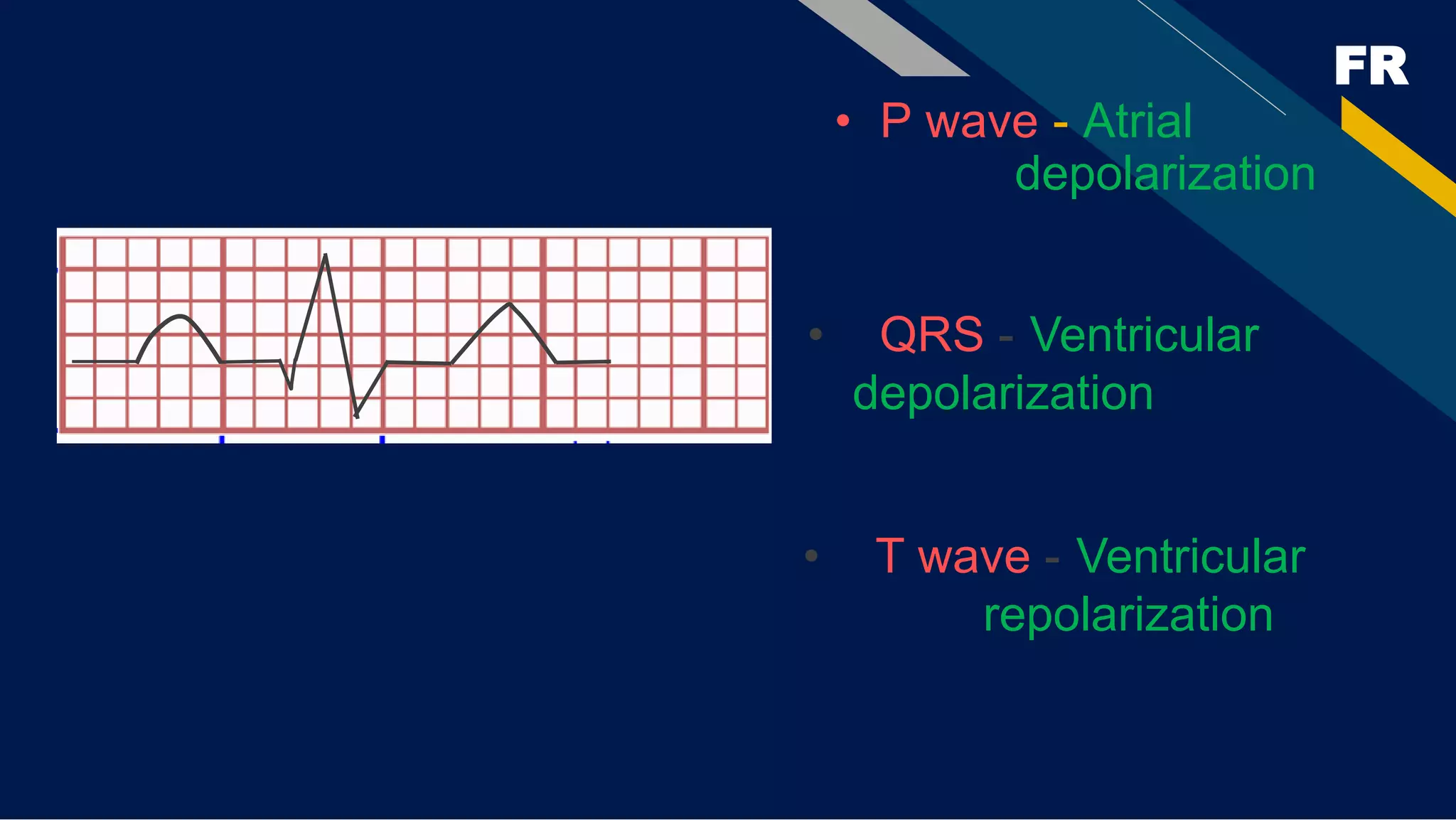
• P wave - Atrial
depolarization
• QRS - Ventricular
depolarization
• T wave - Ventricular
repolarization
FR
FR
FR
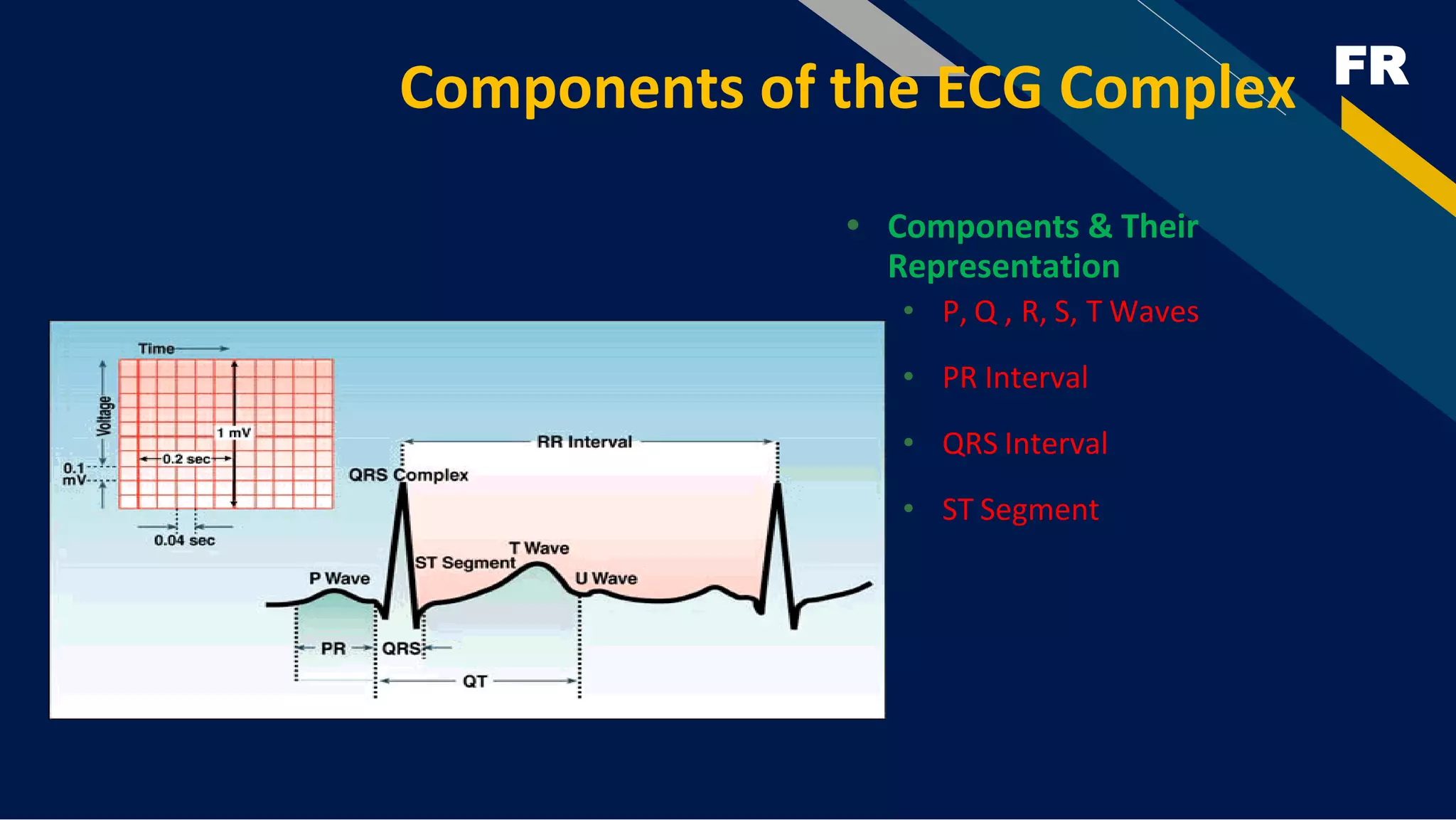
Components of the ECG Complex
• Components & Their
Representation
• P, Q , R, S, T Waves
• PR Interval
• QRS Interval
• ST Segment
FR
Components of the ECG Complex
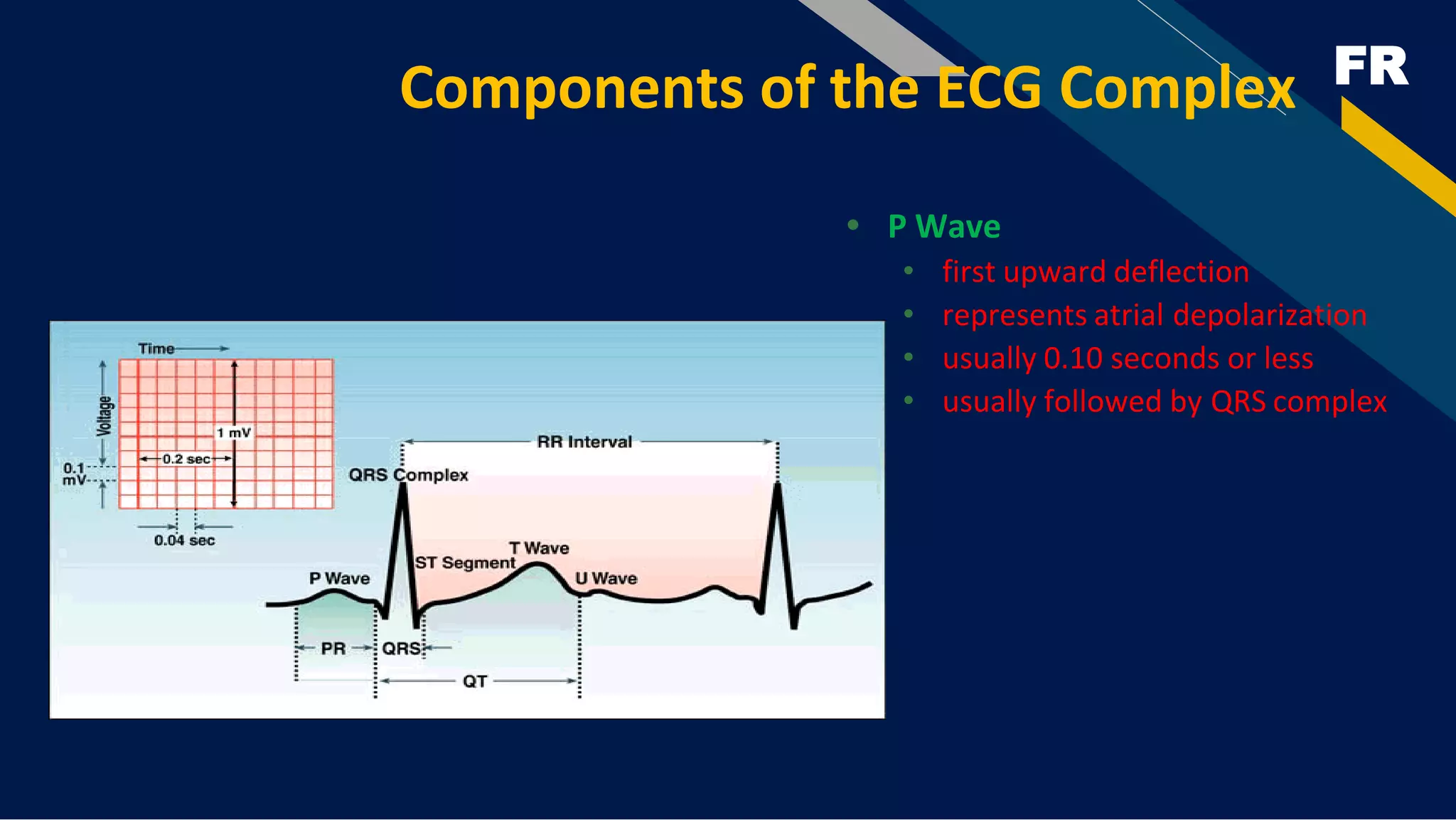
• P Wave
• first upward deflection
• represents atrial depolarization
• usually 0.10 seconds or less
• usually followed by QRS complex
FR
Components of the ECG Complex
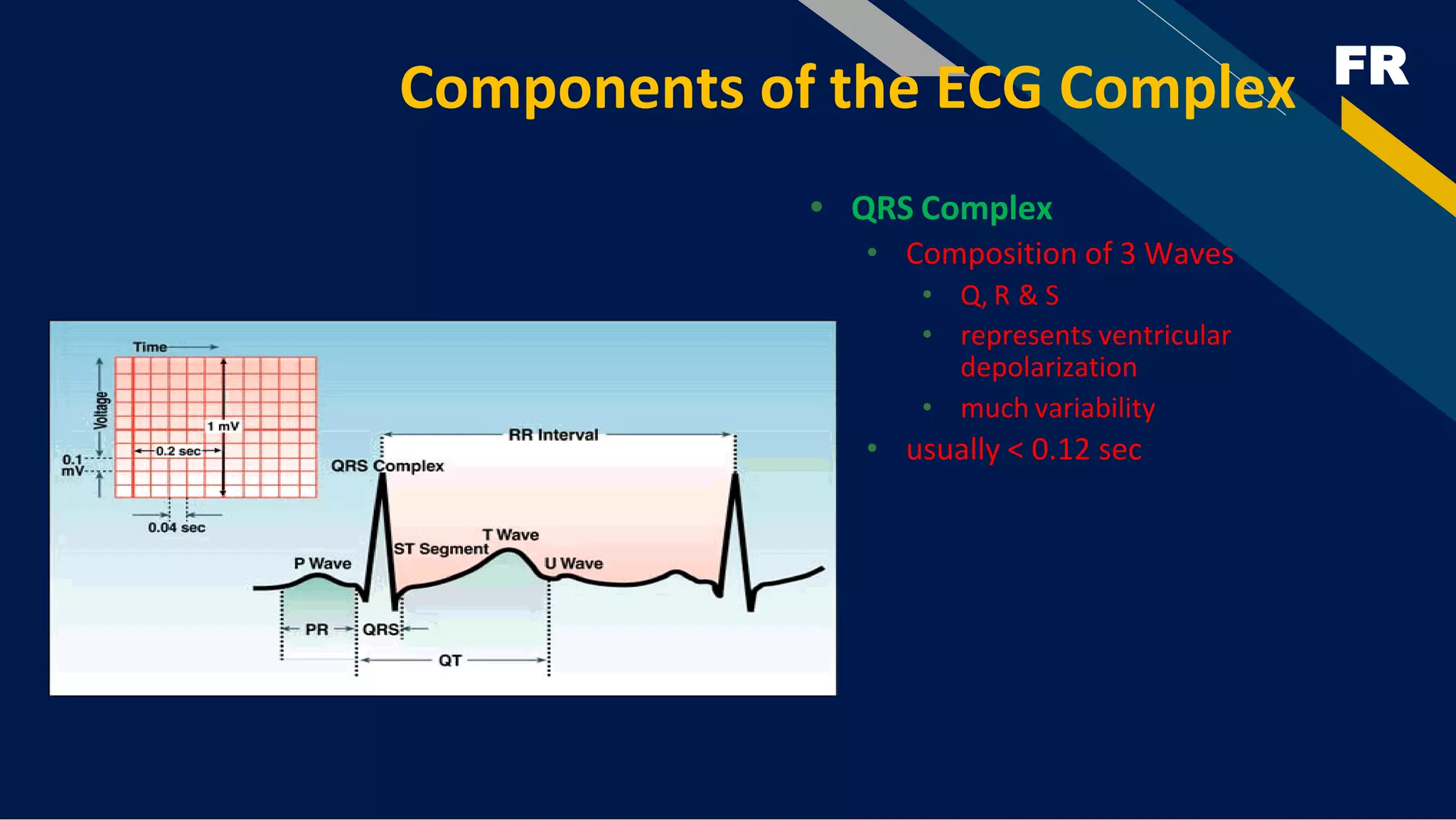
• QRS Complex
• Composition of 3 Waves
• Q, R & S
• represents ventricular
depolarization
• much variability
• usually < 0.12 sec
FR
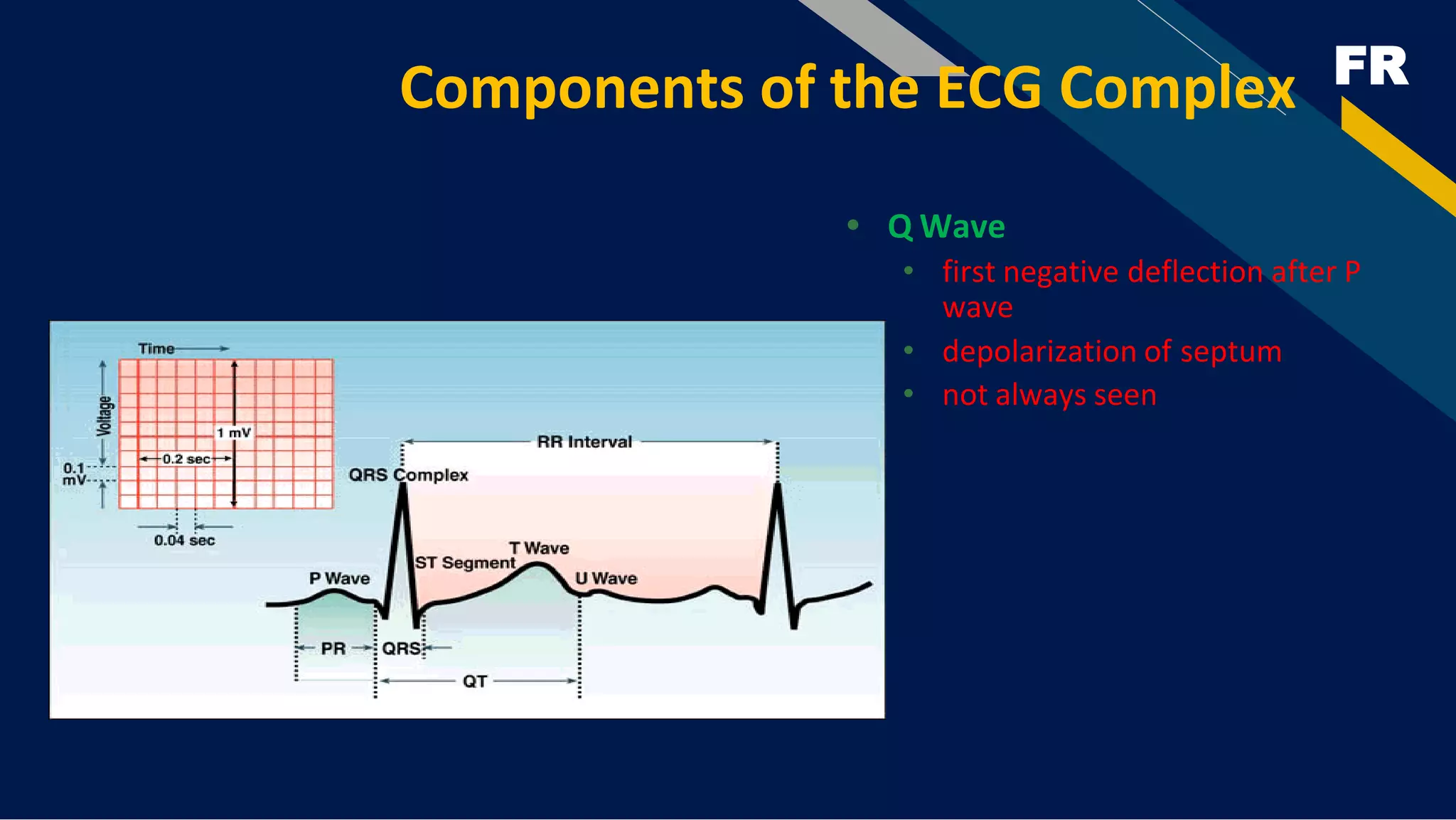
Components of the ECG Complex
• Q Wave
• first negative deflection after P
wave
• depolarization of septum
• not always seen
FR
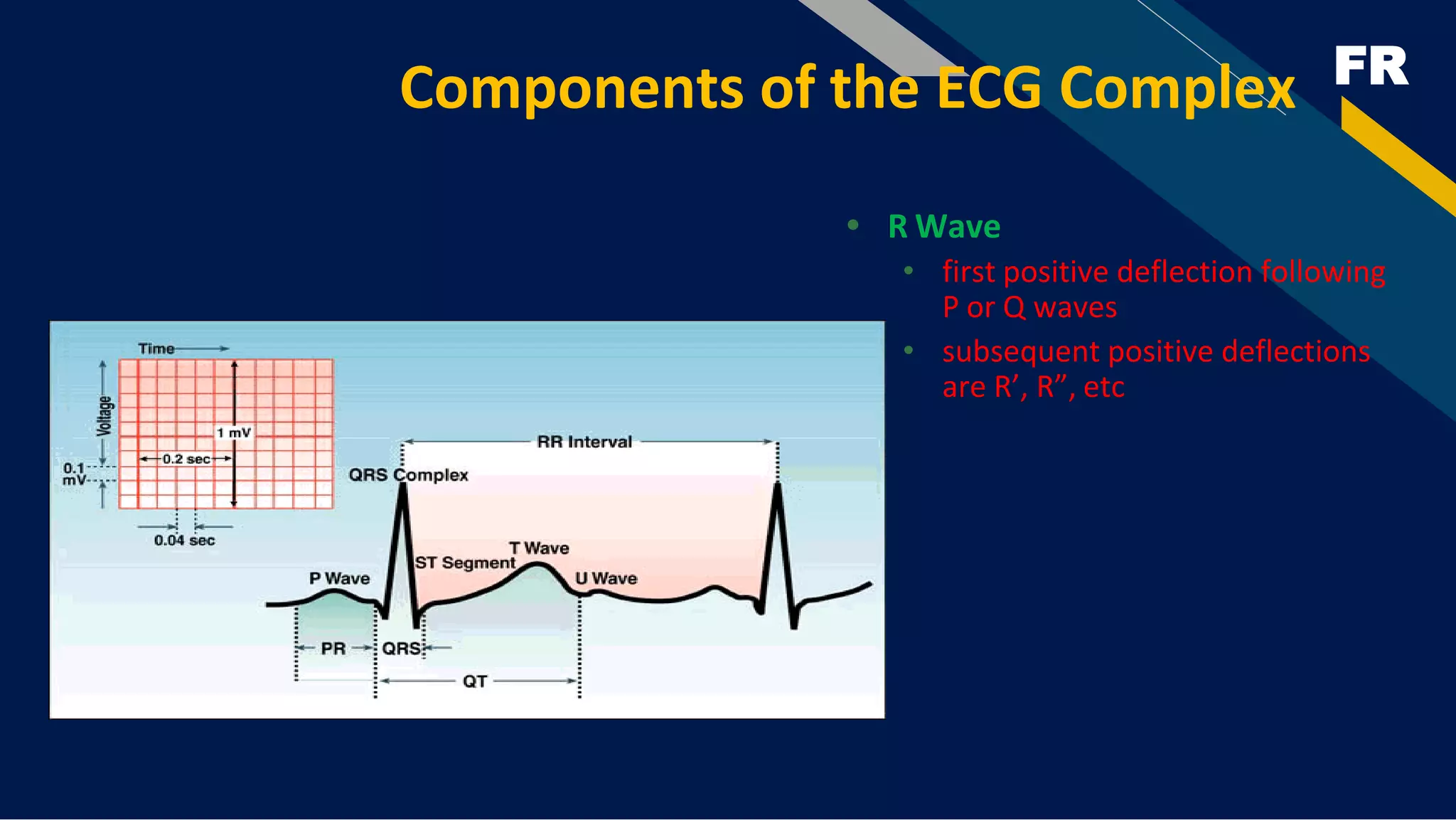
Components of the ECG Complex
• R Wave
• first positive deflection following
P or Q waves
• subsequent positive deflections
are R’, R”, etc
FR
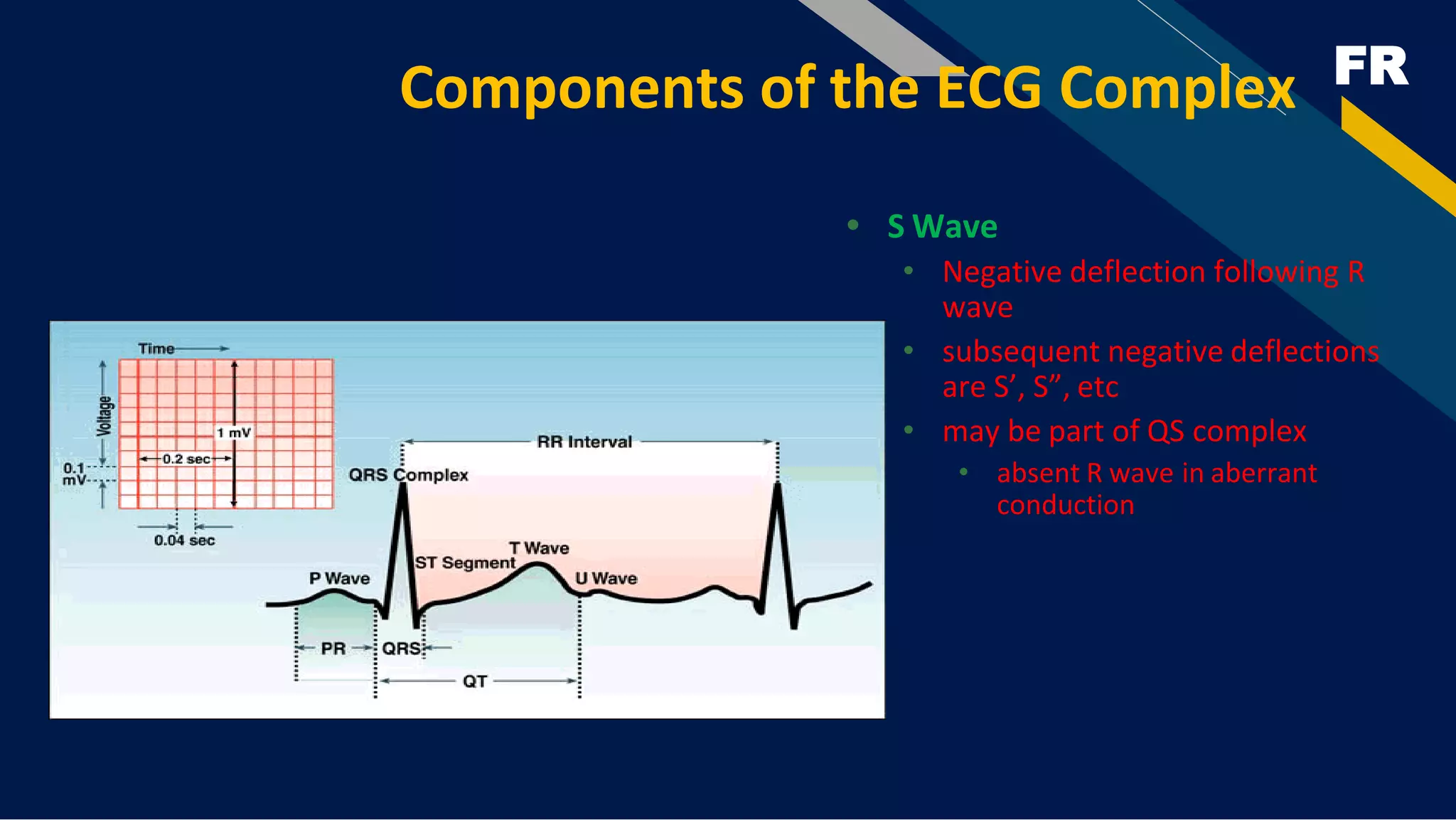
Components of the ECG Complex
• S Wave
• Negative deflection following R
wave
• subsequent negative deflections
are S’, S”, etc
• may be part of QS complex
• absent R wave in aberrant
conduction
FR
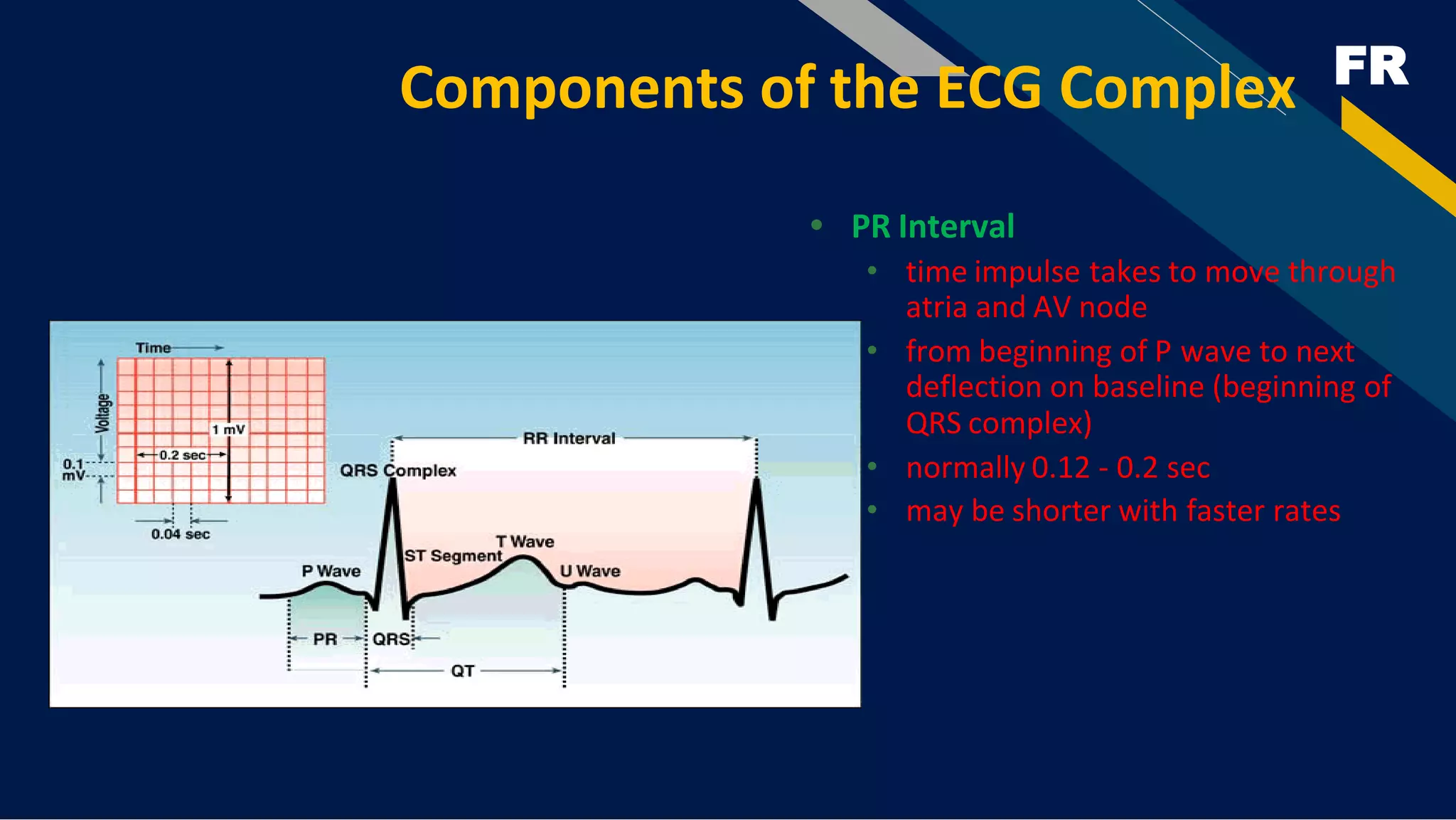
Components of the ECG Complex
• PR Interval
• time impulse takes to move through
atria and AV node
• from beginning of P wave to next
deflection on baseline (beginning of
QRS complex)
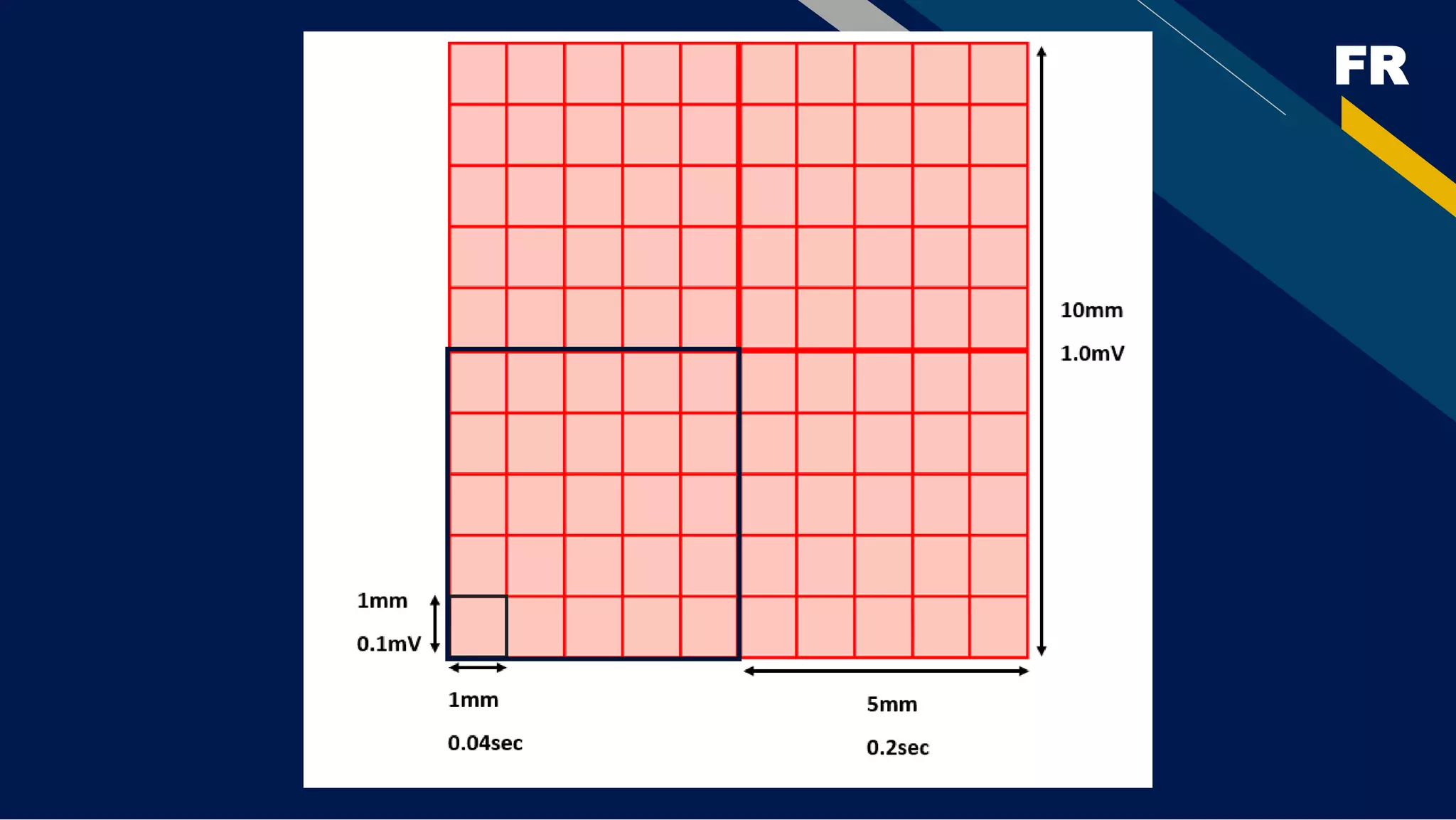
• normally 0.12 - 0.2 sec
• may be shorter with faster rates
FR
Components of the ECG Complex
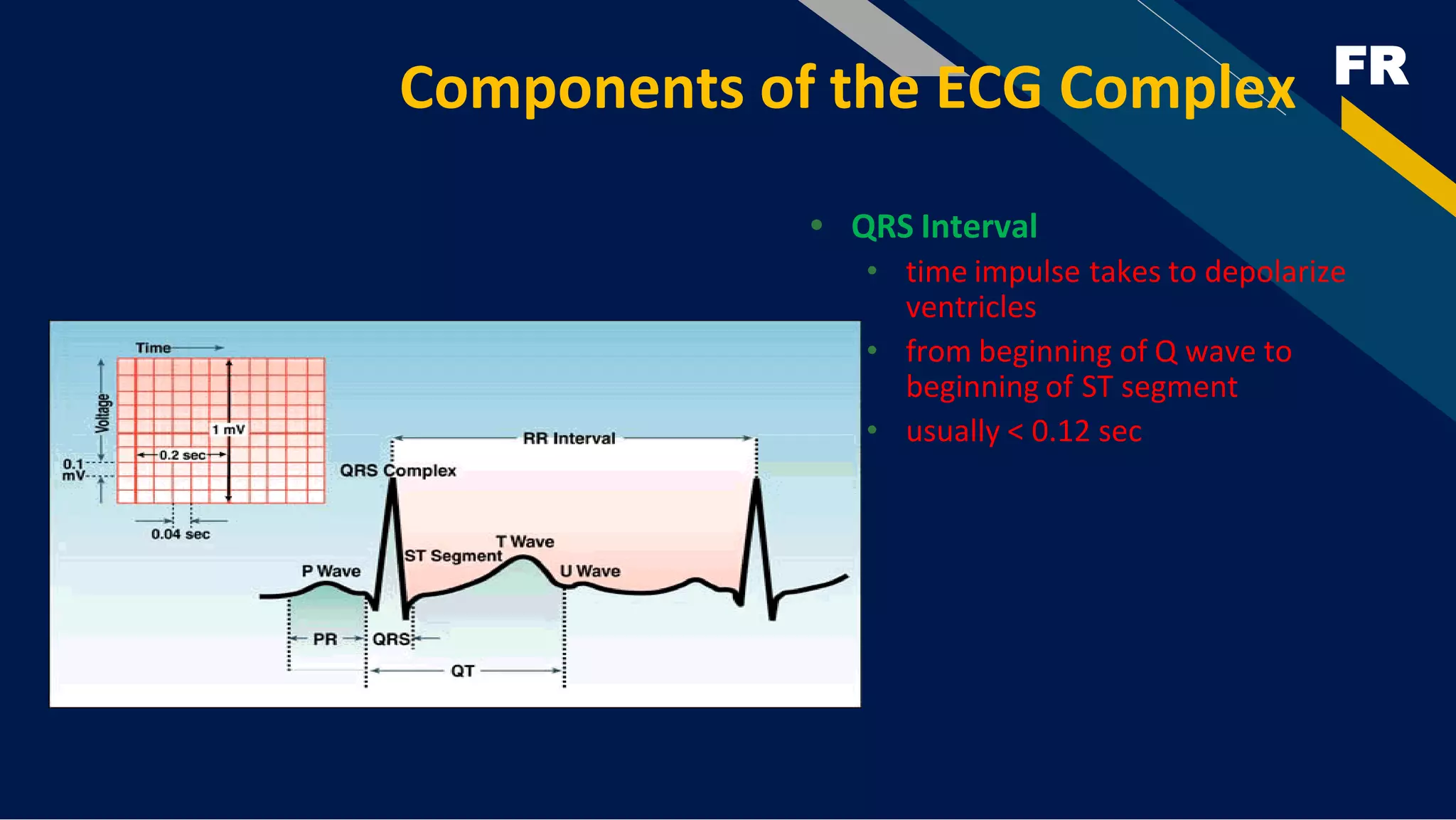
• QRS Interval
• time impulse takes to depolarize
ventricles
• from beginning of Q wave to
beginning of ST segment
• usually < 0.12 sec
FR
Components of the ECG Complex
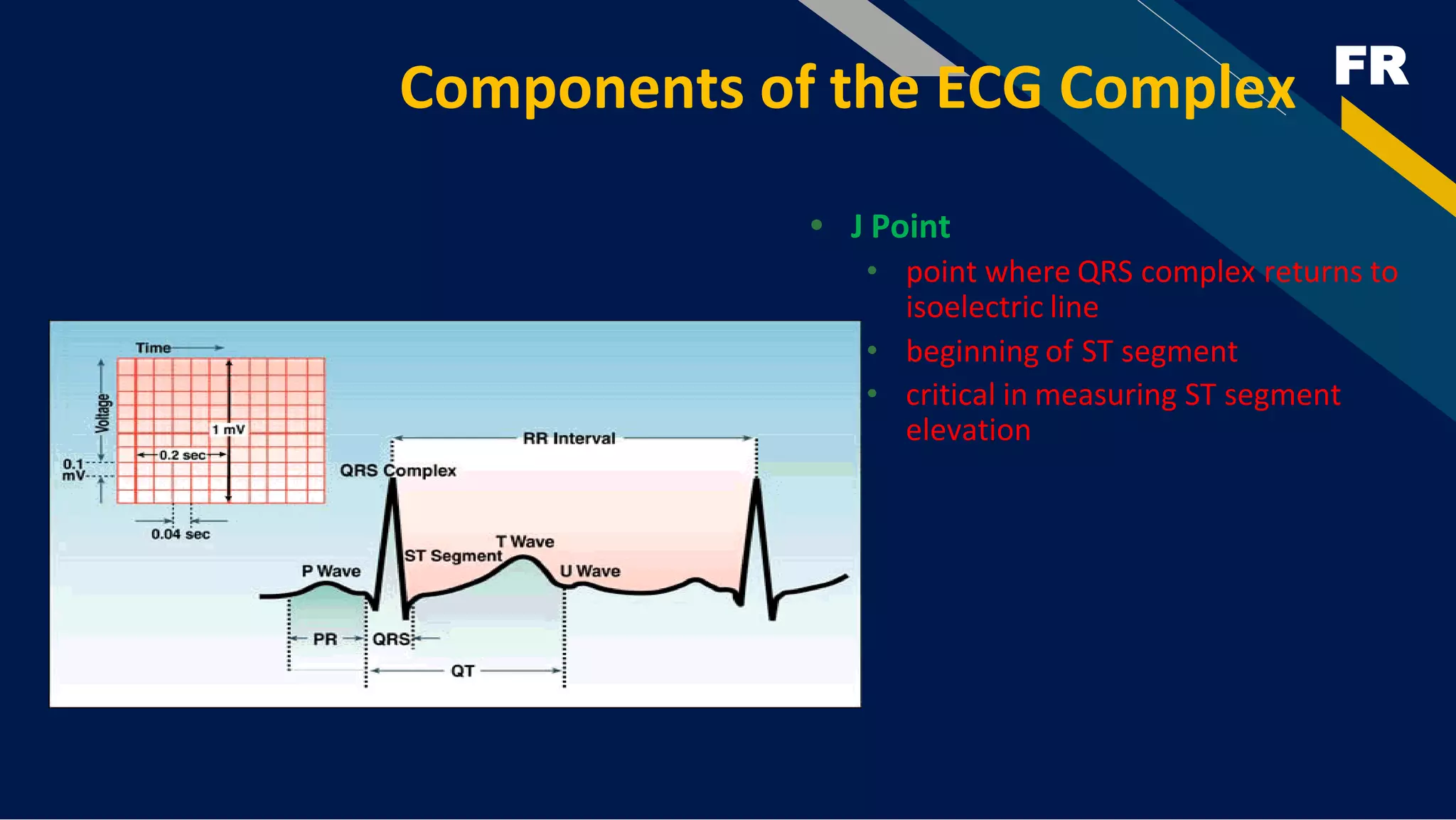
• J Point
• point where QRS complex returns to
isoelectric line
• beginning of ST segment
• critical in measuring ST segment
elevation
FR
Components of the ECG Complex
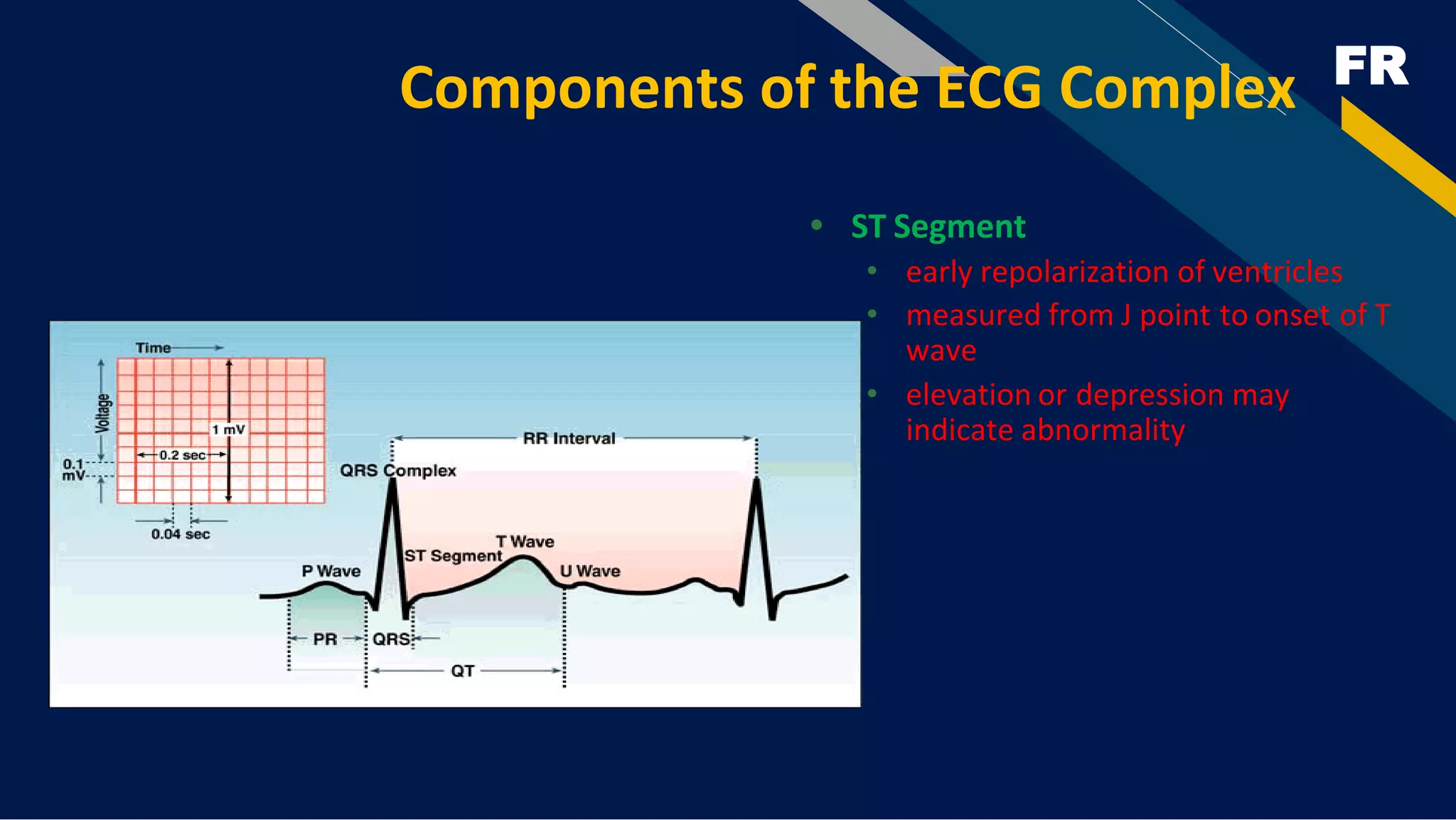
• ST Segment
• early repolarization of ventricles
• measured from J point to onset of T
wave
• elevation or depression may
indicate abnormality
FR
Components of the ECG Complex
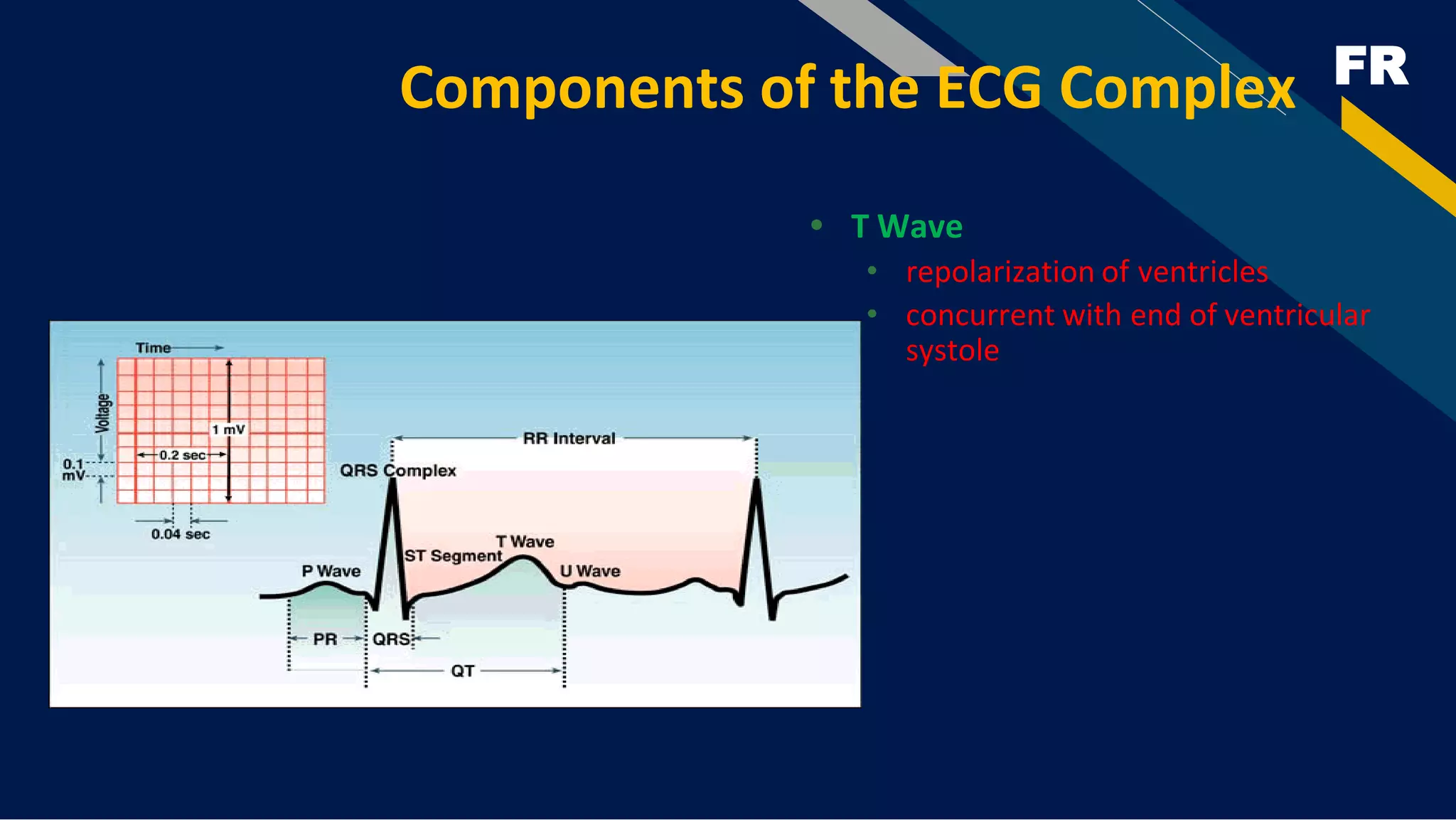
• T Wave
• repolarization of ventricles
• concurrent with end of ventricular
systole
FR
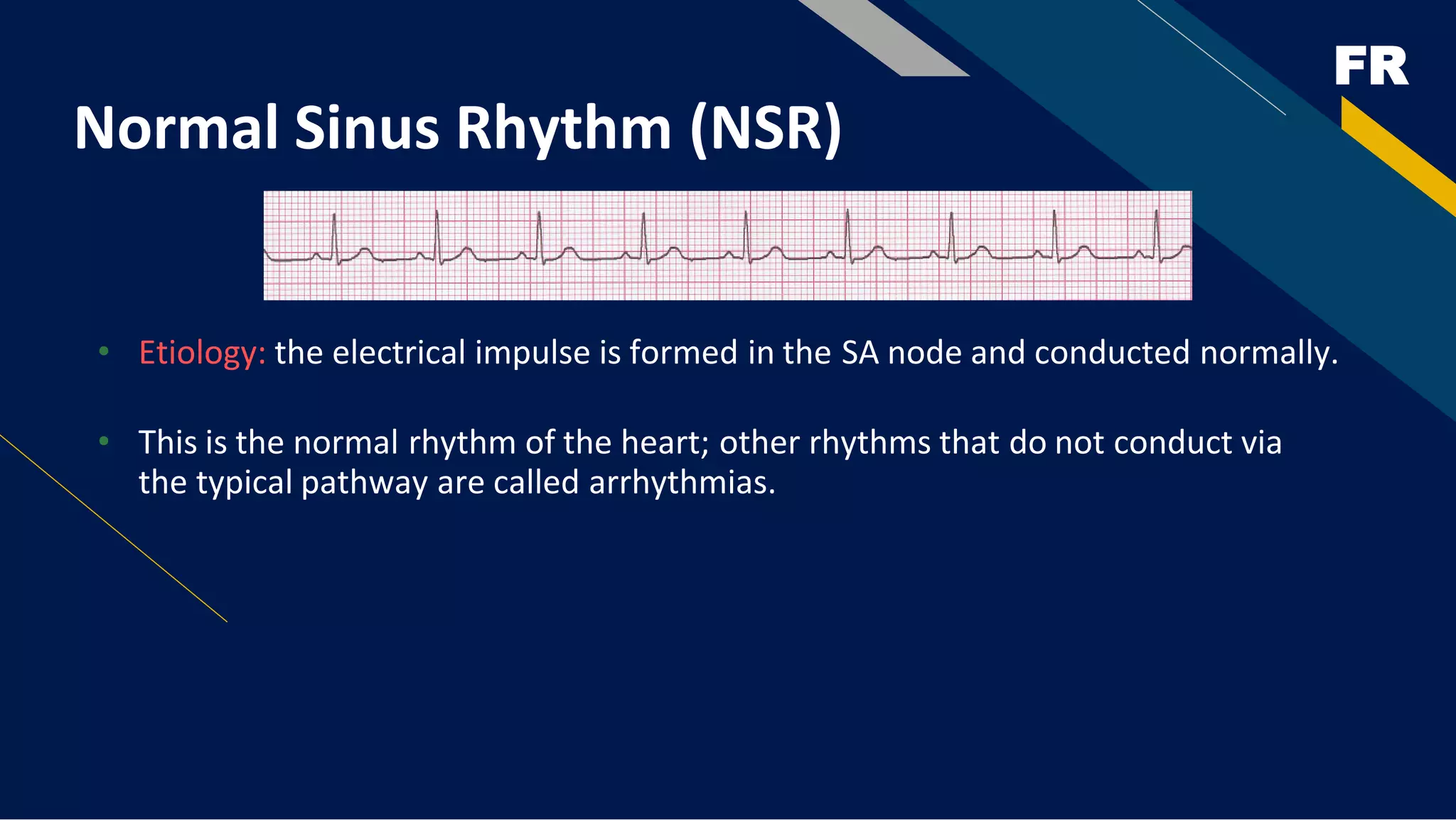
Normal Sinus Rhythm (NSR)
• Etiology: the electrical impulse is formed in the SA node and conducted normally.
• This is the normal rhythm of the heart; other rhythms that do not conduct via
the typical pathway are called arrhythmias.
FR
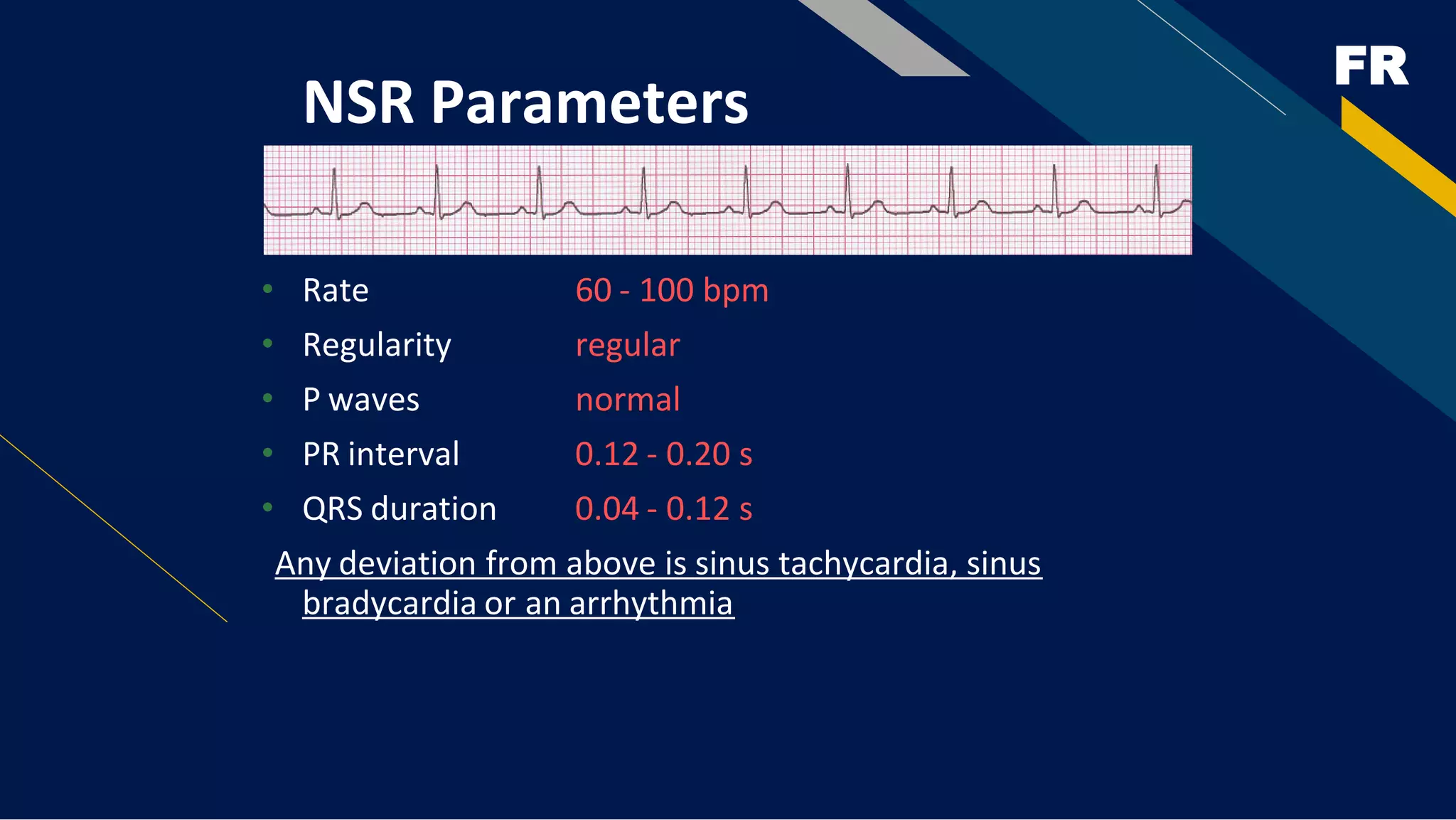
NSR Parameters
• Rate 60 - 100 bpm
• Regularity regular
• P waves normal
• PR interval 0.12 - 0.20 s
• QRS duration 0.04 - 0.12 s
Any deviation from above is sinus tachycardia, sinus
bradycardia or an arrhythmia
FR
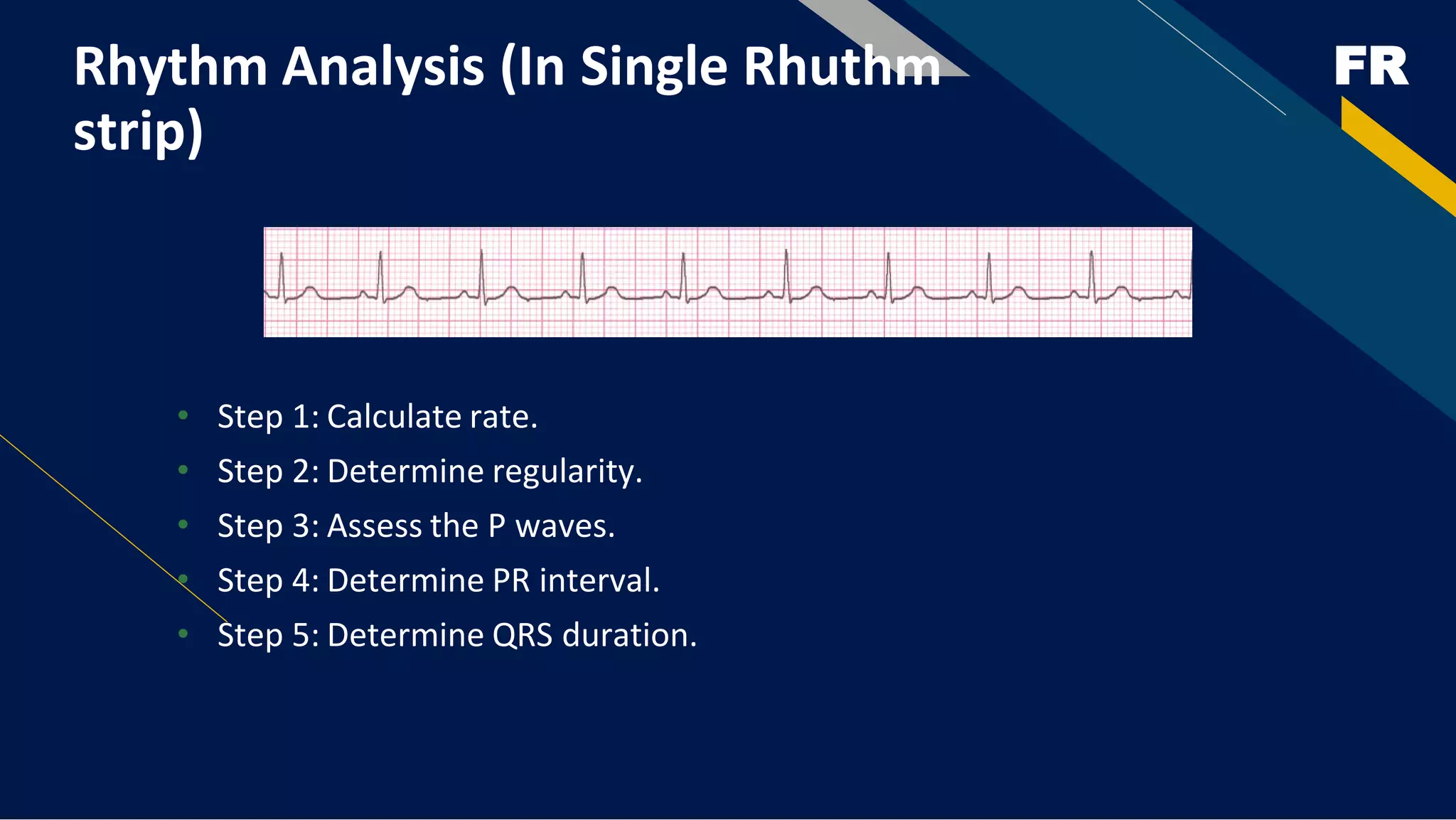
Rhythm Analysis (In Single Rhuthm
strip)
• Step 1: Calculate rate.
• Step 2: Determine regularity.
• Step 3: Assess the P waves.
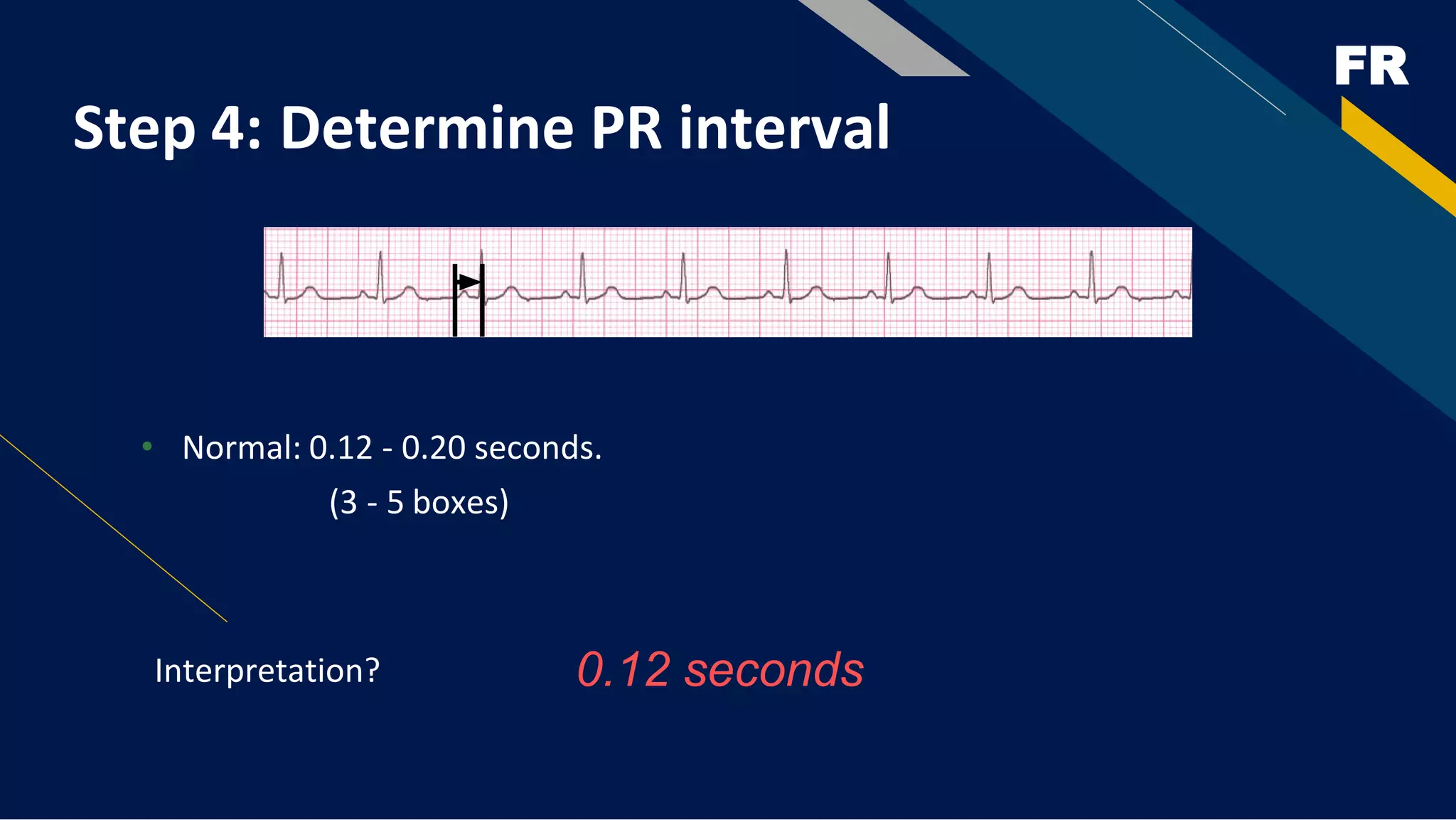
• Step 4: Determine PR interval.
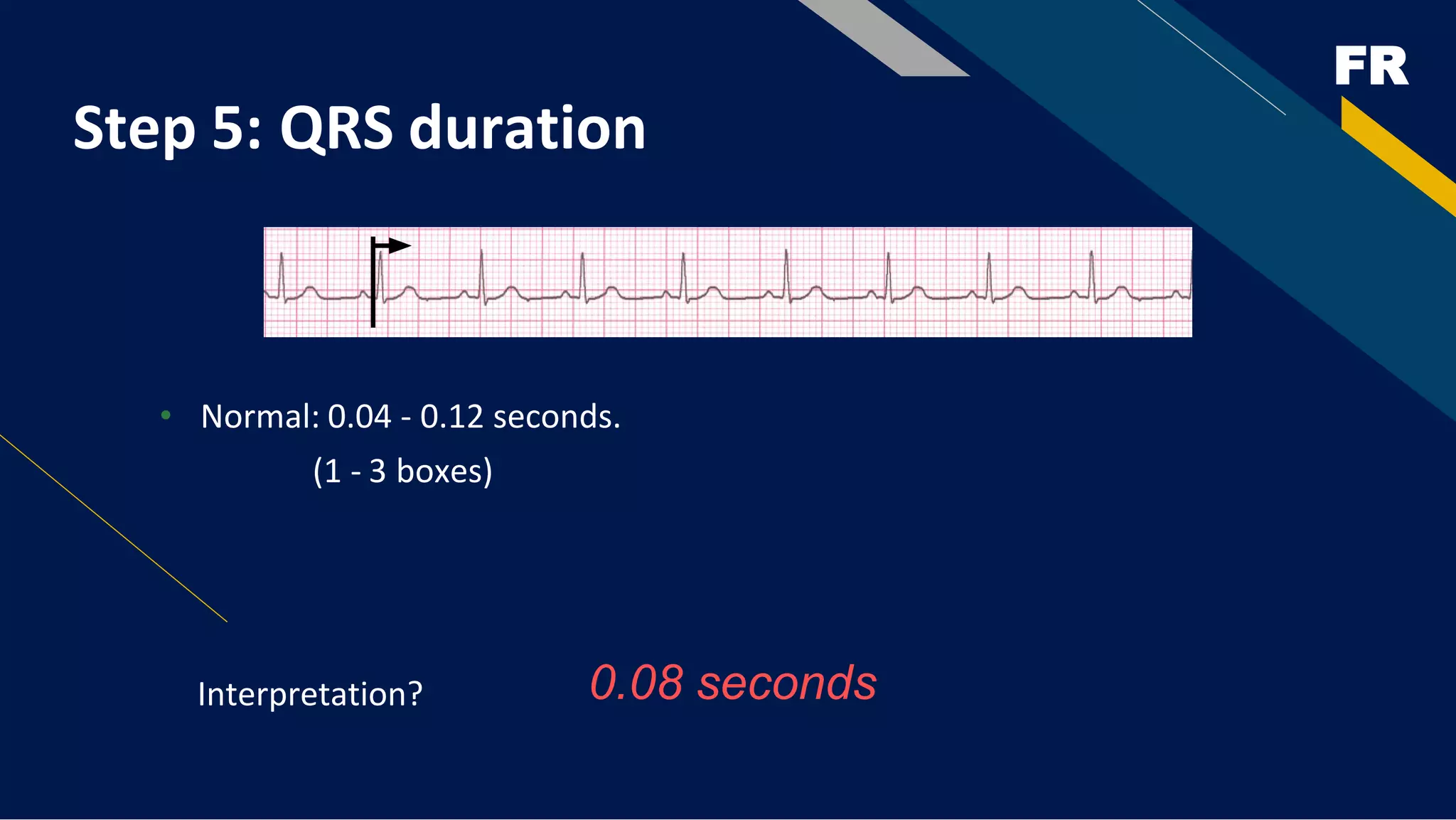
• Step 5: Determine QRS duration.
FR
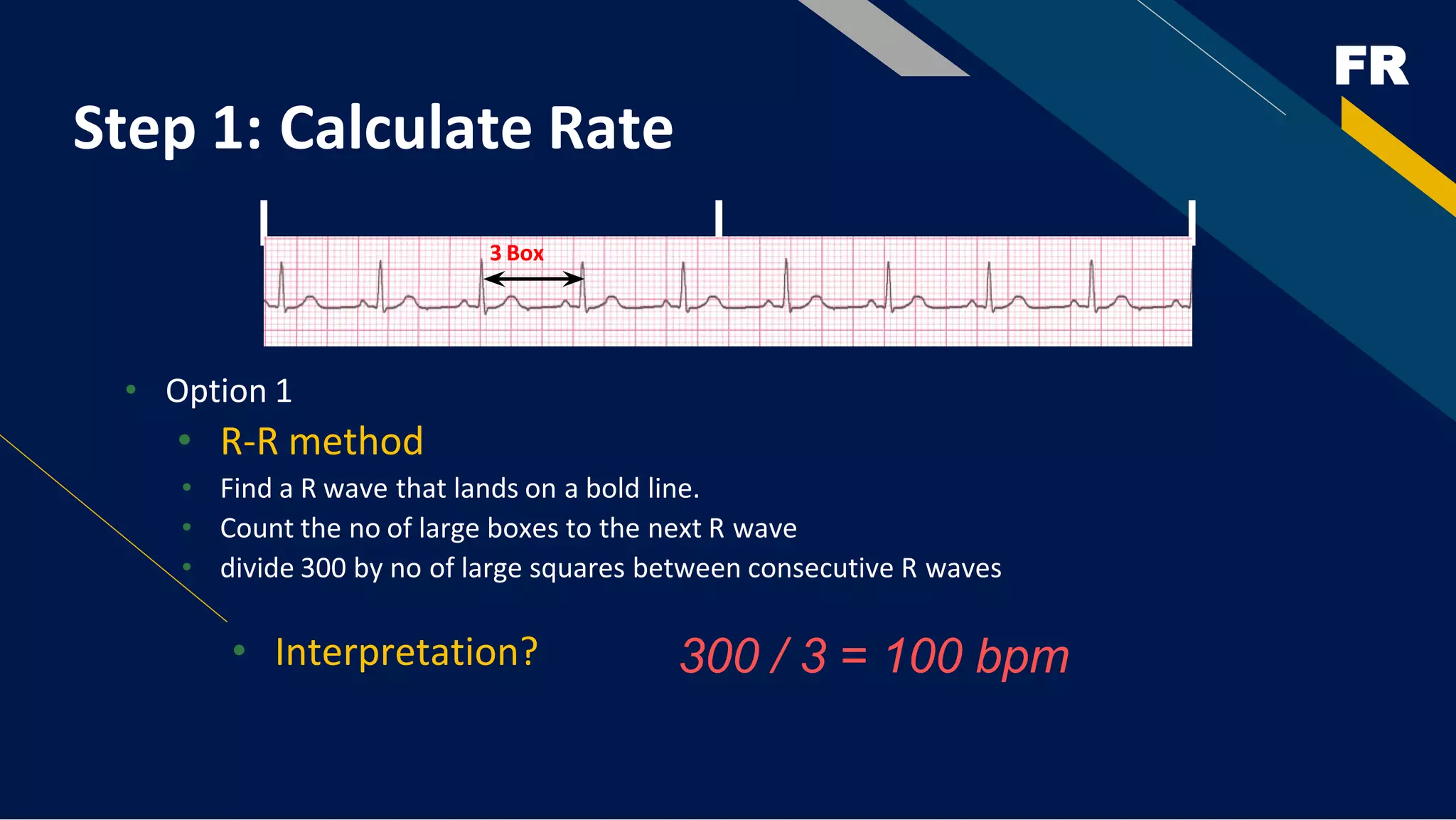
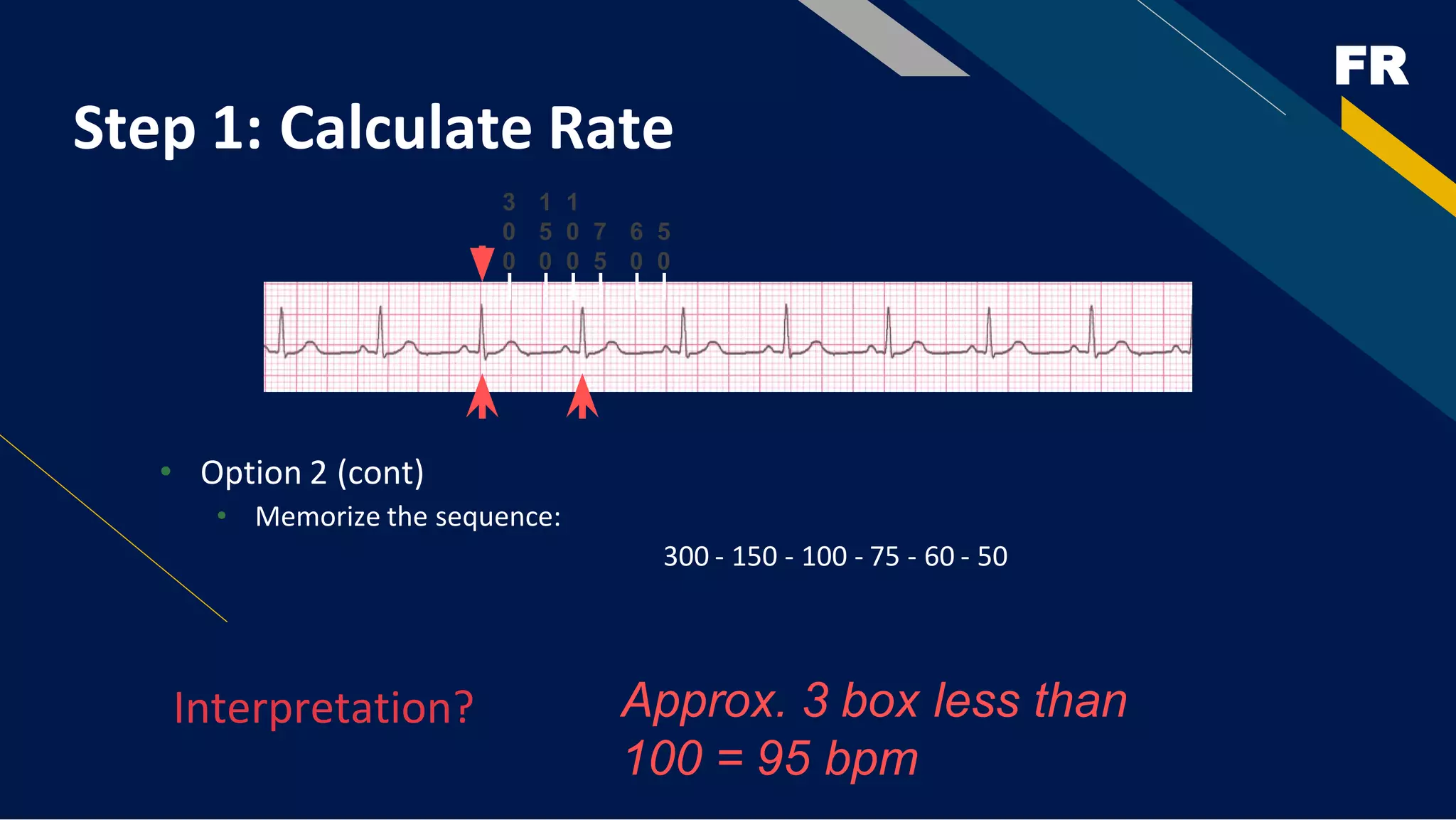
Step 1: Calculate Rate
• Option 1
• R-R method
• Find a R wave that lands on a bold line.
• Count the no of large boxes to the next R wave
• divide 300 by no of large squares between consecutive R waves
• Interpretation? 300 / 3 = 100 bpm
3 Box
FR
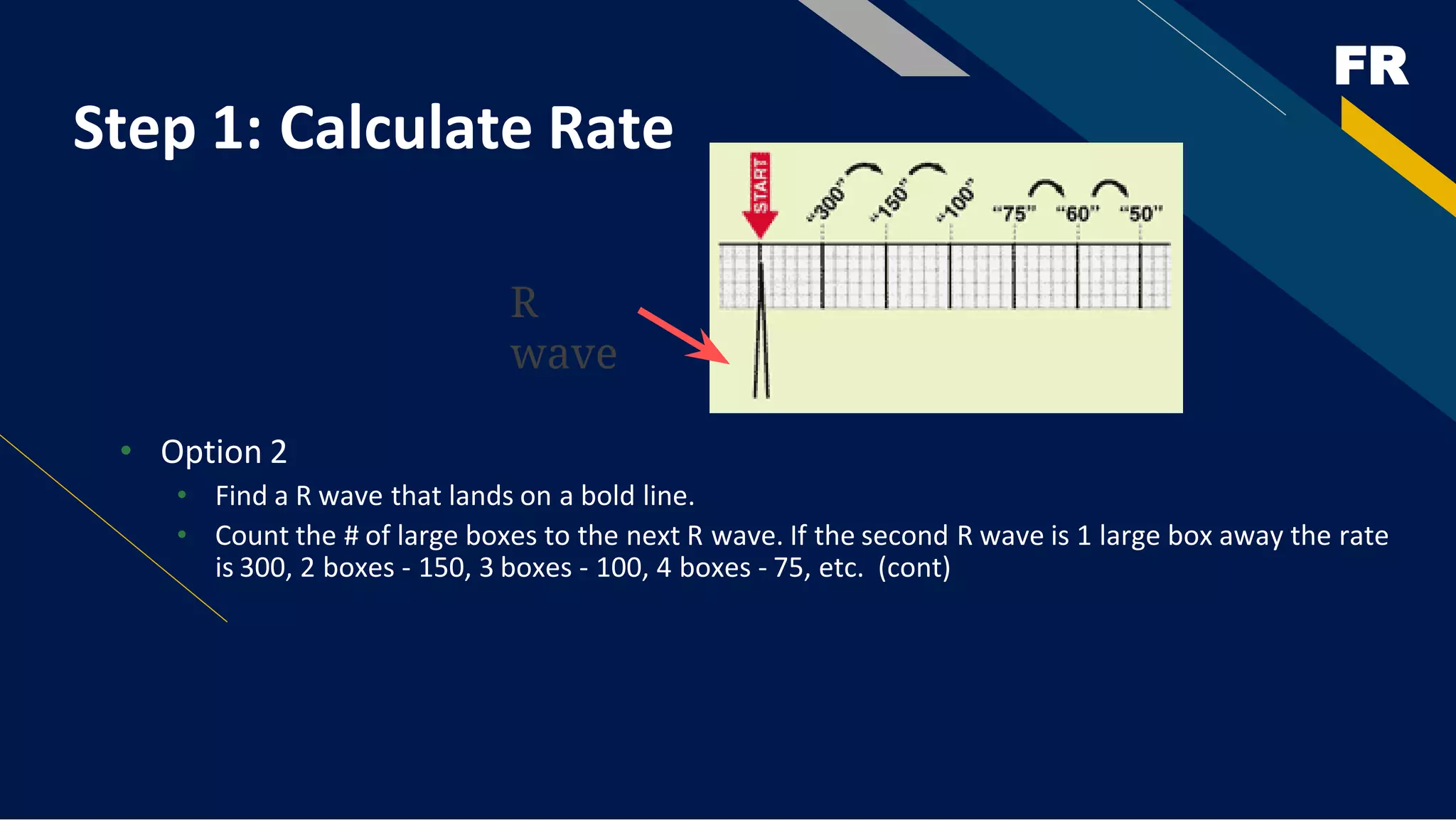
Step 1: Calculate Rate
• Option 2
• Find a R wave that lands on a bold line.
• Count the # of large boxes to the next R wave. If the second R wave is 1 large box away the rate
is 300, 2 boxes - 150, 3 boxes - 100, 4 boxes - 75, etc. (cont)
R
wave
FR
Step 1: Calculate Rate
• Option 2 (cont)
• Memorize the sequence:
300 - 150 - 100 - 75 - 60 - 50
Interpretation?
3
0
0
1
5
0
1
0
0
7
5
6
0
5
0
Approx. 3 box less than
100 = 95 bpm
FR
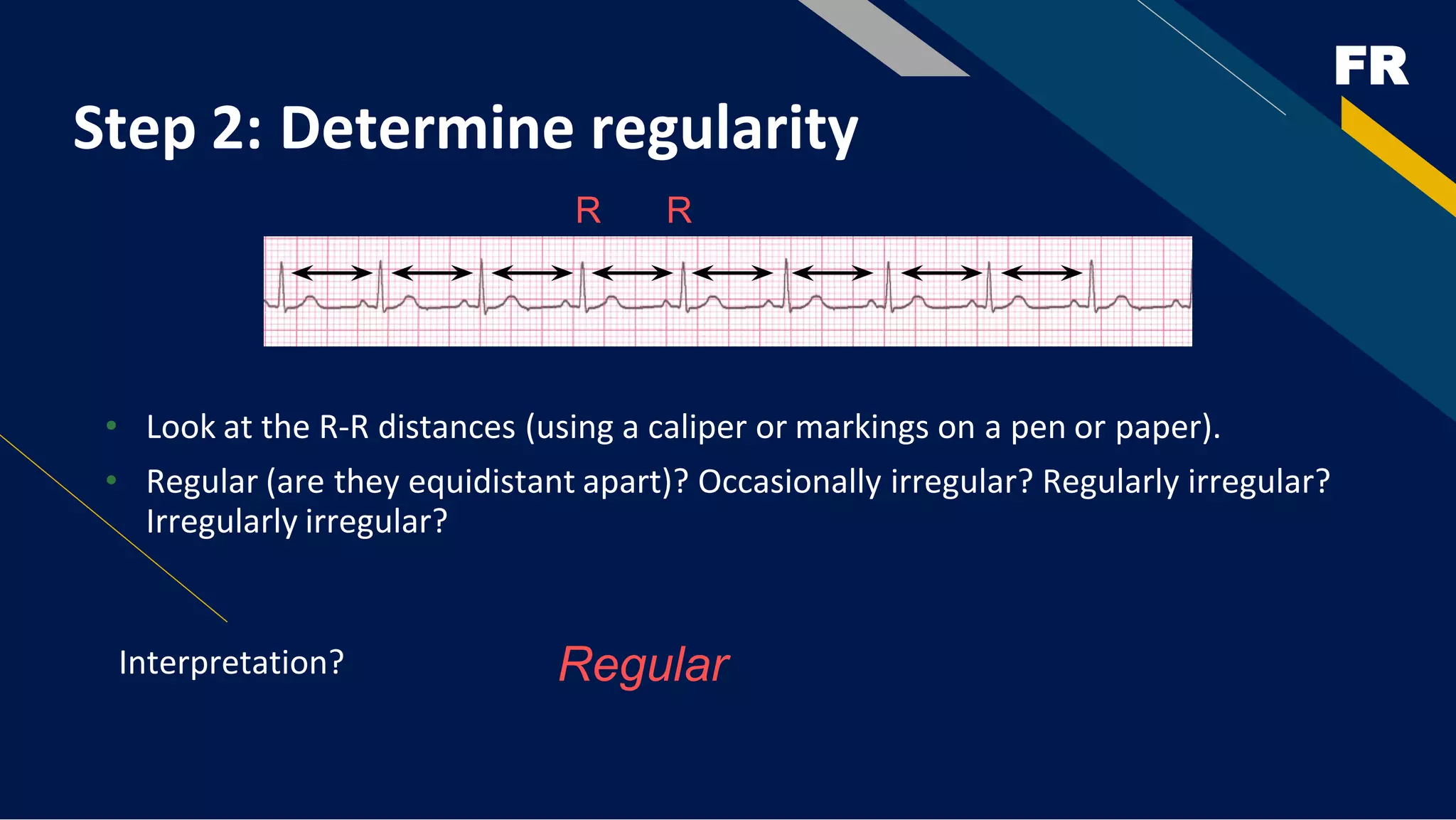
Step 2: Determine regularity
• Look at the R-R distances (using a caliper or markings on a pen or paper).
• Regular (are they equidistant apart)? Occasionally irregular? Regularly irregular?
Irregularly irregular?
Interpretation? Regular
R R
FR
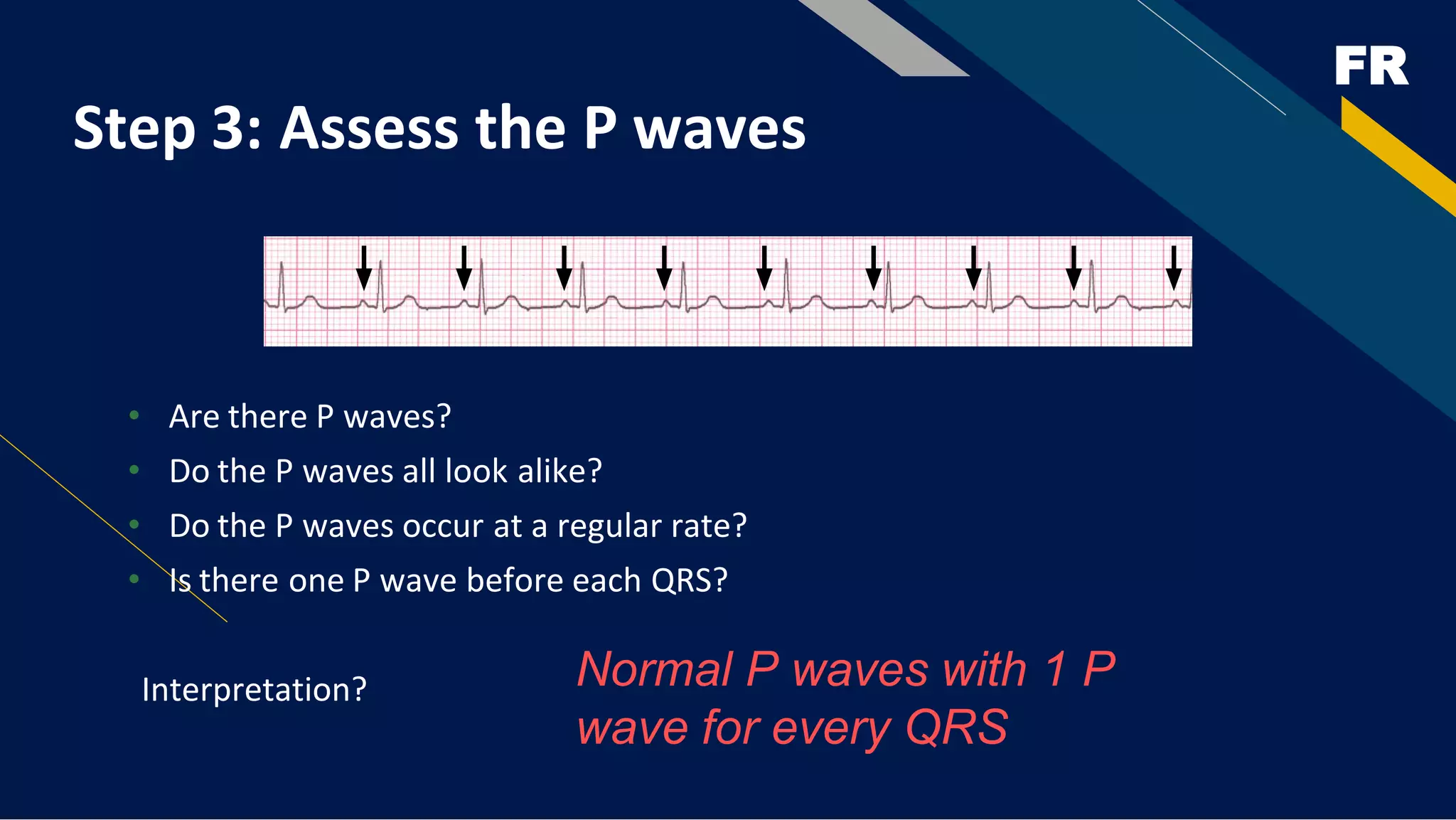
Step 3: Assess the P waves
• Are there P waves?
• Do the P waves all look alike?
• Do the P waves occur at a regular rate?
• Is there one P wave before each QRS?
Interpretation? Normal P waves with 1 P
wave for every QRS
FR
Step 4: Determine PR interval
• Normal: 0.12 - 0.20 seconds.
(3 - 5 boxes)
Interpretation? 0.12 seconds
FR
Step 5: QRS duration
• Normal: 0.04 - 0.12 seconds.
(1 - 3 boxes)
Interpretation? 0.08 seconds
FR
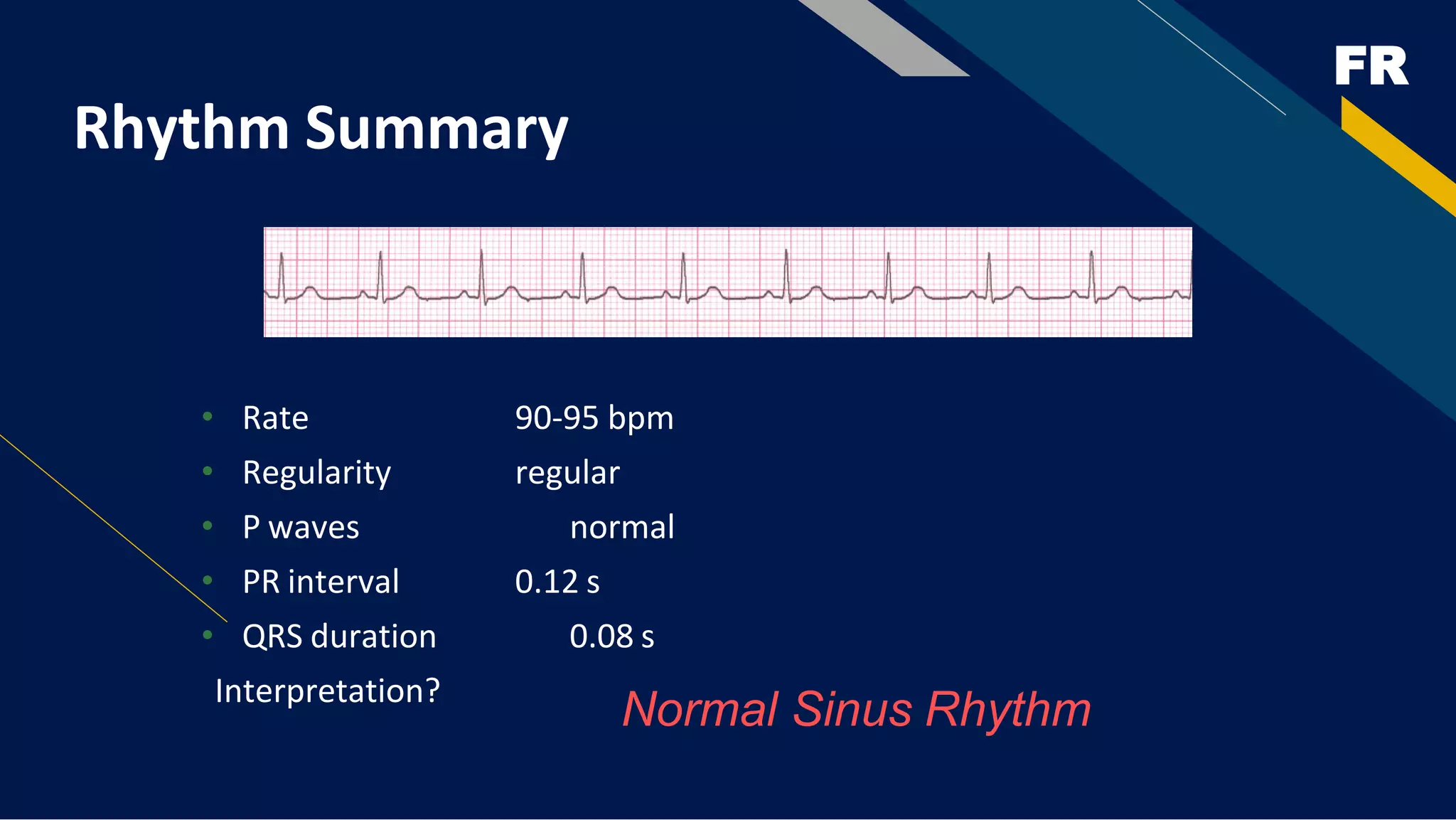
Rhythm Summary
• Rate 90-95 bpm
• Regularity regular
• P waves normal
• PR interval 0.12 s
• QRS duration 0.08 s
Interpretation?
Normal Sinus Rhythm
Supraventricular
Arrhythmias
❖ Atrial Fibrillation
❖ Atrial Flutter
❖ Paroxysmal
Supraventricular
Tachycardia
FR
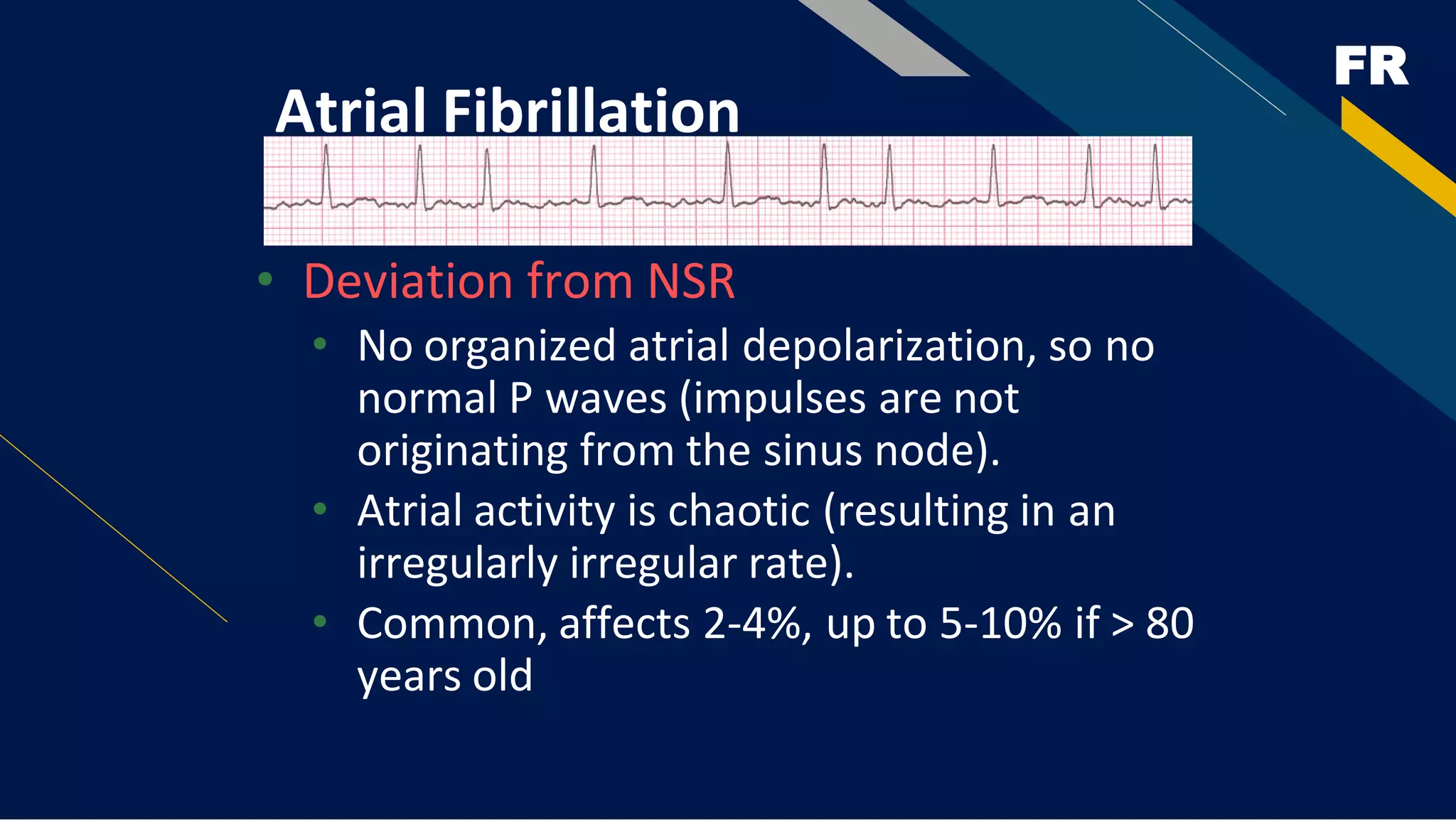
Atrial Fibrillation
• Deviation from NSR
• No organized atrial depolarization, so no
normal P waves (impulses are not
originating from the sinus node).
• Atrial activity is chaotic (resulting in an
irregularly irregular rate).
• Common, affects 2-4%, up to 5-10% if > 80
years old
FR
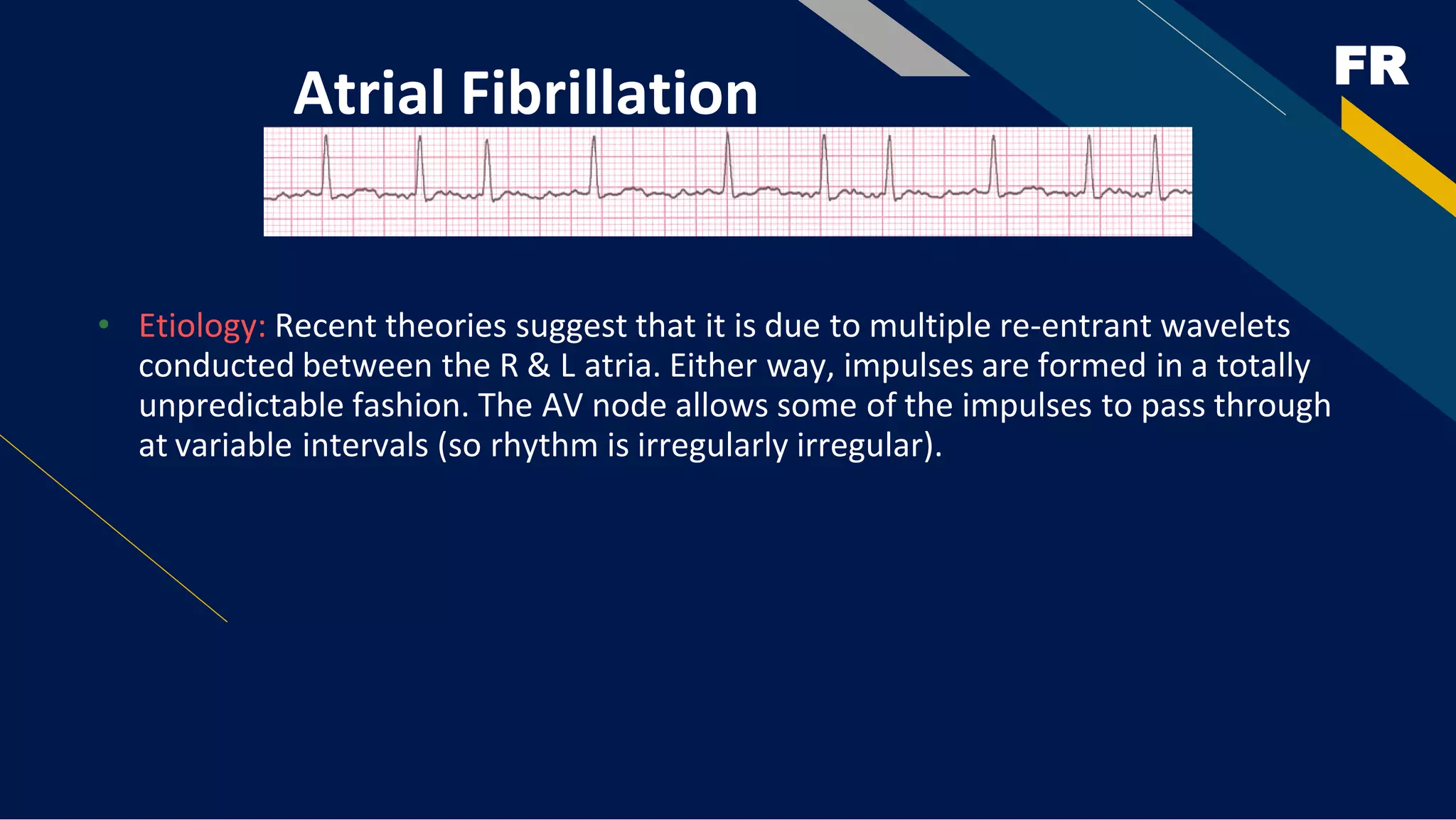
Atrial Fibrillation
• Etiology: Recent theories suggest that it is due to multiple re-entrant wavelets
conducted between the R & L atria. Either way, impulses are formed in a totally
unpredictable fashion. The AV node allows some of the impulses to pass through
at variable intervals (so rhythm is irregularly irregular).
FR
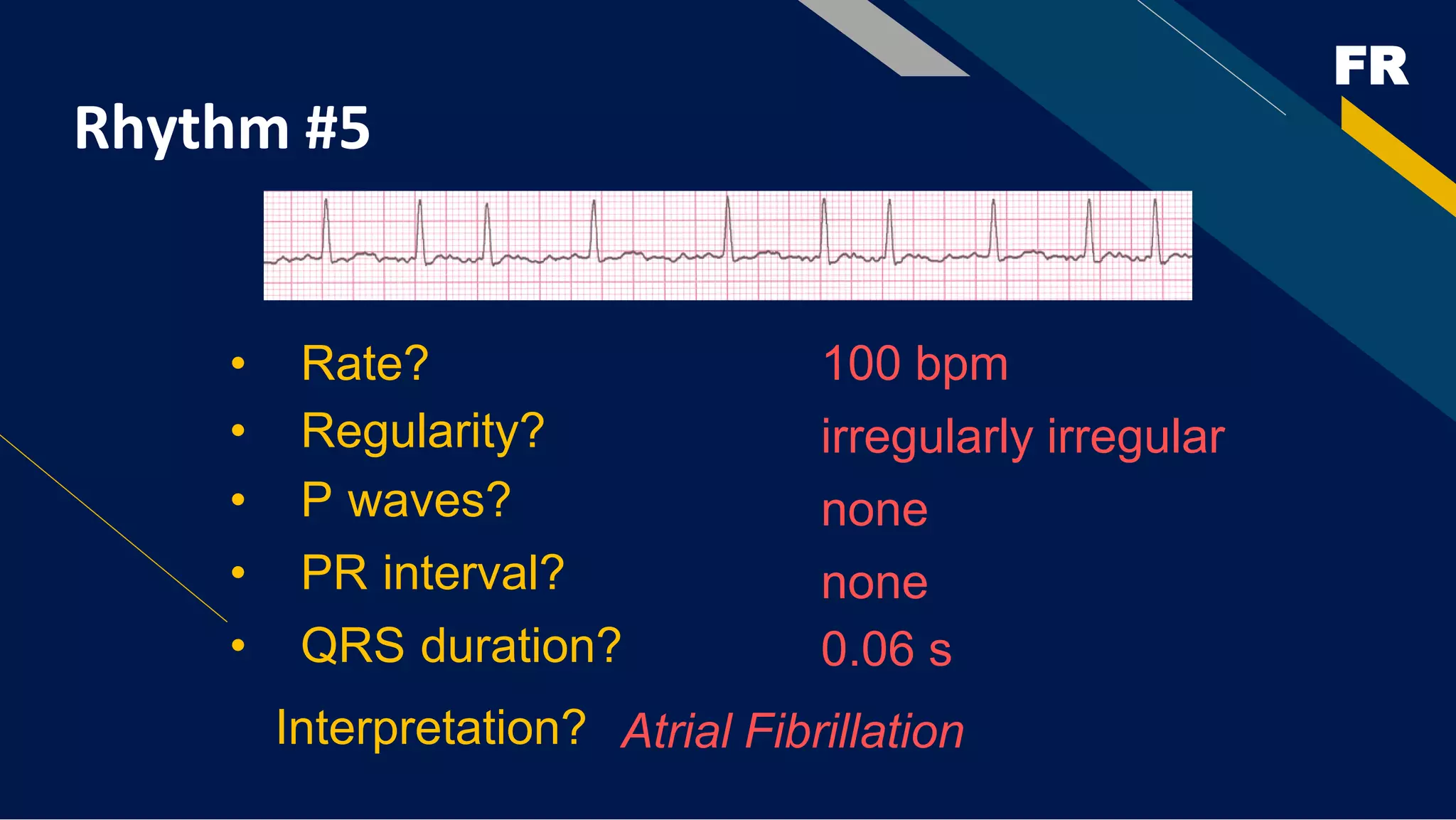
Rhythm #5
100 bpm
• Rate?
• Regularity? irregularly irregular
none
0.06 s
• P waves?
• PR interval? none
• QRS duration?
Interpretation? Atrial Fibrillation
FR
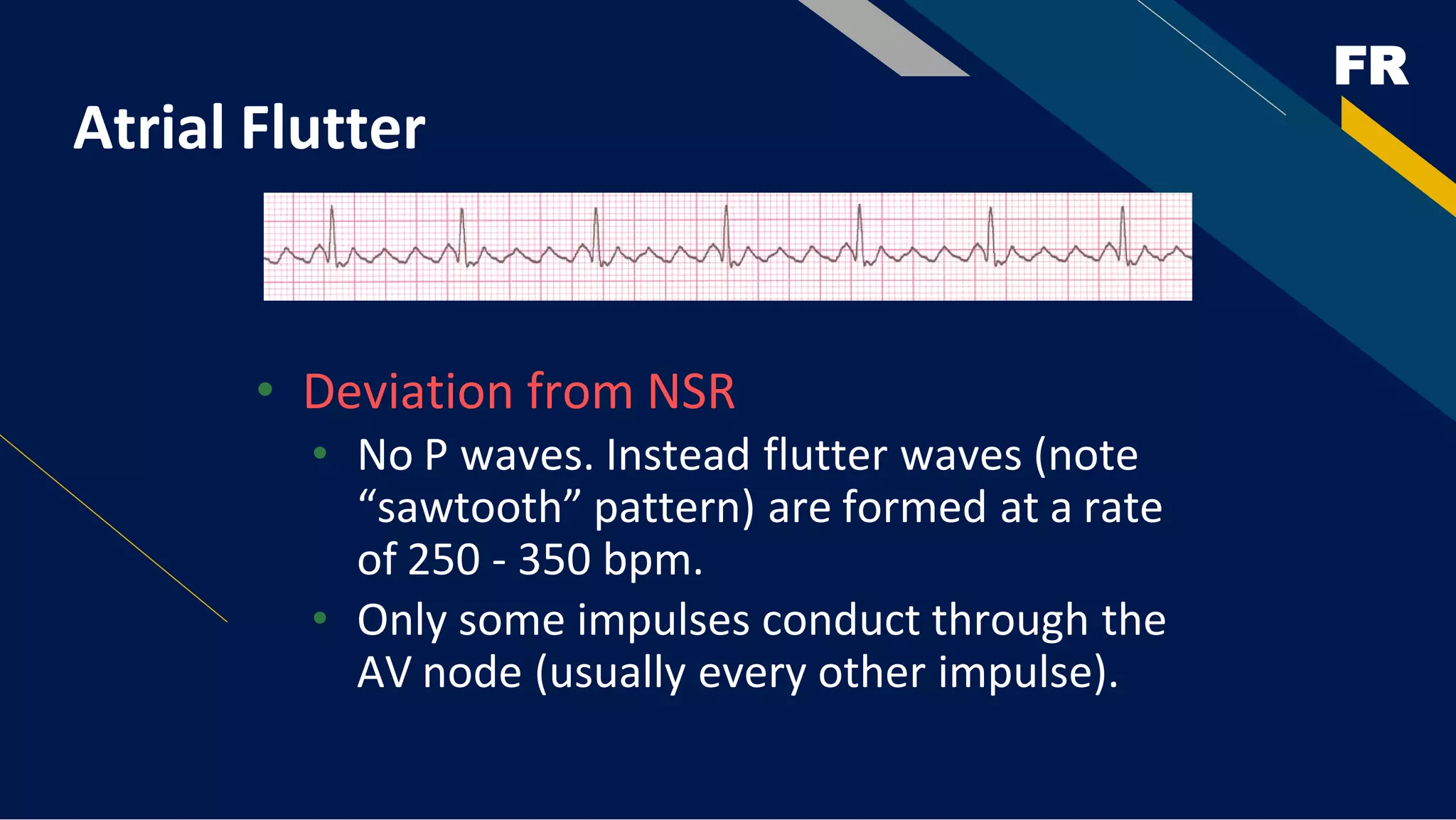
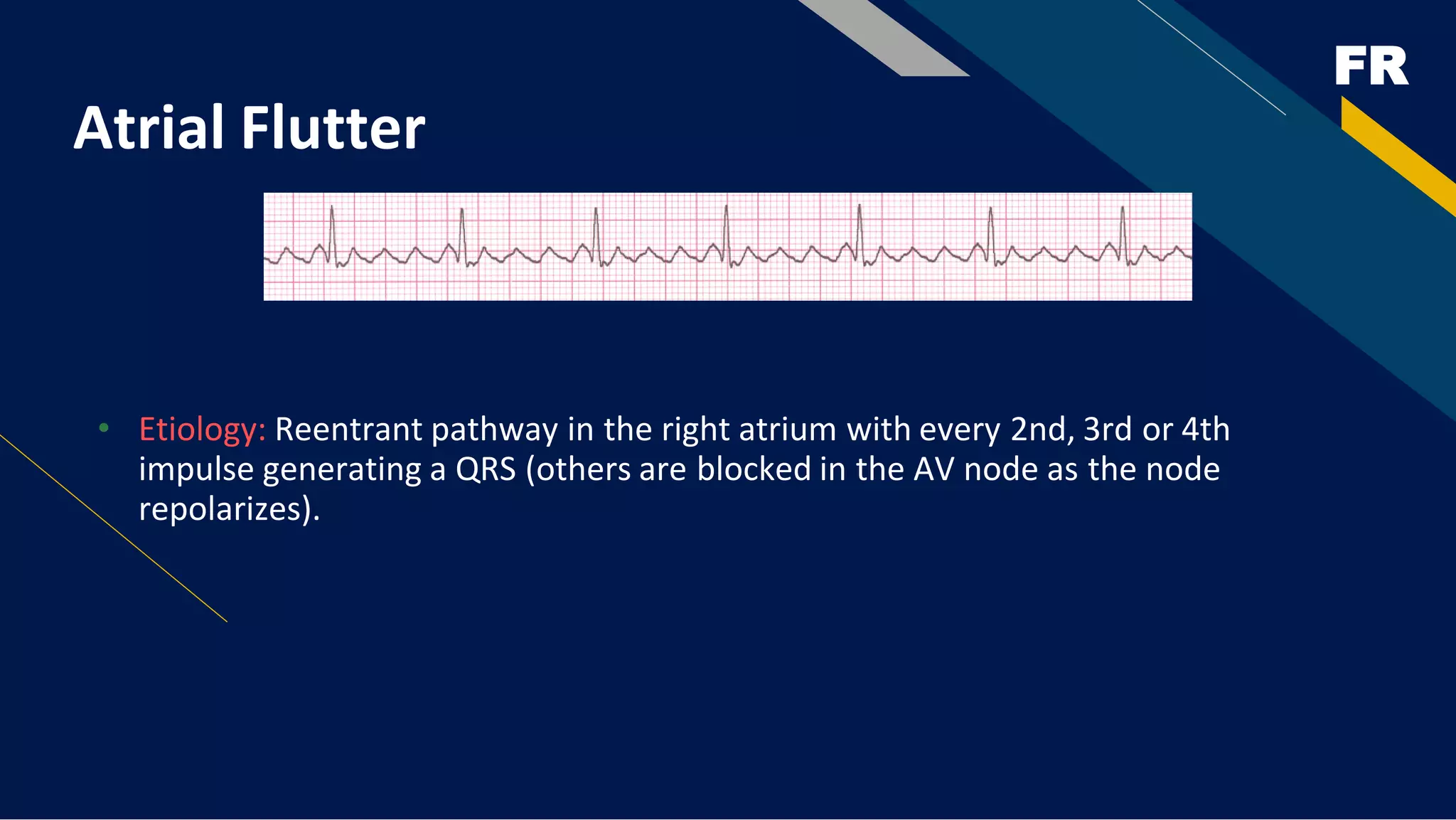
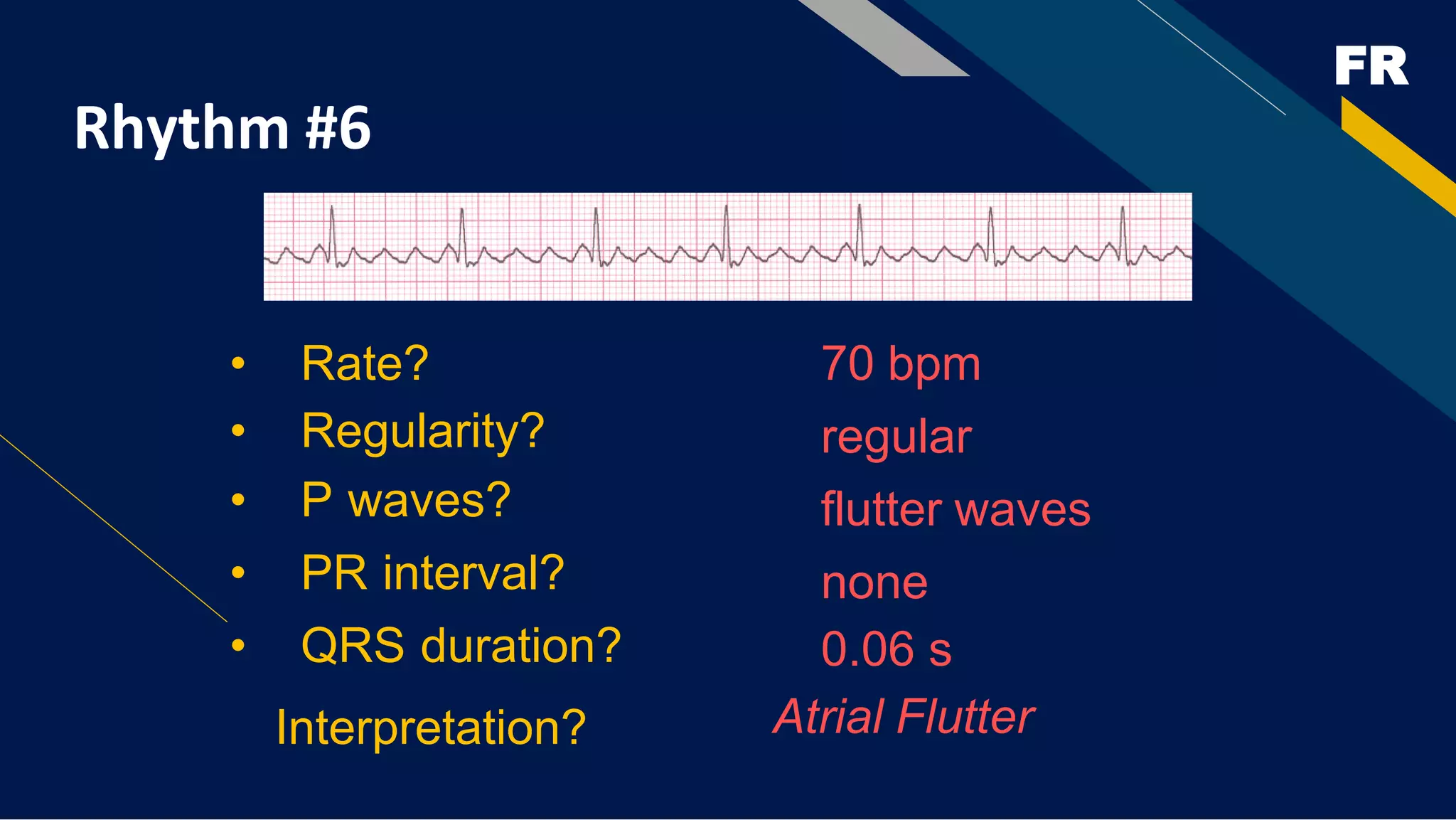
Atrial Flutter
• Deviation from NSR
• No P waves. Instead flutter waves (note
“sawtooth” pattern) are formed at a rate
of 250 - 350 bpm.
• Only some impulses conduct through the
AV node (usually every other impulse).
FR
Atrial Flutter
• Etiology: Reentrant pathway in the right atrium with every 2nd, 3rd or 4th
impulse generating a QRS (others are blocked in the AV node as the node
repolarizes).
FR
Rhythm #6
70 bpm
• Rate?
• Regularity? regular
flutter waves
0.06 s
• P waves?
• PR interval? none
• QRS duration?
Interpretation? Atrial Flutter
Ventricular Arrhythmias
Ventricular Tachycardia
Ventricular Fibrillation
FR
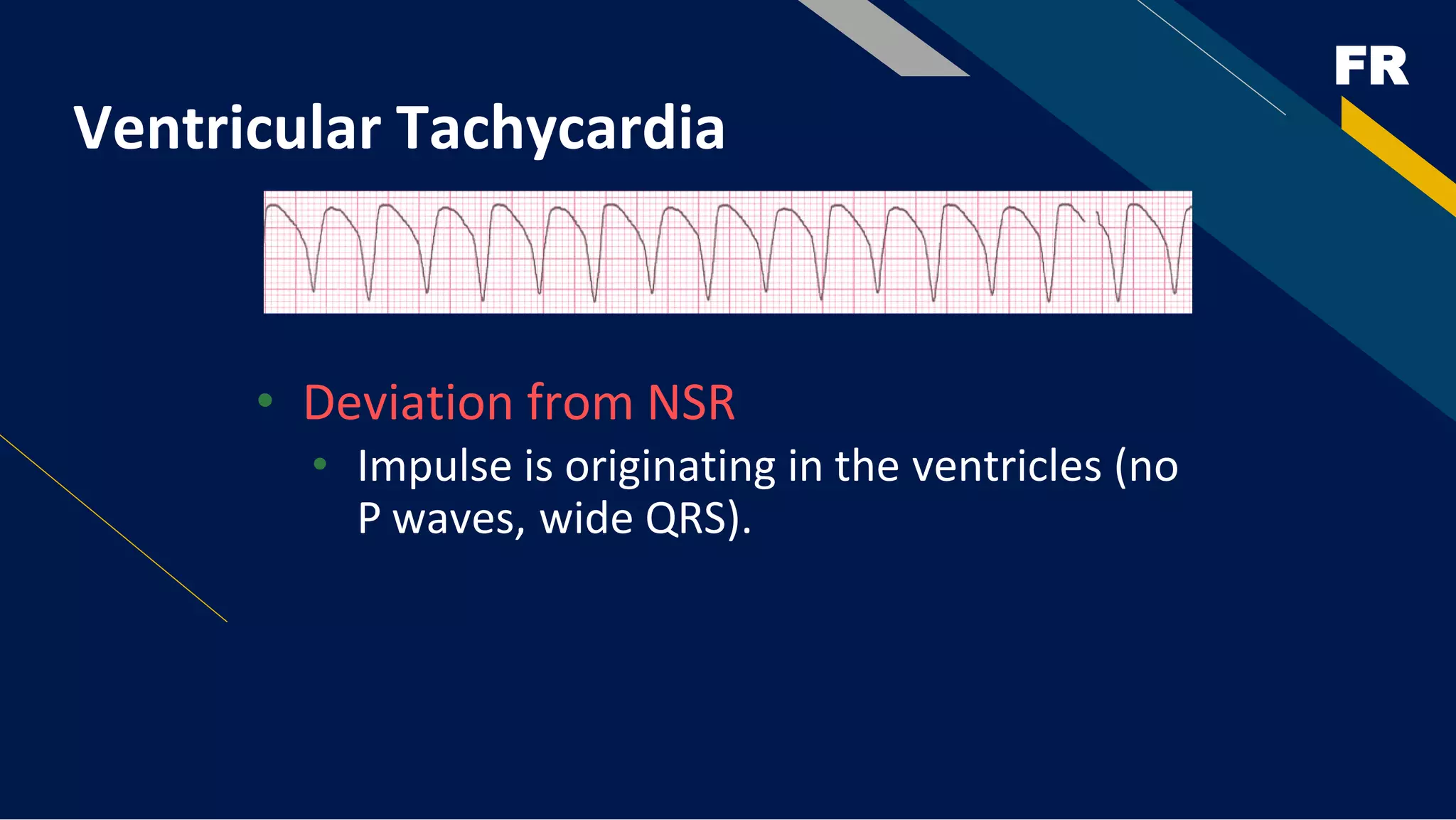
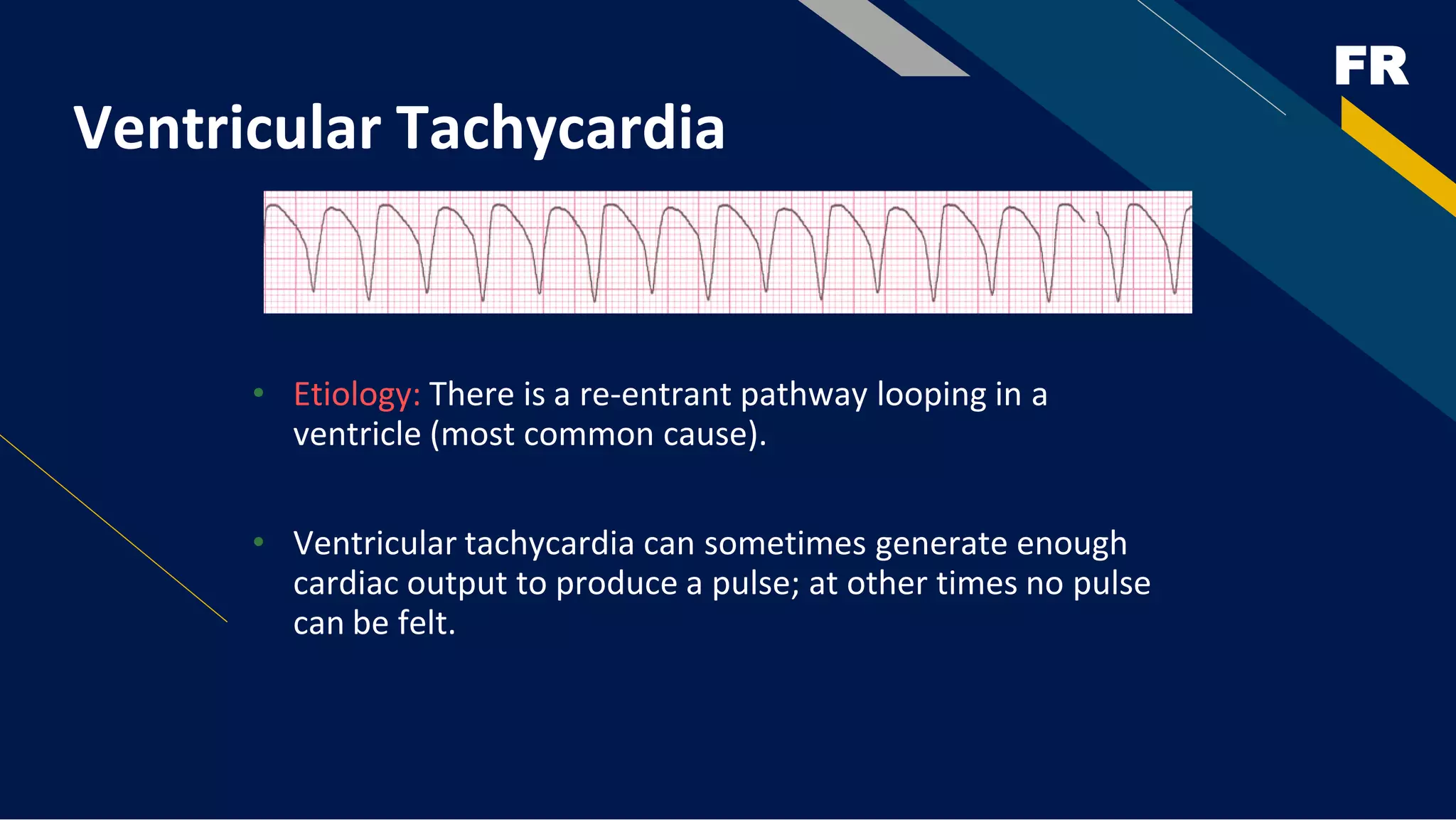
Ventricular Tachycardia
• Deviation from NSR
• Impulse is originating in the ventricles (no
P waves, wide QRS).
FR
Ventricular Tachycardia
• Etiology: There is a re-entrant pathway looping in a
ventricle (most common cause).
• Ventricular tachycardia can sometimes generate enough
cardiac output to produce a pulse; at other times no pulse
can be felt.
FR
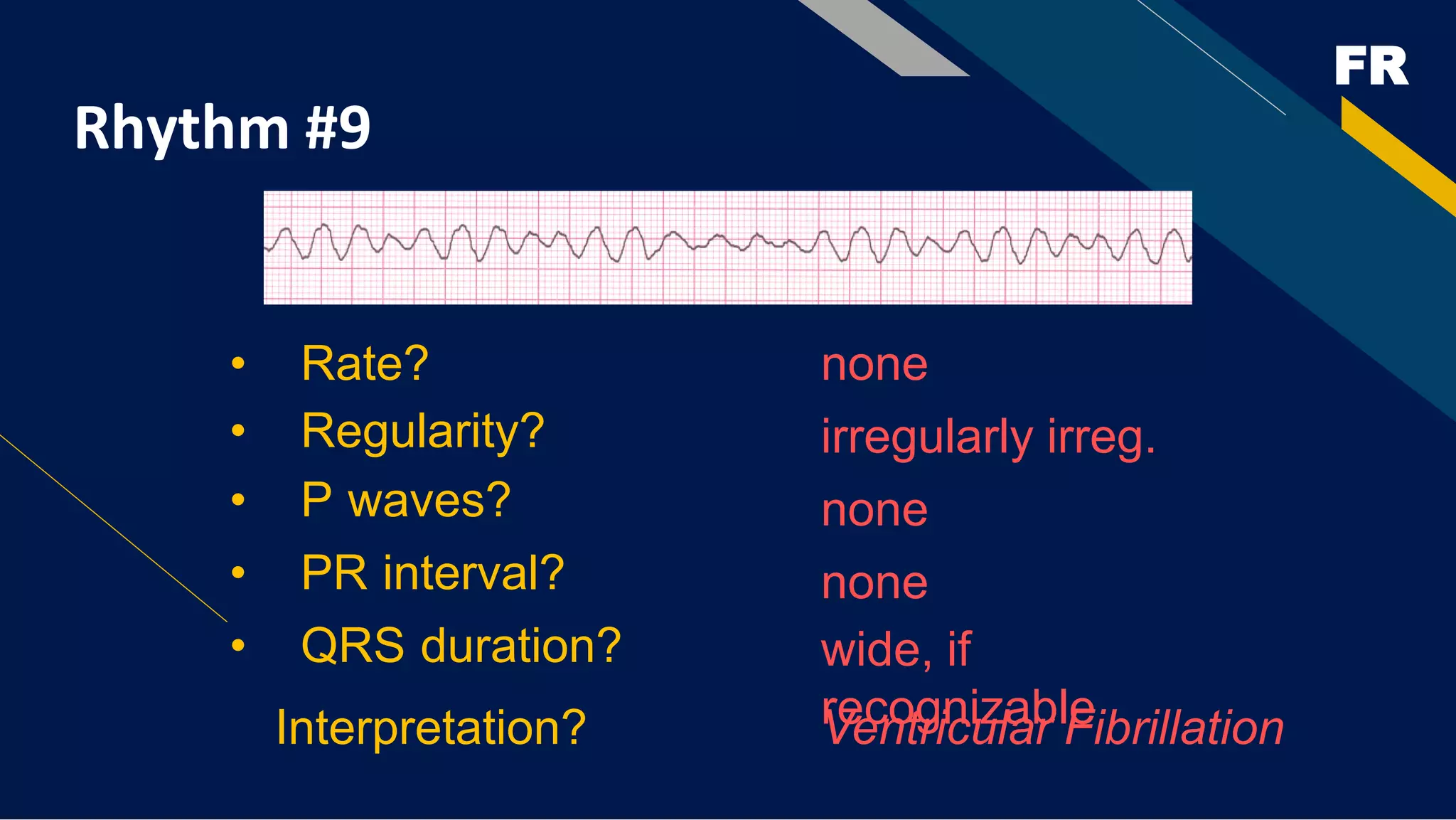
Rhythm #9
none
• Rate?
• Regularity? irregularly irreg.
none
wide, if
recognizable
• P waves?
• PR interval? none
• QRS duration?
Interpretation? Ventricular Fibrillation
FR
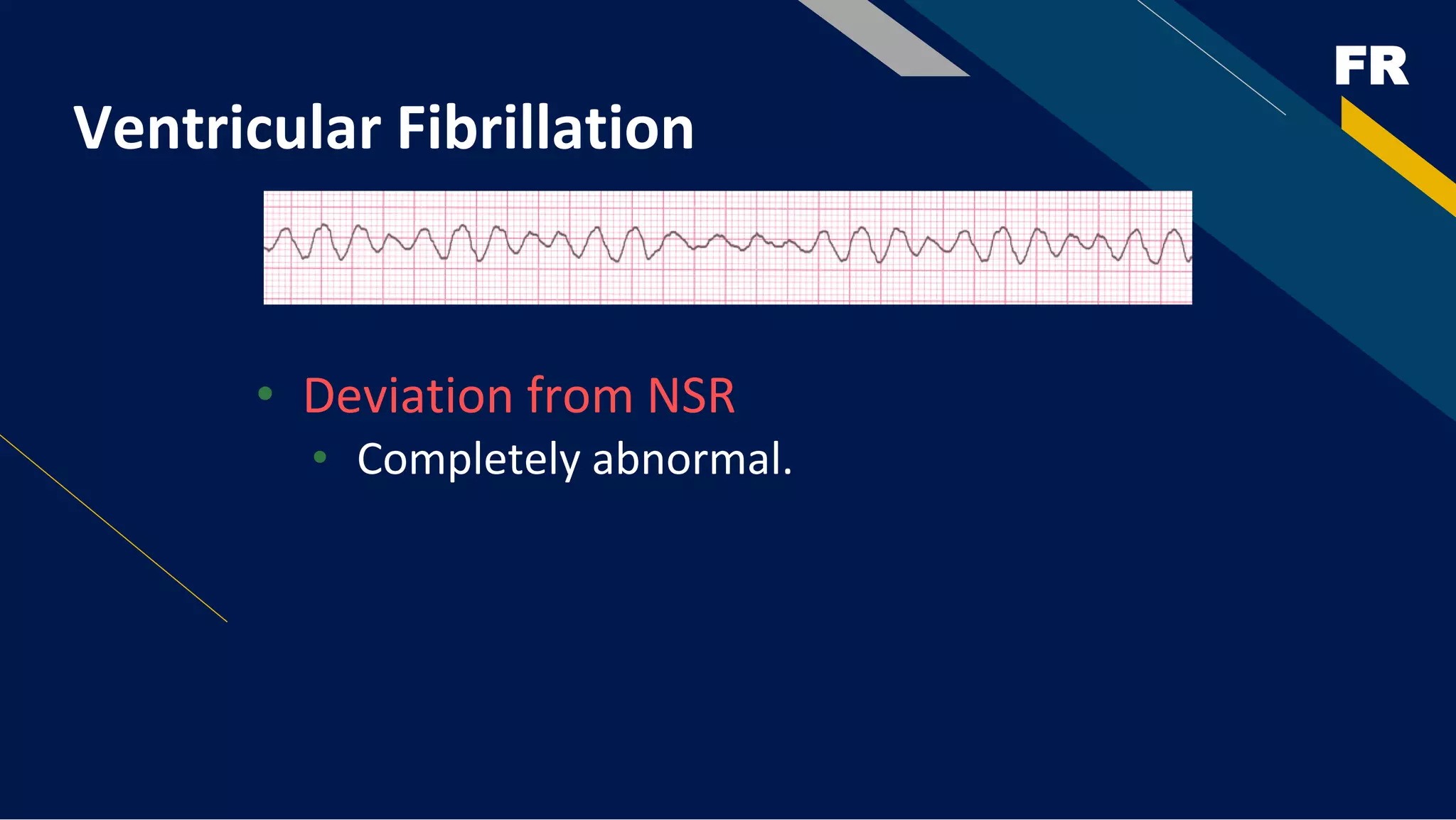
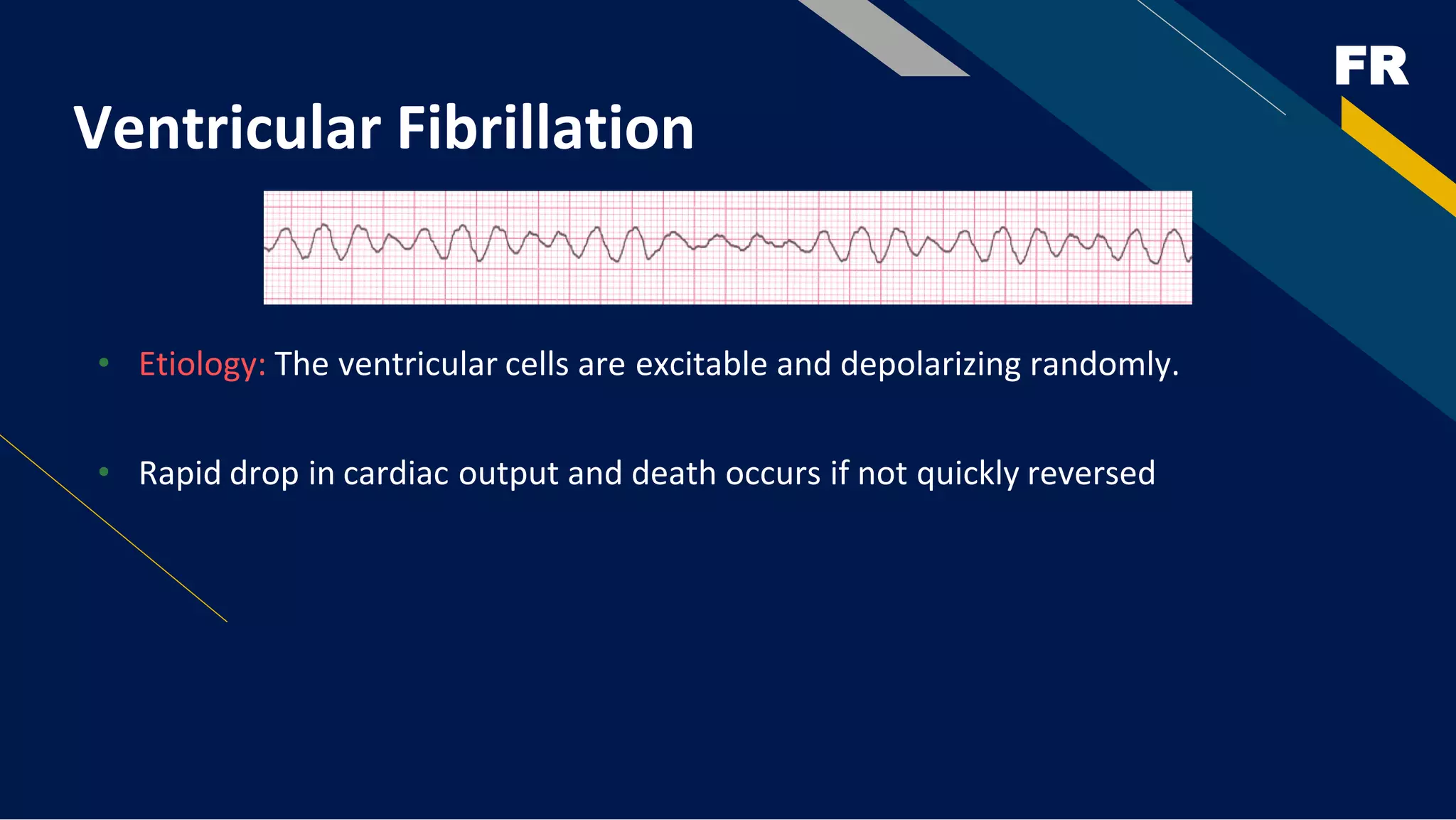
Ventricular Fibrillation
• Deviation from NSR
• Completely abnormal.
FR
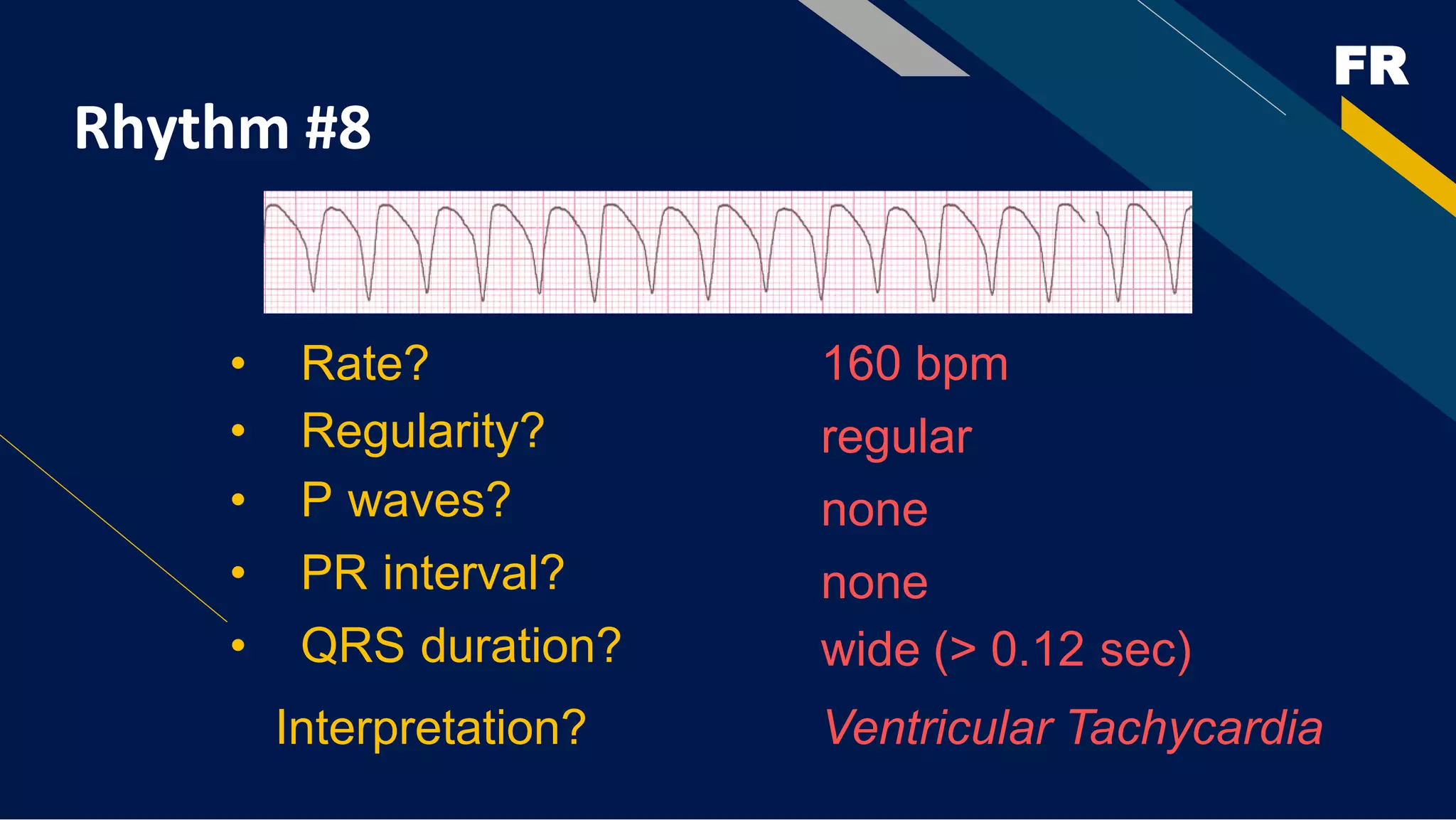
Rhythm #8
160 bpm
• Rate?
• Regularity? regular
none
wide (> 0.12 sec)
• P waves?
• PR interval? none
• QRS duration?
Interpretation? Ventricular Tachycardia
FR
Ventricular Fibrillation
• Etiology: The ventricular cells are excitable and depolarizing randomly.
• Rapid drop in cardiac output and death occurs if not quickly reversed
FR
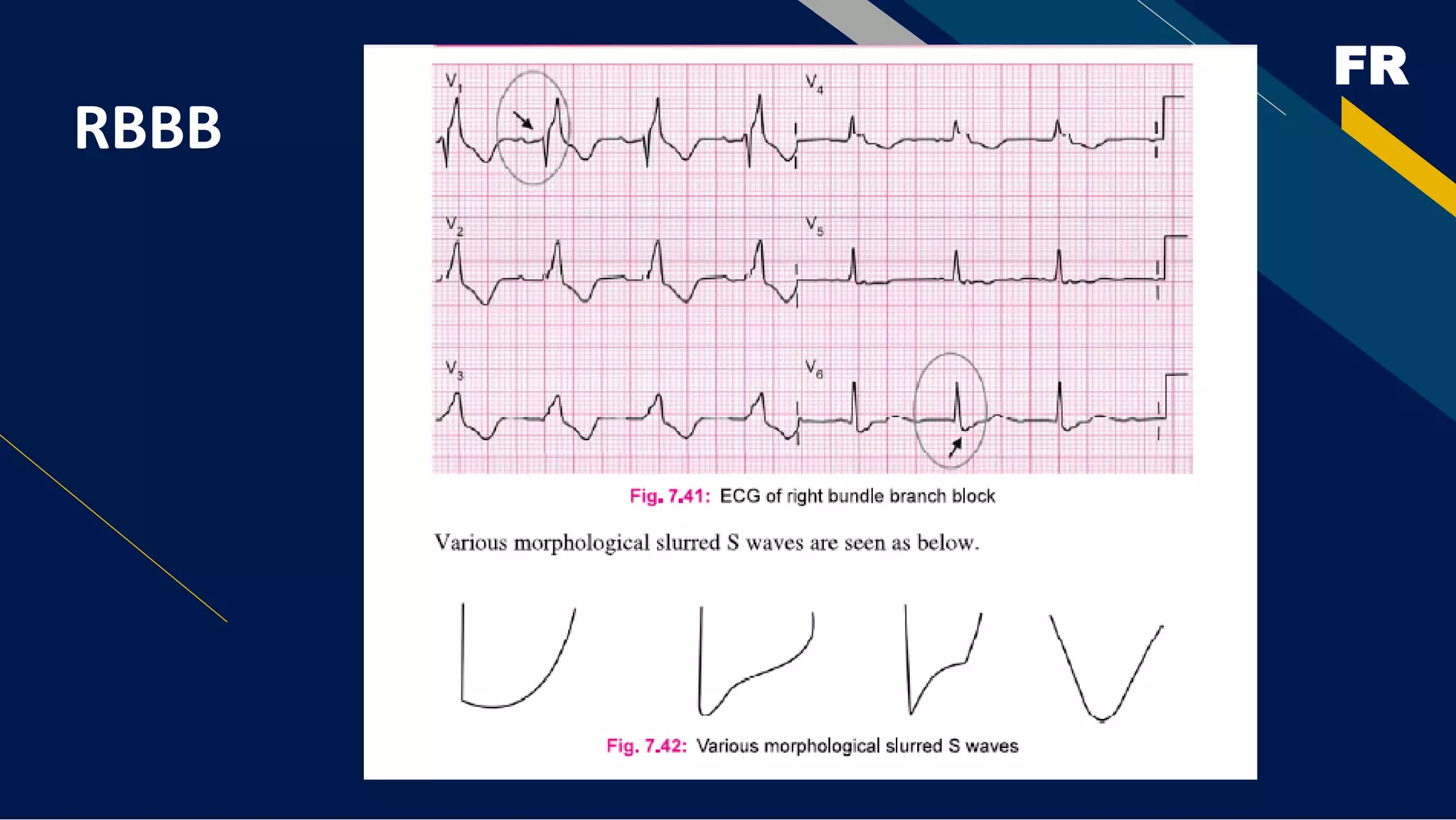
RBBB
FR
RBBB
FR
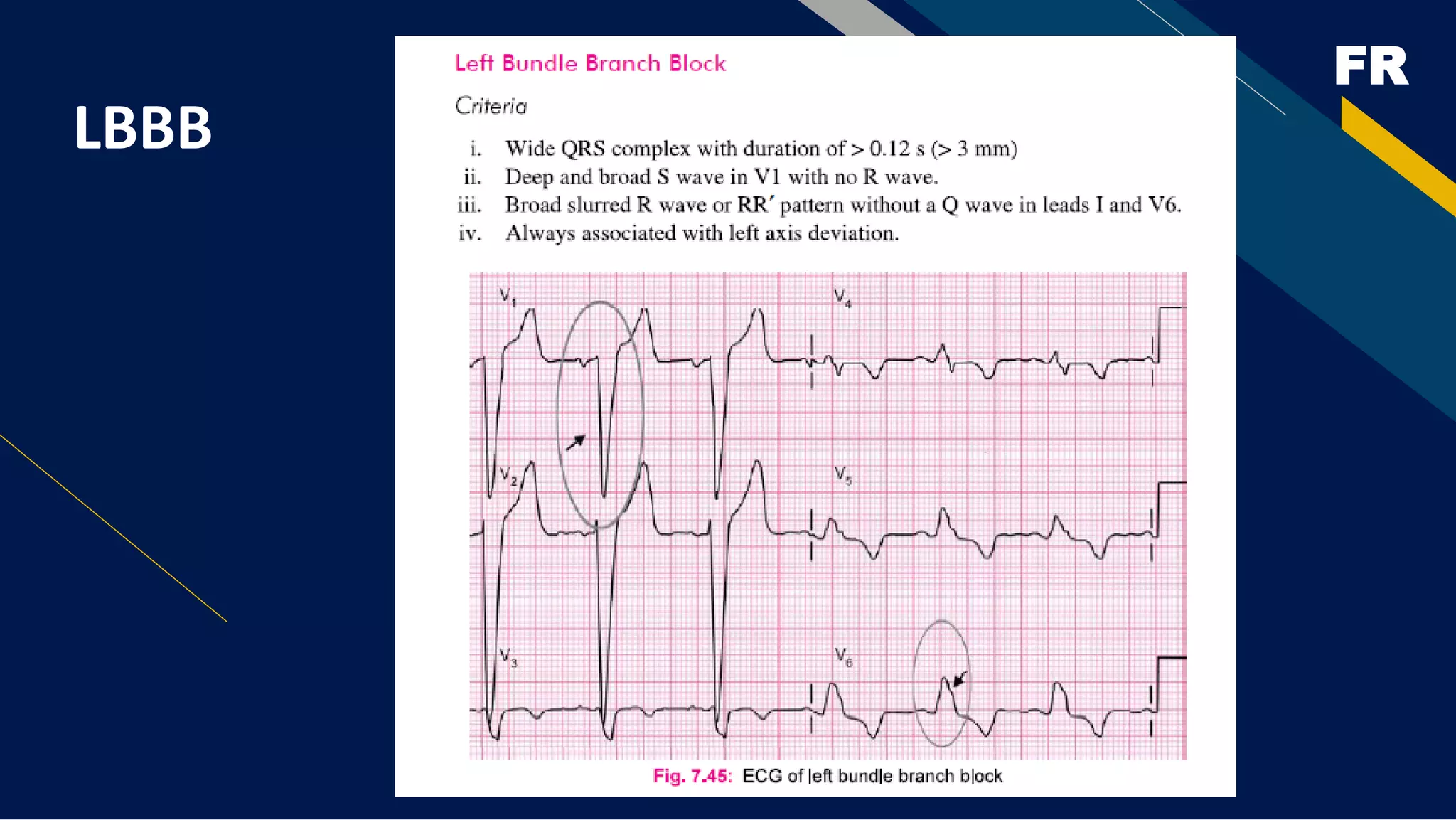
LBBB
FR
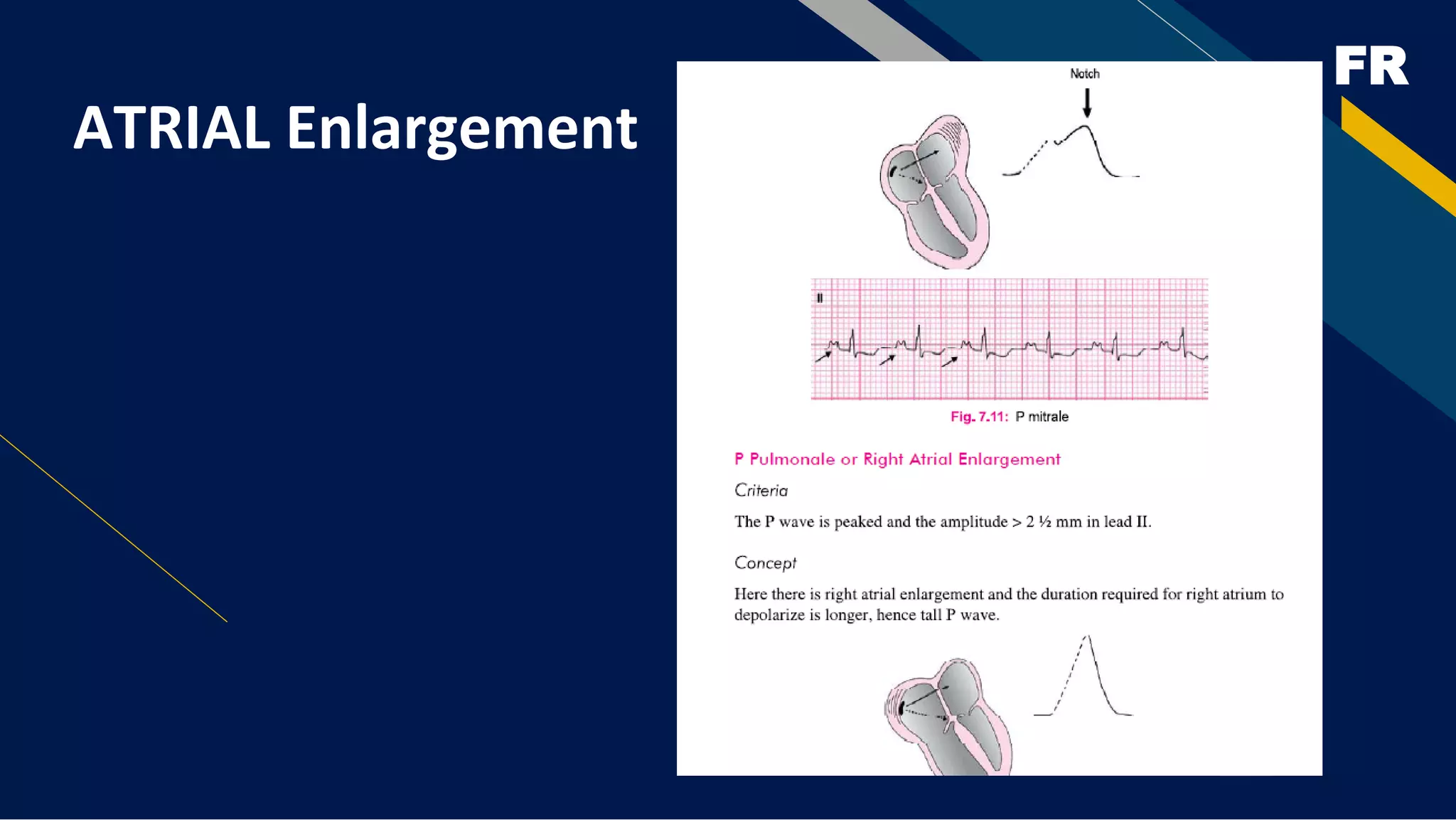
ATRIAL Enlargement
FR
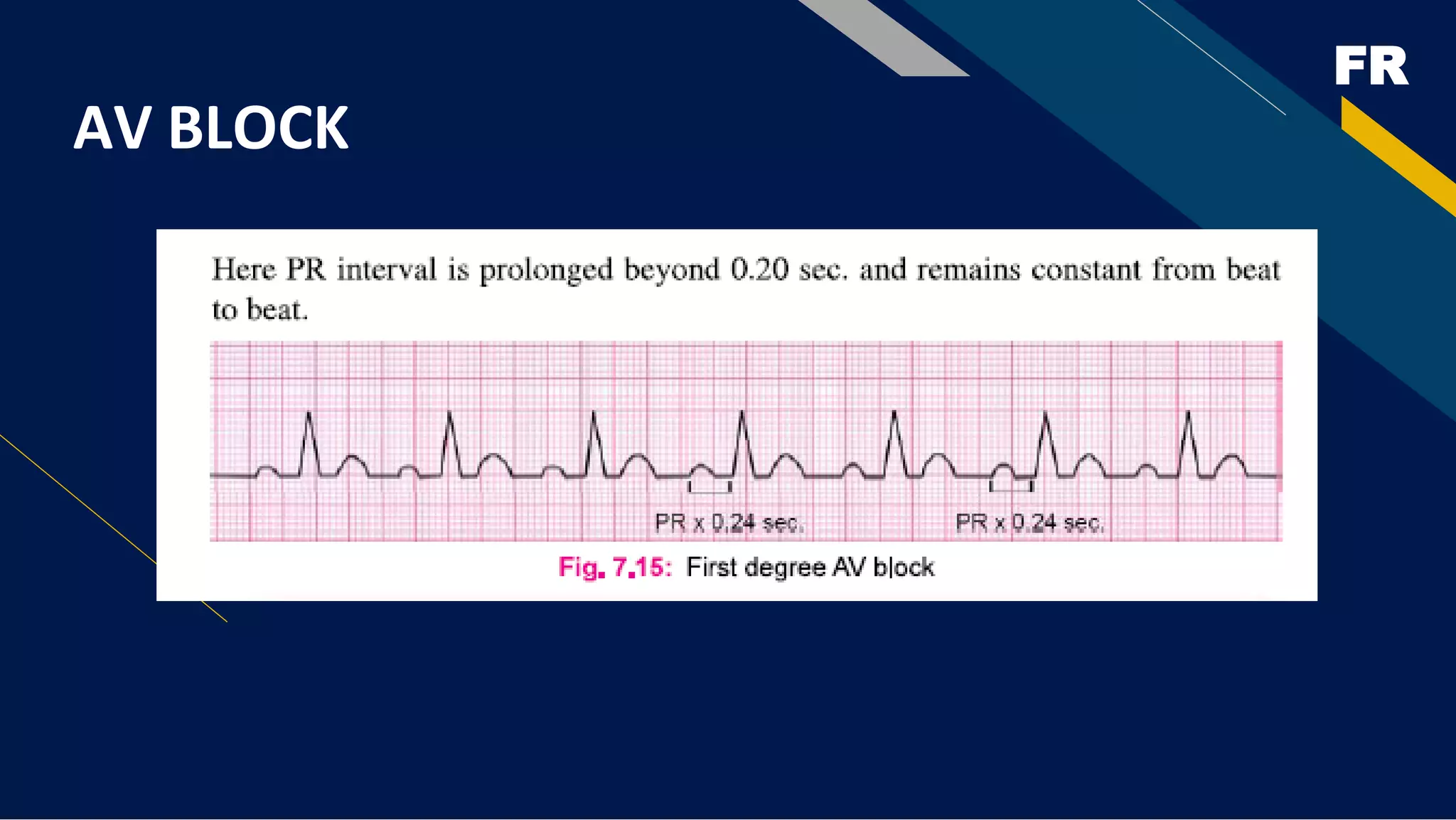
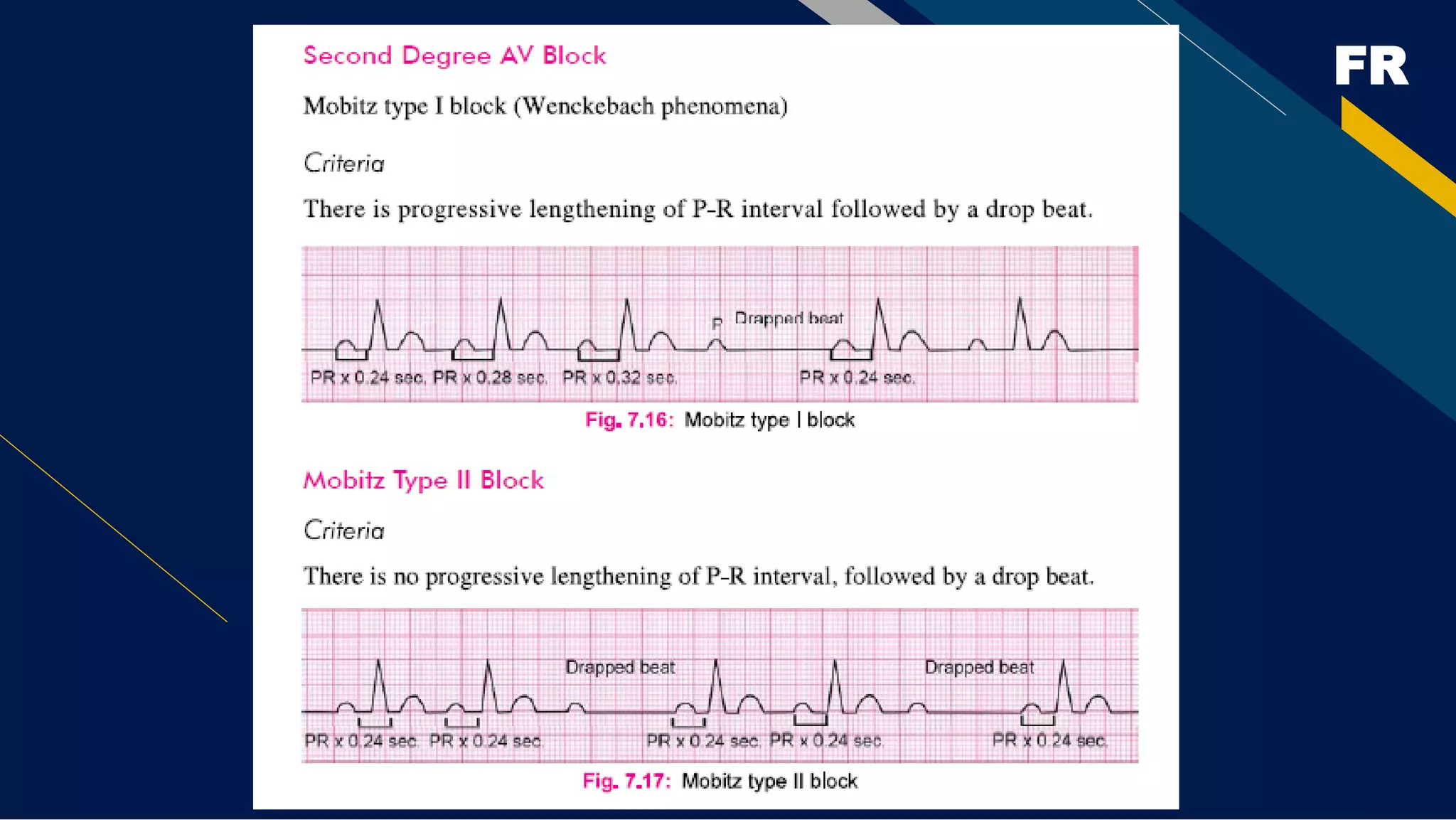
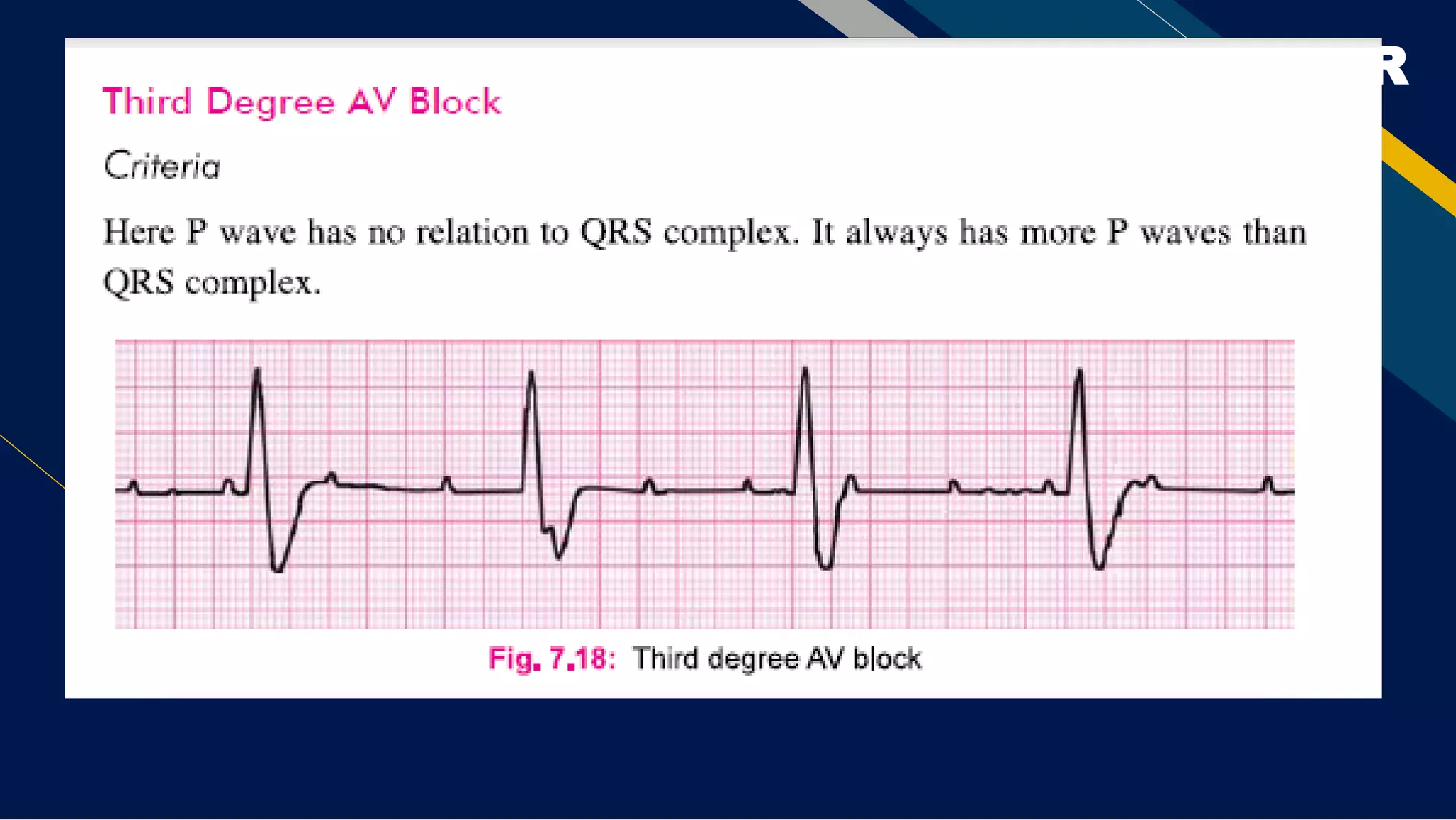
AV BLOCK
FR
FR
FR
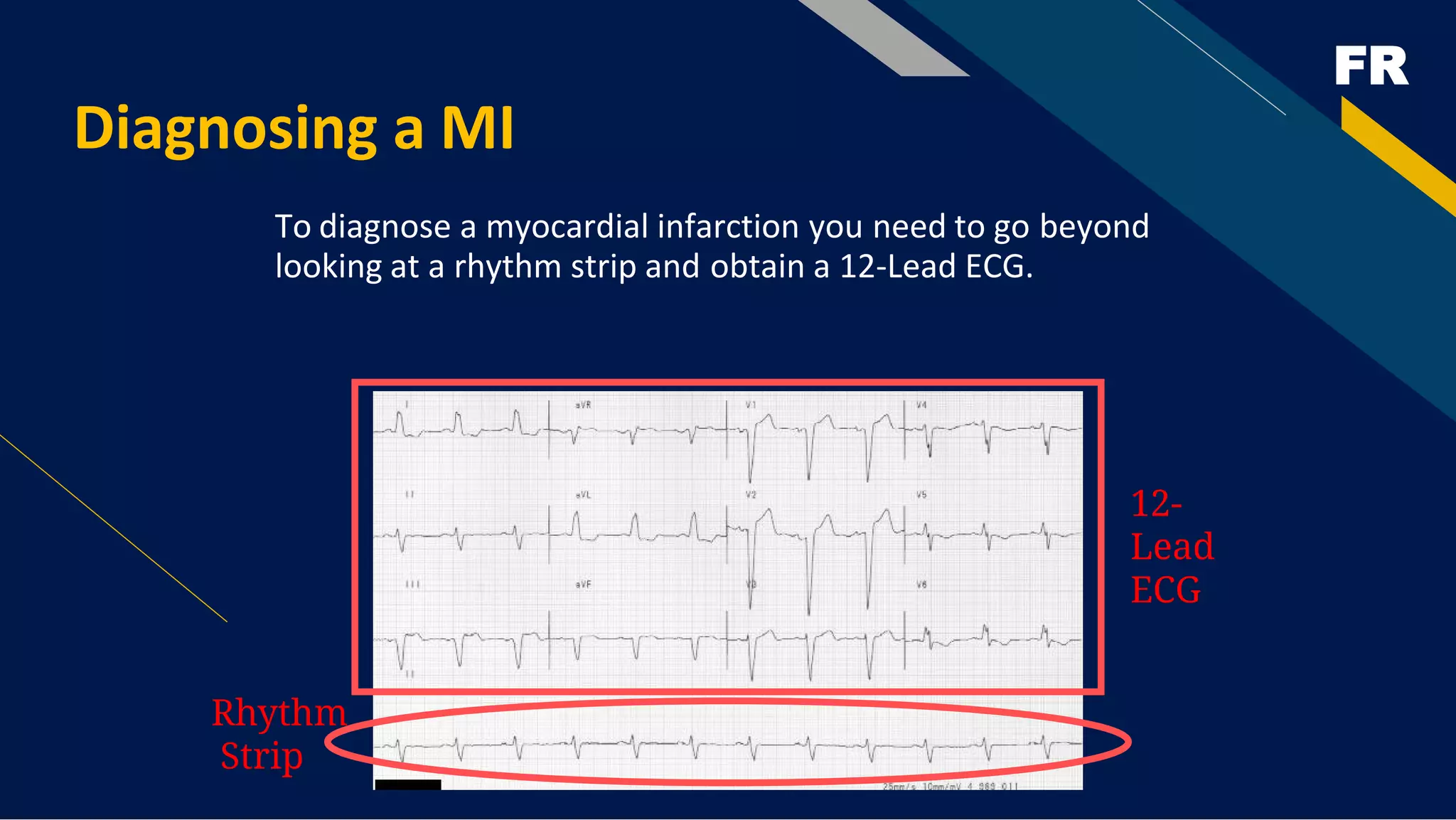
Diagnosing a MI
To diagnose a myocardial infarction you need to go beyond
looking at a rhythm strip and obtain a 12-Lead ECG.
Rhythm
Strip
12-
Lead
ECG
FR
The 12-Lead ECG
• The 12-Lead ECG sees the heart from 12
different views.
• Therefore, the 12-Lead ECG helps you
see what is happening in different
portions of the heart.
• The rhythm strip is only 1 of these 12
views.
FR
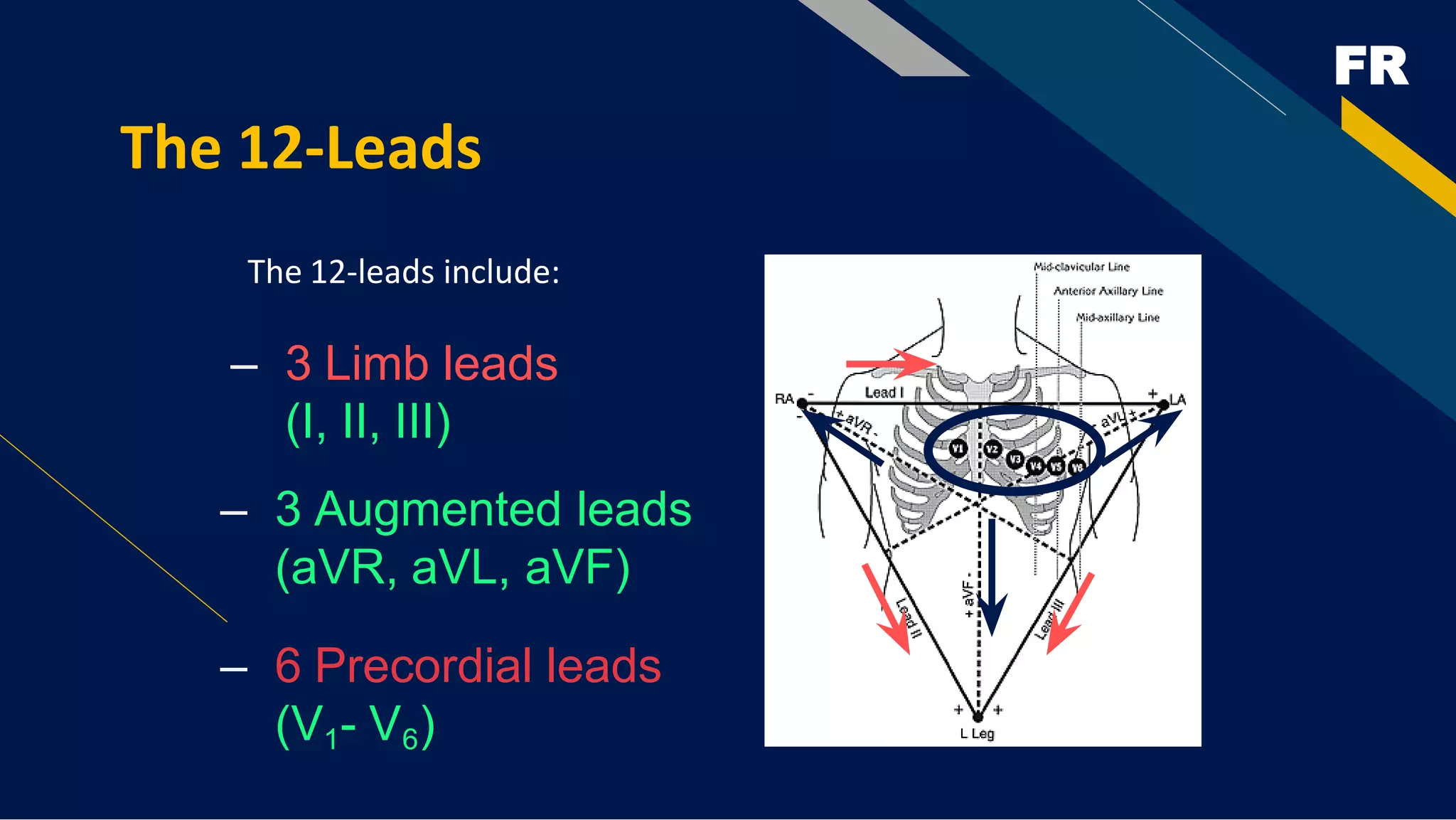
The 12-Leads
The 12-leads include:
– 3 Limb leads
(I, II, III)
– 3 Augmented leads
(aVR, aVL, aVF)
– 6 Precordial leads
(V1- V6)
FR
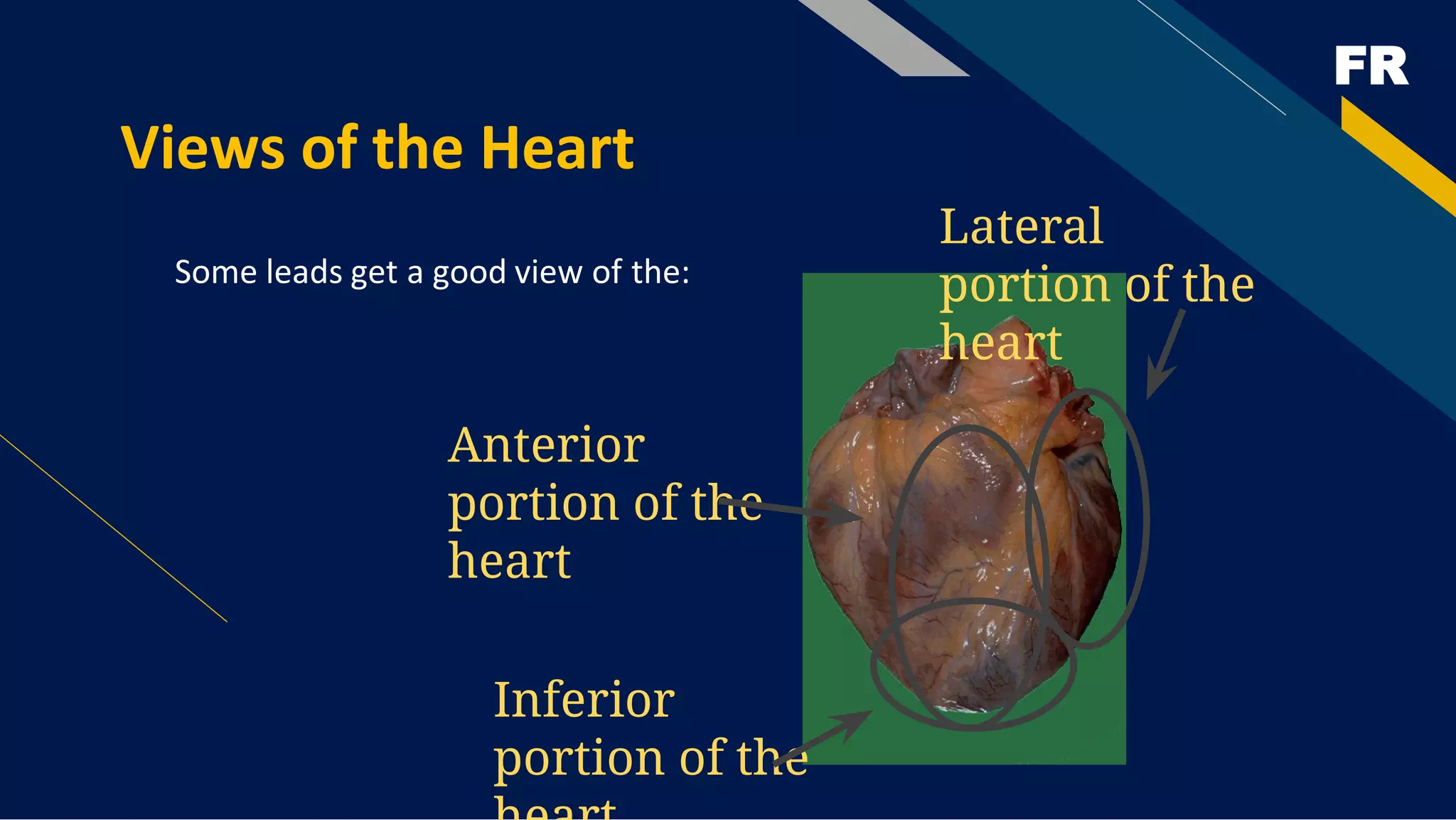
Views of the Heart
Some leads get a good view of the:
Anterior
portion of the
heart
Lateral
portion of the
heart
Inferior
portion of the
FR
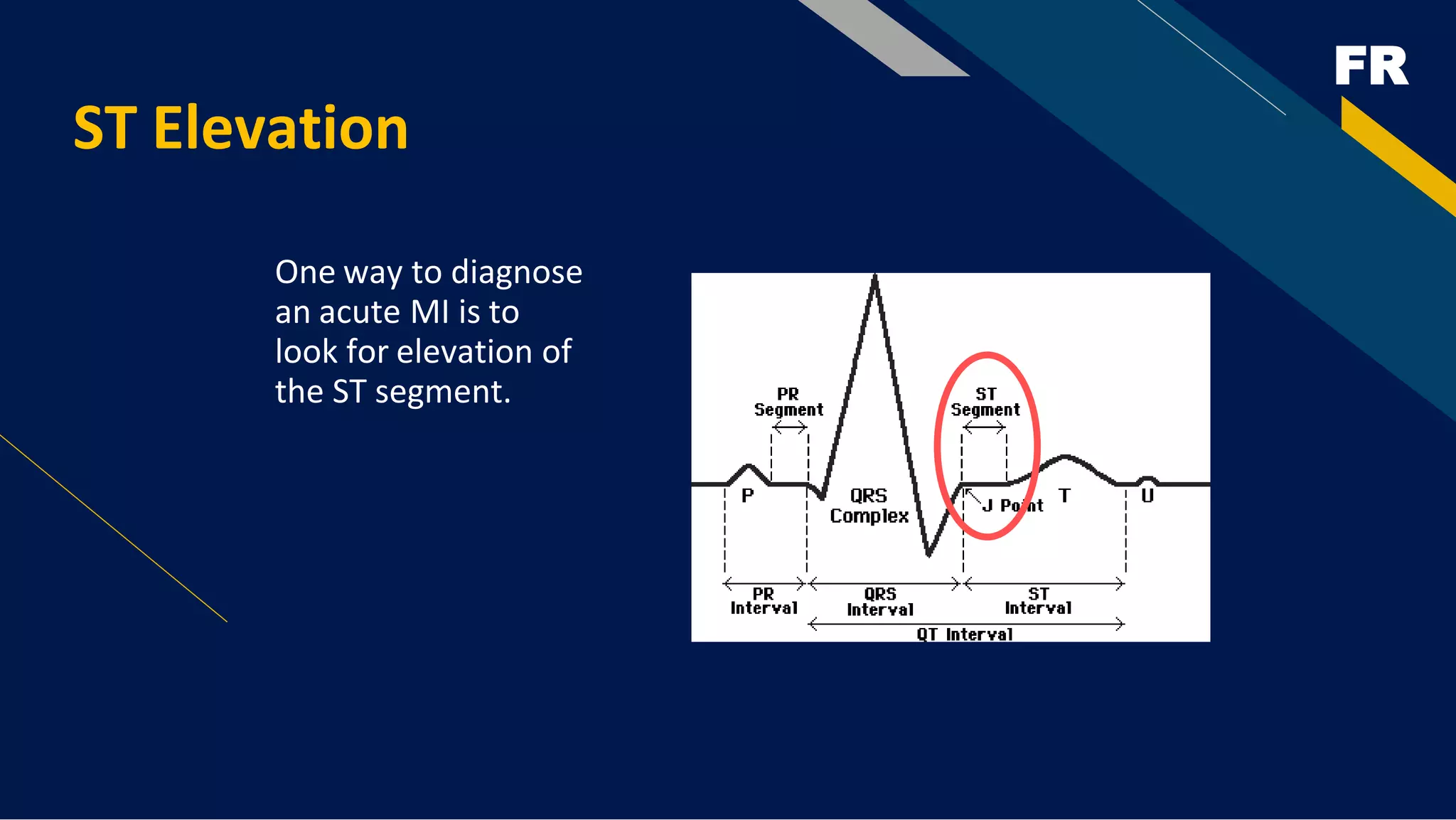
ST Elevation
One way to diagnose
an acute MI is to
look for elevation of
the ST segment.
FR
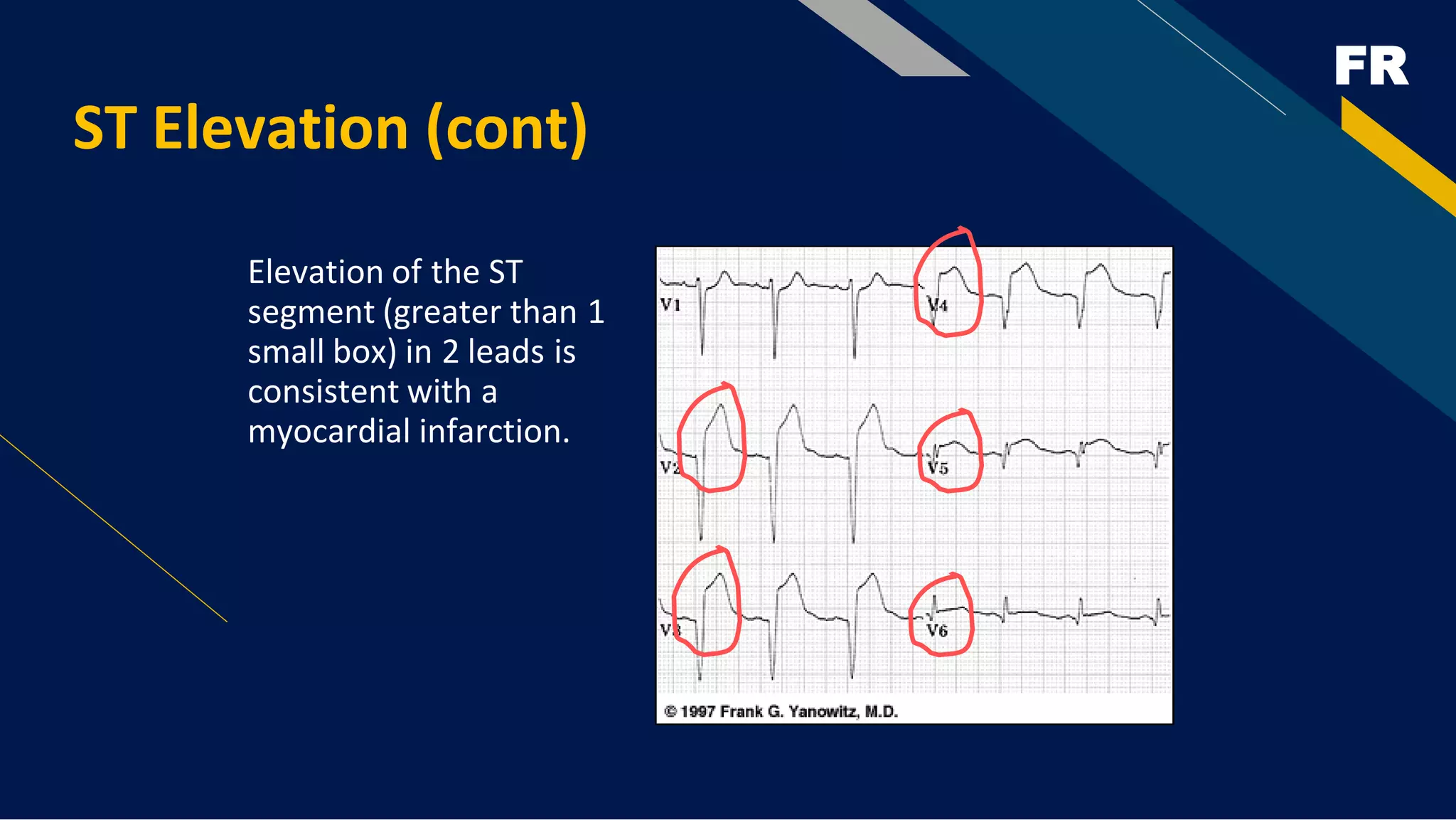
ST Elevation (cont)
Elevation of the ST
segment (greater than 1
small box) in 2 leads is
consistent with a
myocardial infarction.
FR
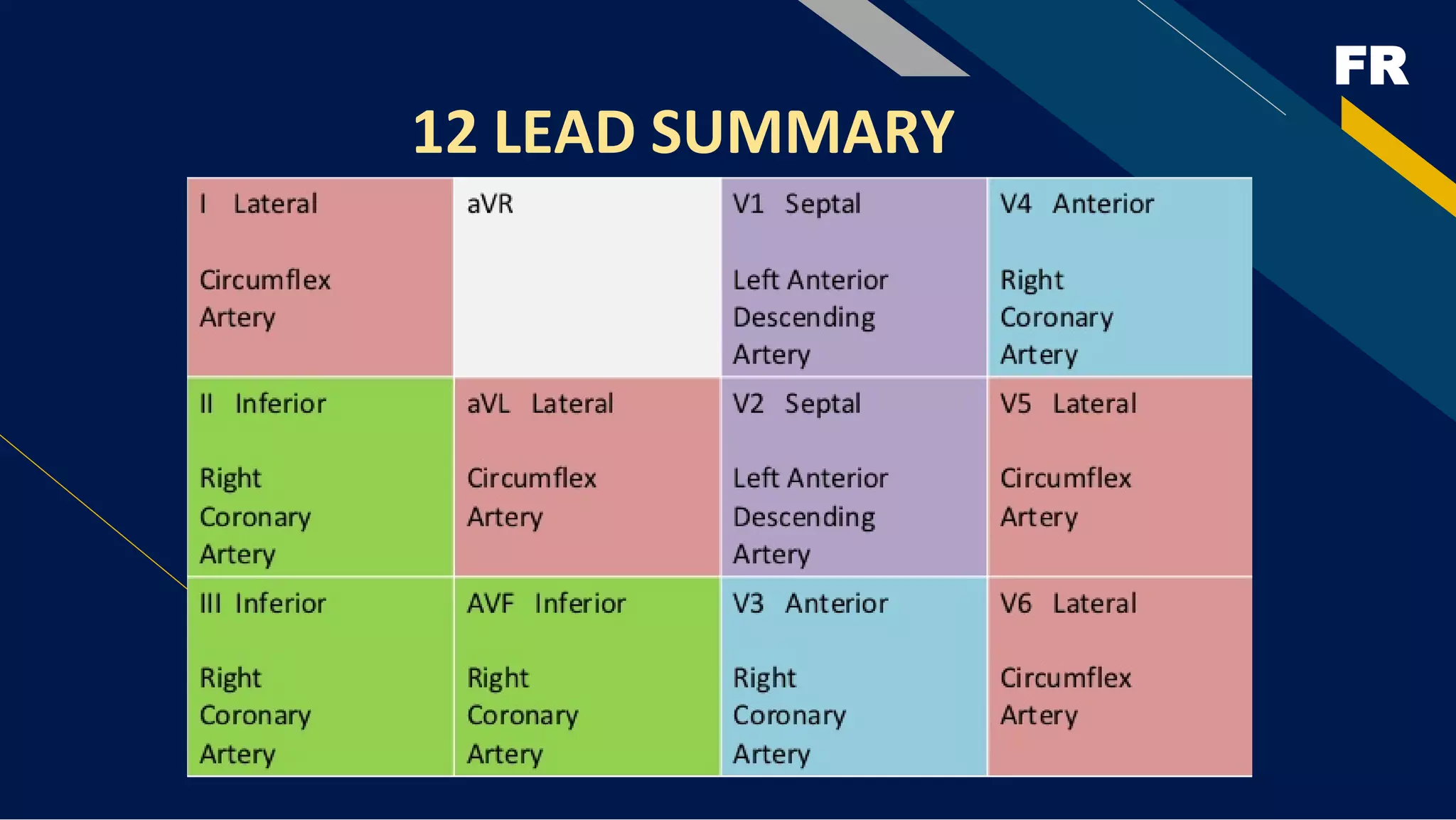
12 LEAD SUMMARY
FR
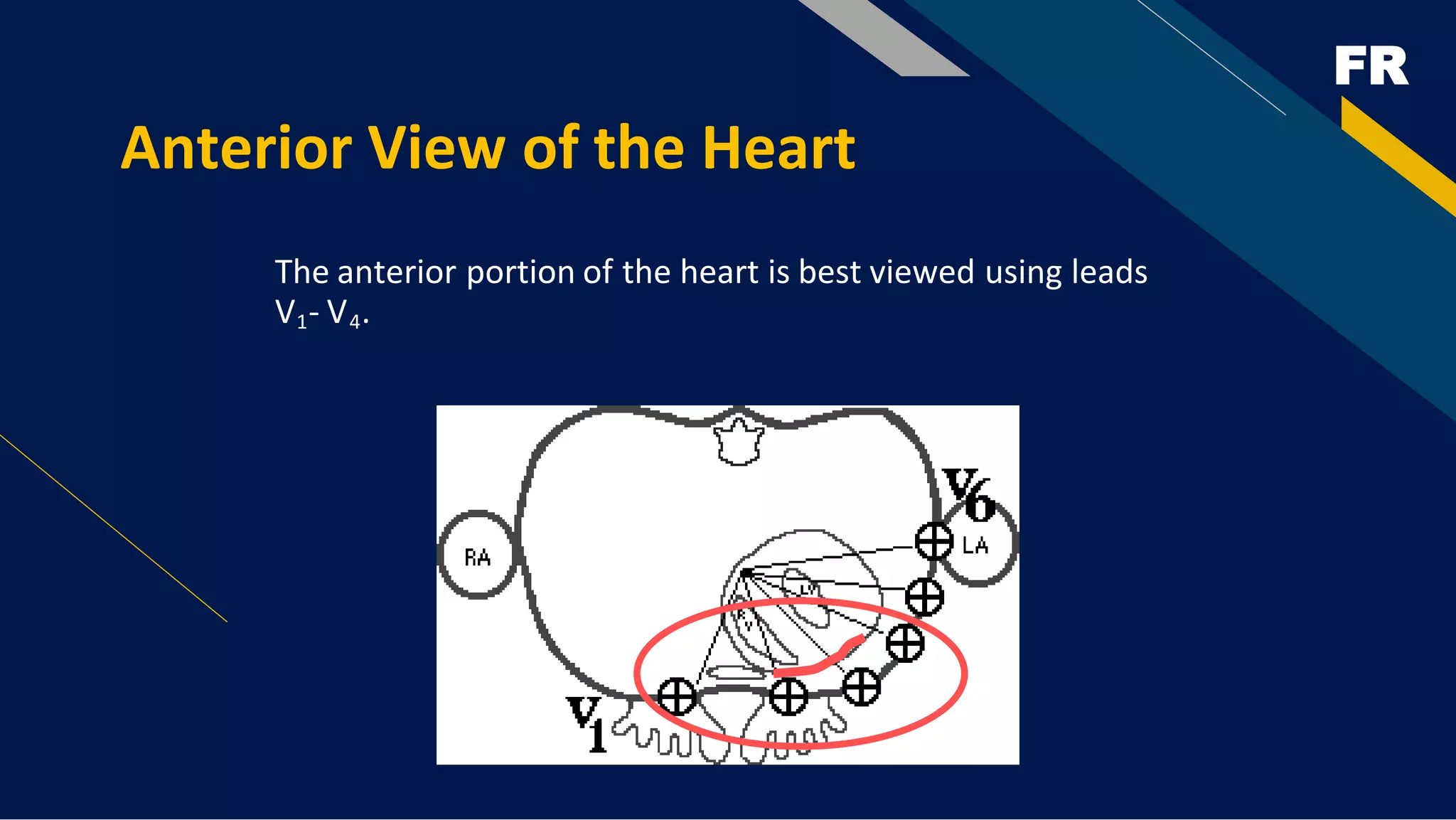
Anterior View of the Heart
The anterior portion of the heart is best viewed using leads
V1- V4.
FR
Anterior Myocardial Infarction
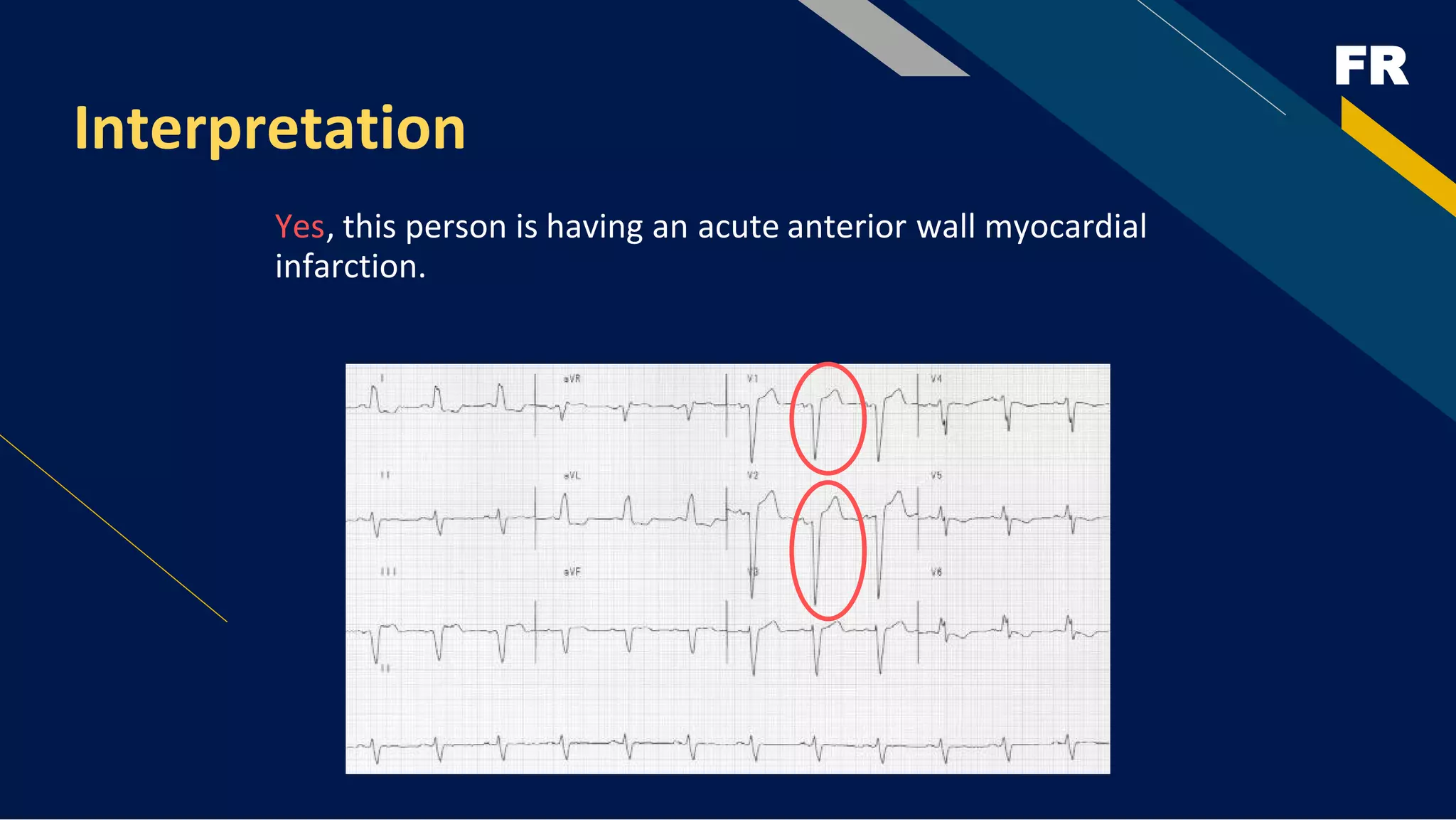
If you see changes in leads V1 - V4 that are consistent
with a myocardial infarction, you can conclude that it is
an anterior wall myocardial infarction.
FR
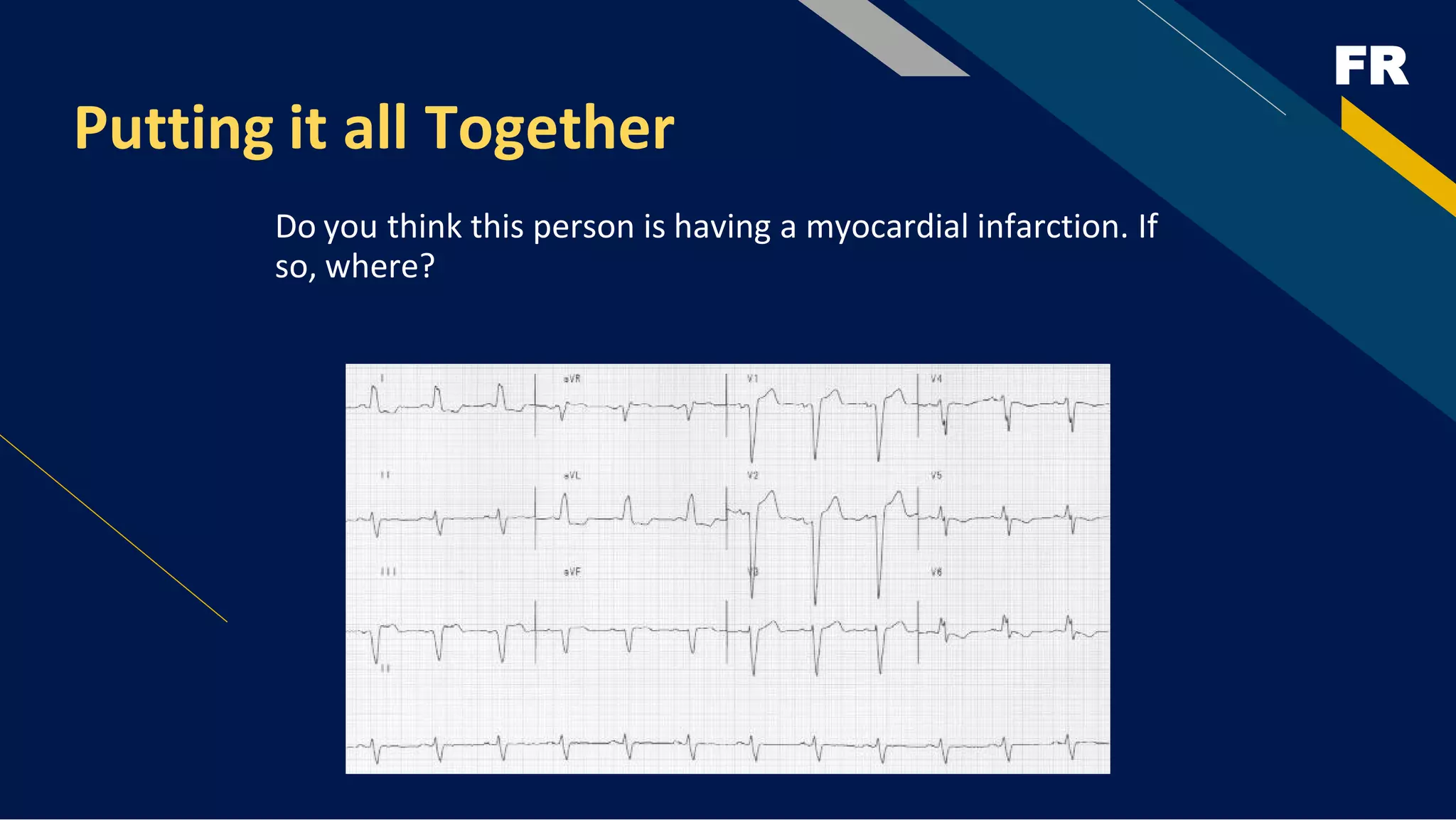
Putting it all Together
Do you think this person is having a myocardial infarction. If
so, where?
FR
Interpretation
Yes, this person is having an acute anterior wall myocardial
infarction.
FR
Other MI Locations
Now that you know where to look for an anterior wall myocardial infarction let’s look
at how you would determine if the MI involves the lateral wall or the inferior wall of
the heart.
FR
Other MI Locations
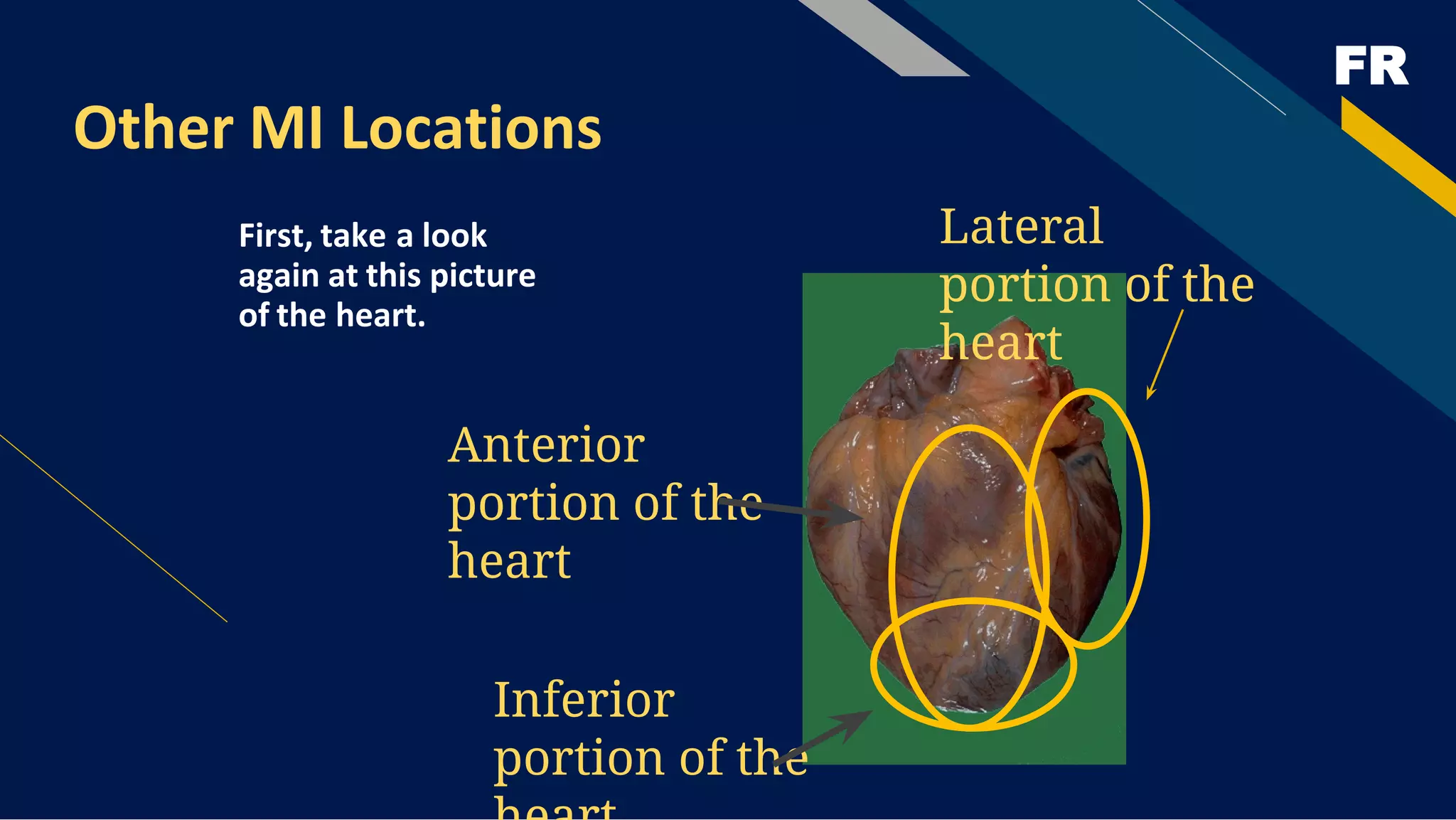
First, take a look
again at this picture
of the heart.
Anterior
portion of the
heart
Lateral
portion of the
heart
Inferior
portion of the
FR
Other MI Locations
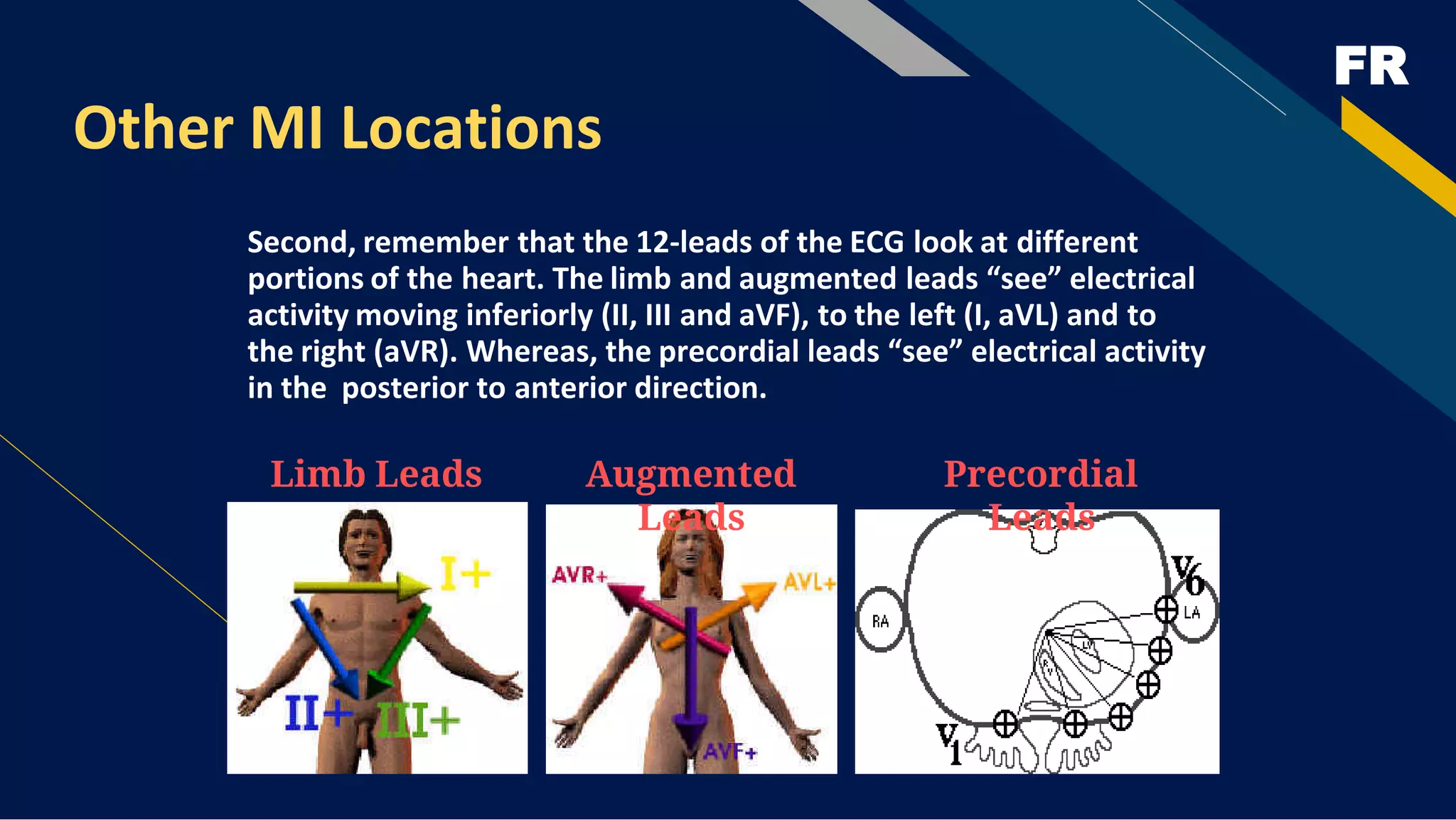
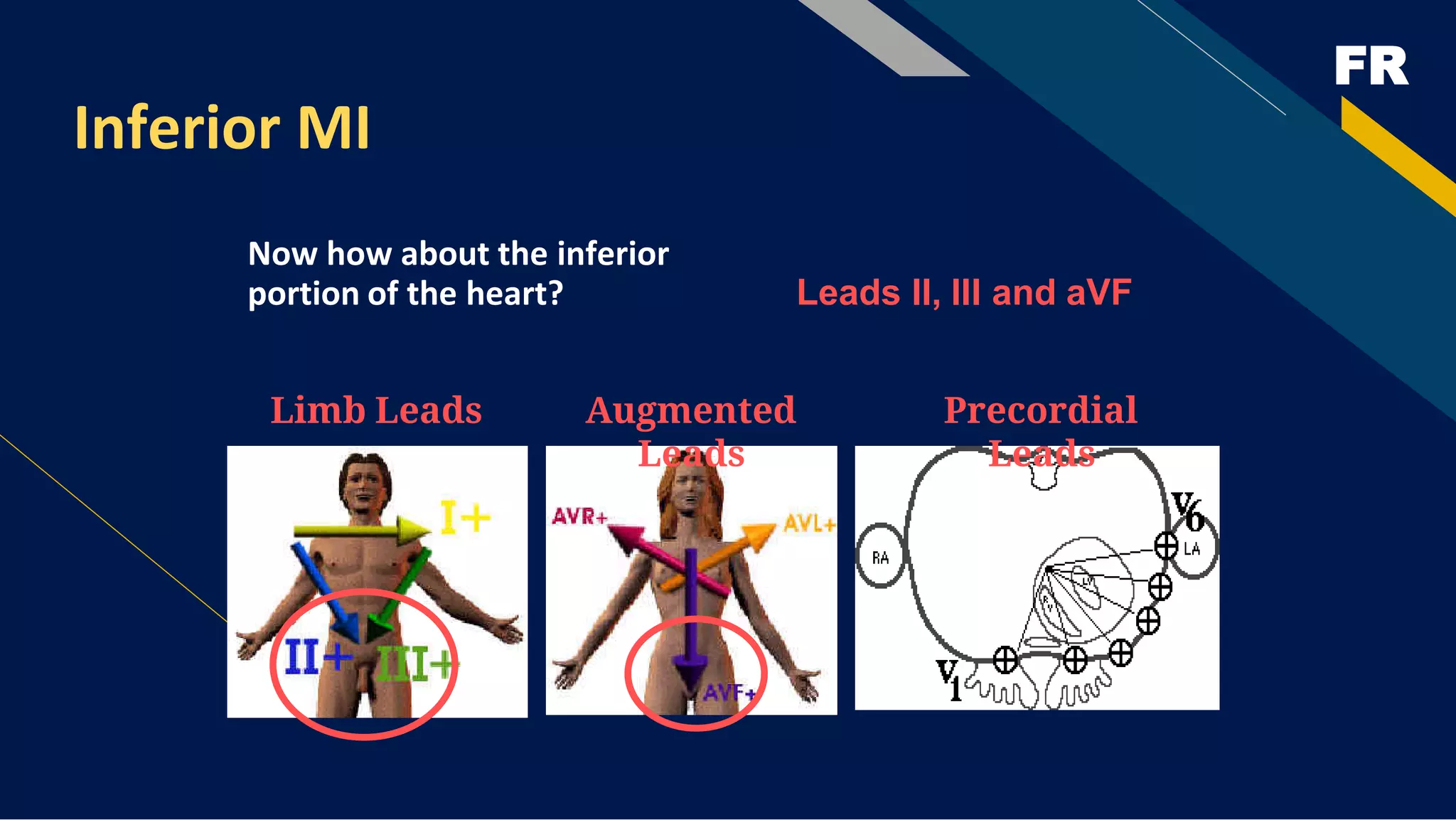
Second, remember that the 12-leads of the ECG look at different
portions of the heart. The limb and augmented leads “see” electrical
activity moving inferiorly (II, III and aVF), to the left (I, aVL) and to
the right (aVR). Whereas, the precordial leads “see” electrical activity
in the posterior to anterior direction.
Limb Leads Augmented
Leads
Precordial
Leads
FR
Other MI Locations
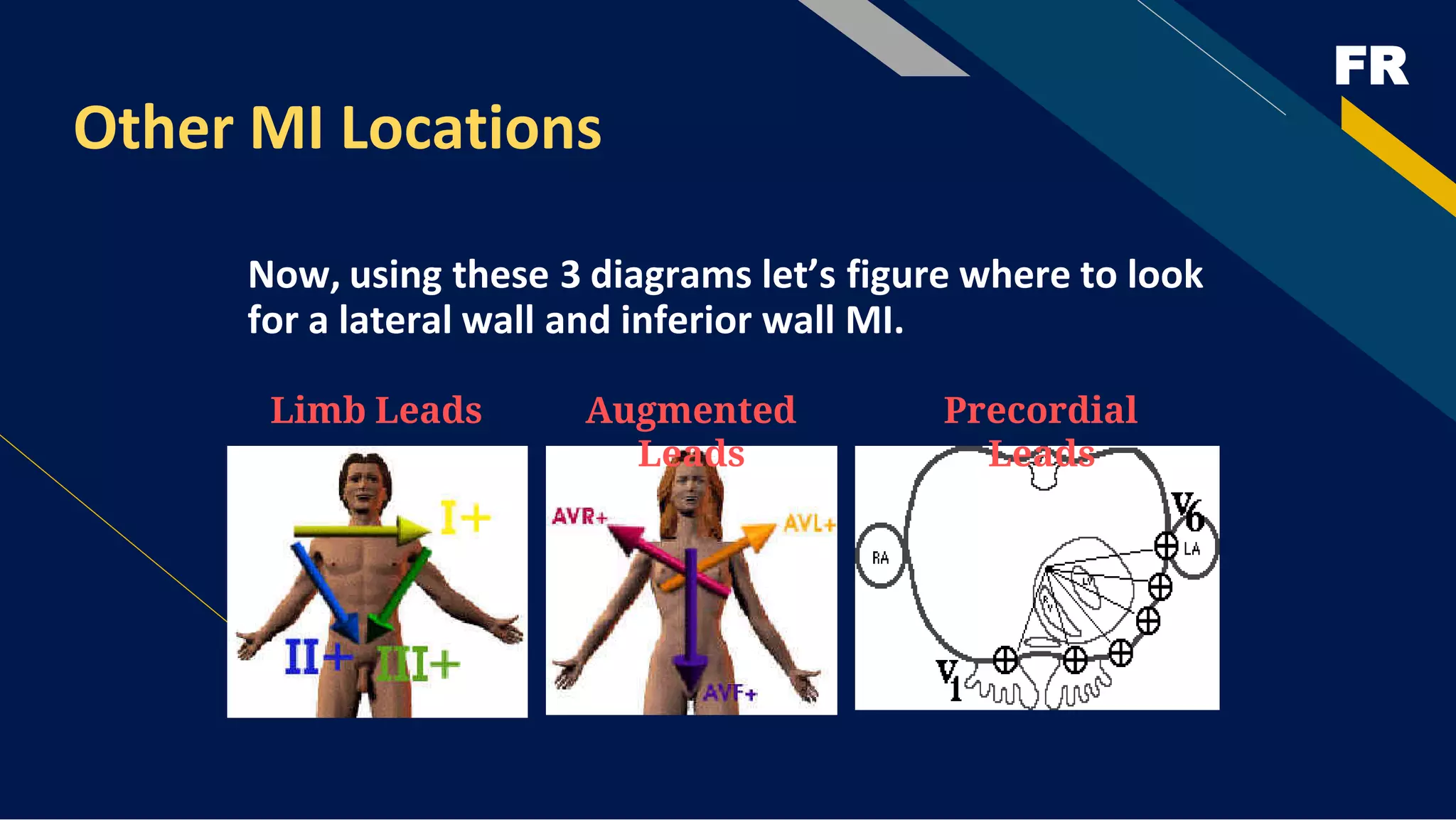
Now, using these 3 diagrams let’s figure where to look
for a lateral wall and inferior wall MI.
Limb Leads Augmented
Leads
Precordial
Leads
FR
Anterior MI
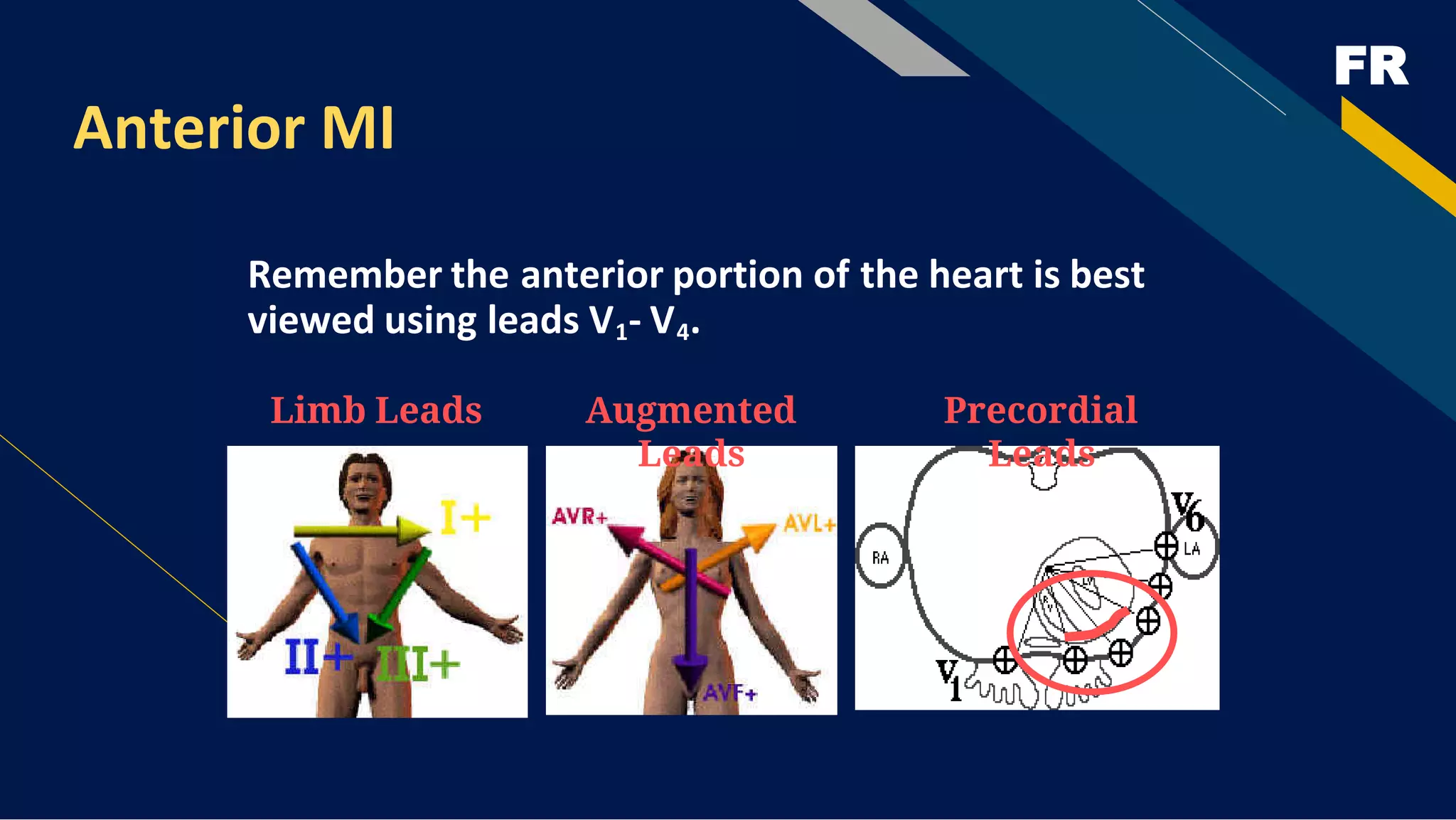
Remember the anterior portion of the heart is best
viewed using leads V1- V4.
Limb Leads Augmented
Leads
Precordial
Leads
FR
Lateral MI
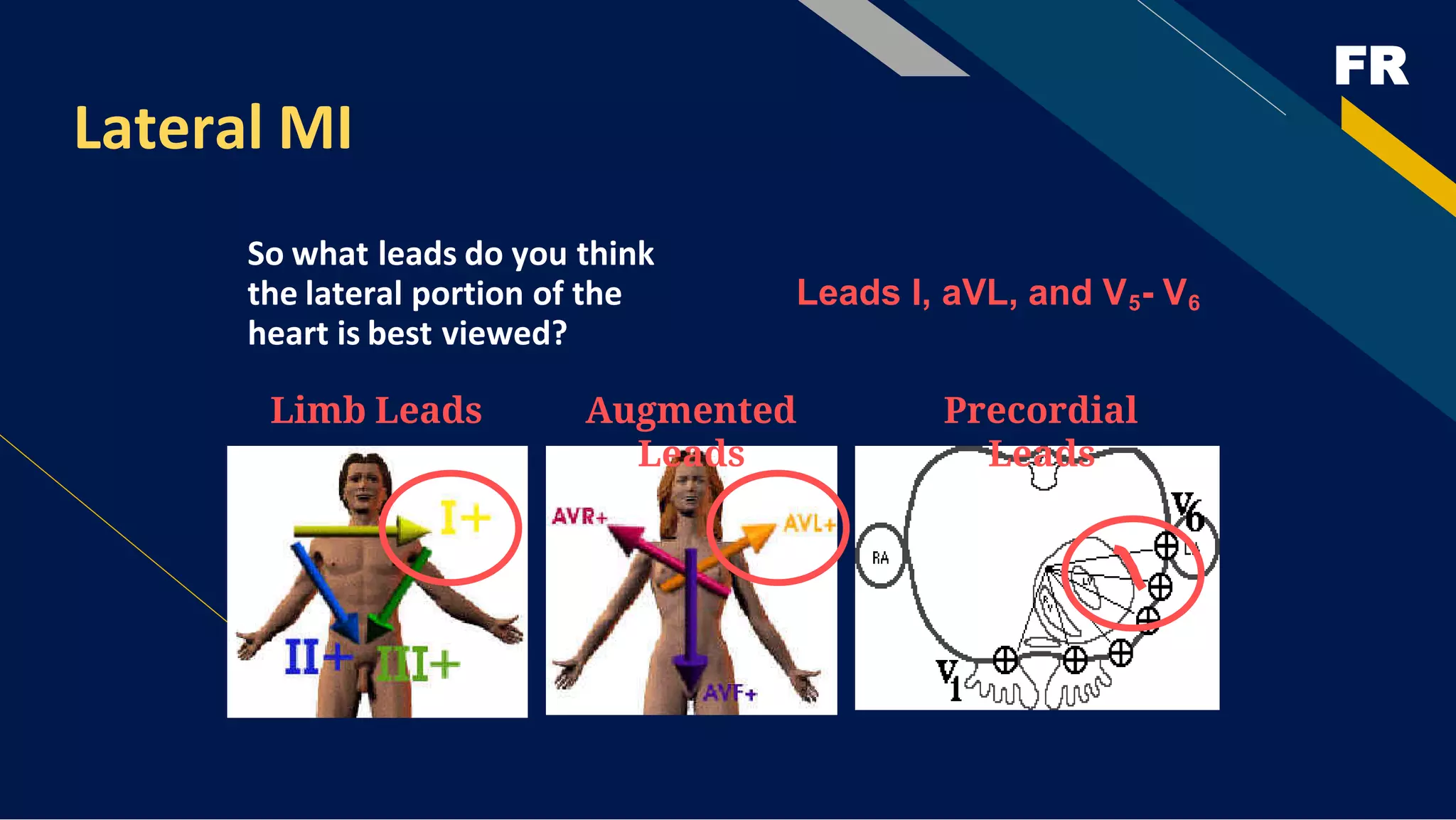
So what leads do you think
the lateral portion of the
heart is best viewed?
Limb Leads Augmented
Leads
Precordial
Leads
Leads I, aVL, and V5- V6
FR
Inferior MI
Now how about the inferior
portion of the heart?
Limb Leads Augmented
Leads
Precordial
Leads
Leads II, III and aVF
FR
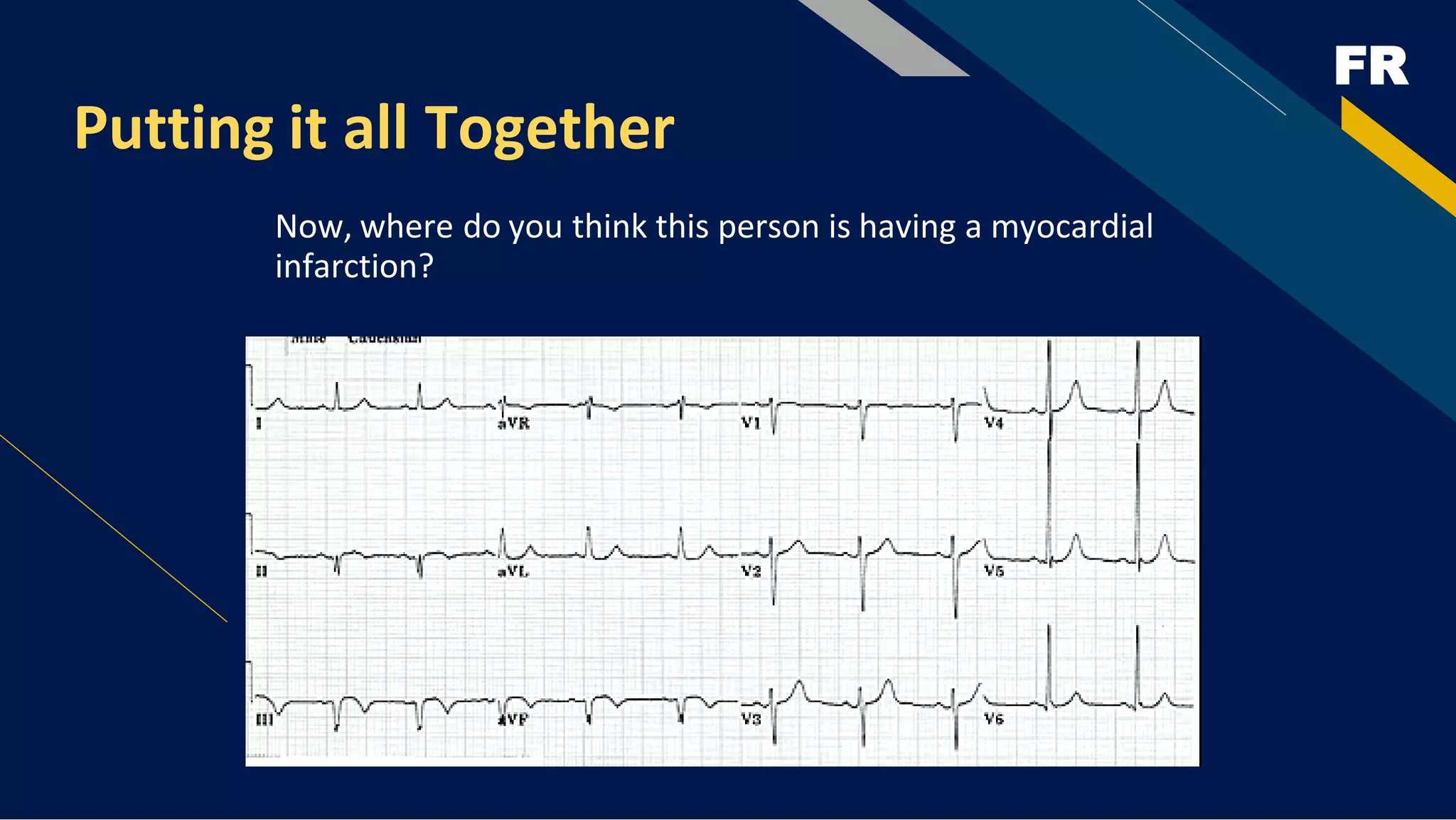
Putting it all Together
Now, where do you think this person is having a myocardial
infarction?
FR
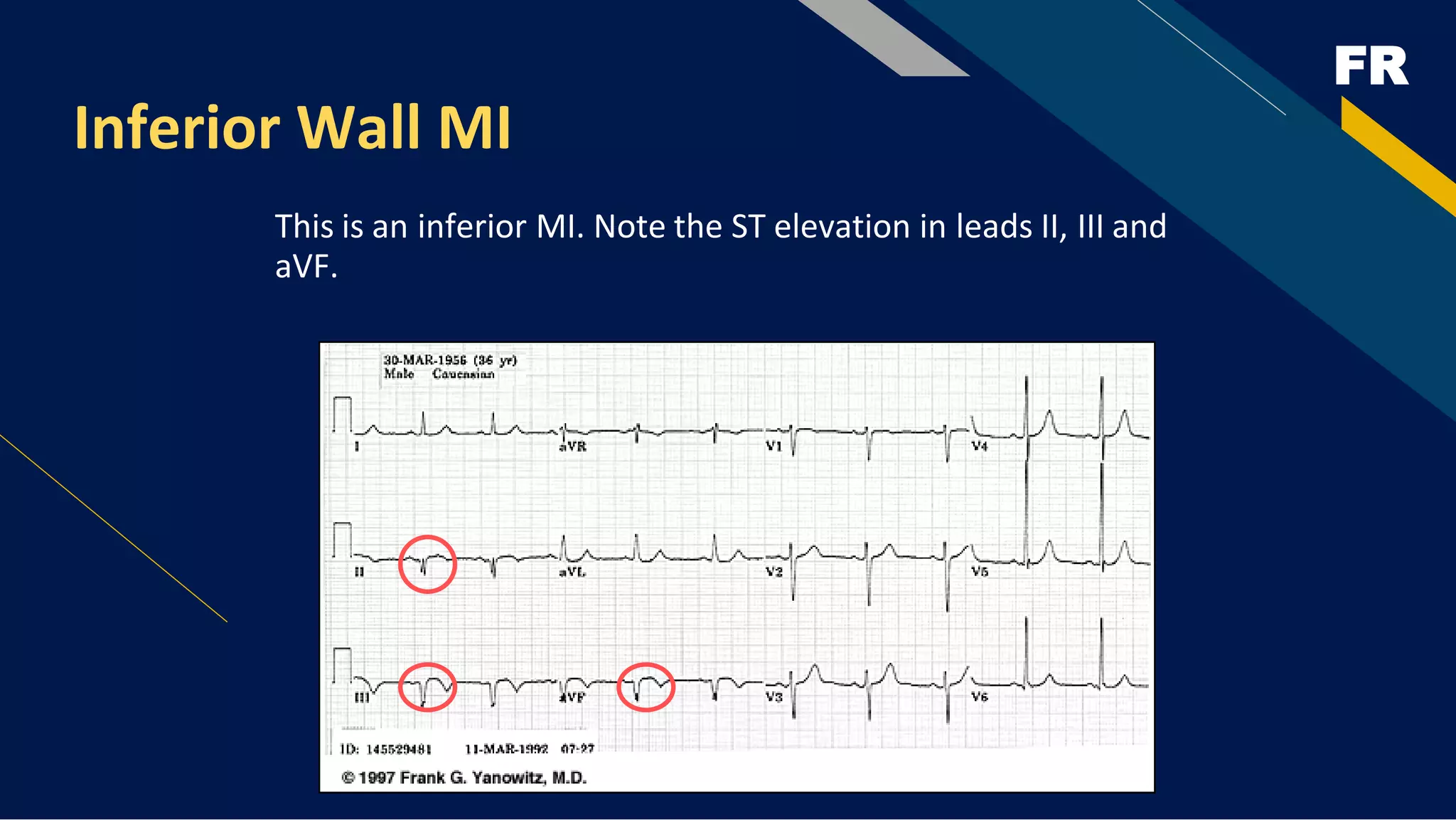
Inferior Wall MI
This is an inferior MI. Note the ST elevation in leads II, III and
aVF.
FR
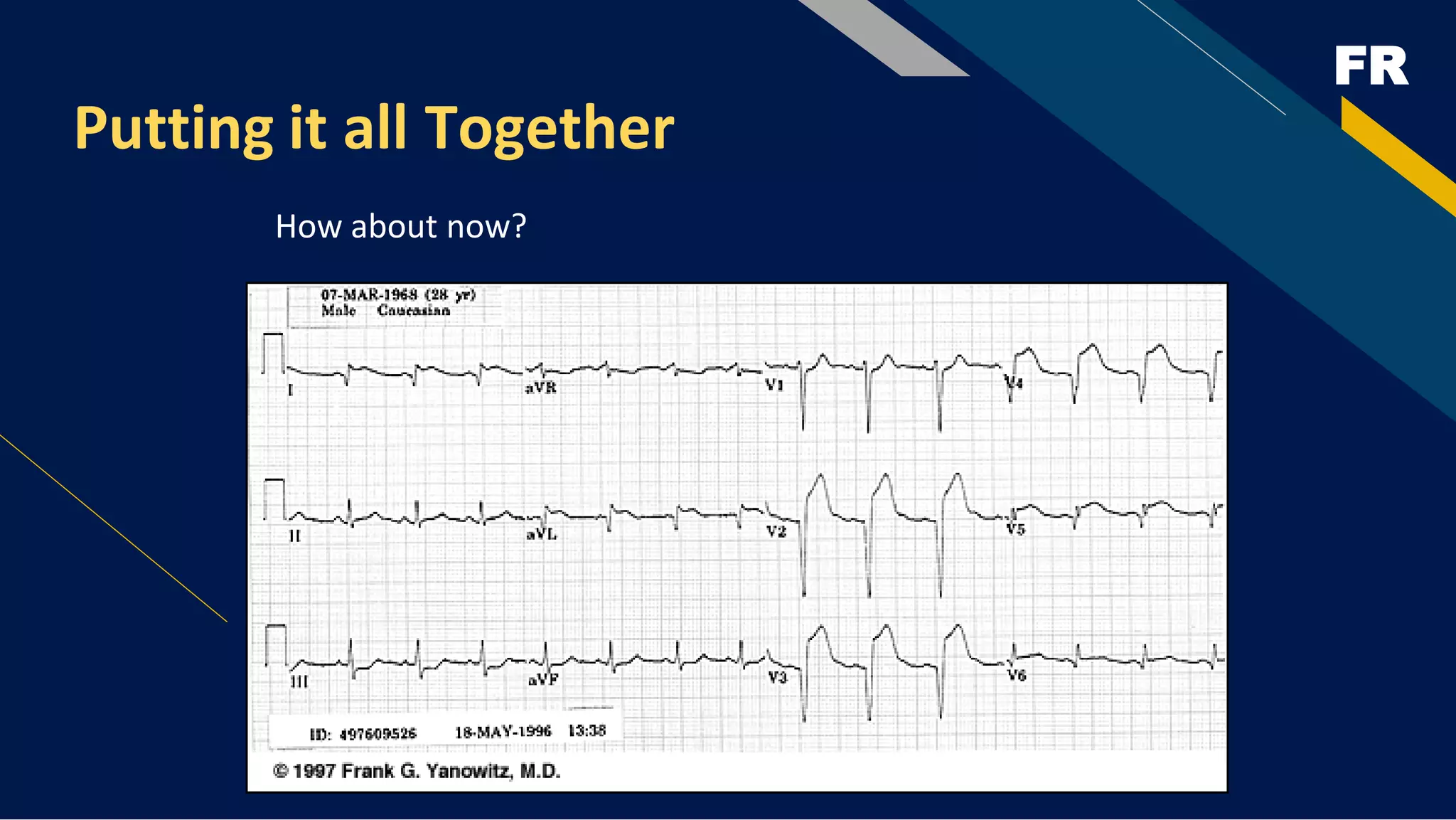
Putting it all Together
How about now?
FR
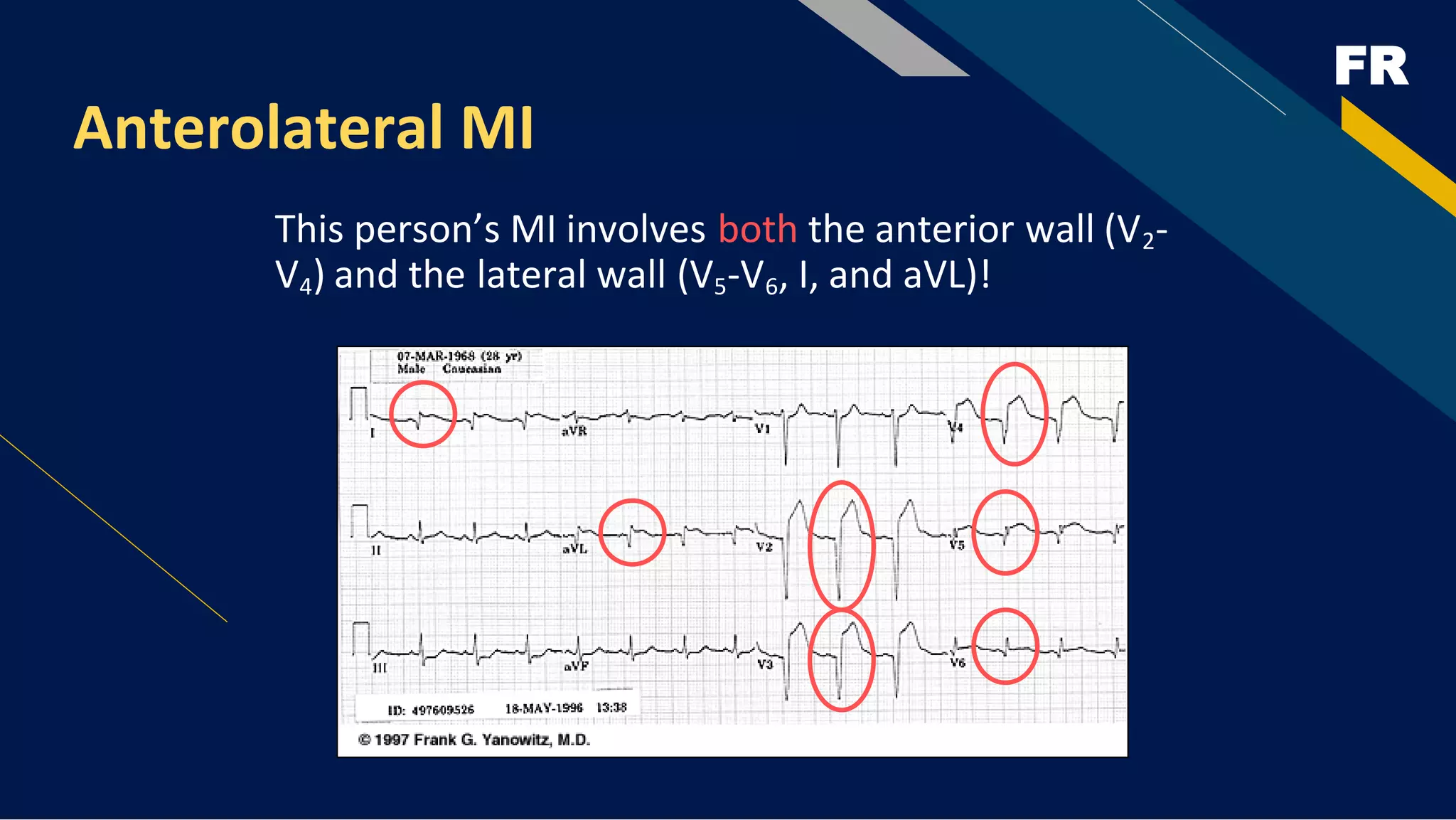
Anterolateral MI
This person’s MI involves both the anterior wall (V2-
V4) and the lateral wall (V5-V6, I, and aVL)!
ST Elevation and
non-ST Elevation MIs
FR
ST Elevation and non-ST Elevation MIs
• When myocardial blood supply is abruptly
reduced or cut off to a region of the heart, a
sequence of injurious events occur beginning with
ischemia (inadequate tissue perfusion), followed
by necrosis (infarction), and eventual fibrosis
(scarring) if the blood supply isn't restored in an
appropriate period of time.
• The ECG changes over time with each of these
events…
FR
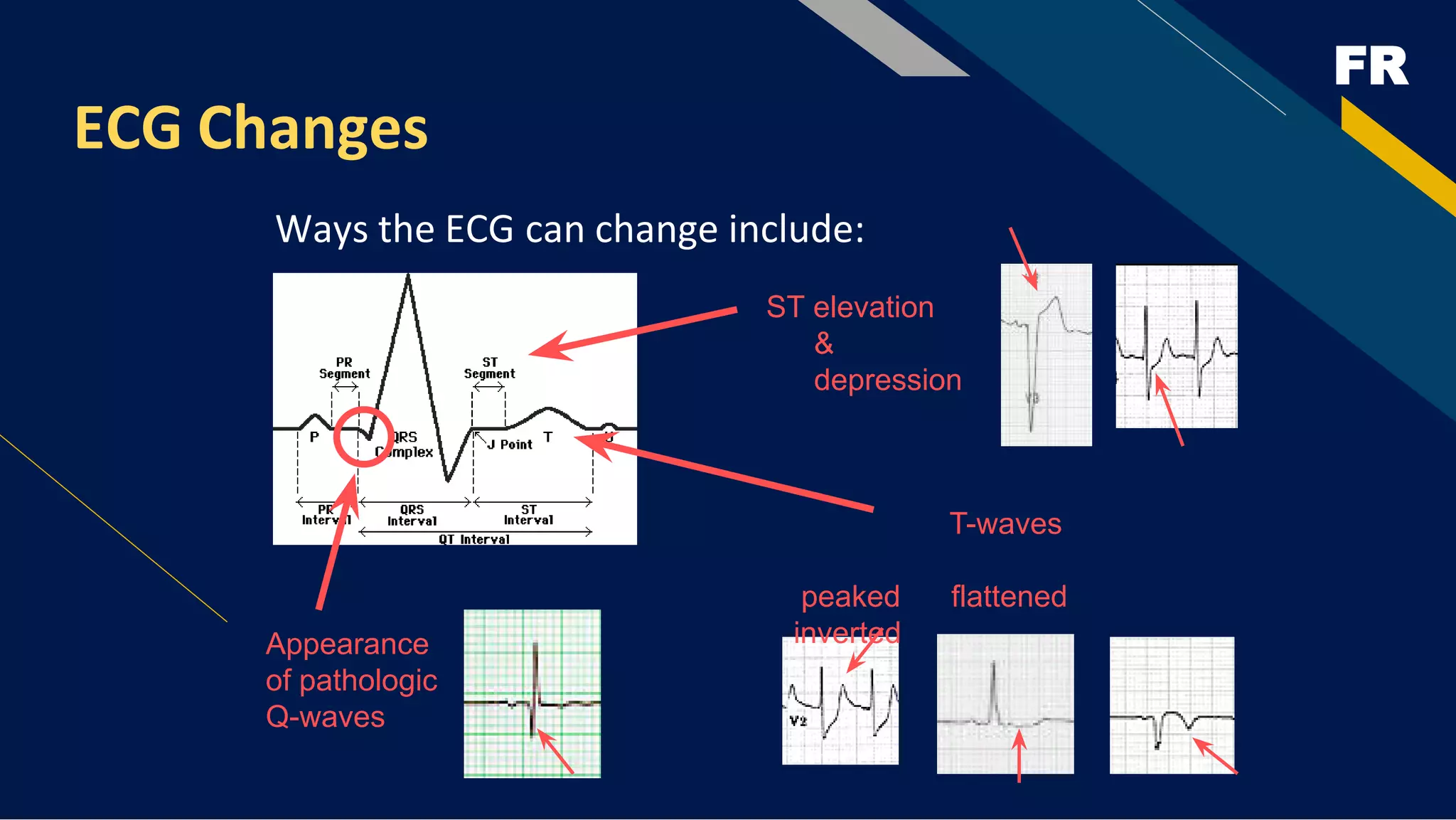
ECG Changes
Ways the ECG can change include:
Appearance
of pathologic
Q-waves
T-waves
peaked flattened
inverted
ST elevation
&
depression
FR
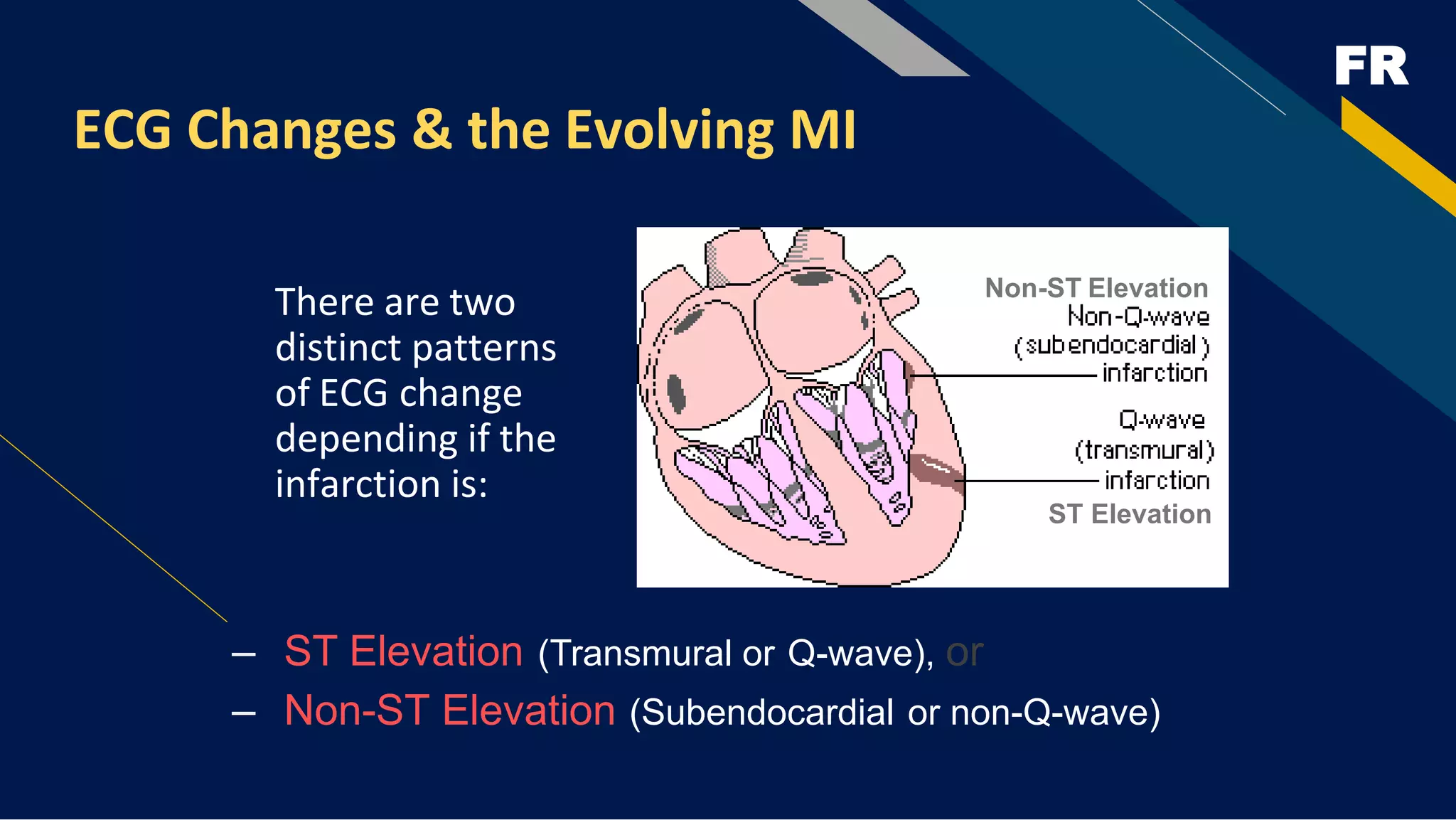
ECG Changes & the Evolving MI
There are two
distinct patterns
of ECG change
depending if the
infarction is:
– ST Elevation (Transmural or Q-wave), or
– Non-ST Elevation (Subendocardial or non-Q-wave)
Non-ST Elevation
ST Elevation
FR
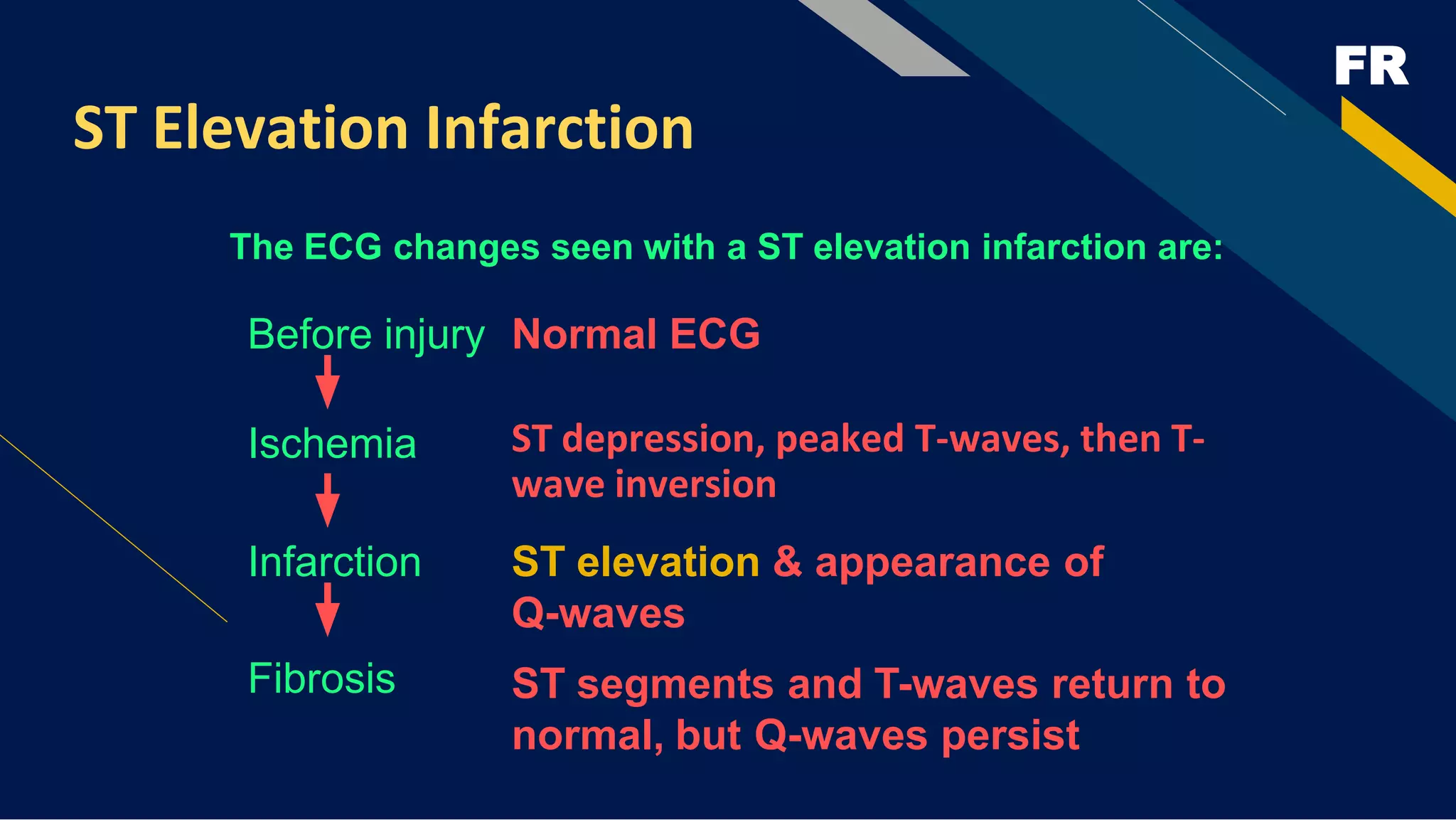
ST Elevation Infarction
ST depression, peaked T-waves, then T-
wave inversion
The ECG changes seen with a ST elevation infarction are:
Before injury Normal ECG
ST elevation & appearance of
Q-waves
ST segments and T-waves return to
normal, but Q-waves persist
Ischemia
Infarction
Fibrosis
FR
ST Elevation Infarction
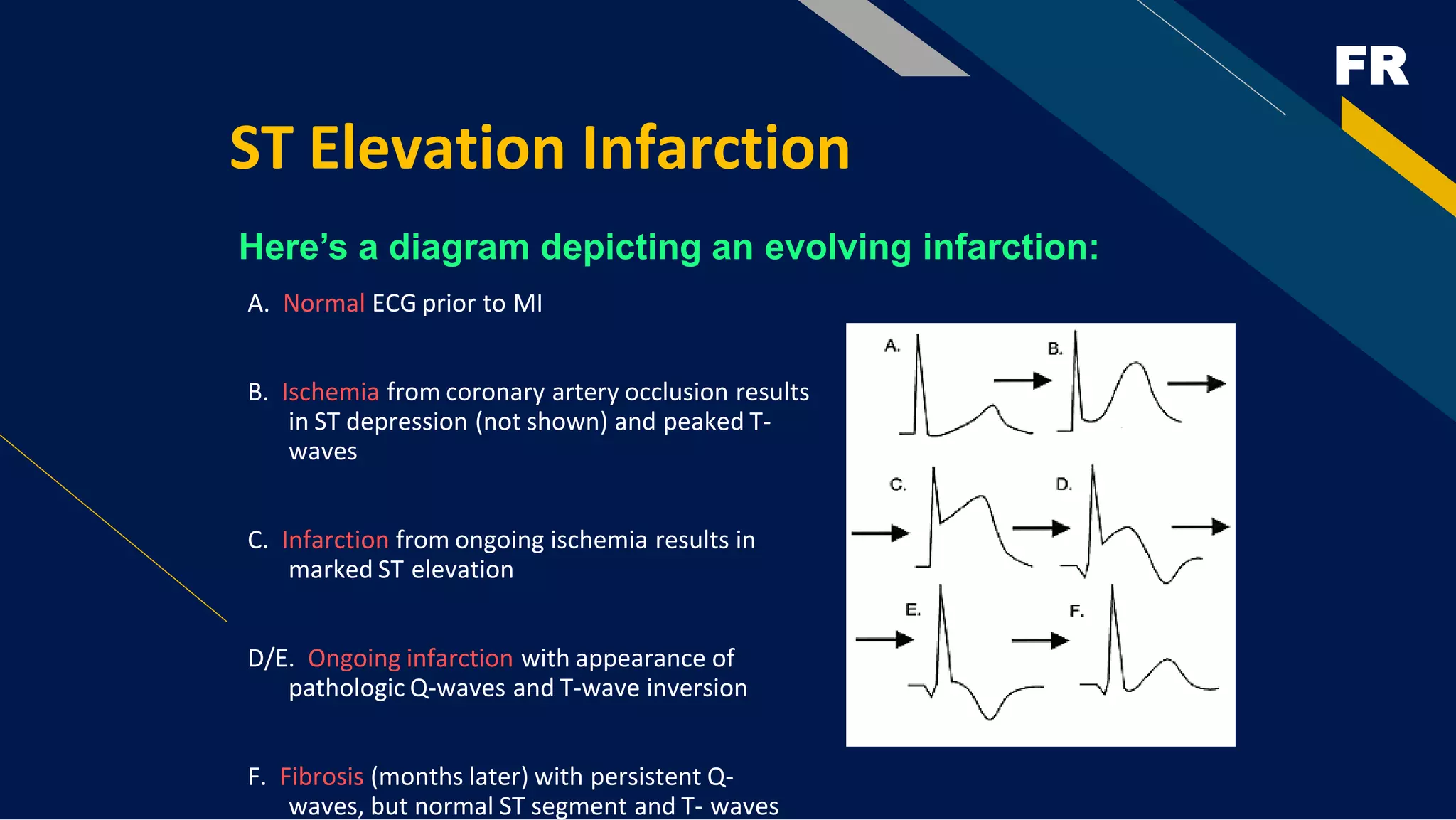
Here’s a diagram depicting an evolving infarction:
A. Normal ECG prior to MI
B. Ischemia from coronary artery occlusion results
in ST depression (not shown) and peaked T-
waves
C. Infarction from ongoing ischemia results in
marked ST elevation
D/E. Ongoing infarction with appearance of
pathologic Q-waves and T-wave inversion
F. Fibrosis (months later) with persistent Q-
waves, but normal ST segment and T- waves
FR
ST Elevation Infarction
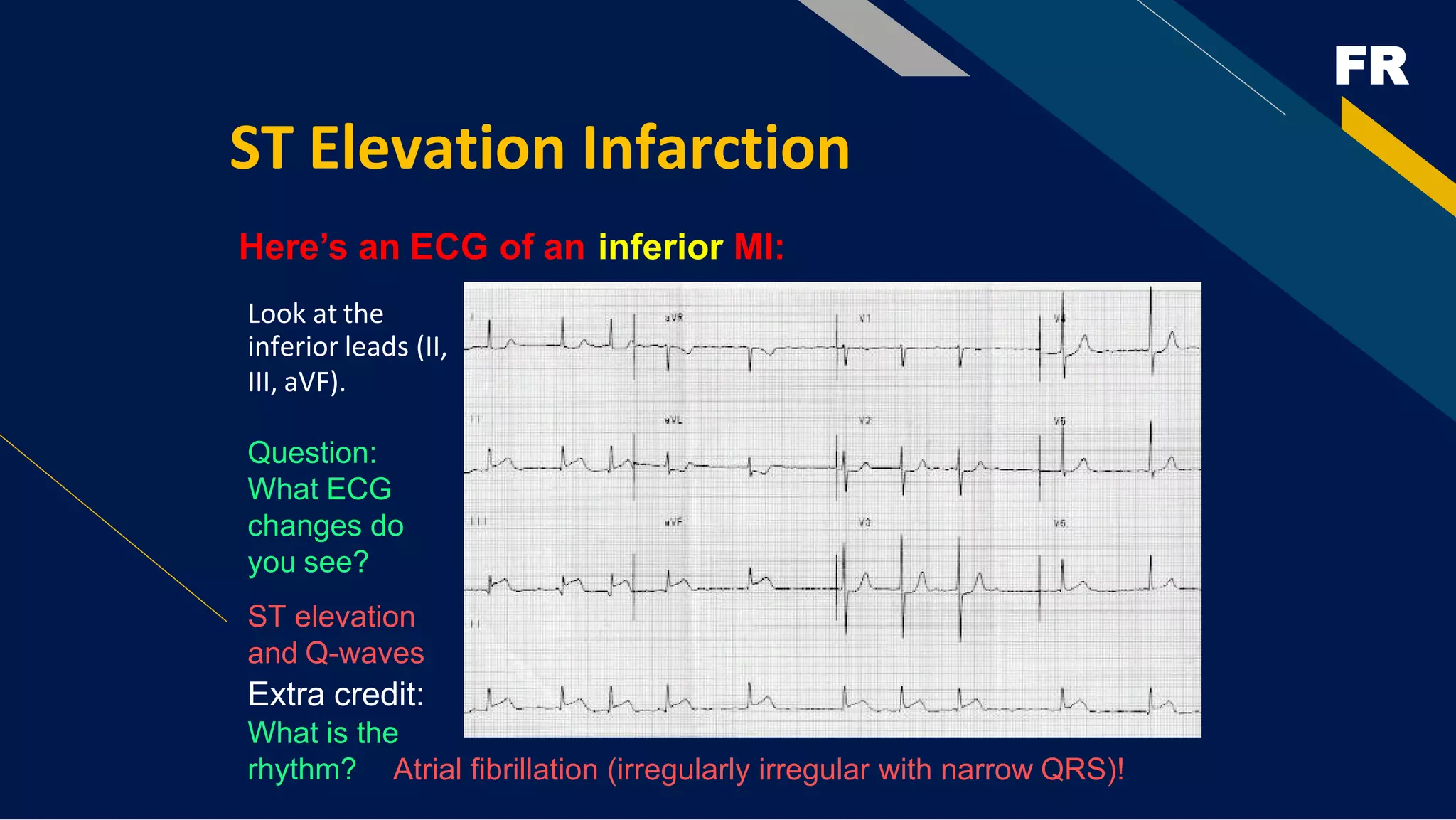
Here’s an ECG of an inferior MI:
Look at the
inferior leads (II,
III, aVF).
Question:
What ECG
changes do
you see?
ST elevation
and Q-waves
Extra credit:
What is the
rhythm? Atrial fibrillation (irregularly irregular with narrow QRS)!
FR
Non-ST Elevation Infarction
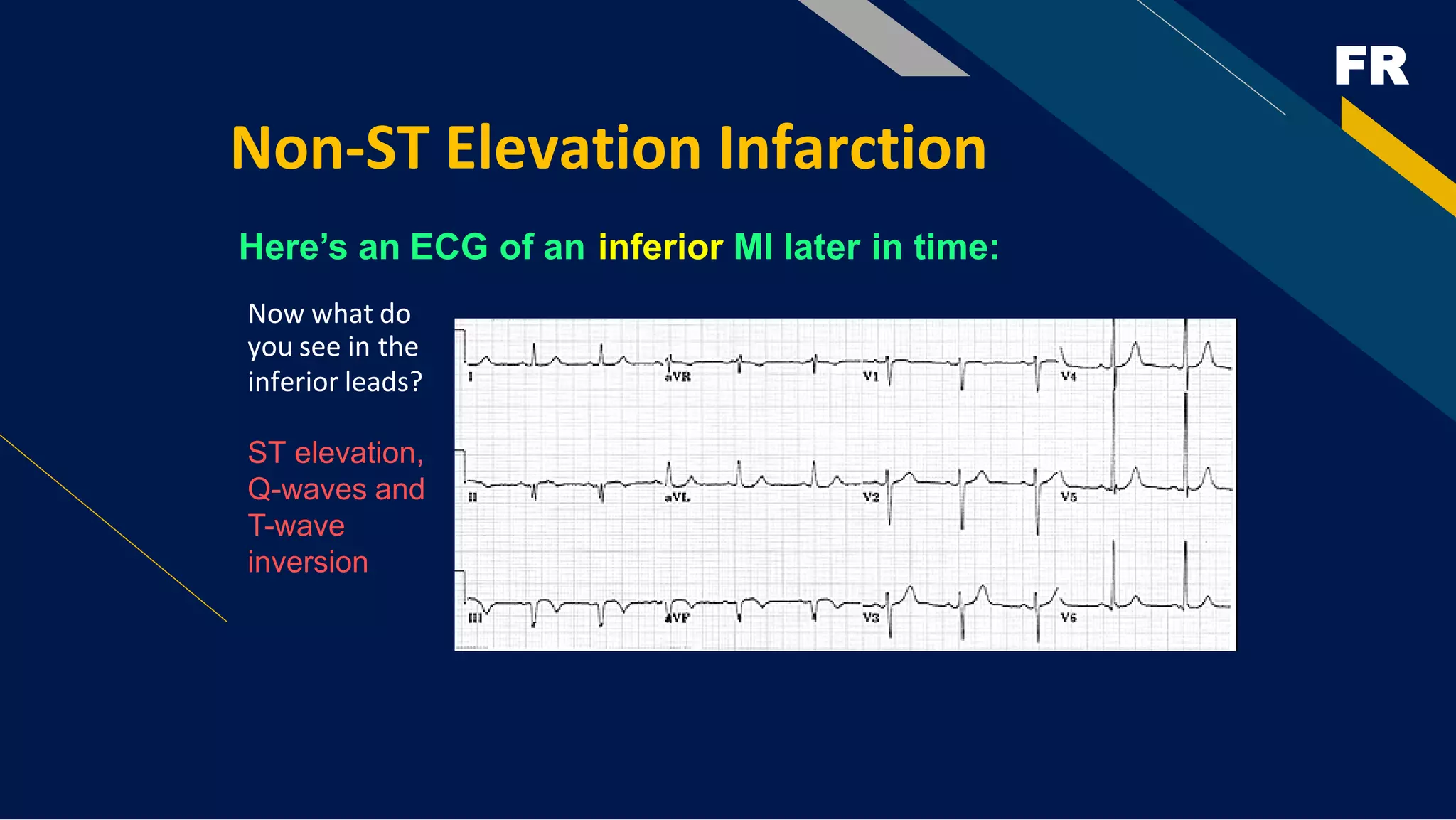
Here’s an ECG of an inferior MI later in time:
Now what do
you see in the
inferior leads?
ST elevation,
Q-waves and
T-wave
inversion
FR
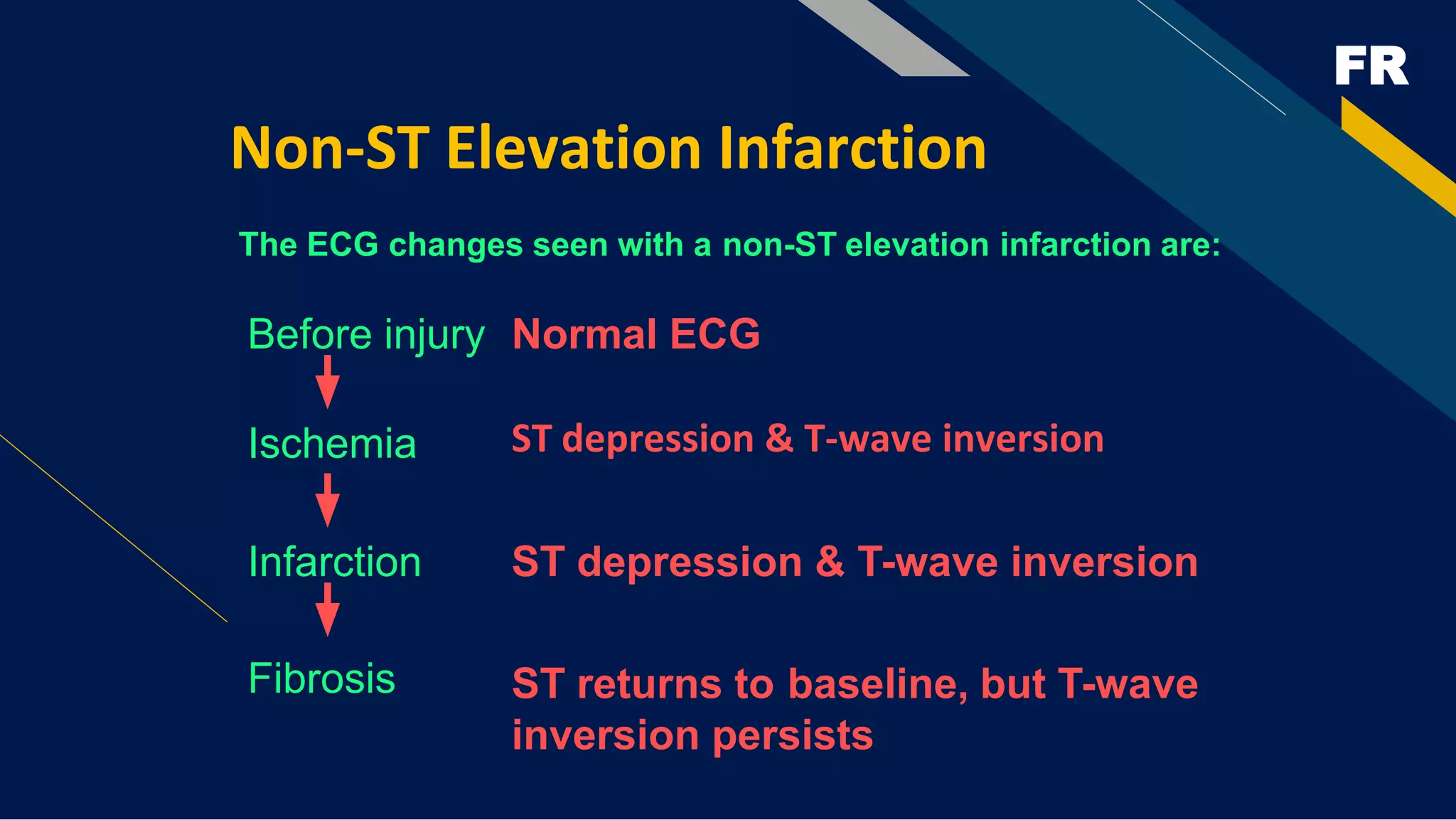
Non-ST Elevation Infarction
ST depression & T-wave inversion
The ECG changes seen with a non-ST elevation infarction are:
Before injury Normal ECG
ST depression & T-wave inversion
ST returns to baseline, but T-wave
inversion persists
Ischemia
Infarction
Fibrosis
FR
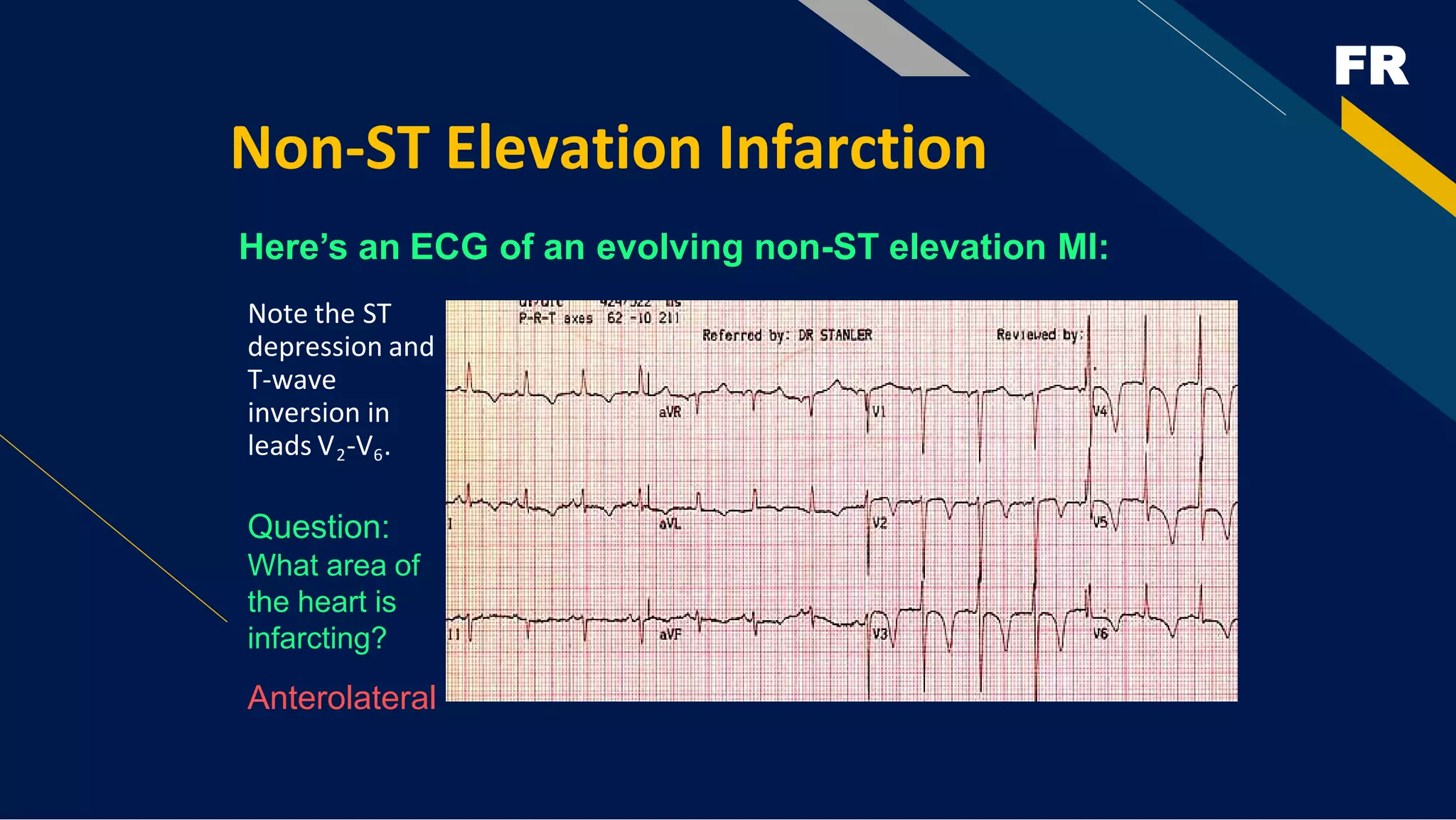
Non-ST Elevation Infarction
Here’s an ECG of an evolving non-ST elevation MI:
Note the ST
depression and
T-wave
inversion in
leads V2-V6.
Question:
What area of
the heart is
infarcting?
Anterolateral
FR
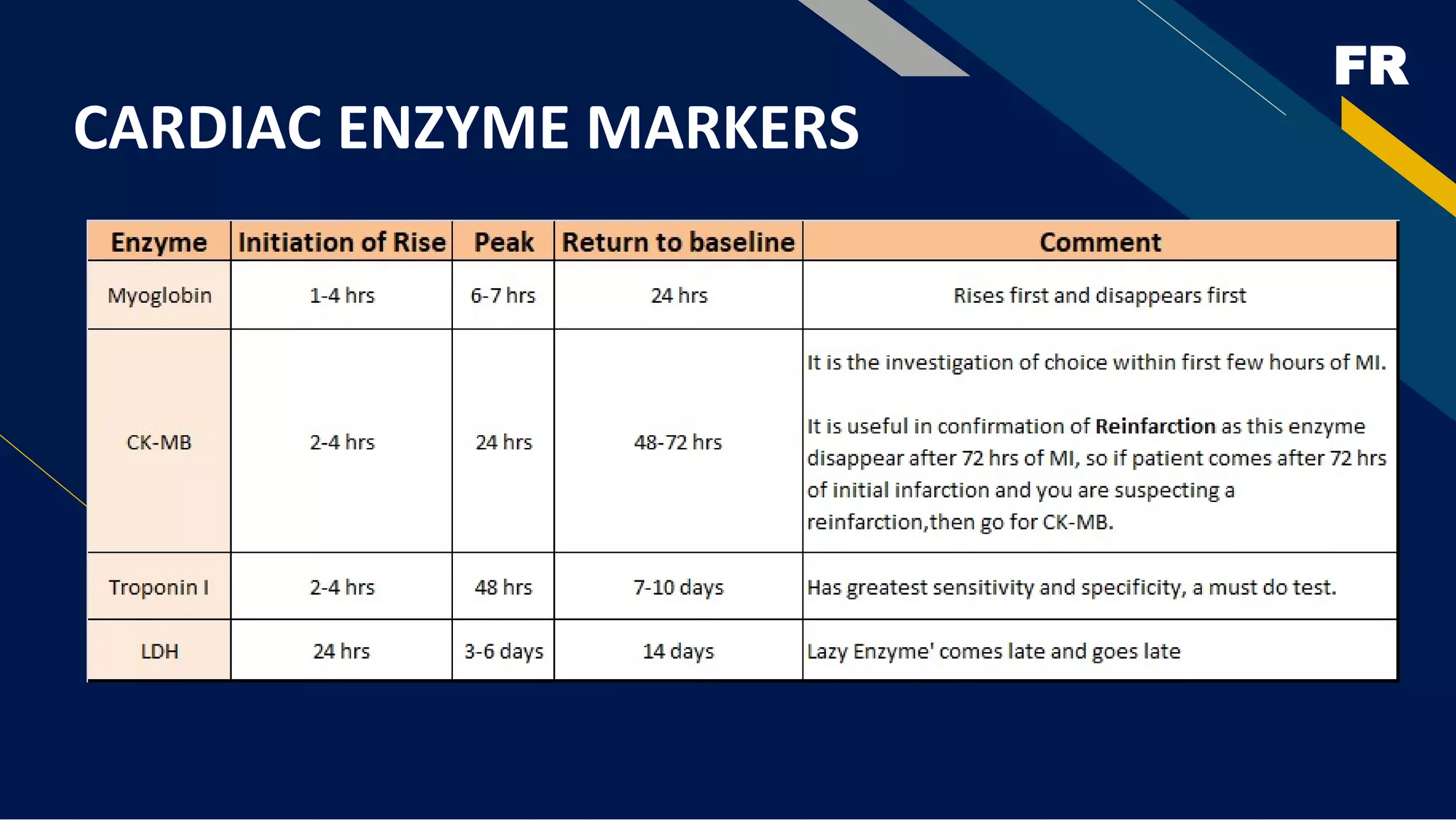
CARDIAC ENZYME MARKERS
FR
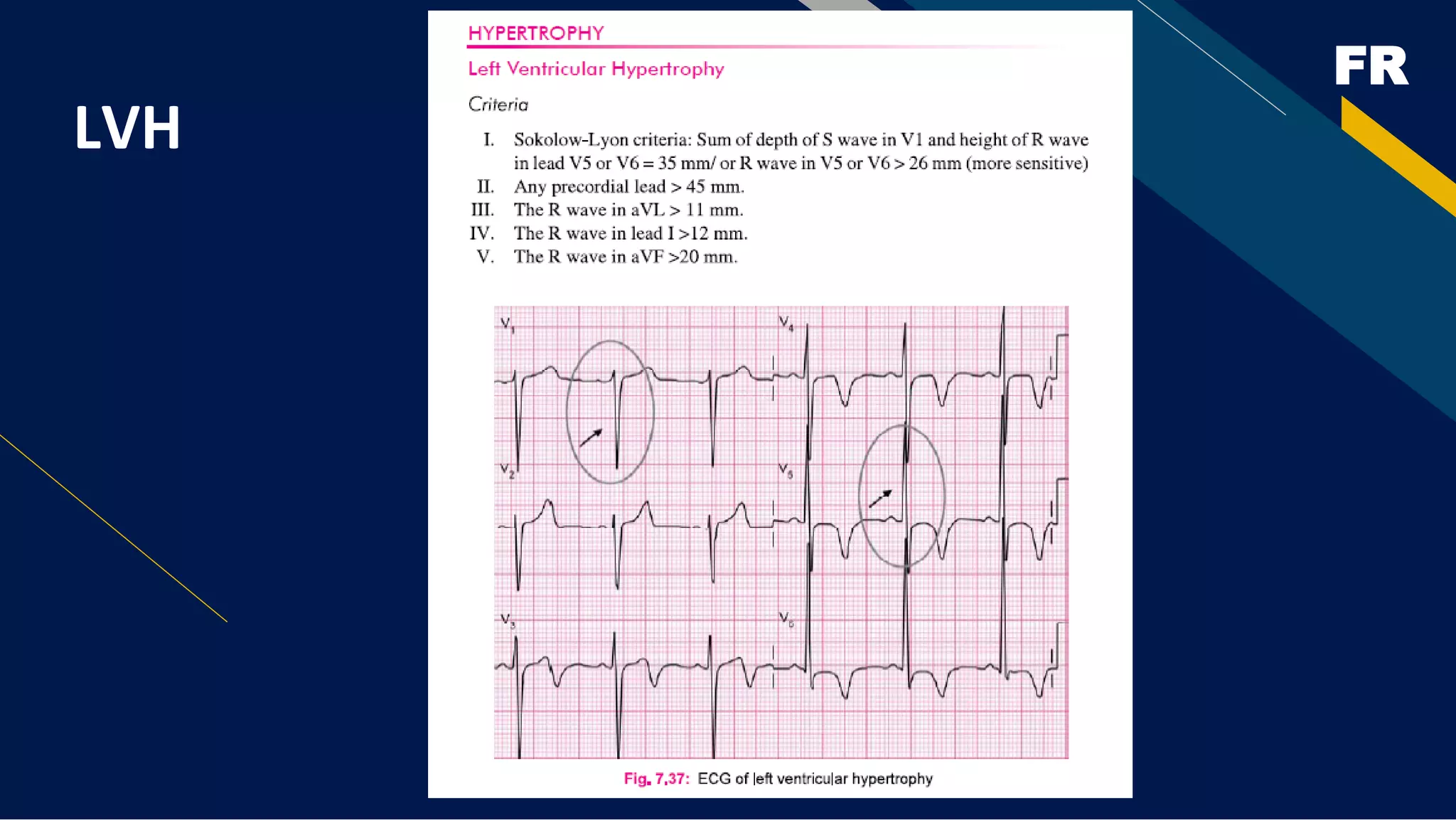
LVH
FR
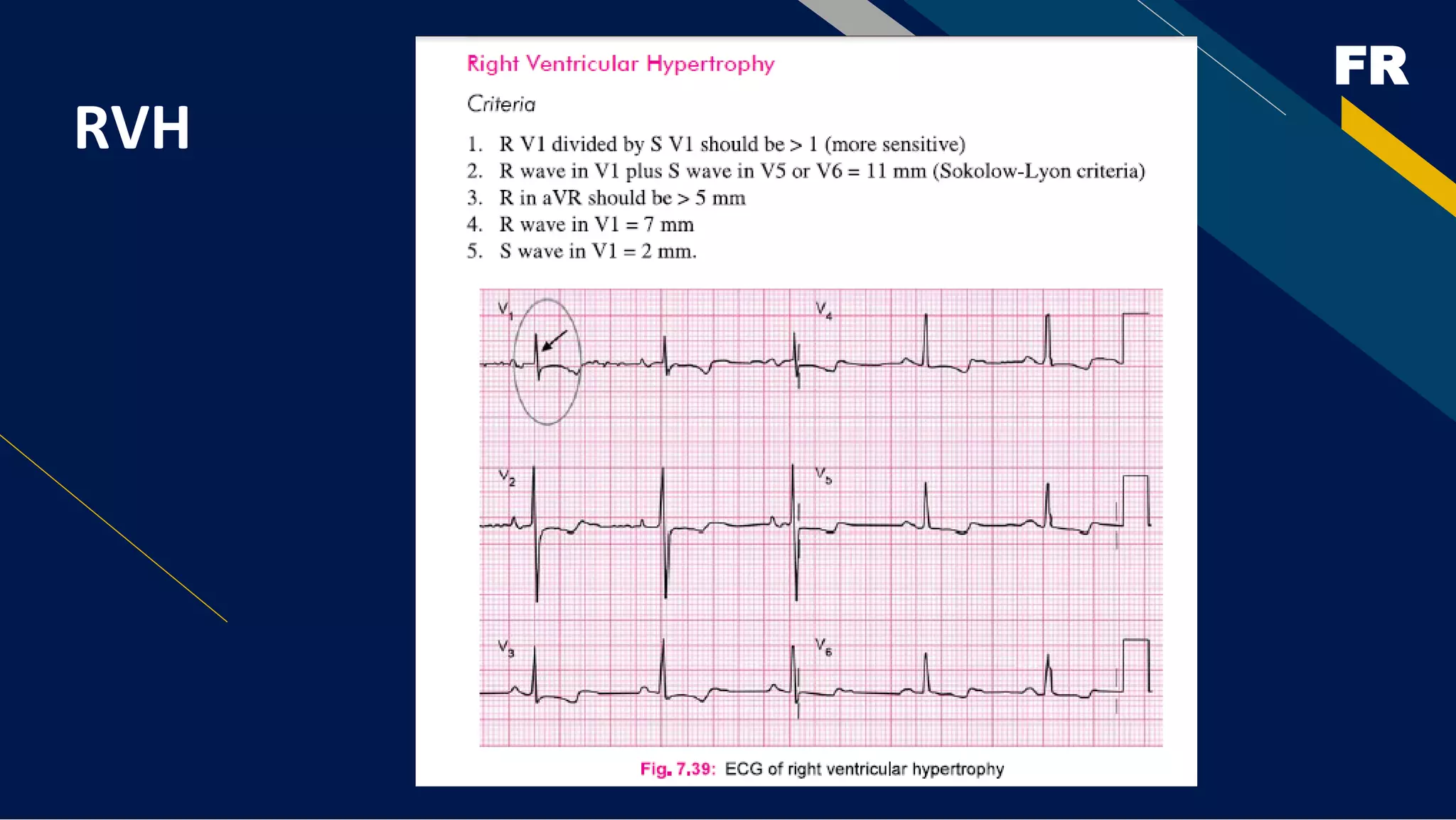
RVH
Basics Of ECG
- DR BIPIN A GOND
REGIONAL MEDICAL HEAD
WESTERN MUMBAI
9768009436

BLUE Basics Of ECG.pdf