Fluid Mechanics II

 Muhammad Usman
Outline
•   Hydraulic Coupling
•   Hydraulic Torque Converter
•   Hydraulic RAM
•   Hydraulic Accumulator
•   Hydraulic Jack
Hydraulic Coupling
• It is a device to transfer torque or power
  from one shaft to another with the help of
  an oil which acts as a working medium.
• The speed of the driven shaft is always
  less than the driving shaft by 2 to 4
  percent.
• Used in diesel locomotives, and
  automotive industry.
Hydraulic Coupling
Hydraulic Torque Converter
• A hydraulic torque converter is the
  improved form of the hydraulic coupling, in
  which guide ring consists of series of
  guide vanes whose function is to change
  the direction of the oil reacts upon the
  turbine runner which multiplies the torque.
Water Hammer
• Water hammer (or, more generally, fluid
  hammer) is a pressure surge or wave resulting
  when a fluid (usually a liquid but sometimes also
  a gas) in motion is forced to stop or change
  direction suddenly (momentum change). Water
  hammer commonly occurs when a valve is
  closed suddenly at an end of a pipeline system,
  and a pressure wave propagates in the pipe. It
  may also be known as hydraulic shock.
Hydraulic Ram
• A hydraulic ram, or hydram, is a cyclic water
  pump powered by hydropower. It functions as a
  hydraulic transformer that takes in water at one
  "hydraulic head" (pressure) and flow-rate, and outputs
  water at a higher hydraulic-head and lower flow-rate. The
  device uses the water hammer effect to develop
  pressure that allows a portion of the input water that
  powers the pump to be lifted to a point higher than where
  the water originally started. The hydraulic ram is
  sometimes used in remote areas, where there is both a
  source of low-head hydropower, and a need for pumping
  water to a destination higher in elevation than the
  source. In this situation, the ram is often useful, since it
  requires no outside source of power other than
  the kinetic energy of water
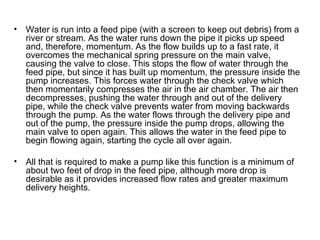
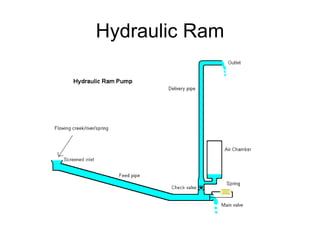
•   Water is run into a feed pipe (with a screen to keep out debris) from a
    river or stream. As the water runs down the pipe it picks up speed
    and, therefore, momentum. As the flow builds up to a fast rate, it
    overcomes the mechanical spring pressure on the main valve,
    causing the valve to close. This stops the flow of water through the
    feed pipe, but since it has built up momentum, the pressure inside the
    pump increases. This forces water through the check valve which
    then momentarily compresses the air in the air chamber. The air then
    decompresses, pushing the water through and out of the delivery
    pipe, while the check valve prevents water from moving backwards
    through the pump. As the water flows through the delivery pipe and
    out of the pump, the pressure inside the pump drops, allowing the
    main valve to open again. This allows the water in the feed pipe to
    begin flowing again, starting the cycle all over again.

•   All that is required to make a pump like this function is a minimum of
    about two feet of drop in the feed pipe, although more drop is
    desirable as it provides increased flow rates and greater maximum
    delivery heights.
Hydraulic Ram
Hydraulic Accumulator
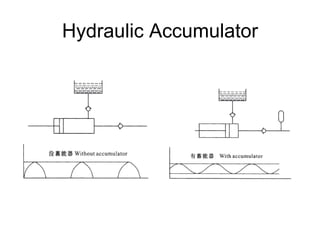
• A hydraulic accumulator is a device used to
  store energy. It holds a hydraulic fluid that
  cannot be compressed under pressure through
  an external source. The external source may be
  a raised weight, a spring or a gas that is
  compressed. The major reason for the use of an
  accumulator in hydraulic systems is to ensure
  that the pump is not too large to handle the extra
  demand. In this way, the supply circuit is able to
  respond faster to smooth pulsations and to
  temporary demand.
Hydraulic Accumulator
Hydrulic Accumulator
• An accumulator installed in line will protect
  the valves, gaskets, pressure guages.
• Common applications are found in
  refineries and pipelines.
Hydraulic Jack
Hydraulic Jack
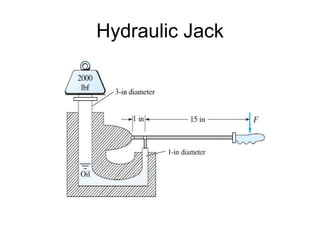
• Hydraulic jacks are used in industry to lift
  heavy objects. Their most well known
  application is raising and supporting an
  automobile to facilitate the replacement of
  a flat tire. They may also be found at work
  in a variety of specialized applications,
  including lifting airplanes, race cars, semi-
  trucks

Hydrauilc systems

  • 1.
    Fluid Mechanics II Muhammad Usman
  • 2.
    Outline • Hydraulic Coupling • Hydraulic Torque Converter • Hydraulic RAM • Hydraulic Accumulator • Hydraulic Jack
  • 3.
    Hydraulic Coupling • Itis a device to transfer torque or power from one shaft to another with the help of an oil which acts as a working medium. • The speed of the driven shaft is always less than the driving shaft by 2 to 4 percent. • Used in diesel locomotives, and automotive industry.
  • 4.
  • 5.
    Hydraulic Torque Converter •A hydraulic torque converter is the improved form of the hydraulic coupling, in which guide ring consists of series of guide vanes whose function is to change the direction of the oil reacts upon the turbine runner which multiplies the torque.
  • 6.
    Water Hammer • Waterhammer (or, more generally, fluid hammer) is a pressure surge or wave resulting when a fluid (usually a liquid but sometimes also a gas) in motion is forced to stop or change direction suddenly (momentum change). Water hammer commonly occurs when a valve is closed suddenly at an end of a pipeline system, and a pressure wave propagates in the pipe. It may also be known as hydraulic shock.
  • 7.
    Hydraulic Ram • Ahydraulic ram, or hydram, is a cyclic water pump powered by hydropower. It functions as a hydraulic transformer that takes in water at one "hydraulic head" (pressure) and flow-rate, and outputs water at a higher hydraulic-head and lower flow-rate. The device uses the water hammer effect to develop pressure that allows a portion of the input water that powers the pump to be lifted to a point higher than where the water originally started. The hydraulic ram is sometimes used in remote areas, where there is both a source of low-head hydropower, and a need for pumping water to a destination higher in elevation than the source. In this situation, the ram is often useful, since it requires no outside source of power other than the kinetic energy of water
  • 8.
    Water is run into a feed pipe (with a screen to keep out debris) from a river or stream. As the water runs down the pipe it picks up speed and, therefore, momentum. As the flow builds up to a fast rate, it overcomes the mechanical spring pressure on the main valve, causing the valve to close. This stops the flow of water through the feed pipe, but since it has built up momentum, the pressure inside the pump increases. This forces water through the check valve which then momentarily compresses the air in the air chamber. The air then decompresses, pushing the water through and out of the delivery pipe, while the check valve prevents water from moving backwards through the pump. As the water flows through the delivery pipe and out of the pump, the pressure inside the pump drops, allowing the main valve to open again. This allows the water in the feed pipe to begin flowing again, starting the cycle all over again. • All that is required to make a pump like this function is a minimum of about two feet of drop in the feed pipe, although more drop is desirable as it provides increased flow rates and greater maximum delivery heights.
  • 9.
  • 10.
    Hydraulic Accumulator • Ahydraulic accumulator is a device used to store energy. It holds a hydraulic fluid that cannot be compressed under pressure through an external source. The external source may be a raised weight, a spring or a gas that is compressed. The major reason for the use of an accumulator in hydraulic systems is to ensure that the pump is not too large to handle the extra demand. In this way, the supply circuit is able to respond faster to smooth pulsations and to temporary demand.
  • 11.
  • 12.
    Hydrulic Accumulator • Anaccumulator installed in line will protect the valves, gaskets, pressure guages. • Common applications are found in refineries and pipelines.
  • 13.
  • 14.
    Hydraulic Jack • Hydraulicjacks are used in industry to lift heavy objects. Their most well known application is raising and supporting an automobile to facilitate the replacement of a flat tire. They may also be found at work in a variety of specialized applications, including lifting airplanes, race cars, semi- trucks