Fluid Mechanics II

    Lecture 10
 Muhammad Usman
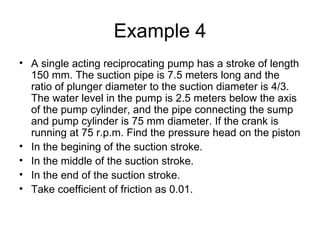
Example 4
• A single acting reciprocating pump has a stroke of length
  150 mm. The suction pipe is 7.5 meters long and the
  ratio of plunger diameter to the suction diameter is 4/3.
  The water level in the pump is 2.5 meters below the axis
  of the pump cylinder, and the pipe connecting the sump
  and pump cylinder is 75 mm diameter. If the crank is
  running at 75 r.p.m. Find the pressure head on the piston
• In the begining of the suction stroke.
• In the middle of the suction stroke.
• In the end of the suction stroke.
• Take coefficient of friction as 0.01.
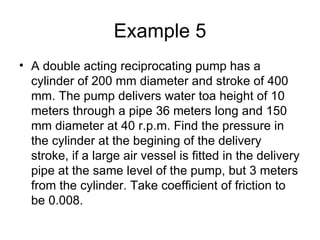
Example 5
• A double acting reciprocating pump has a
  cylinder of 200 mm diameter and stroke of 400
  mm. The pump delivers water toa height of 10
  meters through a pipe 36 meters long and 150
  mm diameter at 40 r.p.m. Find the pressure in
  the cylinder at the begining of the delivery
  stroke, if a large air vessel is fitted in the delivery
  pipe at the same level of the pump, but 3 meters
  from the cylinder. Take coefficient of friction to
  be 0.008.
Separation In Reciprocating Pump
When the vacuum pressure head reaches
-7.8 meters of water or 2.5 meters absolute
  the continuity of flow will stop and
  separation takes place.
This phenomenon occurs in suction and
  delivery pipes of reciprocating pumps.
The speed at which separation may takes
  place can be increase by fitting an air
  vessel.
Example 6
• A single acting reciprocating pump is to raise a liquid of
  11.8 kN/m3 through a verticle height of 11.5 meters
  from 2.5 meters below the pump axis and 9 meters
  above it. The plunger which moves with S.H.M has
  diameter 125 mm and stroke 225 mm. The suction and
  delivery pipes are 75 mm diameter and 3.5 meters and
  13.5 meters long respectively. There is a large air
  vessel placed on the delivery pipe near the pump axis.
  But there is no air vessel on the suction pipe. If
  separation takes place at 90 kPa below atmospheric
  pressure. Find
a Maximum speed with which the pump can run without
  separation taking place and
b Power required to drive the pump if f=0.02.
Manometeric Efficiency
• It is the ratio of manometric head to the
  energy supplied by the impeller/kN of
  water.
Specific Speed of a centrifugal
               Pump
• The speed of the imaginary pump,
  identical with the given pump which will
  discharge one litre per second of water
  while it is being raised through a head of
  one meter.
Example 7
• A single stage centrifugal pump with
  impeller diameter of 300 mm rorates at
  2000 r.p.m and lifts 3 m3 of water per
  minute to a height of 30 meters. Find the
  number of stages and the diameter of
  each impeller of a similar multistage pump
  to lift 4.5 m3 of water per minute to a
  height of 130 m when rotating at 1500
  r.p.m.
Problem 1
• A centrifugal pump delivers 30 litres of
  water per second against a head of 12
  meters and runninng at 1200 r.p.m.
  requires 6 kW power. Determine the
  discharge, head of teh pump and power
  required, if the pump runs at 1500 r.p.m.
Problem 2
• A centrifugal pump was built to supply
  water against a head of 22.5 mters. But
  later on it was required to supply the
  required quantity of water against a head
  of 20 meters. Find teh necessary
  reduction in the impeller diamter, if it
  planned to reduce the original diameter of
  300 mm without reducing the speed of
  impeller.
Problem 3
• Find the specific speed of a centrifula
  pump, delivering 750 litres of water per
  second against a head of 15 meters at
  725 r.p.m.
Problem 4
• A multistage centrifugal pump is required
  to lift 9000 litres of water per minute from
  a mine, the total head including friction
  being 75 meters. If the speed of the pump
  is 1200 r.p.m. Find the least number of
  stages, if teh specific speed per stage is
  not to be less than 60 r.p.m.
Problem 5
• A single acting reciprocating pump has
  plunger of diameter 150 mm and stroke of
  length 400 mm. It draws water fram a
  depth of 4.5 m through a pipe 8 m long
  and 80 mm diameter at 25 r.p.m. If the
  atmospheric pressure head is 10.3 find the
  pressure head on the piston at the
  begining and end of the suciton stroke.
Problem 6
• A single acting reciprocating pump has plunger
  of diameter 150 mm and stroke of 300 mm. The
  lengths of suction and delivery pipes are 6.5 m
  and 39 m respectively and both the pipes are of
  teh same diameter of 75 mm. The axis of the
  pump is 5 m above the level of the water in the
  sump and 33 m below the delivery water level. If
  the atmospheric pressure head is 10.3 m of
  water and coefficient of friction of both pipes is
  0.01. Find the pressure head of the piston at the
  beginning, middle and end of the suction
  strokes. Take speed of crank as 30 r.p.m.

Lecture 10 copy

  • 1.
    Fluid Mechanics II Lecture 10 Muhammad Usman
  • 2.
    Example 4 • Asingle acting reciprocating pump has a stroke of length 150 mm. The suction pipe is 7.5 meters long and the ratio of plunger diameter to the suction diameter is 4/3. The water level in the pump is 2.5 meters below the axis of the pump cylinder, and the pipe connecting the sump and pump cylinder is 75 mm diameter. If the crank is running at 75 r.p.m. Find the pressure head on the piston • In the begining of the suction stroke. • In the middle of the suction stroke. • In the end of the suction stroke. • Take coefficient of friction as 0.01.
  • 3.
    Example 5 • Adouble acting reciprocating pump has a cylinder of 200 mm diameter and stroke of 400 mm. The pump delivers water toa height of 10 meters through a pipe 36 meters long and 150 mm diameter at 40 r.p.m. Find the pressure in the cylinder at the begining of the delivery stroke, if a large air vessel is fitted in the delivery pipe at the same level of the pump, but 3 meters from the cylinder. Take coefficient of friction to be 0.008.
  • 4.
    Separation In ReciprocatingPump When the vacuum pressure head reaches -7.8 meters of water or 2.5 meters absolute the continuity of flow will stop and separation takes place. This phenomenon occurs in suction and delivery pipes of reciprocating pumps. The speed at which separation may takes place can be increase by fitting an air vessel.
  • 5.
    Example 6 • Asingle acting reciprocating pump is to raise a liquid of 11.8 kN/m3 through a verticle height of 11.5 meters from 2.5 meters below the pump axis and 9 meters above it. The plunger which moves with S.H.M has diameter 125 mm and stroke 225 mm. The suction and delivery pipes are 75 mm diameter and 3.5 meters and 13.5 meters long respectively. There is a large air vessel placed on the delivery pipe near the pump axis. But there is no air vessel on the suction pipe. If separation takes place at 90 kPa below atmospheric pressure. Find a Maximum speed with which the pump can run without separation taking place and b Power required to drive the pump if f=0.02.
  • 6.
    Manometeric Efficiency • Itis the ratio of manometric head to the energy supplied by the impeller/kN of water.
  • 7.
    Specific Speed ofa centrifugal Pump • The speed of the imaginary pump, identical with the given pump which will discharge one litre per second of water while it is being raised through a head of one meter.
  • 8.
    Example 7 • Asingle stage centrifugal pump with impeller diameter of 300 mm rorates at 2000 r.p.m and lifts 3 m3 of water per minute to a height of 30 meters. Find the number of stages and the diameter of each impeller of a similar multistage pump to lift 4.5 m3 of water per minute to a height of 130 m when rotating at 1500 r.p.m.
  • 9.
    Problem 1 • Acentrifugal pump delivers 30 litres of water per second against a head of 12 meters and runninng at 1200 r.p.m. requires 6 kW power. Determine the discharge, head of teh pump and power required, if the pump runs at 1500 r.p.m.
  • 10.
    Problem 2 • Acentrifugal pump was built to supply water against a head of 22.5 mters. But later on it was required to supply the required quantity of water against a head of 20 meters. Find teh necessary reduction in the impeller diamter, if it planned to reduce the original diameter of 300 mm without reducing the speed of impeller.
  • 11.
    Problem 3 • Findthe specific speed of a centrifula pump, delivering 750 litres of water per second against a head of 15 meters at 725 r.p.m.
  • 12.
    Problem 4 • Amultistage centrifugal pump is required to lift 9000 litres of water per minute from a mine, the total head including friction being 75 meters. If the speed of the pump is 1200 r.p.m. Find the least number of stages, if teh specific speed per stage is not to be less than 60 r.p.m.
  • 13.
    Problem 5 • Asingle acting reciprocating pump has plunger of diameter 150 mm and stroke of length 400 mm. It draws water fram a depth of 4.5 m through a pipe 8 m long and 80 mm diameter at 25 r.p.m. If the atmospheric pressure head is 10.3 find the pressure head on the piston at the begining and end of the suciton stroke.
  • 14.
    Problem 6 • Asingle acting reciprocating pump has plunger of diameter 150 mm and stroke of 300 mm. The lengths of suction and delivery pipes are 6.5 m and 39 m respectively and both the pipes are of teh same diameter of 75 mm. The axis of the pump is 5 m above the level of the water in the sump and 33 m below the delivery water level. If the atmospheric pressure head is 10.3 m of water and coefficient of friction of both pipes is 0.01. Find the pressure head of the piston at the beginning, middle and end of the suction strokes. Take speed of crank as 30 r.p.m.