Blotting Techniques
SHAROON MUSHTAQ
Bs.MLT 5th Semester
TECHNIQUES & APPLICATIONS
What is Blotting
Blotting is a powerful and sensitive technique for identifying
the presence of specific biomolecules within a sample.
Subtypes of blotting are differentiated by the target
molecule that is being sought.
Types of blotting
Southern blotting
( to detect DNA )01
Northern blotting
( to detect RNA )
02
03 Western blotting
( to detect protein )
SOUTHERN BLOTTING
 Southern blotting is the first blotting technique which made
analysis and recording easy.
 In Southern blotting ,a DNA fragment containing a specific
sequence can be identified by electrophoresis , transferring
them into nitrocellulose & hybridizing with a 32p labelled
single stranded DNA probe complementary to the sequence.
 The fragment containing the sequence then visualized by
audioradiography
 It was first developed by E.M.Southern in 1975
SOUTHERN BLOTTING
PROCEDURE
 For Southern blotting , DNA sample is first digested with a
restriction enzyme and digested sample is electrophoresed.
 The DNA bands in the gel are denatured into single strands with the
help of an alkali solution.
 Subsequently the gel is laid on top of a buffer saturated filter paper
placed on a solid support(eg.glass plate),with its two edges immersed
in the buffer.
 A sheet of nitrocellulose filter membrane is placed on top of the
gel and a stack of many papers on top of this membrane.
Cont…
01
02
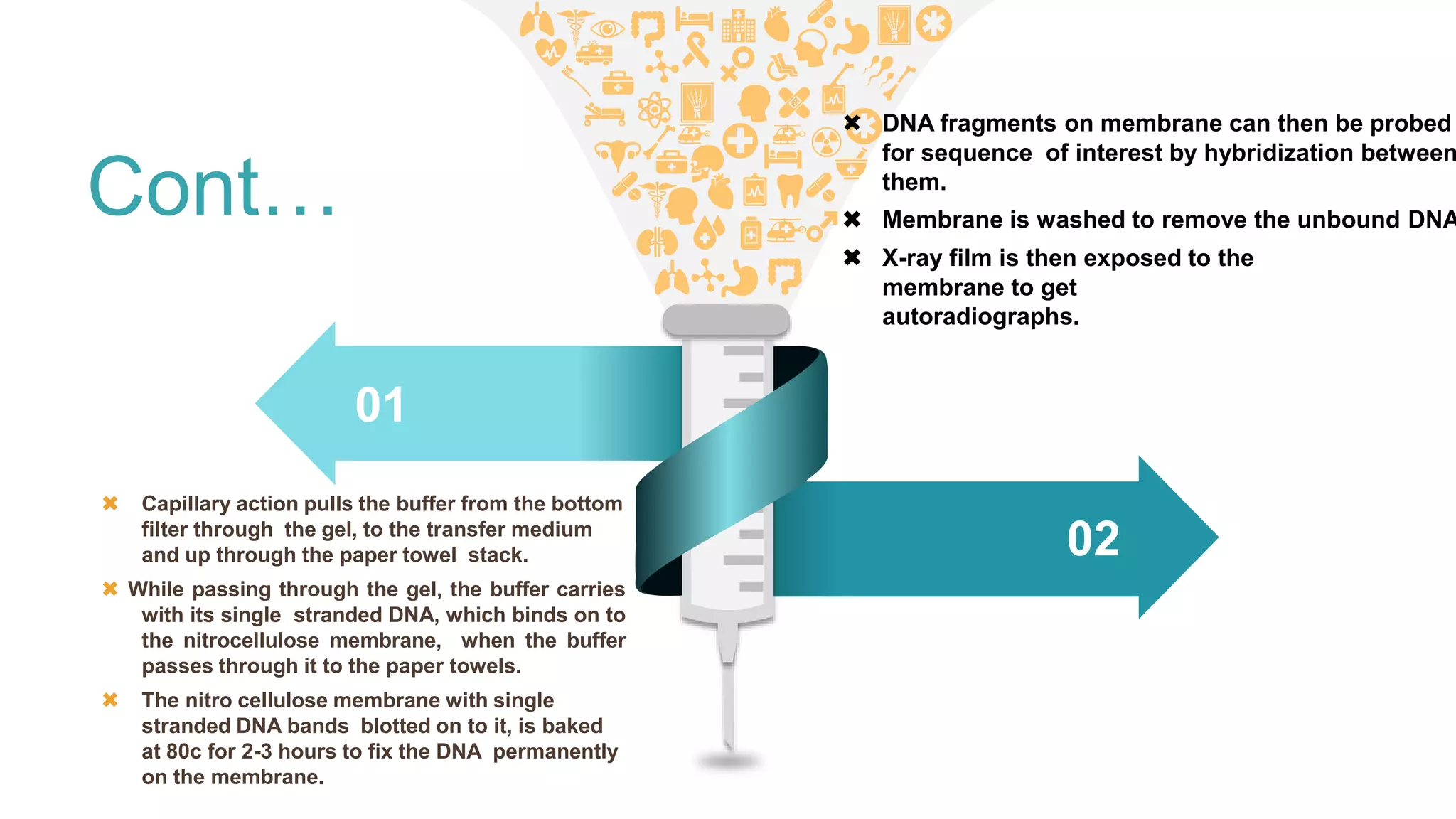
 Capillary action pulls the buffer from the bottom
filter through the gel, to the transfer medium
and up through the paper towel stack.
 While passing through the gel, the buffer carries
with its single stranded DNA, which binds on to
the nitrocellulose membrane, when the buffer
passes through it to the paper towels.
 The nitro cellulose membrane with single
stranded DNA bands blotted on to it, is baked
at 80c for 2-3 hours to fix the DNA permanently
on the membrane.
 DNA fragments on membrane can then be probed
for sequence of interest by hybridization between
them.
 Membrane is washed to remove the unbound DNA
 X-ray film is then exposed to the
membrane to get
autoradiographs.
Applications
 Southern blotting is extremely
sensitive and can be applied to
mapping restriction sites around a
single copy gene sequence in a
complex genome such as that of
man.
 When mini satellite probe is used
the technique can be also used for
forensic purpose for identification of
minute amount of DNA.
 The use of southern blot
technique has also been
done for analyzing the role
of DNA methylation in gene
expression.
 Blotting analysis useful in
detection of mutated genes
in genetic disorders.
 Restriction analysis of genes studied with southern blot helps in this respect.
 DNA finger printing. RFLP mapping.
Northern Blotting
 The Northern blot procedure essentially identical to
that of southern blotting except that here RNAs are
separated by gel electrophoresis.
 Initially southern blotting could not be used
directly to blot transfer RNA from gel to
nitrocellulose membrane because RNA did not
bind to cellulose nitrate.
 Alwine,Kemp and Stark(1979)developed a
procedure for blot transfer of RNA.
 He used a chemically reactive paper(diazotization of
amino benzyl oxymethyl paper which is prepared from
Whatsman 540 papers).
PROCEDURE
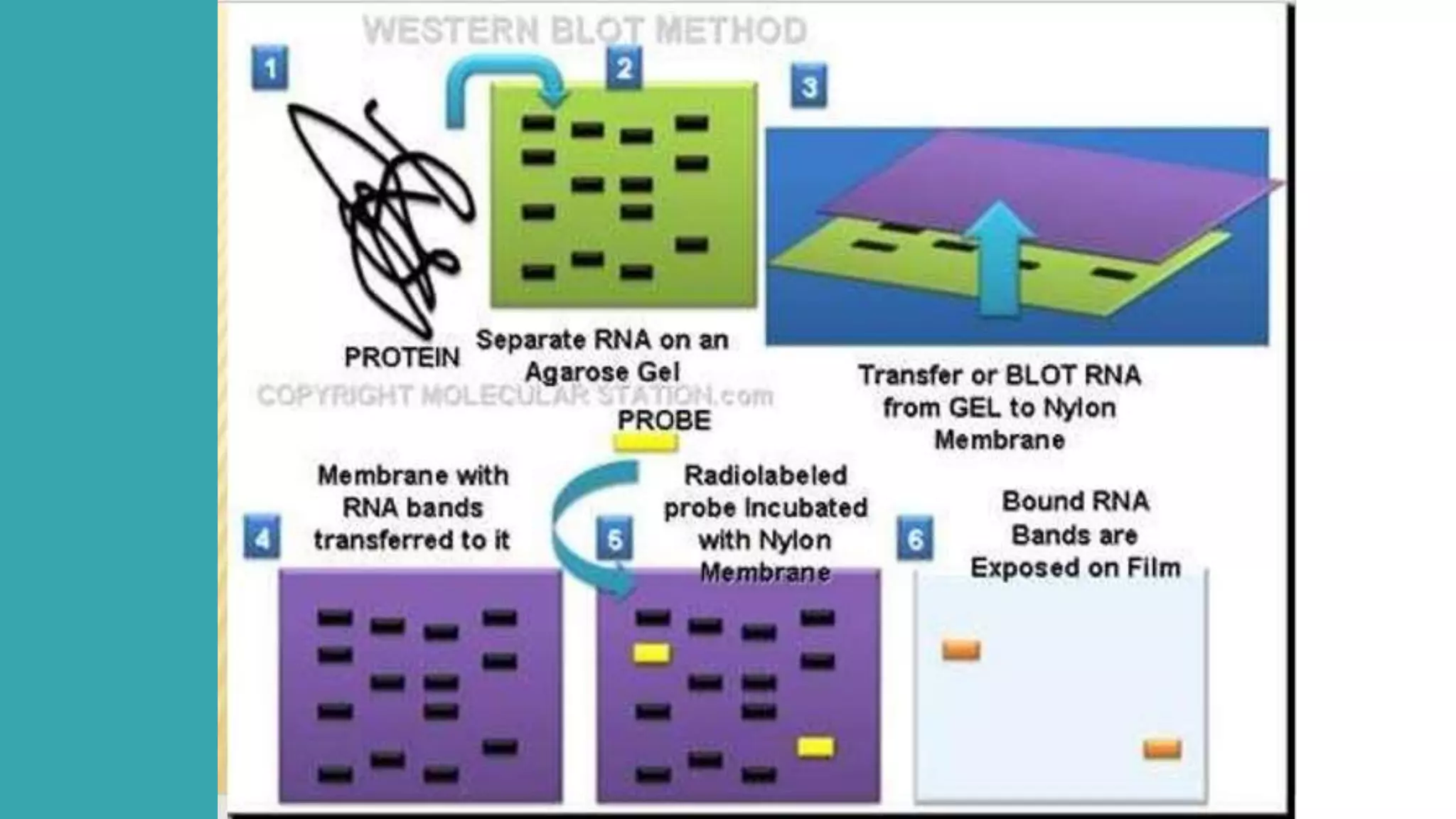
1. RNA species are separated on
the basis of size by
electrophoresis through
agarose gel containing
formaldehyde or glyoxal and
dimethyl sulfoxide.
2. The separated RNA bands are then
blotted on chemically reactive filter
paper.
3. RNA species after blotting are
hybridized to radiolabelled DNA
probe.
4. Auto radiography is carried onto
locate RNA bands that are
complementary to the probe.
APPLICATIONS
 Used for detection and
quantitative estimation of
hybridized mRNA.
 Study RNA degradation
 Study RNA half life
 Study RNA splicing
 It is useful in the studies of gene
expression
WESTERN
BLOTTING
 This technique is used to detect the proteins of a
particular specificity.
 When a transferred gene expresses in transformed
cells,
 The translated product in the form of proteins can
be identified by this technique.
PROCEDURE
40% 50%60%80%
 First we isolate the protein or extract the protein.
 The extracted proteins are subjected to
PAGE(Poly Acrylamide Gel Electrophoresis)
and are then transferred onto nitro cellulose to
which they bind.
 Then radiolabelled specific antibody is added on
such membrane and it binds only to specific
complementary protein.
 The antibody is labelled with 125 I and the
signal is detected again with autoradiography.
 If radio active label is not used, bound antibody may
be detected by a second antibody tagged with an
enzyme.
You can simply impress your audience and
add a unique zing and appeal to your
Presentations. Easy to change colors,
photos and Text. Get a modern
PowerPoint Presentation that is beautifully
designed. You can simply impress your
audience and add a unique zing and
appeal to your Presentations. Easy to
change colors, photos and Text. Get a
modern PowerPoint Presentation that is
beautifully designed.
APPLICATIONS
04
05
06
01
02
03
The confirmatory HIV test employs a western blot to detect
anti- HIV antibody in a human serum sample. Proteins
from known HIV-infected cells are separated and blotted
on a membrane as above. Then, the serum to be tested is
applied in the primary antibody incubation step; free
antibody is washed away, and a secondary anti-human
antibody linked to an enzyme signal is added. The stained
bands then indicate the proteins to which the patient's
serum contains antibody.
A western blot is also used as the definitive test
for Bovine spongiform encephalopathy (BSE,
commonly referred to as 'mad cow disease').Western blot can also be used as a
confirmatory test for Hepatitis B infection
Thank YouInsert the Sub Title of Your Presentation

Blotting techniques dr.raza

  • 1.
    Blotting Techniques SHAROON MUSHTAQ Bs.MLT5th Semester TECHNIQUES & APPLICATIONS
  • 2.
    What is Blotting Blottingis a powerful and sensitive technique for identifying the presence of specific biomolecules within a sample. Subtypes of blotting are differentiated by the target molecule that is being sought.
  • 3.
    Types of blotting Southernblotting ( to detect DNA )01 Northern blotting ( to detect RNA ) 02 03 Western blotting ( to detect protein )
  • 4.
    SOUTHERN BLOTTING  Southernblotting is the first blotting technique which made analysis and recording easy.  In Southern blotting ,a DNA fragment containing a specific sequence can be identified by electrophoresis , transferring them into nitrocellulose & hybridizing with a 32p labelled single stranded DNA probe complementary to the sequence.  The fragment containing the sequence then visualized by audioradiography  It was first developed by E.M.Southern in 1975
  • 5.
  • 6.
    PROCEDURE  For Southernblotting , DNA sample is first digested with a restriction enzyme and digested sample is electrophoresed.  The DNA bands in the gel are denatured into single strands with the help of an alkali solution.  Subsequently the gel is laid on top of a buffer saturated filter paper placed on a solid support(eg.glass plate),with its two edges immersed in the buffer.  A sheet of nitrocellulose filter membrane is placed on top of the gel and a stack of many papers on top of this membrane.
  • 7.
    Cont… 01 02  Capillary actionpulls the buffer from the bottom filter through the gel, to the transfer medium and up through the paper towel stack.  While passing through the gel, the buffer carries with its single stranded DNA, which binds on to the nitrocellulose membrane, when the buffer passes through it to the paper towels.  The nitro cellulose membrane with single stranded DNA bands blotted on to it, is baked at 80c for 2-3 hours to fix the DNA permanently on the membrane.  DNA fragments on membrane can then be probed for sequence of interest by hybridization between them.  Membrane is washed to remove the unbound DNA  X-ray film is then exposed to the membrane to get autoradiographs.
  • 8.
    Applications  Southern blottingis extremely sensitive and can be applied to mapping restriction sites around a single copy gene sequence in a complex genome such as that of man.  When mini satellite probe is used the technique can be also used for forensic purpose for identification of minute amount of DNA.  The use of southern blot technique has also been done for analyzing the role of DNA methylation in gene expression.  Blotting analysis useful in detection of mutated genes in genetic disorders.
  • 9.
     Restriction analysisof genes studied with southern blot helps in this respect.  DNA finger printing. RFLP mapping.
  • 10.
    Northern Blotting  TheNorthern blot procedure essentially identical to that of southern blotting except that here RNAs are separated by gel electrophoresis.  Initially southern blotting could not be used directly to blot transfer RNA from gel to nitrocellulose membrane because RNA did not bind to cellulose nitrate.  Alwine,Kemp and Stark(1979)developed a procedure for blot transfer of RNA.  He used a chemically reactive paper(diazotization of amino benzyl oxymethyl paper which is prepared from Whatsman 540 papers).
  • 12.
    PROCEDURE 1. RNA speciesare separated on the basis of size by electrophoresis through agarose gel containing formaldehyde or glyoxal and dimethyl sulfoxide. 2. The separated RNA bands are then blotted on chemically reactive filter paper. 3. RNA species after blotting are hybridized to radiolabelled DNA probe. 4. Auto radiography is carried onto locate RNA bands that are complementary to the probe.
  • 13.
    APPLICATIONS  Used fordetection and quantitative estimation of hybridized mRNA.  Study RNA degradation  Study RNA half life  Study RNA splicing  It is useful in the studies of gene expression
  • 14.
    WESTERN BLOTTING  This techniqueis used to detect the proteins of a particular specificity.  When a transferred gene expresses in transformed cells,  The translated product in the form of proteins can be identified by this technique.
  • 15.
    PROCEDURE 40% 50%60%80%  Firstwe isolate the protein or extract the protein.  The extracted proteins are subjected to PAGE(Poly Acrylamide Gel Electrophoresis) and are then transferred onto nitro cellulose to which they bind.  Then radiolabelled specific antibody is added on such membrane and it binds only to specific complementary protein.  The antibody is labelled with 125 I and the signal is detected again with autoradiography.  If radio active label is not used, bound antibody may be detected by a second antibody tagged with an enzyme.
  • 16.
    You can simplyimpress your audience and add a unique zing and appeal to your Presentations. Easy to change colors, photos and Text. Get a modern PowerPoint Presentation that is beautifully designed. You can simply impress your audience and add a unique zing and appeal to your Presentations. Easy to change colors, photos and Text. Get a modern PowerPoint Presentation that is beautifully designed.
  • 17.
    APPLICATIONS 04 05 06 01 02 03 The confirmatory HIVtest employs a western blot to detect anti- HIV antibody in a human serum sample. Proteins from known HIV-infected cells are separated and blotted on a membrane as above. Then, the serum to be tested is applied in the primary antibody incubation step; free antibody is washed away, and a secondary anti-human antibody linked to an enzyme signal is added. The stained bands then indicate the proteins to which the patient's serum contains antibody. A western blot is also used as the definitive test for Bovine spongiform encephalopathy (BSE, commonly referred to as 'mad cow disease').Western blot can also be used as a confirmatory test for Hepatitis B infection
  • 18.
    Thank YouInsert theSub Title of Your Presentation