Page 1 of 4
Learning Domains
Cognitive | Affective | Psychomotor
Learning is not an event. It is a process. It is the continual growth and change in the brain's
architecture that results from the many ways we take in information, process it, connect it,
catalogue it, and use it (and sometimes get rid of it).
Bloom’s Taxonomy of Learning Domains
Bloom's Taxonomy was created in 1956 under the leadership of educational psychologist Dr
Benjamin Bloom in order to promote higher forms of thinking in education, such as
analyzing and evaluating concepts, processes, procedures, and principles, rather than just
remembering facts (rote learning). It is most often used when designing educational,
training, and learning processes.
Learning can generally be categorized into three domains: cognitive, affective, and
psychomotor. Within each domain are multiple levels of learning that progress from more
basic, surface-level learning to more complex, deeper-level learning. The level of learning
we strive to impact will vary across learning experiences depending on 1) the nature of the
experience, 2) the developmental levels of the participating students, and 3) the duration and
intensity of the experience.
When writing learning objectives, it is important to think about which domain(s) is relevant
to the learning experience you are designing. The tables below provide further information
about each domain.
Bloom's Revised Taxonomy (Cognitive only)
Lorin Anderson, a former student of Bloom, and David Krathwohl revisited the cognitive
domain in the mid-nineties and made some changes, with perhaps the three most prominent
ones being (Anderson, Krathwohl, Airasian, Cruikshank, Mayer, Pintrich, Raths, Wittrock,
2000):
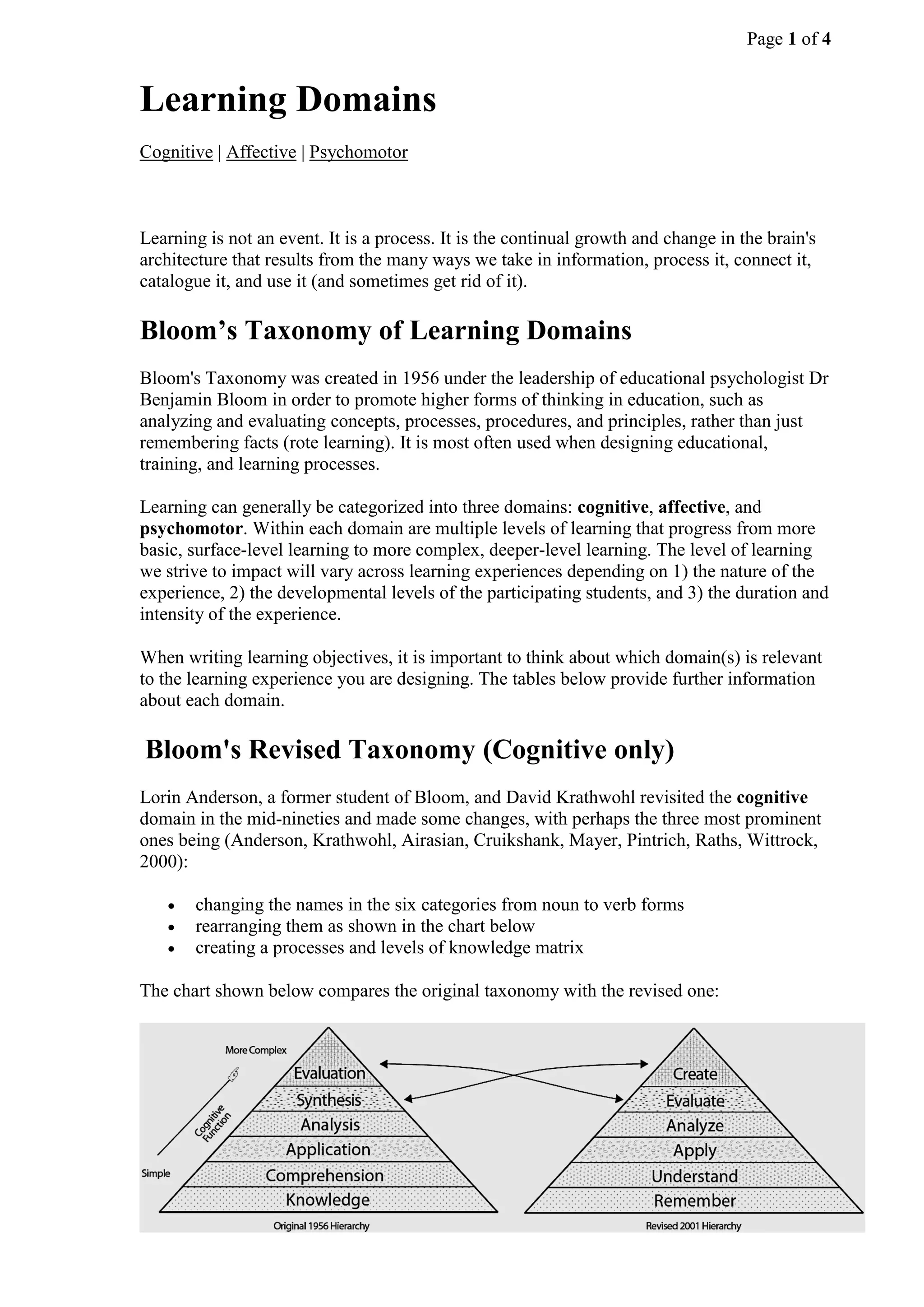
 changing the names in the six categories from noun to verb forms
 rearranging them as shown in the chart below
 creating a processes and levels of knowledge matrix
The chart shown below compares the original taxonomy with the revised one:
Page 2 of 4
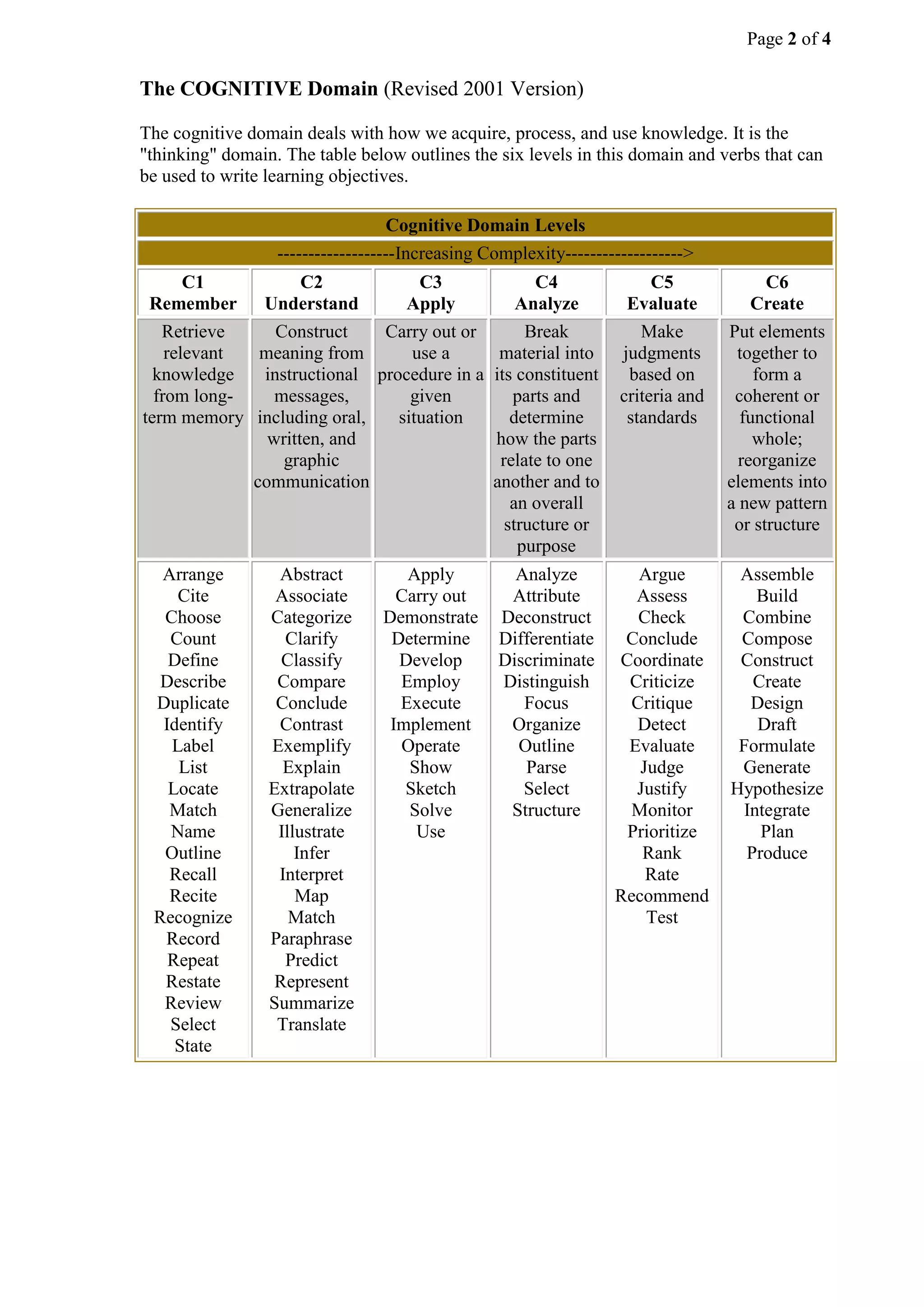
The COGNITIVE Domain (Revised 2001 Version)
The cognitive domain deals with how we acquire, process, and use knowledge. It is the
"thinking" domain. The table below outlines the six levels in this domain and verbs that can
be used to write learning objectives.
Cognitive Domain Levels
-------------------Increasing Complexity------------------->
C1
Remember
C2
Understand
C3
Apply
C4
Analyze
C5
Evaluate
C6
Create
Retrieve
relevant
knowledge
from long-
term memory
Construct
meaning from
instructional
messages,
including oral,
written, and
graphic
communication
Carry out or
use a
procedure in a
given
situation
Break
material into
its constituent
parts and
determine
how the parts
relate to one
another and to
an overall
structure or
purpose
Make
judgments
based on
criteria and
standards
Put elements
together to
form a
coherent or
functional
whole;
reorganize
elements into
a new pattern
or structure
Arrange
Cite
Choose
Count
Define
Describe
Duplicate
Identify
Label
List
Locate
Match
Name
Outline
Recall
Recite
Recognize
Record
Repeat
Restate
Review
Select
State
Abstract
Associate
Categorize
Clarify
Classify
Compare
Conclude
Contrast
Exemplify
Explain
Extrapolate
Generalize
Illustrate
Infer
Interpret
Map
Match
Paraphrase
Predict
Represent
Summarize
Translate
Apply
Carry out
Demonstrate
Determine
Develop
Employ
Execute
Implement
Operate
Show
Sketch
Solve
Use
Analyze
Attribute
Deconstruct
Differentiate
Discriminate
Distinguish
Focus
Organize
Outline
Parse
Select
Structure
Argue
Assess
Check
Conclude
Coordinate
Criticize
Critique
Detect
Evaluate
Judge
Justify
Monitor
Prioritize
Rank
Rate
Recommend
Test
Assemble
Build
Combine
Compose
Construct
Create
Design
Draft
Formulate
Generate
Hypothesize
Integrate
Plan
Produce
Page 3 of 4
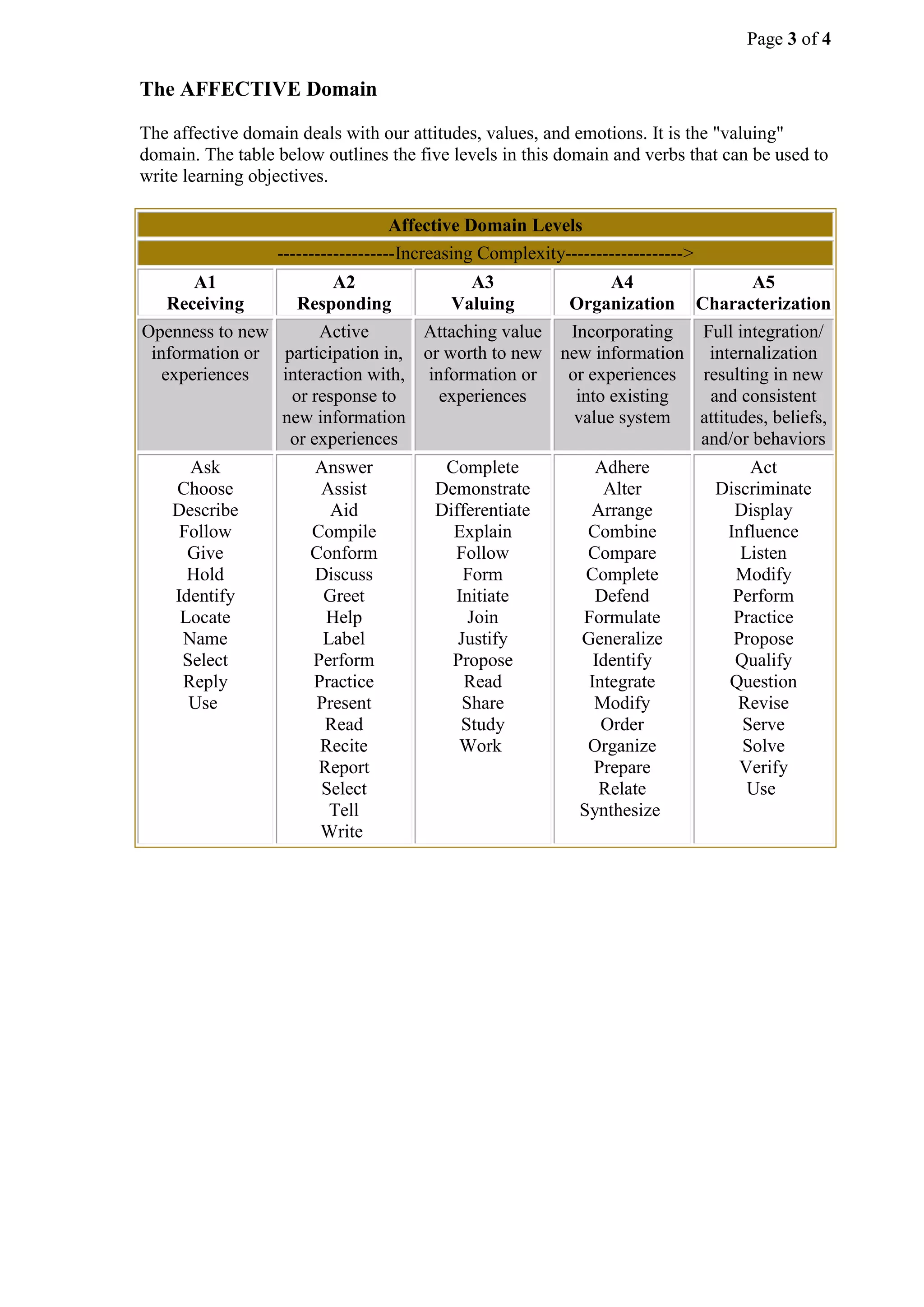
The AFFECTIVE Domain
The affective domain deals with our attitudes, values, and emotions. It is the "valuing"
domain. The table below outlines the five levels in this domain and verbs that can be used to
write learning objectives.
Affective Domain Levels
-------------------Increasing Complexity------------------->
A1
Receiving
A2
Responding
A3
Valuing
A4
Organization
A5
Characterization
Openness to new
information or
experiences
Active
participation in,
interaction with,
or response to
new information
or experiences
Attaching value
or worth to new
information or
experiences
Incorporating
new information
or experiences
into existing
value system
Full integration/
internalization
resulting in new
and consistent
attitudes, beliefs,
and/or behaviors
Ask
Choose
Describe
Follow
Give
Hold
Identify
Locate
Name
Select
Reply
Use
Answer
Assist
Aid
Compile
Conform
Discuss
Greet
Help
Label
Perform
Practice
Present
Read
Recite
Report
Select
Tell
Write
Complete
Demonstrate
Differentiate
Explain
Follow
Form
Initiate
Join
Justify
Propose
Read
Share
Study
Work
Adhere
Alter
Arrange
Combine
Compare
Complete
Defend
Formulate
Generalize
Identify
Integrate
Modify
Order
Organize
Prepare
Relate
Synthesize
Act
Discriminate
Display
Influence
Listen
Modify
Perform
Practice
Propose
Qualify
Question
Revise
Serve
Solve
Verify
Use
Page 4 of 4
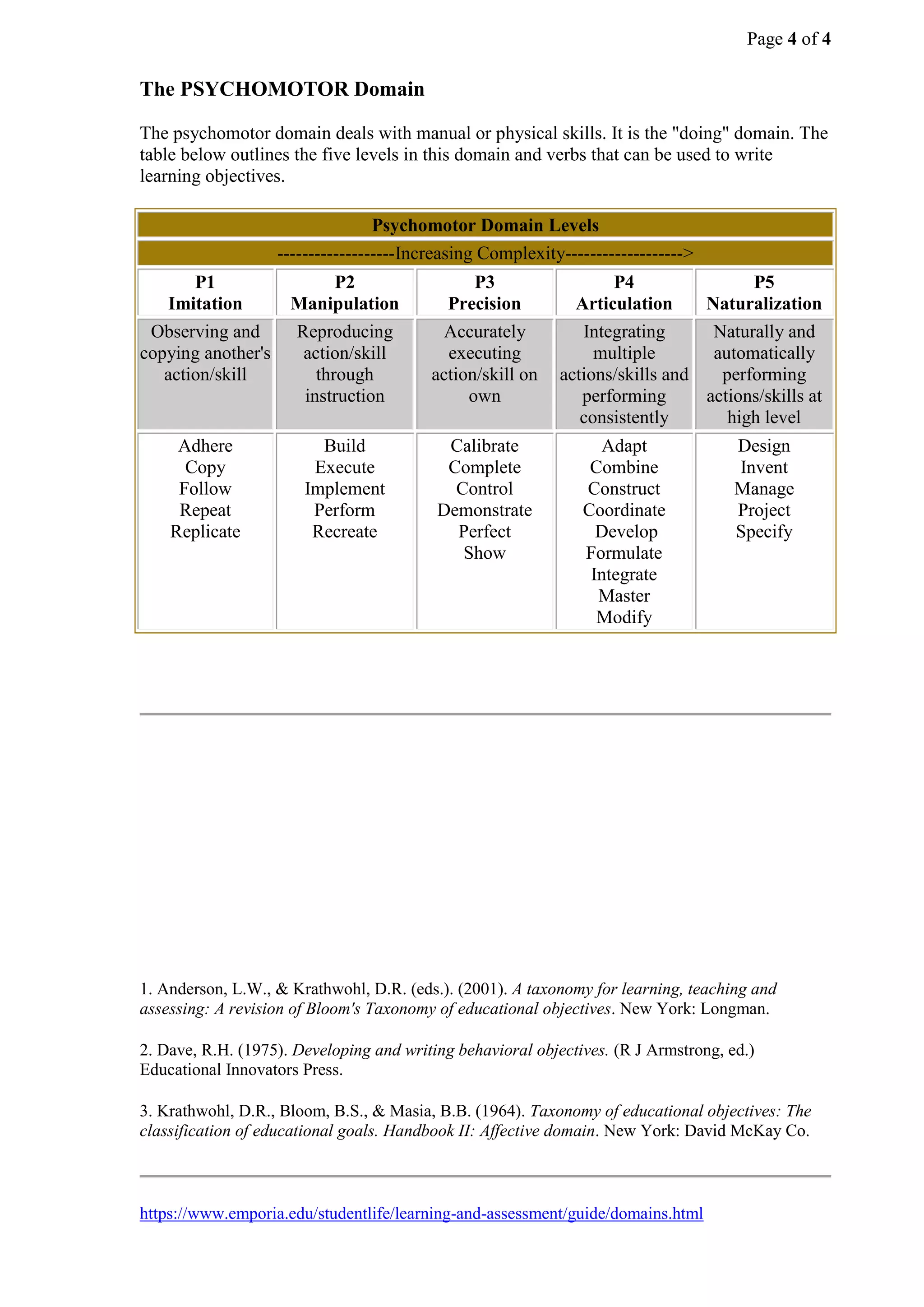
The PSYCHOMOTOR Domain
The psychomotor domain deals with manual or physical skills. It is the "doing" domain. The
table below outlines the five levels in this domain and verbs that can be used to write
learning objectives.
Psychomotor Domain Levels
-------------------Increasing Complexity------------------->
P1
Imitation
P2
Manipulation
P3
Precision
P4
Articulation
P5
Naturalization
Observing and
copying another's
action/skill
Reproducing
action/skill
through
instruction
Accurately
executing
action/skill on
own
Integrating
multiple
actions/skills and
performing
consistently
Naturally and
automatically
performing
actions/skills at
high level
Adhere
Copy
Follow
Repeat
Replicate
Build
Execute
Implement
Perform
Recreate
Calibrate
Complete
Control
Demonstrate
Perfect
Show
Adapt
Combine
Construct
Coordinate
Develop
Formulate
Integrate
Master
Modify
Design
Invent
Manage
Project
Specify
1. Anderson, L.W., & Krathwohl, D.R. (eds.). (2001). A taxonomy for learning, teaching and
assessing: A revision of Bloom's Taxonomy of educational objectives. New York: Longman.
2. Dave, R.H. (1975). Developing and writing behavioral objectives. (R J Armstrong, ed.)
Educational Innovators Press.
3. Krathwohl, D.R., Bloom, B.S., & Masia, B.B. (1964). Taxonomy of educational objectives: The
classification of educational goals. Handbook II: Affective domain. New York: David McKay Co.
https://www.emporia.edu/studentlife/learning-and-assessment/guide/domains.html

Bloom's taxonomy (learning domains)

  • 1.
    Page 1 of4 Learning Domains Cognitive | Affective | Psychomotor Learning is not an event. It is a process. It is the continual growth and change in the brain's architecture that results from the many ways we take in information, process it, connect it, catalogue it, and use it (and sometimes get rid of it). Bloom’s Taxonomy of Learning Domains Bloom's Taxonomy was created in 1956 under the leadership of educational psychologist Dr Benjamin Bloom in order to promote higher forms of thinking in education, such as analyzing and evaluating concepts, processes, procedures, and principles, rather than just remembering facts (rote learning). It is most often used when designing educational, training, and learning processes. Learning can generally be categorized into three domains: cognitive, affective, and psychomotor. Within each domain are multiple levels of learning that progress from more basic, surface-level learning to more complex, deeper-level learning. The level of learning we strive to impact will vary across learning experiences depending on 1) the nature of the experience, 2) the developmental levels of the participating students, and 3) the duration and intensity of the experience. When writing learning objectives, it is important to think about which domain(s) is relevant to the learning experience you are designing. The tables below provide further information about each domain. Bloom's Revised Taxonomy (Cognitive only) Lorin Anderson, a former student of Bloom, and David Krathwohl revisited the cognitive domain in the mid-nineties and made some changes, with perhaps the three most prominent ones being (Anderson, Krathwohl, Airasian, Cruikshank, Mayer, Pintrich, Raths, Wittrock, 2000):  changing the names in the six categories from noun to verb forms  rearranging them as shown in the chart below  creating a processes and levels of knowledge matrix The chart shown below compares the original taxonomy with the revised one:
  • 2.
    Page 2 of4 The COGNITIVE Domain (Revised 2001 Version) The cognitive domain deals with how we acquire, process, and use knowledge. It is the "thinking" domain. The table below outlines the six levels in this domain and verbs that can be used to write learning objectives. Cognitive Domain Levels -------------------Increasing Complexity-------------------> C1 Remember C2 Understand C3 Apply C4 Analyze C5 Evaluate C6 Create Retrieve relevant knowledge from long- term memory Construct meaning from instructional messages, including oral, written, and graphic communication Carry out or use a procedure in a given situation Break material into its constituent parts and determine how the parts relate to one another and to an overall structure or purpose Make judgments based on criteria and standards Put elements together to form a coherent or functional whole; reorganize elements into a new pattern or structure Arrange Cite Choose Count Define Describe Duplicate Identify Label List Locate Match Name Outline Recall Recite Recognize Record Repeat Restate Review Select State Abstract Associate Categorize Clarify Classify Compare Conclude Contrast Exemplify Explain Extrapolate Generalize Illustrate Infer Interpret Map Match Paraphrase Predict Represent Summarize Translate Apply Carry out Demonstrate Determine Develop Employ Execute Implement Operate Show Sketch Solve Use Analyze Attribute Deconstruct Differentiate Discriminate Distinguish Focus Organize Outline Parse Select Structure Argue Assess Check Conclude Coordinate Criticize Critique Detect Evaluate Judge Justify Monitor Prioritize Rank Rate Recommend Test Assemble Build Combine Compose Construct Create Design Draft Formulate Generate Hypothesize Integrate Plan Produce
  • 3.
    Page 3 of4 The AFFECTIVE Domain The affective domain deals with our attitudes, values, and emotions. It is the "valuing" domain. The table below outlines the five levels in this domain and verbs that can be used to write learning objectives. Affective Domain Levels -------------------Increasing Complexity-------------------> A1 Receiving A2 Responding A3 Valuing A4 Organization A5 Characterization Openness to new information or experiences Active participation in, interaction with, or response to new information or experiences Attaching value or worth to new information or experiences Incorporating new information or experiences into existing value system Full integration/ internalization resulting in new and consistent attitudes, beliefs, and/or behaviors Ask Choose Describe Follow Give Hold Identify Locate Name Select Reply Use Answer Assist Aid Compile Conform Discuss Greet Help Label Perform Practice Present Read Recite Report Select Tell Write Complete Demonstrate Differentiate Explain Follow Form Initiate Join Justify Propose Read Share Study Work Adhere Alter Arrange Combine Compare Complete Defend Formulate Generalize Identify Integrate Modify Order Organize Prepare Relate Synthesize Act Discriminate Display Influence Listen Modify Perform Practice Propose Qualify Question Revise Serve Solve Verify Use
  • 4.
    Page 4 of4 The PSYCHOMOTOR Domain The psychomotor domain deals with manual or physical skills. It is the "doing" domain. The table below outlines the five levels in this domain and verbs that can be used to write learning objectives. Psychomotor Domain Levels -------------------Increasing Complexity-------------------> P1 Imitation P2 Manipulation P3 Precision P4 Articulation P5 Naturalization Observing and copying another's action/skill Reproducing action/skill through instruction Accurately executing action/skill on own Integrating multiple actions/skills and performing consistently Naturally and automatically performing actions/skills at high level Adhere Copy Follow Repeat Replicate Build Execute Implement Perform Recreate Calibrate Complete Control Demonstrate Perfect Show Adapt Combine Construct Coordinate Develop Formulate Integrate Master Modify Design Invent Manage Project Specify 1. Anderson, L.W., & Krathwohl, D.R. (eds.). (2001). A taxonomy for learning, teaching and assessing: A revision of Bloom's Taxonomy of educational objectives. New York: Longman. 2. Dave, R.H. (1975). Developing and writing behavioral objectives. (R J Armstrong, ed.) Educational Innovators Press. 3. Krathwohl, D.R., Bloom, B.S., & Masia, B.B. (1964). Taxonomy of educational objectives: The classification of educational goals. Handbook II: Affective domain. New York: David McKay Co. https://www.emporia.edu/studentlife/learning-and-assessment/guide/domains.html