COLLEGE OF EDUCATION
Prepared by:
Ruby Mae O. Viador
Nico P. Garigade
Yendi Romo
Joevelyn Mahilum Submitted to:
Mr. Ariel T. Sumagaysay
BLOOMS TAXONOMY
is a classification system use
to define and distinguish
different levels of human
cognition.
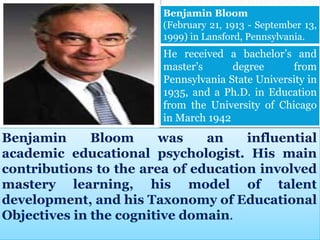
Benjamin Bloom was an influential
academic educational psychologist. His main
contributions to the area of education involved
mastery learning, his model of talent
development, and his Taxonomy of Educational
Objectives in the cognitive domain.
Benjamin Bloom
(February 21, 1913 - September 13,
1999) in Lansford, Pennsylvania.
He received a bachelor’s and
master’s degree from
Pennsylvania State University in
1935, and a Ph.D. in Education
from the University of Chicago
in March 1942
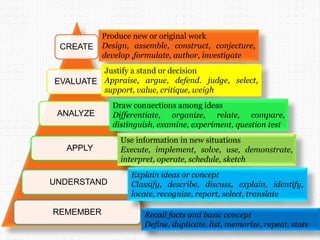
CREATE
EVALUATE
ANALYZE
APPLY
UNDERSTAND
REMEMBER
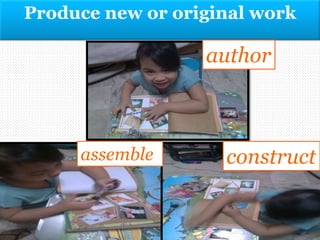
Produce new or original work
Design, assemble, construct, conjecture,
develop ,formulate, author, investigate
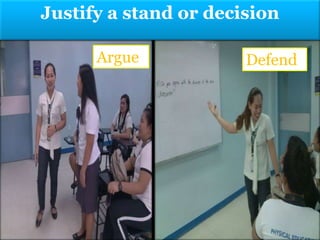
Justify a stand or decision
Appraise, argue, defend. judge, select,
support, value, critique, weigh
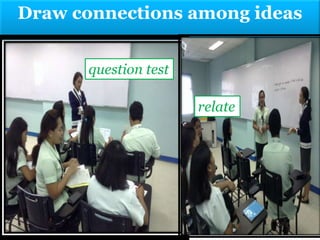
Draw connections among ideas
Differentiate, organize, relate, compare,
distinguish, examine, experiment, question test
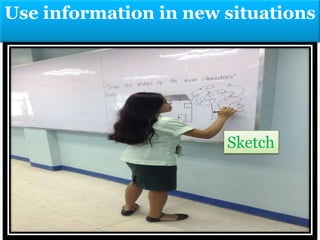
Use information in new situations
Execute, implement, solve, use, demonstrate,
interpret, operate, schedule, sketch
Explain ideas or concept
Classify, describe, discuss, explain, identify,
locate, recognize, report, select, translate
Recall facts and basic concept
Define, duplicate, list, memorize, repeat, state
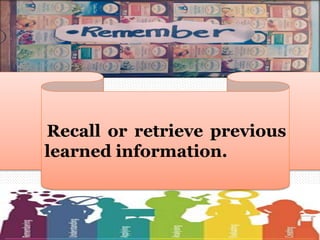
Recall or retrieve previous
learned information.
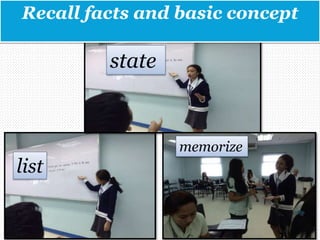
Recall facts and basic concept
state
memorize
list
Comprehending the meaning,
translation, interpolation, and
interpretation of instructions
and problems. State a problem
in one's own words.
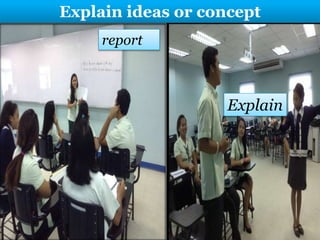
Explain ideas or concept
report
Explain
Use a concept in a new situation or
unprompted use of an abstraction.
Applies what was learned in the
classroom into novel situations in
the work place.
Use information in new situations
Sketch
Separates material or concepts into
component parts so that its
organizational structure may be
understood. Distinguishes between
facts and inferences.
Draw connections among ideas
question test
relate
Make judgments about the value
of ideas or materials.
Justify a stand or decision
Argue Defend
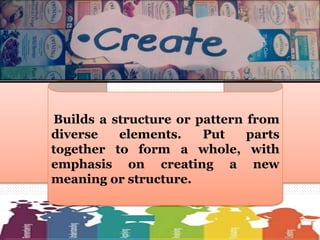
Builds a structure or pattern from
diverse elements. Put parts
together to form a whole, with
emphasis on creating a new
meaning or structure.
Produce new or original work
author
assemble construct
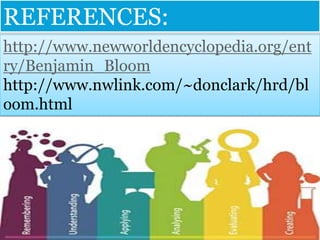
http://www.newworldencyclopedia.org/ent
ry/Benjamin_Bloom
http://www.nwlink.com/~donclark/hrd/bl
oom.html
REFERENCES:
“ A teachers takes a Hand opens a Mind
and touches a Heart”
RUBY
JOEVELYNYENDI
NICO
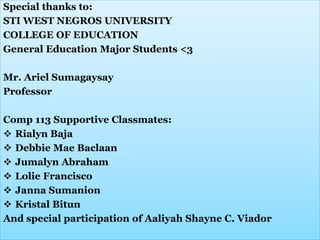
Special thanks to:
STI WEST NEGROS UNIVERSITY
COLLEGE OF EDUCATION
General Education Major Students <3
Mr. Ariel Sumagaysay
Professor
Comp 113 Supportive Classmates:
 Rialyn Baja
 Debbie Mae Baclaan
 Jumalyn Abraham
 Lolie Francisco
 Janna Sumanion
 Kristal Bitun
And special participation of Aaliyah Shayne C. Viador
THANK YOU
AND
MABUHAY!!!

BLOOMS TAXONOMY

  • 1.
    COLLEGE OF EDUCATION Preparedby: Ruby Mae O. Viador Nico P. Garigade Yendi Romo Joevelyn Mahilum Submitted to: Mr. Ariel T. Sumagaysay
  • 3.
    BLOOMS TAXONOMY is aclassification system use to define and distinguish different levels of human cognition.
  • 4.
    Benjamin Bloom wasan influential academic educational psychologist. His main contributions to the area of education involved mastery learning, his model of talent development, and his Taxonomy of Educational Objectives in the cognitive domain. Benjamin Bloom (February 21, 1913 - September 13, 1999) in Lansford, Pennsylvania. He received a bachelor’s and master’s degree from Pennsylvania State University in 1935, and a Ph.D. in Education from the University of Chicago in March 1942
  • 7.
    CREATE EVALUATE ANALYZE APPLY UNDERSTAND REMEMBER Produce new ororiginal work Design, assemble, construct, conjecture, develop ,formulate, author, investigate Justify a stand or decision Appraise, argue, defend. judge, select, support, value, critique, weigh Draw connections among ideas Differentiate, organize, relate, compare, distinguish, examine, experiment, question test Use information in new situations Execute, implement, solve, use, demonstrate, interpret, operate, schedule, sketch Explain ideas or concept Classify, describe, discuss, explain, identify, locate, recognize, report, select, translate Recall facts and basic concept Define, duplicate, list, memorize, repeat, state
  • 8.
    Recall or retrieveprevious learned information.
  • 9.
    Recall facts andbasic concept state memorize list
  • 10.
    Comprehending the meaning, translation,interpolation, and interpretation of instructions and problems. State a problem in one's own words.
  • 11.
    Explain ideas orconcept report Explain
  • 12.
    Use a conceptin a new situation or unprompted use of an abstraction. Applies what was learned in the classroom into novel situations in the work place.
  • 13.
    Use information innew situations Sketch
  • 14.
    Separates material orconcepts into component parts so that its organizational structure may be understood. Distinguishes between facts and inferences.
  • 15.
    Draw connections amongideas question test relate
  • 16.
    Make judgments aboutthe value of ideas or materials.
  • 17.
    Justify a standor decision Argue Defend
  • 18.
    Builds a structureor pattern from diverse elements. Put parts together to form a whole, with emphasis on creating a new meaning or structure.
  • 19.
    Produce new ororiginal work author assemble construct
  • 20.
  • 21.
    “ A teacherstakes a Hand opens a Mind and touches a Heart” RUBY JOEVELYNYENDI NICO
  • 22.
    Special thanks to: STIWEST NEGROS UNIVERSITY COLLEGE OF EDUCATION General Education Major Students <3 Mr. Ariel Sumagaysay Professor Comp 113 Supportive Classmates:  Rialyn Baja  Debbie Mae Baclaan  Jumalyn Abraham  Lolie Francisco  Janna Sumanion  Kristal Bitun And special participation of Aaliyah Shayne C. Viador
  • 23.