Labeling exercise micturition reflex
• http://highered.mheducation.com/sites/007250
7470/student_view0/chapter26/labeling_exerci
ses.html#
• http://highered.mheducation.com/sites/007250
7470/student_view0/chapter26/labeling_exerci
ses.html#
http://highered.mheducation.com/sites/0072507470/student_view0/chapter26/animatio
n__micturition_reflex.html
S Naghma Rizvi
June, 2015
Acknowledgement Muhammad Nisar
*
Objectives
At the end of this session students will be able to:
 Define the Urinary System.
 List the organs of Urinary system
 Understand the functions of the urinary system
 Explain how kidney contributes to homeostasis
 Describe the location of the kidney.
 Describe the :
 gross structure of kidney
 microscopic structure of kidney.
Objectives
 Discuss the role of each component of nephron in
terms of :
 Filtration
 selective reabsorption &
 secretion involved in the formation of urine.
 Briefly discuss the role of kidney in maintaining
water and electrolyte balance.
 Discuss the structure and functions of
 Ureters
 Urinary bladder
 Urthera
 Briefly the process of micturition
Urinary System
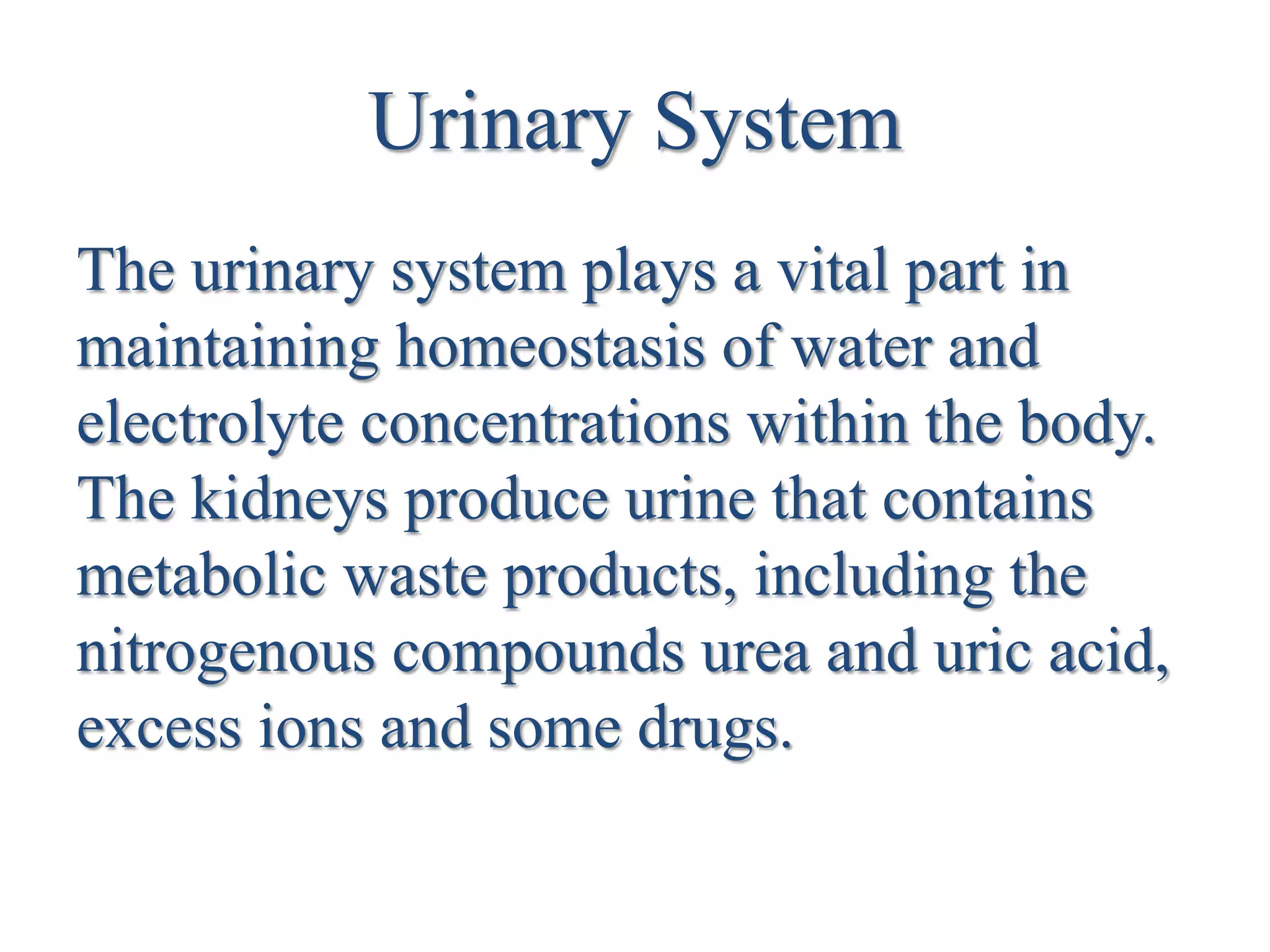
The urinary system plays a vital part in
maintaining homeostasis of water and
electrolyte concentrations within the body.
The kidneys produce urine that contains
metabolic waste products, including the
nitrogenous compounds urea and uric acid,
excess ions and some drugs.
Urinary system VDO
Organs of Urinary System
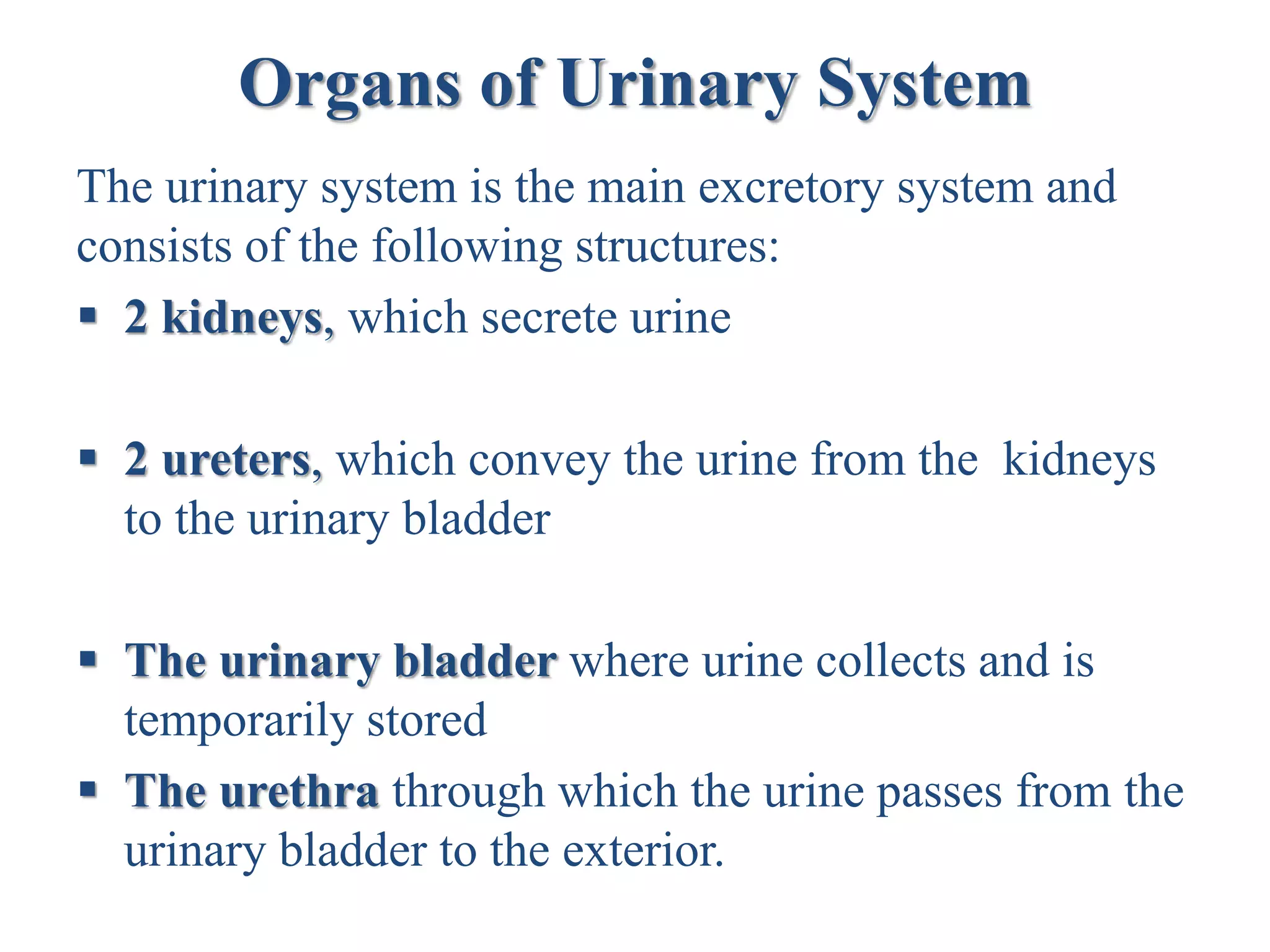
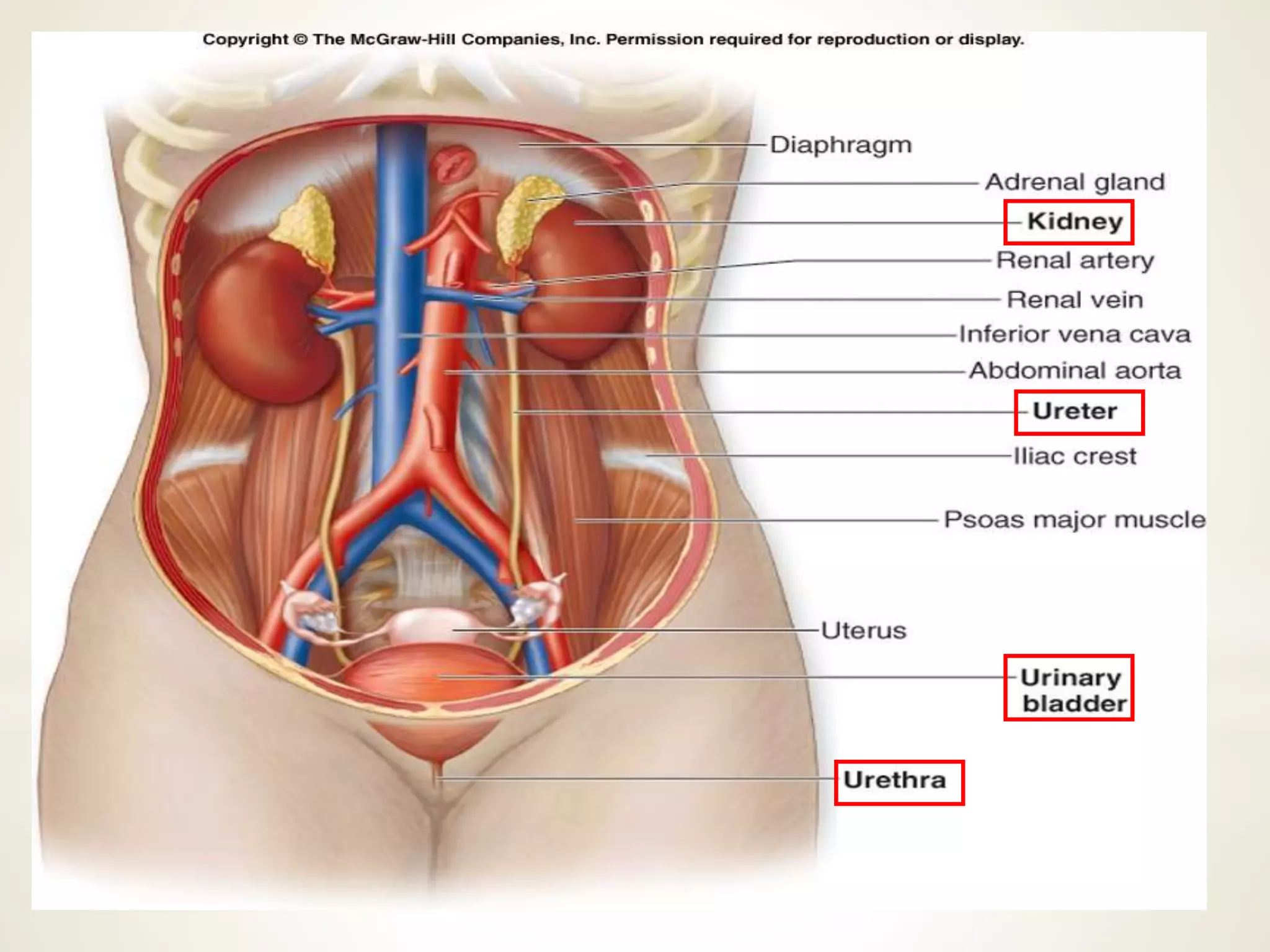
The urinary system is the main excretory system and
consists of the following structures:
 2 kidneys, which secrete urine
 2 ureters, which convey the urine from the kidneys
to the urinary bladder
 The urinary bladder where urine collects and is
temporarily stored
 The urethra through which the urine passes from the
urinary bladder to the exterior.
Functions of Urinary System (FRS)
1. Filtration of the blood by removing toxins or
waste.
2. Reabsorption of vital nutrients, ions and
water by conserving important materials
3. Secretion of excess materials by preventing a
build-up of certain materials in the body such
as drugs, waste, etc.
Functions…
 Activation of Vitamin D
Active Vitamin D (D3) assists homeostasis by increasing
calcium absorption from the digestive tract
 Release of Erythropoietin by the kidney
New RBCs assist homeostasis by ensuring adequate
Oxygen and Carbon Dioxide transport
 Release of Renin by the kidney
• Renin stimulates the formation of a powerful
vasoconstrictor called Angiotensin II
• Angiotensin II assists homeostasis by causing
vasoconstriction which increases blood pressure
 Secretion of H (+1) and reabsorption of HCO3
(-1)
Eliminates excess hydrogen ions and conserves
buffer material such as bicarbonate hence controlling
acid/base conditions in body fluids
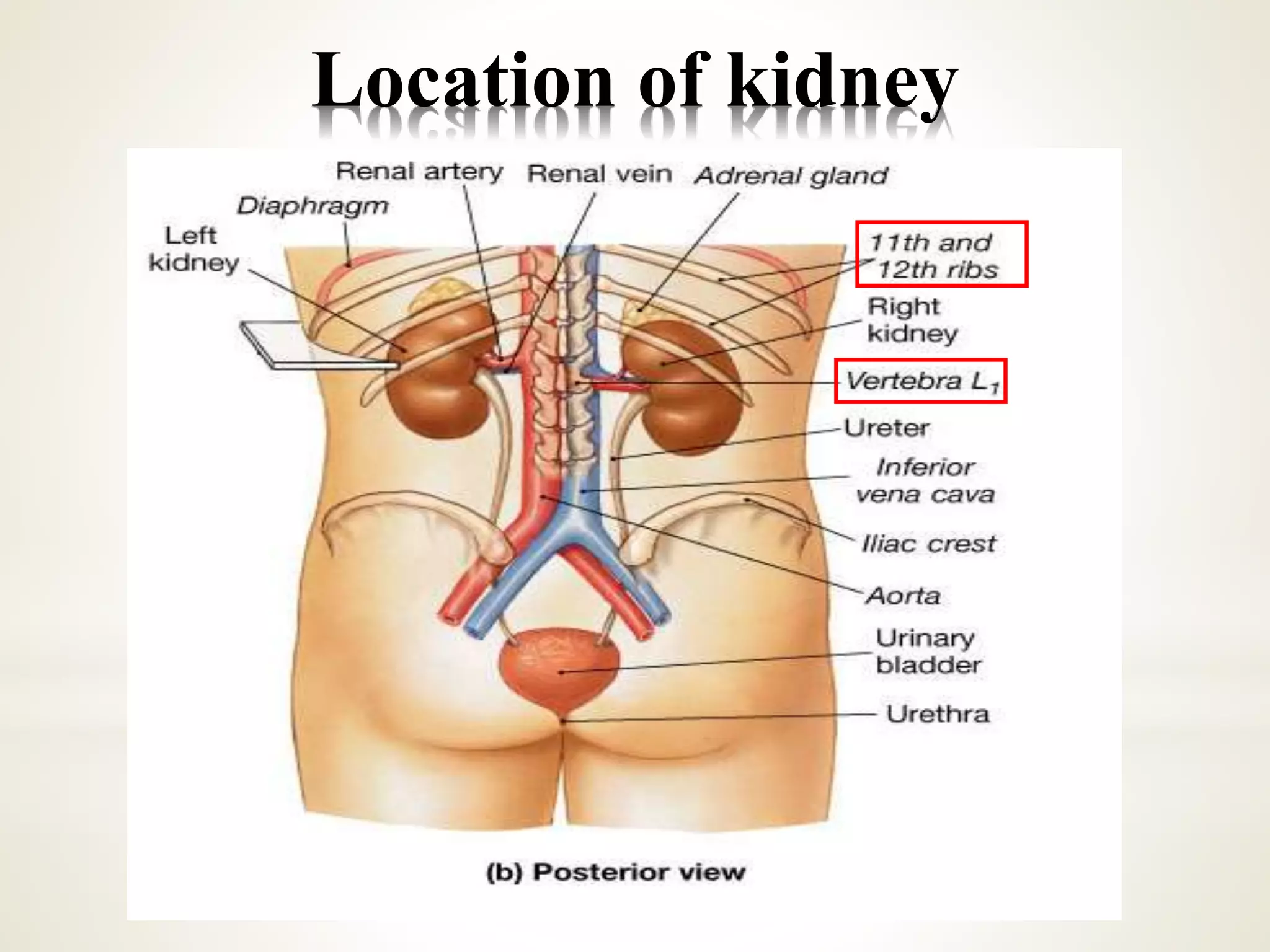
Location of kidney
Location of Kidney
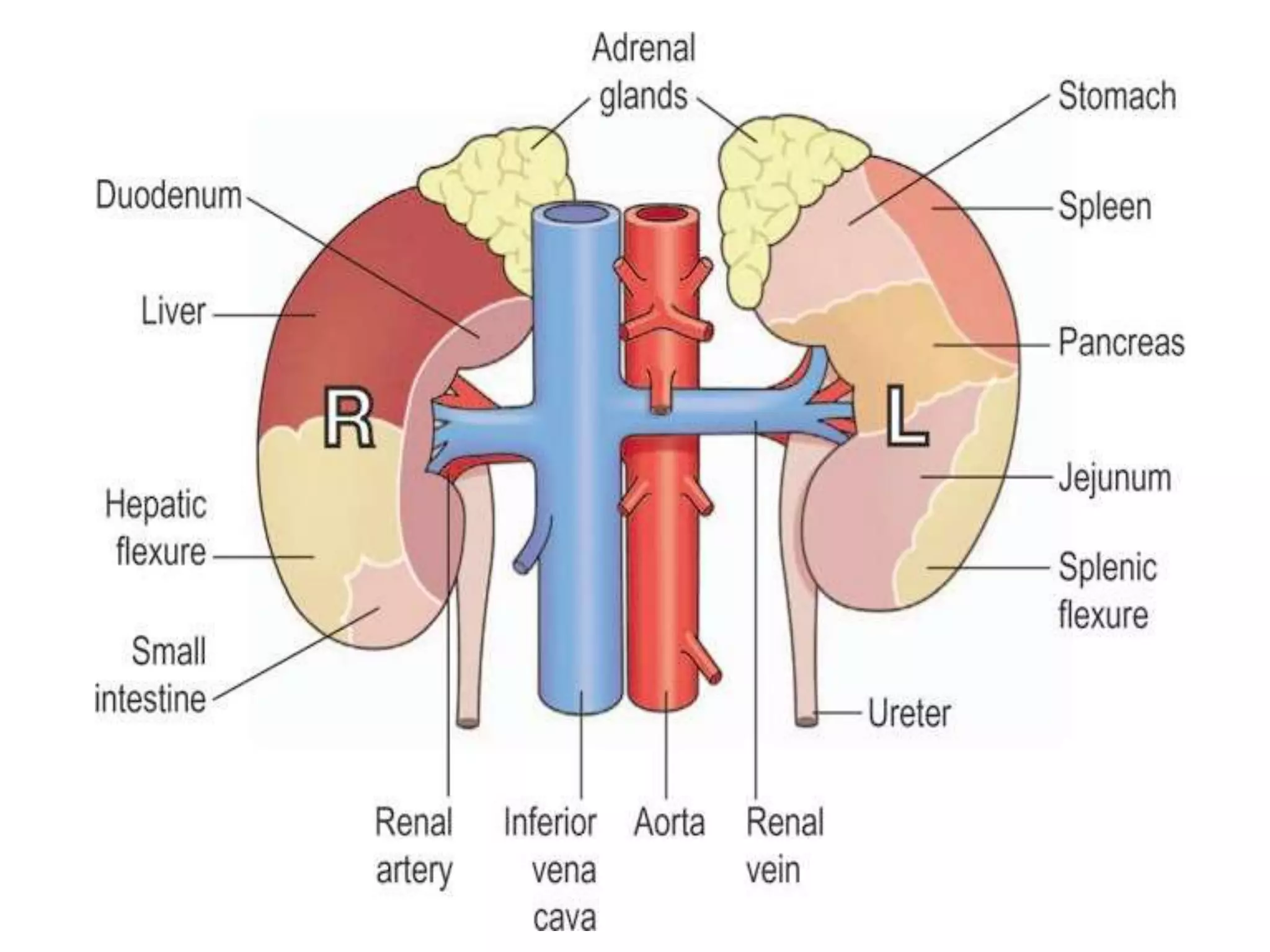
• Kidney lie on the posterior abdominal wall one on each
side of the vertebral column behind the peritoneum and
below the diaphragm.
• They extend from the level of 12th thoracic vertebrae to
the third lumber vertebrae receiving some protection
from lower rib cage
• Right kidney is slightly lower then the left because of
considerable space occupied by the liver.
Structure of Kidney
 Bean shaped organ, weighs 150g
 Length 11cm Width 6cm Thickness 3cm
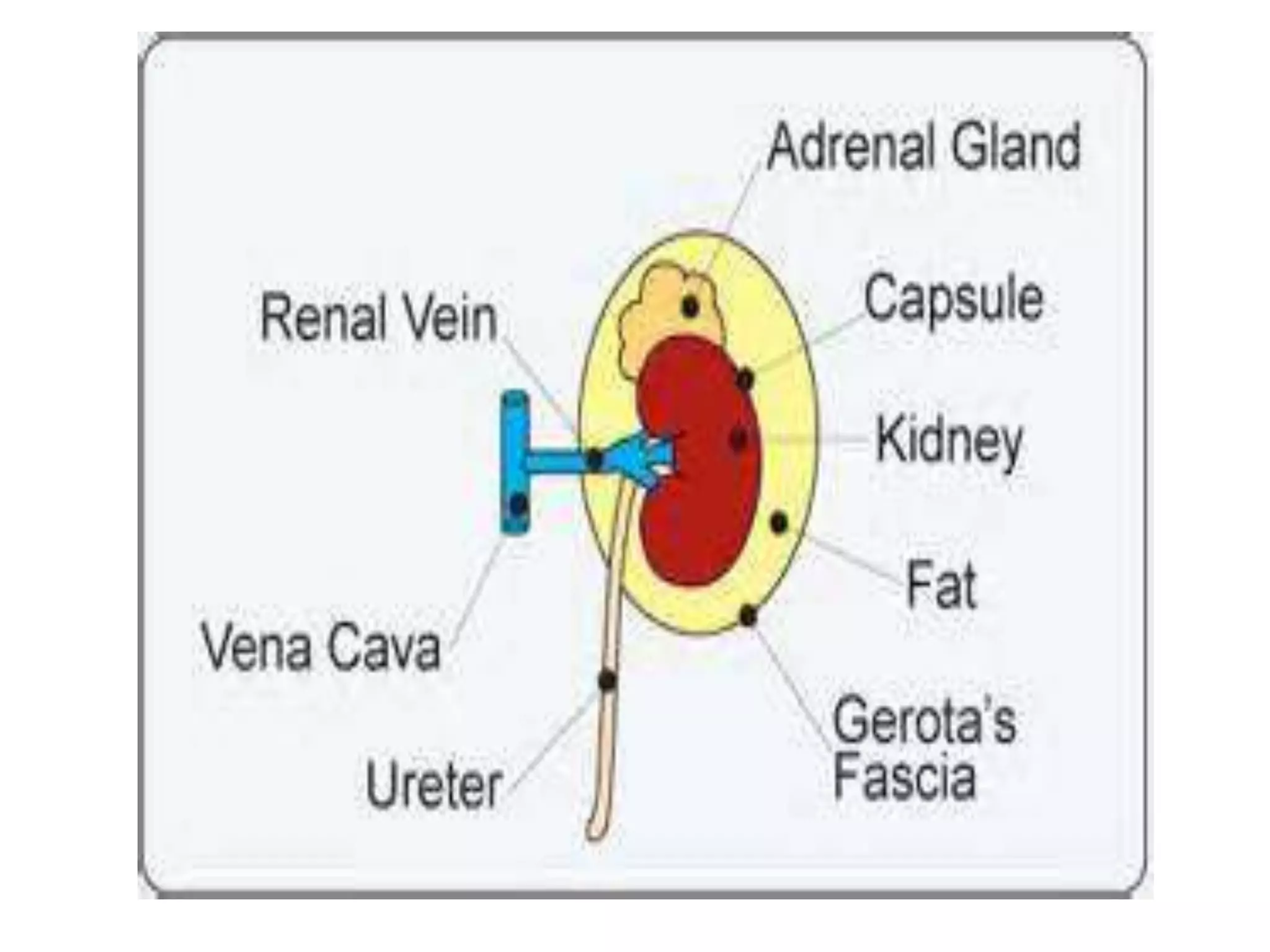
 Three layers of tissue surrounds each kidney
 Renal capsule (innermost)
 Adipose capsule
 Renal Fascia (outermost)
These layers protect, maintains shape, and anchors
kidney with the posterior abdominal wall
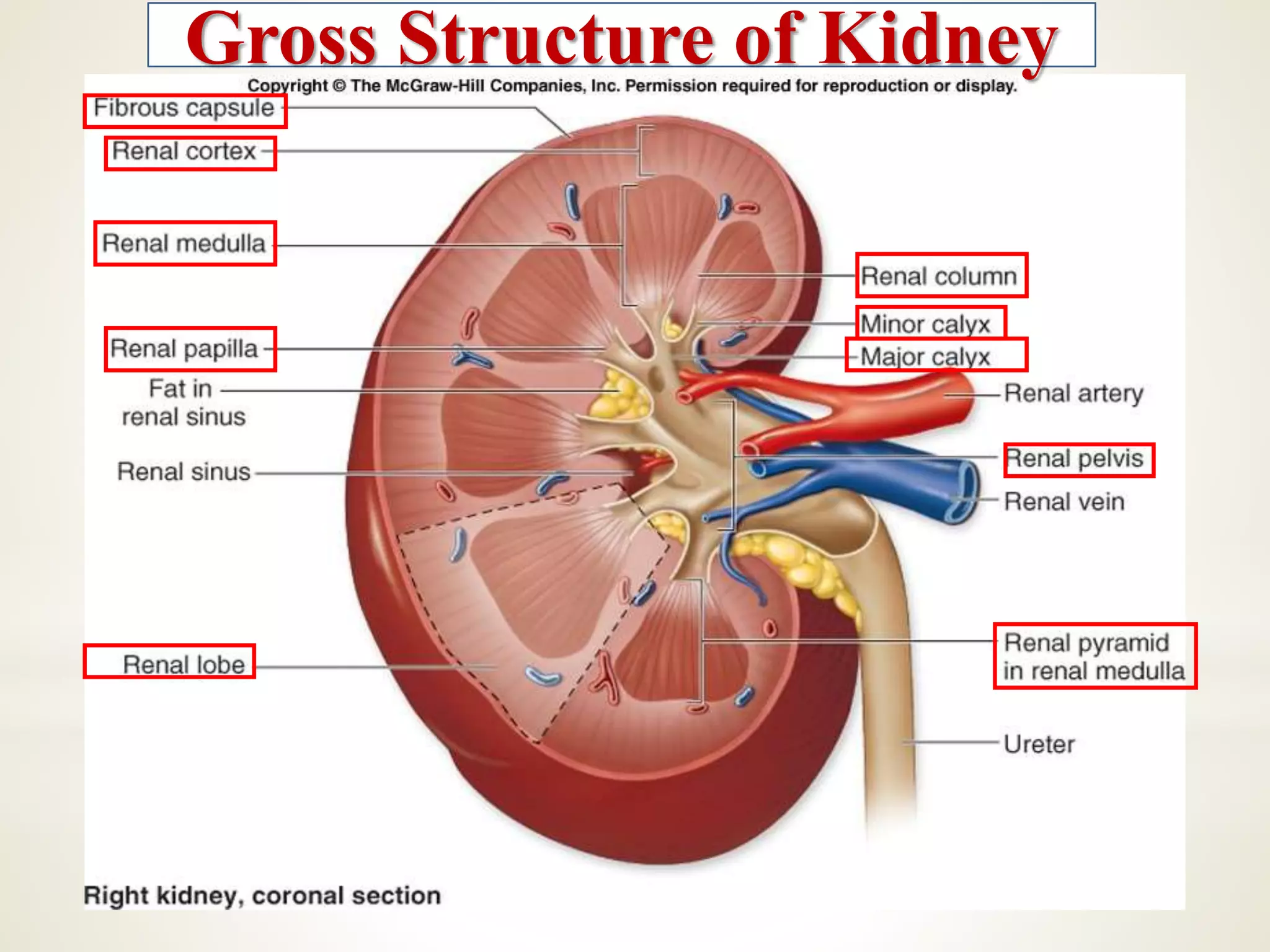
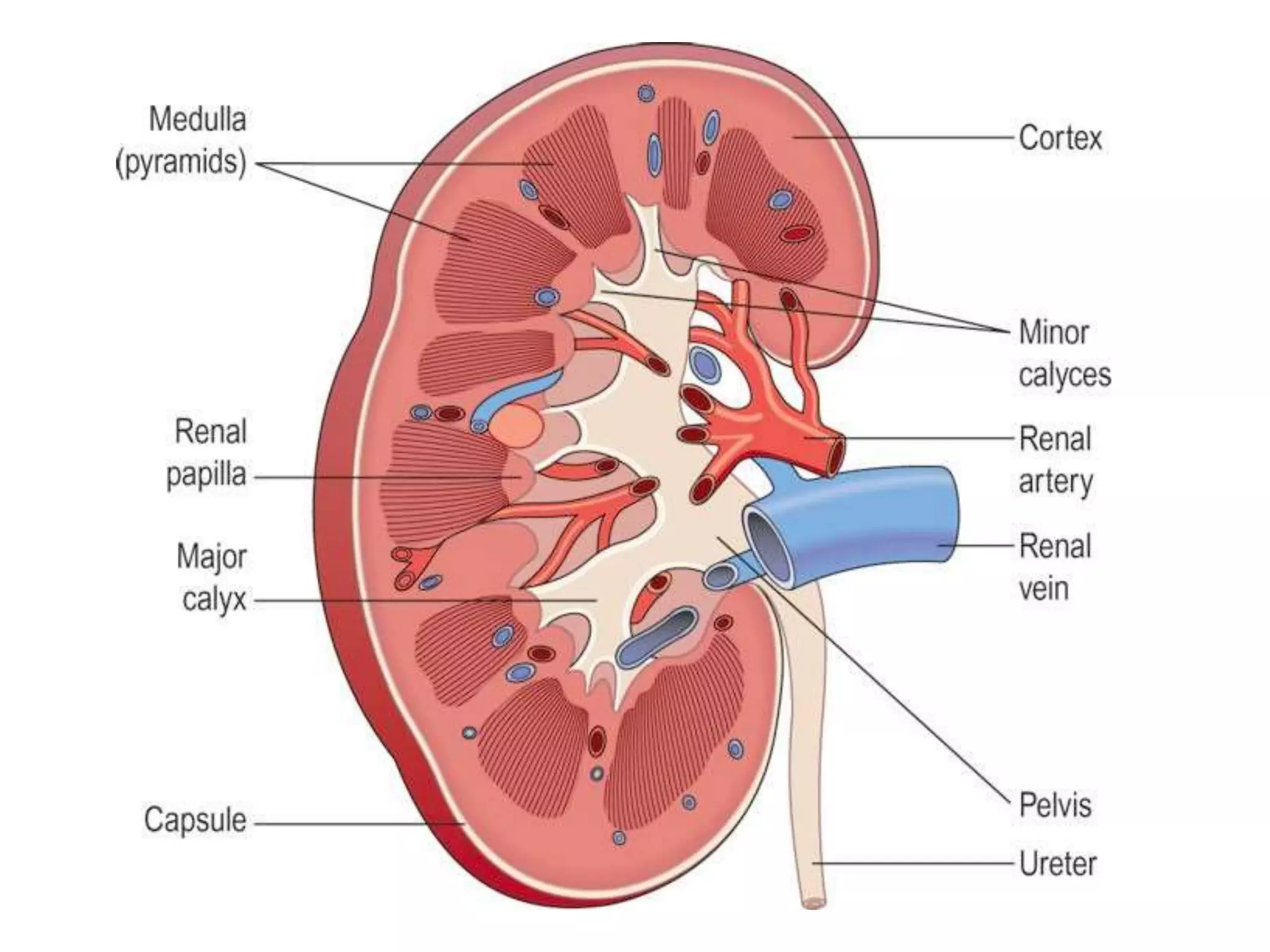
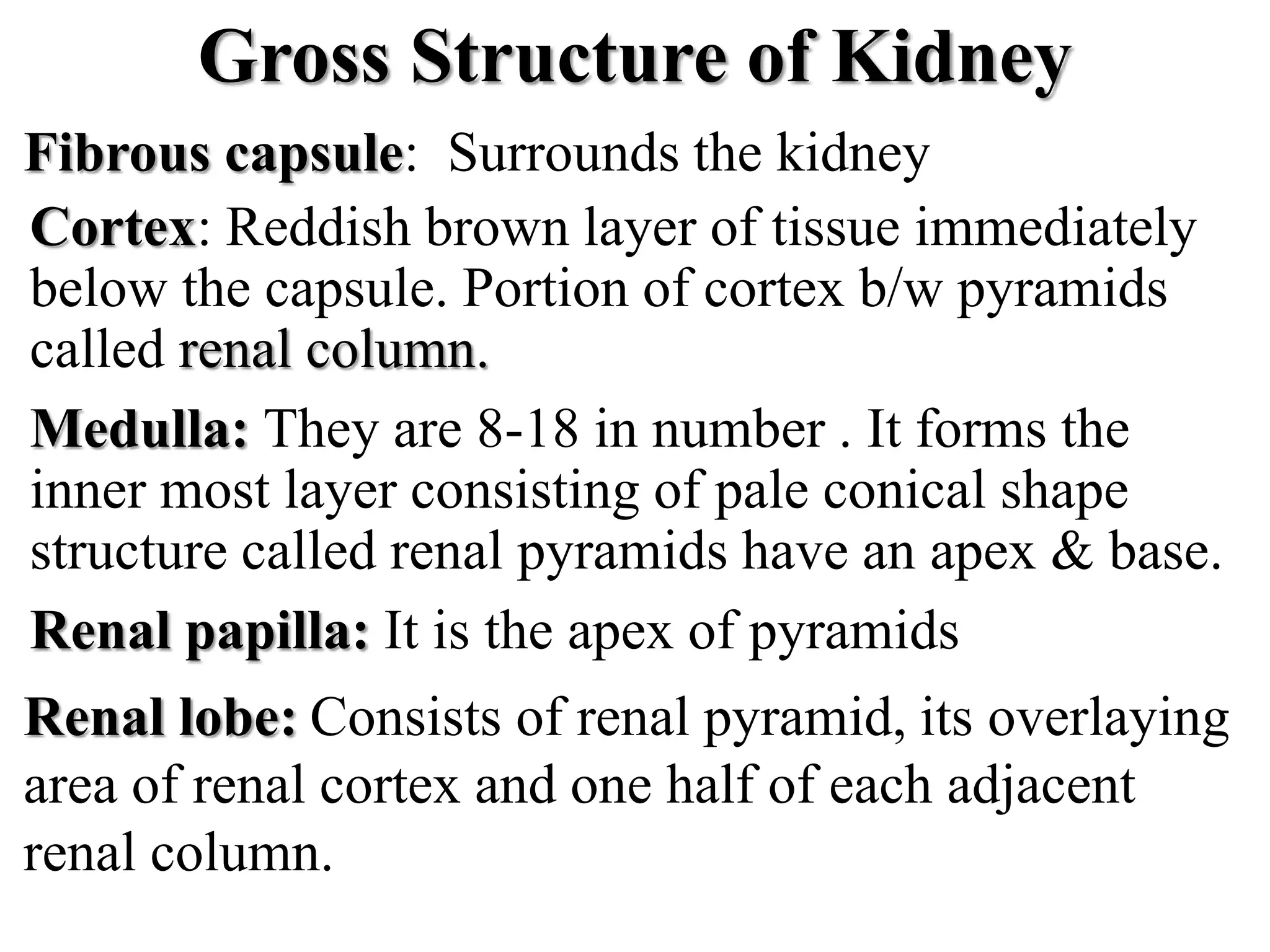
Gross Structure of Kidney
Fibrous capsule: Surrounds the kidney
Cortex: Reddish brown layer of tissue immediately
below the capsule. Portion of cortex b/w pyramids
called renal column.
Medulla: They are 8-18 in number . It forms the
inner most layer consisting of pale conical shape
structure called renal pyramids have an apex & base.
Renal papilla: It is the apex of pyramids
Renal lobe: Consists of renal pyramid, its overlaying
area of renal cortex and one half of each adjacent
renal column.
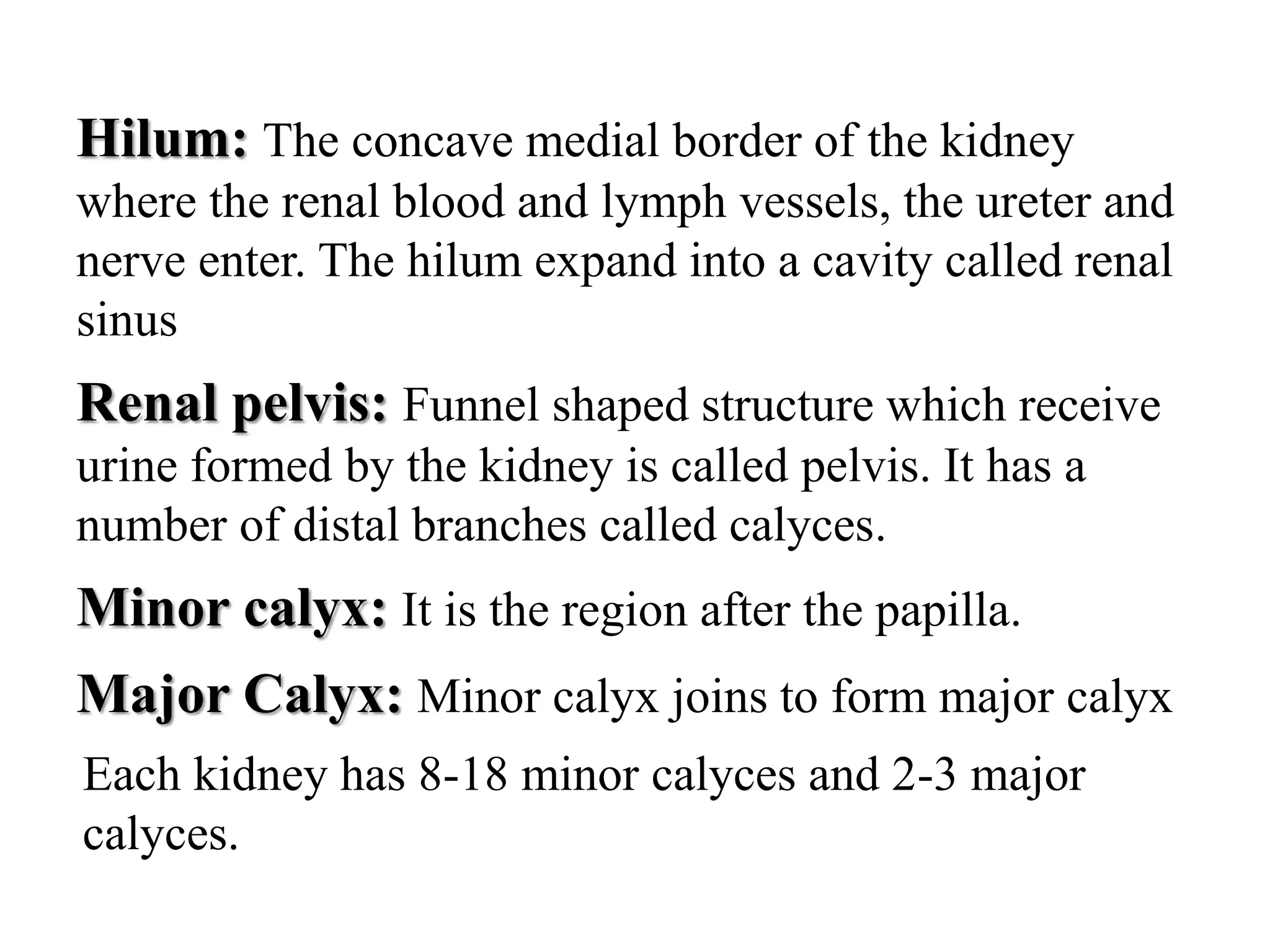
Hilum: The concave medial border of the kidney
where the renal blood and lymph vessels, the ureter and
nerve enter. The hilum expand into a cavity called renal
sinus
Renal pelvis: Funnel shaped structure which receive
urine formed by the kidney is called pelvis. It has a
number of distal branches called calyces.
Minor calyx: It is the region after the papilla.
Major Calyx: Minor calyx joins to form major calyx
Each kidney has 8-18 minor calyces and 2-3 major
calyces.
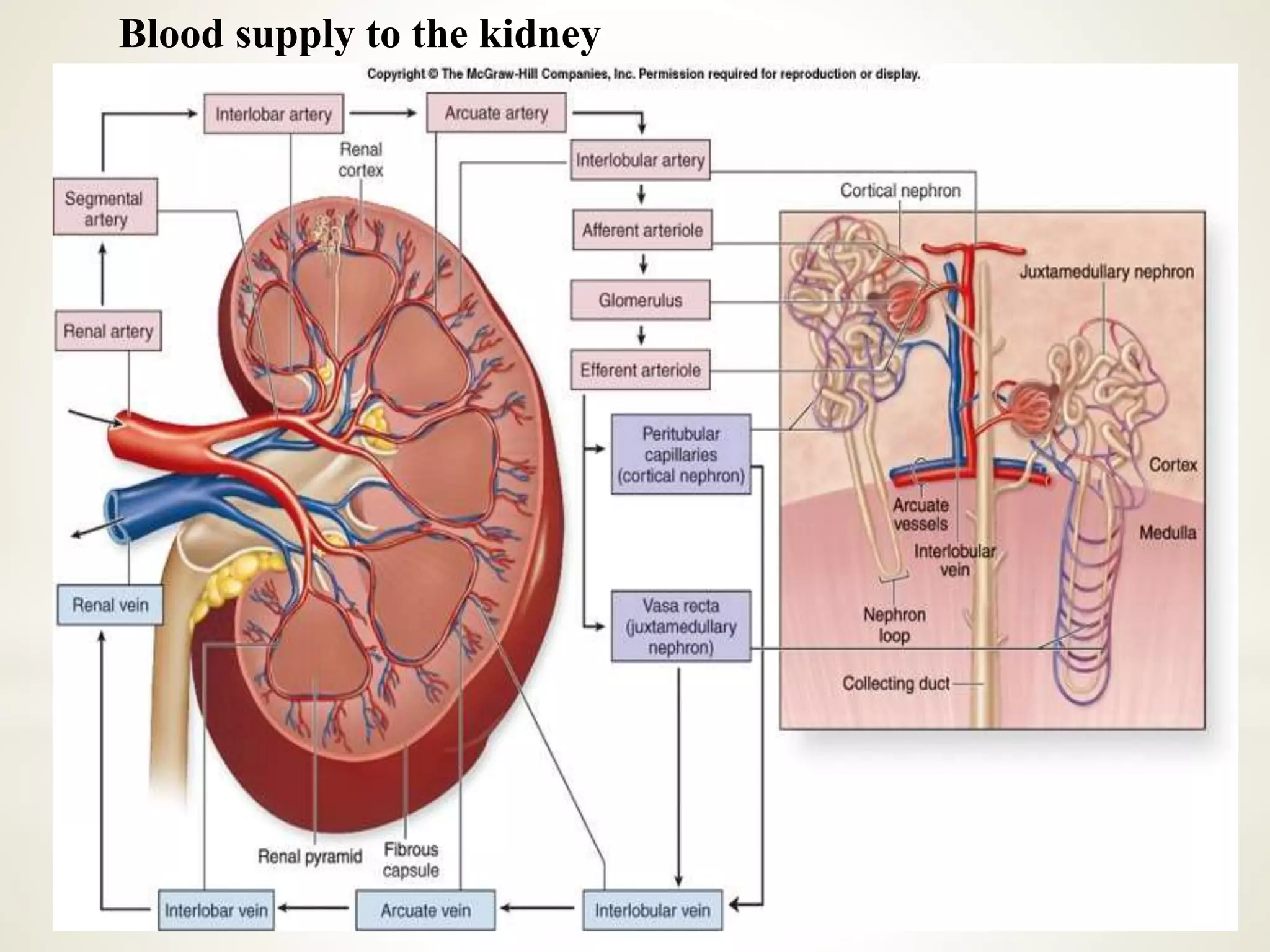
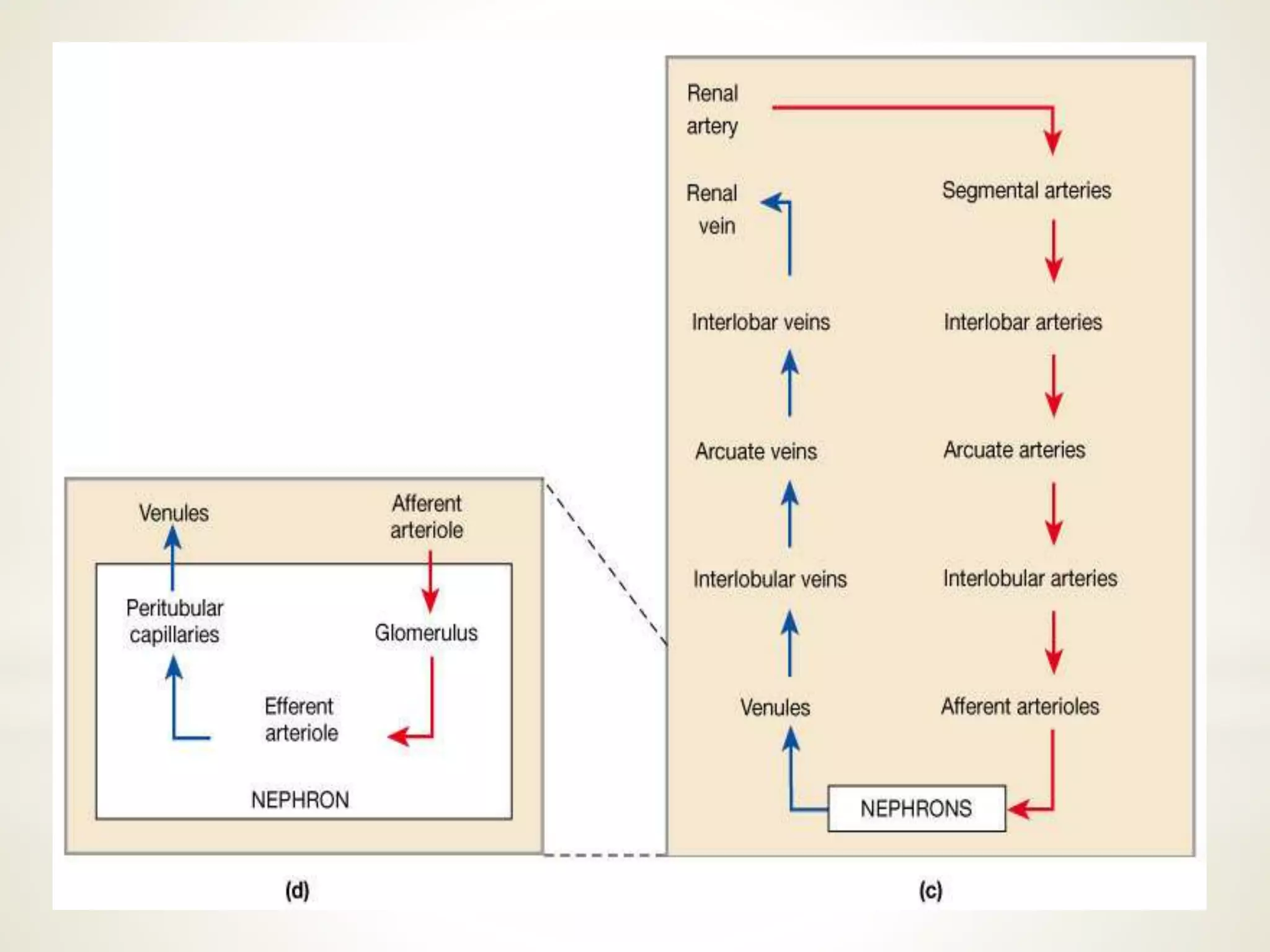
Blood supply to the kidney
• https://www.wisc-online.com/learn/natural-
science/life-science/ap2504/the-vascular-
system-of-the-kidneys
Microscopic structure of kidney
Each kidney is composed of about 1–2 million
functional units, the nephrons, and a smaller
number of collecting ducts.
Each nephron consists of:
1. Renal corpuscles (close end)
2. Renal tubules (open end)
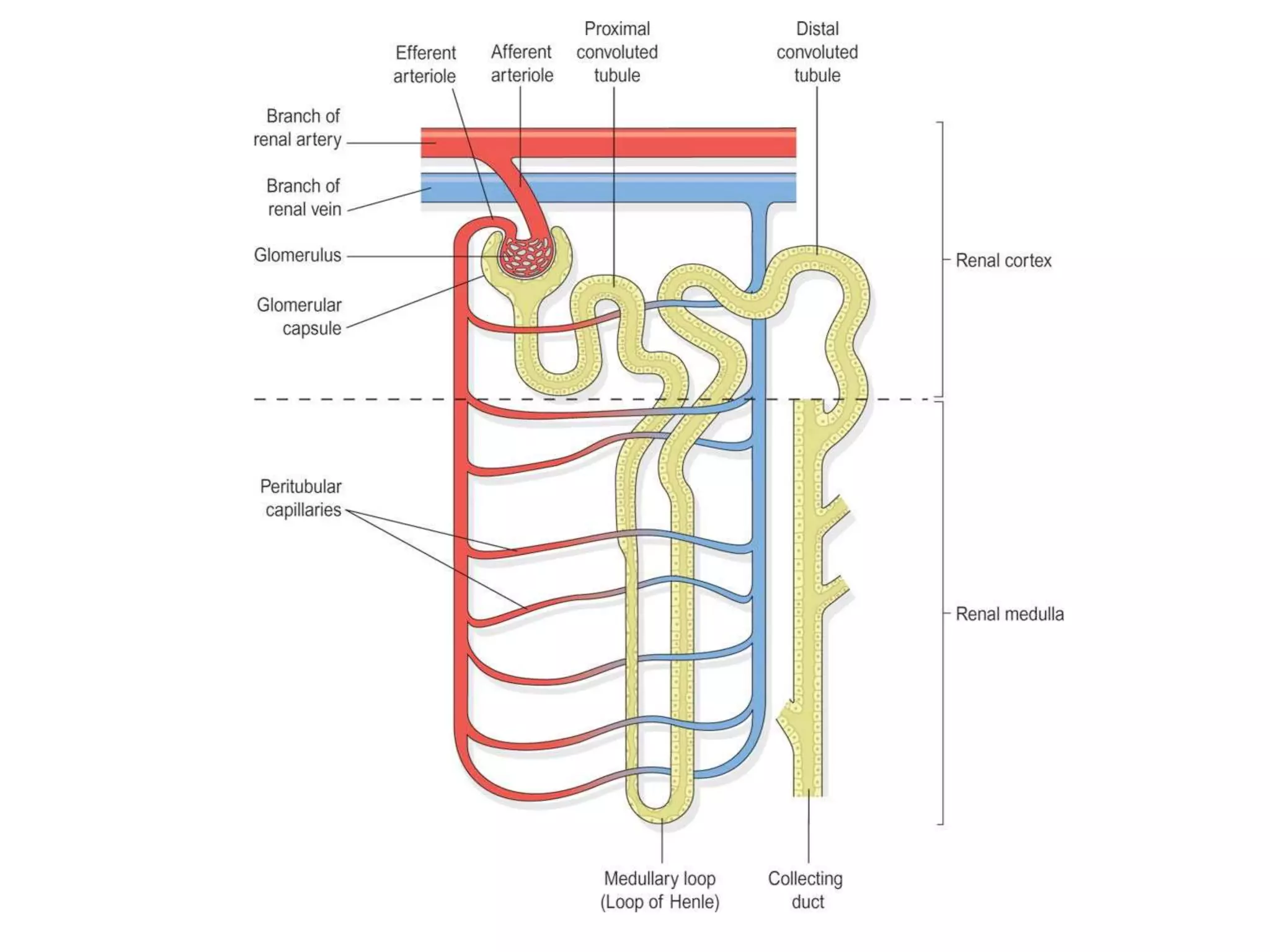
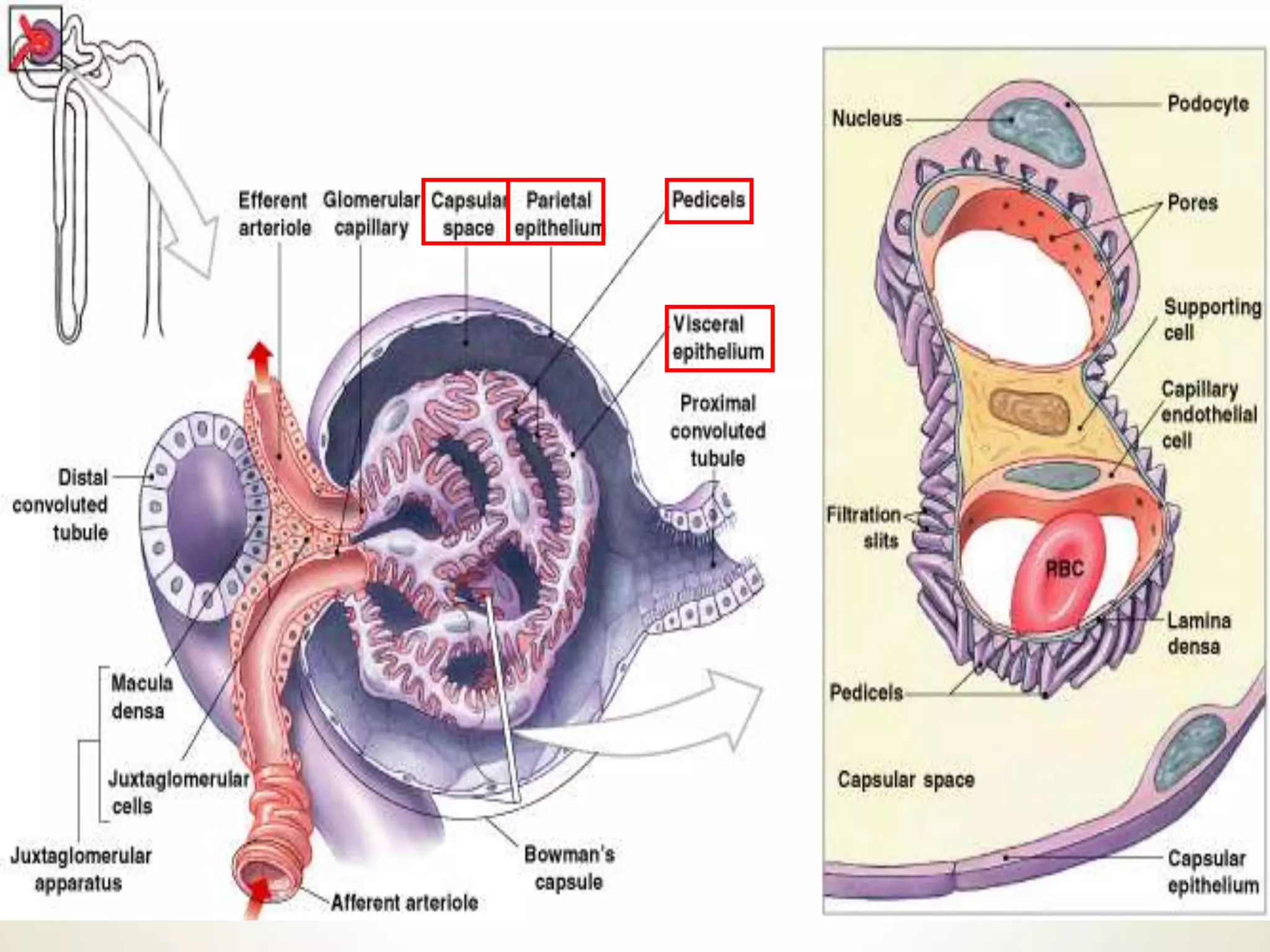
Renal Corpuscles
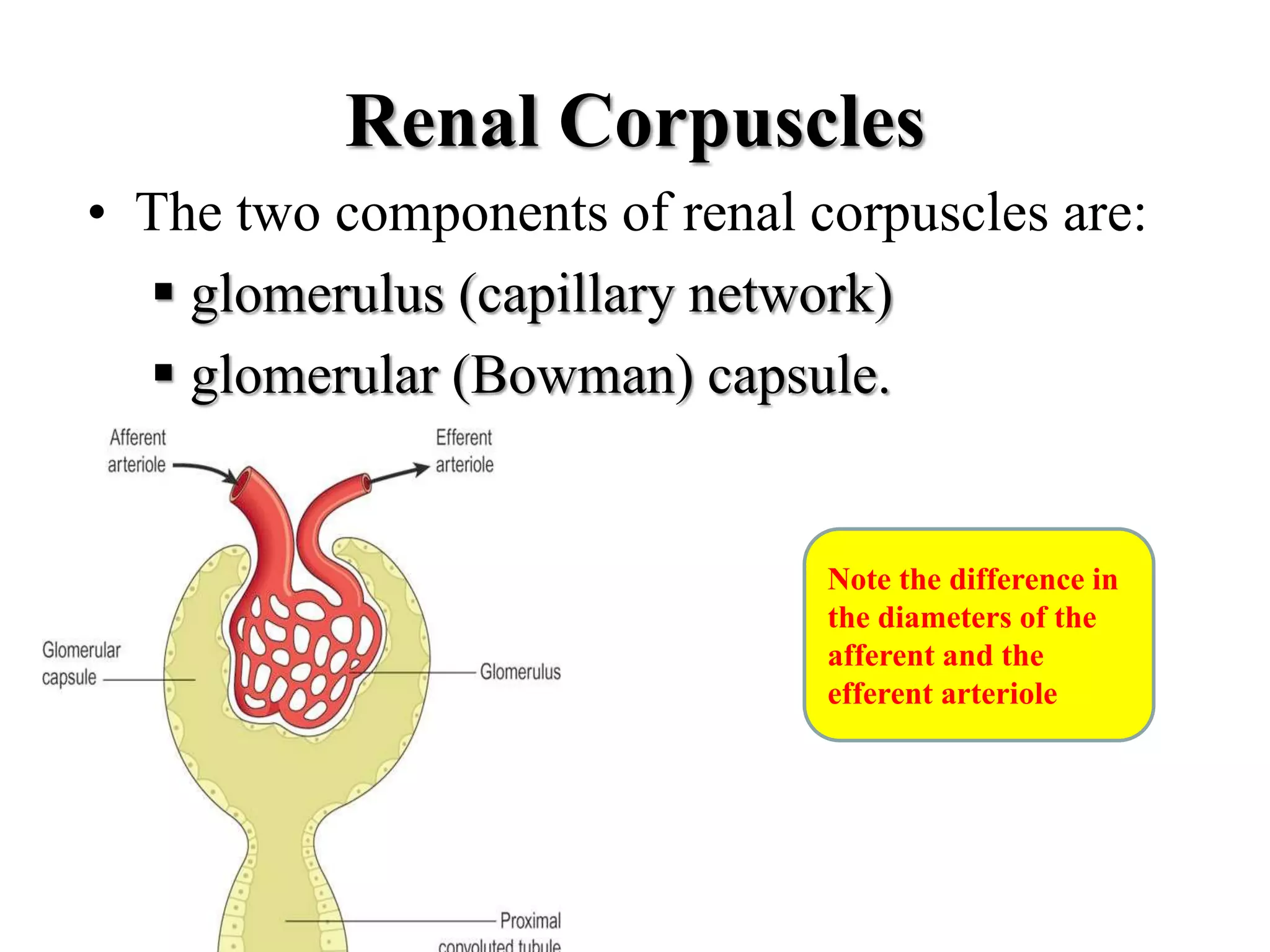
• The two components of renal corpuscles are:
 glomerulus (capillary network)
 glomerular (Bowman) capsule.
Note the difference in
the diameters of the
afferent and the
efferent arteriole
Renal Tubules
Renal tubule consists of the three parts:
Proximal convoluted tubule
It is attached to the glomerular capsule, it is tightly coiled
rather then straight
Loop of Henle
It the proximal and distal convoluted tubule. Its first part
called descending limb of LOH, dips into the renal medulla,
it then make turn and return to renal cortex as a ascending
limb of LOH
Distal convoluted tubule
This part away from glomerular capsule
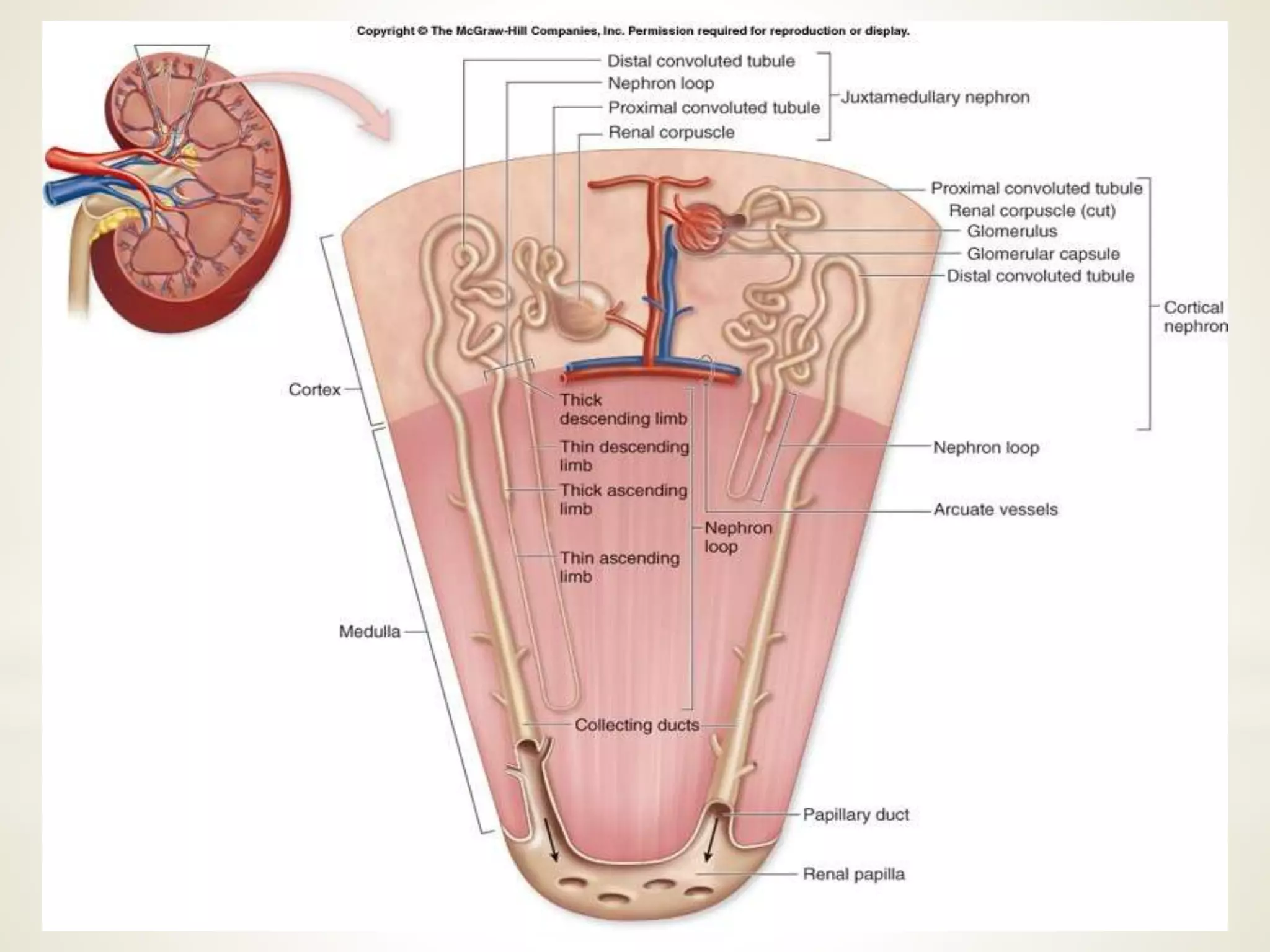
Cortical and Juxtamedullary Nephrons
Cortical nephron
They are 80-85%. Their renal corpuscle lie in the
cortex and they have short LOH that lie mainly
in the cortex and penetrate only in the outer
region of medulla
Juxtamedullary nephron:
They are 15-20%.The renal corpuscle of these
nephron lie deep in the cortex near medulla and
they have long LOH that extend into the deeper
region of the medulla.
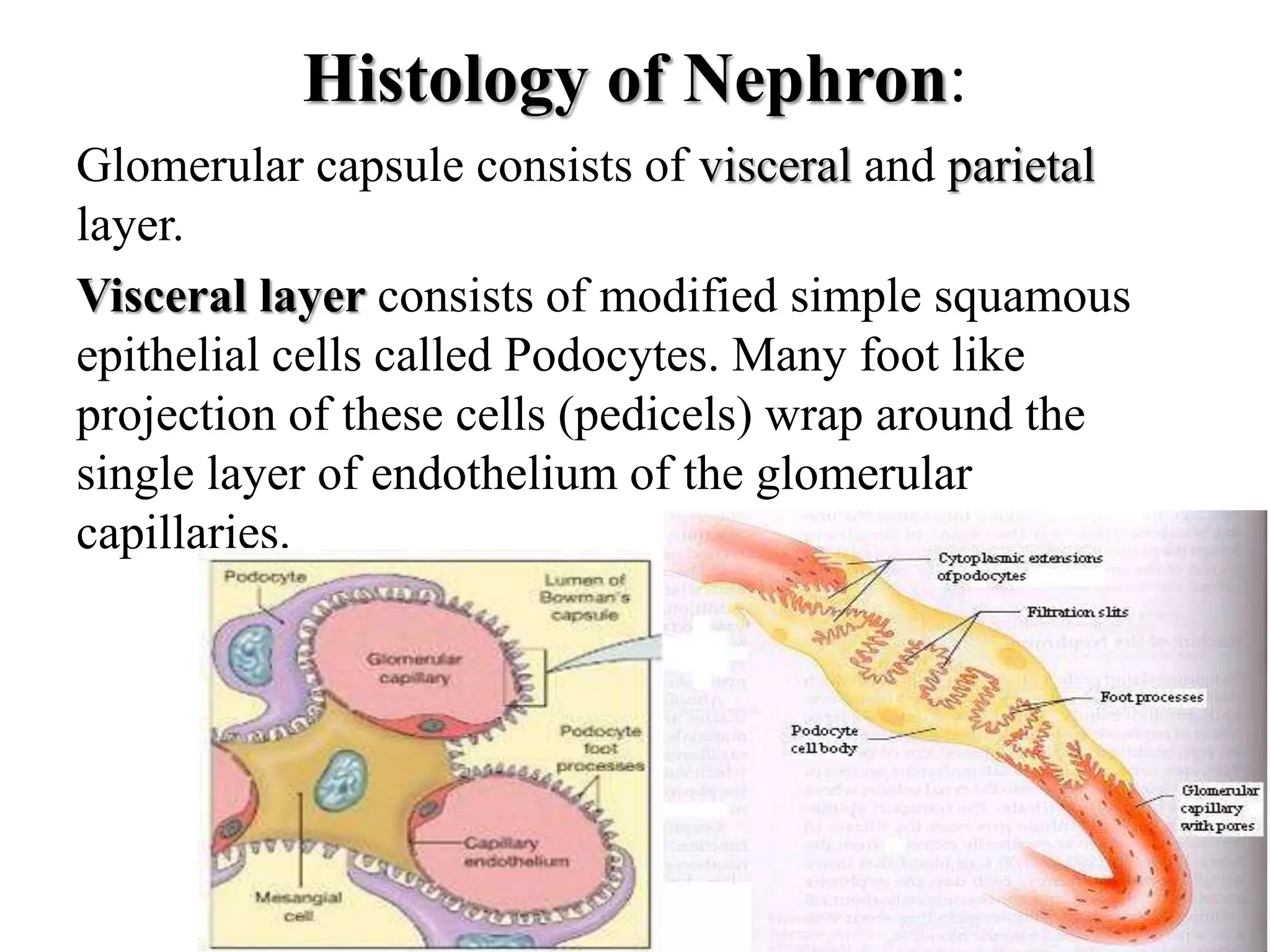
Histology of Nephron:
Glomerular capsule consists of visceral and parietal
layer.
Visceral layer consists of modified simple squamous
epithelial cells called Podocytes. Many foot like
projection of these cells (pedicels) wrap around the
single layer of endothelium of the glomerular
capillaries.
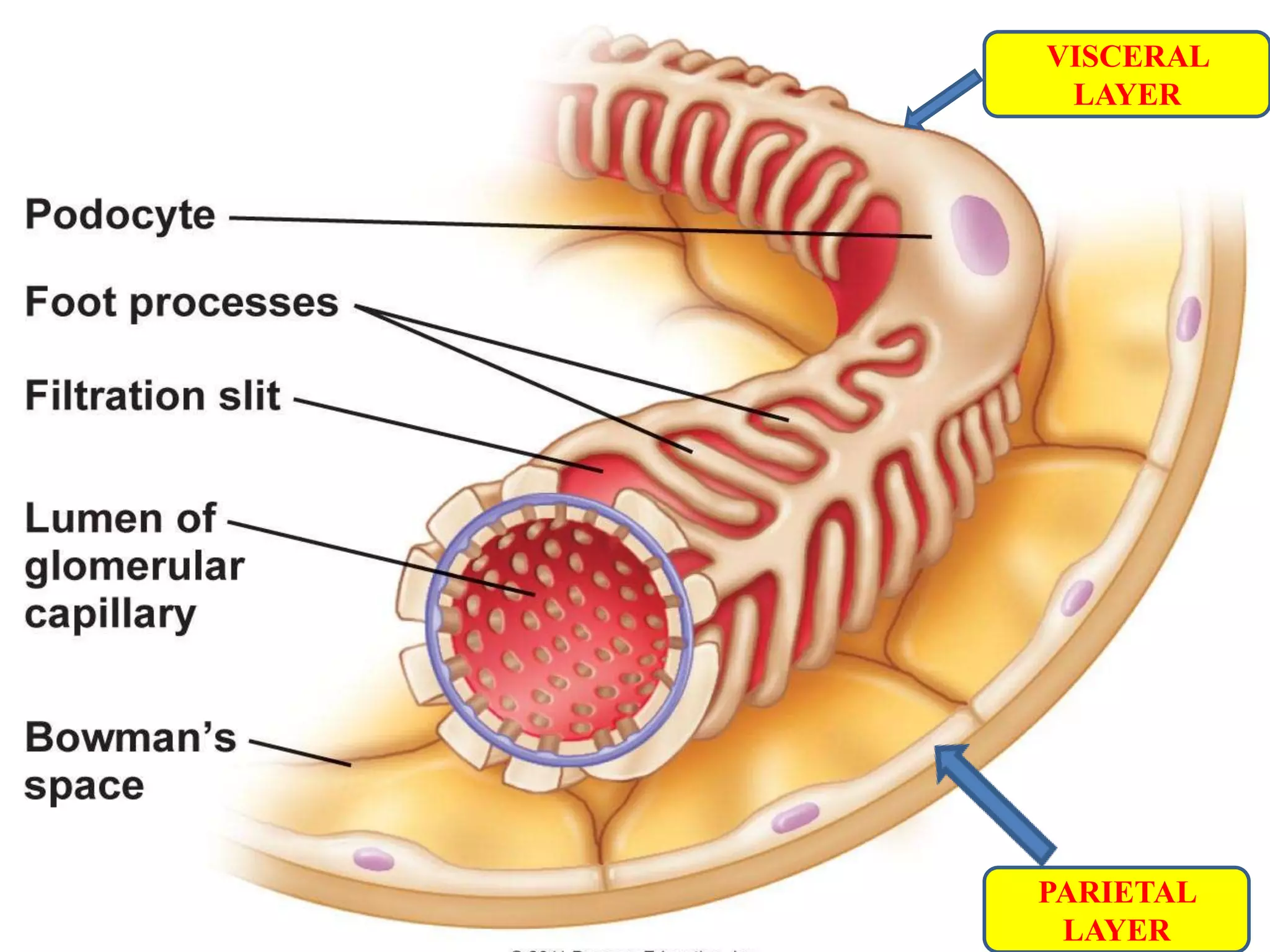
VISCERAL
LAYER
PARIETAL
LAYER
Parietal Layer
The parietal layer of glomerular capsule consists
of simple squamous epithelium and form the
outer wall of the capsule.
Fluid filter in the glomerular capillaries enter
into the capsular space and then to the renal
tubules.
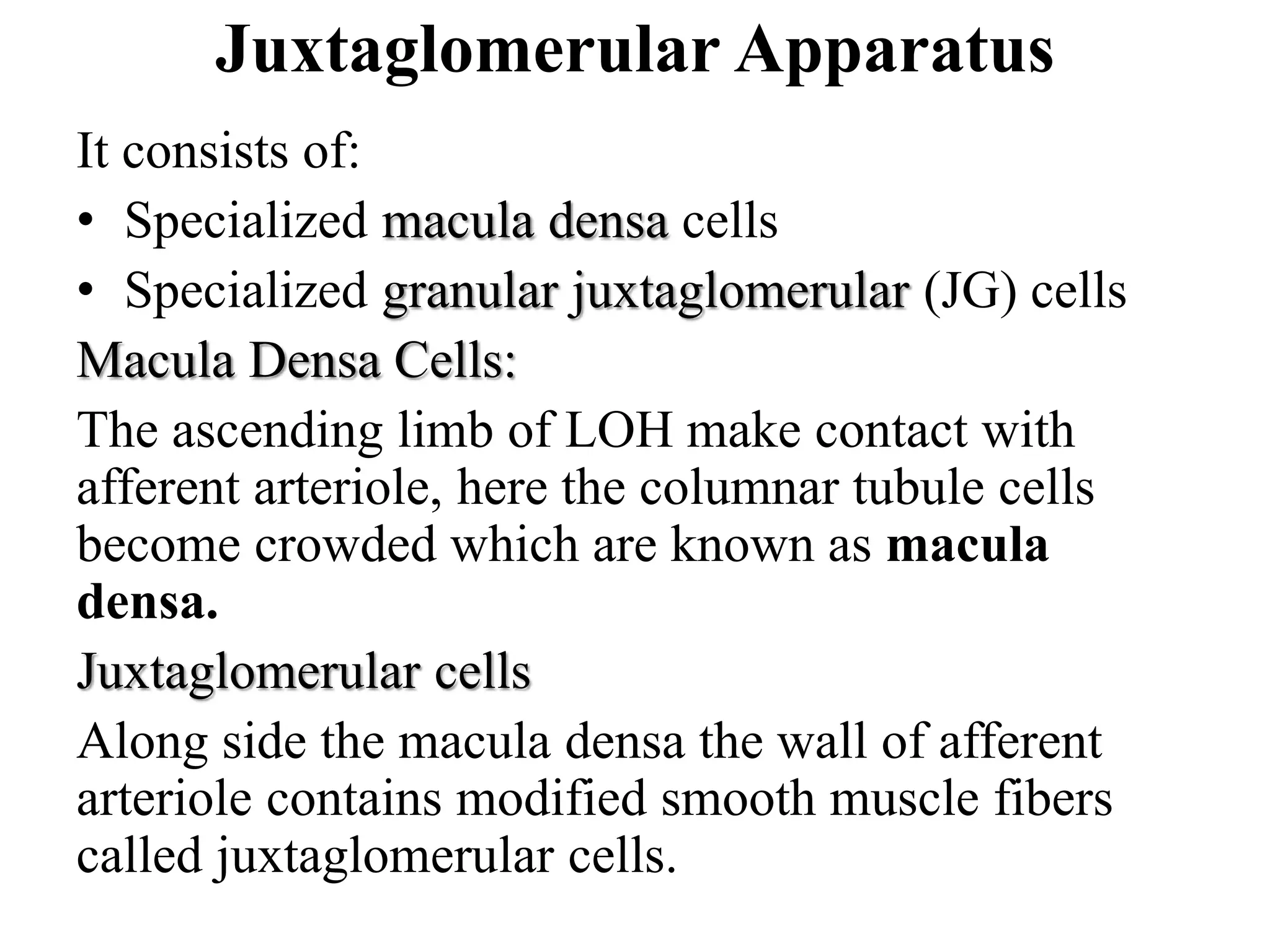
Juxtaglomerular Apparatus
It consists of:
• Specialized macula densa cells
• Specialized granular juxtaglomerular (JG) cells
Macula Densa Cells:
The ascending limb of LOH make contact with
afferent arteriole, here the columnar tubule cells
become crowded which are known as macula
densa.
Juxtaglomerular cells
Along side the macula densa the wall of afferent
arteriole contains modified smooth muscle fibers
called juxtaglomerular cells.
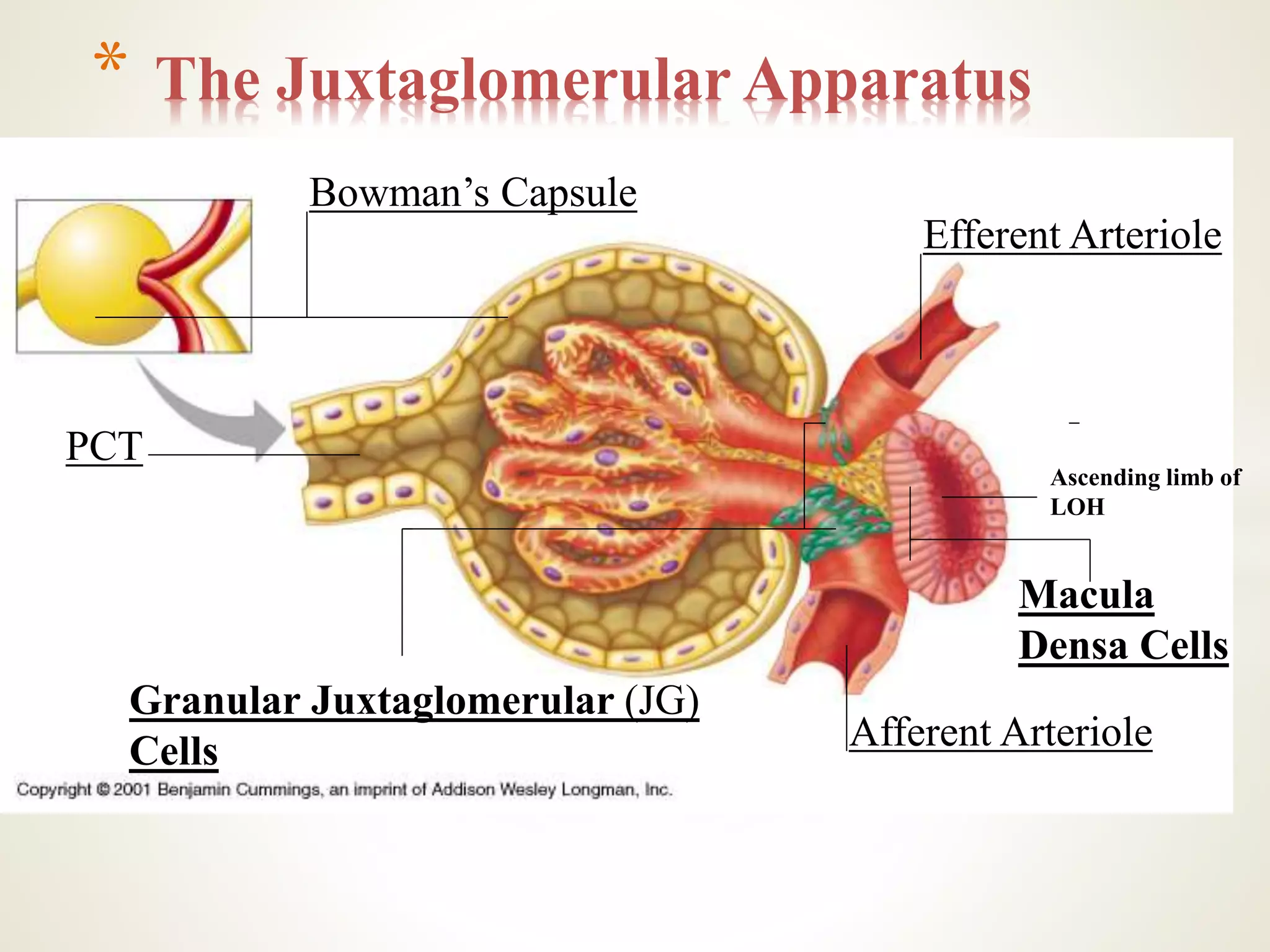
* The Juxtaglomerular Apparatus
Afferent Arteriole
Efferent Arteriole
Ascending limb of
LOH
Macula
Densa Cells
Granular Juxtaglomerular (JG)
Cells
PCT
Bowman’s Capsule
Functions of Juxtaglomerular Apparatus
The JGA helps regulate blood pressure
https://www.wisc-online.com/learn/natural-
science/life-science/ap2204/the-
juxtaglomerular-apparatus
* The Juxtaglomerular Apparatus
Afferent Arteriole
Efferent Arteriole
Ascending limb of
LOH
Macula
Densa Cells
Granular Juxtaglomerular (JG)
Cells
PCT
Bowman’s Capsule

Snr urinary system 2015 (1)

  • 1.
    Labeling exercise micturitionreflex • http://highered.mheducation.com/sites/007250 7470/student_view0/chapter26/labeling_exerci ses.html# • http://highered.mheducation.com/sites/007250 7470/student_view0/chapter26/labeling_exerci ses.html# http://highered.mheducation.com/sites/0072507470/student_view0/chapter26/animatio n__micturition_reflex.html
  • 2.
    S Naghma Rizvi June,2015 Acknowledgement Muhammad Nisar *
  • 3.
    Objectives At the endof this session students will be able to:  Define the Urinary System.  List the organs of Urinary system  Understand the functions of the urinary system  Explain how kidney contributes to homeostasis  Describe the location of the kidney.  Describe the :  gross structure of kidney  microscopic structure of kidney.
  • 4.
    Objectives  Discuss therole of each component of nephron in terms of :  Filtration  selective reabsorption &  secretion involved in the formation of urine.  Briefly discuss the role of kidney in maintaining water and electrolyte balance.  Discuss the structure and functions of  Ureters  Urinary bladder  Urthera  Briefly the process of micturition
  • 5.
    Urinary System The urinarysystem plays a vital part in maintaining homeostasis of water and electrolyte concentrations within the body. The kidneys produce urine that contains metabolic waste products, including the nitrogenous compounds urea and uric acid, excess ions and some drugs.
  • 6.
  • 7.
    Organs of UrinarySystem The urinary system is the main excretory system and consists of the following structures:  2 kidneys, which secrete urine  2 ureters, which convey the urine from the kidneys to the urinary bladder  The urinary bladder where urine collects and is temporarily stored  The urethra through which the urine passes from the urinary bladder to the exterior.
  • 9.
    Functions of UrinarySystem (FRS) 1. Filtration of the blood by removing toxins or waste. 2. Reabsorption of vital nutrients, ions and water by conserving important materials 3. Secretion of excess materials by preventing a build-up of certain materials in the body such as drugs, waste, etc.
  • 10.
    Functions…  Activation ofVitamin D Active Vitamin D (D3) assists homeostasis by increasing calcium absorption from the digestive tract  Release of Erythropoietin by the kidney New RBCs assist homeostasis by ensuring adequate Oxygen and Carbon Dioxide transport  Release of Renin by the kidney • Renin stimulates the formation of a powerful vasoconstrictor called Angiotensin II • Angiotensin II assists homeostasis by causing vasoconstriction which increases blood pressure
  • 11.
     Secretion ofH (+1) and reabsorption of HCO3 (-1) Eliminates excess hydrogen ions and conserves buffer material such as bicarbonate hence controlling acid/base conditions in body fluids
  • 12.
  • 13.
    Location of Kidney •Kidney lie on the posterior abdominal wall one on each side of the vertebral column behind the peritoneum and below the diaphragm. • They extend from the level of 12th thoracic vertebrae to the third lumber vertebrae receiving some protection from lower rib cage • Right kidney is slightly lower then the left because of considerable space occupied by the liver.
  • 15.
    Structure of Kidney Bean shaped organ, weighs 150g  Length 11cm Width 6cm Thickness 3cm  Three layers of tissue surrounds each kidney  Renal capsule (innermost)  Adipose capsule  Renal Fascia (outermost) These layers protect, maintains shape, and anchors kidney with the posterior abdominal wall
  • 17.
  • 19.
    Gross Structure ofKidney Fibrous capsule: Surrounds the kidney Cortex: Reddish brown layer of tissue immediately below the capsule. Portion of cortex b/w pyramids called renal column. Medulla: They are 8-18 in number . It forms the inner most layer consisting of pale conical shape structure called renal pyramids have an apex & base. Renal papilla: It is the apex of pyramids Renal lobe: Consists of renal pyramid, its overlaying area of renal cortex and one half of each adjacent renal column.
  • 20.
    Hilum: The concavemedial border of the kidney where the renal blood and lymph vessels, the ureter and nerve enter. The hilum expand into a cavity called renal sinus Renal pelvis: Funnel shaped structure which receive urine formed by the kidney is called pelvis. It has a number of distal branches called calyces. Minor calyx: It is the region after the papilla. Major Calyx: Minor calyx joins to form major calyx Each kidney has 8-18 minor calyces and 2-3 major calyces.
  • 21.
    Blood supply tothe kidney
  • 23.
  • 24.
    Microscopic structure ofkidney Each kidney is composed of about 1–2 million functional units, the nephrons, and a smaller number of collecting ducts. Each nephron consists of: 1. Renal corpuscles (close end) 2. Renal tubules (open end)
  • 26.
    Renal Corpuscles • Thetwo components of renal corpuscles are:  glomerulus (capillary network)  glomerular (Bowman) capsule. Note the difference in the diameters of the afferent and the efferent arteriole
  • 27.
    Renal Tubules Renal tubuleconsists of the three parts: Proximal convoluted tubule It is attached to the glomerular capsule, it is tightly coiled rather then straight Loop of Henle It the proximal and distal convoluted tubule. Its first part called descending limb of LOH, dips into the renal medulla, it then make turn and return to renal cortex as a ascending limb of LOH Distal convoluted tubule This part away from glomerular capsule
  • 28.
    Cortical and JuxtamedullaryNephrons Cortical nephron They are 80-85%. Their renal corpuscle lie in the cortex and they have short LOH that lie mainly in the cortex and penetrate only in the outer region of medulla Juxtamedullary nephron: They are 15-20%.The renal corpuscle of these nephron lie deep in the cortex near medulla and they have long LOH that extend into the deeper region of the medulla.
  • 30.
    Histology of Nephron: Glomerularcapsule consists of visceral and parietal layer. Visceral layer consists of modified simple squamous epithelial cells called Podocytes. Many foot like projection of these cells (pedicels) wrap around the single layer of endothelium of the glomerular capillaries.
  • 31.
  • 32.
    Parietal Layer The parietallayer of glomerular capsule consists of simple squamous epithelium and form the outer wall of the capsule. Fluid filter in the glomerular capillaries enter into the capsular space and then to the renal tubules.
  • 34.
    Juxtaglomerular Apparatus It consistsof: • Specialized macula densa cells • Specialized granular juxtaglomerular (JG) cells Macula Densa Cells: The ascending limb of LOH make contact with afferent arteriole, here the columnar tubule cells become crowded which are known as macula densa. Juxtaglomerular cells Along side the macula densa the wall of afferent arteriole contains modified smooth muscle fibers called juxtaglomerular cells.
  • 35.
    * The JuxtaglomerularApparatus Afferent Arteriole Efferent Arteriole Ascending limb of LOH Macula Densa Cells Granular Juxtaglomerular (JG) Cells PCT Bowman’s Capsule
  • 36.
    Functions of JuxtaglomerularApparatus The JGA helps regulate blood pressure https://www.wisc-online.com/learn/natural- science/life-science/ap2204/the- juxtaglomerular-apparatus
  • 37.
    * The JuxtaglomerularApparatus Afferent Arteriole Efferent Arteriole Ascending limb of LOH Macula Densa Cells Granular Juxtaglomerular (JG) Cells PCT Bowman’s Capsule