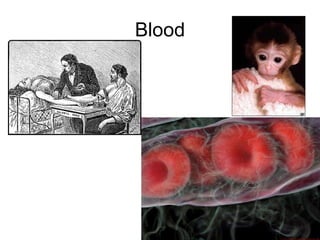
Blood
Homeostasis Dependent on continual transport to and from the cells.
Composition Plasma: 55% of blood Blood cells ( formed elements): 45% of blood
 
 
Formed Elements Measurement of cells: Hematocrit  (packed cell volume).  Normal in males: 45% Normal for females: 42%. Polycythemia:
Blood Volume 4-5 liters in females 5-6 liters in males 1 unit = 0.5 l Volume of blood is dependent upon the body weight/ composition. Inversely related to the amount of fat per kilogram.
Determination of Blood Volume Direct method: removal of all blood in experimental conditions with animals. Indirect method: Injection of a known amount of RBC tagged with radioisotopes.
 
Red Blood Cells or Erythrocytes(RBC) Shaped as biconcave disks. Nucleus is absent. 7.5 micrometer in diameter. Filled with hemoglobin. Thin plasma membrane 5,500,000/mm3 in males 4,800,000mm3 in females
Nucleated red cell
Function of RBC Transport oxygen O2 and carbon dioxide CO2.
Hemoglobin (HB) About 200 to 300 million molecules of HB in every red cell. Each molecule of HB carries 4 oxygen O2 molecules. Normal values: Females: 12 to 14 g/100ml blood Males: 14 to 16 g/100 ml blood Anemia: less than 10 g/100 ml of blood
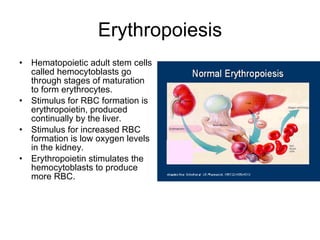
Erythropoiesis Hematopoietic adult stem cells called hemocytoblasts go through stages of maturation to form erythrocytes. Stimulus for RBC formation is erythropoietin, produced continually by the liver. Stimulus for increased RBC formation is low oxygen levels in the kidney. Erythropoietin stimulates the hemocytoblasts to produce more RBC.
 
 
Erythrolysis: Destruction of RBC 1- RBC last about 120 days 2- Old cells are phagocyte by the spleen and the liver through macrophages. Most components are recycled.
White Blood Cells: Leukocytes (WBC) Granulocytes:  Granules in cytoplasm and lobed nuclei. 1- Neutrophils 2- Eosinophils 3- Basophils Agranulocytes : no granules in cytoplasm and unlobed nuclei. 1- Lymphocytes 2- Monocytes Number of WBC: 5,000 to 9,000/ mm3
Formation of White Blood Cells Hemopoietic adult stem cells  (hemocytoblasts) go through differentiation and then various stages to form each type of WBC. Red marrow tissue development for neutrophils, eosinophils and basophils and some lymphocytes and monocytes. Lymphoid tissue development for most lymphocytes and monocytes.
WBC Granulocytes 1- Neutrophils: 65%-75% of total WBC. They increase in number during acute infections.
 
 
Infections
WBC Granulocytes 2- Eosinophils: 2%-5% of total WBC. Increase in number during allergic reactions and parasitic worm infections.
 
 
Dermatitis (allergy by contact)
WBC Granulocytes 3- Basophils: 0.5% to 1% of total WBC. They increase in numbers during allergic reactions and inflammatory process.
 
 
Feline Allergy
WBC Agranulocytes Lymphocytes: 20%-25% of total WBC.  T Lymphocytes or T Cells are Thymus tagged lymphocytes. B Lymphocytes or B Cells are bursal lymphocytes.
 
 
WBC Agranulocytes Monocytes: 3%-8% of total WBC. Become macrophages in tissues.
Monocytes in Tissues: Macrophages
 
Platelets: Thrombocytes 150,000 to 350,000/mm3 2-4 micrometers in diameter. They are plasma membrane bound particles of cytoplasm containing clotting factors.
 
Functions of Platelets 1- Hemostasis: stoppage of blood flow. Platelets form a plug by sticking together. 2- Coagulation: forming of a fibrin clot
Resting and Activated Platelets
Activated Platelets
 
Formation of Platelets Platelets form from hemopoietic adult stem cells called hemocytoblasts, they become megakaryoblasts, which in turn form membrane bound cytoplasmic fragments.(platelets) Average life span of platelets: 7 days
 
Blood Types (or Groups) Blood type depends on the type of agglutinogens present in the RBCs. Agglutination means to stick together Agglutinogens are self-antibodies. Agglutinins (antibodies): Plasma antibodies can cause agglutination of RBCs with specific agglutinogens. Transfusion reactions: agglutination or sticking together of agglutinogens and agglutinins of incompatible blood.
ABO System Type A: RBCs have agglutinogens A; plasma has agglutinins anti-B  Karl Landsteiner 1930 Nobel Prize
 
The Rh System Type Rh Positive: RBCs have a protein called Rh on its plasma membrane. Plasma has no anti-Rh agglutinin
Rh System Rh Negative RBCs have no Rh protein on its plasma membrane. Plasma has no anti Rh agglutinin
Erythroblastosis Fetalis If the mother is Rh negative and has been exposed to Rh positive blood, her blood will have the anti Rh agglutinin in the plasma. If the fetus is Rh positive, the mother’s anti Rh agglutinin will pass through the placenta and cause agglutination of RBCs, condition called erythroblastosis fetalis.
Plasma 91% Water 9% Solutes. They are: Electrolytes (Na, Cl, K) Nonelectrolytes (proteins, nutrients, wastes, gases, hormones, enzymes) Important: Serum is the part of plasma that is liquid and all clotting factors were removed.
Coagulation (blood clotting) Blood clots in three stages: 1- Extrinsic Pathway Stage 1 As a reaction to bleeding due to tissue damage the enzyme prothrombinase or prothrombin activator is released. 2- Intrinsic Pathway Stage 1 As a reaction to damaged endothelial cells contacting platelets, the enzyme prothombinase or prothrombin activator is released. 3- Intrinsic Pathway Stages 2 and 3  Prothrombin activator converts prothrombin to thrombin. Thrombin is an enzyme that converts fibrinogen into fibrin
Clotting Factors (table 17-3)


Coagulation Conditions that oppose clotting in intact vessels: Smooth endothelium. Presence of antithrombins (heparin) Conditions that hasten clotting: Rough places on endothelium. Abnormally slow blood flow.
 
Fibrinolysis Naturally occurring plasminogen can be activated to form plasmin, which dissolves clots. Bacteria produce clot-dissolving chemicals to enhance their invasion, such as streptokinase and t-Pa, both of which have medical applications.
Blood and the Whole Body Plasma links tissues of the body by transporting material throughout  the body to maintain homeostasis. RBCs transport O2 and CO2 WBC are important in the body’s defense mechanisms. Functions of the blood depend on respiratory, endocrine and urinary system. Blood must flow continuously to maintain stability.
Blood Disorders RBCs disorders: Anemia: loss of total oxygen carrying capacity by the RBCs due to either a decrease of hemoglobin or a decrease in RBCs. Anemias can be aplastic, pernicious, folate deficiency, acute, chronic, Changes in Hemoglobin: Hyperchromic Iron deficiency anemia Hemolytic: sickle cell anemia, thalassemia.
 
Sickle Cell Anemia
 
Blood Disorders WBCs disorders: Leukopenia: under 5,000 wbc/mm3. AIDS Leukocytosis: abnormally high WBC count, over 10,000 WBC/mm3. Leukemia CLL, ALL, CML,ACL. Multiple Myeloma Infectious Mononucleosis
Blood Disorders Clotting Disorders: Excessive clotting : Thrombus and Thrombosis,  Embolus and Embolism Failure to clot:  Hemophilia Thrombocytopenia
Thrombosis
Embolism
Hemophilia
Coronary Thrombosis
 
Leukemia


Blood 2010

  • 1.
  • 2.
    Homeostasis Dependent oncontinual transport to and from the cells.
  • 3.
    Composition Plasma: 55%of blood Blood cells ( formed elements): 45% of blood
  • 4.
  • 5.
  • 6.
    Formed Elements Measurementof cells: Hematocrit (packed cell volume). Normal in males: 45% Normal for females: 42%. Polycythemia:
  • 7.
    Blood Volume 4-5liters in females 5-6 liters in males 1 unit = 0.5 l Volume of blood is dependent upon the body weight/ composition. Inversely related to the amount of fat per kilogram.
  • 8.
    Determination of BloodVolume Direct method: removal of all blood in experimental conditions with animals. Indirect method: Injection of a known amount of RBC tagged with radioisotopes.
  • 9.
  • 10.
    Red Blood Cellsor Erythrocytes(RBC) Shaped as biconcave disks. Nucleus is absent. 7.5 micrometer in diameter. Filled with hemoglobin. Thin plasma membrane 5,500,000/mm3 in males 4,800,000mm3 in females
  • 11.
  • 12.
    Function of RBCTransport oxygen O2 and carbon dioxide CO2.
  • 13.
    Hemoglobin (HB) About200 to 300 million molecules of HB in every red cell. Each molecule of HB carries 4 oxygen O2 molecules. Normal values: Females: 12 to 14 g/100ml blood Males: 14 to 16 g/100 ml blood Anemia: less than 10 g/100 ml of blood
  • 14.
    Erythropoiesis Hematopoietic adultstem cells called hemocytoblasts go through stages of maturation to form erythrocytes. Stimulus for RBC formation is erythropoietin, produced continually by the liver. Stimulus for increased RBC formation is low oxygen levels in the kidney. Erythropoietin stimulates the hemocytoblasts to produce more RBC.
  • 15.
  • 16.
  • 17.
    Erythrolysis: Destruction ofRBC 1- RBC last about 120 days 2- Old cells are phagocyte by the spleen and the liver through macrophages. Most components are recycled.
  • 18.
    White Blood Cells:Leukocytes (WBC) Granulocytes: Granules in cytoplasm and lobed nuclei. 1- Neutrophils 2- Eosinophils 3- Basophils Agranulocytes : no granules in cytoplasm and unlobed nuclei. 1- Lymphocytes 2- Monocytes Number of WBC: 5,000 to 9,000/ mm3
  • 19.
    Formation of WhiteBlood Cells Hemopoietic adult stem cells (hemocytoblasts) go through differentiation and then various stages to form each type of WBC. Red marrow tissue development for neutrophils, eosinophils and basophils and some lymphocytes and monocytes. Lymphoid tissue development for most lymphocytes and monocytes.
  • 20.
    WBC Granulocytes 1-Neutrophils: 65%-75% of total WBC. They increase in number during acute infections.
  • 21.
  • 22.
  • 23.
  • 24.
    WBC Granulocytes 2-Eosinophils: 2%-5% of total WBC. Increase in number during allergic reactions and parasitic worm infections.
  • 25.
  • 26.
  • 27.
  • 28.
    WBC Granulocytes 3-Basophils: 0.5% to 1% of total WBC. They increase in numbers during allergic reactions and inflammatory process.
  • 29.
  • 30.
  • 31.
  • 32.
    WBC Agranulocytes Lymphocytes:20%-25% of total WBC. T Lymphocytes or T Cells are Thymus tagged lymphocytes. B Lymphocytes or B Cells are bursal lymphocytes.
  • 33.
  • 34.
  • 35.
    WBC Agranulocytes Monocytes:3%-8% of total WBC. Become macrophages in tissues.
  • 36.
  • 37.
  • 38.
    Platelets: Thrombocytes 150,000to 350,000/mm3 2-4 micrometers in diameter. They are plasma membrane bound particles of cytoplasm containing clotting factors.
  • 39.
  • 40.
    Functions of Platelets1- Hemostasis: stoppage of blood flow. Platelets form a plug by sticking together. 2- Coagulation: forming of a fibrin clot
  • 41.
  • 42.
  • 43.
  • 44.
    Formation of PlateletsPlatelets form from hemopoietic adult stem cells called hemocytoblasts, they become megakaryoblasts, which in turn form membrane bound cytoplasmic fragments.(platelets) Average life span of platelets: 7 days
  • 45.
  • 46.
    Blood Types (orGroups) Blood type depends on the type of agglutinogens present in the RBCs. Agglutination means to stick together Agglutinogens are self-antibodies. Agglutinins (antibodies): Plasma antibodies can cause agglutination of RBCs with specific agglutinogens. Transfusion reactions: agglutination or sticking together of agglutinogens and agglutinins of incompatible blood.
  • 47.
    ABO System TypeA: RBCs have agglutinogens A; plasma has agglutinins anti-B Karl Landsteiner 1930 Nobel Prize
  • 48.
  • 49.
    The Rh SystemType Rh Positive: RBCs have a protein called Rh on its plasma membrane. Plasma has no anti-Rh agglutinin
  • 50.
    Rh System RhNegative RBCs have no Rh protein on its plasma membrane. Plasma has no anti Rh agglutinin
  • 51.
    Erythroblastosis Fetalis Ifthe mother is Rh negative and has been exposed to Rh positive blood, her blood will have the anti Rh agglutinin in the plasma. If the fetus is Rh positive, the mother’s anti Rh agglutinin will pass through the placenta and cause agglutination of RBCs, condition called erythroblastosis fetalis.
  • 52.
    Plasma 91% Water9% Solutes. They are: Electrolytes (Na, Cl, K) Nonelectrolytes (proteins, nutrients, wastes, gases, hormones, enzymes) Important: Serum is the part of plasma that is liquid and all clotting factors were removed.
  • 53.
    Coagulation (blood clotting)Blood clots in three stages: 1- Extrinsic Pathway Stage 1 As a reaction to bleeding due to tissue damage the enzyme prothrombinase or prothrombin activator is released. 2- Intrinsic Pathway Stage 1 As a reaction to damaged endothelial cells contacting platelets, the enzyme prothombinase or prothrombin activator is released. 3- Intrinsic Pathway Stages 2 and 3 Prothrombin activator converts prothrombin to thrombin. Thrombin is an enzyme that converts fibrinogen into fibrin
  • 54.
  • 55.
  • 56.
  • 57.
  • 58.
    Coagulation Conditions thatoppose clotting in intact vessels: Smooth endothelium. Presence of antithrombins (heparin) Conditions that hasten clotting: Rough places on endothelium. Abnormally slow blood flow.
  • 59.
  • 60.
    Fibrinolysis Naturally occurringplasminogen can be activated to form plasmin, which dissolves clots. Bacteria produce clot-dissolving chemicals to enhance their invasion, such as streptokinase and t-Pa, both of which have medical applications.
  • 61.
    Blood and theWhole Body Plasma links tissues of the body by transporting material throughout the body to maintain homeostasis. RBCs transport O2 and CO2 WBC are important in the body’s defense mechanisms. Functions of the blood depend on respiratory, endocrine and urinary system. Blood must flow continuously to maintain stability.
  • 62.
    Blood Disorders RBCsdisorders: Anemia: loss of total oxygen carrying capacity by the RBCs due to either a decrease of hemoglobin or a decrease in RBCs. Anemias can be aplastic, pernicious, folate deficiency, acute, chronic, Changes in Hemoglobin: Hyperchromic Iron deficiency anemia Hemolytic: sickle cell anemia, thalassemia.
  • 63.
  • 64.
  • 65.
  • 66.
    Blood Disorders WBCsdisorders: Leukopenia: under 5,000 wbc/mm3. AIDS Leukocytosis: abnormally high WBC count, over 10,000 WBC/mm3. Leukemia CLL, ALL, CML,ACL. Multiple Myeloma Infectious Mononucleosis
  • 67.
    Blood Disorders ClottingDisorders: Excessive clotting : Thrombus and Thrombosis, Embolus and Embolism Failure to clot: Hemophilia Thrombocytopenia
  • 68.
  • 69.
  • 70.
  • 71.
  • 72.
  • 73.
  • 74.
  • 75.