Group 9
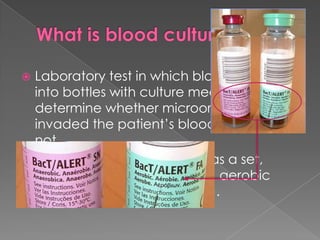
 Laboratory test in which blood is injected
into bottles with culture media to
determine whether microorganisms have
invaded the patient’s bloodstream or
not.
 Blood cultures are ordered as a set,
which consists of 2 bottles (1 aerobic
bottle & 1 anaerobic bottle).
1. Wear gloves
2. Cultures should be drawn before
administration of antibiotics, if possible.
3. Blood should be drawn via venipunture.
Venipunture
Collection of blood from a vein, usually
from elbow or back of hand
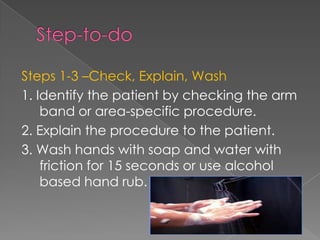
Steps 1-3 –Check, Explain, Wash
1. Identify the patient by checking the arm
band or area-specific procedure.
2. Explain the procedure to the patient.
3. Wash hands with soap and water with
friction for 15 seconds or use alcohol
based hand rub.
Step 4
 Decontaminate blood culture bottle tops
Remove lids and disinfect rubber access points
with an alcohol based disinfectant
Step 5
 Apply alcohol based skin antiseptic and leave to
dry
Patient’s skin is decontaminated at insertion site with alcohol
based antiseptic and is allowed to dry for 30 seconds before
taking the blood culture
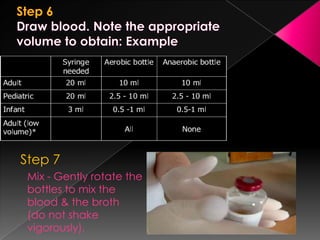
Step 7
Mix - Gently rotate the
bottles to mix the
blood & the broth
(do not shake
vigorously).
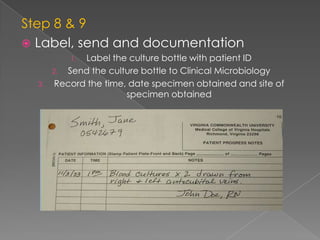
Step 8 & 9
 Label, send and documentation
1. Label the culture bottle with patient ID
2. Send the culture bottle to Clinical Microbiology
3. Record the time, date specimen obtained and site of
specimen obtained
STARTING TO GROWTH
AS FOUND NEW
NUTRIENTS
EQUAL CELL
REPRODUCTION
AND DEATH
RATE OF DEATH
EXCEED RATE OF
REPRODUCTION
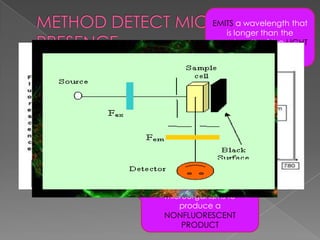
 Use fluorescence
EMITS
REACTS
FLUOROMETER
EMITS a wavelength that
is longer than the
wavelength of the LIGHT
IT ABSORBS
FLUORESCENCE
COUNTER
REACTS in the presence of
microorganisms to
produce a
NONFLUORESCENT
PRODUCT
 Using Colorimetry
THE DETECTION OF COLOR CHANGES
IN PH INDICATORS CAUSED BY
METABOLIC END PRODUCTS.
 Photoelectric cell
MEASURES CHANGES IN THE REFLECTANCE
OF LIGHT AT THE BOTTOM OF THE CULTURE
BOTTLE.
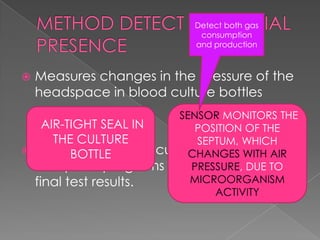
 Measures changes in the pressure of the
headspace in blood culture bottles
 Automated blood culture analyzers have
computer programs to determine the
final test results.
AIR-TIGHT SEAL IN
THE CULTURE
BOTTLE
SENSOR MONITORS THE
POSITION OF THE
SEPTUM, WHICH
CHANGES WITH AIR
PRESSURE, DUE TO
MICROORGANISM
ACTIVITY
Detect both gas
consumption
and production
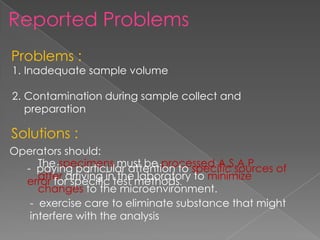
Reported Problems
1. Inadequate sample volume
2. Contamination during sample collect and
preparation
Problems :
Solutions :
Operators should:
The specimens must be processed A.S.A.P
after arriving in the laboratory to minimize
changes to the microenvironment.
- exercise care to eliminate substance that might
interfere with the analysis
- paying particular attention to specific sources of
error for specific test methods.
Purchase Consideration
1. Whether the detector can accept future
hardware upgrades
2. Whether the unit can interface with other laboratory
instruments (e.g., automated microbiological systems)
that can provide additional parameters.
3. Choose an instrument that can handle both
adult and pediatric samples
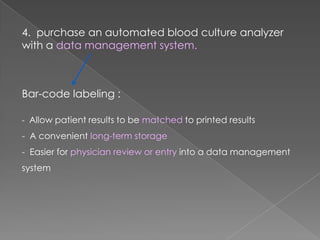
4. purchase an automated blood culture analyzer
with a data management system.
Bar-code labeling :
- Allow patient results to be matched to printed results
- A convenient long-term storage
- Easier for physician review or entry into a data management
system
Purchase Consideration
5. Purchase additional mandatory quality control (QC)
strains, usually from a third party
6. The effectiveness of the system’s interface with the
hospital’s central computer system according to
CLIA guidelines.
7. Enviroment: look for manufacturers who offer take-
back programs on system components
8. Cost :
- Warranty agreements, maintenance contracts, and
software upgrades
Should purchase service
contract
Blood culturing has remained a stable technology
for many years. Improvements include faster
detection time, smaller footprint, and
comprehensive data processing and storage.
Researchers are exploring the use of molecular
diagnostic techniques such as polymerase chain
reaction and chip array, which are currently used
in DNA research, to perform rapid blood testing.
These techniques, which are increasingly being used
for detection of Methicillin-resistant Staphylococcus
aureus (MRSA), may prove to be quicker and more
efficient than traditional blood culture analysis
Blood culture analyzer

Blood culture analyzer

  • 1.
  • 2.
     Laboratory testin which blood is injected into bottles with culture media to determine whether microorganisms have invaded the patient’s bloodstream or not.  Blood cultures are ordered as a set, which consists of 2 bottles (1 aerobic bottle & 1 anaerobic bottle).
  • 3.
    1. Wear gloves 2.Cultures should be drawn before administration of antibiotics, if possible. 3. Blood should be drawn via venipunture. Venipunture Collection of blood from a vein, usually from elbow or back of hand
  • 4.
    Steps 1-3 –Check,Explain, Wash 1. Identify the patient by checking the arm band or area-specific procedure. 2. Explain the procedure to the patient. 3. Wash hands with soap and water with friction for 15 seconds or use alcohol based hand rub.
  • 5.
    Step 4  Decontaminateblood culture bottle tops Remove lids and disinfect rubber access points with an alcohol based disinfectant Step 5  Apply alcohol based skin antiseptic and leave to dry Patient’s skin is decontaminated at insertion site with alcohol based antiseptic and is allowed to dry for 30 seconds before taking the blood culture
  • 6.
    Step 7 Mix -Gently rotate the bottles to mix the blood & the broth (do not shake vigorously).
  • 7.
    Step 8 &9  Label, send and documentation 1. Label the culture bottle with patient ID 2. Send the culture bottle to Clinical Microbiology 3. Record the time, date specimen obtained and site of specimen obtained
  • 10.
    STARTING TO GROWTH ASFOUND NEW NUTRIENTS EQUAL CELL REPRODUCTION AND DEATH RATE OF DEATH EXCEED RATE OF REPRODUCTION
  • 11.
     Use fluorescence EMITS REACTS FLUOROMETER EMITSa wavelength that is longer than the wavelength of the LIGHT IT ABSORBS FLUORESCENCE COUNTER REACTS in the presence of microorganisms to produce a NONFLUORESCENT PRODUCT
  • 12.
     Using Colorimetry THEDETECTION OF COLOR CHANGES IN PH INDICATORS CAUSED BY METABOLIC END PRODUCTS.
  • 13.
     Photoelectric cell MEASURESCHANGES IN THE REFLECTANCE OF LIGHT AT THE BOTTOM OF THE CULTURE BOTTLE.
  • 14.
     Measures changesin the pressure of the headspace in blood culture bottles  Automated blood culture analyzers have computer programs to determine the final test results. AIR-TIGHT SEAL IN THE CULTURE BOTTLE SENSOR MONITORS THE POSITION OF THE SEPTUM, WHICH CHANGES WITH AIR PRESSURE, DUE TO MICROORGANISM ACTIVITY Detect both gas consumption and production
  • 16.
    Reported Problems 1. Inadequatesample volume 2. Contamination during sample collect and preparation Problems : Solutions : Operators should: The specimens must be processed A.S.A.P after arriving in the laboratory to minimize changes to the microenvironment. - exercise care to eliminate substance that might interfere with the analysis - paying particular attention to specific sources of error for specific test methods.
  • 17.
  • 18.
    Purchase Consideration 1. Whetherthe detector can accept future hardware upgrades 2. Whether the unit can interface with other laboratory instruments (e.g., automated microbiological systems) that can provide additional parameters. 3. Choose an instrument that can handle both adult and pediatric samples
  • 19.
    4. purchase anautomated blood culture analyzer with a data management system. Bar-code labeling : - Allow patient results to be matched to printed results - A convenient long-term storage - Easier for physician review or entry into a data management system
  • 20.
    Purchase Consideration 5. Purchaseadditional mandatory quality control (QC) strains, usually from a third party 6. The effectiveness of the system’s interface with the hospital’s central computer system according to CLIA guidelines. 7. Enviroment: look for manufacturers who offer take- back programs on system components 8. Cost : - Warranty agreements, maintenance contracts, and software upgrades Should purchase service contract
  • 21.
    Blood culturing hasremained a stable technology for many years. Improvements include faster detection time, smaller footprint, and comprehensive data processing and storage. Researchers are exploring the use of molecular diagnostic techniques such as polymerase chain reaction and chip array, which are currently used in DNA research, to perform rapid blood testing. These techniques, which are increasingly being used for detection of Methicillin-resistant Staphylococcus aureus (MRSA), may prove to be quicker and more efficient than traditional blood culture analysis