PHLEBOTOMY
 The process of collecting a blood sample is called
phlebotomy
 This procedure is also known as venipuncture
 A person who performs phlebotomy is called a
phlebotomist, although doctors nurses, and
medical laboratory scientists.
BLOOD SPECIMEN COLLECTION AND
PROCESSING
 The first step in acquiring a quality lab. Test result
for any patient is the specimen collection
procedure.
 Blood specimen are obtained through capillary skin
puncture ( finger, toe, heel), arterial , venous
sampling.
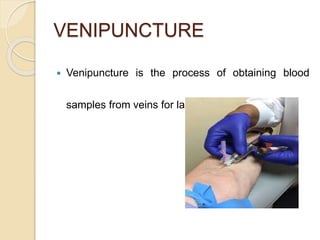
VENIPUNCTURE
 Venipuncture is the process of obtaining blood
samples from veins for lab testing
VENIPUNCTURE PROCEDURE
STEPS
 STEP 1:-
 Preparation of specimen collection material:
 Following material should be readily available in
the specimen collection section-
Disposable syringes and needles or vacutainer
systems.
Disposable lancets
Gauze pads or cotton
Tourniquet
70% (V/V) ethanol
Clean and dry wide mouth bottles
Blood collection tubes
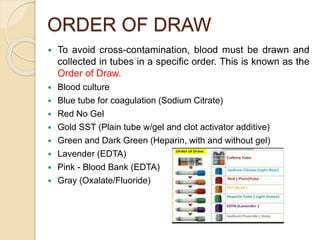
ORDER OF DRAW
 To avoid cross-contamination, blood must be drawn and
collected in tubes in a specific order. This is known as the
Order of Draw.
 Blood culture
 Blue tube for coagulation (Sodium Citrate)
 Red No Gel
 Gold SST (Plain tube w/gel and clot activator additive)
 Green and Dark Green (Heparin, with and without gel)
 Lavender (EDTA)
 Pink - Blood Bank (EDTA)
 Gray (Oxalate/Fluoride)
VENIPUNCTURE PROCEDURE
STEPS
 Step 2:-
 Patient preparation:
 Following instruction is given to the patient
1. patient should be on balanced diet at least for 2 to 3 days
prior to the test.
2. The day before sample collection, the patient should not
drink intoxicating substance, esp. alcoholic drinks and eat
tobacco.
3. Patient should report to the lab. After fasting for12-16hrs.
Patient should not drink tea, or coffee or any other drinks
except one glassful of water.
SPECIMEN COLLECTION
 The phlebotomist must be conversant with following OSHA
rules-
 All human blood and certain body fluids are treated as
infectious for HIV, HBV, and other blood born pathogens.
 Personal protective equipment (PPE) is specialized clothing
or equipment worn to provide protection from occupational
exposure. PPE includes gloves, gowns, laboratory coat, face
shields or mask etc.
VENIPUNCTURE
PROCEDURE STEPS
 Step 3:-
 Laboratory request form
 The laboratory request form should provide the following
information:
 Patient’s full name , age , sex
 Identification number
 List of required specific tests
 Urgent tests (only those tests that are required for the
immediate care)
 Name of the physician ordering the test.
VENIPUNCTURE PROCEDURE
STEPS
 Step 4:-
 Reassuring the patient:-
 The technician must gain the patients confidence and assure
him that, although the Venipuncture will be slightly painful, it will
be of short duration.
 Positioning the patient:-
The patient should be made comfortably in a chair and should
position his arm straight from the shoulder and it should bend
at the elbow.
If the patient want to lie down, let the patient lie comfortably
on the back.
VENIPUNCTURE PROCEDURE
STEPS
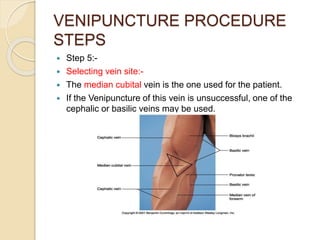
 Step 5:-
 Selecting vein site:-
 The median cubital vein is the one used for the patient.
 If the Venipuncture of this vein is unsuccessful, one of the
cephalic or basilic veins may be used.
VENIPUNCTURE PROCEDURE
STEPS
 Following techniques are useful when encountering a patient
with difficult veins:
Look for a blood drawing site
Feel for a vein using the tip of the finger. Think of four
things when feeling for a vein, bounce, direction of vein,
size of needle, and depth.
Choose the vein that feels the fullest.
Try the other arm unless otherwise instructed.
Ask the patient to make the fit.
Apply a tourniquet.
Massage the arm from wrist to elbow.
VENIPUNCTURE PROCEDURE
STEPS
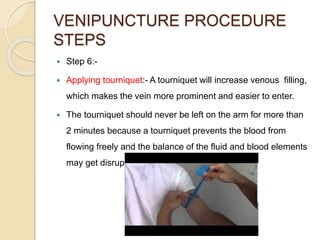
 Step 6:-
 Applying tourniquet:- A tourniquet will increase venous filling,
which makes the vein more prominent and easier to enter.
 The tourniquet should never be left on the arm for more than
2 minutes because a tourniquet prevents the blood from
flowing freely and the balance of the fluid and blood elements
may get disrupted.
VENIPUNCTURE PROCEDURE
STEPS
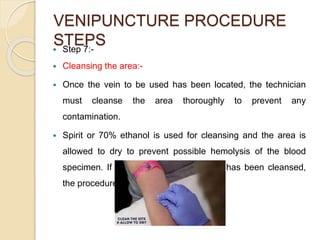
 Step 7:-
 Cleansing the area:-
 Once the vein to be used has been located, the technician
must cleanse the area thoroughly to prevent any
contamination.
 Spirit or 70% ethanol is used for cleansing and the area is
allowed to dry to prevent possible hemolysis of the blood
specimen. If the skin is touched after it has been cleansed,
the procedure must be repeated
VENIPUNCTURE PROCEDURE
STEPS
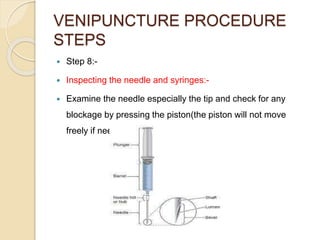
 Step 8:-
 Inspecting the needle and syringes:-
 Examine the needle especially the tip and check for any
blockage by pressing the piston(the piston will not move
freely if needle is blocked)
VENIPUNCTURE PROCEDURE
STEPS
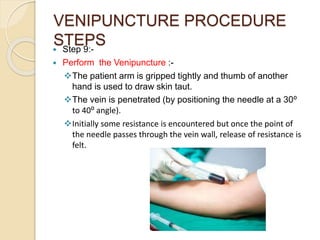
 Step 9:-
 Perform the Venipuncture :-
The patient arm is gripped tightly and thumb of another
hand is used to draw skin taut.
The vein is penetrated (by positioning the needle at a 30⁰
to 40⁰ angle).
Initially some resistance is encountered but once the point of
the needle passes through the vein wall, release of resistance is
felt.
VENIPUNCTURE PROCEDURE
STEPS
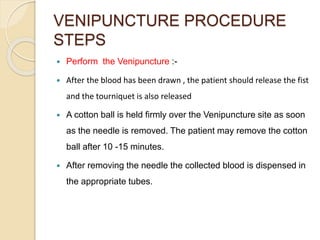
 Perform the Venipuncture :-
 After the blood has been drawn , the patient should release the fist
and the tourniquet is also released
 A cotton ball is held firmly over the Venipuncture site as soon
as the needle is removed. The patient may remove the cotton
ball after 10 -15 minutes.
 After removing the needle the collected blood is dispensed in
the appropriate tubes.
 Perform the Venipuncture:-
 The blood in anticoagulated tubes is mixed carefully and the
blood collected in tubes without anticoagulants is kept at
room temperature (25℃± 5℃ for the separation of serum.
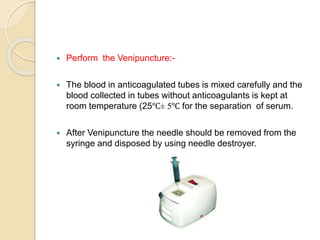
 After Venipuncture the needle should be removed from the
syringe and disposed by using needle destroyer.
Blood collection

Blood collection

  • 2.
    PHLEBOTOMY  The processof collecting a blood sample is called phlebotomy  This procedure is also known as venipuncture  A person who performs phlebotomy is called a phlebotomist, although doctors nurses, and medical laboratory scientists.
  • 3.
    BLOOD SPECIMEN COLLECTIONAND PROCESSING  The first step in acquiring a quality lab. Test result for any patient is the specimen collection procedure.  Blood specimen are obtained through capillary skin puncture ( finger, toe, heel), arterial , venous sampling.
  • 4.
    VENIPUNCTURE  Venipuncture isthe process of obtaining blood samples from veins for lab testing
  • 5.
    VENIPUNCTURE PROCEDURE STEPS  STEP1:-  Preparation of specimen collection material:  Following material should be readily available in the specimen collection section- Disposable syringes and needles or vacutainer systems. Disposable lancets Gauze pads or cotton Tourniquet 70% (V/V) ethanol Clean and dry wide mouth bottles Blood collection tubes
  • 6.
    ORDER OF DRAW To avoid cross-contamination, blood must be drawn and collected in tubes in a specific order. This is known as the Order of Draw.  Blood culture  Blue tube for coagulation (Sodium Citrate)  Red No Gel  Gold SST (Plain tube w/gel and clot activator additive)  Green and Dark Green (Heparin, with and without gel)  Lavender (EDTA)  Pink - Blood Bank (EDTA)  Gray (Oxalate/Fluoride)
  • 7.
    VENIPUNCTURE PROCEDURE STEPS  Step2:-  Patient preparation:  Following instruction is given to the patient 1. patient should be on balanced diet at least for 2 to 3 days prior to the test. 2. The day before sample collection, the patient should not drink intoxicating substance, esp. alcoholic drinks and eat tobacco. 3. Patient should report to the lab. After fasting for12-16hrs. Patient should not drink tea, or coffee or any other drinks except one glassful of water.
  • 8.
    SPECIMEN COLLECTION  Thephlebotomist must be conversant with following OSHA rules-  All human blood and certain body fluids are treated as infectious for HIV, HBV, and other blood born pathogens.  Personal protective equipment (PPE) is specialized clothing or equipment worn to provide protection from occupational exposure. PPE includes gloves, gowns, laboratory coat, face shields or mask etc.
  • 9.
    VENIPUNCTURE PROCEDURE STEPS  Step3:-  Laboratory request form  The laboratory request form should provide the following information:  Patient’s full name , age , sex  Identification number  List of required specific tests  Urgent tests (only those tests that are required for the immediate care)  Name of the physician ordering the test.
  • 10.
    VENIPUNCTURE PROCEDURE STEPS  Step4:-  Reassuring the patient:-  The technician must gain the patients confidence and assure him that, although the Venipuncture will be slightly painful, it will be of short duration.  Positioning the patient:- The patient should be made comfortably in a chair and should position his arm straight from the shoulder and it should bend at the elbow. If the patient want to lie down, let the patient lie comfortably on the back.
  • 11.
    VENIPUNCTURE PROCEDURE STEPS  Step5:-  Selecting vein site:-  The median cubital vein is the one used for the patient.  If the Venipuncture of this vein is unsuccessful, one of the cephalic or basilic veins may be used.
  • 12.
    VENIPUNCTURE PROCEDURE STEPS  Followingtechniques are useful when encountering a patient with difficult veins: Look for a blood drawing site Feel for a vein using the tip of the finger. Think of four things when feeling for a vein, bounce, direction of vein, size of needle, and depth. Choose the vein that feels the fullest. Try the other arm unless otherwise instructed. Ask the patient to make the fit. Apply a tourniquet. Massage the arm from wrist to elbow.
  • 13.
    VENIPUNCTURE PROCEDURE STEPS  Step6:-  Applying tourniquet:- A tourniquet will increase venous filling, which makes the vein more prominent and easier to enter.  The tourniquet should never be left on the arm for more than 2 minutes because a tourniquet prevents the blood from flowing freely and the balance of the fluid and blood elements may get disrupted.
  • 14.
    VENIPUNCTURE PROCEDURE STEPS  Step7:-  Cleansing the area:-  Once the vein to be used has been located, the technician must cleanse the area thoroughly to prevent any contamination.  Spirit or 70% ethanol is used for cleansing and the area is allowed to dry to prevent possible hemolysis of the blood specimen. If the skin is touched after it has been cleansed, the procedure must be repeated
  • 15.
    VENIPUNCTURE PROCEDURE STEPS  Step8:-  Inspecting the needle and syringes:-  Examine the needle especially the tip and check for any blockage by pressing the piston(the piston will not move freely if needle is blocked)
  • 16.
    VENIPUNCTURE PROCEDURE STEPS  Step9:-  Perform the Venipuncture :- The patient arm is gripped tightly and thumb of another hand is used to draw skin taut. The vein is penetrated (by positioning the needle at a 30⁰ to 40⁰ angle). Initially some resistance is encountered but once the point of the needle passes through the vein wall, release of resistance is felt.
  • 17.
    VENIPUNCTURE PROCEDURE STEPS  Performthe Venipuncture :-  After the blood has been drawn , the patient should release the fist and the tourniquet is also released  A cotton ball is held firmly over the Venipuncture site as soon as the needle is removed. The patient may remove the cotton ball after 10 -15 minutes.  After removing the needle the collected blood is dispensed in the appropriate tubes.
  • 18.
     Perform theVenipuncture:-  The blood in anticoagulated tubes is mixed carefully and the blood collected in tubes without anticoagulants is kept at room temperature (25℃± 5℃ for the separation of serum.  After Venipuncture the needle should be removed from the syringe and disposed by using needle destroyer.