



Tanya Joosten, @tjoosten, tanyajoosten.com Associate Director, Interim, Learning Technology Center Lecturer, Department of Communication University of Wisconsin-Milwaukee
 
 
Part 1: Getting Started with Social Media Tweeting, hashtags, and more Strategies to building your network Part 2: Engaging Students and Building Community Part 3: Managing your social network


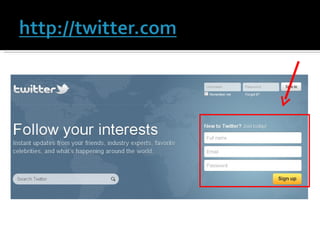
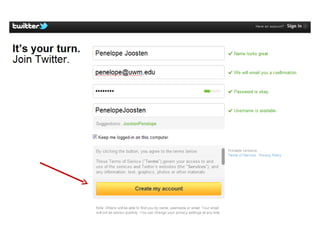
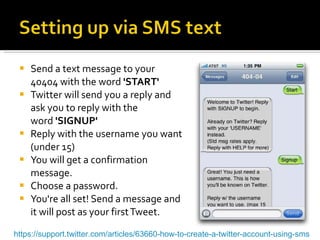
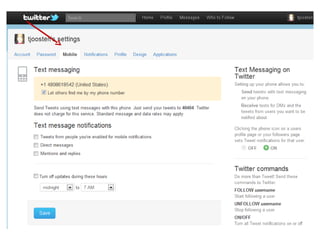
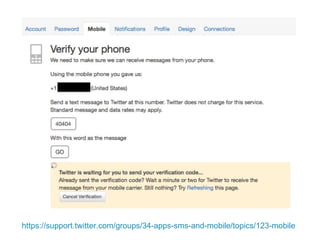
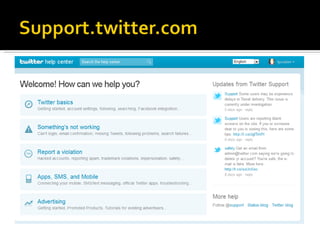
Send a text message to your 40404 with the word  'START' Twitter will send you a reply and ask you to reply with the word  'SIGNUP'   Reply with the username you want (under 15) You will get a confirmation message. Choose a password. You're all set! Send a message and it will post as your first Tweet. https://support.twitter.com/articles/63660-how-to-create-a-twitter-account-using-sms


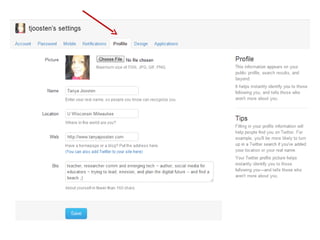
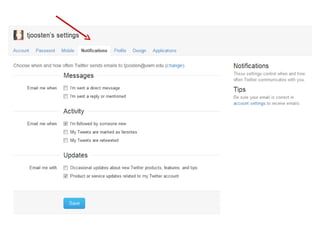
https://support.twitter.com/groups/34-apps-sms-and-mobile/topics/123-mobile-basics/articles/110250-how-to-add-your-phone-via-web
 
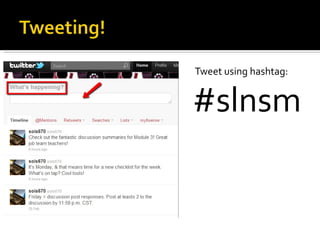
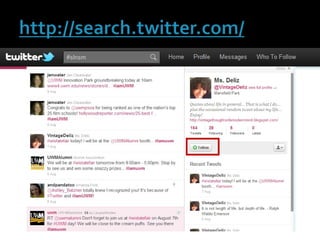
Tweet using hashtag:  #slnsm


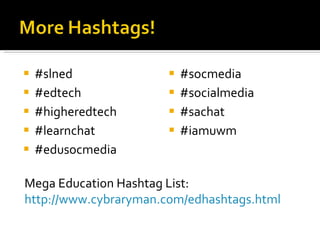
#slned #edtech #higheredtech #learnchat #edusocmedia #socmedia #socialmedia #sachat #iamuwm Mega Education Hashtag List: http://www.cybraryman.com/edhashtags.html
 
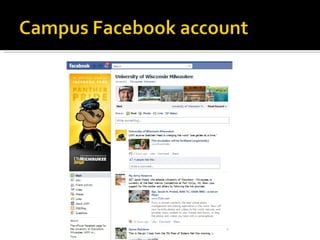
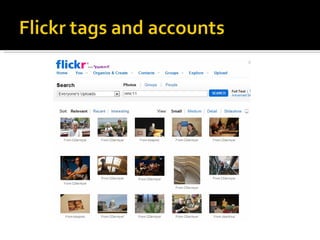
Conference/meeting Twitter hashtag Campus Twitter account Campus Twitter mentions Campus Facebook page Conference/Campus Flickr tag
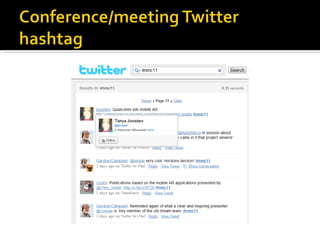
Conference/meeting Twitter hashtag


Announcements Supplemental information Live microblogging Connections/PLNs (e.g., Siemens, 2004) Collect real world data Twitter polls Backchannel communication Other?
Why social media?
 
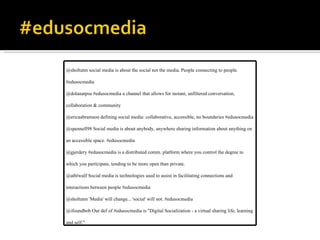
@sholtutm social media is about the social not the media. People connecting to people. #edusocmedia @dolanatpsu #edusocmedia a channel that allows for instant, unfiltered conversation, collaboration & community @ericaabramson defining social media: collaborative, accessible, no boundaries #edusocmedia @spennell98 Social media is about anybody, anywhere sharing information about anything on an accessible space. #edusocmedia @gjerdery #edusocmedia is a distributed comm. platform where you control the degree to which you participate, tending to be more open than private. @athlwulf Social media is technologies used to assist in facilitating connections and interactions between people #edusocmedia @sholtutm 'Media' will change... 'social' will not. #edusocmedia @ifoundbob Our def of #edusocmedia is "Digital Socialization - a virtual sharing life, learning and self."


According to a survey by Joosten (2009), students reported that they need good (67%) and  frequent communication (90%) with their instructor  and good communication with their classmates (75%).  They also reported that they  need to feel connected to learn (80%)  (http://tinyurl.com/yafu8qz).
 
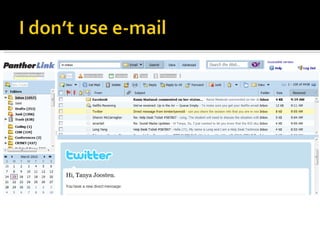
According to PEW Internet study, “Teens who participated in focus groups for this study said that they view  email as something you use to talk to ‘old people,’  institutions, or to send complex instructions to large groups “ (http://www.pewinternet.org/Reports/2005/Teens-and-Technology.aspx?r=1).
 
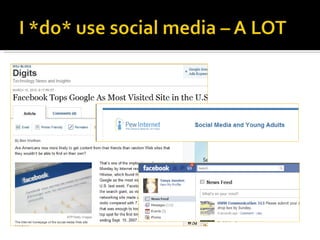
According to Bulik (July 8 th , 2009) “…They  go to social networking sites 5 days per week and check in 4 times a day for a total of an hour per day”  (para 7).  According to PEW Internet study, “… Nearly three-quarters (72%) of online 18-29 year olds use these sites –similar to the rate among teens–with 45% doing so on a typical day” (http://tinyurl.com/33hynyx).
New survey results also show that among adults 18 and older, Facebook has taken over as the social network of choice 73% of adult profile owners use Facebook
 
According to Joosten (2009),  71% of students want to receive text messages  about their class (http://tinyurl.com/yafu8qz).  According to PEW Interent, “the typical American teen  sends and receives 50 or more messages per day, or 1,500 per month .”
 
How is your campus implementing social media?


Facilitating interactivity and engagement Expanding the classroom walls: Experiential learning Professional development


Supplementary materials Videos Articles Websites Discussions Community building inside/outside classroom New student “recruitment”


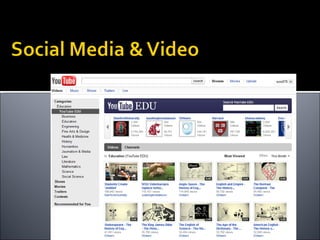
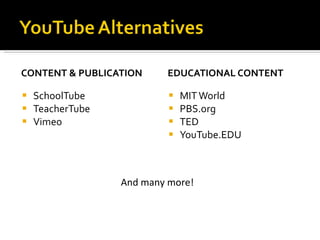
CONTENT & PUBLICATION SchoolTube TeacherTube Vimeo EDUCATIONAL CONTENT MIT World PBS.org TED  YouTube.EDU And many more!
Presence Content – no need to recreate the wheel Student-created content Active learning Interactivity Engagement Creativity
 
 
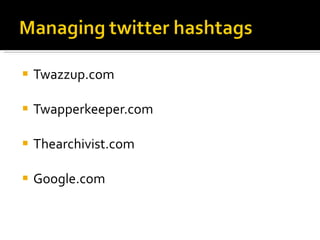
Twazzup.com Twapperkeeper.com Thearchivist.com Google.com
 
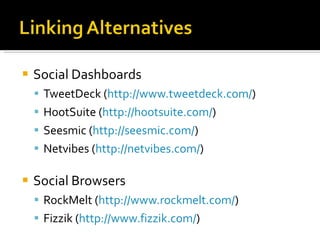
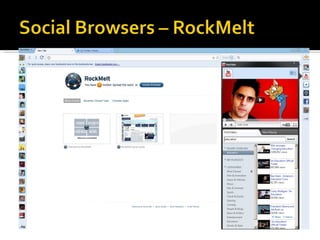
Social Dashboards TweetDeck ( http://www.tweetdeck.com/ ) HootSuite ( http://hootsuite.com/ ) Seesmic ( http://seesmic.com/ ) Netvibes ( http://netvibes.com/ )  Social Browsers RockMelt ( http://www.rockmelt.com/ ) Fizzik ( http://www.fizzik.com/ )
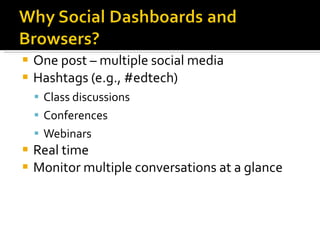
One post – multiple social media Hashtags (e.g., #edtech) Class discussions Conferences Webinars Real time Monitor multiple conversations at a glance
 
 
Social media for educators To be published by Jossey Bass Spring 2012
twitter.com/tjoosten facebook.com/tjoosten juice gyoza  |  second life professorjoosten.blogspot.com tanyajoosten. com
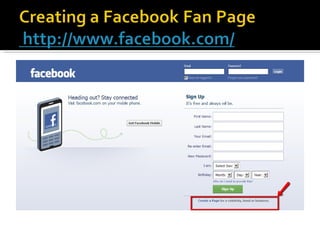
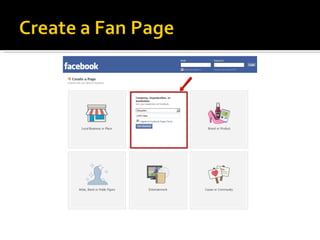
UWM Social Media Grant project  http://uwmsocialmedia.wikispaces.com Presentation and Data http://uwmsocialmedia.wikispaces.com/Presentations+by+Tanya Set-up Instructions http://uwmsocialmedia.wikispaces.com/Howtosocialmedia10 Creating a Twitter Account  http://tinyurl.com/4lkdkj3   Creating a Facebook Fan Page http://www.facebook.com/pages/create.php #edusocmedia on YouTube, Twitter, wikispaces
Heiberger, G., & Harper, R. (2008). Have you Facebooked Astin lately? Using technology to increase student involvement.  New Directions for Student Services , 124. Retrieved  http://tinyurl.com/4vygtde   Higher Education Research Institute (HERI). (2007). College freshman and online social networking sites. Retrieved from  http://gseis.ucla.edu/heri/PDFs/pubs/briefs/brief-091107-SocialNetworking.pdf   Junco, R., Heibergert, G., & Loken, E. (2010). The effect of Twitter on college student engagement and grades.  Journal of Computer Assisted Learning.  http://blog.reyjunco.com/pdf/JuncoHeibergerLokenTwitterEngagementGrades.pdf Kopytoff, V. G. (2011). Blogs wane as the young drift to sites like Twitter.  The New York Times . Retrieved from  http://www.nytimes.com/2011/02/21/technology/internet/21blog.html?_r=1 Zickuhr, K. (2010).  Generations 2010 . Washington DC: Pew Internet and American Life. Retrieved from  http://www.pewinternet.org/Reports/2010/Generations-2010.aspx

Social Media: Engaging Students, SUNY

  • 1.
    Tanya Joosten, @tjoosten,tanyajoosten.com Associate Director, Interim, Learning Technology Center Lecturer, Department of Communication University of Wisconsin-Milwaukee
  • 2.
  • 3.
  • 4.
    Part 1: GettingStarted with Social Media Tweeting, hashtags, and more Strategies to building your network Part 2: Engaging Students and Building Community Part 3: Managing your social network
  • 5.
  • 6.
  • 7.
  • 8.
  • 9.
    Send a textmessage to your 40404 with the word  'START' Twitter will send you a reply and ask you to reply with the word  'SIGNUP'   Reply with the username you want (under 15) You will get a confirmation message. Choose a password. You're all set! Send a message and it will post as your first Tweet. https://support.twitter.com/articles/63660-how-to-create-a-twitter-account-using-sms
  • 10.
  • 11.
  • 12.
  • 13.
  • 14.
  • 15.
  • 16.
  • 17.
  • 18.
  • 19.
    #slned #edtech #higheredtech#learnchat #edusocmedia #socmedia #socialmedia #sachat #iamuwm Mega Education Hashtag List: http://www.cybraryman.com/edhashtags.html
  • 20.
  • 21.
    Conference/meeting Twitter hashtagCampus Twitter account Campus Twitter mentions Campus Facebook page Conference/Campus Flickr tag
  • 22.
  • 23.
  • 24.
  • 25.
  • 26.
  • 27.
  • 28.
    Announcements Supplemental informationLive microblogging Connections/PLNs (e.g., Siemens, 2004) Collect real world data Twitter polls Backchannel communication Other?
  • 29.
  • 30.
  • 31.
    @sholtutm social mediais about the social not the media. People connecting to people. #edusocmedia @dolanatpsu #edusocmedia a channel that allows for instant, unfiltered conversation, collaboration & community @ericaabramson defining social media: collaborative, accessible, no boundaries #edusocmedia @spennell98 Social media is about anybody, anywhere sharing information about anything on an accessible space. #edusocmedia @gjerdery #edusocmedia is a distributed comm. platform where you control the degree to which you participate, tending to be more open than private. @athlwulf Social media is technologies used to assist in facilitating connections and interactions between people #edusocmedia @sholtutm 'Media' will change... 'social' will not. #edusocmedia @ifoundbob Our def of #edusocmedia is "Digital Socialization - a virtual sharing life, learning and self."
  • 32.
  • 33.
  • 34.
  • 35.
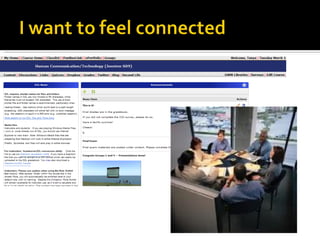
    According to asurvey by Joosten (2009), students reported that they need good (67%) and frequent communication (90%) with their instructor and good communication with their classmates (75%). They also reported that they need to feel connected to learn (80%) (http://tinyurl.com/yafu8qz).
  • 36.
  • 37.
    According to PEWInternet study, “Teens who participated in focus groups for this study said that they view email as something you use to talk to ‘old people,’ institutions, or to send complex instructions to large groups “ (http://www.pewinternet.org/Reports/2005/Teens-and-Technology.aspx?r=1).
  • 38.
  • 39.
    According to Bulik(July 8 th , 2009) “…They go to social networking sites 5 days per week and check in 4 times a day for a total of an hour per day” (para 7). According to PEW Internet study, “… Nearly three-quarters (72%) of online 18-29 year olds use these sites –similar to the rate among teens–with 45% doing so on a typical day” (http://tinyurl.com/33hynyx).
  • 40.
    New survey resultsalso show that among adults 18 and older, Facebook has taken over as the social network of choice 73% of adult profile owners use Facebook
  • 41.
  • 42.
    According to Joosten(2009), 71% of students want to receive text messages about their class (http://tinyurl.com/yafu8qz). According to PEW Interent, “the typical American teen sends and receives 50 or more messages per day, or 1,500 per month .”
  • 43.
  • 44.
    How is yourcampus implementing social media?
  • 45.
  • 46.
  • 47.
  • 48.
    Facilitating interactivity andengagement Expanding the classroom walls: Experiential learning Professional development
  • 49.
  • 50.
  • 51.
  • 52.
  • 53.
  • 54.
    Supplementary materials VideosArticles Websites Discussions Community building inside/outside classroom New student “recruitment”
  • 55.
  • 56.
  • 57.
  • 58.
  • 59.
    CONTENT & PUBLICATIONSchoolTube TeacherTube Vimeo EDUCATIONAL CONTENT MIT World PBS.org TED YouTube.EDU And many more!
  • 60.
    Presence Content –no need to recreate the wheel Student-created content Active learning Interactivity Engagement Creativity
  • 61.
  • 62.
  • 63.
  • 64.
  • 65.
    Social Dashboards TweetDeck( http://www.tweetdeck.com/ ) HootSuite ( http://hootsuite.com/ ) Seesmic ( http://seesmic.com/ ) Netvibes ( http://netvibes.com/ ) Social Browsers RockMelt ( http://www.rockmelt.com/ ) Fizzik ( http://www.fizzik.com/ )
  • 66.
    One post –multiple social media Hashtags (e.g., #edtech) Class discussions Conferences Webinars Real time Monitor multiple conversations at a glance
  • 67.
  • 68.
  • 69.
    Social media foreducators To be published by Jossey Bass Spring 2012
  • 70.
    twitter.com/tjoosten facebook.com/tjoosten juicegyoza | second life professorjoosten.blogspot.com tanyajoosten. com
  • 71.
    UWM Social MediaGrant project http://uwmsocialmedia.wikispaces.com Presentation and Data http://uwmsocialmedia.wikispaces.com/Presentations+by+Tanya Set-up Instructions http://uwmsocialmedia.wikispaces.com/Howtosocialmedia10 Creating a Twitter Account http://tinyurl.com/4lkdkj3 Creating a Facebook Fan Page http://www.facebook.com/pages/create.php #edusocmedia on YouTube, Twitter, wikispaces
  • 72.
    Heiberger, G., &Harper, R. (2008). Have you Facebooked Astin lately? Using technology to increase student involvement. New Directions for Student Services , 124. Retrieved http://tinyurl.com/4vygtde Higher Education Research Institute (HERI). (2007). College freshman and online social networking sites. Retrieved from http://gseis.ucla.edu/heri/PDFs/pubs/briefs/brief-091107-SocialNetworking.pdf Junco, R., Heibergert, G., & Loken, E. (2010). The effect of Twitter on college student engagement and grades. Journal of Computer Assisted Learning. http://blog.reyjunco.com/pdf/JuncoHeibergerLokenTwitterEngagementGrades.pdf Kopytoff, V. G. (2011). Blogs wane as the young drift to sites like Twitter. The New York Times . Retrieved from http://www.nytimes.com/2011/02/21/technology/internet/21blog.html?_r=1 Zickuhr, K. (2010). Generations 2010 . Washington DC: Pew Internet and American Life. Retrieved from http://www.pewinternet.org/Reports/2010/Generations-2010.aspx

Editor's Notes

  • #2 How do we harness the opportunity provides by student use of social media and mobile technologies to enhance their learning?  How do these tools help us as instructors develop networks to information to increase our effectiveness?  Social media tools, such as Twitter, Facebook, and YouTube, are changing the way that people across the globe communicate, share ideas, and build networks. Just over a year ago, Google lost its position as the most visited site on the web to the social media phenomenon, Facebook (see Wall Street Journal, March 14th, 2010). The interest in social media is quickly increasing, and as with many other technologies, the educational community is looking to harness the potential of these technologies to overcome challenges in the classroom and on campus. Not only do social media have the potential to improve learning in the classroom, they will be transformational for the future of education. This session will characterize the transformational potential of social media in education.
  • #3 My work with these initiatives has gained national attention. Last year, my survey of students' use of Twitter was quoted in The Chronicle of Higher Education's Wired Campus, and this summer, my social media work on Facebook was highlighted as well.  I have presented my research, including pedagogical uses, best practices, and faculty development tips, on several emerging technologies projects, including social media and virtual worlds at the EDUCAUSE annual conferences, several Sloan-C conferences, the New Media Consortium annual conference, the National Communication Association annual conference, and others.  My work was mentioned in various technology blogs and media outlets, such as Ed Tech Magazine, eCampus News, and EDUCAUSE Quarterly.   In addition, I am the EDUCAUSE social media constituent group leader, a reviewer for the EDUCAUSE Quarterly, and a reviewer for the EDUCAUSE annual conference. I am also a member of the EDUCAUSE evolving technology steering committee, the ELI Focus Group steering committee, the Sage Publications digital media advisory board, and the Sloan-C Blended conference steering committee.
  • #4 Most will be functioning as online learning concierges (the librarians will be helping the students with information fluency/literacy) The learning concierges and librarians will have primary responsibility for building and maintaining a social networking hub for online students. They will be responsible for positively and proactively reaching out to online students in our NGLC project to engage, support and scaffold them with encouragement, information, referrals, and information about the supports and services available to them on their home campuses (or elsewhere even perhaps). They need to know how to curate content that will be fed through the social networking hub “SLN online student commons” to support online students (including building support and awareness of online student self-efficacy and self regulation). They need to know how to use the social web to build community. They need to know how to use the social web for professional development – on the topics of online teaching/learning – specifically online student success. They need to know how to generate and participate in affinity groups and online discussions. I wouldn’t mind some discussion on mobile learning strategies that might be incorporated into this.
  • #5 Part 1: Getting Started with Social Media Hands-on practice with social media Tweeting, hashtags, and more Strategies to building your network Part 2: Engaging Students and Building Community Modeling, YouTube video cases Twitter, Facebook, YouTube Building knowledge, sharing and promoting Part 3: Managing your social network Social media dashboards and more Mobile devices - text, apps, and browsers
  • #31 Tweet using #edusocmedia – what is social media
  • #35 ONLINE COUORSES: POOR COMMUNICATION As Metts (2003) reported that “Over half (52%) said the worst part of the online experience was poor communication. And half of those (26% of the total) said the problem was communicating with their instructors” (para 16). STUDENTS NEED GOOD COMMUNICATION According to a survey by Joosten (2009), students reported that they need good (67%) and frequent communication (90%) with their instructor and good communication with their classmates (75%). They also reported that they need to feel connected to learn (80%) (see http://tinyurl.com/yafu8qz). Connecting with students and building connections amongst students allows us to create learning communities. Community and peer networks increases students motivation to perform and provides them with resources to help do better in class.
  • #37 D2L only pushes down e-mail, no discussion notifications for posts, no mobile notifications, etc. STUDENTS DON’T CHECK EMAIL c PEW Study – don’t check email?? As Shannon from Seton Hall Law School stated in ELI Mobile session the first week in March, they view e-mail as old technology or for old people.
  • #39 STUDENTS USE SOCIAL MEDIA OFTEN According to Bulik (July 8 th , 2009) “Out of the 110 million Americans (or 60% of the online population) who use social networks, the average social networking user logs on to these sites quite a bit. They go to social networking sites 5 days per week and check in 4 times a day for a total of an hour per day. Nine percent of that group stay logged in all day long and are ‘constantly checking what's new’” (para 7).
  • #42 In 2004 a study at UW system reported that the majority of students do not want their personal media convoluted with course-related media 5 years later in 2009, that has changed STUDENTS WANT SOCIAL MEDIA Preliminary research conducted (see http://tinyurl.com/yafu8qz ) indicates to us that the majority of students would like to receive communication about their course via text messaging and that the majority of students are on Facebook where they communicate most often.
  • #44 Social Mobile –content deliveyr
  • #65 delete