
1
What is a blog?
• Is a journal or diary (Blog, 2006)
• Usually displayed in a reverse chronological order.
• A commentary or news on a particular subject
• blogs are primarily textual…
– they sometimes contain;
• photographs (photoblog)
• videos (vlog)
• audio (podcasting)
• Are part of the social network / media
ACTIVE TEACHING & LEARNING
BLOG
DR C ANNAMALAI
SEAMEO RECSAM
PENANG
Blogs and learning
• Encourages students to write
• Students will/may write even when they do
not need to
• Reach out to the world
• Feedback from peers, teachers and the world
(possibly)
Blogs and learning
• Students link up with the writings of others
• Collaborative blogs
• Students realise that their peers can read their
work ~ motivating ~ driven
• Progress reports
• Project diaries
• Field reports
Educational Blogging
 Using blog for free blogging services, instructors
in varied disciplines are addressing:
 e-portfolios
 Writing concepts (audience, voice…)
 Publishing
 copyright and plagiarism
 authentic writing
 writing in a digital age
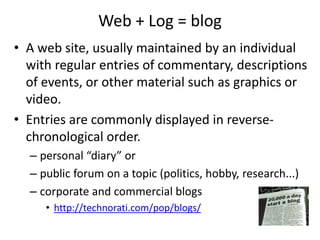
Web + Log = blog
• A web site, usually maintained by an individual
with regular entries of commentary, descriptions
of events, or other material such as graphics or
video.
• Entries are commonly displayed in reverse-
chronological order.
– personal “diary” or
– public forum on a topic (politics, hobby, research...)
– corporate and commercial blogs
• http://technorati.com/pop/blogs/
Reading Blogs
• According to 2006 survey by the Pew Internet
and American Life Project
– 39% of Internet users (57 million American adults)
said they read blogs
– An increase of 27% from 2004
• Universal McCann (March 2008) determined
that there are 184 million blogs worldwide
and 26.4 million are in the United States.
– Blog readers = 346 million worldwide with 60.3
million being Americans.
– 77% of active Internet users report that they read
blogs.
• http://www.edtechpost.ca/gems/matrix2.gif
Blogs Offer Students & Teachers
• online discussion through time-stamped
comments
• video posting (vlog)
• podcasting
• posting via email & cell phone
• free web space for class materials, portfolios,
projects
• minimal web design skills required
Getting Started - Blog Hosts
• FREE blogger.com (from Google) and
• livejournal.com, wordpress.com
• edublogs.org - Create your own ad-free fully featured WordPress blog
including free assessment tool from the Chalkface Project and an ad-free
wikispace
• Students may be familiar with sites such as
MySpace.com, Vox.com which offer blogging.
• And paid services such as typepad.com
Many Styles & Templates Offered
How Blog can be used?
• Blog as writing portfolio
• Reflections on course modules
• A tool for web design
• http://ss2233.blogspot.com
Creating a Blog
• Visit www.blogger.com
Creating a Blog (1)
• Fill in all fields: User name, password, blog name, email address, accept
terms. Click on CONTINUE.
• However, if you already have an account from Gmail, Google Groups, or
Orkut, instead of doing the above, click on sign in first.
Creating a Blog (2)
• Name your blog
– Enter your blog title, blog address (URL), word verification. Click on
CONTINUE.
Creating a Blog (3)
• Select a template (colors, layouts)
– Click on CONTINUE.
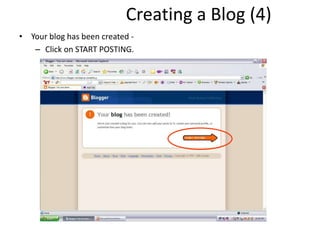
Creating a Blog (4)
• Your blog has been created -
– Click on START POSTING.
Inviting Blog Members (1)
• Click on Settings.
• Click on Permissions.
Inviting Blog Members (2)
Inviting Blog Members (3)
• Click on ADD AUTHORS.
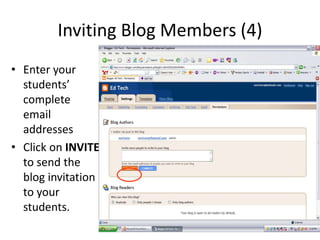
Inviting Blog Members (4)
• Enter your
students’
complete
email
addresses
• Click on INVITE
to send the
blog invitation
to your
students.
Joining the Blog (1)
• Students will receive an e-mail invitation
with a link to the registration site.
Joining the Blog (2)
• If you are a Blogger user, sign in with your username and password.
• If you are not a Blogger user, you will have to create an account.
Posting a Blog Entry
Type the title & text message and then click on
PUBLISH POST.
Posting a Photo in Your Blog (1)
 Click on the image icon, which is indicated with a box showing a picture with a blue
sky. You’ll find this icon in between the ABC checkmark and the Add Video icon.
Posting a Photo in Your Blog (2)
• Click on Browse and select your image.
• Click on Upload image.
Adding a Hyperlink (1)
Click on the hyperlink icon, which is indicated with a picture of a
chain link and globe.
Adding a Hyperlink (2)
• Type in the URL and then click on Publish Post.
Application
As you create your class blog,
consider the following:
– What are your instructional objectives?
– How will you set up guidelines for proper use
of the blog?
– How will you assess your students?
– Do all participants have the resources to
engage in your class blog?

Blog ICT slides

  • 1.
    1 What is ablog? • Is a journal or diary (Blog, 2006) • Usually displayed in a reverse chronological order. • A commentary or news on a particular subject • blogs are primarily textual… – they sometimes contain; • photographs (photoblog) • videos (vlog) • audio (podcasting) • Are part of the social network / media
  • 2.
    ACTIVE TEACHING &LEARNING BLOG DR C ANNAMALAI SEAMEO RECSAM PENANG
  • 3.
    Blogs and learning •Encourages students to write • Students will/may write even when they do not need to • Reach out to the world • Feedback from peers, teachers and the world (possibly)
  • 4.
    Blogs and learning •Students link up with the writings of others • Collaborative blogs • Students realise that their peers can read their work ~ motivating ~ driven • Progress reports • Project diaries • Field reports
  • 5.
    Educational Blogging  Usingblog for free blogging services, instructors in varied disciplines are addressing:  e-portfolios  Writing concepts (audience, voice…)  Publishing  copyright and plagiarism  authentic writing  writing in a digital age
  • 6.
    Web + Log= blog • A web site, usually maintained by an individual with regular entries of commentary, descriptions of events, or other material such as graphics or video. • Entries are commonly displayed in reverse- chronological order. – personal “diary” or – public forum on a topic (politics, hobby, research...) – corporate and commercial blogs • http://technorati.com/pop/blogs/
  • 7.
    Reading Blogs • Accordingto 2006 survey by the Pew Internet and American Life Project – 39% of Internet users (57 million American adults) said they read blogs – An increase of 27% from 2004 • Universal McCann (March 2008) determined that there are 184 million blogs worldwide and 26.4 million are in the United States. – Blog readers = 346 million worldwide with 60.3 million being Americans. – 77% of active Internet users report that they read blogs.
  • 8.
  • 9.
    Blogs Offer Students& Teachers • online discussion through time-stamped comments • video posting (vlog) • podcasting • posting via email & cell phone • free web space for class materials, portfolios, projects • minimal web design skills required
  • 10.
    Getting Started -Blog Hosts • FREE blogger.com (from Google) and • livejournal.com, wordpress.com • edublogs.org - Create your own ad-free fully featured WordPress blog including free assessment tool from the Chalkface Project and an ad-free wikispace • Students may be familiar with sites such as MySpace.com, Vox.com which offer blogging. • And paid services such as typepad.com
  • 11.
    Many Styles &Templates Offered
  • 12.
    How Blog canbe used? • Blog as writing portfolio • Reflections on course modules • A tool for web design • http://ss2233.blogspot.com
  • 13.
    Creating a Blog •Visit www.blogger.com
  • 14.
    Creating a Blog(1) • Fill in all fields: User name, password, blog name, email address, accept terms. Click on CONTINUE. • However, if you already have an account from Gmail, Google Groups, or Orkut, instead of doing the above, click on sign in first.
  • 15.
    Creating a Blog(2) • Name your blog – Enter your blog title, blog address (URL), word verification. Click on CONTINUE.
  • 16.
    Creating a Blog(3) • Select a template (colors, layouts) – Click on CONTINUE.
  • 17.
    Creating a Blog(4) • Your blog has been created - – Click on START POSTING.
  • 18.
    Inviting Blog Members(1) • Click on Settings.
  • 19.
    • Click onPermissions. Inviting Blog Members (2)
  • 20.
    Inviting Blog Members(3) • Click on ADD AUTHORS.
  • 21.
    Inviting Blog Members(4) • Enter your students’ complete email addresses • Click on INVITE to send the blog invitation to your students.
  • 22.
    Joining the Blog(1) • Students will receive an e-mail invitation with a link to the registration site.
  • 23.
    Joining the Blog(2) • If you are a Blogger user, sign in with your username and password. • If you are not a Blogger user, you will have to create an account.
  • 24.
    Posting a BlogEntry Type the title & text message and then click on PUBLISH POST.
  • 25.
    Posting a Photoin Your Blog (1)  Click on the image icon, which is indicated with a box showing a picture with a blue sky. You’ll find this icon in between the ABC checkmark and the Add Video icon.
  • 26.
    Posting a Photoin Your Blog (2) • Click on Browse and select your image. • Click on Upload image.
  • 27.
    Adding a Hyperlink(1) Click on the hyperlink icon, which is indicated with a picture of a chain link and globe.
  • 28.
    Adding a Hyperlink(2) • Type in the URL and then click on Publish Post.
  • 29.
    Application As you createyour class blog, consider the following: – What are your instructional objectives? – How will you set up guidelines for proper use of the blog? – How will you assess your students? – Do all participants have the resources to engage in your class blog?