Dr. Shahnawaz Alam
Guided by: Dr. Vikas Chandra Jha
HOD, Dept. of Neurosurgery
Moderated by: Dr. Saraj kumar Singh
Faculty, Dept. of Neurosurgery
Facial Nerve Examination
Content
• Introduction
• Anatomy
• Clinical Examination
• Applied aspect
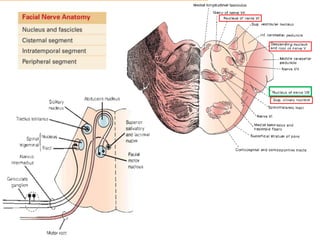
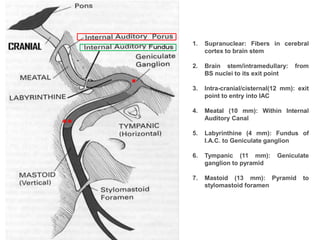
1. Supranuclear: Fibers in cerebral
cortex to brain stem
2. Brain stem/intramedullary: from
BS nuclei to its exit point
3. Intra-cranial/cisternal(12 mm): exit
point to entry into IAC
4. Meatal (10 mm): Within Internal
Auditory Canal
5. Labyrinthine (4 mm): Fundus of
I.A.C. to Geniculate ganglion
6. Tympanic (11 mm): Geniculate
ganglion to pyramid
7. Mastoid (13 mm): Pyramid to
stylomastoid foramen
*
**
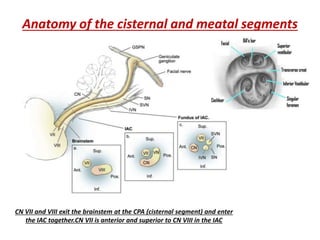
Anatomy of the cisternal and meatal segments
CN VII and VIII exit the brainstem at the CPA (cisternal segment) and enter
the IAC together.CN VII is anterior and superior to CN VIII in the IAC
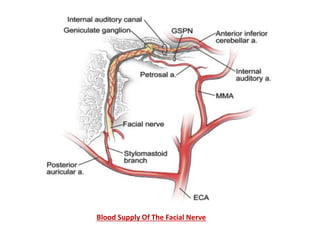
Blood Supply Of The Facial Nerve
CLINICAL EXAMINATION
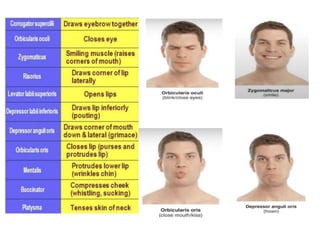
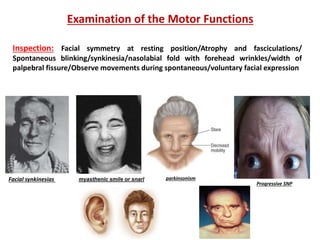
Examination of the Motor Functions
Inspection: Facial symmetry at resting position/Atrophy and fasciculations/
Spontaneous blinking/synkinesia/nasolabial fold with forehead wrinkles/width of
palpebral fissure/Observe movements during spontaneous/voluntary facial expression
Facial synkinesias myasthenic smile or snarl parkinsonism
Progressive SNP
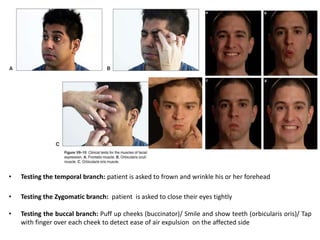
• Testing the temporal branch: patient is asked to frown and wrinkle his or her forehead
• Testing the Zygomatic branch: patient is asked to close their eyes tightly
• Testing the buccal branch: Puff up cheeks (buccinator)/ Smile and show teeth (orbicularis oris)/ Tap
with finger over each cheek to detect ease of air expulsion on the affected side
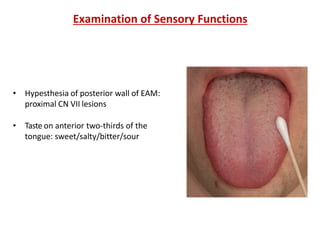
Examination of Sensory Functions
• Hypesthesia of posterior wall of EAM:
proximal CN VII lesions
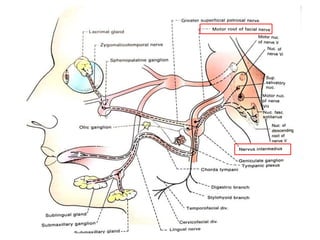
• Taste on anterior two-thirds of the
tongue: sweet/salty/bitter/sour
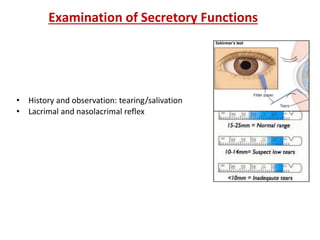
Examination of Secretory Functions
• History and observation: tearing/salivation
• Lacrimal and nasolacrimal reflex
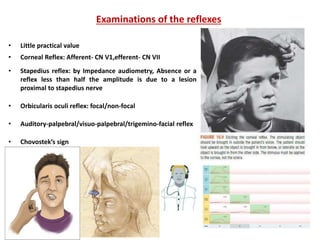
• Little practical value
• Corneal Reflex: Afferent- CN V1,efferent- CN VII
• Stapedius reflex: by Impedance audiometry, Absence or a
reflex less than half the amplitude is due to a lesion
proximal to stapedius nerve
• Orbicularis oculi reflex: focal/non-focal
• Auditory-palpebral/visuo-palpebral/trigemino-facial reflex
• Chovostek’s sign
Examinations of the reflexes
Disorders of functions
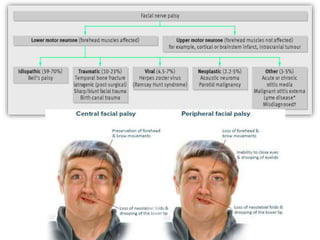
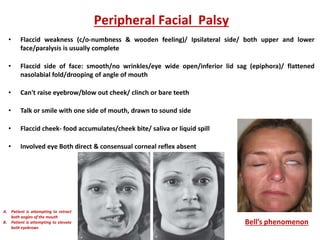
Peripheral Facial Palsy
• Flaccid weakness (c/o-numbness & wooden feeling)/ Ipsilateral side/ both upper and lower
face/paralysis is usually complete
• Flaccid side of face: smooth/no wrinkles/eye wide open/inferior lid sag (epiphora)/ flattened
nasolabial fold/drooping of angle of mouth
• Can't raise eyebrow/blow out cheek/ clinch or bare teeth
• Talk or smile with one side of mouth, drawn to sound side
• Flaccid cheek- food accumulates/cheek bite/ saliva or liquid spill
• Involved eye Both direct & consensual corneal reflex absent
Bell’s phenomenon
A. Patient is attempting to retract
both angles of the mouth
B. Patient is attempting to elevate
both eyebrows
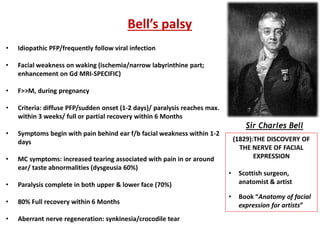
Sir Charles Bell
Bell’s palsy
• Idiopathic PFP/frequently follow viral infection
• Facial weakness on waking (ischemia/narrow labyrinthine part;
enhancement on Gd MRI-SPECIFIC)
• F>>M, during pregnancy
• Criteria: diffuse PFP/sudden onset (1-2 days)/ paralysis reaches max.
within 3 weeks/ full or partial recovery within 6 Months
• Symptoms begin with pain behind ear f/b facial weakness within 1-2
days
• MC symptoms: increased tearing associated with pain in or around
ear/ taste abnormalities (dysgeusia 60%)
• Paralysis complete in both upper & lower face (70%)
• 80% Full recovery within 6 Months
• Aberrant nerve regeneration: synkinesia/crocodile tear
(1829):THE DISCOVERY OF
THE NERVE OF FACIAL
EXPRESSION
• Scottish surgeon,
anatomist & artist
• Book “Anatomy of facial
expression for artists”
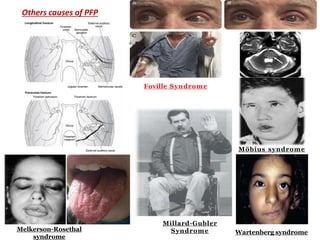
Wartenberg syndrome
Others causes of PFP
Möbius syndrome
Millard-Gubler
Syndrome
Foville Syndrome
Melkerson-Rosethal
syndrome
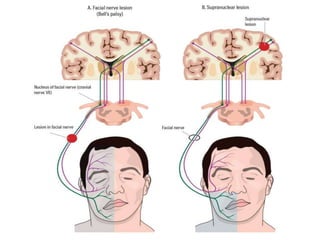
Facial Weakness of Central Origin
• Weakness of C/L lower face with relative sparing of upper face/ paralysis rarely
complete
• Subtle weakness of orbicularis oculi But involvement of frontalis & corrugator is
unusual
• Always able to close eye/ Bell phenomenon absent/ corneal reflex present
• In most cases, facial asymmetry present in both voluntary & spontaneous facial
movement; But when it is more marked with one than other (Dissociation)
 Two variations:
1. Volitional/voluntary: Facial asymmetry more marked during voluntary
contraction/ Lesion of lower third of the precentral gyrus or the
corticobulbar tract
2. Emotional/mimetic: Thalamic or striatocapsular lesions
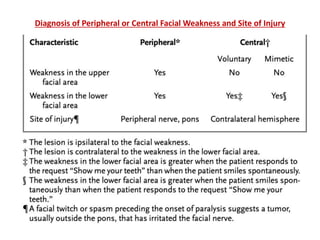
Diagnosis of Peripheral or Central Facial Weakness and Site of Injury
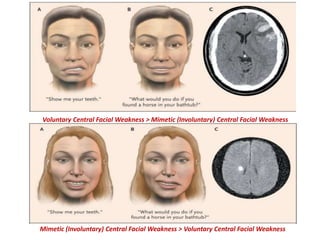
Voluntary Central Facial Weakness > Mimetic (Involuntary) Central Facial Weakness
Mimetic (Involuntary) Central Facial Weakness > Voluntary Central Facial Weakness
Abnormal Facial Movements
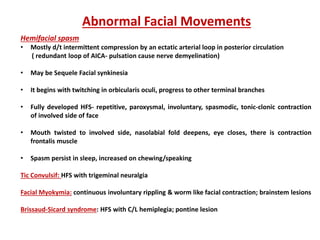
Hemifacial spasm
• Mostly d/t intermittent compression by an ectatic arterial loop in posterior circulation
( redundant loop of AICA- pulsation cause nerve demyelination)
• May be Sequele Facial synkinesia
• It begins with twitching in orbicularis oculi, progress to other terminal branches
• Fully developed HFS- repetitive, paroxysmal, involuntary, spasmodic, tonic-clonic contraction
of involved side of face
• Mouth twisted to involved side, nasolabial fold deepens, eye closes, there is contraction
frontalis muscle
• Spasm persist in sleep, increased on chewing/speaking
Tic Convulsif: HFS with trigeminal neuralgia
Facial Myokymia: continuous involuntary rippling & worm like facial contraction; brainstem lesions
Brissaud-Sicard syndrome: HFS with C/L hemiplegia; pontine lesion
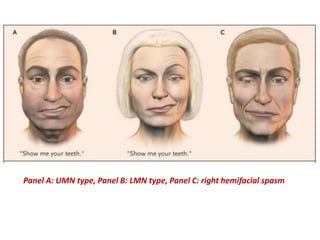
Panel A: UMN type, Panel B: LMN type, Panel C: right hemifacial spasm
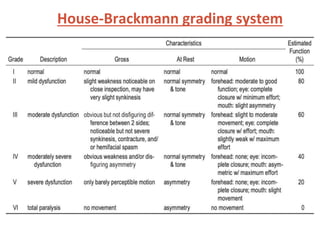
House-Brackmann grading system
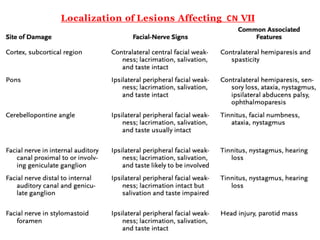
Localization of Lesions Affecting CN VII
THANK YOU

facial nerve examination

  • 1.
    Dr. Shahnawaz Alam Guidedby: Dr. Vikas Chandra Jha HOD, Dept. of Neurosurgery Moderated by: Dr. Saraj kumar Singh Faculty, Dept. of Neurosurgery Facial Nerve Examination
  • 2.
    Content • Introduction • Anatomy •Clinical Examination • Applied aspect
  • 5.
    1. Supranuclear: Fibersin cerebral cortex to brain stem 2. Brain stem/intramedullary: from BS nuclei to its exit point 3. Intra-cranial/cisternal(12 mm): exit point to entry into IAC 4. Meatal (10 mm): Within Internal Auditory Canal 5. Labyrinthine (4 mm): Fundus of I.A.C. to Geniculate ganglion 6. Tympanic (11 mm): Geniculate ganglion to pyramid 7. Mastoid (13 mm): Pyramid to stylomastoid foramen * **
  • 6.
    Anatomy of thecisternal and meatal segments CN VII and VIII exit the brainstem at the CPA (cisternal segment) and enter the IAC together.CN VII is anterior and superior to CN VIII in the IAC
  • 7.
    Blood Supply OfThe Facial Nerve
  • 10.
  • 11.
    Examination of theMotor Functions Inspection: Facial symmetry at resting position/Atrophy and fasciculations/ Spontaneous blinking/synkinesia/nasolabial fold with forehead wrinkles/width of palpebral fissure/Observe movements during spontaneous/voluntary facial expression Facial synkinesias myasthenic smile or snarl parkinsonism Progressive SNP
  • 12.
    • Testing thetemporal branch: patient is asked to frown and wrinkle his or her forehead • Testing the Zygomatic branch: patient is asked to close their eyes tightly • Testing the buccal branch: Puff up cheeks (buccinator)/ Smile and show teeth (orbicularis oris)/ Tap with finger over each cheek to detect ease of air expulsion on the affected side
  • 13.
    Examination of SensoryFunctions • Hypesthesia of posterior wall of EAM: proximal CN VII lesions • Taste on anterior two-thirds of the tongue: sweet/salty/bitter/sour
  • 14.
    Examination of SecretoryFunctions • History and observation: tearing/salivation • Lacrimal and nasolacrimal reflex
  • 15.
    • Little practicalvalue • Corneal Reflex: Afferent- CN V1,efferent- CN VII • Stapedius reflex: by Impedance audiometry, Absence or a reflex less than half the amplitude is due to a lesion proximal to stapedius nerve • Orbicularis oculi reflex: focal/non-focal • Auditory-palpebral/visuo-palpebral/trigemino-facial reflex • Chovostek’s sign Examinations of the reflexes
  • 16.
  • 19.
    Peripheral Facial Palsy •Flaccid weakness (c/o-numbness & wooden feeling)/ Ipsilateral side/ both upper and lower face/paralysis is usually complete • Flaccid side of face: smooth/no wrinkles/eye wide open/inferior lid sag (epiphora)/ flattened nasolabial fold/drooping of angle of mouth • Can't raise eyebrow/blow out cheek/ clinch or bare teeth • Talk or smile with one side of mouth, drawn to sound side • Flaccid cheek- food accumulates/cheek bite/ saliva or liquid spill • Involved eye Both direct & consensual corneal reflex absent Bell’s phenomenon A. Patient is attempting to retract both angles of the mouth B. Patient is attempting to elevate both eyebrows
  • 20.
    Sir Charles Bell Bell’spalsy • Idiopathic PFP/frequently follow viral infection • Facial weakness on waking (ischemia/narrow labyrinthine part; enhancement on Gd MRI-SPECIFIC) • F>>M, during pregnancy • Criteria: diffuse PFP/sudden onset (1-2 days)/ paralysis reaches max. within 3 weeks/ full or partial recovery within 6 Months • Symptoms begin with pain behind ear f/b facial weakness within 1-2 days • MC symptoms: increased tearing associated with pain in or around ear/ taste abnormalities (dysgeusia 60%) • Paralysis complete in both upper & lower face (70%) • 80% Full recovery within 6 Months • Aberrant nerve regeneration: synkinesia/crocodile tear (1829):THE DISCOVERY OF THE NERVE OF FACIAL EXPRESSION • Scottish surgeon, anatomist & artist • Book “Anatomy of facial expression for artists”
  • 21.
    Wartenberg syndrome Others causesof PFP Möbius syndrome Millard-Gubler Syndrome Foville Syndrome Melkerson-Rosethal syndrome
  • 22.
    Facial Weakness ofCentral Origin • Weakness of C/L lower face with relative sparing of upper face/ paralysis rarely complete • Subtle weakness of orbicularis oculi But involvement of frontalis & corrugator is unusual • Always able to close eye/ Bell phenomenon absent/ corneal reflex present • In most cases, facial asymmetry present in both voluntary & spontaneous facial movement; But when it is more marked with one than other (Dissociation)  Two variations: 1. Volitional/voluntary: Facial asymmetry more marked during voluntary contraction/ Lesion of lower third of the precentral gyrus or the corticobulbar tract 2. Emotional/mimetic: Thalamic or striatocapsular lesions
  • 23.
    Diagnosis of Peripheralor Central Facial Weakness and Site of Injury
  • 24.
    Voluntary Central FacialWeakness > Mimetic (Involuntary) Central Facial Weakness Mimetic (Involuntary) Central Facial Weakness > Voluntary Central Facial Weakness
  • 25.
    Abnormal Facial Movements Hemifacialspasm • Mostly d/t intermittent compression by an ectatic arterial loop in posterior circulation ( redundant loop of AICA- pulsation cause nerve demyelination) • May be Sequele Facial synkinesia • It begins with twitching in orbicularis oculi, progress to other terminal branches • Fully developed HFS- repetitive, paroxysmal, involuntary, spasmodic, tonic-clonic contraction of involved side of face • Mouth twisted to involved side, nasolabial fold deepens, eye closes, there is contraction frontalis muscle • Spasm persist in sleep, increased on chewing/speaking Tic Convulsif: HFS with trigeminal neuralgia Facial Myokymia: continuous involuntary rippling & worm like facial contraction; brainstem lesions Brissaud-Sicard syndrome: HFS with C/L hemiplegia; pontine lesion
  • 26.
    Panel A: UMNtype, Panel B: LMN type, Panel C: right hemifacial spasm
  • 27.
  • 28.
    Localization of LesionsAffecting CN VII
  • 29.