The Stories
We Live By
A free online course
in ecolinguistics
www.storiesweliveby.org.uk by Arran Stibbe
University of
Gloucestershire
Part 1: Introduction
Stories we live by
 Stories are cognitive structures in the
minds of individuals which influence
how they think, talk and act.
 Stories-we-live-by are stories in the minds
of multiple individuals across a culture.
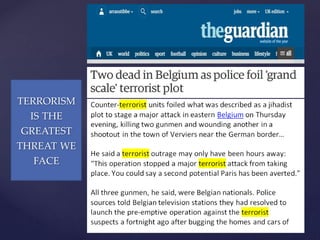
TERRORISM
IS THE
GREATEST
THREAT WE
FACE
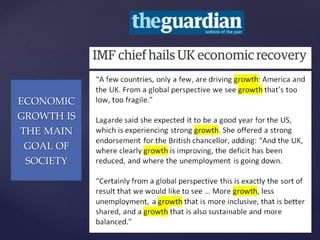
ECONOMIC
GROWTH IS
THE MAIN
GOAL OF
SOCIETY
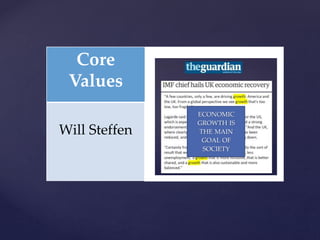
Core
Values
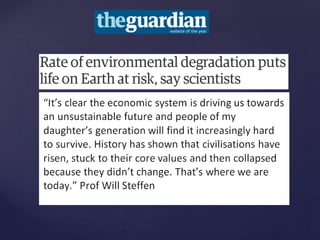
Will Steffen
ECONOMIC
GROWTH IS
THE MAIN
GOAL OF
SOCIETY
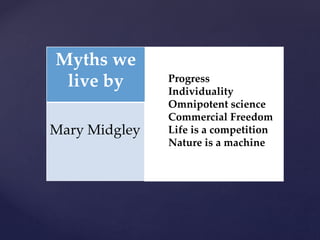
Myths we
live by Progress
Individuality
Omnipotent science
Commercial Freedom
Life is a competition
Nature is a machine
Mary Midgley
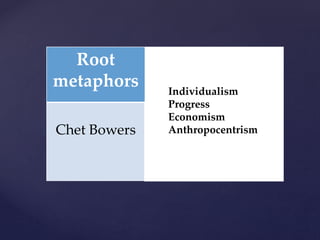
Root
metaphors Individualism
Progress
Economism
AnthropocentrismChet Bowers
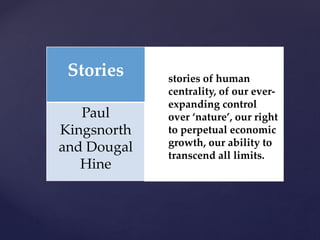
Stories stories of human
centrality, of our ever-
expanding control
over ‘nature’, our right
to perpetual economic
growth, our ability to
transcend all limits.
Paul
Kingsnorth
and Dougal
Hine
Stories are the secret reservoir of
values: change the stories that
individuals or nations live by and
you change the individuals and
nations themselves.
BenOkri
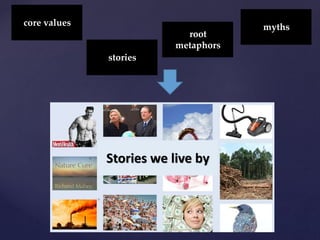
Stories we live by
mythscore values
root
metaphors
stories
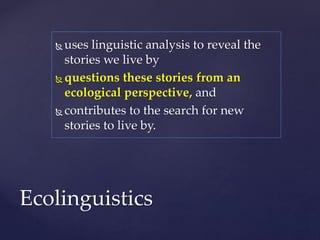
 uses linguistic analysis to reveal the
stories we live by
 questions these stories from an
ecological perspective, and
 contributes to the search for new
stories to live by.
Ecolinguistics
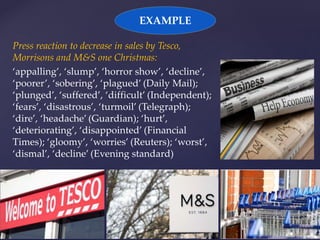
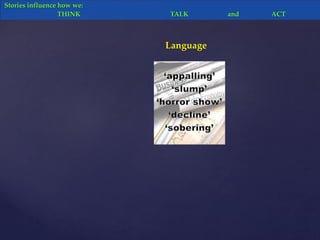
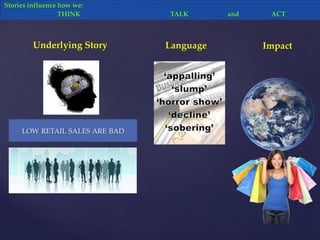
Press reaction to decrease in sales by Tesco,
Morrisons and M&S one Christmas:
‘appalling’, ‘slump’, ‘horror show’, ‘decline’,
‘poorer’, ‘sobering’, ‘plagued’ (Daily Mail);
‘plunged’, ‘suffered’, ‘difficult’ (Independent);
‘fears’, ‘disastrous’, ‘turmoil’ (Telegraph);
‘dire’, ‘headache’ (Guardian); ‘hurt’,
‘deteriorating’, ‘disappointed’ (Financial
Times); ‘gloomy’, ‘worries’ (Reuters); ‘worst’,
‘dismal’, ‘decline’ (Evening standard)
EXAMPLE
Language
Stories influence how we:
THINK TALK and ACT
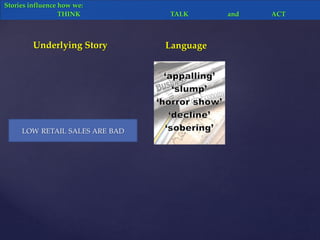
LOW RETAIL SALES ARE BAD
Underlying Story Language
Stories influence how we:
THINK TALK and ACT
LOW RETAIL SALES ARE BAD
Underlying Story Language
Stories influence how we:
THINK TALK and ACT
LOW RETAIL SALES ARE BAD
Underlying Story Language
Stories influence how we:
THINK TALK and ACT
 uses linguistic analysis to reveal the
stories we live by
 questions these stories from an
ecological perspective, and
 contributes to the search for new
stories to live by.
Ecolinguistics
LOW RETAIL SALES ARE BAD
Underlying Story Language Impact
Stories influence how we:
THINK TALK and ACT
 uses linguistic analysis to reveal the
stories we live by
 questions these stories from an
ecological perspective, and
 contributes to the search for new
stories to live by.
Ecolinguistics
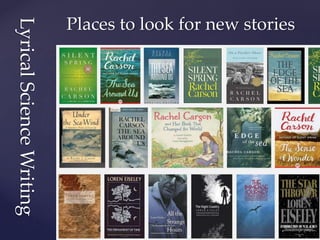
LyricalScienceWriting Places to look for new stories
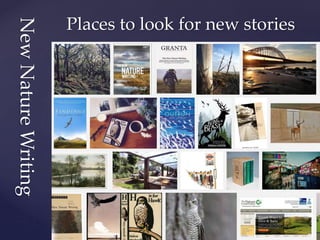
NewNatureWriting Places to look for new stories
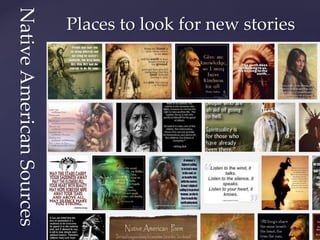
NativeAmericanSources Places to look for new stories
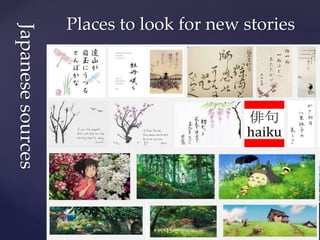
Japanesesources Places to look for new stories
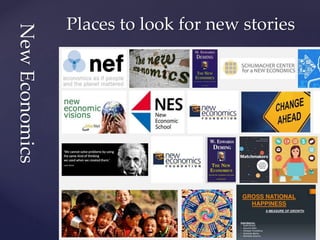
NewEconomics Places to look for new stories
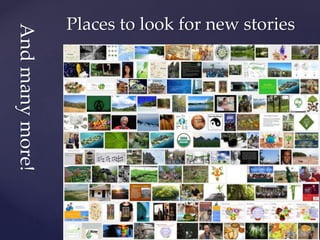
Andmanymore! Places to look for new stories
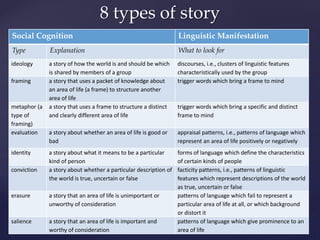
Social Cognition Linguistic Manifestation
Type Explanation What to look for
ideology a story of how the world is and should be which
is shared by members of a group
discourses, i.e., clusters of linguistic features
characteristically used by the group
framing a story that uses a packet of knowledge about
an area of life (a frame) to structure another
area of life
trigger words which bring a frame to mind
metaphor (a
type of
framing)
a story that uses a frame to structure a distinct
and clearly different area of life
trigger words which bring a specific and distinct
frame to mind
evaluation a story about whether an area of life is good or
bad
appraisal patterns, i.e., patterns of language which
represent an area of life positively or negatively
identity a story about what it means to be a particular
kind of person
forms of language which define the characteristics
of certain kinds of people
conviction a story about whether a particular description of
the world is true, uncertain or false
facticity patterns, i.e., patterns of linguistic
features which represent descriptions of the world
as true, uncertain or false
erasure a story that an area of life is unimportant or
unworthy of consideration
patterns of language which fail to represent a
particular area of life at all, or which background
or distort it
salience a story that an area of life is important and
worthy of consideration
patterns of language which give prominence to an
area of life
8 types of story
End of Part 1
BASED ON
chapter 1 of
Stibbe, Arran (2015)
Ecolinguistics: language,
ecology and the stories we
live by. London: Routledge
Produced by Arran Stibbe, with the assistance of:
Charlotte Dover
Alex James
Meg Shaw
Nicole Walker
and other volunteers from the International Ecolinguistics Association
and the University of Gloucestershire.
Filming by Unit One Films, http://unit1films.co.uk
CREDITS
REFERENCES
Bowers, C., 2014. The false promises of the digital revolution. New York: Peter
Lang. p.27
Kingsnorth, P. and Hine, D., 2009. The Dark Mountain Project manifesto
http://dark-mountain.net
Midgley, M., 2011. The myths we live by. New York: Routledge. p.1
Okri, B., 1996. Birds of heaven. London: Phoenix. p.21
Steffen, Will (2015) in Milman, Oliver. Rate of environmental degradation puts life
on Earth at risk, say scientists. Guardian (online) Jan 15 2016
www.theguardian.com/environment/2015/jan/15
Traynor, Ian, J. Borger and A. Topping (2015) Two dead in Belgium as police foil
'grand scale' terrorist plot. Guardian online. Jan 16
https://www.theguardian.com/world/2015/jan/15
Watt, N. (2015) IMF chief hails UK economic recovery.
www.theguardian.com/politics/2015/jan/16
These materials have been produced for
public benefit and the producer places no
restriction on their subsequent re-use for
any purpose. However, copyright of images
and quotations used in these materials
remains with the original producers.
COPYRIGHT
Head cogs Copyright: Krisdog / 123RF Stock Photo
(www.123rf.com/profile_Krisdog)
World Copyright: robertsrob / 123RF Stock Photo
(www.123rf.com/profile_robertsrob)
Society Copyright: eobrazy / 123RF Stock Photo
(www.123rf.com/profile_eobrazy)
Nature person Copyright: lenanet / 123RF Stock Photo
(www.123rf.com/profile_lenanet)
Military and Factory Copyright: route55 / 123RF Stock Photo
(www.123rf.com/profile_route55)
Newspapers Copyright: nikolaev / 123RF Stock Photo
(www.123rf.com/profile_nikolaev)
Shopping Bags Copyright: ariwasabi / 123RF Stock Photo
(http://www.123rf.com/profile_ariwasabi)
IMAGES
IMAGES
Screen shot of Guardian website Jan 16 2015 under
fair dealing legislation, for purposes of criticism (to
comment on the location of the environmental
report)
Pastiche images used under fair dealing legislation
to concisely convey a wide range of sources for new
stories to live by.
Any quotations and images not mentioned
above are reproduced as fair dealing under
Section 29(1), Section 30(1) and 30A of the
UK 1988 Copyright, Designs and Patents Act,
for non-commercial purposes of instruction,
review, criticism, parody or pastiche.
Any requests for removal of copyright material should
be sent to astibbe@glos.ac.uk
OTHER QUOTATIONS AND IMAGES

Ecolinguistics

  • 1.
    The Stories We LiveBy A free online course in ecolinguistics www.storiesweliveby.org.uk by Arran Stibbe University of Gloucestershire
  • 2.
  • 3.
    Stories we liveby  Stories are cognitive structures in the minds of individuals which influence how they think, talk and act.  Stories-we-live-by are stories in the minds of multiple individuals across a culture.
  • 4.
  • 5.
  • 8.
  • 9.
    Myths we live byProgress Individuality Omnipotent science Commercial Freedom Life is a competition Nature is a machine Mary Midgley
  • 10.
  • 11.
    Stories stories ofhuman centrality, of our ever- expanding control over ‘nature’, our right to perpetual economic growth, our ability to transcend all limits. Paul Kingsnorth and Dougal Hine
  • 12.
    Stories are thesecret reservoir of values: change the stories that individuals or nations live by and you change the individuals and nations themselves. BenOkri
  • 13.
    Stories we liveby mythscore values root metaphors stories
  • 14.
     uses linguisticanalysis to reveal the stories we live by  questions these stories from an ecological perspective, and  contributes to the search for new stories to live by. Ecolinguistics
  • 15.
    Press reaction todecrease in sales by Tesco, Morrisons and M&S one Christmas: ‘appalling’, ‘slump’, ‘horror show’, ‘decline’, ‘poorer’, ‘sobering’, ‘plagued’ (Daily Mail); ‘plunged’, ‘suffered’, ‘difficult’ (Independent); ‘fears’, ‘disastrous’, ‘turmoil’ (Telegraph); ‘dire’, ‘headache’ (Guardian); ‘hurt’, ‘deteriorating’, ‘disappointed’ (Financial Times); ‘gloomy’, ‘worries’ (Reuters); ‘worst’, ‘dismal’, ‘decline’ (Evening standard) EXAMPLE
  • 16.
    Language Stories influence howwe: THINK TALK and ACT
  • 17.
    LOW RETAIL SALESARE BAD Underlying Story Language Stories influence how we: THINK TALK and ACT
  • 18.
    LOW RETAIL SALESARE BAD Underlying Story Language Stories influence how we: THINK TALK and ACT
  • 19.
    LOW RETAIL SALESARE BAD Underlying Story Language Stories influence how we: THINK TALK and ACT
  • 20.
     uses linguisticanalysis to reveal the stories we live by  questions these stories from an ecological perspective, and  contributes to the search for new stories to live by. Ecolinguistics
  • 21.
    LOW RETAIL SALESARE BAD Underlying Story Language Impact Stories influence how we: THINK TALK and ACT
  • 22.
     uses linguisticanalysis to reveal the stories we live by  questions these stories from an ecological perspective, and  contributes to the search for new stories to live by. Ecolinguistics
  • 23.
    LyricalScienceWriting Places tolook for new stories
  • 24.
    NewNatureWriting Places tolook for new stories
  • 25.
    NativeAmericanSources Places tolook for new stories
  • 26.
    Japanesesources Places tolook for new stories
  • 27.
    NewEconomics Places tolook for new stories
  • 28.
    Andmanymore! Places tolook for new stories
  • 29.
    Social Cognition LinguisticManifestation Type Explanation What to look for ideology a story of how the world is and should be which is shared by members of a group discourses, i.e., clusters of linguistic features characteristically used by the group framing a story that uses a packet of knowledge about an area of life (a frame) to structure another area of life trigger words which bring a frame to mind metaphor (a type of framing) a story that uses a frame to structure a distinct and clearly different area of life trigger words which bring a specific and distinct frame to mind evaluation a story about whether an area of life is good or bad appraisal patterns, i.e., patterns of language which represent an area of life positively or negatively identity a story about what it means to be a particular kind of person forms of language which define the characteristics of certain kinds of people conviction a story about whether a particular description of the world is true, uncertain or false facticity patterns, i.e., patterns of linguistic features which represent descriptions of the world as true, uncertain or false erasure a story that an area of life is unimportant or unworthy of consideration patterns of language which fail to represent a particular area of life at all, or which background or distort it salience a story that an area of life is important and worthy of consideration patterns of language which give prominence to an area of life 8 types of story
  • 30.
  • 31.
    BASED ON chapter 1of Stibbe, Arran (2015) Ecolinguistics: language, ecology and the stories we live by. London: Routledge
  • 32.
    Produced by ArranStibbe, with the assistance of: Charlotte Dover Alex James Meg Shaw Nicole Walker and other volunteers from the International Ecolinguistics Association and the University of Gloucestershire. Filming by Unit One Films, http://unit1films.co.uk CREDITS
  • 33.
    REFERENCES Bowers, C., 2014.The false promises of the digital revolution. New York: Peter Lang. p.27 Kingsnorth, P. and Hine, D., 2009. The Dark Mountain Project manifesto http://dark-mountain.net Midgley, M., 2011. The myths we live by. New York: Routledge. p.1 Okri, B., 1996. Birds of heaven. London: Phoenix. p.21 Steffen, Will (2015) in Milman, Oliver. Rate of environmental degradation puts life on Earth at risk, say scientists. Guardian (online) Jan 15 2016 www.theguardian.com/environment/2015/jan/15 Traynor, Ian, J. Borger and A. Topping (2015) Two dead in Belgium as police foil 'grand scale' terrorist plot. Guardian online. Jan 16 https://www.theguardian.com/world/2015/jan/15 Watt, N. (2015) IMF chief hails UK economic recovery. www.theguardian.com/politics/2015/jan/16
  • 34.
    These materials havebeen produced for public benefit and the producer places no restriction on their subsequent re-use for any purpose. However, copyright of images and quotations used in these materials remains with the original producers. COPYRIGHT
  • 35.
    Head cogs Copyright:Krisdog / 123RF Stock Photo (www.123rf.com/profile_Krisdog) World Copyright: robertsrob / 123RF Stock Photo (www.123rf.com/profile_robertsrob) Society Copyright: eobrazy / 123RF Stock Photo (www.123rf.com/profile_eobrazy) Nature person Copyright: lenanet / 123RF Stock Photo (www.123rf.com/profile_lenanet) Military and Factory Copyright: route55 / 123RF Stock Photo (www.123rf.com/profile_route55) Newspapers Copyright: nikolaev / 123RF Stock Photo (www.123rf.com/profile_nikolaev) Shopping Bags Copyright: ariwasabi / 123RF Stock Photo (http://www.123rf.com/profile_ariwasabi) IMAGES
  • 36.
    IMAGES Screen shot ofGuardian website Jan 16 2015 under fair dealing legislation, for purposes of criticism (to comment on the location of the environmental report) Pastiche images used under fair dealing legislation to concisely convey a wide range of sources for new stories to live by.
  • 37.
    Any quotations andimages not mentioned above are reproduced as fair dealing under Section 29(1), Section 30(1) and 30A of the UK 1988 Copyright, Designs and Patents Act, for non-commercial purposes of instruction, review, criticism, parody or pastiche. Any requests for removal of copyright material should be sent to astibbe@glos.ac.uk OTHER QUOTATIONS AND IMAGES

Editor's Notes

  • #3 I’m Arran Stibbe, a Reader in Ecological Linguistics, at the University of Gloucestershire. I’d like to invite you to join me to explore the stories we live by: the stories that our society is built on. First some definitions:
  • #5 We can get a glimpse at the stories we live by through looking at a typical online newspaper. The main story, as it often is, is about terrorism. Terrorism appears so often in the press that we can start seeing it as the greatest threat that we face. But in the UK, there are 29,000 deaths per year from air pollution (source: : Air Quality: Public Health Impacts and Local Actions – LAQM). The story ‘terrorism is a threat’ is much more of a story that we live by than ‘air pollution is a threat’.
  • #6 As we scroll down the newspaper, we find articles about the economy, and a preoccupation, almost an obsession with ‘growth’. Growth, profit, getting richer is the goal of society. Another story that we live by.
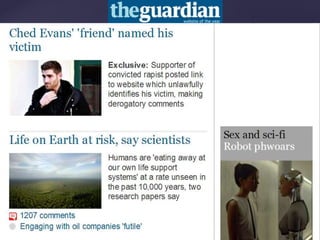
  • #7 As we scroll down to the bottom, right next to an article about sexy robots (Robot Phwoars), we find an article ‘Life on earth at risk’ say scientists.
  • #8 If we click on it we get this chilling message. So Will Steffen is talking about the ‘core values’ at the heart of our society that are leading us on a path towards destruction
  • #9 Core values, like economic growth is main goal of society.
  • #10 Mary Midgely talks of the ’myths we live by’; the ones which are leading our society down a dangerous path.
  • #11 Bowers speaks of ‘root’ metaphors. An overemphasis on the individual rather than the group, on technological progress, on the economy, and seeing humans as the centre of the world.
  • #12 Kingsnoth and Hine speak of ‘stories’. The most dangerous stories of all, they say, are “stories of human centrality, of our ever-expanding control over ‘nature’, our right to perpetual economic growth, our ability to transcend all limits”
  • #13 Here’s a great quote from Ben Okri…
  • #14 In Ecolinguistics we take core values, stories, root metaphors, and myths, and put them all together as STORIES WE LIVE BY.
  • #15 What ecolinguistics does is to use linguistic analysis to reveal the stories we live by.
  • #16 Here’s an example. At Christmas a while back sales in three major supermarkets in the UK went down. The supermarkets still made a profit, but it was a smaller profit than usual. The reaction from the press treated this as if it was a tragedy.
  • #17 So we can we see there’s a particular type of language that’s being used here.
  • #18 And underlying these ways of using language there is a story. The story is that ‘low retail sales are bad’.
  • #19 The story is one which is in the minds of individual people – cognition.
  • #20 But it’s also in the minds of multiple people right across a society, which is what we call ‘social cognition’. So is the story ‘low retail sales are bad’ a useful story for us to live by?
  • #21 Well the next thing that ecolinguistics does is to question stories from an ecological perspective. Does the story encourage people to consume less, respect the natural world, share resources more fairly, protect the environment, or other things that the analyst believes are important for protecting the ecosystems that life depends on?
  • #22 So for ‘low retail sales are bad’ we could say that this is a destructive story because it encourages people to buy more goods. And the more goods we buy the greater the environmental impact on the world. So the stories we live by influence how we think, talk and act. And some stories are destructive in encouraging us to behave in ways that harm the ecosystems that life depends on.
  • #23 And finally, when we find stories that aren’t working, that are leading to inequality or destruction of the environment, then the task of ecolinguistics is to search for new stories to live by. We are searching for ways of using language that encourage people to consume less, respect the natural world, share resources more fairly, or other things that we believe are important. So where can we look for new stories to live by?
  • #30 This course will explore eight different kinds of stories we live by. It will give a toolkit for revealing the stories we live by, questioning those stories and contributing to the search for new stories to live by.