Blended Redesign Workshop
Center for Excellence in Learning and Teaching
Sue Hines & Bob Andersen
Saint Mary’s University of MN
2015
In this 2-hour session you will
• Discover the unique qualities of a blended
course
• Reflect on your instructional design process
• Begin redesigning your course to a blended
course
• Understand how to communicate your
blended course design in a syllabus
In the next 2-hour session, you will
• Begin to identify learning technologies that
best fit your blended course
• Apply basic Blackboard practices to design and
deliver your blended course
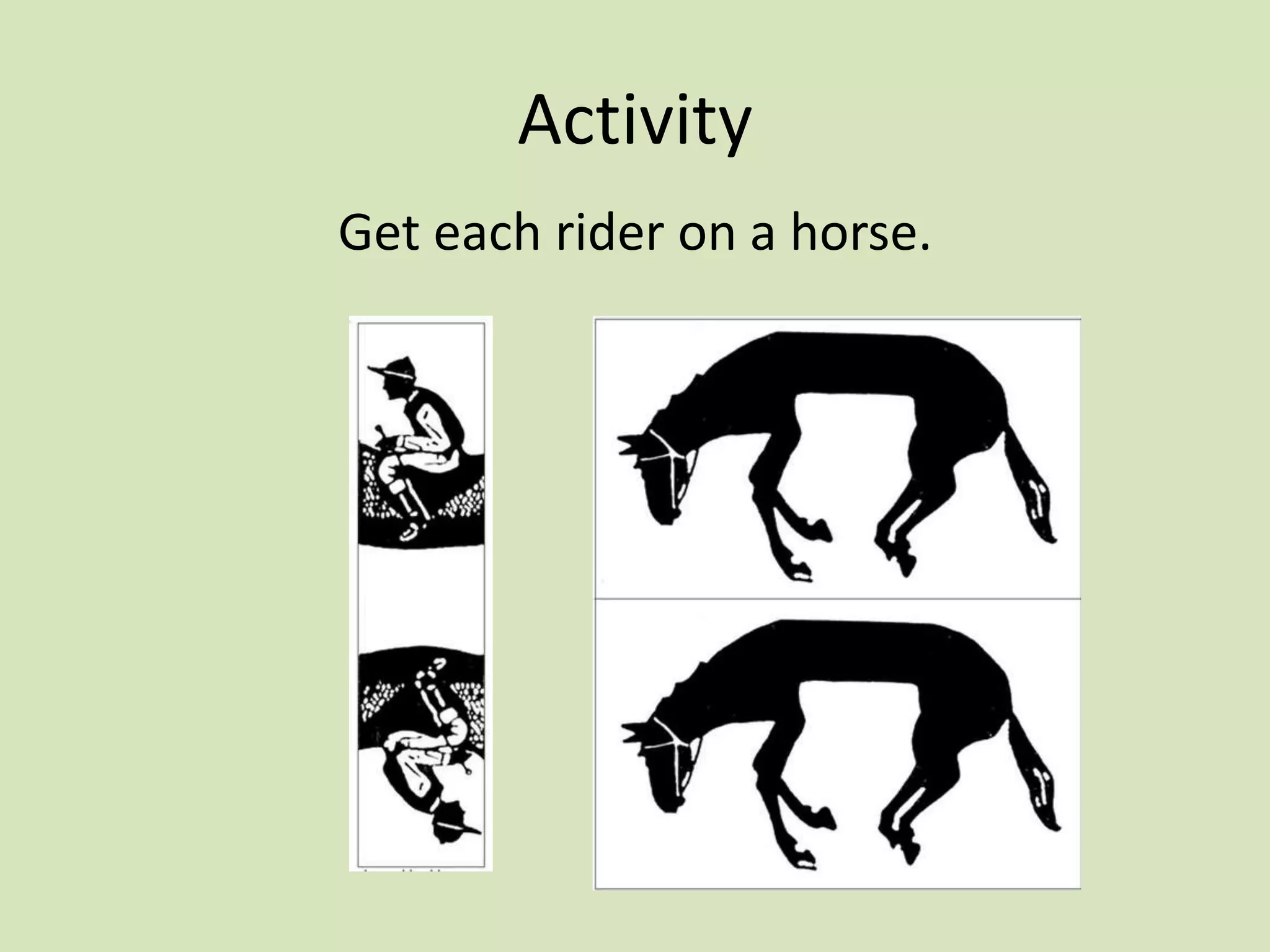
Activity
Get each rider on a horse.
Oftentimes when we are learning to redesign
our courses it can feel similar
– A little frustrating
– A little confusing
– But once you do it….it’s fun!
– And you might want to share it with others
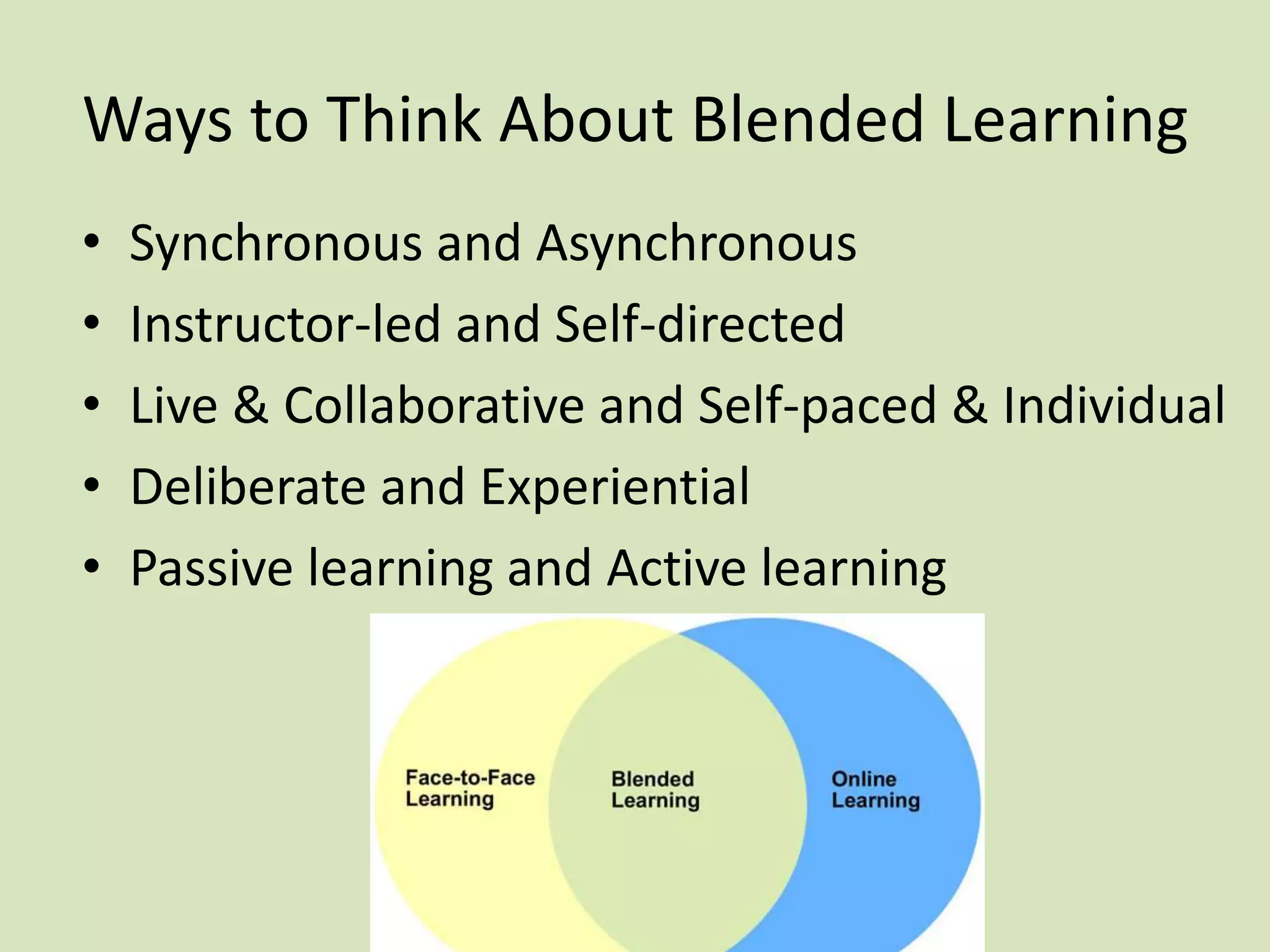
Blended Learning
What do you think it is?
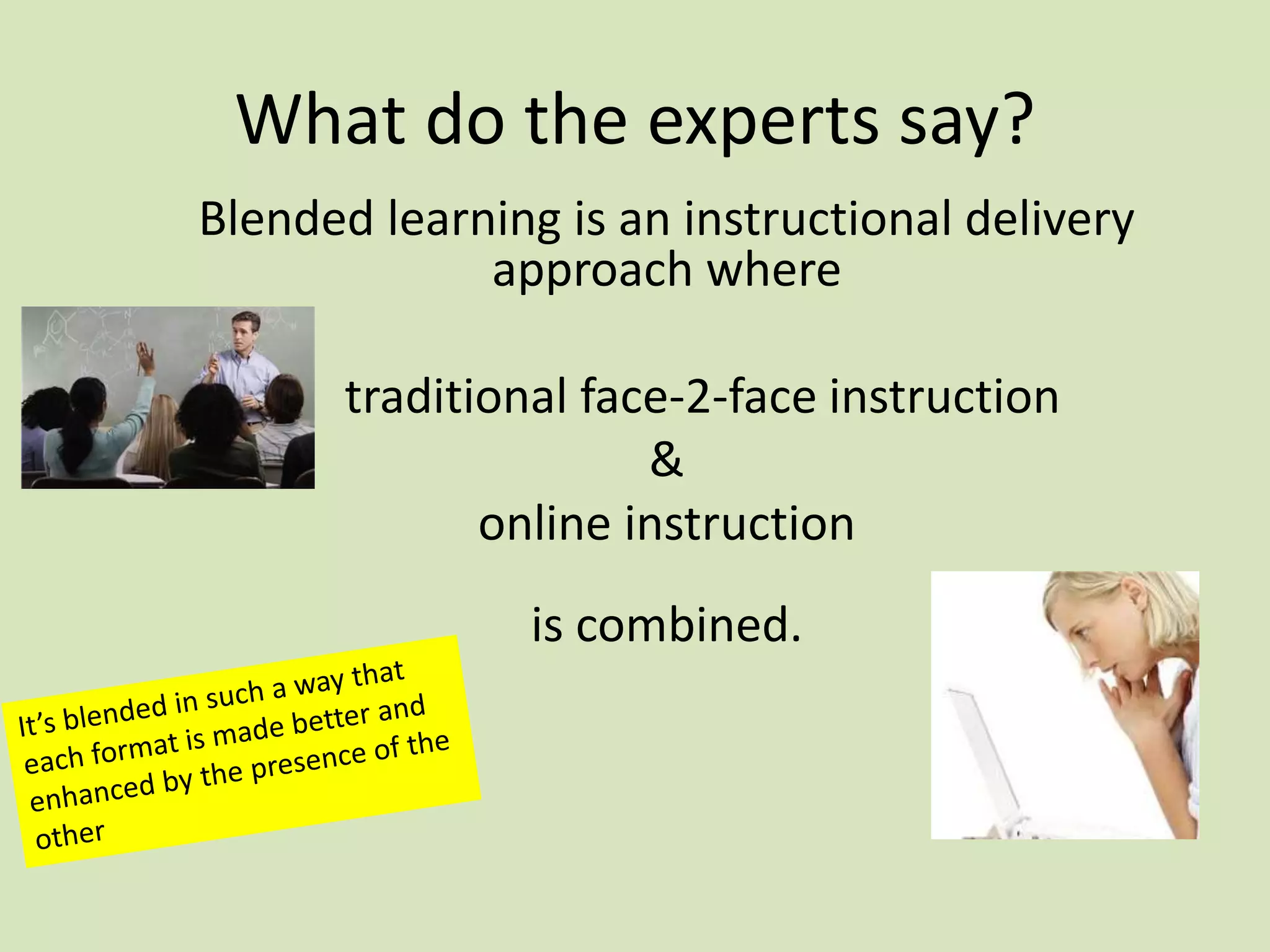
What do the experts say?
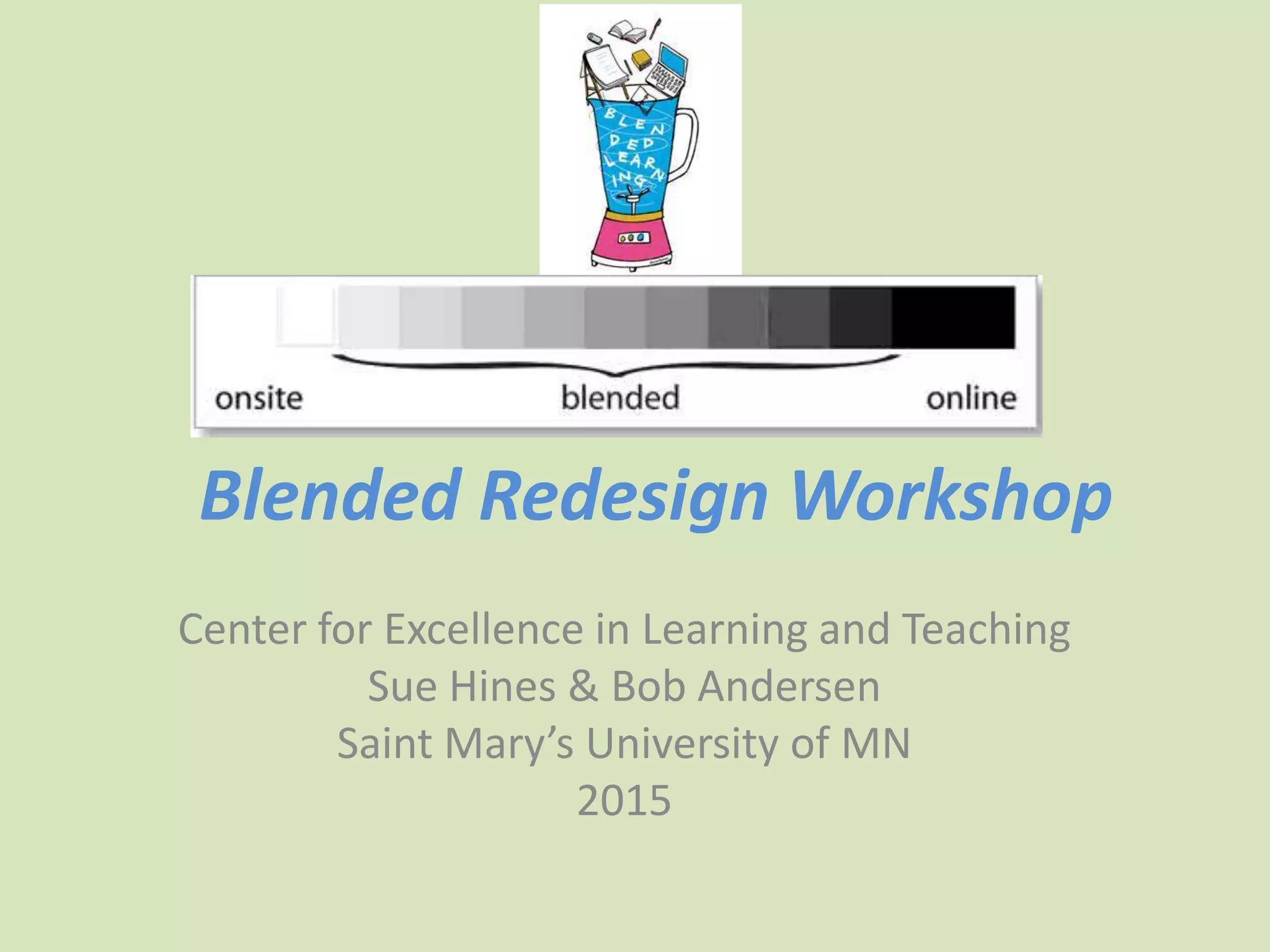
Blended learning is an instructional delivery
approach where
traditional face-2-face instruction
&
online instruction
is combined.
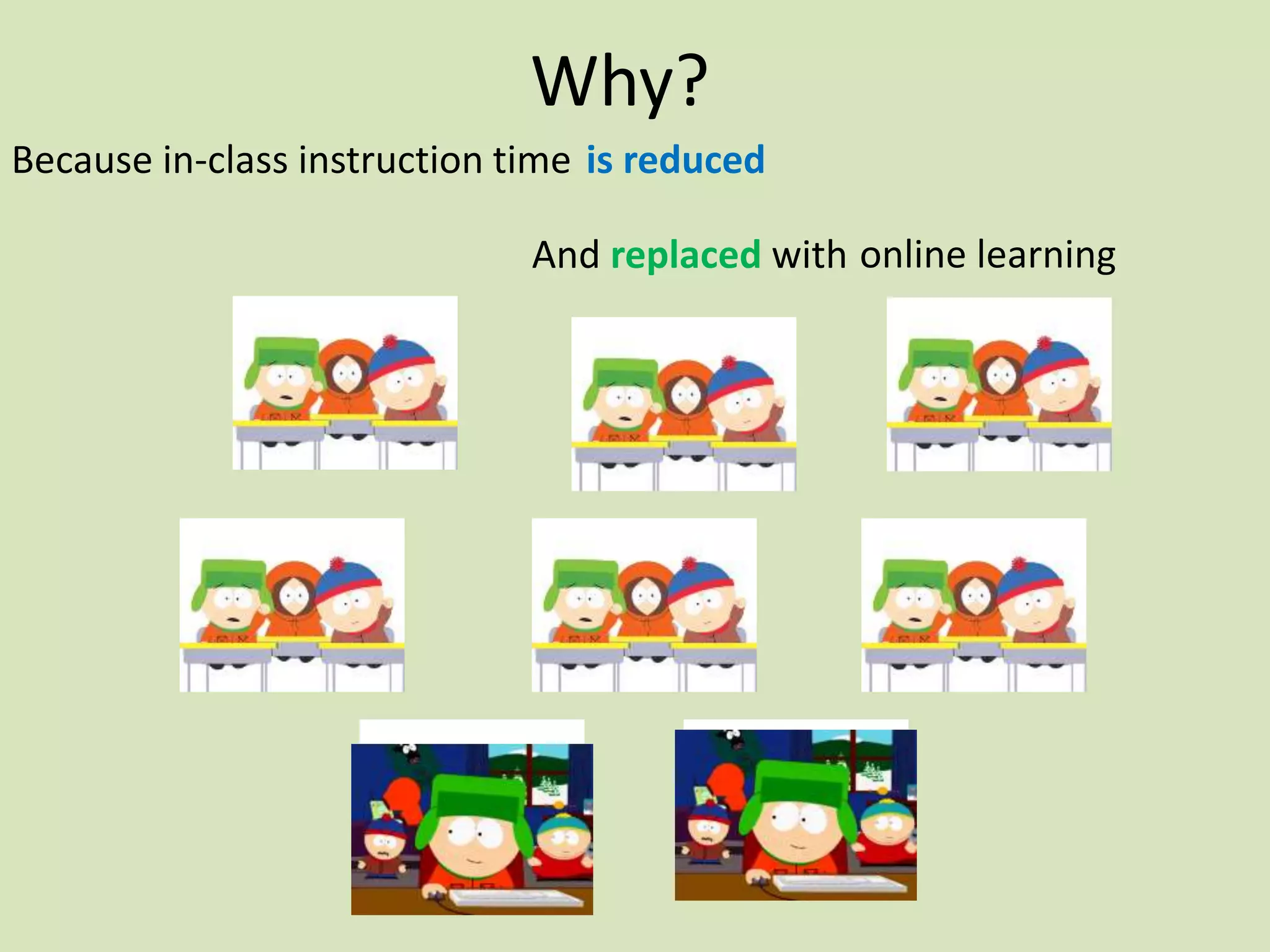
Why?
Because in-class instruction time
And replaced with
is reduced
online learning
Ways to Think About Blended Learning
• Synchronous and Asynchronous
• Instructor-led and Self-directed
• Live & Collaborative and Self-paced & Individual
• Deliberate and Experiential
• Passive learning and Active learning
Determining the “Blend”
• The f2f and online blended structure is
determined for you.
• But how you design the f2f and online learning
experience is up to you.
• There is no one set way to do it.
It’s your
choice 
However, it’s not simply
• Bolting on online work to the existing course
• Plugging in online discussion during “off weeks”
• Using the online week for homework time
• Adding technology to face-to-face learning
• Converting face-to-face instruction to an online
environment
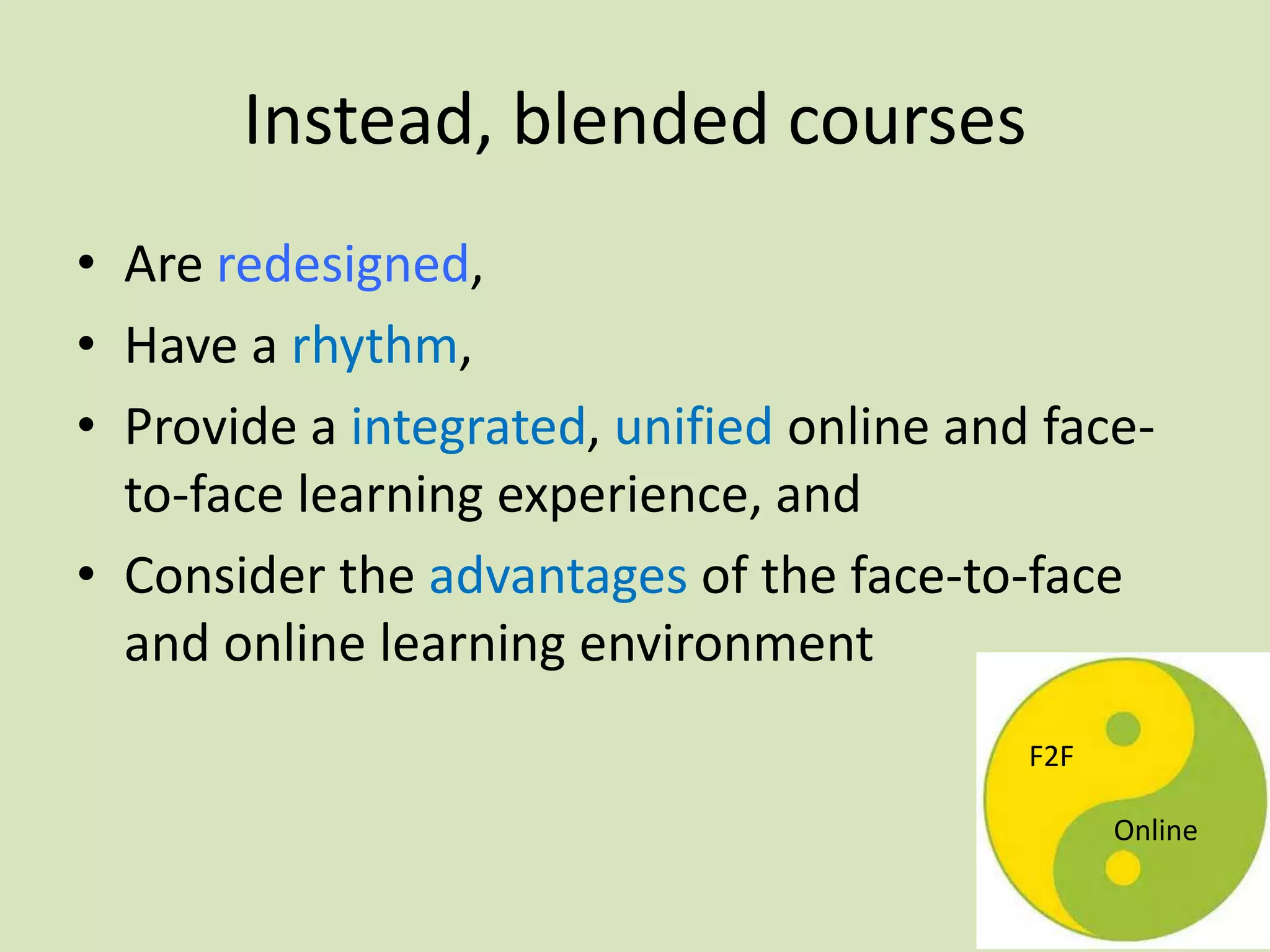
Instead, blended courses
• Are redesigned,
• Have a rhythm,
• Provide a integrated, unified online and face-
to-face learning experience, and
• Consider the advantages of the face-to-face
and online learning environment
F2F
Online
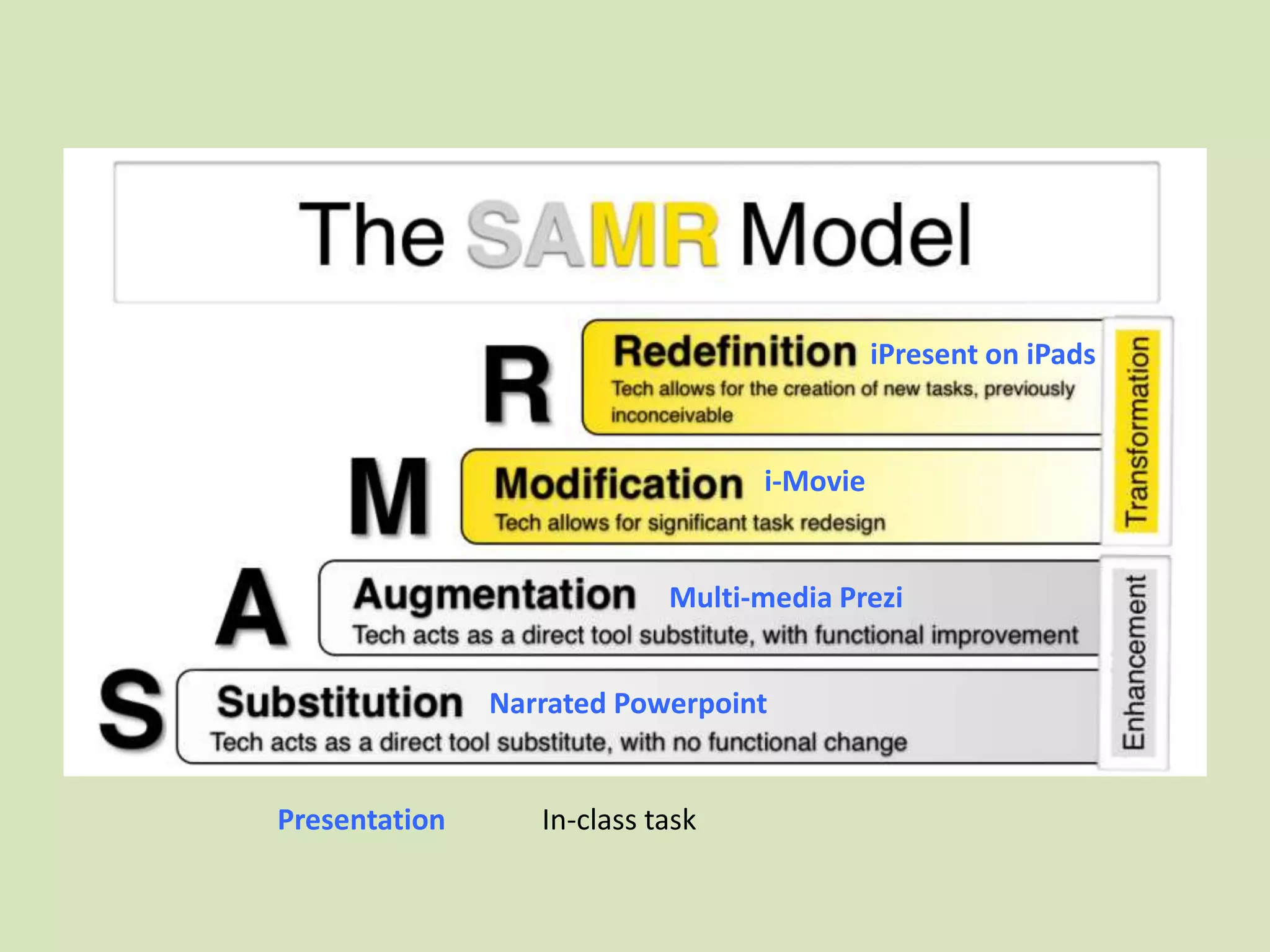
Presentation In-class task
iPresent on iPads
i-Movie
Multi-media Prezi
Narrated Powerpoint
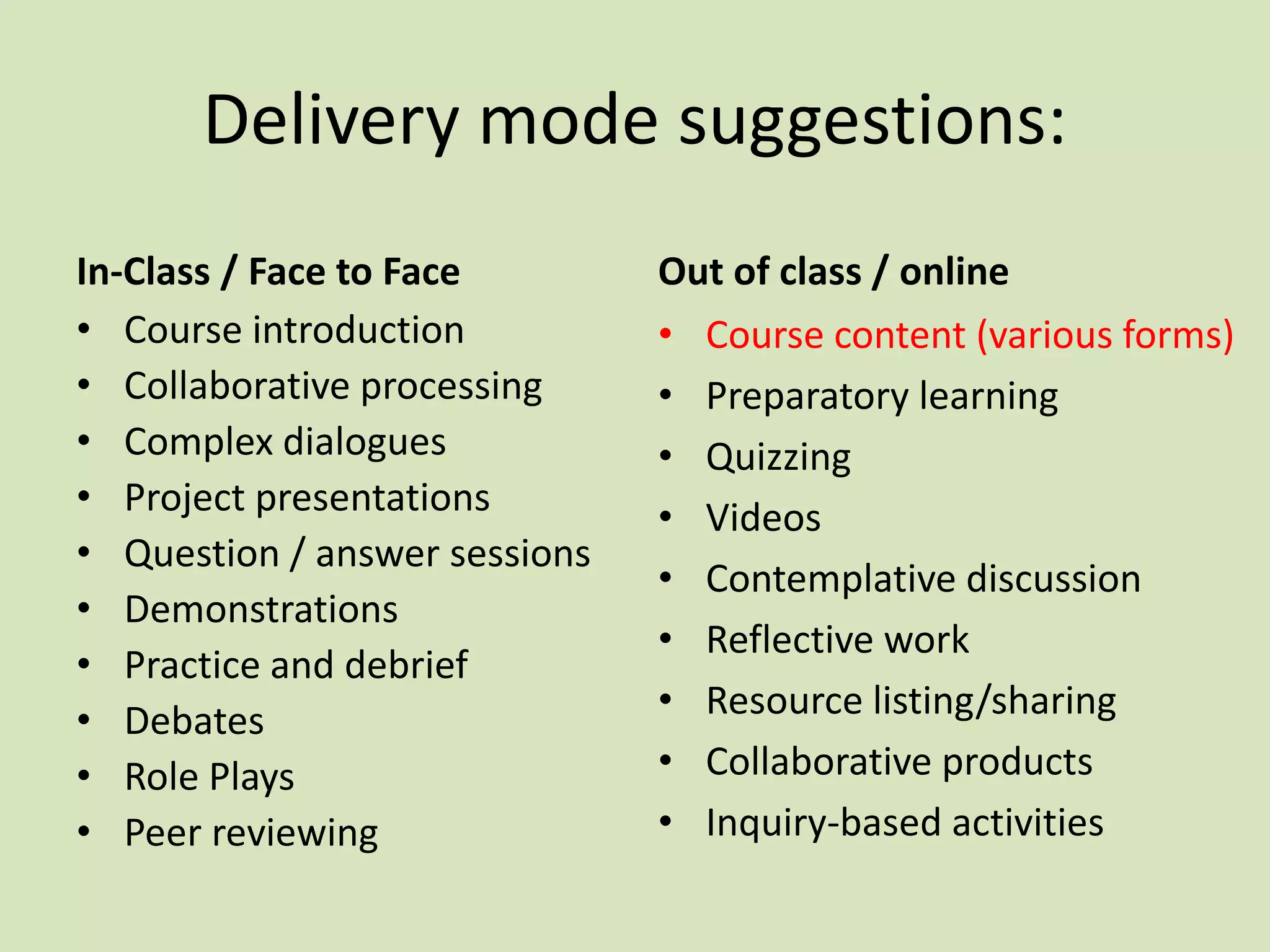
Delivery mode suggestions:
In-Class / Face to Face
• Course introduction
• Collaborative processing
• Complex dialogues
• Project presentations
• Question / answer sessions
• Demonstrations
• Practice and debrief
• Debates
• Role Plays
• Peer reviewing
Out of class / online
• Course content (various forms)
• Preparatory learning
• Quizzing
• Videos
• Contemplative discussion
• Reflective work
• Resource listing/sharing
• Collaborative products
• Inquiry-based activities
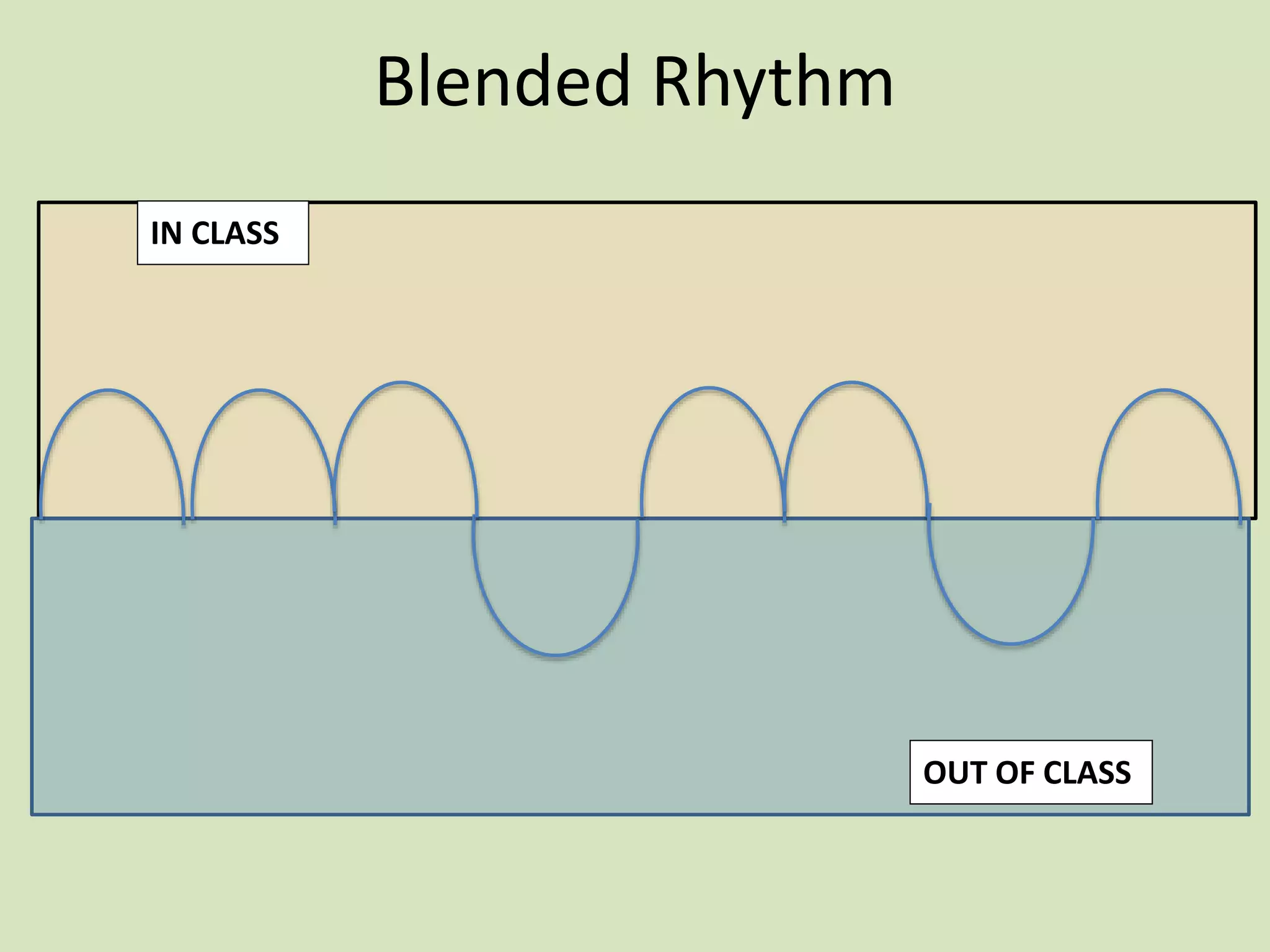
Blended Rhythm
OUT OF CLASS
IN CLASS
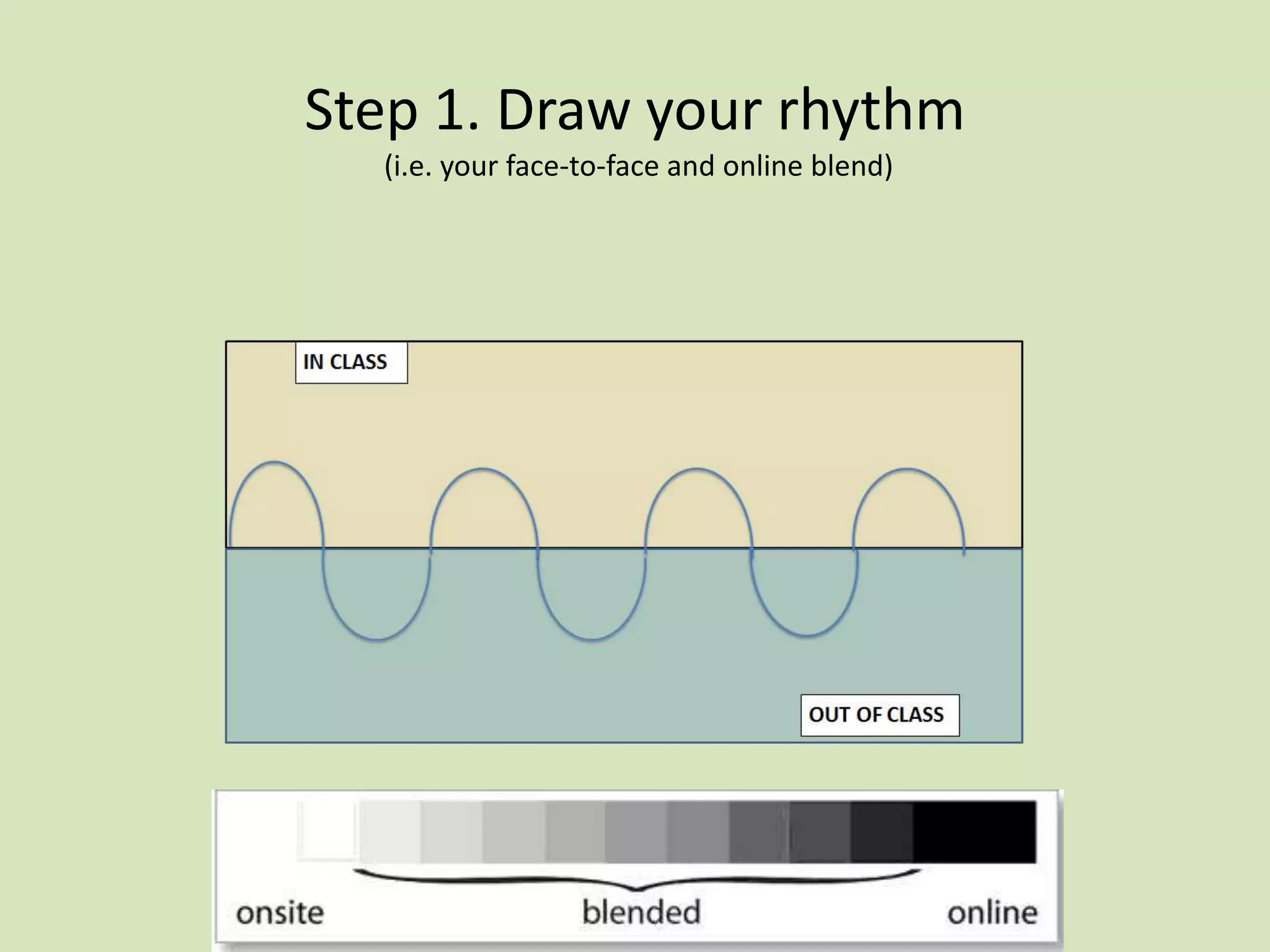
Step 1. Draw your rhythm
(i.e. your face-to-face and online blend)
Think about your integrated blended design
• What do I want my students to accomplish in my course?
• What do I want my students to accomplish each session?
• What is the best blend, given my blended “rhythm”
– What is best learned online?
– What is best learned face-to-face?
• What teaching methods are the best fit?
Guiding Questions:
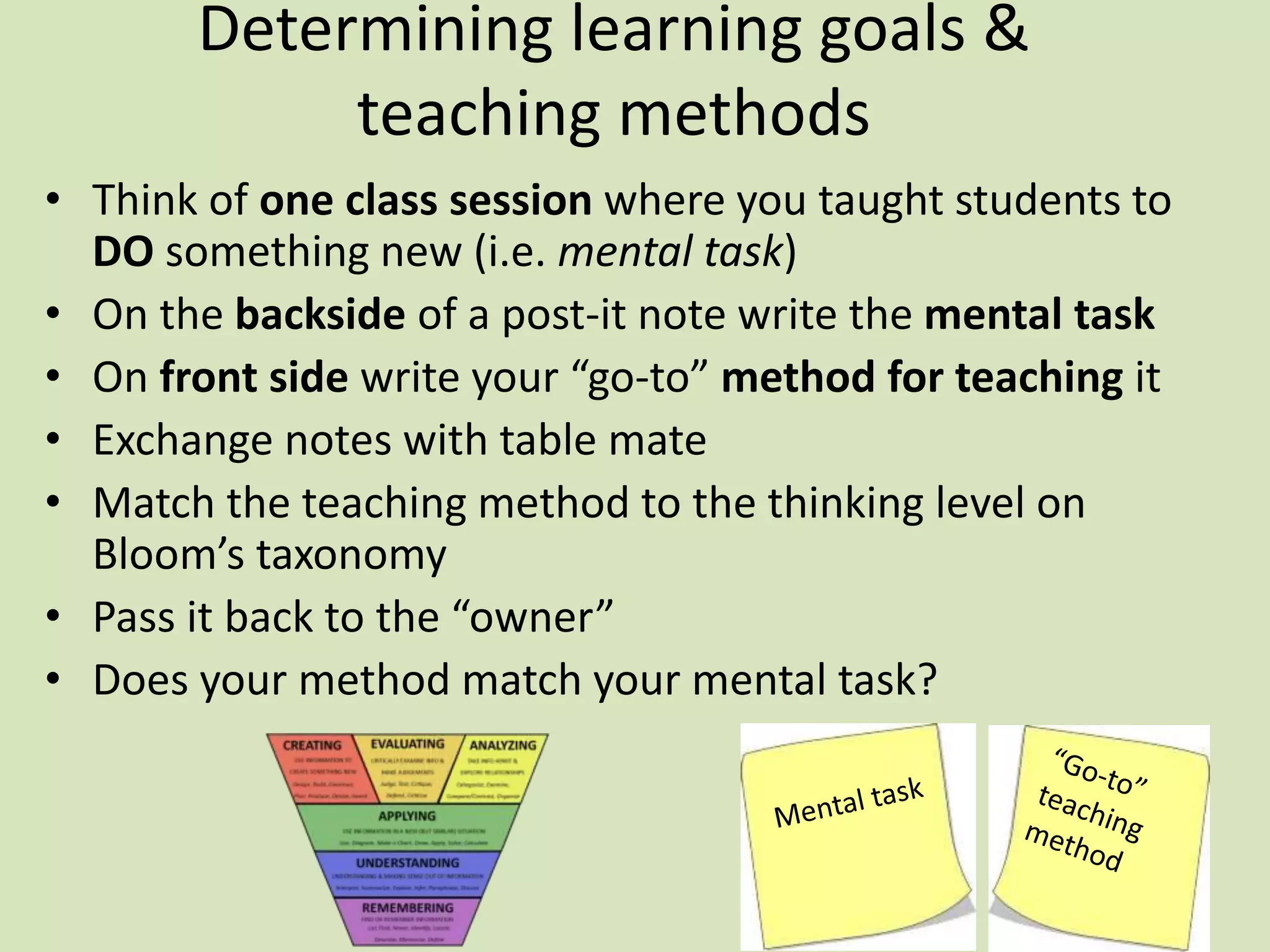
Determining learning goals &
teaching methods
• Think of one class session where you taught students to
DO something new (i.e. mental task)
• On the backside of a post-it note write the mental task
• On front side write your “go-to” method for teaching it
• Exchange notes with table mate
• Match the teaching method to the thinking level on
Bloom’s taxonomy
• Pass it back to the “owner”
• Does your method match your mental task?
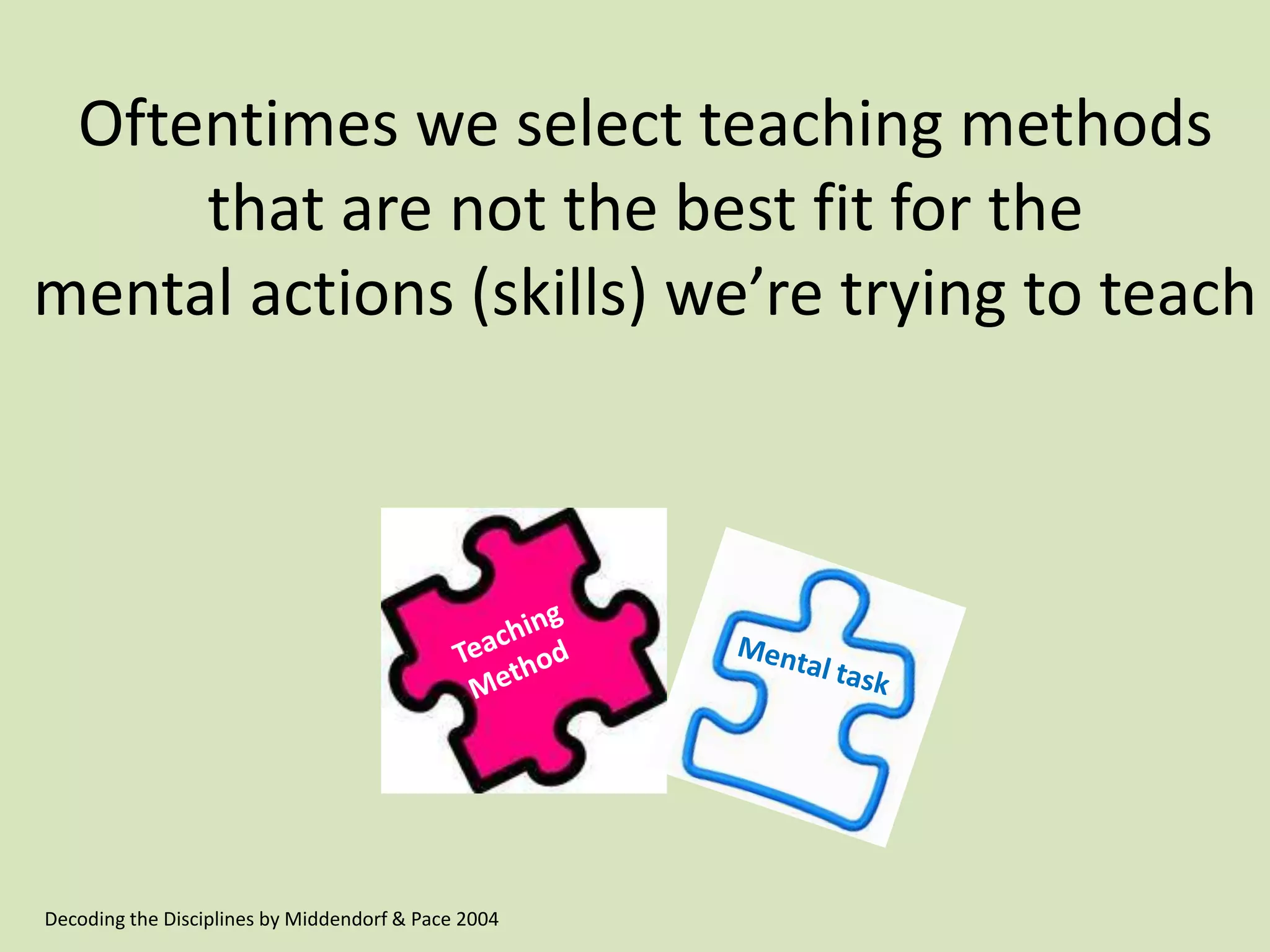
Oftentimes we select teaching methods
that are not the best fit for the
mental actions (skills) we’re trying to teach
Decoding the Disciplines by Middendorf & Pace 2004
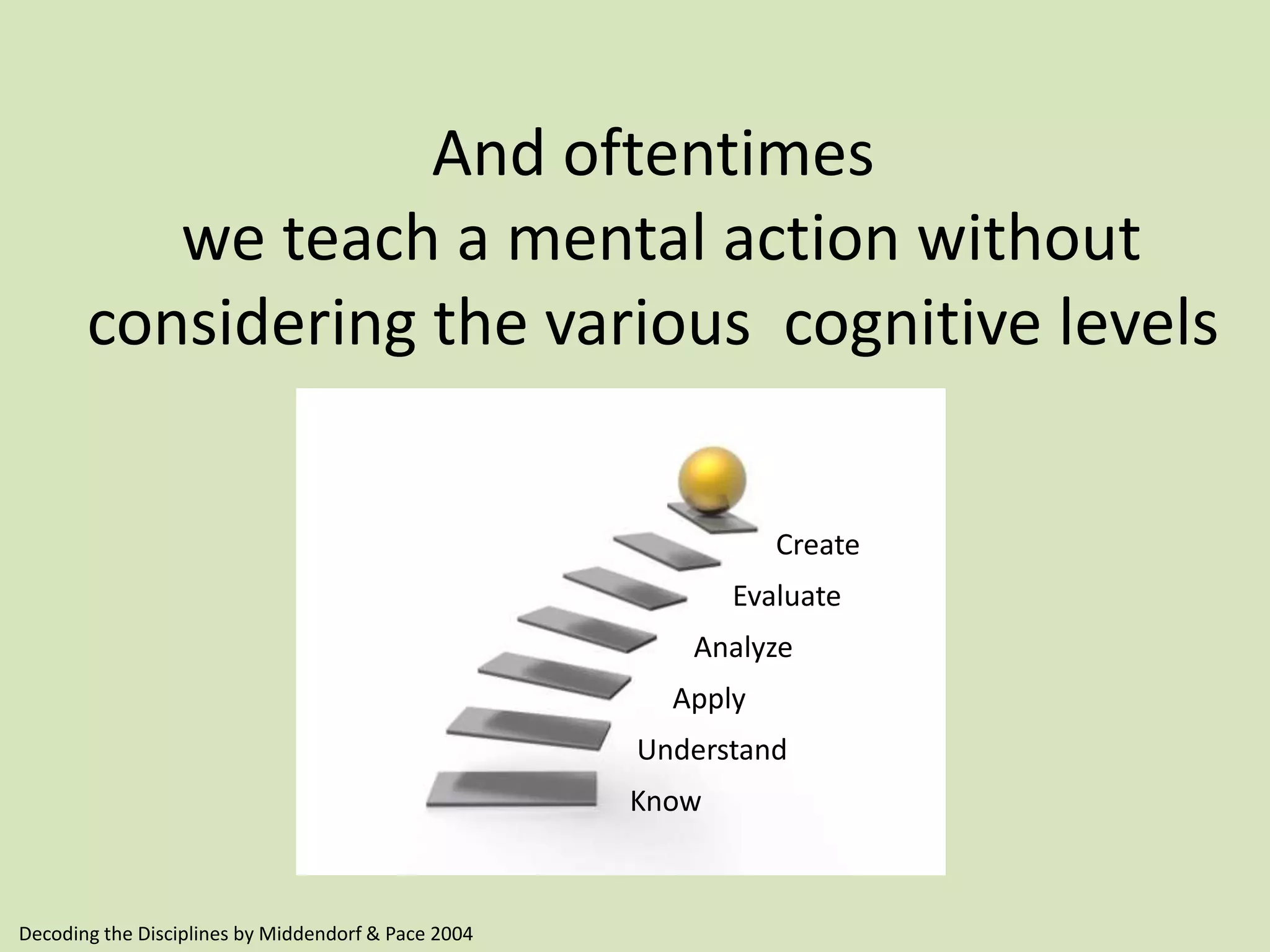
And oftentimes
we teach a mental action without
considering the various cognitive levels
Create
Understand
Apply
Analyze
Evaluate
Know
Decoding the Disciplines by Middendorf & Pace 2004
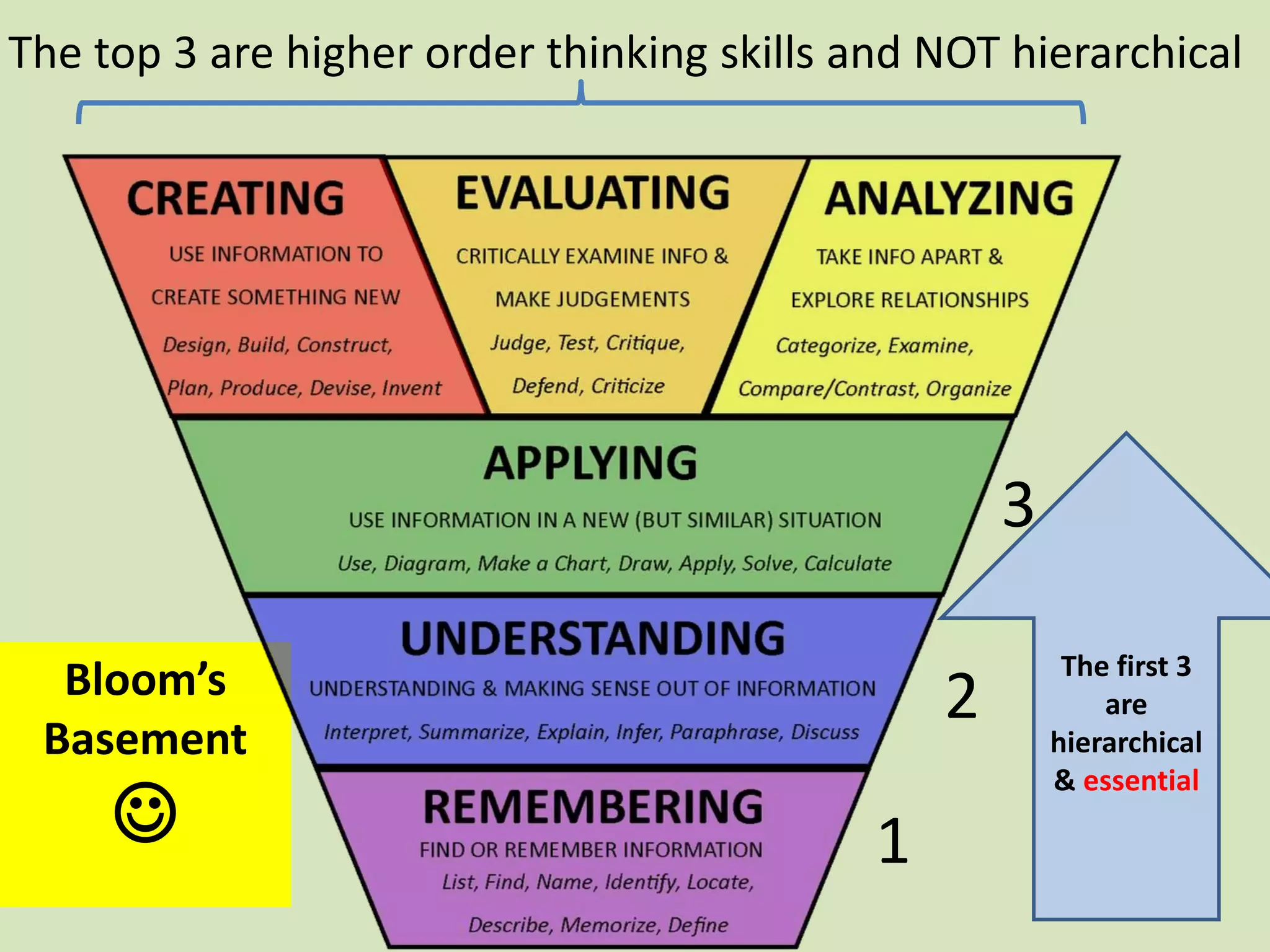
Bloom’s
Basement

The first 3
are
hierarchical
& essential
1
2
3
The top 3 are higher order thinking skills and NOT hierarchical
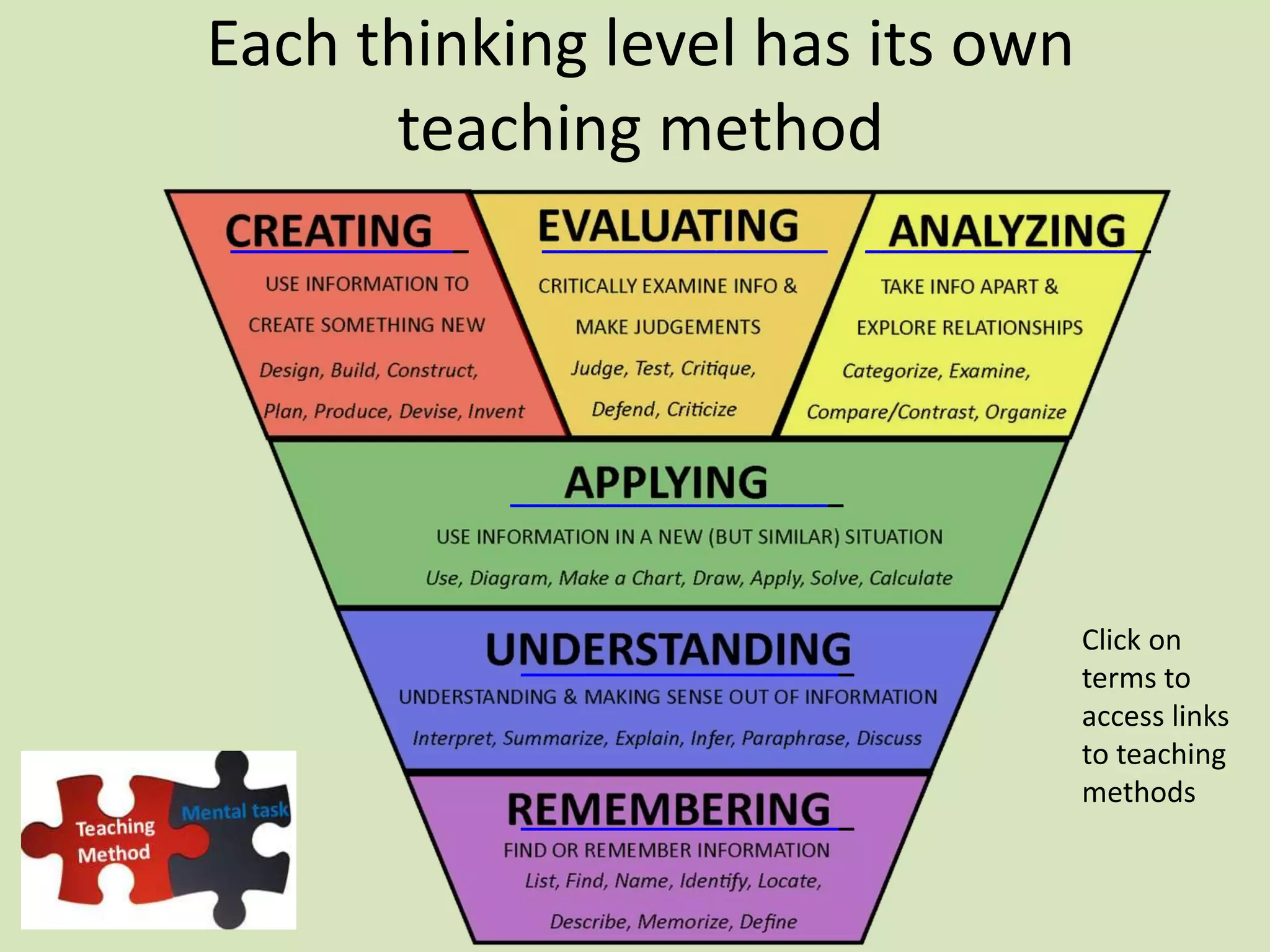
Each thinking level has its own
teaching method
_____________________
_____________________
_____________________
__________________ _________________________________
Click on
terms to
access links
to teaching
methods
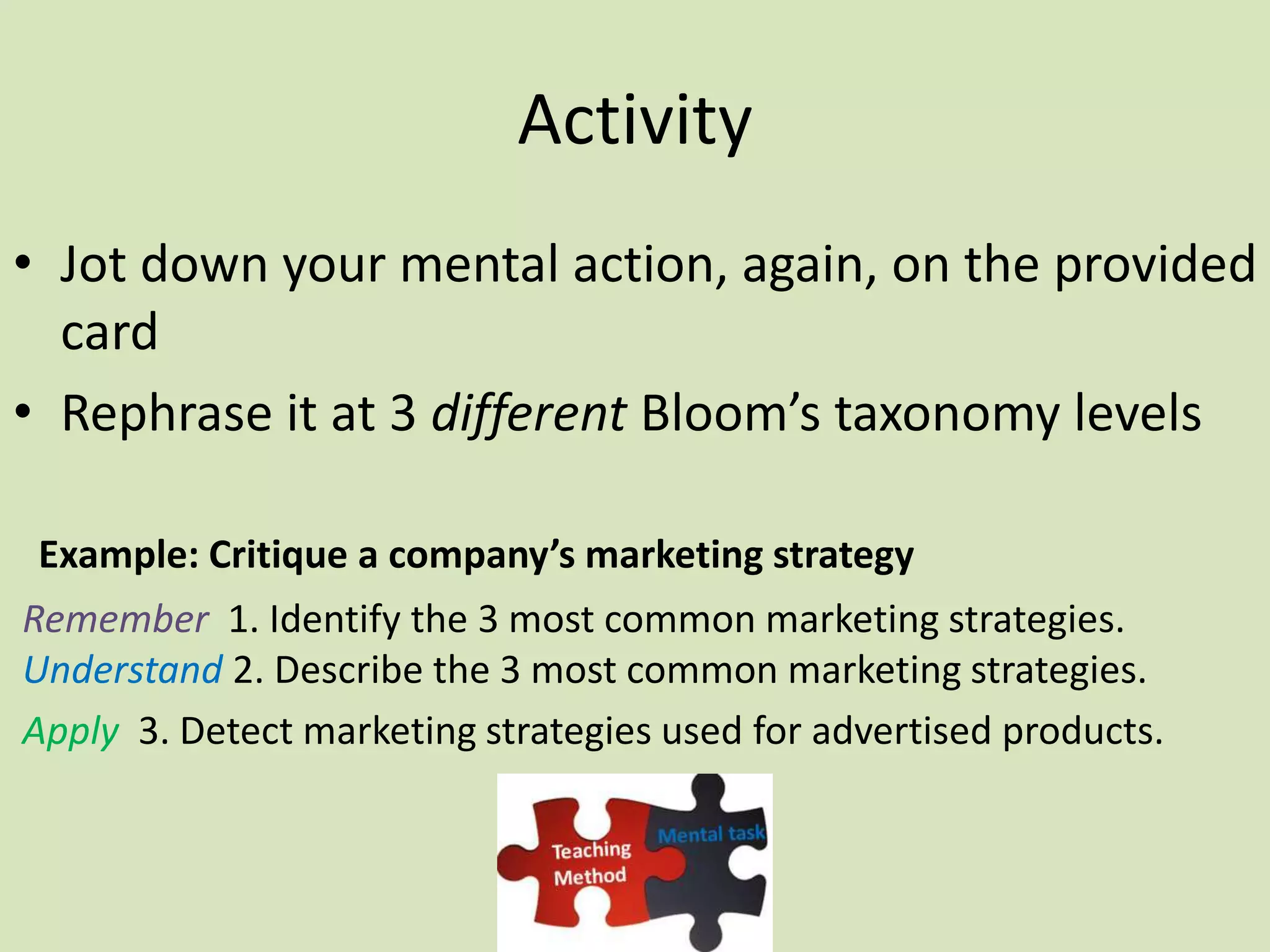
Activity
• Jot down your mental action, again, on the provided
card
• Rephrase it at 3 different Bloom’s taxonomy levels
Example: Critique a company’s marketing strategy
Remember 1. Identify the 3 most common marketing strategies.
Understand 2. Describe the 3 most common marketing strategies.
Apply 3. Detect marketing strategies used for advertised products.
• Exchange cards with a tablemate
• Select a teaching method for each level
• Write your suggested methods on the back of
the card
• Pass it back
Shop for teaching methods
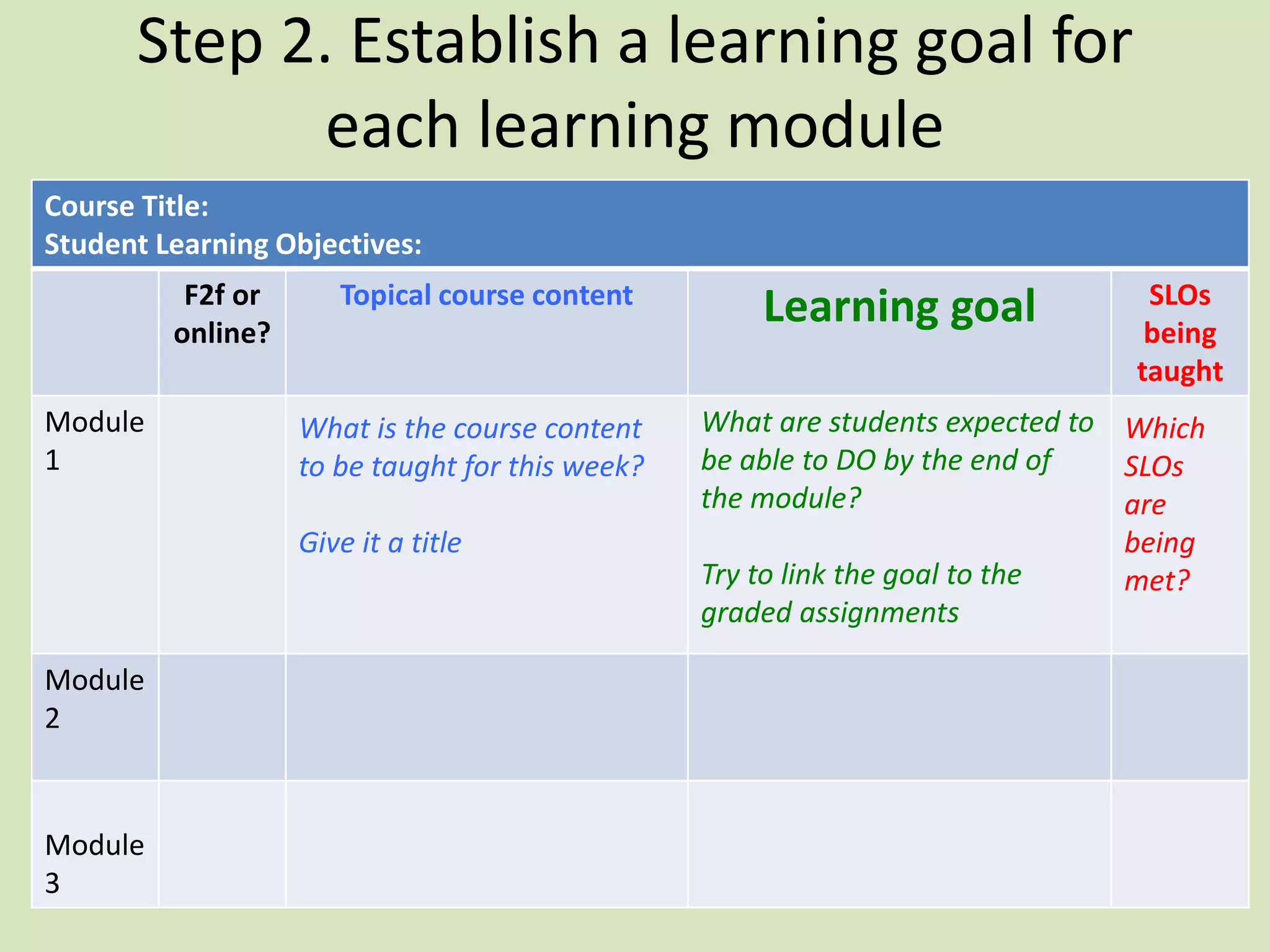
Step 2. Establish a learning goal for
each learning module
Course Title:
Student Learning Objectives:
F2f or
online?
Topical course content
Learning goal SLOs
being
taught
Module
1
What are students expected to
be able to DO by the end of
the module?
Try to link the goal to the
graded assignments
Module
2
Module
3
What is the course content
to be taught for this week?
Give it a title
Which
SLOs
are
being
met?
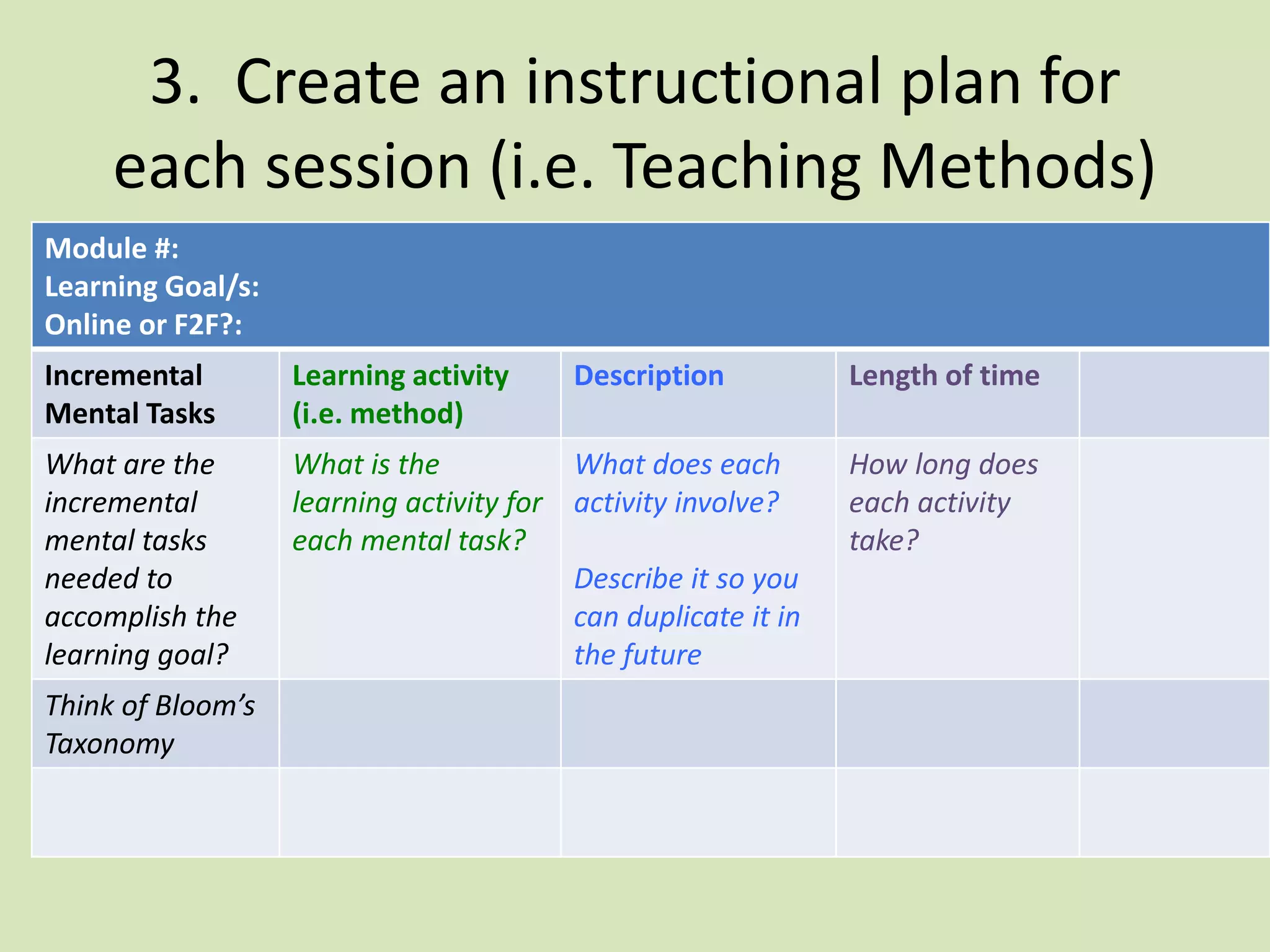
3. Create an instructional plan for
each session (i.e. Teaching Methods)
Module #:
Learning Goal/s:
Online or F2F?:
Incremental
Mental Tasks
Learning activity
(i.e. method)
Description Length of time
What are the
incremental
mental tasks
needed to
accomplish the
learning goal?
What is the
learning activity for
each mental task?
What does each
activity involve?
Describe it so you
can duplicate it in
the future
How long does
each activity
take?
Think of Bloom’s
Taxonomy
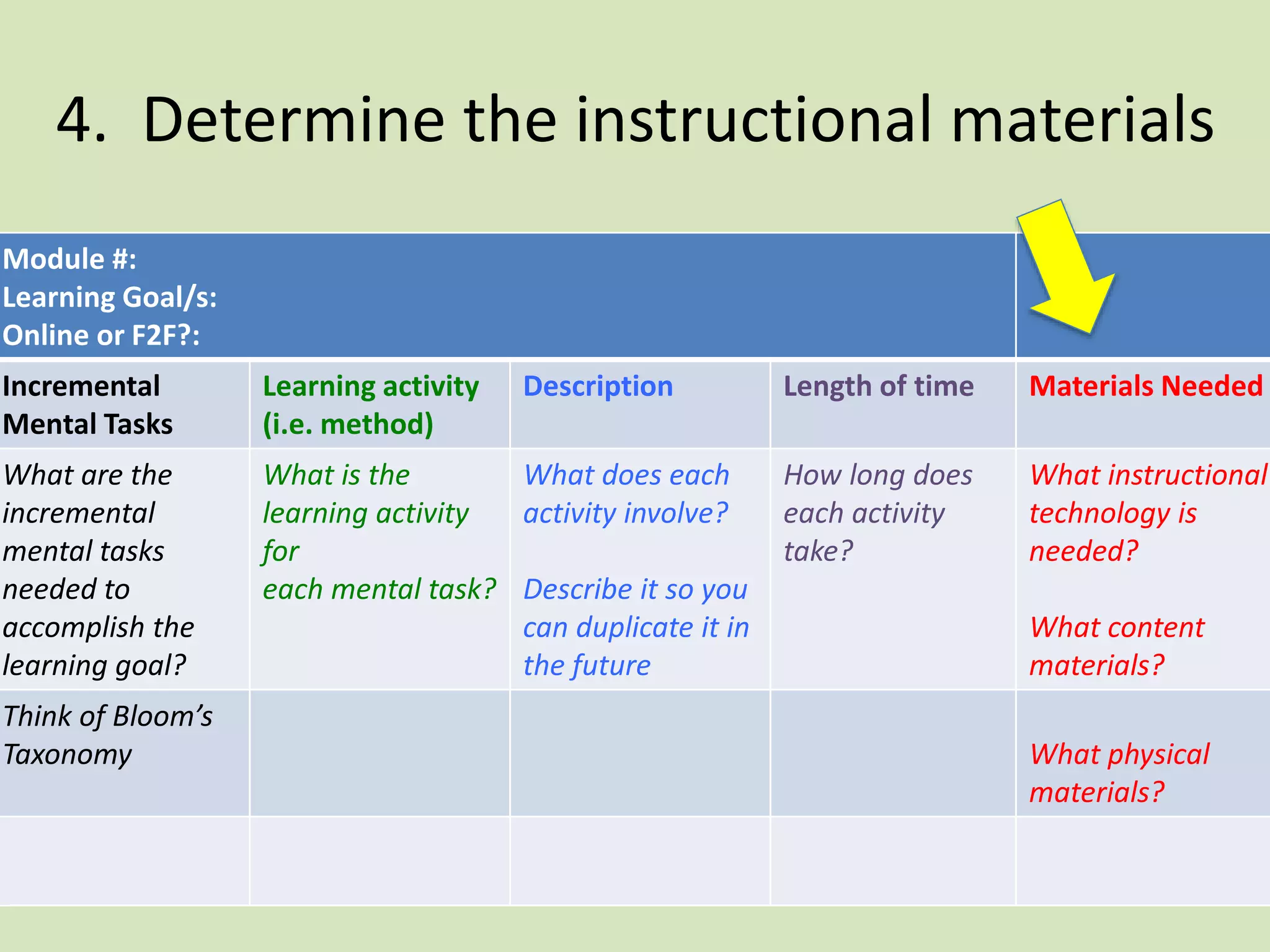
4. Determine the instructional materials
Module #:
Learning Goal/s:
Online or F2F?:
Incremental
Mental Tasks
Learning activity
(i.e. method)
Description Length of time Materials Needed
What are the
incremental
mental tasks
needed to
accomplish the
learning goal?
What is the
learning activity
for
each mental task?
What does each
activity involve?
Describe it so you
can duplicate it in
the future
How long does
each activity
take?
What instructional
technology is
needed?
What content
materials?
Think of Bloom’s
Taxonomy What physical
materials?
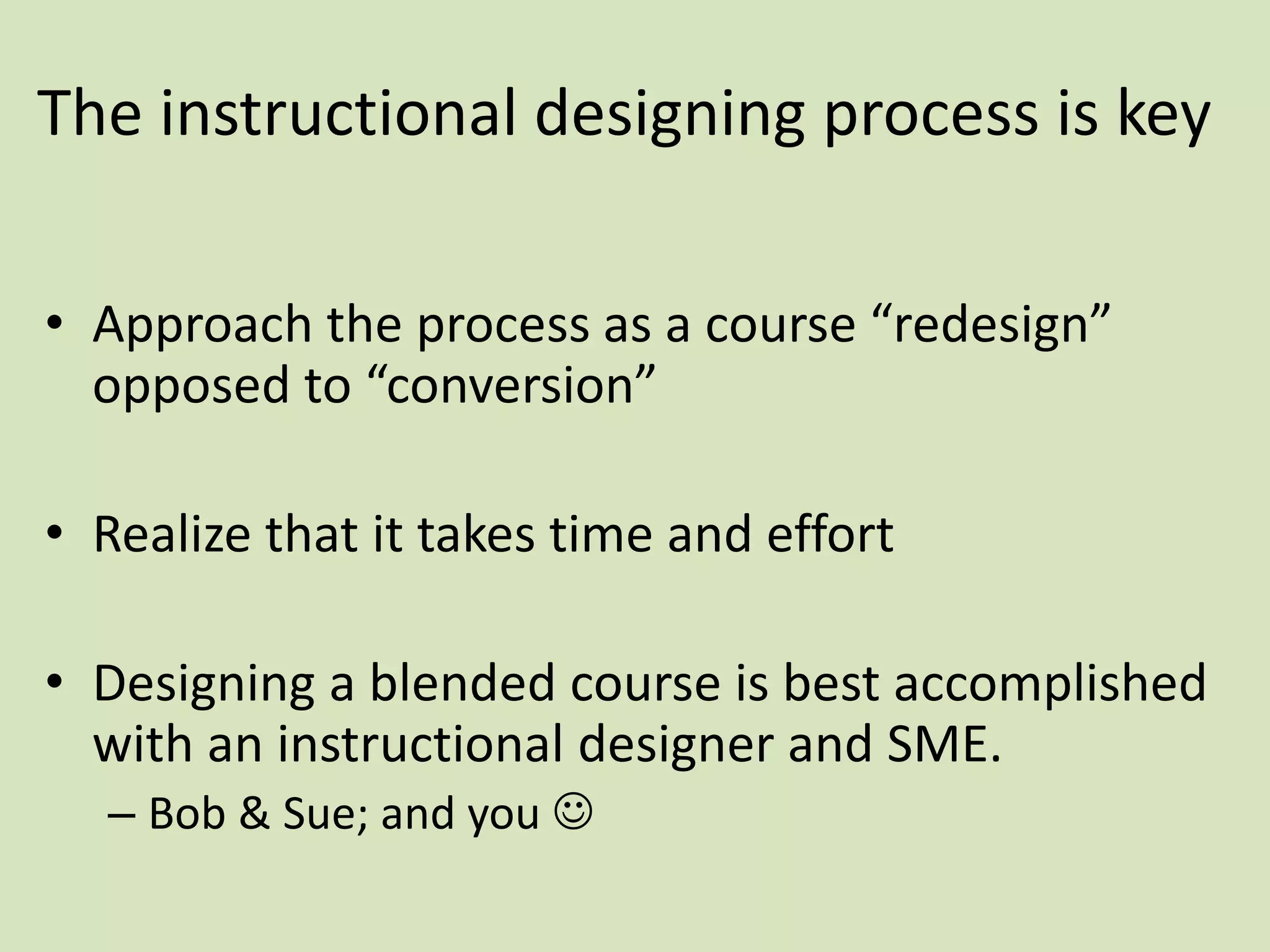
The instructional designing process is key
• Approach the process as a course “redesign”
opposed to “conversion”
• Realize that it takes time and effort
• Designing a blended course is best accomplished
with an instructional designer and SME.
– Bob & Sue; and you 
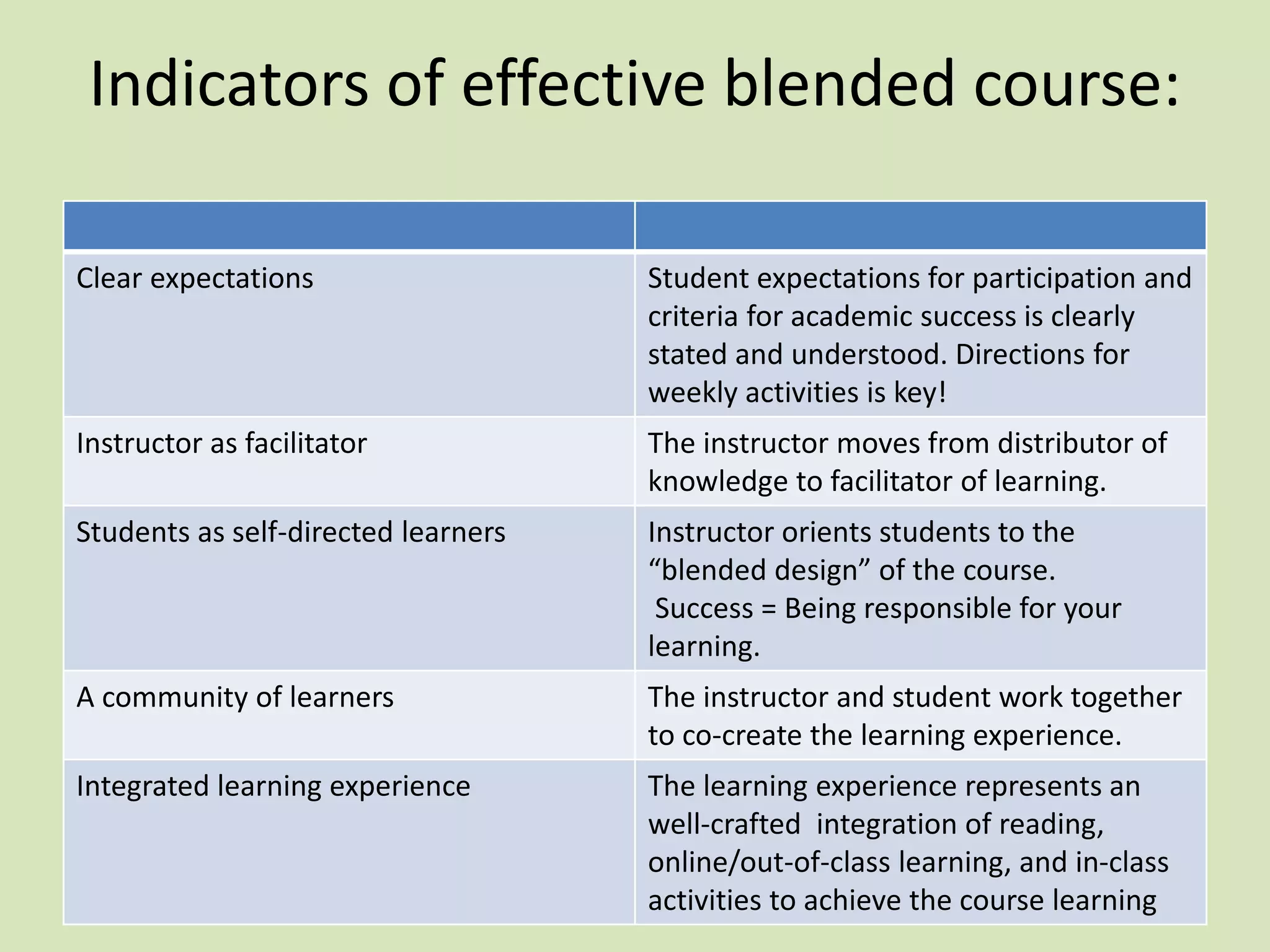
Indicators of effective blended course:
Clear expectations Student expectations for participation and
criteria for academic success is clearly
stated and understood. Directions for
weekly activities is key!
Instructor as facilitator The instructor moves from distributor of
knowledge to facilitator of learning.
Students as self-directed learners Instructor orients students to the
“blended design” of the course.
Success = Being responsible for your
learning.
A community of learners The instructor and student work together
to co-create the learning experience.
Integrated learning experience The learning experience represents an
well-crafted integration of reading,
online/out-of-class learning, and in-class
activities to achieve the course learning
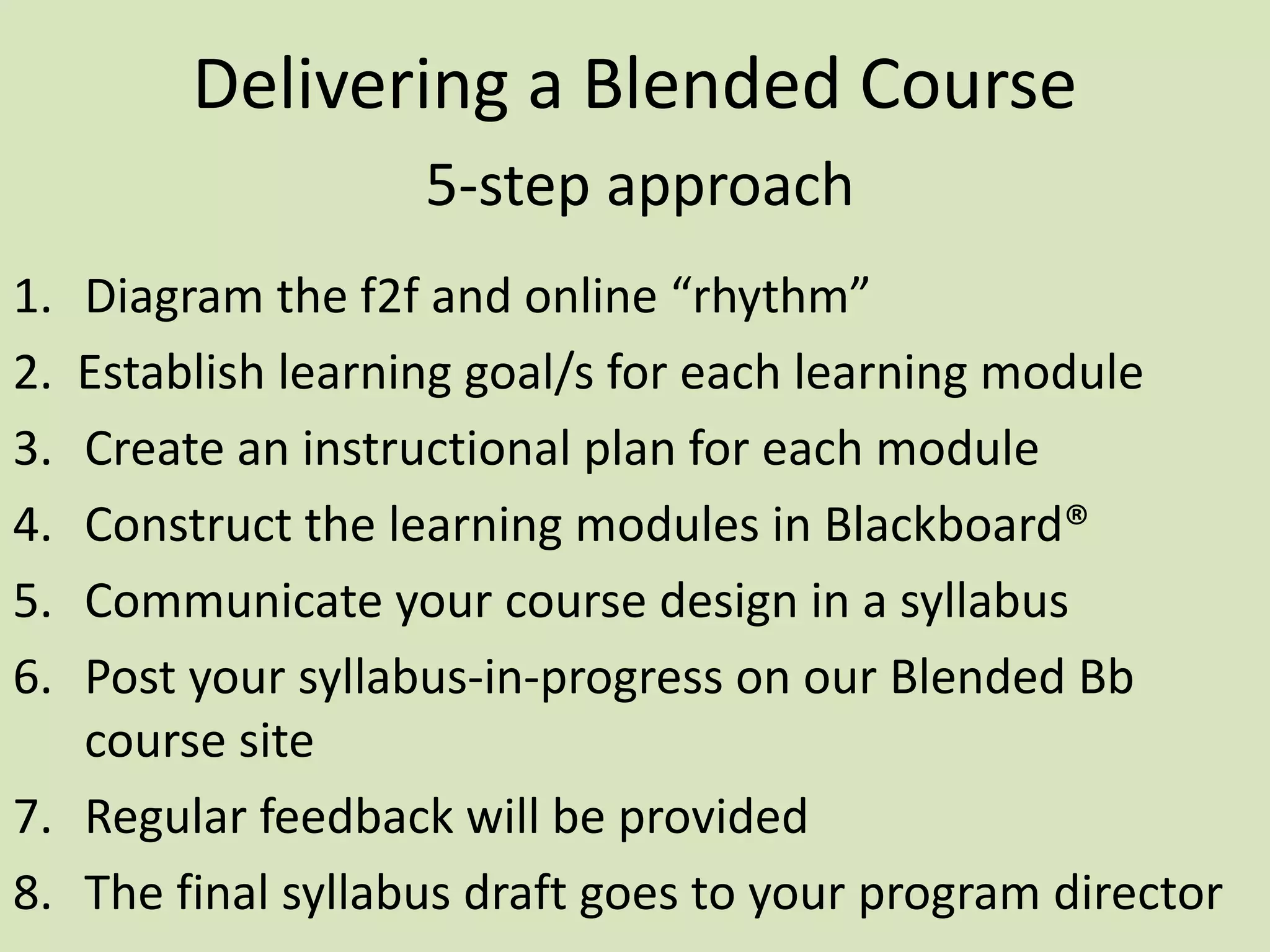
Delivering a Blended Course
5-step approach
1. Diagram the f2f and online “rhythm”
2. Establish learning goal/s for each learning module
3. Create an instructional plan for each module
4. Construct the learning modules in Blackboard®
5. Communicate your course design in a syllabus
6. Post your syllabus-in-progress on our Blended Bb
course site
7. Regular feedback will be provided
8. The final syllabus draft goes to your program director
Want to see an example?
See the Blended Course Example handout
Want to learn about online learning
technologies?
Take it away……..…Bob!

Blended redesign workshop 10 1-15

  • 1.
    Blended Redesign Workshop Centerfor Excellence in Learning and Teaching Sue Hines & Bob Andersen Saint Mary’s University of MN 2015
  • 2.
    In this 2-hoursession you will • Discover the unique qualities of a blended course • Reflect on your instructional design process • Begin redesigning your course to a blended course • Understand how to communicate your blended course design in a syllabus
  • 3.
    In the next2-hour session, you will • Begin to identify learning technologies that best fit your blended course • Apply basic Blackboard practices to design and deliver your blended course
  • 4.
  • 5.
    Oftentimes when weare learning to redesign our courses it can feel similar – A little frustrating – A little confusing – But once you do it….it’s fun! – And you might want to share it with others
  • 6.
    Blended Learning What doyou think it is?
  • 7.
    What do theexperts say? Blended learning is an instructional delivery approach where traditional face-2-face instruction & online instruction is combined.
  • 8.
    Why? Because in-class instructiontime And replaced with is reduced online learning
  • 9.
    Ways to ThinkAbout Blended Learning • Synchronous and Asynchronous • Instructor-led and Self-directed • Live & Collaborative and Self-paced & Individual • Deliberate and Experiential • Passive learning and Active learning
  • 10.
    Determining the “Blend” •The f2f and online blended structure is determined for you. • But how you design the f2f and online learning experience is up to you. • There is no one set way to do it. It’s your choice 
  • 11.
    However, it’s notsimply • Bolting on online work to the existing course • Plugging in online discussion during “off weeks” • Using the online week for homework time • Adding technology to face-to-face learning • Converting face-to-face instruction to an online environment
  • 12.
    Instead, blended courses •Are redesigned, • Have a rhythm, • Provide a integrated, unified online and face- to-face learning experience, and • Consider the advantages of the face-to-face and online learning environment F2F Online
  • 13.
    Presentation In-class task iPresenton iPads i-Movie Multi-media Prezi Narrated Powerpoint
  • 14.
    Delivery mode suggestions: In-Class/ Face to Face • Course introduction • Collaborative processing • Complex dialogues • Project presentations • Question / answer sessions • Demonstrations • Practice and debrief • Debates • Role Plays • Peer reviewing Out of class / online • Course content (various forms) • Preparatory learning • Quizzing • Videos • Contemplative discussion • Reflective work • Resource listing/sharing • Collaborative products • Inquiry-based activities
  • 15.
    Blended Rhythm OUT OFCLASS IN CLASS
  • 16.
    Step 1. Drawyour rhythm (i.e. your face-to-face and online blend)
  • 18.
    Think about yourintegrated blended design • What do I want my students to accomplish in my course? • What do I want my students to accomplish each session? • What is the best blend, given my blended “rhythm” – What is best learned online? – What is best learned face-to-face? • What teaching methods are the best fit? Guiding Questions:
  • 19.
    Determining learning goals& teaching methods • Think of one class session where you taught students to DO something new (i.e. mental task) • On the backside of a post-it note write the mental task • On front side write your “go-to” method for teaching it • Exchange notes with table mate • Match the teaching method to the thinking level on Bloom’s taxonomy • Pass it back to the “owner” • Does your method match your mental task?
  • 20.
    Oftentimes we selectteaching methods that are not the best fit for the mental actions (skills) we’re trying to teach Decoding the Disciplines by Middendorf & Pace 2004
  • 21.
    And oftentimes we teacha mental action without considering the various cognitive levels Create Understand Apply Analyze Evaluate Know Decoding the Disciplines by Middendorf & Pace 2004
  • 22.
    Bloom’s Basement  The first 3 are hierarchical &essential 1 2 3 The top 3 are higher order thinking skills and NOT hierarchical
  • 23.
    Each thinking levelhas its own teaching method _____________________ _____________________ _____________________ __________________ _________________________________ Click on terms to access links to teaching methods
  • 24.
    Activity • Jot downyour mental action, again, on the provided card • Rephrase it at 3 different Bloom’s taxonomy levels Example: Critique a company’s marketing strategy Remember 1. Identify the 3 most common marketing strategies. Understand 2. Describe the 3 most common marketing strategies. Apply 3. Detect marketing strategies used for advertised products.
  • 25.
    • Exchange cardswith a tablemate • Select a teaching method for each level • Write your suggested methods on the back of the card • Pass it back Shop for teaching methods
  • 26.
    Step 2. Establisha learning goal for each learning module Course Title: Student Learning Objectives: F2f or online? Topical course content Learning goal SLOs being taught Module 1 What are students expected to be able to DO by the end of the module? Try to link the goal to the graded assignments Module 2 Module 3 What is the course content to be taught for this week? Give it a title Which SLOs are being met?
  • 27.
    3. Create aninstructional plan for each session (i.e. Teaching Methods) Module #: Learning Goal/s: Online or F2F?: Incremental Mental Tasks Learning activity (i.e. method) Description Length of time What are the incremental mental tasks needed to accomplish the learning goal? What is the learning activity for each mental task? What does each activity involve? Describe it so you can duplicate it in the future How long does each activity take? Think of Bloom’s Taxonomy
  • 28.
    4. Determine theinstructional materials Module #: Learning Goal/s: Online or F2F?: Incremental Mental Tasks Learning activity (i.e. method) Description Length of time Materials Needed What are the incremental mental tasks needed to accomplish the learning goal? What is the learning activity for each mental task? What does each activity involve? Describe it so you can duplicate it in the future How long does each activity take? What instructional technology is needed? What content materials? Think of Bloom’s Taxonomy What physical materials?
  • 29.
    The instructional designingprocess is key • Approach the process as a course “redesign” opposed to “conversion” • Realize that it takes time and effort • Designing a blended course is best accomplished with an instructional designer and SME. – Bob & Sue; and you 
  • 30.
    Indicators of effectiveblended course: Clear expectations Student expectations for participation and criteria for academic success is clearly stated and understood. Directions for weekly activities is key! Instructor as facilitator The instructor moves from distributor of knowledge to facilitator of learning. Students as self-directed learners Instructor orients students to the “blended design” of the course. Success = Being responsible for your learning. A community of learners The instructor and student work together to co-create the learning experience. Integrated learning experience The learning experience represents an well-crafted integration of reading, online/out-of-class learning, and in-class activities to achieve the course learning
  • 31.
    Delivering a BlendedCourse 5-step approach 1. Diagram the f2f and online “rhythm” 2. Establish learning goal/s for each learning module 3. Create an instructional plan for each module 4. Construct the learning modules in Blackboard® 5. Communicate your course design in a syllabus 6. Post your syllabus-in-progress on our Blended Bb course site 7. Regular feedback will be provided 8. The final syllabus draft goes to your program director
  • 32.
    Want to seean example? See the Blended Course Example handout
  • 33.
    Want to learnabout online learning technologies? Take it away……..…Bob!

Editor's Notes

  • #16 7 week class with 4 f2f weeks and 3 online weeks