Designing for Blended Learning
Blended course redesign requires a  willingness to step back and  consider the goals and  range of possibilities, strategies,  techniques, and tools Garrison and Vaughan, 2008
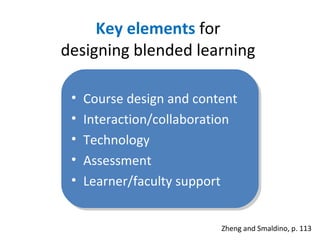
Key elements  for  designing blended learning  Zheng and Smaldino, p. 113 Course design and content Interaction/collaboration Technology Assessment Learner/faculty support
Zheng and Smaldino, p. 113 Course design and content
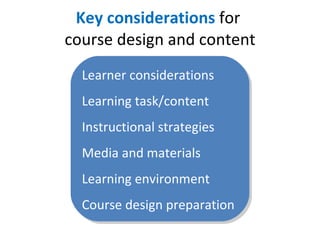
Key considerations   for  course design and content Learner considerations Learning task/content Instructional strategies Media and materials Learning environment Course design preparation
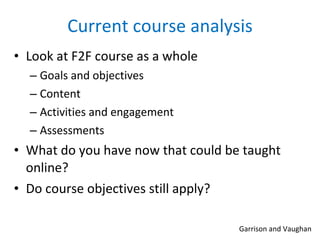
Current course analysis Look at F2F course as a whole Goals and objectives Content Activities and engagement Assessments What do you have now that could be taught online? Do course objectives still apply?  Garrison and Vaughan
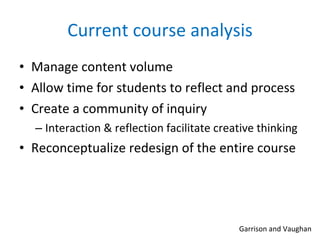
Current course analysis Manage content volume Allow time for students to reflect and process Create a community of inquiry Interaction & reflection facilitate creative thinking Reconceptualize redesign of the entire course Garrison and Vaughan
What do you want your students to learn and how will you know they have learned it?
Learning task/content What are key objectives/learning outcomes? Are they clearly written for student level and in each module? How much content will be F2F vs. online? Can you chunk content into manageable segments? In logical sequence? Can you make quick updates to online content?
Learner considerations What are students’ knowledge and skill gaps? How many students? Are students comfortable with technologies you plan to use? How will you support them? Access to the Internet? Access to a computer / use a computer? Staley
Learner considerations Are students open to new ways of learning? Are students self-motivated? How will you encourage students to participate? How will you mix learning activities that cater to variety of student learning preferences?
Instructional strategies What works well F2F? Lecture vs. discussion What does not work well F2F? Move online? What strategies best support learning objectives? What strategies best meet students’ needs? Will learning activities align with learning objectives?
Media and materials Enhance content with visual / auditory stimuli – music, video, recorded narration Make ancillary resources available on and off-line Make content available internally (CDROM) / externally (Internet) Utilize Blackboard
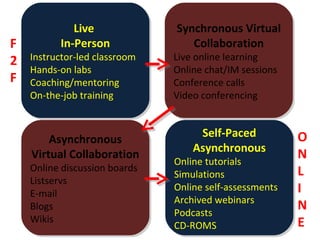
Live  In-Person Instructor-led classroom Hands-on labs Coaching/mentoring On-the-job training Synchronous Virtual Collaboration Live online learning Online chat/IM sessions Conference calls Video conferencing Asynchronous Virtual Collaboration Online discussion boards Listservs E-mail Blogs Wikis Self-Paced Asynchronous Online tutorials Simulations Online self-assessments Archived webinars Podcasts CD-ROMS F2F ONLINE
Learning environment Identify student/instructor roles Learner-centered Collaborative, sharing, community Motivational activities/techniques Frequent student feedback Address accessibility at all levels (design, content,  technology)
Course design preparation Minimum 3 months – 1 year optimal Go easy – repurpose  slowly Experiment along the way Use familiar technology , add more later Consider number of assignments > consider your work load Focus on design – not technology Use existing resources Build support network
Visual design considerations Layout  Meaningful headings, bullet points, keywords Appropriate colors, font styles/size Images – only if they support content
Course redesign planning framework Identify the desired results What do I want my students to be able to do at the end of the lesson? Determine acceptable evidence What evidence or documentation do I require to demonstrate my students’ learning? Plan learning experiences and instruction What learning activities will produce this evidence or documentation? Joosten and Mangrich
Example:  Decision-making processes Identify Desired Results Ability to analyze and critique decision-making processes Acceptable Evidence Accurate written application of theory from the content given a decision-making situation in determining what was effective and what was ineffective in the decision-making process Learning Experiences and Instruction Students view video clips from Apollo 13 movie Students post analysis that integrates concepts from reading and lecture Joosten and Mangrich
Identify Desired Results I want my students to apply standard forms of textual analysis to “decode” advertising,  both print and audio/visual Acceptable Evidence Use of standard textual-critical techniques such as asymmetry and substitution to identify “preferred” and “resistant” readings of ads Learning Experience Studying exercise on asymmetry and substitution Example:  Ads in American Culture Joosten and Mangrich
Blended course learning activities Joosten and Mangrich Readings Lectures Expert guests Simulations Role-plays Case studies Video/web analyses Research modules Brainstorming Individual presentations Debate teams Structured group projects Collaborative exams Collaborative discussions Student-led discussions Instructor-led group discussions
The first week of class Course orientation  Discussion board topics Technical help discussion – “Tech help” Course help – “Peer Assist” Online activity – assessment / bio  Posting  activity University of Central Florida
During the course Virtual and/or F2F office hours Communicate frequently Read and respond to discussion postings Update and release content as needed Grade assessments Ongoing student feedback Manage your time Build a support system University of Central Florida
The end of the course Summative student feedback Finalize and submit grades Archive course Self assess Plan next course University of Central Florida
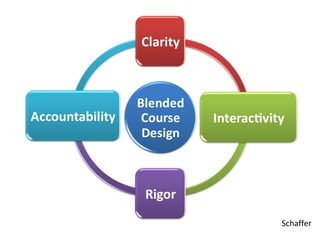
Schaffer
Summary Analyze F2F course for planning Scrutinize course objectives Know your online role & level of expertise Be aware of time commitment Learn/teach the technologies Seek out support systems Reflect and revise
Let’s Practice Worksheet for  Redesigning a  Face-to-face Course  with Online Components
References and Resources Bersin, J. (2004 ). The blended learning book: Best practices, proven methodologies, and lessons learned.  San Francisco, CA: Pfeiffer. Fink, L. D. (2003).  Creating significant learning experiences: An integrated approach to designing college courses.  San Francisco, CA: Jossey-Bass. Garrison, D. Randy, & Vaughan, N. D. (2008).  Blended learning in higher education: Framework, principles, and guidelines.  San Francisco, CA: Jossey-Bass. Illinois Online Network (2007).  Instructional Design.  http://www.ion.uillinois.edu/resources/tutorials/id/index.asp Joosten, T., & Mangrich, A. (2009). Welcome to getting started with blended learning.  http://www.slideshare.net/tjoosten/blended-learning-day-2-riyadh Minnesota State Colleges and Universities. (2007).  Getting Started Online: Advantages, Disadvantages and How to Begin.  http://vfc.project.mnscu.edu
References and Resources Savery, J. R. (2005).  BE VOCAL: Characteristics of successful online instructors.   http://www.ncolr.org/jiol/issues/PDF/4.2.6.pdf Shaffer, S. C. (2009). Blended learning.  http://tinyurl.com/y96mg4x Staley, L. (2007).  Blended learning guide.  http://www.webjunction.org/c/document_library/get_file?folderId=443615&name=DLFE-12302.pdf University of California, Chico. (2009).  Rubric for Online Instruction.  http://www.csuchico.edu/celt/roi/ University of Central Florida (2008).  Teaching Online.   http://teach.ucf.edu/ Zheng, J., & Smaldino,  S. (2009). Key instructional design elements for distance education. In A. Orellana, T. L. Hudgins, & M. Simonson (Eds.),  The perfect online Course: Best practices for designing and teaching  (pp. 107-126).  Charlotte, NC: Information Age Publishing, Inc.

Blended Course Design

  • 1.
  • 2.
    Blended course redesignrequires a willingness to step back and consider the goals and range of possibilities, strategies, techniques, and tools Garrison and Vaughan, 2008
  • 3.
    Key elements for designing blended learning Zheng and Smaldino, p. 113 Course design and content Interaction/collaboration Technology Assessment Learner/faculty support
  • 4.
    Zheng and Smaldino,p. 113 Course design and content
  • 5.
    Key considerations for course design and content Learner considerations Learning task/content Instructional strategies Media and materials Learning environment Course design preparation
  • 6.
    Current course analysisLook at F2F course as a whole Goals and objectives Content Activities and engagement Assessments What do you have now that could be taught online? Do course objectives still apply? Garrison and Vaughan
  • 7.
    Current course analysisManage content volume Allow time for students to reflect and process Create a community of inquiry Interaction & reflection facilitate creative thinking Reconceptualize redesign of the entire course Garrison and Vaughan
  • 8.
    What do youwant your students to learn and how will you know they have learned it?
  • 9.
    Learning task/content Whatare key objectives/learning outcomes? Are they clearly written for student level and in each module? How much content will be F2F vs. online? Can you chunk content into manageable segments? In logical sequence? Can you make quick updates to online content?
  • 10.
    Learner considerations Whatare students’ knowledge and skill gaps? How many students? Are students comfortable with technologies you plan to use? How will you support them? Access to the Internet? Access to a computer / use a computer? Staley
  • 11.
    Learner considerations Arestudents open to new ways of learning? Are students self-motivated? How will you encourage students to participate? How will you mix learning activities that cater to variety of student learning preferences?
  • 12.
    Instructional strategies Whatworks well F2F? Lecture vs. discussion What does not work well F2F? Move online? What strategies best support learning objectives? What strategies best meet students’ needs? Will learning activities align with learning objectives?
  • 13.
    Media and materialsEnhance content with visual / auditory stimuli – music, video, recorded narration Make ancillary resources available on and off-line Make content available internally (CDROM) / externally (Internet) Utilize Blackboard
  • 14.
    Live In-PersonInstructor-led classroom Hands-on labs Coaching/mentoring On-the-job training Synchronous Virtual Collaboration Live online learning Online chat/IM sessions Conference calls Video conferencing Asynchronous Virtual Collaboration Online discussion boards Listservs E-mail Blogs Wikis Self-Paced Asynchronous Online tutorials Simulations Online self-assessments Archived webinars Podcasts CD-ROMS F2F ONLINE
  • 15.
    Learning environment Identifystudent/instructor roles Learner-centered Collaborative, sharing, community Motivational activities/techniques Frequent student feedback Address accessibility at all levels (design, content, technology)
  • 16.
    Course design preparationMinimum 3 months – 1 year optimal Go easy – repurpose slowly Experiment along the way Use familiar technology , add more later Consider number of assignments > consider your work load Focus on design – not technology Use existing resources Build support network
  • 17.
    Visual design considerationsLayout Meaningful headings, bullet points, keywords Appropriate colors, font styles/size Images – only if they support content
  • 18.
    Course redesign planningframework Identify the desired results What do I want my students to be able to do at the end of the lesson? Determine acceptable evidence What evidence or documentation do I require to demonstrate my students’ learning? Plan learning experiences and instruction What learning activities will produce this evidence or documentation? Joosten and Mangrich
  • 19.
    Example: Decision-makingprocesses Identify Desired Results Ability to analyze and critique decision-making processes Acceptable Evidence Accurate written application of theory from the content given a decision-making situation in determining what was effective and what was ineffective in the decision-making process Learning Experiences and Instruction Students view video clips from Apollo 13 movie Students post analysis that integrates concepts from reading and lecture Joosten and Mangrich
  • 20.
    Identify Desired ResultsI want my students to apply standard forms of textual analysis to “decode” advertising, both print and audio/visual Acceptable Evidence Use of standard textual-critical techniques such as asymmetry and substitution to identify “preferred” and “resistant” readings of ads Learning Experience Studying exercise on asymmetry and substitution Example: Ads in American Culture Joosten and Mangrich
  • 21.
    Blended course learningactivities Joosten and Mangrich Readings Lectures Expert guests Simulations Role-plays Case studies Video/web analyses Research modules Brainstorming Individual presentations Debate teams Structured group projects Collaborative exams Collaborative discussions Student-led discussions Instructor-led group discussions
  • 22.
    The first weekof class Course orientation Discussion board topics Technical help discussion – “Tech help” Course help – “Peer Assist” Online activity – assessment / bio Posting activity University of Central Florida
  • 23.
    During the courseVirtual and/or F2F office hours Communicate frequently Read and respond to discussion postings Update and release content as needed Grade assessments Ongoing student feedback Manage your time Build a support system University of Central Florida
  • 24.
    The end ofthe course Summative student feedback Finalize and submit grades Archive course Self assess Plan next course University of Central Florida
  • 25.
  • 26.
    Summary Analyze F2Fcourse for planning Scrutinize course objectives Know your online role & level of expertise Be aware of time commitment Learn/teach the technologies Seek out support systems Reflect and revise
  • 27.
    Let’s Practice Worksheetfor Redesigning a Face-to-face Course with Online Components
  • 28.
    References and ResourcesBersin, J. (2004 ). The blended learning book: Best practices, proven methodologies, and lessons learned. San Francisco, CA: Pfeiffer. Fink, L. D. (2003). Creating significant learning experiences: An integrated approach to designing college courses. San Francisco, CA: Jossey-Bass. Garrison, D. Randy, & Vaughan, N. D. (2008). Blended learning in higher education: Framework, principles, and guidelines. San Francisco, CA: Jossey-Bass. Illinois Online Network (2007). Instructional Design. http://www.ion.uillinois.edu/resources/tutorials/id/index.asp Joosten, T., & Mangrich, A. (2009). Welcome to getting started with blended learning. http://www.slideshare.net/tjoosten/blended-learning-day-2-riyadh Minnesota State Colleges and Universities. (2007). Getting Started Online: Advantages, Disadvantages and How to Begin. http://vfc.project.mnscu.edu
  • 29.
    References and ResourcesSavery, J. R. (2005). BE VOCAL: Characteristics of successful online instructors. http://www.ncolr.org/jiol/issues/PDF/4.2.6.pdf Shaffer, S. C. (2009). Blended learning. http://tinyurl.com/y96mg4x Staley, L. (2007). Blended learning guide. http://www.webjunction.org/c/document_library/get_file?folderId=443615&name=DLFE-12302.pdf University of California, Chico. (2009). Rubric for Online Instruction. http://www.csuchico.edu/celt/roi/ University of Central Florida (2008). Teaching Online. http://teach.ucf.edu/ Zheng, J., & Smaldino, S. (2009). Key instructional design elements for distance education. In A. Orellana, T. L. Hudgins, & M. Simonson (Eds.), The perfect online Course: Best practices for designing and teaching (pp. 107-126). Charlotte, NC: Information Age Publishing, Inc.

Editor's Notes

  • #13 Online lectures can come to life with video, audio and images Online discussions can come to life with effective prompts, questions and comments
  • #23 up/downloading email attachments, Wimba login, virtual classroom, chat, – questions on assignments, schedule, content, introductions/biographies - survey, quiz, assignment