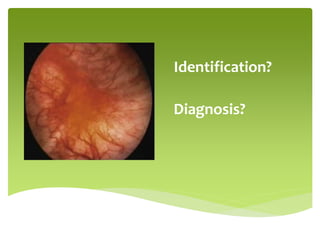
Identification?
Diagnosis?
BY
Dr. Muhammad Saifullah
REGISTRAR UROLOGY
MADINAH TEACHING HOSPITAL, FAISALABAD
bladder PAIN SYNDROME
 Persistent or recurrent pain perceived in the urinary
bladder region.
 Accompanied by at least one other symptom, such as pain
worsening with bladder filling and day-time and/or night-
time urinary frequency
 Absence of any proven infection or other obvious local
pathology.
DEFINITION
 Localisation of the pain can be difficult by
examination, and consequently, another localising
symptom is required.
Why storage symptom must co-exist?
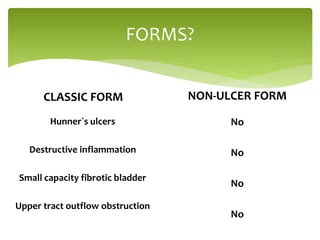
FORMS?
CLASSIC FORM
Hunner`s ulcers
Destructive inflammation
Small capacity fibrotic bladder
Upper tract outflow obstruction
NON-ULCER FORM
No
No
No
No
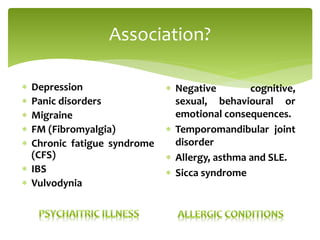
Association?
 Depression
 Panic disorders
 Migraine
 FM (Fibromyalgia)
 Chronic fatigue syndrome
(CFS)
 IBS
 Vulvodynia
 Negative cognitive,
sexual, behavioural or
emotional consequences.
 Temporomandibular joint
disorder
 Allergy, asthma and SLE.
 Sicca syndrome
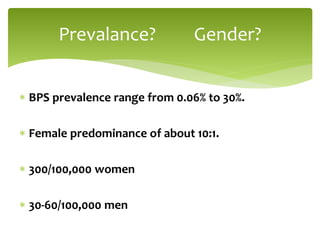
 BPS prevalence range from 0.06% to 30%.
 Female predominance of about 10:1.
 300/100,000 women
 30-60/100,000 men
Prevalance? Gender?
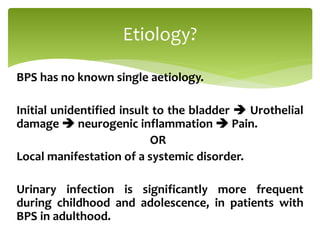
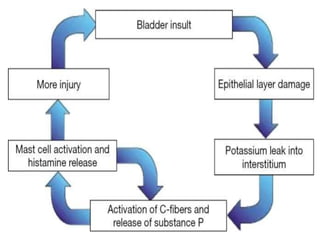
BPS has no known single aetiology.
Initial unidentified insult to the bladder  Urothelial
damage  neurogenic inflammation  Pain.
OR
Local manifestation of a systemic disorder.
Urinary infection is significantly more frequent
during childhood and adolescence, in patients with
BPS in adulthood.
Etiology?
Etiology?
 MAST CELLS  Histamine release  Pain,
Hyperemia & fibrosis
 C-FIBRE ACTIVATION & Substance P Release
 Defective bladder epithelium (Abnormal GAG
layer)
 Neurogenic inflammation
Etiology?
 Reflex sympathetic dystrophy of the bladder
 Bladder autoimmune response
 Urinary toxins & allergens
 Urine antiproliferative factor (APF) from
bladder urothelium  Decreased cell
propagation  Predispose to bladder insults
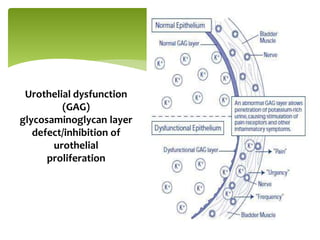
Cystoscopic and biopsy findings in both lesion and
non-lesion BPS are consistent with defects in the
urothelial glycosaminoglycan (GAG) layer, which
might expose submucosal structures to noxious urine
components and a consequent cytotoxic effect.
Defect in _________ layer?
Urothelial dysfunction
(GAG)
glycosaminoglycan layer
defect/inhibition of
urothelial
proliferation
 History
 Focused physical examination
 Frequency-volume chart
Evaluation?
 Urine dipstick and urine culture (including culture
for TB if sterile pyuria) are recommended in all
patients suspected of having BPS.
 Urine cytology is also recommended in risk groups.
Investigations?
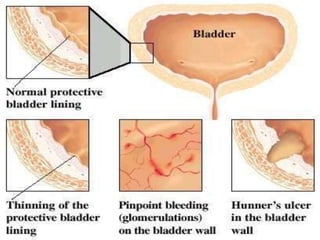
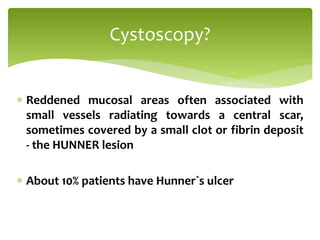
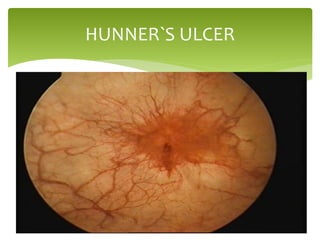
 Reddened mucosal areas often associated with
small vessels radiating towards a central scar,
sometimes covered by a small clot or fibrin deposit
- the HUNNER lesion
 About 10% patients have Hunner`s ulcer
Cystoscopy?
HUNNER`S ULCER
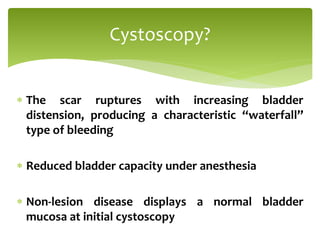
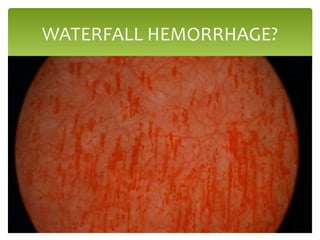
 The scar ruptures with increasing bladder
distension, producing a characteristic “waterfall”
type of bleeding
 Reduced bladder capacity under anesthesia
 Non-lesion disease displays a normal bladder
mucosa at initial cystoscopy
Cystoscopy?
WATERFALL HEMORRHAGE?
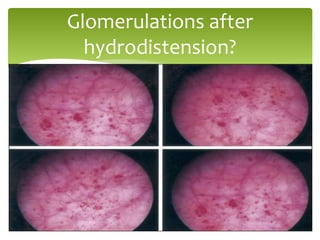
 Glomerations after low pressure hydrodistension is
considered to be a positive diagnostic sign although
they can be observed without BPS
 Distended twice to 80 cm of H2O for 1-2 min
 >10 glomerulations/quadrant in 3 out of 4 quadrants
Cystoscopy after hydrodistension?
Glomerulations after
hydrodistension?
 Biopsies are helpful in establishing or supporting
the clinical diagnosis of both classic and non-lesion
types of the disease
 Exclude carcinoma in situ and tuberculosis cystitis
Bladder biopsy?
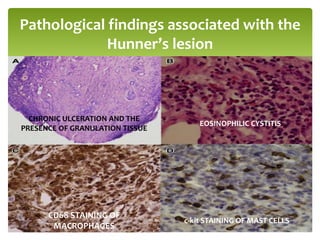
Pathological findings associated with the
Hunner’s lesion
CHRONIC ULCERATION AND THE
PRESENCE OF GRANULATION TISSUE
EOSINOPHILIC CYSTITIS
CD68 STAINING OF
MACROPHAGES
c-kit STAINING OF MAST CELLS
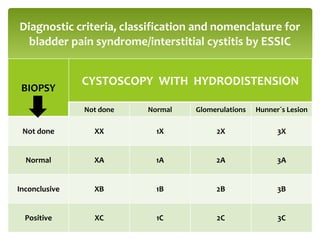
Diagnostic criteria, classification and nomenclature for
bladder pain syndrome/interstitial cystitis by ESSIC
BIOPSY
CYSTOSCOPY WITH HYDRODISTENSION
Not done Normal Glomerulations Hunner`s Lesion
Not done XX 1X 2X 3X
Normal XA 1A 2A 3A
Inconclusive XB 1B 2B 3B
Positive XC 1C 2C 3C
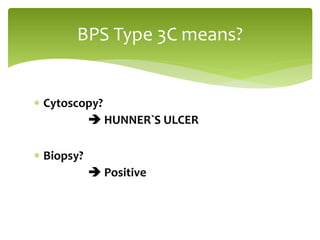
 Cytoscopy?
 HUNNER`S ULCER
 Biopsy?
 Positive
BPS Type 3C means?
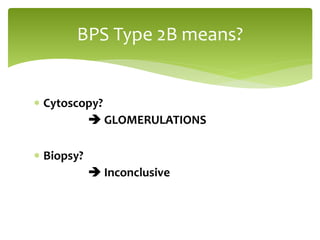
 Cytoscopy?
 GLOMERULATIONS
 Biopsy?
 Inconclusive
BPS Type 2B means?
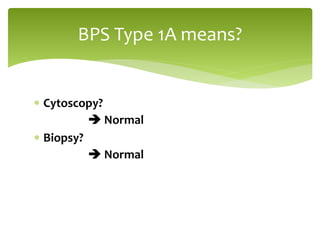
 Cytoscopy?
 Normal
 Biopsy?
 Normal
BPS Type 1A means?
 Patients with bladder pain should undergo general
anaesthetic rigid cystoscopy in accordance with
European Society for the Study of Interstitial
Cystitis guidelines.
 After primary exclusion of specific diseases,
patients with symptoms according to the above
definition should be diagnosed with bladder pain
syndrome (BPS) by subtype and phenotype.
Recommendations by EAU?
 Assess BPS associated non-bladder diseases
systematically.
 Assess BPS associated negative cognitive,
behavioral, sexual, or emotional consequences.
 Use a validated symptom and quality of life scoring
instrument for initial assessment and follow-up.
Recommendations by EAU?
 Patients must have either Glomerulations on cystoscopic
examination or a classic Hunner’s ulcer
 And either Pain associated with the bladder or urinary
urgency
 An examination for glomerulations should be undertaken
after distention of the bladder under anesthesia to 80–100 cm
of water pressure for 1–2 minutes. The bladder may be
distended up to two times before evaluation.
 The glomerulations must be diffuse and present in at least 3
quadrants of the bladder and be present at a rate of at least 10
glomerulations per quadrant
 Not be along the path of the cystoscope (to eliminate artifact
from contact instrumentation)
National Institute of Diabetes and Digestive
and Kidney Diseases Criteria for interstitial cystitis?
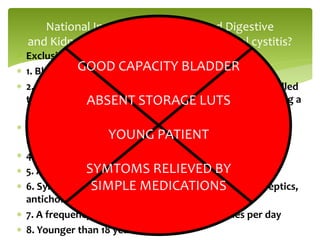
 Exclusion of IC
 1. Bladder capacity of >350 cc on awake cystometry.
 2. Absence of an intense urge to void with the bladder filled
to 100 cc of gas or 150 cc of water during cystometry, using a
fill rate of 30–100 cc/min
 3. Phasic involuntary bladder contractions on cystometry
using the fill rate described above
 4. Duration of symptoms <9 months
 5. Absence of nocturia
 6. Symptoms relieved by antimicrobials, urinary antiseptics,
anticholinergics, or antispasmodics
 7. A frequency of urination less than eight times per day
 8. Younger than 18 years
National Institute of Diabetes and Digestive
and Kidney Diseases Criteria for interstitial cystitis?
GOOD CAPACITY BLADDER
ABSENT STORAGE LUTS
YOUNG PATIENT
SYMTOMS RELIEVED BY
SIMPLE MEDICATIONS
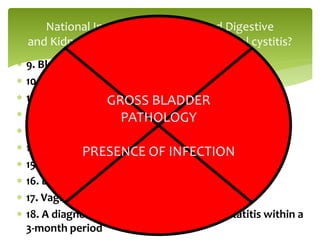
 9. Bladder or ureteral calculi
 10. Active genital herpes
 11. Uterine, cervical, vaginal, or urethral cancer
 12. Urethral diverticulum
 13. Cyclophosphamide or any type of chemical cystitis
 14. Tuberculous cystitis
 15. Radiation cystitis
 16. Benign or malignant bladder tumors
 17. Vaginitis
 18. A diagnosis of bacterial cystitis or prostatitis within a
3-month period
National Institute of Diabetes and Digestive
and Kidney Diseases Criteria for interstitial cystitis?
GROSS BLADDER
PATHOLOGY
PRESENCE OF INFECTION
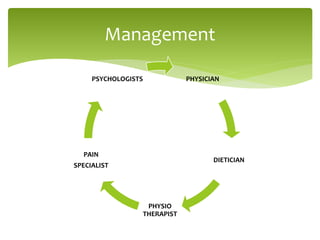
PHYSICIAN
DIETICIAN
PHYSIO
THERAPIST
PAIN
SPECIALIST
PSYCHOLOGISTS
Management
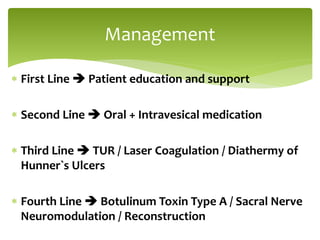
 First Line  Patient education and support
 Second Line  Oral + Intravesical medication
 Third Line  TUR / Laser Coagulation / Diathermy of
Hunner`s Ulcers
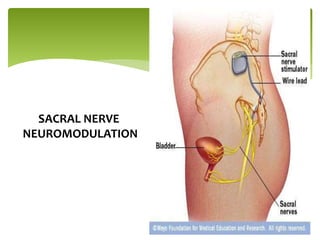
 Fourth Line  Botulinum Toxin Type A / Sacral Nerve
Neuromodulation / Reconstruction
Management
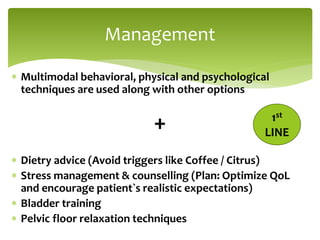
 Multimodal behavioral, physical and psychological
techniques are used along with other options
+
 Dietry advice (Avoid triggers like Coffee / Citrus)
 Stress management & counselling (Plan: Optimize QoL
and encourage patient`s realistic expectations)
 Bladder training
 Pelvic floor relaxation techniques
Management
1st
LINE
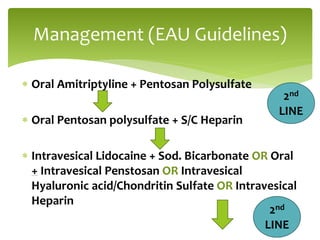
 Oral Amitriptyline + Pentosan Polysulfate
 Oral Pentosan polysulfate + S/C Heparin
 Intravesical Lidocaine + Sod. Bicarbonate OR Oral
+ Intravesical Penstosan OR Intravesical
Hyaluronic acid/Chondritin Sulfate OR Intravesical
Heparin
Management (EAU Guidelines)
2nd
LINE
2nd
LINE
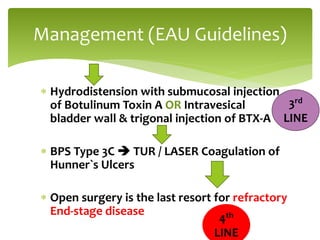
 Hydrodistension with submucosal injection
of Botulinum Toxin A OR Intravesical
bladder wall & trigonal injection of BTX-A
 BPS Type 3C  TUR / LASER Coagulation of
Hunner`s Ulcers
 Open surgery is the last resort for refractory
End-stage disease
Management (EAU Guidelines)
3rd
LINE
4th
LINE
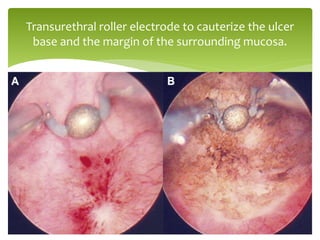
Transurethral roller electrode to cauterize the ulcer
base and the margin of the surrounding mucosa.
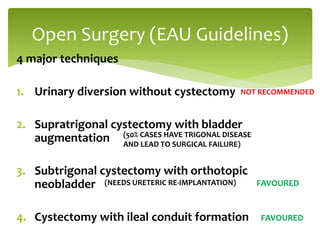
4 major techniques
1. Urinary diversion without cystectomy
2. Supratrigonal cystectomy with bladder
augmentation
3. Subtrigonal cystectomy with orthotopic
neobladder
4. Cystectomy with ileal conduit formation
Open Surgery (EAU Guidelines)
NOT RECOMMENDED
(50% CASES HAVE TRIGONAL DISEASE
AND LEAD TO SURGICAL FAILURE)
(NEEDS URETERIC RE-IMPLANTATION)
FAVOURED
FAVOURED
SACRAL NERVE
NEUROMODULATION

Bladder pain syndrome / Interstitial Cystitis

  • 1.
  • 2.
    BY Dr. Muhammad Saifullah REGISTRARUROLOGY MADINAH TEACHING HOSPITAL, FAISALABAD bladder PAIN SYNDROME
  • 3.
     Persistent orrecurrent pain perceived in the urinary bladder region.  Accompanied by at least one other symptom, such as pain worsening with bladder filling and day-time and/or night- time urinary frequency  Absence of any proven infection or other obvious local pathology. DEFINITION
  • 4.
     Localisation ofthe pain can be difficult by examination, and consequently, another localising symptom is required. Why storage symptom must co-exist?
  • 5.
    FORMS? CLASSIC FORM Hunner`s ulcers Destructiveinflammation Small capacity fibrotic bladder Upper tract outflow obstruction NON-ULCER FORM No No No No
  • 6.
    Association?  Depression  Panicdisorders  Migraine  FM (Fibromyalgia)  Chronic fatigue syndrome (CFS)  IBS  Vulvodynia  Negative cognitive, sexual, behavioural or emotional consequences.  Temporomandibular joint disorder  Allergy, asthma and SLE.  Sicca syndrome
  • 7.
     BPS prevalencerange from 0.06% to 30%.  Female predominance of about 10:1.  300/100,000 women  30-60/100,000 men Prevalance? Gender?
  • 8.
    BPS has noknown single aetiology. Initial unidentified insult to the bladder  Urothelial damage  neurogenic inflammation  Pain. OR Local manifestation of a systemic disorder. Urinary infection is significantly more frequent during childhood and adolescence, in patients with BPS in adulthood. Etiology?
  • 9.
    Etiology?  MAST CELLS Histamine release  Pain, Hyperemia & fibrosis  C-FIBRE ACTIVATION & Substance P Release  Defective bladder epithelium (Abnormal GAG layer)  Neurogenic inflammation
  • 10.
    Etiology?  Reflex sympatheticdystrophy of the bladder  Bladder autoimmune response  Urinary toxins & allergens  Urine antiproliferative factor (APF) from bladder urothelium  Decreased cell propagation  Predispose to bladder insults
  • 12.
    Cystoscopic and biopsyfindings in both lesion and non-lesion BPS are consistent with defects in the urothelial glycosaminoglycan (GAG) layer, which might expose submucosal structures to noxious urine components and a consequent cytotoxic effect. Defect in _________ layer?
  • 14.
  • 15.
     History  Focusedphysical examination  Frequency-volume chart Evaluation?
  • 16.
     Urine dipstickand urine culture (including culture for TB if sterile pyuria) are recommended in all patients suspected of having BPS.  Urine cytology is also recommended in risk groups. Investigations?
  • 17.
     Reddened mucosalareas often associated with small vessels radiating towards a central scar, sometimes covered by a small clot or fibrin deposit - the HUNNER lesion  About 10% patients have Hunner`s ulcer Cystoscopy?
  • 18.
  • 19.
     The scarruptures with increasing bladder distension, producing a characteristic “waterfall” type of bleeding  Reduced bladder capacity under anesthesia  Non-lesion disease displays a normal bladder mucosa at initial cystoscopy Cystoscopy?
  • 20.
  • 21.
     Glomerations afterlow pressure hydrodistension is considered to be a positive diagnostic sign although they can be observed without BPS  Distended twice to 80 cm of H2O for 1-2 min  >10 glomerulations/quadrant in 3 out of 4 quadrants Cystoscopy after hydrodistension?
  • 22.
  • 23.
     Biopsies arehelpful in establishing or supporting the clinical diagnosis of both classic and non-lesion types of the disease  Exclude carcinoma in situ and tuberculosis cystitis Bladder biopsy?
  • 24.
    Pathological findings associatedwith the Hunner’s lesion CHRONIC ULCERATION AND THE PRESENCE OF GRANULATION TISSUE EOSINOPHILIC CYSTITIS CD68 STAINING OF MACROPHAGES c-kit STAINING OF MAST CELLS
  • 25.
    Diagnostic criteria, classificationand nomenclature for bladder pain syndrome/interstitial cystitis by ESSIC BIOPSY CYSTOSCOPY WITH HYDRODISTENSION Not done Normal Glomerulations Hunner`s Lesion Not done XX 1X 2X 3X Normal XA 1A 2A 3A Inconclusive XB 1B 2B 3B Positive XC 1C 2C 3C
  • 26.
     Cytoscopy?  HUNNER`SULCER  Biopsy?  Positive BPS Type 3C means?
  • 27.
     Cytoscopy?  GLOMERULATIONS Biopsy?  Inconclusive BPS Type 2B means?
  • 28.
     Cytoscopy?  Normal Biopsy?  Normal BPS Type 1A means?
  • 29.
     Patients withbladder pain should undergo general anaesthetic rigid cystoscopy in accordance with European Society for the Study of Interstitial Cystitis guidelines.  After primary exclusion of specific diseases, patients with symptoms according to the above definition should be diagnosed with bladder pain syndrome (BPS) by subtype and phenotype. Recommendations by EAU?
  • 30.
     Assess BPSassociated non-bladder diseases systematically.  Assess BPS associated negative cognitive, behavioral, sexual, or emotional consequences.  Use a validated symptom and quality of life scoring instrument for initial assessment and follow-up. Recommendations by EAU?
  • 31.
     Patients musthave either Glomerulations on cystoscopic examination or a classic Hunner’s ulcer  And either Pain associated with the bladder or urinary urgency  An examination for glomerulations should be undertaken after distention of the bladder under anesthesia to 80–100 cm of water pressure for 1–2 minutes. The bladder may be distended up to two times before evaluation.  The glomerulations must be diffuse and present in at least 3 quadrants of the bladder and be present at a rate of at least 10 glomerulations per quadrant  Not be along the path of the cystoscope (to eliminate artifact from contact instrumentation) National Institute of Diabetes and Digestive and Kidney Diseases Criteria for interstitial cystitis?
  • 32.
     Exclusion ofIC  1. Bladder capacity of >350 cc on awake cystometry.  2. Absence of an intense urge to void with the bladder filled to 100 cc of gas or 150 cc of water during cystometry, using a fill rate of 30–100 cc/min  3. Phasic involuntary bladder contractions on cystometry using the fill rate described above  4. Duration of symptoms <9 months  5. Absence of nocturia  6. Symptoms relieved by antimicrobials, urinary antiseptics, anticholinergics, or antispasmodics  7. A frequency of urination less than eight times per day  8. Younger than 18 years National Institute of Diabetes and Digestive and Kidney Diseases Criteria for interstitial cystitis? GOOD CAPACITY BLADDER ABSENT STORAGE LUTS YOUNG PATIENT SYMTOMS RELIEVED BY SIMPLE MEDICATIONS
  • 33.
     9. Bladderor ureteral calculi  10. Active genital herpes  11. Uterine, cervical, vaginal, or urethral cancer  12. Urethral diverticulum  13. Cyclophosphamide or any type of chemical cystitis  14. Tuberculous cystitis  15. Radiation cystitis  16. Benign or malignant bladder tumors  17. Vaginitis  18. A diagnosis of bacterial cystitis or prostatitis within a 3-month period National Institute of Diabetes and Digestive and Kidney Diseases Criteria for interstitial cystitis? GROSS BLADDER PATHOLOGY PRESENCE OF INFECTION
  • 34.
  • 35.
     First Line Patient education and support  Second Line  Oral + Intravesical medication  Third Line  TUR / Laser Coagulation / Diathermy of Hunner`s Ulcers  Fourth Line  Botulinum Toxin Type A / Sacral Nerve Neuromodulation / Reconstruction Management
  • 36.
     Multimodal behavioral,physical and psychological techniques are used along with other options +  Dietry advice (Avoid triggers like Coffee / Citrus)  Stress management & counselling (Plan: Optimize QoL and encourage patient`s realistic expectations)  Bladder training  Pelvic floor relaxation techniques Management 1st LINE
  • 37.
     Oral Amitriptyline+ Pentosan Polysulfate  Oral Pentosan polysulfate + S/C Heparin  Intravesical Lidocaine + Sod. Bicarbonate OR Oral + Intravesical Penstosan OR Intravesical Hyaluronic acid/Chondritin Sulfate OR Intravesical Heparin Management (EAU Guidelines) 2nd LINE 2nd LINE
  • 38.
     Hydrodistension withsubmucosal injection of Botulinum Toxin A OR Intravesical bladder wall & trigonal injection of BTX-A  BPS Type 3C  TUR / LASER Coagulation of Hunner`s Ulcers  Open surgery is the last resort for refractory End-stage disease Management (EAU Guidelines) 3rd LINE 4th LINE
  • 39.
    Transurethral roller electrodeto cauterize the ulcer base and the margin of the surrounding mucosa.
  • 40.
    4 major techniques 1.Urinary diversion without cystectomy 2. Supratrigonal cystectomy with bladder augmentation 3. Subtrigonal cystectomy with orthotopic neobladder 4. Cystectomy with ileal conduit formation Open Surgery (EAU Guidelines) NOT RECOMMENDED (50% CASES HAVE TRIGONAL DISEASE AND LEAD TO SURGICAL FAILURE) (NEEDS URETERIC RE-IMPLANTATION) FAVOURED FAVOURED
  • 41.