






CARCINOMA URINARY BLADDER
MANAGEMENT
By
Dr. Muhammad Saifullah
Post-Graduate Resident (FINAL YEAR)
Department of Urology & Renal Transplantation
Allied Hospital, Faisalabad.
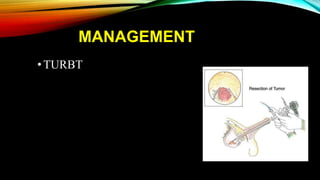
MANAGEMENT
•TURBT
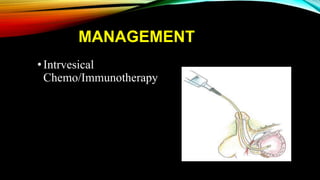
MANAGEMENT
•Intrvesical
Chemo/Immunotherapy
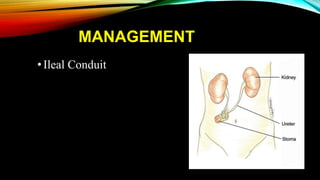
MANAGEMENT
•Ileal Conduit
MANAGEMENT
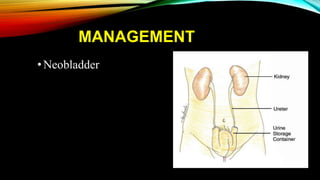
•Neobladder
MANAGEMENT
•Neoadjuvant / Adjuvant
Chemotherapy
DIAGNOSIS OF BLADDER
CANCER
•Examination - N.B. DRE in men
•Investigations
• MSU
• Urinary cytology
• IVP / Renal ultrasound with KUB
• Cystoscopy - Flexible vs Rigid
MANAGEMENT OF
BLADDER CANCER
•Depends on Stage of disease
• Adequate TURBT and biopsy
• Further investigation e.g. CT
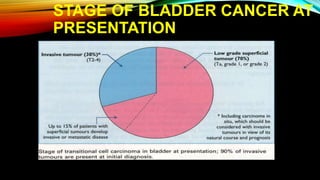
STAGE OF BLADDER CANCER AT
PRESENTATION
SUPERFICIAL BLADDER
CANCER
Stages Ta/T1
•Surveillance +/- TUR or cystodiathermy
•Interval at which cystoscopy takes place is variable
•Rationale is to spot invasive change early
•Multifocal tumours or repeated recurrence can be
treated with intravesical chemotherapy
•N.B. High grade T1 tumours are a special case - up
to 50% will become invasive
INVASIVE BLADDER
CANCER
Stages T2-T3
•Cystectomy + ileal conduit is the gold standard,
but many patients will already have
micrometastases
•Radiotherapy (alone) does not cure locally
invasive disease. Neoadjuvant radiotherapy does
not appear to improve the results of cystectomy
INVASIVE BLADDER
CANCER
Stages T4 and Metastatic disease
•Chemotherapy; responses to single drugs short-
lived and incomplete
•Greater success with combination of drugs e.g.
M-VAC
•Treatment is toxic but selected patients have
shown long-term and complete responses
CARCINOMA IN SITU
Tis / Cis
•Classified as Superficial but should be considered
along with malignant disease
•High rate of progression to invasive disease
•Once treatable only by cystectomy, now managed
initially by intravesical chemotherapy
AND INVESTIGATION OF
BLADDER CANCER
•Molecular Genetics of Bladder Cancer
•Prognostic Markers
•BTA test
MOLECULAR GENETICS OF
BLADDER CANCER
•No single chromosome alteration consistently observed
but loss of 9q is a frequent early event - ? the site of a
suppressor gene
•Loss of chromosomes 11p and 17q are associated with
higher stage disease, ? associated with loss of p53 gene
INDEPENDENT MARKERS OF
PROGRESSION
• Epidermal Growth Factor receptor sensitive and specific in predicting
progression in pT1G3 tumours
• p53 overexpression may serve as an important prognostic factor for Cis
• E-cadherin can function as an invasion suppressor. Loss of E-cadherin
associated with worse prognosis
BLADDER TUMOUR ANTIGEN
(BTA) TEST
• Detects basement membrane complexes shed into urine by the action of
tumour cell collagenases
• Latex spheres coated with modified human IgG antibodies
• Positive agglutination reaction traps blue dye, leaving yellow dye free to
migrate
MANAGEMENT OF BLADDER
CANCER
•Intravesical Therapy
•Bladder reconstruction and replacement
•Photodynamic Therapy
INTRAVESICAL THERAPY
•Indicated as prophylaxis to reduce recurrence and
tumour progression in high risk cases
• Previous recurrence
• Multiple tumours
• High grade tumours
• Carcinoma in situ
INTRAVESICAL THERAPY
•Intravesical Chemotherapy
• eg thiotepa, Mitomycin C, Doxorubicin
(Adriamycin)
•Intravesical Immunotherapy
• Bacillus Calmette et Guerin (BCG)
INTRAVESICAL
CHEMOTHERAPY
• 7 year data with Mitomycin C shows that instillation at presentation after TURBT
effectively reduces risk of recurrence and risk of progression.
• Four subsequent doses at 3/12 intervals may have further protective effect
INTRAVESICAL
IMMUNOTHERAPY• BCG is an attenuated strain of M. bovis
• Believed to exert anti-tumour effect through immune mechanism
• BCG induces a weak granulomatous response in bladder and
correlation exists between granuloma formation and favourable
response
INTRAVESICAL
IMMUNOTHERAPY
•Has been used for
• prophylaxis in tumour free patients
• treatment of residual tumour in patients with papillary
TCC and no Cis
• Treatment of Cis
RESULTS OF BCG TREATMENT
OF CIS
•Complete response rate in short term of up to
72%
•Long term studies have reported favourable
response rates in up to 89%
•Those who fail to respond to initial therapy may
respond to more intense regimen, but failure to
respond at this stage may necessitate early
cystectomy
SIDE EFFECTS OF BCG
THERAPY
•Include
• Dysuria (91%)
• Frequency (90%)
• Haematuria (46%)
•Severe reactions requiring anti TB therapy occur in 6%
patients
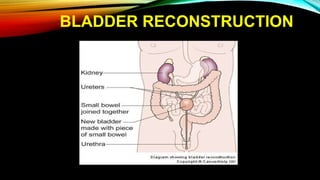
BLADDER RECONSTRUCTION
AND REPLACEMENT
•Advances in anaesthetic and surgical techniques have
led to alternatives to ileal conduit after radical
cystectomy
•Choices now include
• Substitution cystoplasty
• Continent diversion
SUBSTITUTION
CYSTOPLASTY
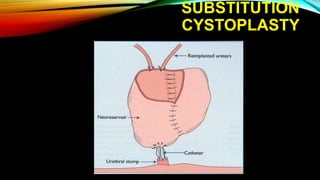
•Creation of a new reservoir from bowel segment(s)
•Ileum, ileo-caecum, or colon may be used
•Ureters implanted at proximal end and neo-bladder is
sutured to bladder neck
SUBSTITUTION
CYSTOPLASTY
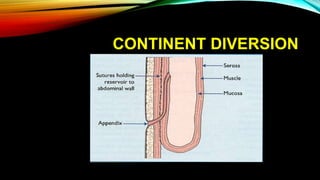
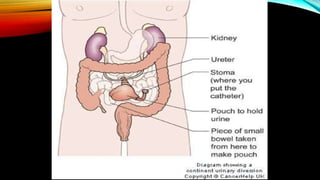
CONTINENT DIVERSION
•Used when neobladder can not be sutured to bladder
neck
•Tubularised ureter, ileum, or appendix used to provide
channel for catheterisation
•Neobladder emptied by intermittent catheterisation
CONTINENT DIVERSION
COMPLICATIONS OF BLADDER
RECONSTRUCTION
•Laparotomy in 10%, usually for bowel obstruction
•Stone formation in 8%
•Hyperchloraemic metabolic acidosis
•Stomal stenosis
•?Risk of tumours
PHOTODYNAMIC THERAPY
•Chemical photosensitisation of tumour cells, which
concentrate the photosensitiser
•Optical fibre placed in bladder down a cystoscope and
laser light stimulates the sensitised cells
•Complete response rates reported in up to 80%, but
follow up remains short
URINARY DIVERSION
•Diversion of urinary pathway from its natural path
•Types:
•Temporary
•Permanent
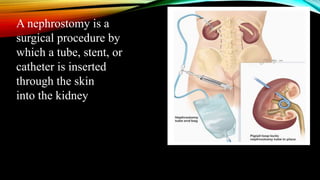
A nephrostomy is a
surgical procedure by
which a tube, stent, or
catheter is inserted
through the skin
into the kidney
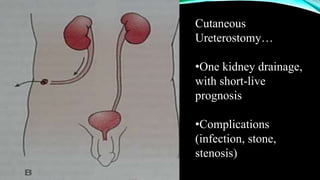
Cutaneous
Ureterostomy…
•One kidney drainage,
with short-live
prognosis
•Complications
(infection, stone,
stenosis)
PERMANENT URINARY
DIVERSION
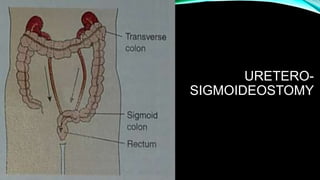
•Uretero – sigmoidostomy
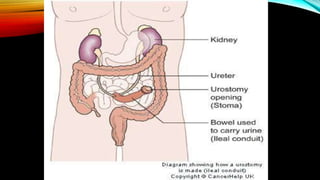
•Ileal conduit
•Colon conduit
•Ileocaecaecal segment
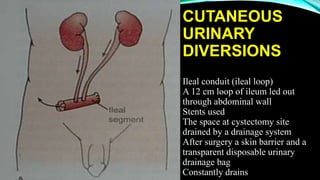
CUTANEOUS
URINARY
DIVERSIONS
Ileal conduit (ileal loop)
A 12 cm loop of ileum led out
through abdominal wall
Stents used
The space at cystectomy site
drained by a drainage system
After surgery a skin barrier and a
transparent disposable urinary
drainage bag
Constantly drains
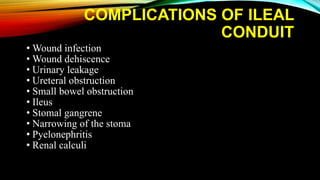
COMPLICATIONS OF ILEAL
CONDUIT
• Wound infection
• Wound dehiscence
• Urinary leakage
• Ureteral obstruction
• Small bowel obstruction
• Ileus
• Stomal gangrene
• Narrowing of the stoma
• Pyelonephritis
• Renal calculi
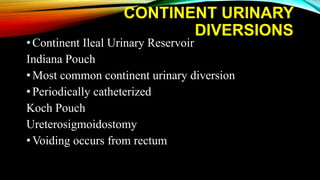
CONTINENT URINARY
DIVERSIONS
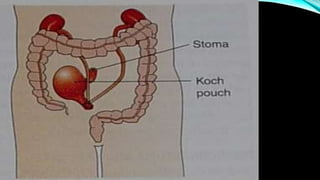
•Continent Ileal Urinary Reservoir
Indiana Pouch
•Most common continent urinary diversion
•Periodically catheterized
Koch Pouch
Ureterosigmoidostomy
•Voiding occurs from rectum
URETERO-
SIGMOIDEOSTOMY
URETERO- SIGMOIDOSTOMY
•Complications:
•Reflux of urine
•Hyperchloraemic acidosis (ammonium chloride
reabsorption, bicarbonates secretion)
•Renal infection
•Stricture formation
POTENTIAL COMPLICATIONS
•Peritonitis due to disruption of anastomosis
•Stoma ischaemia and necrosis due to compromised
blood supply to stoma
•Stoma retraction and separation of mucocutaneous
border due to tension or trauma
BLADDER RECONSTRUCTION
PROGNOSIS….. TCC
Untreated bladder cancer produces significant morbidity,
including the following:
 Hematuria
 Dysuria
 Irritative urinary symptoms
 Urinary retention
 Urinary incontinence
 Ureteral obstruction
 Pelvic pain
PROGNOSIS….. TCC
The recurrence rate for superficial TCC of the bladder is
high. As many as 80% of patients have at least one
recurrence.
Prognostic factors for bladder cancer are
Grade
Depth of invasion
Presence of Cis
In patients undergoing radical cystectomy for muscle-
invasive bladder cancer, the presence of nodal
involvement is the most important prognostic factor.
PROGNOSIS….. TCC
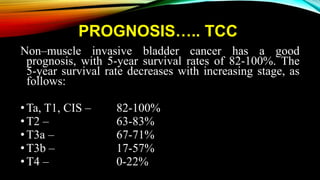
Non–muscle invasive bladder cancer has a good
prognosis, with 5-year survival rates of 82-100%. The
5-year survival rate decreases with increasing stage, as
follows:
•Ta, T1, CIS – 82-100%
•T2 – 63-83%
•T3a – 67-71%
•T3b – 17-57%
•T4 – 0-22%
PROGNOSIS….. TCC
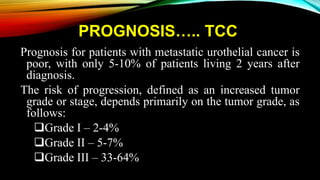
Prognosis for patients with metastatic urothelial cancer is
poor, with only 5-10% of patients living 2 years after
diagnosis.
The risk of progression, defined as an increased tumor
grade or stage, depends primarily on the tumor grade, as
follows:
Grade I – 2-4%
Grade II – 5-7%
Grade III – 33-64%
PROGNOSIS CARCINOMA IN
SITU
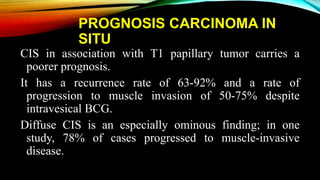
CIS in association with T1 papillary tumor carries a
poorer prognosis.
It has a recurrence rate of 63-92% and a rate of
progression to muscle invasion of 50-75% despite
intravesical BCG.
Diffuse CIS is an especially ominous finding; in one
study, 78% of cases progressed to muscle-invasive
disease.
PROGNOSIS….. SQUAMOUS
CELL CA
•Tumor stage, lymph node involvement, and tumor
grade have been shown to be of independent
prognostic value in SCC.[54, 55] However,
pathologic stage is the most important prognostic
factor.
•In SCC, the survival rate appears to be better with
radical surgery than with radiation therapy and/or
chemotherapy. In locally advanced tumors, however,
neoadjuvant radiation improves the outcome.
PROGNOSIS….. SMALL CELL
CA
• Patients with small cell carcinoma of the
bladder usually have disease in an advanced
stage at diagnosis, and they have a poor
prognosis.
• Overall median survival is only 1.7 years. The
5-year survival rates for stage II, III, and IV
disease are 64%, 15%, and 11%, respectively.
RECURRENT BLADDER
CARCINOMA
• Bladder cancer has the highest recurrence rate of any
malignancy (ie, 70% within 5 y).
• The underlying genetic changes that result in a bladder
tumor occur in the entire urothelium, making the whole
lining of the urinary system susceptible to tumor
recurrence.
RECURRENT BLADDER
CARCINOMA
Risk factors for recurrence and progression include the
following:
 Female sex
 Larger tumor size
 Multifocality
 Larger number of tumors
 High tumor grade
 Advanced stage
 Presence of Cis
RECURRENT BLADDER
CARCINOMA
The time interval to recurrence is also significant.
Patients with tumor recurrences within 2 years,
and especially with recurrences within 3-6 months,
have an aggressive tumor and an increased risk of
disease progression.
Bladder cancer management

Bladder cancer management

  • 1.
    CARCINOMA URINARY BLADDER MANAGEMENT By Dr.Muhammad Saifullah Post-Graduate Resident (FINAL YEAR) Department of Urology & Renal Transplantation Allied Hospital, Faisalabad.
  • 3.
  • 4.
  • 5.
  • 6.
  • 7.
  • 8.
    DIAGNOSIS OF BLADDER CANCER •Examination- N.B. DRE in men •Investigations • MSU • Urinary cytology • IVP / Renal ultrasound with KUB • Cystoscopy - Flexible vs Rigid
  • 9.
    MANAGEMENT OF BLADDER CANCER •Dependson Stage of disease • Adequate TURBT and biopsy • Further investigation e.g. CT
  • 10.
    STAGE OF BLADDERCANCER AT PRESENTATION
  • 11.
    SUPERFICIAL BLADDER CANCER Stages Ta/T1 •Surveillance+/- TUR or cystodiathermy •Interval at which cystoscopy takes place is variable •Rationale is to spot invasive change early •Multifocal tumours or repeated recurrence can be treated with intravesical chemotherapy •N.B. High grade T1 tumours are a special case - up to 50% will become invasive
  • 12.
    INVASIVE BLADDER CANCER Stages T2-T3 •Cystectomy+ ileal conduit is the gold standard, but many patients will already have micrometastases •Radiotherapy (alone) does not cure locally invasive disease. Neoadjuvant radiotherapy does not appear to improve the results of cystectomy
  • 13.
    INVASIVE BLADDER CANCER Stages T4and Metastatic disease •Chemotherapy; responses to single drugs short- lived and incomplete •Greater success with combination of drugs e.g. M-VAC •Treatment is toxic but selected patients have shown long-term and complete responses
  • 14.
    CARCINOMA IN SITU Tis/ Cis •Classified as Superficial but should be considered along with malignant disease •High rate of progression to invasive disease •Once treatable only by cystectomy, now managed initially by intravesical chemotherapy
  • 15.
    AND INVESTIGATION OF BLADDERCANCER •Molecular Genetics of Bladder Cancer •Prognostic Markers •BTA test
  • 16.
    MOLECULAR GENETICS OF BLADDERCANCER •No single chromosome alteration consistently observed but loss of 9q is a frequent early event - ? the site of a suppressor gene •Loss of chromosomes 11p and 17q are associated with higher stage disease, ? associated with loss of p53 gene
  • 17.
    INDEPENDENT MARKERS OF PROGRESSION •Epidermal Growth Factor receptor sensitive and specific in predicting progression in pT1G3 tumours • p53 overexpression may serve as an important prognostic factor for Cis • E-cadherin can function as an invasion suppressor. Loss of E-cadherin associated with worse prognosis
  • 18.
    BLADDER TUMOUR ANTIGEN (BTA)TEST • Detects basement membrane complexes shed into urine by the action of tumour cell collagenases • Latex spheres coated with modified human IgG antibodies • Positive agglutination reaction traps blue dye, leaving yellow dye free to migrate
  • 19.
    MANAGEMENT OF BLADDER CANCER •IntravesicalTherapy •Bladder reconstruction and replacement •Photodynamic Therapy
  • 20.
    INTRAVESICAL THERAPY •Indicated asprophylaxis to reduce recurrence and tumour progression in high risk cases • Previous recurrence • Multiple tumours • High grade tumours • Carcinoma in situ
  • 21.
    INTRAVESICAL THERAPY •Intravesical Chemotherapy •eg thiotepa, Mitomycin C, Doxorubicin (Adriamycin) •Intravesical Immunotherapy • Bacillus Calmette et Guerin (BCG)
  • 22.
    INTRAVESICAL CHEMOTHERAPY • 7 yeardata with Mitomycin C shows that instillation at presentation after TURBT effectively reduces risk of recurrence and risk of progression. • Four subsequent doses at 3/12 intervals may have further protective effect
  • 23.
    INTRAVESICAL IMMUNOTHERAPY• BCG isan attenuated strain of M. bovis • Believed to exert anti-tumour effect through immune mechanism • BCG induces a weak granulomatous response in bladder and correlation exists between granuloma formation and favourable response
  • 24.
    INTRAVESICAL IMMUNOTHERAPY •Has been usedfor • prophylaxis in tumour free patients • treatment of residual tumour in patients with papillary TCC and no Cis • Treatment of Cis
  • 25.
    RESULTS OF BCGTREATMENT OF CIS •Complete response rate in short term of up to 72% •Long term studies have reported favourable response rates in up to 89% •Those who fail to respond to initial therapy may respond to more intense regimen, but failure to respond at this stage may necessitate early cystectomy
  • 26.
    SIDE EFFECTS OFBCG THERAPY •Include • Dysuria (91%) • Frequency (90%) • Haematuria (46%) •Severe reactions requiring anti TB therapy occur in 6% patients
  • 27.
    BLADDER RECONSTRUCTION AND REPLACEMENT •Advancesin anaesthetic and surgical techniques have led to alternatives to ileal conduit after radical cystectomy •Choices now include • Substitution cystoplasty • Continent diversion
  • 28.
    SUBSTITUTION CYSTOPLASTY •Creation of anew reservoir from bowel segment(s) •Ileum, ileo-caecum, or colon may be used •Ureters implanted at proximal end and neo-bladder is sutured to bladder neck
  • 29.
  • 30.
    CONTINENT DIVERSION •Used whenneobladder can not be sutured to bladder neck •Tubularised ureter, ileum, or appendix used to provide channel for catheterisation •Neobladder emptied by intermittent catheterisation
  • 31.
  • 32.
    COMPLICATIONS OF BLADDER RECONSTRUCTION •Laparotomyin 10%, usually for bowel obstruction •Stone formation in 8% •Hyperchloraemic metabolic acidosis •Stomal stenosis •?Risk of tumours
  • 33.
    PHOTODYNAMIC THERAPY •Chemical photosensitisationof tumour cells, which concentrate the photosensitiser •Optical fibre placed in bladder down a cystoscope and laser light stimulates the sensitised cells •Complete response rates reported in up to 80%, but follow up remains short
  • 34.
    URINARY DIVERSION •Diversion ofurinary pathway from its natural path •Types: •Temporary •Permanent
  • 35.
    A nephrostomy isa surgical procedure by which a tube, stent, or catheter is inserted through the skin into the kidney
  • 36.
    Cutaneous Ureterostomy… •One kidney drainage, withshort-live prognosis •Complications (infection, stone, stenosis)
  • 37.
    PERMANENT URINARY DIVERSION •Uretero –sigmoidostomy •Ileal conduit •Colon conduit •Ileocaecaecal segment
  • 38.
    CUTANEOUS URINARY DIVERSIONS Ileal conduit (ilealloop) A 12 cm loop of ileum led out through abdominal wall Stents used The space at cystectomy site drained by a drainage system After surgery a skin barrier and a transparent disposable urinary drainage bag Constantly drains
  • 40.
    COMPLICATIONS OF ILEAL CONDUIT •Wound infection • Wound dehiscence • Urinary leakage • Ureteral obstruction • Small bowel obstruction • Ileus • Stomal gangrene • Narrowing of the stoma • Pyelonephritis • Renal calculi
  • 41.
    CONTINENT URINARY DIVERSIONS •Continent IlealUrinary Reservoir Indiana Pouch •Most common continent urinary diversion •Periodically catheterized Koch Pouch Ureterosigmoidostomy •Voiding occurs from rectum
  • 42.
  • 43.
    URETERO- SIGMOIDOSTOMY •Complications: •Reflux ofurine •Hyperchloraemic acidosis (ammonium chloride reabsorption, bicarbonates secretion) •Renal infection •Stricture formation
  • 46.
    POTENTIAL COMPLICATIONS •Peritonitis dueto disruption of anastomosis •Stoma ischaemia and necrosis due to compromised blood supply to stoma •Stoma retraction and separation of mucocutaneous border due to tension or trauma
  • 49.
  • 50.
    PROGNOSIS….. TCC Untreated bladdercancer produces significant morbidity, including the following:  Hematuria  Dysuria  Irritative urinary symptoms  Urinary retention  Urinary incontinence  Ureteral obstruction  Pelvic pain
  • 51.
    PROGNOSIS….. TCC The recurrencerate for superficial TCC of the bladder is high. As many as 80% of patients have at least one recurrence. Prognostic factors for bladder cancer are Grade Depth of invasion Presence of Cis In patients undergoing radical cystectomy for muscle- invasive bladder cancer, the presence of nodal involvement is the most important prognostic factor.
  • 52.
    PROGNOSIS….. TCC Non–muscle invasivebladder cancer has a good prognosis, with 5-year survival rates of 82-100%. The 5-year survival rate decreases with increasing stage, as follows: •Ta, T1, CIS – 82-100% •T2 – 63-83% •T3a – 67-71% •T3b – 17-57% •T4 – 0-22%
  • 53.
    PROGNOSIS….. TCC Prognosis forpatients with metastatic urothelial cancer is poor, with only 5-10% of patients living 2 years after diagnosis. The risk of progression, defined as an increased tumor grade or stage, depends primarily on the tumor grade, as follows: Grade I – 2-4% Grade II – 5-7% Grade III – 33-64%
  • 54.
    PROGNOSIS CARCINOMA IN SITU CISin association with T1 papillary tumor carries a poorer prognosis. It has a recurrence rate of 63-92% and a rate of progression to muscle invasion of 50-75% despite intravesical BCG. Diffuse CIS is an especially ominous finding; in one study, 78% of cases progressed to muscle-invasive disease.
  • 55.
    PROGNOSIS….. SQUAMOUS CELL CA •Tumorstage, lymph node involvement, and tumor grade have been shown to be of independent prognostic value in SCC.[54, 55] However, pathologic stage is the most important prognostic factor. •In SCC, the survival rate appears to be better with radical surgery than with radiation therapy and/or chemotherapy. In locally advanced tumors, however, neoadjuvant radiation improves the outcome.
  • 56.
    PROGNOSIS….. SMALL CELL CA •Patients with small cell carcinoma of the bladder usually have disease in an advanced stage at diagnosis, and they have a poor prognosis. • Overall median survival is only 1.7 years. The 5-year survival rates for stage II, III, and IV disease are 64%, 15%, and 11%, respectively.
  • 57.
    RECURRENT BLADDER CARCINOMA • Bladdercancer has the highest recurrence rate of any malignancy (ie, 70% within 5 y). • The underlying genetic changes that result in a bladder tumor occur in the entire urothelium, making the whole lining of the urinary system susceptible to tumor recurrence.
  • 58.
    RECURRENT BLADDER CARCINOMA Risk factorsfor recurrence and progression include the following:  Female sex  Larger tumor size  Multifocality  Larger number of tumors  High tumor grade  Advanced stage  Presence of Cis
  • 59.
    RECURRENT BLADDER CARCINOMA The timeinterval to recurrence is also significant. Patients with tumor recurrences within 2 years, and especially with recurrences within 3-6 months, have an aggressive tumor and an increased risk of disease progression.