Dr. Muhammad Saifullah
HOUSE SURGEON (SU-III)
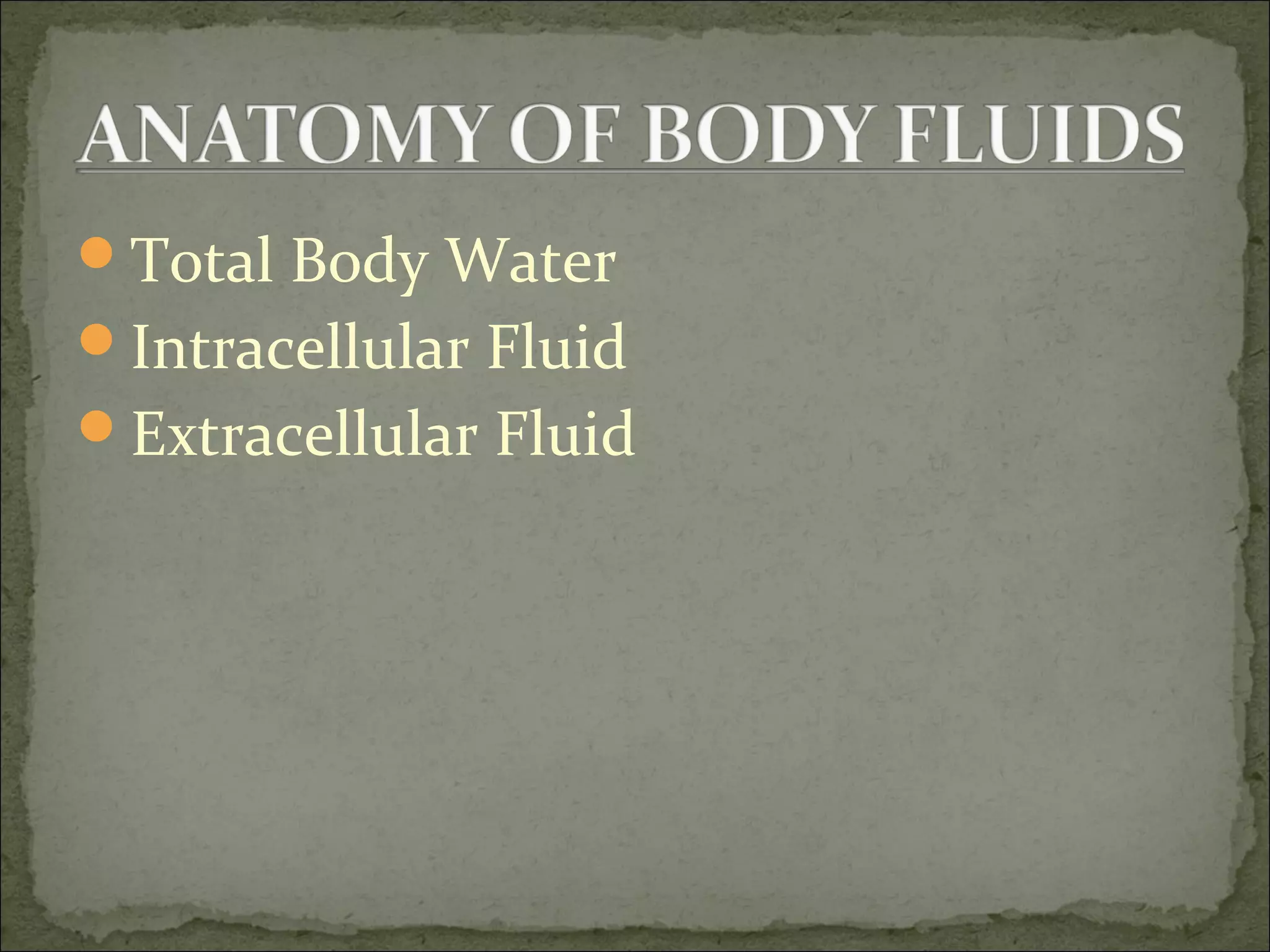
Total Body Water
Intracellular Fluid
Extracellular Fluid
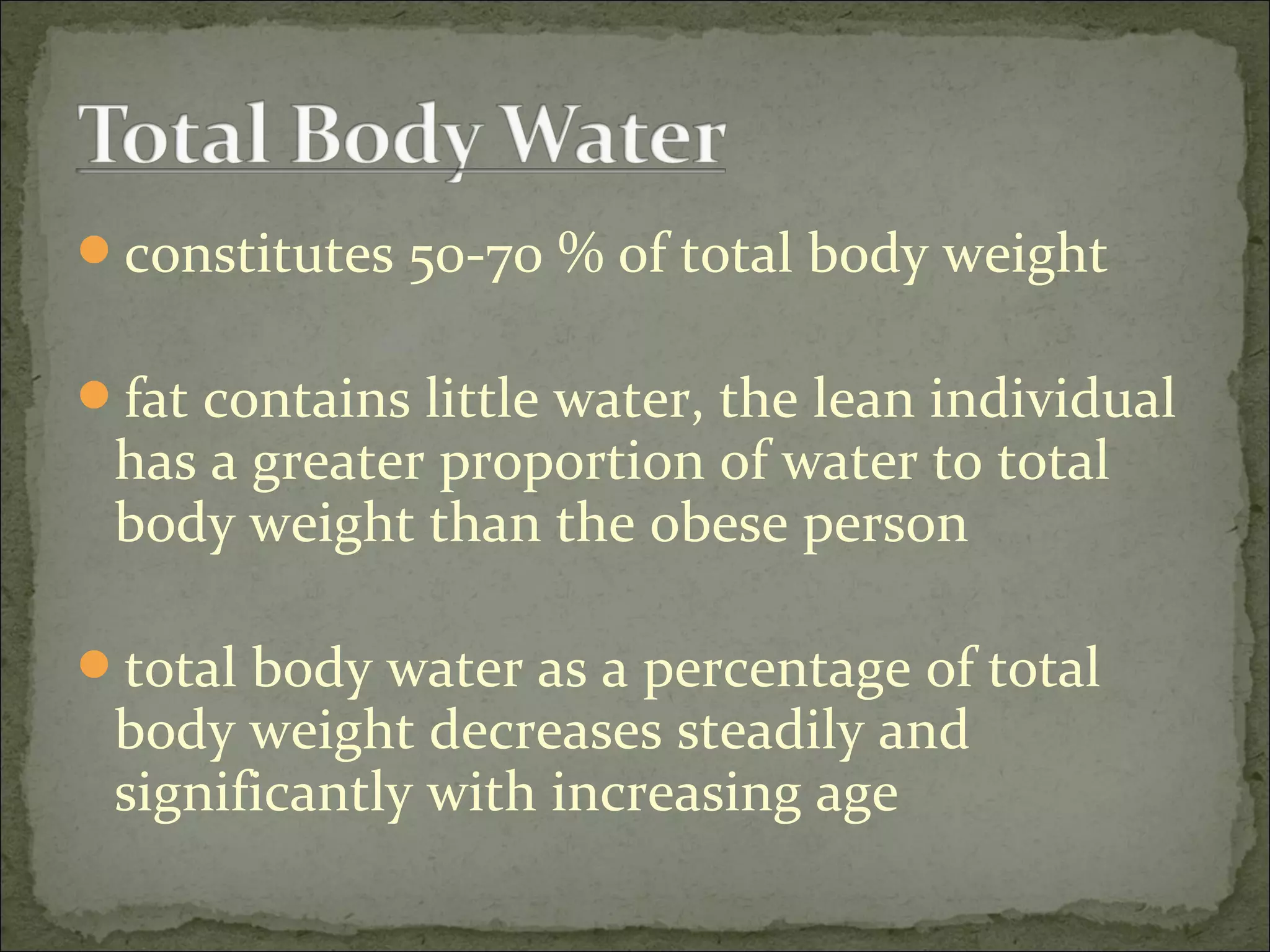
constitutes 50-70 % of total body weight
fat contains little water, the lean individual
has a greater proportion of water to total
body weight than the obese person
total body water as a percentage of total
body weight decreases steadily and
significantly with increasing age
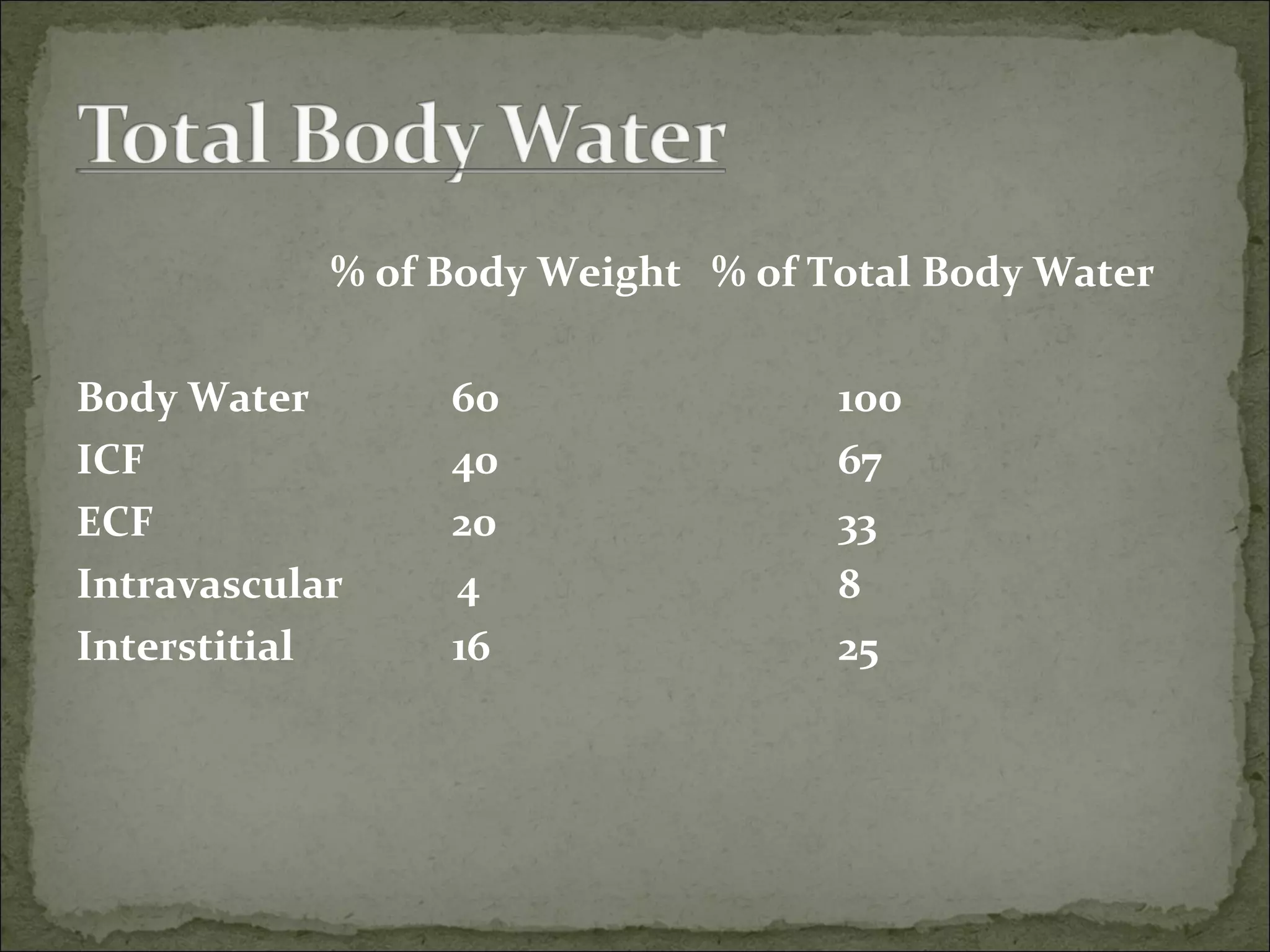
% of Body Weight % of Total Body Water
Body Water 60 100
ICF 40 67
ECF 20 33
Intravascular 4 8
Interstitial 16 25
largest proportion in the skeletal muscle
potassium and magnesium are the
principal cations
phosphates and proteins the principal
anions
interstitial fluid: two types
functional component (90%) - rapidly equilibrating
nonfunctioning components (10%) - slowly
equilibrating
connective tissue water and transcellular water
called a “third space” or distributional change
sodium is the principal cation
chloride and bicarb the principal anions
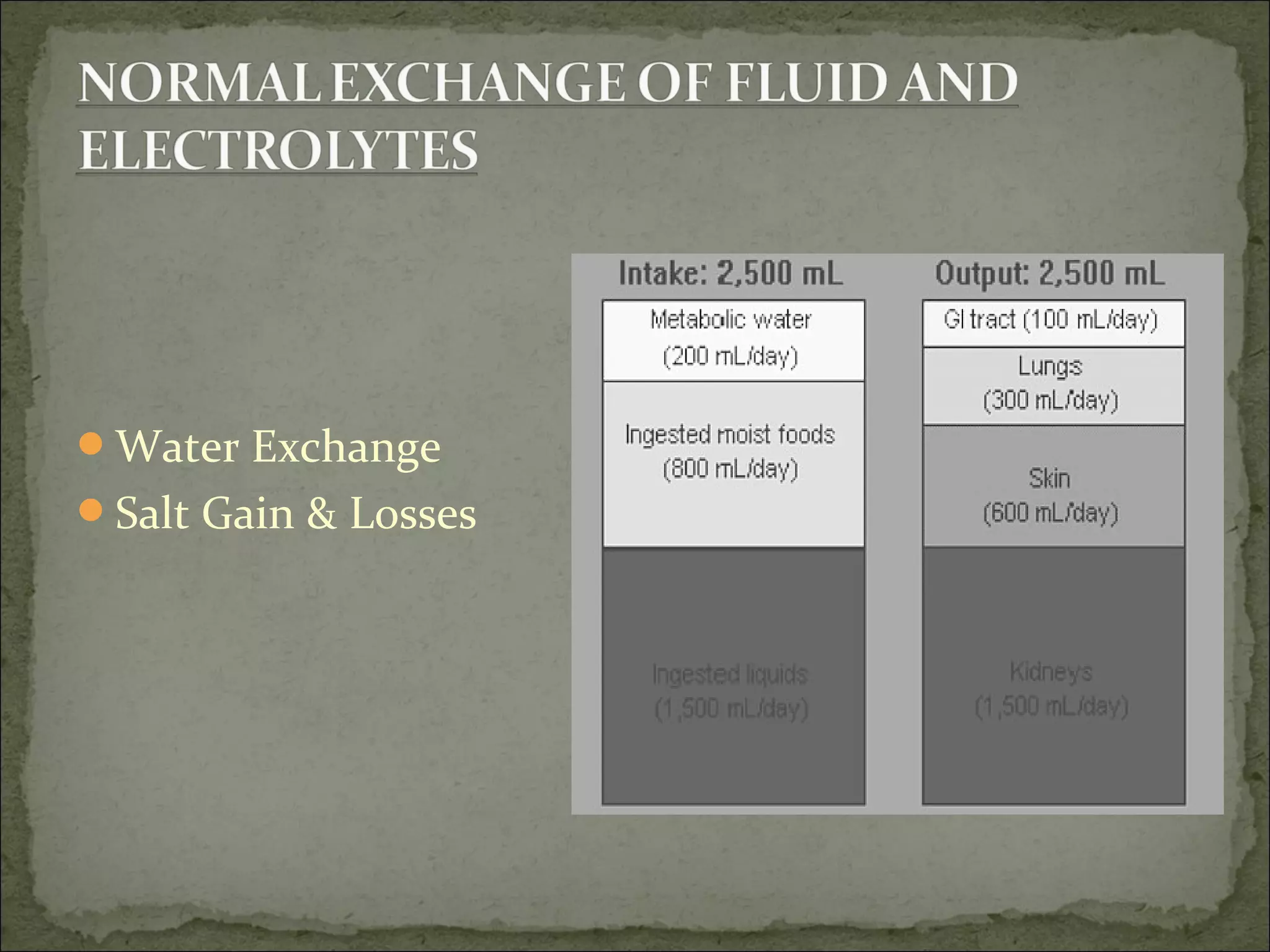
Water Exchange
Salt Gain & Losses
daily water gains
normal individual consumes 2500 mL
water per day
approximately 2000-2200 mL taken by
mouth…half in Solid food!!!
rest is extracted from food as the product
of oxidation, about 300-500 mL
daily water losses
60-150 mL in stools, 1500 mL in urine, and 600 mL as
insensible loss
total losses ~ 2.2 liters
Insensible loss: skin (75%) and lungs (25%)
increased by hypermetabolism, hyperventilation, and fever
250 mL/day per degree of fever
unhumidified tracheostomy with hyperventilation =
insensible loss up to 1.5 L/day
Minimum of 400 mL urine per 24 hrs
required to excrete the products of
protein catabolism
daily salt intake varies 3-5 gm as NaCl
kidneys excretes excess salt: can vary from < 1 to > 200
mEq/day
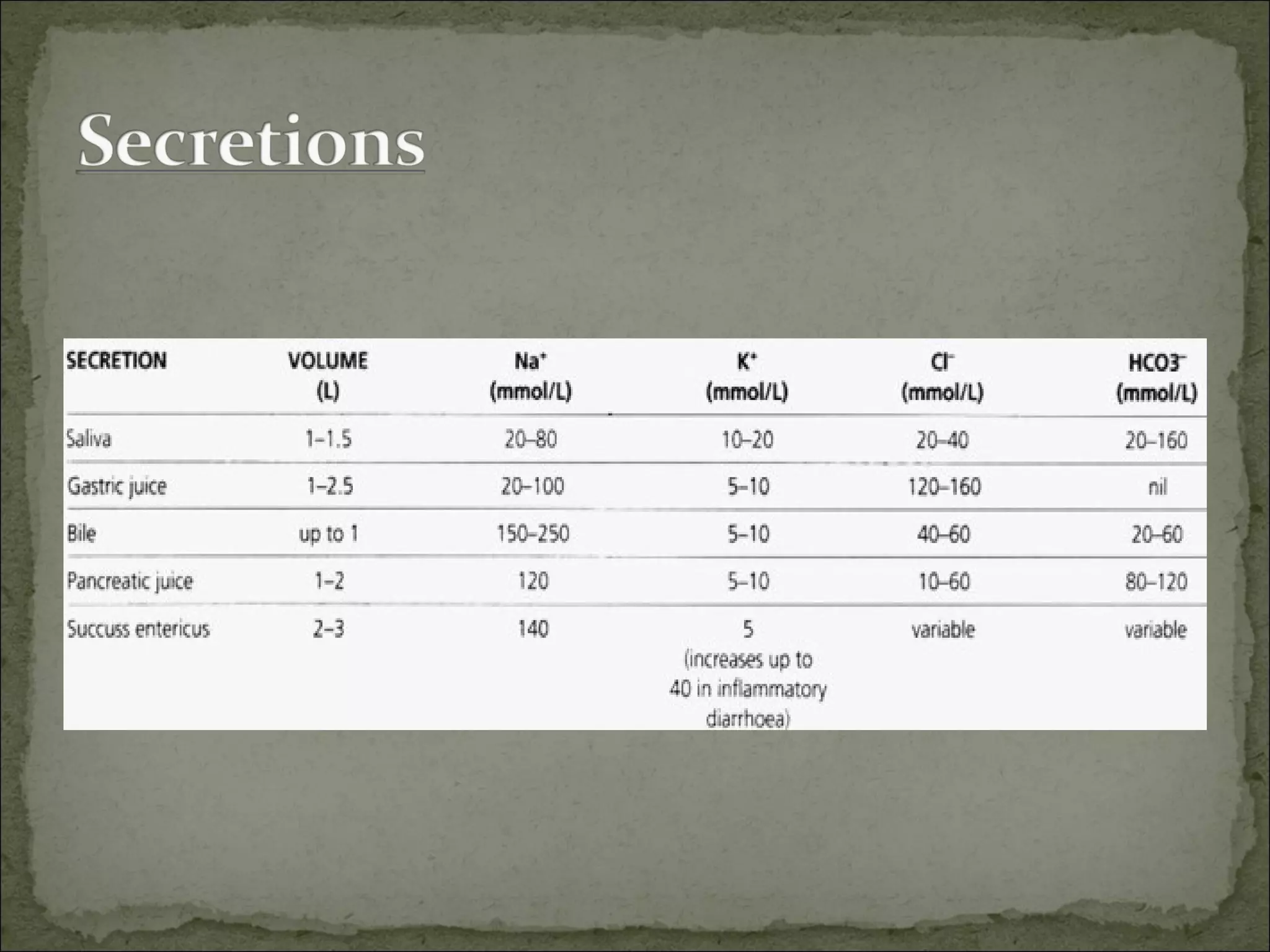
Volume and composition of various types of
gastrointestinal secretions
Gastrointestinal losses usually are isotonic or slightly
hypotonic
should replace by isotonic salt solution
Volume Changes
Concentration Changes
Composition Changes
Potassium Abnormalities
Calcium Abnormalities
Magnesium Abnormalities
If isotonic salt solution is added to or lost from
the body fluids, only the volume of the ECF is
changed, ICF is relatively unaffected
If water is added to or lost from the ECF, the conc.
of osmotically active particles changes
Water will pass into the intracellular space until
osmolarity is again equal in the two compartments
BUN level rises with an ECF deficit of sufficient
magnitude to reduce GFR
creatinine level may not incr. proportionally in young
people with healthy kidneys
hematocrit increases with an ECF deficit and decreases
with ECF excess
sodium is not reliably related to the volume status of
ECF
a severe volume deficit may exist with a normal,
low, or high serum level
ECF volume deficit is most common fluid loss in
surgical patients
most common causes of ECF volume deficit are: GI
losses from vomiting, nasogastric suction,diarrhea,
and fistular drainage
other common causes: soft-tissue injuries and
infections, peritonitis, obstruction,
and burns
signs and symptoms of volume deficit:
CNS: sleepy, apathy – stupor, coma
GI: dec food consumption – N/V
CVS: orthostatic, tachy, collapsed veins
- hypotension
Tissue: dec skin turgor, small tongue –
sunken eyes, atonia
Iatrogenic or Secondary to renal insufficiency,
cirrhosis, or CHF
signs & symptoms of volume excess:
CNS: none
GI: edema of bowel
CVS: elevated CVP, venous distension –
pulmonary edema
Tissue: pitting edema – anasarca
Na+ primarily responsible for ECF osmolarity
Hyponatremia and hypernatremia s&s often occur if
changes are severe or occur rapidly
The concentration of most ions within the ECF can be
altered without significant osmolality change, thus
producing only a compositional change
Example: rise of potassium from 4 to 8 mEq/L would
significantly effect the myocardium, but not the effective
osmotic pressure of the ECF
acute symptomatic hyponatremia (< 130)
hypertension can occur & is probably induced by the rise in
intracranial pressure
signs & symptoms:
CNS: twitching, hyperactive reflexes – inc ICP,
convulsions, areflexia
CVS: HTN/brady due to inc ICP
Tissue: salivation, watery diarrhea
Renal: oliguria - anuria
Hyponatremia occurs when water is given to replace
losses of sodium-containing fluids or when water
administration consistently exceeds water losses
Hyperglycemia: glucose exerts an osmotic force in the
ECF and causes the transfer of cellular water into the
ECF, resulting in a dilutional hyponatremia
The only state in which dry, sticky mucous membranes are
characteristic
sign does not occur with pure ECF deficit alone
signs & symptoms:
CNS: restless, weak - delirium
CVS: tachycardia - hypotension
Tissue: dry/sticky muc membranes – swollen tongue
Renal: oliguria
Metabolic: fever – heat stroke
Potassium Abnormalities
Calcium Abnormalities
Magnesium Abnormalities
normal daily dietary intake of K+ is approx. 50 to
100 mEq
majority of K+ is excreted in the urine
98% of the potassium in the body is located in ICF
@ 150 mEq/L and it is the major cation of
intracellular water
intracellular K+ is released into the extracellular
space in response to severe injury or surgical stress,
acidosis, and the catabolic state
signs & symptoms:
CVS: peaked T waves, widened QRS
complex, and depressed ST segments 
Disappearance of T waves, heart block,
and diastolic cardiac arrest
GI: nausea, vomiting, diarrhea
(hyperfunctional bowel)
K+ has an important role in the regulation of acid-base
balance
alkalosis causes increased renal K+/H+ excretion
signs & symptoms:
CVS: flatten T waves, depressed ST segments
GI: paralytic ileus
Muscular: weakness - flaccid paralysis, diminished to
absent tendon reflexes
majority of the 1000 to 1200g of calcium in the
average-sized adult is found in the bone
Normal daily intake of calcium is 1 to 3 gm
Most is excreted via the GI tract
half is non-ionized and bound to proteins
ionized portion is responsible for neuromuscular
stability
signs & symptoms (serum level < 8):
numbness and tingling of the circumoral region and the
tips of the fingers and toes
hyperactive tendon reflexes, positive Chvostek's sign,
muscle and abdominal cramps, tetany with carpopedal
spasm, convulsions (with severe deficit), and
prolongation of the Q-T interval on the ECG
causes:
acute pancreatitis, massive soft-tissue
infections (necrotizing fasciitis), acute
and chronic renal failure, pancreatic
and small-bowel fistulas, and
hypoparathyroidism
signs & symptoms:
CNS: easy fatigue, weakness, stupor, and
coma
GI: anorexia, nausea, vomiting, and
weight loss, thirst, polydipsia, and
polyuria
two major causes:
hyperparathyroidism and cancer
bone mets
PTH-like peptide in malignancies
total body content of magnesium 2000 mEq
about half of which is incorporated in bone
distribution of Mg similar to K+, the major
portion being intracellular
normal daily dietary intake of magnesium is
approximately 240 mg
most is excreted in the feces and the remainder in
the urine
causes:
starvation, malabsorption syndromes, GI
losses, prolonged IV or TPN with
magnesium-free solutions
signs & symptoms:
similar to those of calcium deficiency
Symptomatic hypermagnesemia, although rare, is
most commonly seen with severe renal insufficiency
signs & symptoms:
CNS: lethargy and weakness with progressive loss of
DTR’s – somnolence, coma, death
CVS: increased P-R interval, widened QRS complex, and
elevated T waves (resemble hyperkalemia) – cardiac
arrest
Preoperative Fluid Therapy
Intraoperative Fluid Therapy
Postoperative Fluid Therapy
Correction of Volume Changes: Volume deficits result
from external loss of fluids or from an internal
redistribution of ECF into a nonfunctional compartment
 nonfunctional because it is no longer able to participate in the
normal function of the ECF and may just as well have been lost
externally
Correction of Concentration Changes: If severe
symptomatic hypo or hypernatremia complicates the
volume loss, prompt correction of the concentration
abnormality to the extent that symptoms are relieved is
necessary
replace losses & supply a maintenance:
open abdomen losses: 8 cc/kg/hr
NGT & urine output
Blood loss x 3
Replace with isotonic salt solution (LR or NS)
unwise to administer potassium during the first 24 h,
until adequate urine output has been established even a
small quantity of potassium may be detrimental
because of fluid shifts
Postoperative fluids:
1-Dextrose saline will produce hyponatraemia in a
postoperative patient.
2-Alternate bags of saline and dextrose saline with
supplementary potassium give the best balance.
Fluids distribute into :
1-Colloid(blood, albumin or gelatine solution ) stays in the
vascular compartment.
2-Saline stays in the extracellular compartment.
3-Dextrose eventually goes to all compartment
Fluids & Electrolyte Management of the surgical patient

Fluids & Electrolyte Management of the surgical patient

  • 1.
  • 2.
    Total Body Water IntracellularFluid Extracellular Fluid
  • 3.
    constitutes 50-70 %of total body weight fat contains little water, the lean individual has a greater proportion of water to total body weight than the obese person total body water as a percentage of total body weight decreases steadily and significantly with increasing age
  • 4.
    % of BodyWeight % of Total Body Water Body Water 60 100 ICF 40 67 ECF 20 33 Intravascular 4 8 Interstitial 16 25
  • 5.
    largest proportion inthe skeletal muscle potassium and magnesium are the principal cations phosphates and proteins the principal anions
  • 6.
    interstitial fluid: twotypes functional component (90%) - rapidly equilibrating nonfunctioning components (10%) - slowly equilibrating connective tissue water and transcellular water called a “third space” or distributional change sodium is the principal cation chloride and bicarb the principal anions
  • 7.
  • 8.
    daily water gains normalindividual consumes 2500 mL water per day approximately 2000-2200 mL taken by mouth…half in Solid food!!! rest is extracted from food as the product of oxidation, about 300-500 mL
  • 9.
    daily water losses 60-150mL in stools, 1500 mL in urine, and 600 mL as insensible loss total losses ~ 2.2 liters Insensible loss: skin (75%) and lungs (25%) increased by hypermetabolism, hyperventilation, and fever 250 mL/day per degree of fever unhumidified tracheostomy with hyperventilation = insensible loss up to 1.5 L/day
  • 10.
    Minimum of 400mL urine per 24 hrs required to excrete the products of protein catabolism
  • 11.
    daily salt intakevaries 3-5 gm as NaCl kidneys excretes excess salt: can vary from < 1 to > 200 mEq/day Volume and composition of various types of gastrointestinal secretions Gastrointestinal losses usually are isotonic or slightly hypotonic should replace by isotonic salt solution
  • 12.
    Volume Changes Concentration Changes CompositionChanges Potassium Abnormalities Calcium Abnormalities Magnesium Abnormalities
  • 13.
    If isotonic saltsolution is added to or lost from the body fluids, only the volume of the ECF is changed, ICF is relatively unaffected If water is added to or lost from the ECF, the conc. of osmotically active particles changes Water will pass into the intracellular space until osmolarity is again equal in the two compartments
  • 14.
    BUN level riseswith an ECF deficit of sufficient magnitude to reduce GFR creatinine level may not incr. proportionally in young people with healthy kidneys hematocrit increases with an ECF deficit and decreases with ECF excess sodium is not reliably related to the volume status of ECF a severe volume deficit may exist with a normal, low, or high serum level
  • 15.
    ECF volume deficitis most common fluid loss in surgical patients most common causes of ECF volume deficit are: GI losses from vomiting, nasogastric suction,diarrhea, and fistular drainage other common causes: soft-tissue injuries and infections, peritonitis, obstruction, and burns
  • 16.
    signs and symptomsof volume deficit: CNS: sleepy, apathy – stupor, coma GI: dec food consumption – N/V CVS: orthostatic, tachy, collapsed veins - hypotension Tissue: dec skin turgor, small tongue – sunken eyes, atonia
  • 17.
    Iatrogenic or Secondaryto renal insufficiency, cirrhosis, or CHF signs & symptoms of volume excess: CNS: none GI: edema of bowel CVS: elevated CVP, venous distension – pulmonary edema Tissue: pitting edema – anasarca
  • 18.
    Na+ primarily responsiblefor ECF osmolarity Hyponatremia and hypernatremia s&s often occur if changes are severe or occur rapidly The concentration of most ions within the ECF can be altered without significant osmolality change, thus producing only a compositional change Example: rise of potassium from 4 to 8 mEq/L would significantly effect the myocardium, but not the effective osmotic pressure of the ECF
  • 19.
    acute symptomatic hyponatremia(< 130) hypertension can occur & is probably induced by the rise in intracranial pressure signs & symptoms: CNS: twitching, hyperactive reflexes – inc ICP, convulsions, areflexia CVS: HTN/brady due to inc ICP Tissue: salivation, watery diarrhea Renal: oliguria - anuria
  • 20.
    Hyponatremia occurs whenwater is given to replace losses of sodium-containing fluids or when water administration consistently exceeds water losses Hyperglycemia: glucose exerts an osmotic force in the ECF and causes the transfer of cellular water into the ECF, resulting in a dilutional hyponatremia
  • 21.
    The only statein which dry, sticky mucous membranes are characteristic sign does not occur with pure ECF deficit alone signs & symptoms: CNS: restless, weak - delirium CVS: tachycardia - hypotension Tissue: dry/sticky muc membranes – swollen tongue Renal: oliguria Metabolic: fever – heat stroke
  • 22.
  • 23.
    normal daily dietaryintake of K+ is approx. 50 to 100 mEq majority of K+ is excreted in the urine 98% of the potassium in the body is located in ICF @ 150 mEq/L and it is the major cation of intracellular water intracellular K+ is released into the extracellular space in response to severe injury or surgical stress, acidosis, and the catabolic state
  • 24.
    signs & symptoms: CVS:peaked T waves, widened QRS complex, and depressed ST segments  Disappearance of T waves, heart block, and diastolic cardiac arrest GI: nausea, vomiting, diarrhea (hyperfunctional bowel)
  • 25.
    K+ has animportant role in the regulation of acid-base balance alkalosis causes increased renal K+/H+ excretion signs & symptoms: CVS: flatten T waves, depressed ST segments GI: paralytic ileus Muscular: weakness - flaccid paralysis, diminished to absent tendon reflexes
  • 26.
    majority of the1000 to 1200g of calcium in the average-sized adult is found in the bone Normal daily intake of calcium is 1 to 3 gm Most is excreted via the GI tract half is non-ionized and bound to proteins ionized portion is responsible for neuromuscular stability
  • 27.
    signs & symptoms(serum level < 8): numbness and tingling of the circumoral region and the tips of the fingers and toes hyperactive tendon reflexes, positive Chvostek's sign, muscle and abdominal cramps, tetany with carpopedal spasm, convulsions (with severe deficit), and prolongation of the Q-T interval on the ECG
  • 28.
    causes: acute pancreatitis, massivesoft-tissue infections (necrotizing fasciitis), acute and chronic renal failure, pancreatic and small-bowel fistulas, and hypoparathyroidism
  • 29.
    signs & symptoms: CNS:easy fatigue, weakness, stupor, and coma GI: anorexia, nausea, vomiting, and weight loss, thirst, polydipsia, and polyuria
  • 30.
    two major causes: hyperparathyroidismand cancer bone mets PTH-like peptide in malignancies
  • 31.
    total body contentof magnesium 2000 mEq about half of which is incorporated in bone distribution of Mg similar to K+, the major portion being intracellular normal daily dietary intake of magnesium is approximately 240 mg most is excreted in the feces and the remainder in the urine
  • 32.
    causes: starvation, malabsorption syndromes,GI losses, prolonged IV or TPN with magnesium-free solutions signs & symptoms: similar to those of calcium deficiency
  • 33.
    Symptomatic hypermagnesemia, althoughrare, is most commonly seen with severe renal insufficiency signs & symptoms: CNS: lethargy and weakness with progressive loss of DTR’s – somnolence, coma, death CVS: increased P-R interval, widened QRS complex, and elevated T waves (resemble hyperkalemia) – cardiac arrest
  • 35.
    Preoperative Fluid Therapy IntraoperativeFluid Therapy Postoperative Fluid Therapy
  • 36.
    Correction of VolumeChanges: Volume deficits result from external loss of fluids or from an internal redistribution of ECF into a nonfunctional compartment  nonfunctional because it is no longer able to participate in the normal function of the ECF and may just as well have been lost externally Correction of Concentration Changes: If severe symptomatic hypo or hypernatremia complicates the volume loss, prompt correction of the concentration abnormality to the extent that symptoms are relieved is necessary
  • 37.
    replace losses &supply a maintenance: open abdomen losses: 8 cc/kg/hr NGT & urine output Blood loss x 3 Replace with isotonic salt solution (LR or NS) unwise to administer potassium during the first 24 h, until adequate urine output has been established even a small quantity of potassium may be detrimental because of fluid shifts
  • 38.
    Postoperative fluids: 1-Dextrose salinewill produce hyponatraemia in a postoperative patient. 2-Alternate bags of saline and dextrose saline with supplementary potassium give the best balance. Fluids distribute into : 1-Colloid(blood, albumin or gelatine solution ) stays in the vascular compartment. 2-Saline stays in the extracellular compartment. 3-Dextrose eventually goes to all compartment