INTERSTITIAL CYSTITIS
& CYSTITIS
GLADULARIS
By Yacob Sh.
Moderator – Dr. Samodi
(Consultant Urologis)
March 5, 2023G.C
Outline
• Definition
• Epidemiology
• Etiology
• Clinical presentation
• Diagnosis
• Management
8/3/2023 2
Jacob
INTERSTITIAL CYSTITIS
8/3/2023 3
Jacob
Definition
“An unpleasant sensation (pain, pressure, discomfort)
perceived to be related to the urinary bladder,
associated with lower urinary tract symptoms (LUTS)
of more than six weeks duration, in the absence of
infection or other identifiable causes”
8/3/2023 4
Jacob
Symptoms
• Pain
• Urgency
• Frequency
8/3/2023 5
Jacob
Epidemiology
• A significant increase in IC/BPS prevalence estimates
• A female-to-male ratio of 5 : 1
8/3/2023 6
Jacob
Etiology
• Multifactorial
15/3/2021 7
Cont’d
• Infection
• Proposed as a cause since the dawn of the disease
• Negative studies far outnumber positive ones
• Autoimmune
• The exact role remains controversial
15/3/2021 8
Cont’d
• Mast cell involvement
• Final common pathway
• Epithelial permeability
• Lead to sensitization of sensory nerves by irritants
• Inhibition of uroepithelial cell proliferation
• APF, a sensitive and specific biomarker for IC/BPS patients who
met NIDDK criteria
15/3/2021 9
Cont’d
• Neurobiology
• Activation of sensory nerves, specifically pain fibers, is known to
trigger neurogenic inflammation through release of neuropeptides
• Cross-sensitization
• An overlap of neurohumoral mechanisms
15/3/2021 10
Cont’d
• Urine abnormalities
• Inflammatory response induced by toxic, allergic, or
immunologic means
• Genetics
• A genetic component adds to the susceptibility to IC/BPS
15/3/2021 11
8/3/2023 Jacob 12
Pathology
• There is no histology pathognomonic of IC/BPS
• Histologic features can be bland or show inflammatory features
• Histopathology can distinguish IC/BPS+HL and IC/BPS-HL
15/3/2021 13
Diagnosis
• The most challenging aspect to accurately diagnose
IC/BPS is excluding other identifiable causes of
symptoms
15/3/2021 14
Cont’d
• Hx & P/E
• Urine studies
• Voiding diary
• Symptom scale
• Urodynamic evaluation
• Cystoscopy
• KCl test
15/3/2021 15
Cont’d
15/3/2021 16
NIDDK Criteria
15/3/2021 17
Treatment
• Treatment strategies should proceed using more
conservative therapies first
• Ineffective treatments should be stopped once a clinically
meaningful interval has elapsed
15/3/2021 18
Cont’d
First line
• General relaxation/stress
management
• Patient education
• Self-care/behavior modification
Second line
• Specialized manual physical therapy
• Oral agents: amitriptyline, hydroxyzine,
cimetidine, PPS
• Intravesical therapy: DMSO, heparin,
lidocaine
15/3/2021 19
Cont’d
Third line
• Cystoscopy under anesthesia with
hydrodistention
• Treatment of Hunner lesions
Fourth line
• Intradetrusor botulinum A toxin
• Neuromodulation
15/3/2021 20
Cont’d
Fifth line
• Cyclosporine A
Sixth line
• Urinary diversion (with or without
cystectomy)
• Substitution cystoplasty
15/3/2021 21
15/3/2021 22
CYSTITIS GLANDULARIS
15/3/2021 23
Introduction
• Is a benign reactional metaplasia of the urothelium
• Occurs in the context of chronic irritation
• Pelvic lipomatosis is associated with glandular cystitis in
75% of cases
15/3/2021 24
Epidemiology
• Occurs in < 2% of the general population
• Commonly affects men
• It can occur at any age with extremes of 3 to 82 years
15/3/2021 25
Clinical feature
• Non specific
• LUTS + hematuria
15/3/2021 26
Diagnosis
• Imaging
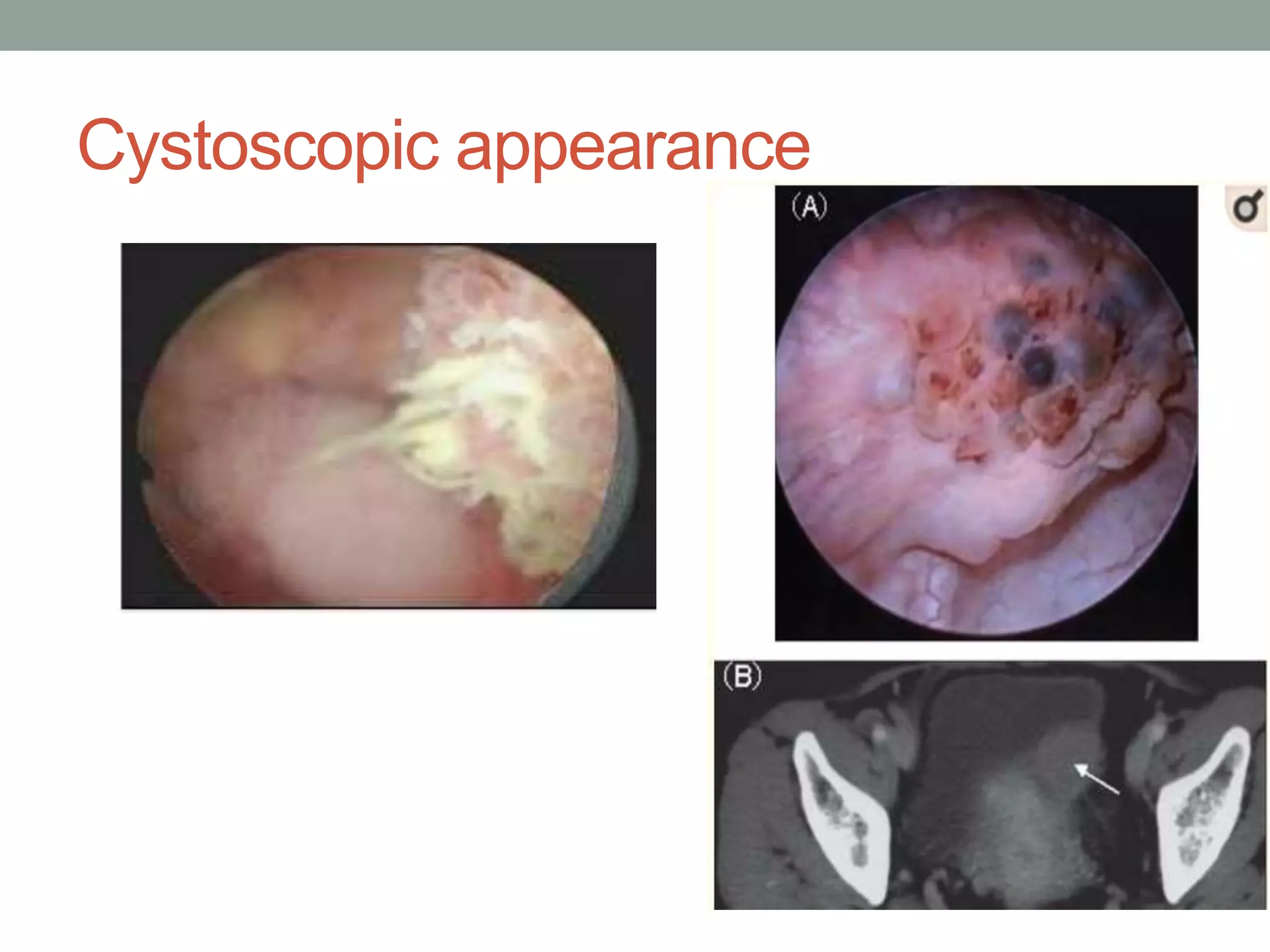
• Cystoscopy
• Histological analysis of TUBR
15/3/2021 27
Cystoscopic appearance
Pathology
• Two forms of glandular cystitis are recognized:
• Typical
• Intestinal
15/3/2021 29
Treatment
Endoscopic
• TUBR
Surgical
• Cystectomy
15/3/2021 30
8/3/2023 31
Jacob Sh.

Interstitial cystitis and Cystitis gandularis Finale.pptx

Editor's Notes

  • #21 - Treatment of Hunner lesions, if found
  • #26 Its clinical incidence is low, estimated at less than 2% of the general population. clinical incidence varies from 0.1% to 1.9 % The most affected age group is between the fifth and sixth decades of life; nevertheless, cases have been reported in children, as it can occur at any age with extremes of 3 to 82 years. This condition affects men much more commonly than women [7]. In literature only 3 cases would have been described in women