












CARCINOMA URINARY BLADDER
CLINICAL FEATURES & STAGING
By
Dr. Muhammad Saifullah
Post-Graduate Resident (FINAL YEAR)
Department of Urology & Renal Transplantation
Allied Hospital, Faisalabad.
CLINICAL FEATURES
HEMATURIA
Hematuria is the presenting
symptom in 85–90% of
patients
Gross or microscopic
Intermittent rather than
constant
IRRITATIVE SYMPTOMS
•Vesical irritability
•Frequency
•Urgency
•Dysuria
Irritative voiding symptoms…..
common in patients with diffuse
CIS.
CLINICAL FEATURES
Advanced disease…
• Bone pain….. Metastases
CLINICAL FEATURES
Advanced disease…
• Flank pain…..
retroperitoneal metastases /
ureteral obstruction.
SIGNS
Asymptomatic….. If not muscle
invasive!
WHY STAGING
THE DISEASES IS
NECESSARY?
1. TREATMENT OPTIONS
2. PROGNOSIS
STAGING
PAPILLARY VS FLAT GROWTHS
STAGING
PRIMARY TUMOUR
•Tx….. Primary tumour cannot be
assessed
•To….. No evidence of primary tumour
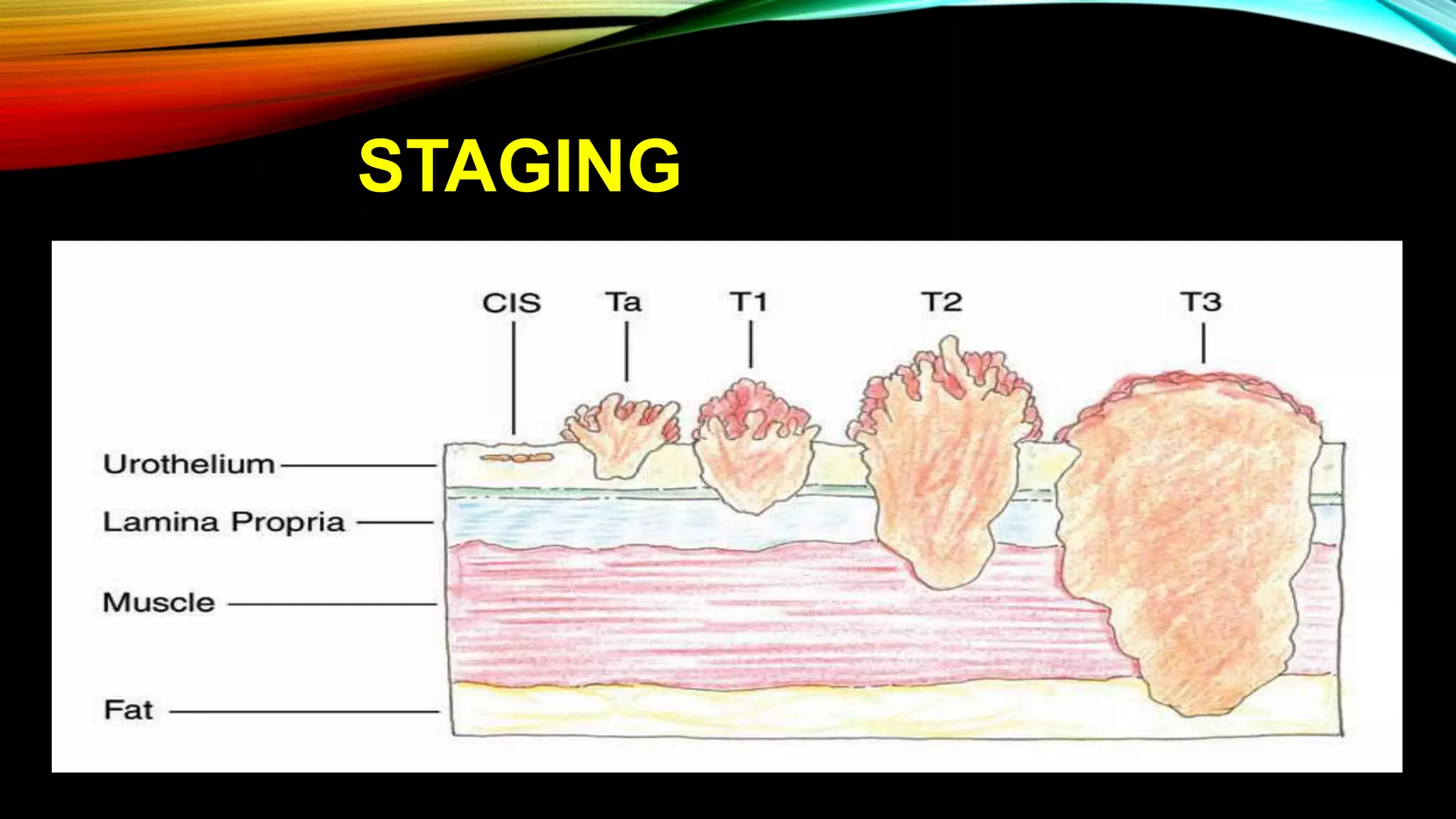
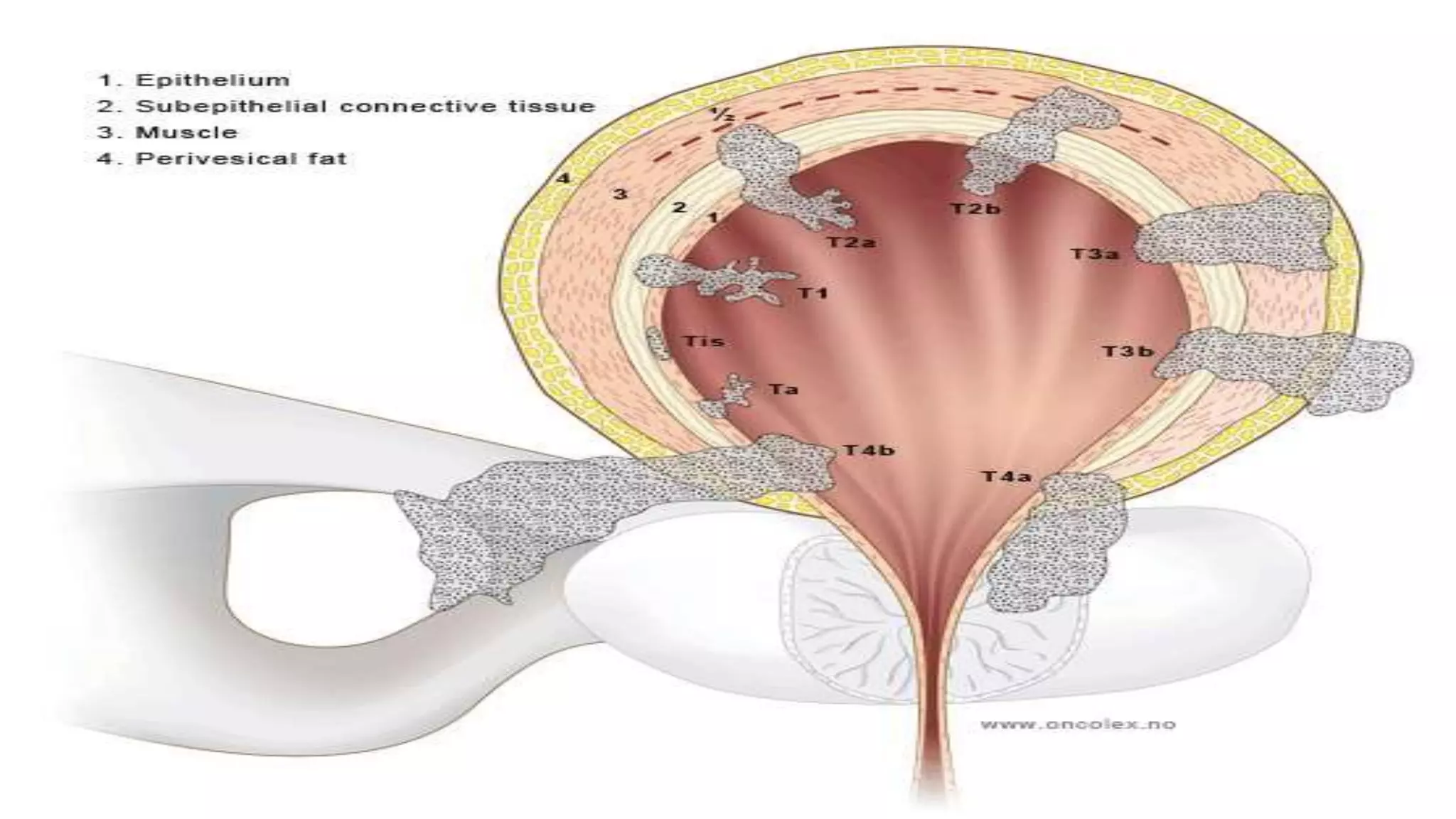
•Tis….. Carcinoma in situ: ‘flat tumour’
STAGING
STAGING
PRIMARY TUMOUR
•Ta….. Non-invasive papillary carcinoma
STAGING
STAGING
PRIMARY TUMOUR
•T1….. Tumour invades subepithelial
connective tissue
STAGING
STAGING
T2….. Tumour invades muscle
•T2a….. Tumour invades superficial muscle
(inner half)
•T2b….. Tumour invades deep muscle (outer
half)
STAGING
STAGING
T3….. Tumour invades perivesical tissue
•T3a….. Microscopically
•T3b….. Macroscopically (extravesical
mass)
STAGING
STAGING
T4….. Tumour invades any of the following:
prostate, uterus, vagina, pelvic wall, abdominal
wall
•T4a….. Tumour invades prostate, uterus or vagina
•T4b….. Tumour invades pelvic wall or abdominal
wall
STAGING
N….. Lymph nodes
•Nx….. Regional lymph nodes cannot be assessed
•No..... No regional lymph node metastasis
STAGING
Lymph nodes
•N1….. Metastasis in a single lymph node in the true
pelvis
HYPOGASTRIC, OBTURATOR,
EXTERNAL ILIAC, PRESACRAL…..
STAGING
H….. Hypogastric
O….. Obturator
P….. Presacral
E….. External Iliac
STAGING
•N2….. Metastasis in multiple lymph nodes in
the true pelvis (hypogastric, obturator, external
iliac, or presacral)
•N3….. Metastasis in common iliac lymph
node(s)
STAGING
M - Distant metastasis
•Mx….. Distant metastasis cannot be assessed
•Mo….. No distant metastasis
•M1….. Distant metastasis
METASTASIS
Transitional cell carcinoma
(TCC) of the bladder commonly
metastasizes to the
i. Lungs
ii. Liver
iii. Bones
iv. Adrenals
v. brain.
METASTASIS
Unusual sites
include the heart,
kidney, spleen,
pancreas, and
reproductive system.
STAGE OF BLADDER CANCER AT
PRESENTATION
GRADING
GRADING….. WHO GRADING IN
1973
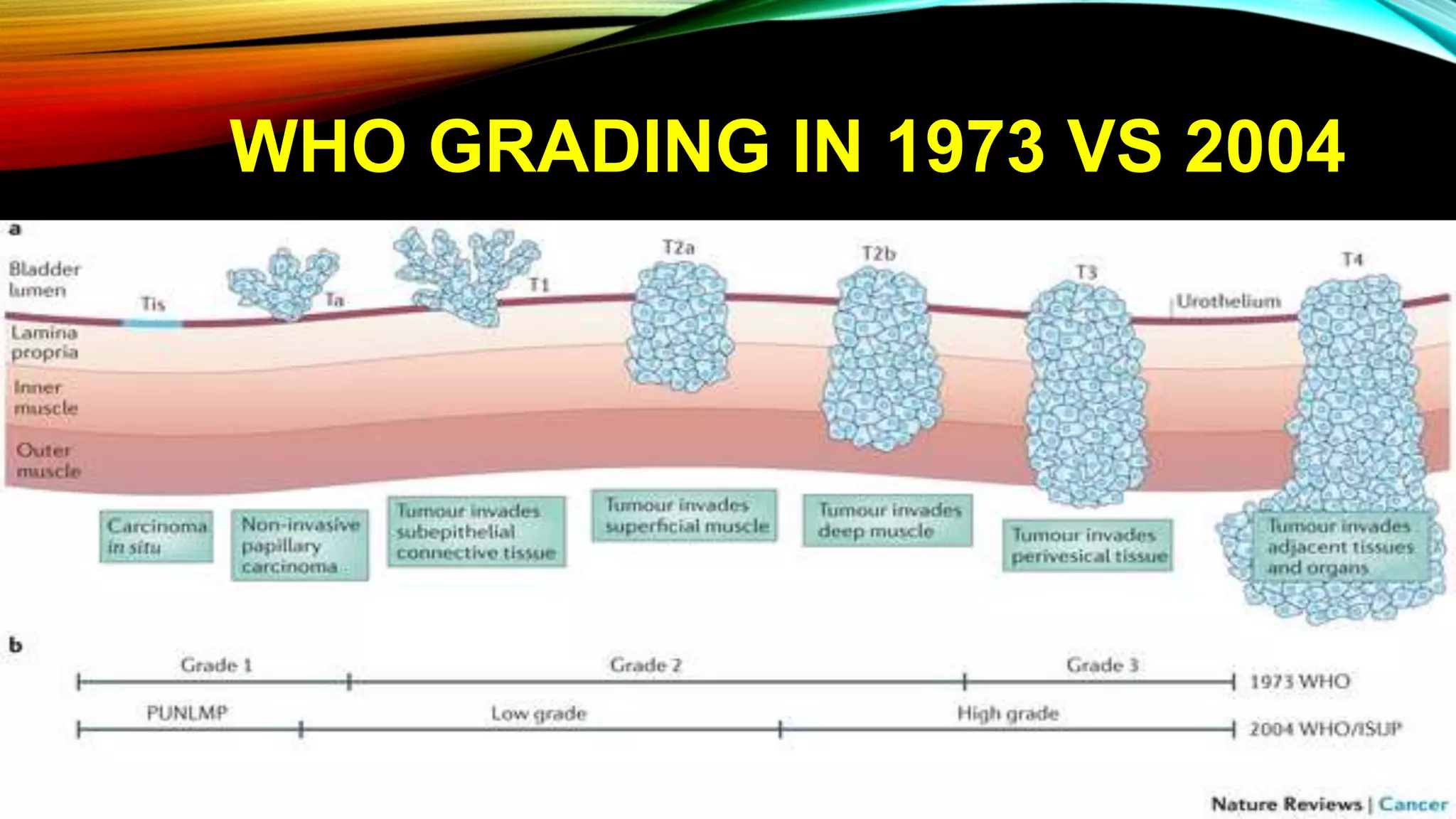
•Urothelial papilloma
•Grade 1: well differentiated
•Grade 2: moderately differentiated
•Grade 3: poorly differentiated
GRADING….. WHO GRADING IN
2004
•Urothelial papilloma (completely benign lesion)
•Papillary urothelial neoplasm of low malignant
potential (PUNLMP)
•Low-grade (LG) papillary urothelial carcinoma
•High-grade (HG) papillary urothelial carcinoma
WHO GRADING IN 1973 VS 2004
MOST
WORRISOME
THING ABOUT
BLADDER
CARCINOMA…..?
RECURRENCE
…..
RECURRENT BLADDER
CARCINOMA
• Bladder cancer has the highest recurrence rate of any
malignancy (ie, 70% within 5 y).
• The underlying genetic changes that result in a bladder
tumor occur in the entire urothelium, making the whole
lining of the urinary system susceptible to tumor
recurrence.
RECURRENT BLADDER
CARCINOMA
Risk factors for recurrence and progression include the
following:
 Female sex
 Larger tumor size
 Multifocality
 Larger number of tumors
 High tumor grade
 Advanced stage
 Presence of Cis
RECURRENT BLADDER
CARCINOMA
The time interval to recurrence is also significant.
Patients with tumor recurrences within 2 years,
and especially with recurrences within 3-6 months,
have an aggressive tumor and an increased risk of
disease progression.
Bladder mass clinical features & staging

Bladder mass clinical features & staging