Dept of Urology
Govt Royapettah Hospital and Kilpauk Medical College
Chennai
Management of Seminoma Testis
1
Moderators:
Professors:
 Prof. Dr. G. Sivasankar, M.S., M.Ch.,
 Prof. Dr.A. Senthilvel, M.S., M.Ch.,
Asst Professors:
 Dr. J. Sivabalan, M.S., M.Ch.,
 Dr. R. Bhargavi, M.S., M.Ch.,
 Dr. S. Raju, M.S., M.Ch.,
 Dr. K. Muthurathinam, M.S., M.Ch.,
 Dr. D.Tamilselvan, M.S., M.Ch.,
 Dr. K. Senthilkumar, M.S., M.Ch.
Dept of Urology, GRH and KMC, Chennai.
2
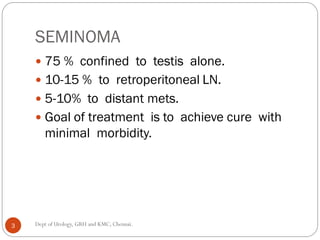
SEMINOMA
 75 % confined to testis alone.
 10-15 % to retroperitoneal LN.
 5-10% to distant mets.
 Goal of treatment is to achieve cure with
minimal morbidity.
3 Dept of Urology, GRH and KMC, Chennai.
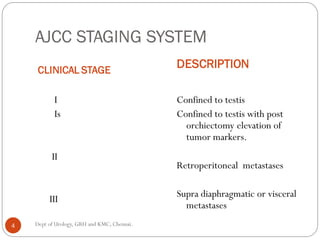
AJCC STAGING SYSTEM
CLINICAL STAGE
DESCRIPTION
I
Is
II
III
Confined to testis
Confined to testis with post
orchiectomy elevation of
tumor markers.
Retroperitoneal metastases
Supra diaphragmatic or visceral
metastases
4 Dept of Urology, GRH and KMC, Chennai.
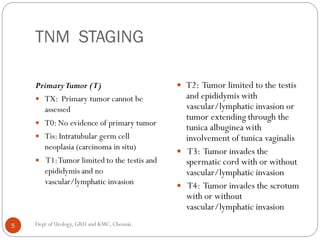
TNM STAGING
PrimaryTumor (T)
 TX: Primary tumor cannot be
assessed
 T0: No evidence of primary tumor
 Tis: Intratubular germ cell
neoplasia (carcinoma in situ)
 T1:Tumor limited to the testis and
epididymis and no
vascular/lymphatic invasion
 T2: Tumor limited to the testis
and epididymis with
vascular/lymphatic invasion or
tumor extending through the
tunica albuginea with
involvement of tunica vaginalis
 T3: Tumor invades the
spermatic cord with or without
vascular/lymphatic invasion
 T4: Tumor invades the scrotum
with or without
vascular/lymphatic invasion
5 Dept of Urology, GRH and KMC, Chennai.
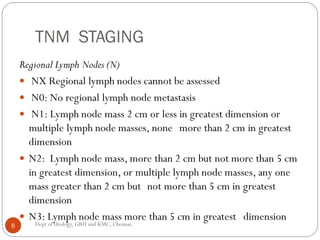
TNM STAGING
Regional Lymph Nodes (N)
 NX Regional lymph nodes cannot be assessed
 N0: No regional lymph node metastasis
 N1: Lymph node mass 2 cm or less in greatest dimension or
multiple lymph node masses, none more than 2 cm in greatest
dimension
 N2: Lymph node mass, more than 2 cm but not more than 5 cm
in greatest dimension, or multiple lymph node masses, any one
mass greater than 2 cm but not more than 5 cm in greatest
dimension
 N3: Lymph node mass more than 5 cm in greatest dimension
6 Dept of Urology, GRH and KMC, Chennai.
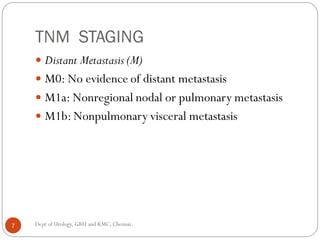
TNM STAGING
 Distant Metastasis (M)
 M0: No evidence of distant metastasis
 M1a: Nonregional nodal or pulmonary metastasis
 M1b: Nonpulmonary visceral metastasis
7 Dept of Urology, GRH and KMC, Chennai.
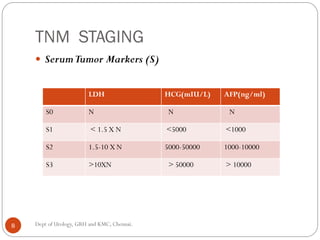
TNM STAGING
 SerumTumor Markers (S)
LDH HCG(mIU/L) AFP(ng/ml)
S0 N N N
S1 < 1.5 X N <5000 <1000
S2 1.5-10 X N 5000-50000 1000-10000
S3 >10XN > 50000 > 10000
8 Dept of Urology, GRH and KMC, Chennai.
PRINCIPLES OF TREATMENT
 Radical inguinal orchidectomy is standard first line of
therapy
 Lymphatic spread initially goes to RETRO-
PERITONEAL NODES
 Early hematogenous spread RARE
 Bulky RetroperitonealTumours or MetastaticTumors
CHEMOTHERAPY
9 Dept of Urology, GRH and KMC, Chennai.
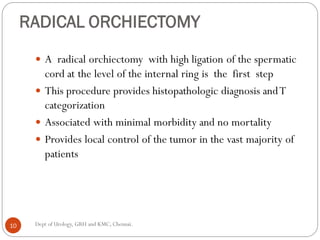
RADICAL ORCHIECTOMY
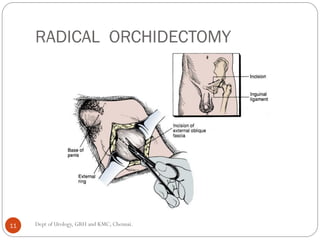
 A radical orchiectomy with high ligation of the spermatic
cord at the level of the internal ring is the first step
 This procedure provides histopathologic diagnosis andT
categorization
 Associated with minimal morbidity and no mortality
 Provides local control of the tumor in the vast majority of
patients
10 Dept of Urology, GRH and KMC, Chennai.
RADICAL ORCHIDECTOMY
11 Dept of Urology, GRH and KMC, Chennai.
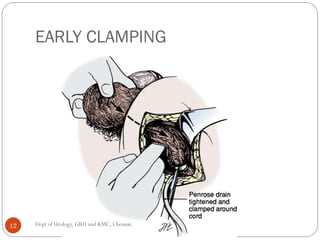
EARLY CLAMPING
12 Dept of Urology, GRH and KMC, Chennai.
Organ Sparing Surgery
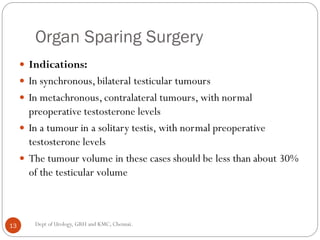
 Indications:
 In synchronous, bilateral testicular tumours
 In metachronous, contralateral tumours, with normal
preoperative testosterone levels
 In a tumour in a solitary testis, with normal preoperative
testosterone levels
 The tumour volume in these cases should be less than about 30%
of the testicular volume
13 Dept of Urology, GRH and KMC, Chennai.
Organ Sparing Surgery
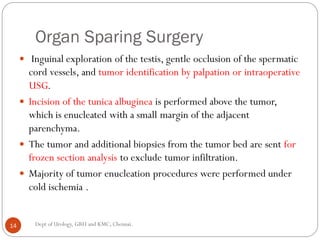
 Inguinal exploration of the testis, gentle occlusion of the spermatic
cord vessels, and tumor identification by palpation or intraoperative
USG.
 Incision of the tunica albuginea is performed above the tumor,
which is enucleated with a small margin of the adjacent
parenchyma.
 The tumor and additional biopsies from the tumor bed are sent for
frozen section analysis to exclude tumor infiltration.
 Majority of tumor enucleation procedures were performed under
cold ischemia .
14 Dept of Urology, GRH and KMC, Chennai.
Pathological examination of the testis
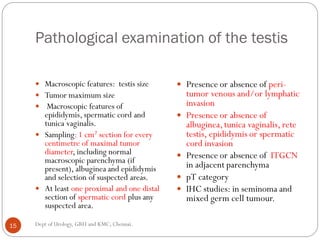
 Macroscopic features: testis size
 Tumor maximum size
 Macroscopic features of
epididymis, spermatic cord and
tunica vaginalis.
 Sampling:1 cm2 section for every
centimetre of maximal tumor
diameter, including normal
macroscopic parenchyma (if
present), albuginea and epididymis
and selection of suspected areas.
 At least one proximal and one distal
section of spermatic cord plus any
suspected area.
 Presence or absence of peri-
tumor venous and/or lymphatic
invasion
 Presence or absence of
albuginea,tunica vaginalis, rete
testis, epididymis or spermatic
cord invasion
 Presence or absence of ITGCN
in adjacent parenchyma
 pT category
 IHC studies: in seminoma and
mixed germ cell tumour.
15 Dept of Urology, GRH and KMC, Chennai.
Intra-tubular Germ Cell Neoplasia
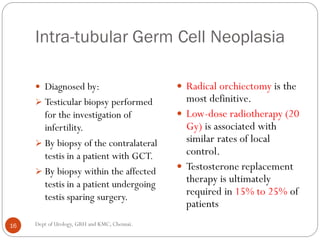
 Diagnosed by:
 Testicular biopsy performed
for the investigation of
infertility.
 By biopsy of the contralateral
testis in a patient with GCT.
 By biopsy within the affected
testis in a patient undergoing
testis sparing surgery.
 Radical orchiectomy is the
most definitive.
 Low-dose radiotherapy (20
Gy) is associated with
similar rates of local
control.
 Testosterone replacement
therapy is ultimately
required in 15% to 25% of
patients
16 Dept of Urology, GRH and KMC, Chennai.
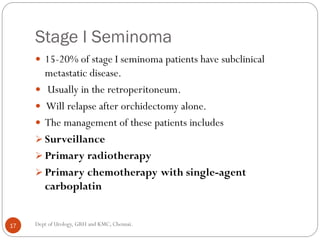
Stage I Seminoma
 15-20% of stage I seminoma patients have subclinical
metastatic disease.
 Usually in the retroperitoneum.
 Will relapse after orchidectomy alone.
 The management of these patients includes
 Surveillance
 Primary radiotherapy
 Primary chemotherapy with single-agent
carboplatin
17 Dept of Urology, GRH and KMC, Chennai.
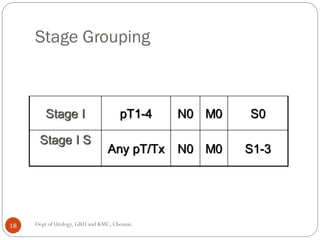
Stage Grouping
Stage I pT1-4 N0 M0 S0
Stage I S
Any pT/Tx N0 M0 S1-3
18 Dept of Urology, GRH and KMC, Chennai.
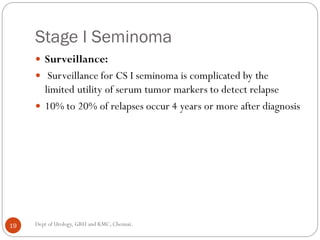
Stage I Seminoma
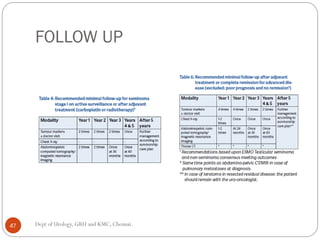
 Surveillance:
 Surveillance for CS I seminoma is complicated by the
limited utility of serum tumor markers to detect relapse
 10% to 20% of relapses occur 4 years or more after diagnosis
19 Dept of Urology, GRH and KMC, Chennai.
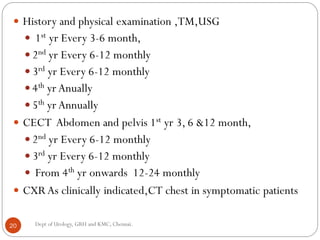
 History and physical examination ,TM,USG
 1st yr Every 3-6 month,
 2nd yr Every 6-12 monthly
 3rd yr Every 6-12 monthly
 4th yr Anually
 5th yr Annually
 CECT Abdomen and pelvis 1st yr 3, 6 &12 month,
 2nd yr Every 6-12 monthly
 3rd yr Every 6-12 monthly
 From 4th yr onwards 12-24 monthly
 CXRAs clinically indicated,CT chest in symptomatic patients
20 Dept of Urology, GRH and KMC, Chennai.
Stage I Seminoma
 Primary Radiotherapy
 mainstay of treatment for CS I seminoma
 Radiotherapy is given to the retroperitoneum and ipsilateral
pelvis, termed dogleg configuration
 The optimal radiation dose : 20 to 25.5 Gy in 10 to 17 daily
fractions
21 Dept of Urology, GRH and KMC, Chennai.
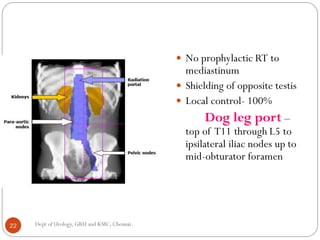
 No prophylactic RT to
mediastinum
 Shielding of opposite testis
 Local control- 100%
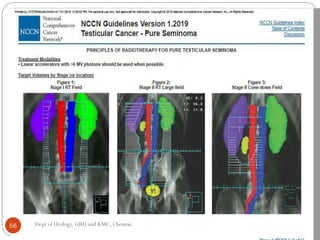
Dog leg port –
top of T11 through L5 to
ipsilateral iliac nodes up to
mid-obturator foramen
22 Dept of Urology, GRH and KMC, Chennai.
Stage I Seminoma
 Primary chemotherapy
 A single agent course of
carboplatin
 Low myelotoxicity and
gonadal toxicity
 Recurrence rate 9%.
 Primary chemotherapy
 Two courses of carboplatin
were associated with no
relapses .
 The optimal dosing of
carboplatin is calculated by
the formula 7 ×
(glomerular filtration rate
[GFR, mL/min] + 25) mg
23 Dept of Urology, GRH and KMC, Chennai.
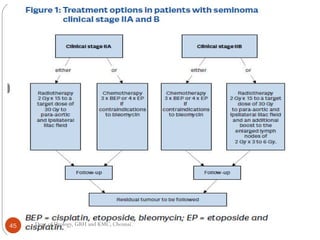
Stage IIA and IIB Seminoma
 The standard treatment of stage II A/B seminoma is radiotherapy
 The radiation dose delivered in stage IIA and IIB is 30 Gy and 36
Gy, respectively
 The standard radiation field –dog leg
24 Dept of Urology, GRH and KMC, Chennai.
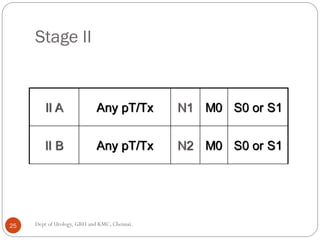
Stage II
II A Any pT/Tx N1 M0 S0 or S1
II B Any pT/Tx N2 M0 S0 or S1
25 Dept of Urology, GRH and KMC, Chennai.
Stage IIA and IIB Seminoma
 In stage IIB, the lateral borders should include the metastatic
lymph nodes with a safety margin of 1.0-1.5 cm
 Induction chemotherapy (BEP×3 or EP×4) is preferentially
given to patients with bulky (>3 cm) and/or multiple
retroperitoneal masses .
26 Dept of Urology, GRH and KMC, Chennai.
Stage IIA and IIB Seminoma
 The retroperitoneal lymph node groups included in radiation
treatment fields for stage II seminoma are :
1. Ipsilateral external iliac
2. Bilateral common iliac
3. Paracaval
4. Para-aortic nodes superiorly.
27 Dept of Urology, GRH and KMC, Chennai.
Stage IIA and IIB Seminoma
 Retroperitoneal disease in close relation to the kidney,
chemotherapy is usually preferred to avoid exposing the
kidney to radiation
 In patients with a history of herniorrhaphy or prior
orchiopexy, field includes the contralateral inguinal region.
 The contralateral testis shielded .
 Patients treated with postorchiectomy radiation therapy 5-
year survival rates of approximately 80%(70% to 92% ).
28 Dept of Urology, GRH and KMC, Chennai.
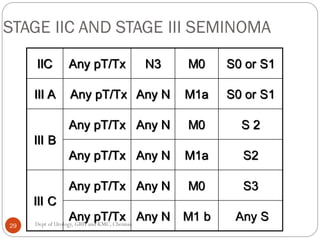
STAGE IIC AND STAGE III SEMINOMA
IIC Any pT/Tx N3 M0 S0 or S1
III A Any pT/Tx Any N M1a S0 or S1
III B
Any pT/Tx Any N M0 S 2
Any pT/Tx Any N M1a S2
III C
Any pT/Tx Any N M0 S3
Any pT/Tx Any N M1 b Any S
29 Dept of Urology, GRH and KMC, Chennai.
Stage IIc and Stage III Disease:
Advanced Seminoma
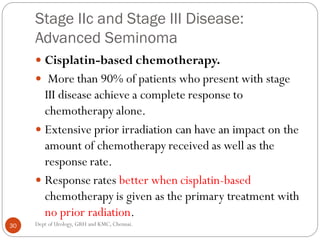
 Cisplatin-based chemotherapy.
 More than 90% of patients who present with stage
III disease achieve a complete response to
chemotherapy alone.
 Extensive prior irradiation can have an impact on the
amount of chemotherapy received as well as the
response rate.
 Response rates better when cisplatin-based
chemotherapy is given as the primary treatment with
no prior radiation.
30 Dept of Urology, GRH and KMC, Chennai.
RISK CLASSIFICATION
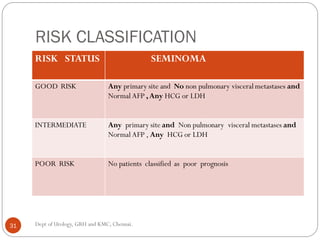
RISK STATUS SEMINOMA
GOOD RISK Any primary site and No non pulmonary visceral metastases and
Normal AFP ,Any HCG or LDH
INTERMEDIATE Any primary site and Non pulmonary visceral metastases and
Normal AFP , Any HCG or LDH
POOR RISK No patients classified as poor prognosis
31 Dept of Urology, GRH and KMC, Chennai.
Stage IIc and Stage III Disease:
Advanced Seminoma
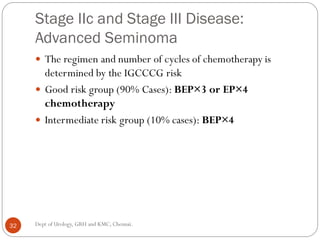
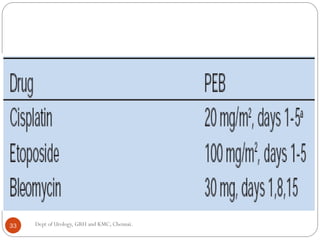
 The regimen and number of cycles of chemotherapy is
determined by the IGCCCG risk
 Good risk group (90% Cases): BEP×3 or EP×4
chemotherapy
 Intermediate risk group (10% cases): BEP×4
32 Dept of Urology, GRH and KMC, Chennai.
33 Dept of Urology, GRH and KMC, Chennai.
RESIDUAL MASS
 The approach to the patient with pure seminoma and
a residual mass after chemotherapy is controversial
 Two important differences between seminoma and
NSGCT in this setting
 First, teratoma in the residual mass is very rare.
 Second, a complete RPLND is often not technically
possible owing to obliteration of tissue planes secondary to
the severe desmoplastic reaction of these tumors after
chemotherapy
34 Dept of Urology, GRH and KMC, Chennai.
RESIDUAL MASS
 Patients with residual masses smaller than 3 cm after
chemotherapy may be observed
 An FDG PET scan should be done for masses 3 cm or larger.
 A negative PET scan usually implies freedom from disease
35 Dept of Urology, GRH and KMC, Chennai.
RESIDUAL MASS
 A positive PET scan is often associated with residual viable
seminoma and additional therapy should be considered.
 If surgical resection appears feasible, it should be done
 Second line chemotherapy(vinblastine, ifosfamide,cisplatin)
36 Dept of Urology, GRH and KMC, Chennai.
Relapse Seminoma
 Chemotherapy-Naive Seminoma Relapse:
 Occurs in men with CS I seminoma on surveillance and in
those with CS I-IIB seminoma treated with primary
radiotherapy
 Patients with CSI on surveillance- Dog-leg radiotherapy is
employed cure rates of 70% to 90% are reported
 Patients with bulky (>3 cm) retroperitoneal masses and
systemic relapse should receive first-line chemotherapy,and
salvage rates approach 100%
37 Dept of Urology, GRH and KMC, Chennai.
Relapse Seminoma
 Postchemotherapy Seminoma Relapse—Early:
 15% to 20% of patients with advanced seminoma will
experience relapse after induction chemotherapy.
 Includes 10% who achieve an initial complete response
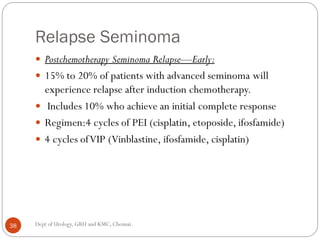
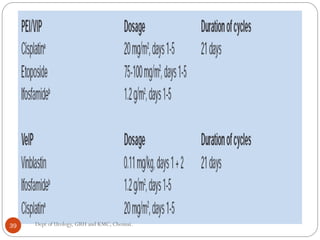
 Regimen:4 cycles of PEI (cisplatin, etoposide, ifosfamide)
 4 cycles ofVIP (Vinblastine, ifosfamide, cisplatin)
38 Dept of Urology, GRH and KMC, Chennai.
39 Dept of Urology, GRH and KMC, Chennai.
Relapse Seminoma
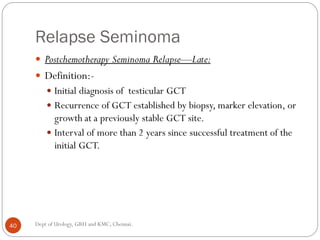
 Postchemotherapy Seminoma Relapse—Late:
 Definition:-
 Initial diagnosis of testicular GCT
 Recurrence of GCT established by biopsy, marker elevation, or
growth at a previously stable GCT site.
 Interval of more than 2 years since successful treatment of the
initial GCT.
40 Dept of Urology, GRH and KMC, Chennai.
Relapse Seminoma
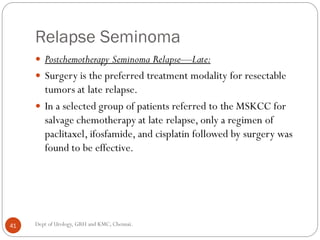
 Postchemotherapy Seminoma Relapse—Late:
 Surgery is the preferred treatment modality for resectable
tumors at late relapse.
 In a selected group of patients referred to the MSKCC for
salvage chemotherapy at late relapse, only a regimen of
paclitaxel, ifosfamide, and cisplatin followed by surgery was
found to be effective.
41 Dept of Urology, GRH and KMC, Chennai.
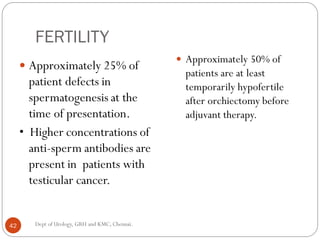
FERTILITY
 Approximately 25% of
patient defects in
spermatogenesis at the
time of presentation.
• Higher concentrations of
anti-sperm antibodies are
present in patients with
testicular cancer.
 Approximately 50% of
patients are at least
temporarily hypofertile
after orchiectomy before
adjuvant therapy.
42 Dept of Urology, GRH and KMC, Chennai.
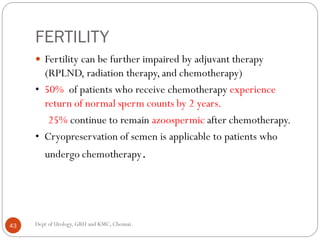
FERTILITY
 Fertility can be further impaired by adjuvant therapy
(RPLND, radiation therapy, and chemotherapy)
• 50% of patients who receive chemotherapy experience
return of normal sperm counts by 2 years.
25% continue to remain azoospermic after chemotherapy.
• Cryopreservation of semen is applicable to patients who
undergo chemotherapy.
43 Dept of Urology, GRH and KMC, Chennai.
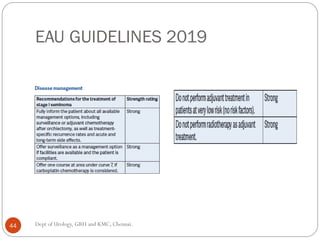
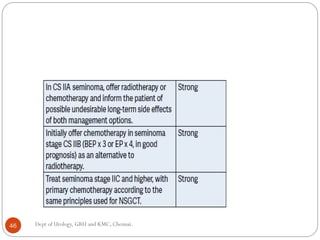
EAU GUIDELINES 2019
44 Dept of Urology, GRH and KMC, Chennai.
45 Dept of Urology, GRH and KMC, Chennai.
46 Dept of Urology, GRH and KMC, Chennai.
FOLLOW UP
47 Dept of Urology, GRH and KMC, Chennai.
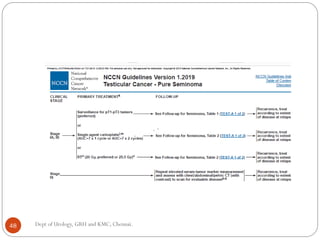
48 Dept of Urology, GRH and KMC, Chennai.
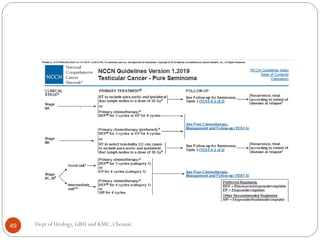
49 Dept of Urology, GRH and KMC, Chennai.
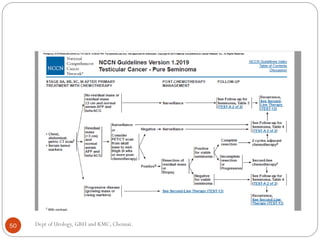
50 Dept of Urology, GRH and KMC, Chennai.
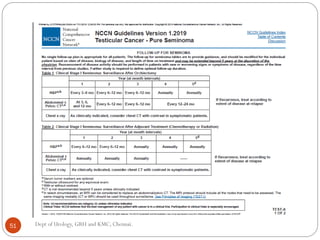
51 Dept of Urology, GRH and KMC, Chennai.
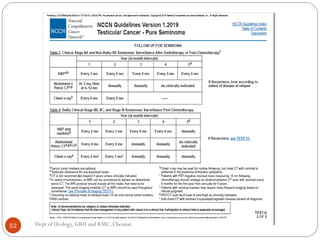
52 Dept of Urology, GRH and KMC, Chennai.
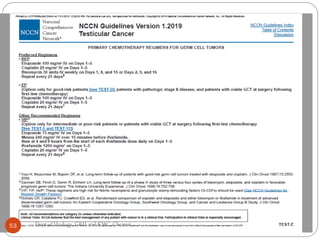
53 Dept of Urology, GRH and KMC, Chennai.
54 Dept of Urology, GRH and KMC, Chennai.
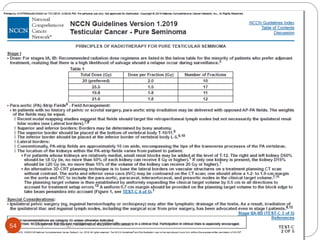
55 Dept of Urology, GRH and KMC, Chennai.
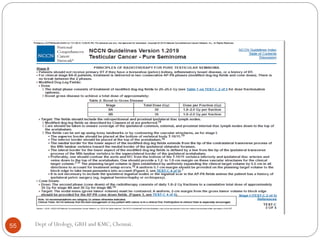
56 Dept of Urology, GRH and KMC, Chennai.
Thank You
57 Dept of Urology, GRH and KMC, Chennai.

Testis carcinoma- management- seminoma

  • 1.
    Dept of Urology GovtRoyapettah Hospital and Kilpauk Medical College Chennai Management of Seminoma Testis 1
  • 2.
    Moderators: Professors:  Prof. Dr.G. Sivasankar, M.S., M.Ch.,  Prof. Dr.A. Senthilvel, M.S., M.Ch., Asst Professors:  Dr. J. Sivabalan, M.S., M.Ch.,  Dr. R. Bhargavi, M.S., M.Ch.,  Dr. S. Raju, M.S., M.Ch.,  Dr. K. Muthurathinam, M.S., M.Ch.,  Dr. D.Tamilselvan, M.S., M.Ch.,  Dr. K. Senthilkumar, M.S., M.Ch. Dept of Urology, GRH and KMC, Chennai. 2
  • 3.
    SEMINOMA  75 %confined to testis alone.  10-15 % to retroperitoneal LN.  5-10% to distant mets.  Goal of treatment is to achieve cure with minimal morbidity. 3 Dept of Urology, GRH and KMC, Chennai.
  • 4.
    AJCC STAGING SYSTEM CLINICALSTAGE DESCRIPTION I Is II III Confined to testis Confined to testis with post orchiectomy elevation of tumor markers. Retroperitoneal metastases Supra diaphragmatic or visceral metastases 4 Dept of Urology, GRH and KMC, Chennai.
  • 5.
    TNM STAGING PrimaryTumor (T) TX: Primary tumor cannot be assessed  T0: No evidence of primary tumor  Tis: Intratubular germ cell neoplasia (carcinoma in situ)  T1:Tumor limited to the testis and epididymis and no vascular/lymphatic invasion  T2: Tumor limited to the testis and epididymis with vascular/lymphatic invasion or tumor extending through the tunica albuginea with involvement of tunica vaginalis  T3: Tumor invades the spermatic cord with or without vascular/lymphatic invasion  T4: Tumor invades the scrotum with or without vascular/lymphatic invasion 5 Dept of Urology, GRH and KMC, Chennai.
  • 6.
    TNM STAGING Regional LymphNodes (N)  NX Regional lymph nodes cannot be assessed  N0: No regional lymph node metastasis  N1: Lymph node mass 2 cm or less in greatest dimension or multiple lymph node masses, none more than 2 cm in greatest dimension  N2: Lymph node mass, more than 2 cm but not more than 5 cm in greatest dimension, or multiple lymph node masses, any one mass greater than 2 cm but not more than 5 cm in greatest dimension  N3: Lymph node mass more than 5 cm in greatest dimension 6 Dept of Urology, GRH and KMC, Chennai.
  • 7.
    TNM STAGING  DistantMetastasis (M)  M0: No evidence of distant metastasis  M1a: Nonregional nodal or pulmonary metastasis  M1b: Nonpulmonary visceral metastasis 7 Dept of Urology, GRH and KMC, Chennai.
  • 8.
    TNM STAGING  SerumTumorMarkers (S) LDH HCG(mIU/L) AFP(ng/ml) S0 N N N S1 < 1.5 X N <5000 <1000 S2 1.5-10 X N 5000-50000 1000-10000 S3 >10XN > 50000 > 10000 8 Dept of Urology, GRH and KMC, Chennai.
  • 9.
    PRINCIPLES OF TREATMENT Radical inguinal orchidectomy is standard first line of therapy  Lymphatic spread initially goes to RETRO- PERITONEAL NODES  Early hematogenous spread RARE  Bulky RetroperitonealTumours or MetastaticTumors CHEMOTHERAPY 9 Dept of Urology, GRH and KMC, Chennai.
  • 10.
    RADICAL ORCHIECTOMY  Aradical orchiectomy with high ligation of the spermatic cord at the level of the internal ring is the first step  This procedure provides histopathologic diagnosis andT categorization  Associated with minimal morbidity and no mortality  Provides local control of the tumor in the vast majority of patients 10 Dept of Urology, GRH and KMC, Chennai.
  • 11.
    RADICAL ORCHIDECTOMY 11 Deptof Urology, GRH and KMC, Chennai.
  • 12.
    EARLY CLAMPING 12 Deptof Urology, GRH and KMC, Chennai.
  • 13.
    Organ Sparing Surgery Indications:  In synchronous, bilateral testicular tumours  In metachronous, contralateral tumours, with normal preoperative testosterone levels  In a tumour in a solitary testis, with normal preoperative testosterone levels  The tumour volume in these cases should be less than about 30% of the testicular volume 13 Dept of Urology, GRH and KMC, Chennai.
  • 14.
    Organ Sparing Surgery Inguinal exploration of the testis, gentle occlusion of the spermatic cord vessels, and tumor identification by palpation or intraoperative USG.  Incision of the tunica albuginea is performed above the tumor, which is enucleated with a small margin of the adjacent parenchyma.  The tumor and additional biopsies from the tumor bed are sent for frozen section analysis to exclude tumor infiltration.  Majority of tumor enucleation procedures were performed under cold ischemia . 14 Dept of Urology, GRH and KMC, Chennai.
  • 15.
    Pathological examination ofthe testis  Macroscopic features: testis size  Tumor maximum size  Macroscopic features of epididymis, spermatic cord and tunica vaginalis.  Sampling:1 cm2 section for every centimetre of maximal tumor diameter, including normal macroscopic parenchyma (if present), albuginea and epididymis and selection of suspected areas.  At least one proximal and one distal section of spermatic cord plus any suspected area.  Presence or absence of peri- tumor venous and/or lymphatic invasion  Presence or absence of albuginea,tunica vaginalis, rete testis, epididymis or spermatic cord invasion  Presence or absence of ITGCN in adjacent parenchyma  pT category  IHC studies: in seminoma and mixed germ cell tumour. 15 Dept of Urology, GRH and KMC, Chennai.
  • 16.
    Intra-tubular Germ CellNeoplasia  Diagnosed by:  Testicular biopsy performed for the investigation of infertility.  By biopsy of the contralateral testis in a patient with GCT.  By biopsy within the affected testis in a patient undergoing testis sparing surgery.  Radical orchiectomy is the most definitive.  Low-dose radiotherapy (20 Gy) is associated with similar rates of local control.  Testosterone replacement therapy is ultimately required in 15% to 25% of patients 16 Dept of Urology, GRH and KMC, Chennai.
  • 17.
    Stage I Seminoma 15-20% of stage I seminoma patients have subclinical metastatic disease.  Usually in the retroperitoneum.  Will relapse after orchidectomy alone.  The management of these patients includes  Surveillance  Primary radiotherapy  Primary chemotherapy with single-agent carboplatin 17 Dept of Urology, GRH and KMC, Chennai.
  • 18.
    Stage Grouping Stage IpT1-4 N0 M0 S0 Stage I S Any pT/Tx N0 M0 S1-3 18 Dept of Urology, GRH and KMC, Chennai.
  • 19.
    Stage I Seminoma Surveillance:  Surveillance for CS I seminoma is complicated by the limited utility of serum tumor markers to detect relapse  10% to 20% of relapses occur 4 years or more after diagnosis 19 Dept of Urology, GRH and KMC, Chennai.
  • 20.
     History andphysical examination ,TM,USG  1st yr Every 3-6 month,  2nd yr Every 6-12 monthly  3rd yr Every 6-12 monthly  4th yr Anually  5th yr Annually  CECT Abdomen and pelvis 1st yr 3, 6 &12 month,  2nd yr Every 6-12 monthly  3rd yr Every 6-12 monthly  From 4th yr onwards 12-24 monthly  CXRAs clinically indicated,CT chest in symptomatic patients 20 Dept of Urology, GRH and KMC, Chennai.
  • 21.
    Stage I Seminoma Primary Radiotherapy  mainstay of treatment for CS I seminoma  Radiotherapy is given to the retroperitoneum and ipsilateral pelvis, termed dogleg configuration  The optimal radiation dose : 20 to 25.5 Gy in 10 to 17 daily fractions 21 Dept of Urology, GRH and KMC, Chennai.
  • 22.
     No prophylacticRT to mediastinum  Shielding of opposite testis  Local control- 100% Dog leg port – top of T11 through L5 to ipsilateral iliac nodes up to mid-obturator foramen 22 Dept of Urology, GRH and KMC, Chennai.
  • 23.
    Stage I Seminoma Primary chemotherapy  A single agent course of carboplatin  Low myelotoxicity and gonadal toxicity  Recurrence rate 9%.  Primary chemotherapy  Two courses of carboplatin were associated with no relapses .  The optimal dosing of carboplatin is calculated by the formula 7 × (glomerular filtration rate [GFR, mL/min] + 25) mg 23 Dept of Urology, GRH and KMC, Chennai.
  • 24.
    Stage IIA andIIB Seminoma  The standard treatment of stage II A/B seminoma is radiotherapy  The radiation dose delivered in stage IIA and IIB is 30 Gy and 36 Gy, respectively  The standard radiation field –dog leg 24 Dept of Urology, GRH and KMC, Chennai.
  • 25.
    Stage II II AAny pT/Tx N1 M0 S0 or S1 II B Any pT/Tx N2 M0 S0 or S1 25 Dept of Urology, GRH and KMC, Chennai.
  • 26.
    Stage IIA andIIB Seminoma  In stage IIB, the lateral borders should include the metastatic lymph nodes with a safety margin of 1.0-1.5 cm  Induction chemotherapy (BEP×3 or EP×4) is preferentially given to patients with bulky (>3 cm) and/or multiple retroperitoneal masses . 26 Dept of Urology, GRH and KMC, Chennai.
  • 27.
    Stage IIA andIIB Seminoma  The retroperitoneal lymph node groups included in radiation treatment fields for stage II seminoma are : 1. Ipsilateral external iliac 2. Bilateral common iliac 3. Paracaval 4. Para-aortic nodes superiorly. 27 Dept of Urology, GRH and KMC, Chennai.
  • 28.
    Stage IIA andIIB Seminoma  Retroperitoneal disease in close relation to the kidney, chemotherapy is usually preferred to avoid exposing the kidney to radiation  In patients with a history of herniorrhaphy or prior orchiopexy, field includes the contralateral inguinal region.  The contralateral testis shielded .  Patients treated with postorchiectomy radiation therapy 5- year survival rates of approximately 80%(70% to 92% ). 28 Dept of Urology, GRH and KMC, Chennai.
  • 29.
    STAGE IIC ANDSTAGE III SEMINOMA IIC Any pT/Tx N3 M0 S0 or S1 III A Any pT/Tx Any N M1a S0 or S1 III B Any pT/Tx Any N M0 S 2 Any pT/Tx Any N M1a S2 III C Any pT/Tx Any N M0 S3 Any pT/Tx Any N M1 b Any S 29 Dept of Urology, GRH and KMC, Chennai.
  • 30.
    Stage IIc andStage III Disease: Advanced Seminoma  Cisplatin-based chemotherapy.  More than 90% of patients who present with stage III disease achieve a complete response to chemotherapy alone.  Extensive prior irradiation can have an impact on the amount of chemotherapy received as well as the response rate.  Response rates better when cisplatin-based chemotherapy is given as the primary treatment with no prior radiation. 30 Dept of Urology, GRH and KMC, Chennai.
  • 31.
    RISK CLASSIFICATION RISK STATUSSEMINOMA GOOD RISK Any primary site and No non pulmonary visceral metastases and Normal AFP ,Any HCG or LDH INTERMEDIATE Any primary site and Non pulmonary visceral metastases and Normal AFP , Any HCG or LDH POOR RISK No patients classified as poor prognosis 31 Dept of Urology, GRH and KMC, Chennai.
  • 32.
    Stage IIc andStage III Disease: Advanced Seminoma  The regimen and number of cycles of chemotherapy is determined by the IGCCCG risk  Good risk group (90% Cases): BEP×3 or EP×4 chemotherapy  Intermediate risk group (10% cases): BEP×4 32 Dept of Urology, GRH and KMC, Chennai.
  • 33.
    33 Dept ofUrology, GRH and KMC, Chennai.
  • 34.
    RESIDUAL MASS  Theapproach to the patient with pure seminoma and a residual mass after chemotherapy is controversial  Two important differences between seminoma and NSGCT in this setting  First, teratoma in the residual mass is very rare.  Second, a complete RPLND is often not technically possible owing to obliteration of tissue planes secondary to the severe desmoplastic reaction of these tumors after chemotherapy 34 Dept of Urology, GRH and KMC, Chennai.
  • 35.
    RESIDUAL MASS  Patientswith residual masses smaller than 3 cm after chemotherapy may be observed  An FDG PET scan should be done for masses 3 cm or larger.  A negative PET scan usually implies freedom from disease 35 Dept of Urology, GRH and KMC, Chennai.
  • 36.
    RESIDUAL MASS  Apositive PET scan is often associated with residual viable seminoma and additional therapy should be considered.  If surgical resection appears feasible, it should be done  Second line chemotherapy(vinblastine, ifosfamide,cisplatin) 36 Dept of Urology, GRH and KMC, Chennai.
  • 37.
    Relapse Seminoma  Chemotherapy-NaiveSeminoma Relapse:  Occurs in men with CS I seminoma on surveillance and in those with CS I-IIB seminoma treated with primary radiotherapy  Patients with CSI on surveillance- Dog-leg radiotherapy is employed cure rates of 70% to 90% are reported  Patients with bulky (>3 cm) retroperitoneal masses and systemic relapse should receive first-line chemotherapy,and salvage rates approach 100% 37 Dept of Urology, GRH and KMC, Chennai.
  • 38.
    Relapse Seminoma  PostchemotherapySeminoma Relapse—Early:  15% to 20% of patients with advanced seminoma will experience relapse after induction chemotherapy.  Includes 10% who achieve an initial complete response  Regimen:4 cycles of PEI (cisplatin, etoposide, ifosfamide)  4 cycles ofVIP (Vinblastine, ifosfamide, cisplatin) 38 Dept of Urology, GRH and KMC, Chennai.
  • 39.
    39 Dept ofUrology, GRH and KMC, Chennai.
  • 40.
    Relapse Seminoma  PostchemotherapySeminoma Relapse—Late:  Definition:-  Initial diagnosis of testicular GCT  Recurrence of GCT established by biopsy, marker elevation, or growth at a previously stable GCT site.  Interval of more than 2 years since successful treatment of the initial GCT. 40 Dept of Urology, GRH and KMC, Chennai.
  • 41.
    Relapse Seminoma  PostchemotherapySeminoma Relapse—Late:  Surgery is the preferred treatment modality for resectable tumors at late relapse.  In a selected group of patients referred to the MSKCC for salvage chemotherapy at late relapse, only a regimen of paclitaxel, ifosfamide, and cisplatin followed by surgery was found to be effective. 41 Dept of Urology, GRH and KMC, Chennai.
  • 42.
    FERTILITY  Approximately 25%of patient defects in spermatogenesis at the time of presentation. • Higher concentrations of anti-sperm antibodies are present in patients with testicular cancer.  Approximately 50% of patients are at least temporarily hypofertile after orchiectomy before adjuvant therapy. 42 Dept of Urology, GRH and KMC, Chennai.
  • 43.
    FERTILITY  Fertility canbe further impaired by adjuvant therapy (RPLND, radiation therapy, and chemotherapy) • 50% of patients who receive chemotherapy experience return of normal sperm counts by 2 years. 25% continue to remain azoospermic after chemotherapy. • Cryopreservation of semen is applicable to patients who undergo chemotherapy. 43 Dept of Urology, GRH and KMC, Chennai.
  • 44.
    EAU GUIDELINES 2019 44Dept of Urology, GRH and KMC, Chennai.
  • 45.
    45 Dept ofUrology, GRH and KMC, Chennai.
  • 46.
    46 Dept ofUrology, GRH and KMC, Chennai.
  • 47.
    FOLLOW UP 47 Deptof Urology, GRH and KMC, Chennai.
  • 48.
    48 Dept ofUrology, GRH and KMC, Chennai.
  • 49.
    49 Dept ofUrology, GRH and KMC, Chennai.
  • 50.
    50 Dept ofUrology, GRH and KMC, Chennai.
  • 51.
    51 Dept ofUrology, GRH and KMC, Chennai.
  • 52.
    52 Dept ofUrology, GRH and KMC, Chennai.
  • 53.
    53 Dept ofUrology, GRH and KMC, Chennai.
  • 54.
    54 Dept ofUrology, GRH and KMC, Chennai.
  • 55.
    55 Dept ofUrology, GRH and KMC, Chennai.
  • 56.
    56 Dept ofUrology, GRH and KMC, Chennai.
  • 57.
    Thank You 57 Deptof Urology, GRH and KMC, Chennai.