Submitted to Presented by
Dr. G. S. Tomar Ashish Raghuvanshi
Prof. Deptt. Of Deptt. Of
Aronomy Agricultural Economics
College of Agriculture IGKV Raipur (C.G.)
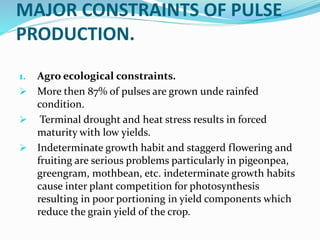
MAJOR CONSTRAINTS OF PULSE
PRODUCTION.
1. Agro ecological constraints.
 More then 87% of pulses are grown unde rainfed
condition.
 Terminal drought and heat stress results in forced
maturity with low yields.
 Indeterminate growth habit and staggerd flowering and
fruiting are serious problems particularly in pigeonpea,
greengram, mothbean, etc. indeterminate growth habits
cause inter plant competition for photosynthesis
resulting in poor portioning in yield components which
reduce the grain yield of the crop.
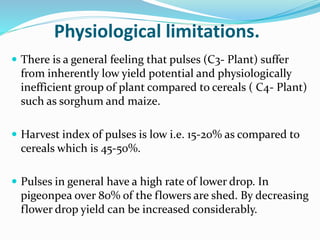
Physiological limitations.
 There is a general feeling that pulses (C3- Plant) suffer
from inherently low yield potential and physiologically
inefficient group of plant compared to cereals ( C4- Plant)
such as sorghum and maize.
 Harvest index of pulses is low i.e. 15-20% as compared to
cereals which is 45-50%.
 Pulses in general have a high rate of lower drop. In
pigeonpea over 80% of the flowers are shed. By decreasing
flower drop yield can be increased considerably.
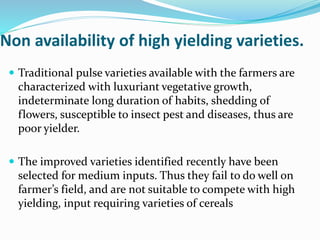
Non availability of high yielding varieties.
 Traditional pulse varieties available with the farmers are
characterized with luxuriant vegetative growth,
indeterminate long duration of habits, shedding of
flowers, susceptible to insect pest and diseases, thus are
poor yielder.
 The improved varieties identified recently have been
selected for medium inputs. Thus they fail to do well on
farmer’s field, and are not suitable to compete with high
yielding, input requiring varieties of cereals
Lack of proper agronomic management.
1. Poor management condition.
2. Unavailability of Rhizobium culture.
3. Improper sowing time.
4. Inadequate seed rate and poor plant stand.
5. System and method of sowing.
6. Weed infestation.
7. Non adoption of plant protection measures.
Socio- economic constraints
The farmers being poor, can not afford to use costly
inputs under such uncertain conditions of farming.
Benefit cost ratio is less attractive in pulses as
compared to cereals such as wheat and rice. This has
compelled the farmers to cultivate pulses on marginal
and sub- marginal lands.
Research and extension gaps
The production technologies which has recently been
developed have not reached the farmers in a
meaningful way.
Overall impact on pulse production is only been
marginal.
This is because wide gape exist between the yield of
improved varieties and production technology on
research farms and those obtained from farmer’s field.
Post harvest constraints
Post harvest losses account for 9.5% on total pulse
production.
 Among post harvest operations storage is responsible
for maximum loss (7.5%), processing, threshing and
transport cause 1%, 0.5%, 0.5% losses respectively.
Losses due to insect during storage is high in pulses as
compared to cereals.
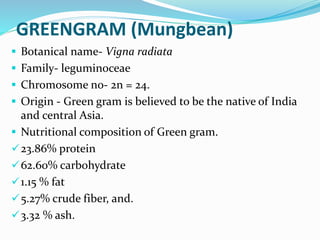
GREENGRAM (Mungbean)
 Botanical name- Vigna radiata
 Family- leguminoceae
 Chromosome no- 2n = 24.
 Origin - Green gram is believed to be the native of India
and central Asia.
 Nutritional composition of Green gram.
23.86% protein
62.60% carbohydrate
1.15 % fat
5.27% crude fiber, and.
3.32 % ash.
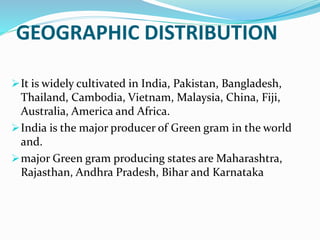
GEOGRAPHIC DISTRIBUTION
It is widely cultivated in India, Pakistan, Bangladesh,
Thailand, Cambodia, Vietnam, Malaysia, China, Fiji,
Australia, America and Africa.
India is the major producer of Green gram in the world
and.
major Green gram producing states are Maharashtra,
Rajasthan, Andhra Pradesh, Bihar and Karnataka
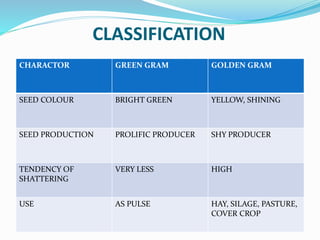
CLASSIFICATION
CHARACTOR GREEN GRAM GOLDEN GRAM
SEED COLOUR BRIGHT GREEN YELLOW, SHINING
SEED PRODUCTION PROLIFIC PRODUCER SHY PRODUCER
TENDENCY OF
SHATTERING
VERY LESS HIGH
USE AS PULSE HAY, SILAGE, PASTURE,
COVER CROP
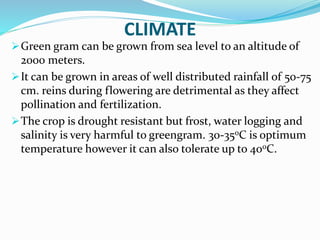
CLIMATE
Green gram can be grown from sea level to an altitude of
2000 meters.
It can be grown in areas of well distributed rainfall of 50-75
cm. reins during flowering are detrimental as they affect
pollination and fertilization.
The crop is drought resistant but frost, water logging and
salinity is very harmful to greengram. 30-350C is optimum
temperature however it can also tolerate up to 400C.
SOILS
In general, a well drained loamy to sandy loams are
ideal for mungbean cultivation. Acidic and saline soils
are not suitable. The crop performs best in soils with
6.2 – 7.2 pH.
FIELD PREPARATION
In kharif, the land preparation involves 2-3 cross
ploughings or harrowings followed by planking. A
thorough land leveling is must for quick drainage.
For spring and summer mungbean, a pre-sowing
irrigation is needed for the land preparation.
VARIETIES
 Pairy mung ( TM 2000-2):): It is jointly developed by IGKV and
BARC Trombay from cross TARM-1 and J-781. Its average yield is
959 kg/ha. it is resistant for two genes of powdery mildew up to
pod filling stage. Its plants are determinate with synchronous
podding and maturity and seeds are medium bold and shining
green color. The variety is suitable for utera and semi irrigated rice
fallows of Chhattisgarh.
 Pragya (RUM 1-20): this variety is developed throw selection
from local germplasm of durg district and released in 1997. It
matures in 101-116 days. This variety is photo and thermo sensitive
and hence, it is recommended for cultivation in winter season
only. It has high level of resistance to powdery mildew disease. It is
perhaps the only variety, which performed well under utera
condition, where it yields 5-6 q/ha. its average yield under upland
condition is 10-12 q/ha
TIME OF SOWING
In kahrif it is sown between first week of june – mid july.
In rabi it is sown from September to October or January.
Spring mungbean is sown in the month of February after
the harvest of early Rabi crops.
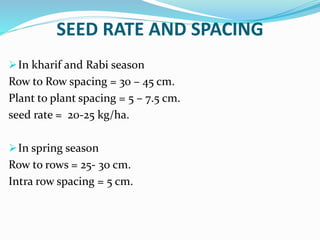
SEED RATE AND SPACING
In kharif and Rabi season
Row to Row spacing = 30 – 45 cm.
Plant to plant spacing = 5 – 7.5 cm.
seed rate = 20-25 kg/ha.
In spring season
Row to rows = 25- 30 cm.
Intra row spacing = 5 cm.
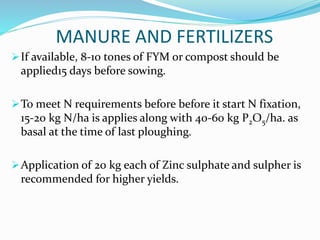
MANURE AND FERTILIZERS
If available, 8-10 tones of FYM or compost should be
applied15 days before sowing.
To meet N requirements before before it start N fixation,
15-20 kg N/ha is applies along with 40-60 kg P2O5/ha. as
basal at the time of last ploughing.
Application of 20 kg each of Zinc sulphate and sulpher is
recommended for higher yields.
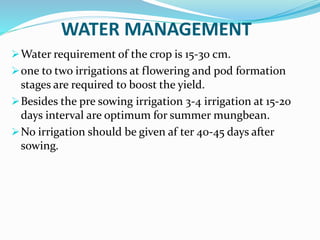
WATER MANAGEMENT
Water requirement of the crop is 15-30 cm.
one to two irrigations at flowering and pod formation
stages are required to boost the yield.
Besides the pre sowing irrigation 3-4 irrigation at 15-20
days interval are optimum for summer mungbean.
No irrigation should be given af ter 40-45 days after
sowing.
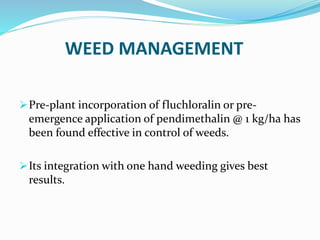
WEED MANAGEMENT
Pre-plant incorporation of fluchloralin or pre-
emergence application of pendimethalin @ 1 kg/ha has
been found effective in control of weeds.
Its integration with one hand weeding gives best
results.
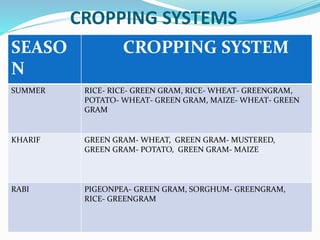
CROPPING SYSTEMS
SEASO
N
CROPPING SYSTEM
SUMMER RICE- RICE- GREEN GRAM, RICE- WHEAT- GREENGRAM,
POTATO- WHEAT- GREEN GRAM, MAIZE- WHEAT- GREEN
GRAM
KHARIF GREEN GRAM- WHEAT, GREEN GRAM- MUSTERED,
GREEN GRAM- POTATO, GREEN GRAM- MAIZE
RABI PIGEONPEA- GREEN GRAM, SORGHUM- GREENGRAM,
RICE- GREENGRAM
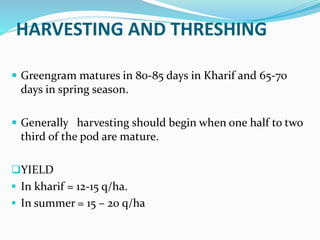
HARVESTING AND THRESHING
 Greengram matures in 80-85 days in Kharif and 65-70
days in spring season.
 Generally harvesting should begin when one half to two
third of the pod are mature.
YIELD
 In kharif = 12-15 q/ha.
 In summer = 15 – 20 q/ha
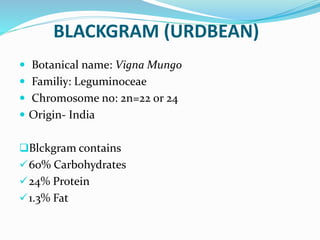
BLACKGRAM (URDBEAN)
 Botanical name: Vigna Mungo
 Familiy: Leguminoceae
 Chromosome no: 2n=22 or 24
 Origin- India
Blckgram contains
60% Carbohydrates
24% Protein
1.3% Fat
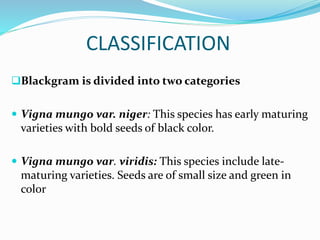
CLASSIFICATION
Blackgram is divided into two categories
 Vigna mungo var. niger: This species has early maturing
varieties with bold seeds of black color.
 Vigna mungo var. viridis: This species include late-
maturing varieties. Seeds are of small size and green in
color
CLIMATE
It is cultivated in areas receiving rainfall of 500 to 700 mm
in kharif and on residual moisture in rice fallows or under
irrigated conditions during rabi.
The crop is susceptible to frost and waterlogging.
The optimum temperature for growth ranges from 25-
35oC. However, it can tolerate temperature up to 42oC. It
SOILS
 Owing to its salt tolerance, it can be grown in
moderate saline and alkali soils.
 The crop can be successfully grown in soils with pH 5
to 8.
 In scanty rainfall areas, heavy soils are preferred.
FIELD PREPARATION
The crop does not require fine filth. The land preparation
involves 1-2 deep ploughings followed by 2-3 harrowings
and planking in both kharif as well as in irrigated
conditions of rabi.
TIME OF SOWING
 In kharif, the crop is sown between mid June to mid
July.
 Rabi crop is sown in the months of October-
November.
 Spring and summer blackgram are sown in February
and mid March – early April, respectively
VARIETIES
 Indira Urd Pratham (RU 03-14) : RU 03-14 has been
proposed for in Chhattisgarh State for kharif as well as
summer irrigated condition.
 Other varieties are
 Khargon 3.
 Gwalior 2.
SEED RATE AND SPCING
In kharif the crop is sown in rows 30-45 cm apart,
while for summer crop of blackgram, a narrow rows of
20-30 cm are recommended.
The plants are thinned to maintain within a plant
spacing of 5-10cm.
Thus the seed rate of 12-15kg/ha in kharif is optimum,
while in other seasons, double the seed rate of kharif is
required
MANURES AND FERTILIZERS
To meet the initial N requirement before start of N
fixation, 15-20 kg N/ha is applied along with 30-50 kg
P2O5/ha at the time of sowing.
Potassic fertilizers should be applied as per soil test
value. In case, soil test facilities are not available, apply
30-40 kg K2O/ha.
Application of S @ 20 kg/ha and 0.5 kg Mo/ha is also
beneficial.
WATER MANAGEMENT
Blackgram is grown under rainfed conditions in kharif.
Blackgram grown on residual moisture in rice fallows,
however, experience moisture stress at reproductive stage.
Under these conditions, provision of one irrigation at
flowering and pod filling stage is promising.
 Under irrigated conditions of rabi, spring and summer
seasons, the crop requires 3-5 irrigations at 15-20 days
interval depending upon soil and climatic conditions.
WEED MANAGEMENT
Spray fluchloralin 1.5 lt/ha or pendimethalin 2.0 lt/ha
as preemergence 3 DAS followed by one hand weeding
30 DAS.
HARVESTING AND THRESHING
 Crop comes to maturity at 80-95 DAS. Upon ripening,
blackgram pods turn from green to yellow and then to black.
 If plants come to even harvest, then plants are cut and spread
on threshing field to dry.
YIELD
 A good crop of blackgram may yield 10-12 q/ha in kharif
 about 8-10 q grains/ha in summer season besides 20-25 q/ha of
straw.
 The grains are stored at seed moisture of 8-10 percent.

Agronomy ppt

  • 1.
    Submitted to Presentedby Dr. G. S. Tomar Ashish Raghuvanshi Prof. Deptt. Of Deptt. Of Aronomy Agricultural Economics College of Agriculture IGKV Raipur (C.G.)
  • 2.
    MAJOR CONSTRAINTS OFPULSE PRODUCTION. 1. Agro ecological constraints.  More then 87% of pulses are grown unde rainfed condition.  Terminal drought and heat stress results in forced maturity with low yields.  Indeterminate growth habit and staggerd flowering and fruiting are serious problems particularly in pigeonpea, greengram, mothbean, etc. indeterminate growth habits cause inter plant competition for photosynthesis resulting in poor portioning in yield components which reduce the grain yield of the crop.
  • 3.
    Physiological limitations.  Thereis a general feeling that pulses (C3- Plant) suffer from inherently low yield potential and physiologically inefficient group of plant compared to cereals ( C4- Plant) such as sorghum and maize.  Harvest index of pulses is low i.e. 15-20% as compared to cereals which is 45-50%.  Pulses in general have a high rate of lower drop. In pigeonpea over 80% of the flowers are shed. By decreasing flower drop yield can be increased considerably.
  • 4.
    Non availability ofhigh yielding varieties.  Traditional pulse varieties available with the farmers are characterized with luxuriant vegetative growth, indeterminate long duration of habits, shedding of flowers, susceptible to insect pest and diseases, thus are poor yielder.  The improved varieties identified recently have been selected for medium inputs. Thus they fail to do well on farmer’s field, and are not suitable to compete with high yielding, input requiring varieties of cereals
  • 5.
    Lack of properagronomic management. 1. Poor management condition. 2. Unavailability of Rhizobium culture. 3. Improper sowing time. 4. Inadequate seed rate and poor plant stand. 5. System and method of sowing. 6. Weed infestation. 7. Non adoption of plant protection measures.
  • 6.
    Socio- economic constraints Thefarmers being poor, can not afford to use costly inputs under such uncertain conditions of farming. Benefit cost ratio is less attractive in pulses as compared to cereals such as wheat and rice. This has compelled the farmers to cultivate pulses on marginal and sub- marginal lands.
  • 7.
    Research and extensiongaps The production technologies which has recently been developed have not reached the farmers in a meaningful way. Overall impact on pulse production is only been marginal. This is because wide gape exist between the yield of improved varieties and production technology on research farms and those obtained from farmer’s field.
  • 8.
    Post harvest constraints Postharvest losses account for 9.5% on total pulse production.  Among post harvest operations storage is responsible for maximum loss (7.5%), processing, threshing and transport cause 1%, 0.5%, 0.5% losses respectively. Losses due to insect during storage is high in pulses as compared to cereals.
  • 9.
    GREENGRAM (Mungbean)  Botanicalname- Vigna radiata  Family- leguminoceae  Chromosome no- 2n = 24.  Origin - Green gram is believed to be the native of India and central Asia.  Nutritional composition of Green gram. 23.86% protein 62.60% carbohydrate 1.15 % fat 5.27% crude fiber, and. 3.32 % ash.
  • 10.
    GEOGRAPHIC DISTRIBUTION It iswidely cultivated in India, Pakistan, Bangladesh, Thailand, Cambodia, Vietnam, Malaysia, China, Fiji, Australia, America and Africa. India is the major producer of Green gram in the world and. major Green gram producing states are Maharashtra, Rajasthan, Andhra Pradesh, Bihar and Karnataka
  • 11.
    CLASSIFICATION CHARACTOR GREEN GRAMGOLDEN GRAM SEED COLOUR BRIGHT GREEN YELLOW, SHINING SEED PRODUCTION PROLIFIC PRODUCER SHY PRODUCER TENDENCY OF SHATTERING VERY LESS HIGH USE AS PULSE HAY, SILAGE, PASTURE, COVER CROP
  • 12.
    CLIMATE Green gram canbe grown from sea level to an altitude of 2000 meters. It can be grown in areas of well distributed rainfall of 50-75 cm. reins during flowering are detrimental as they affect pollination and fertilization. The crop is drought resistant but frost, water logging and salinity is very harmful to greengram. 30-350C is optimum temperature however it can also tolerate up to 400C.
  • 13.
    SOILS In general, awell drained loamy to sandy loams are ideal for mungbean cultivation. Acidic and saline soils are not suitable. The crop performs best in soils with 6.2 – 7.2 pH.
  • 14.
    FIELD PREPARATION In kharif,the land preparation involves 2-3 cross ploughings or harrowings followed by planking. A thorough land leveling is must for quick drainage. For spring and summer mungbean, a pre-sowing irrigation is needed for the land preparation.
  • 15.
    VARIETIES  Pairy mung( TM 2000-2):): It is jointly developed by IGKV and BARC Trombay from cross TARM-1 and J-781. Its average yield is 959 kg/ha. it is resistant for two genes of powdery mildew up to pod filling stage. Its plants are determinate with synchronous podding and maturity and seeds are medium bold and shining green color. The variety is suitable for utera and semi irrigated rice fallows of Chhattisgarh.  Pragya (RUM 1-20): this variety is developed throw selection from local germplasm of durg district and released in 1997. It matures in 101-116 days. This variety is photo and thermo sensitive and hence, it is recommended for cultivation in winter season only. It has high level of resistance to powdery mildew disease. It is perhaps the only variety, which performed well under utera condition, where it yields 5-6 q/ha. its average yield under upland condition is 10-12 q/ha
  • 16.
    TIME OF SOWING Inkahrif it is sown between first week of june – mid july. In rabi it is sown from September to October or January. Spring mungbean is sown in the month of February after the harvest of early Rabi crops.
  • 17.
    SEED RATE ANDSPACING In kharif and Rabi season Row to Row spacing = 30 – 45 cm. Plant to plant spacing = 5 – 7.5 cm. seed rate = 20-25 kg/ha. In spring season Row to rows = 25- 30 cm. Intra row spacing = 5 cm.
  • 18.
    MANURE AND FERTILIZERS Ifavailable, 8-10 tones of FYM or compost should be applied15 days before sowing. To meet N requirements before before it start N fixation, 15-20 kg N/ha is applies along with 40-60 kg P2O5/ha. as basal at the time of last ploughing. Application of 20 kg each of Zinc sulphate and sulpher is recommended for higher yields.
  • 19.
    WATER MANAGEMENT Water requirementof the crop is 15-30 cm. one to two irrigations at flowering and pod formation stages are required to boost the yield. Besides the pre sowing irrigation 3-4 irrigation at 15-20 days interval are optimum for summer mungbean. No irrigation should be given af ter 40-45 days after sowing.
  • 20.
    WEED MANAGEMENT Pre-plant incorporationof fluchloralin or pre- emergence application of pendimethalin @ 1 kg/ha has been found effective in control of weeds. Its integration with one hand weeding gives best results.
  • 21.
    CROPPING SYSTEMS SEASO N CROPPING SYSTEM SUMMERRICE- RICE- GREEN GRAM, RICE- WHEAT- GREENGRAM, POTATO- WHEAT- GREEN GRAM, MAIZE- WHEAT- GREEN GRAM KHARIF GREEN GRAM- WHEAT, GREEN GRAM- MUSTERED, GREEN GRAM- POTATO, GREEN GRAM- MAIZE RABI PIGEONPEA- GREEN GRAM, SORGHUM- GREENGRAM, RICE- GREENGRAM
  • 22.
    HARVESTING AND THRESHING Greengram matures in 80-85 days in Kharif and 65-70 days in spring season.  Generally harvesting should begin when one half to two third of the pod are mature. YIELD  In kharif = 12-15 q/ha.  In summer = 15 – 20 q/ha
  • 23.
    BLACKGRAM (URDBEAN)  Botanicalname: Vigna Mungo  Familiy: Leguminoceae  Chromosome no: 2n=22 or 24  Origin- India Blckgram contains 60% Carbohydrates 24% Protein 1.3% Fat
  • 24.
    CLASSIFICATION Blackgram is dividedinto two categories  Vigna mungo var. niger: This species has early maturing varieties with bold seeds of black color.  Vigna mungo var. viridis: This species include late- maturing varieties. Seeds are of small size and green in color
  • 25.
    CLIMATE It is cultivatedin areas receiving rainfall of 500 to 700 mm in kharif and on residual moisture in rice fallows or under irrigated conditions during rabi. The crop is susceptible to frost and waterlogging. The optimum temperature for growth ranges from 25- 35oC. However, it can tolerate temperature up to 42oC. It
  • 26.
    SOILS  Owing toits salt tolerance, it can be grown in moderate saline and alkali soils.  The crop can be successfully grown in soils with pH 5 to 8.  In scanty rainfall areas, heavy soils are preferred.
  • 27.
    FIELD PREPARATION The cropdoes not require fine filth. The land preparation involves 1-2 deep ploughings followed by 2-3 harrowings and planking in both kharif as well as in irrigated conditions of rabi.
  • 28.
    TIME OF SOWING In kharif, the crop is sown between mid June to mid July.  Rabi crop is sown in the months of October- November.  Spring and summer blackgram are sown in February and mid March – early April, respectively
  • 29.
    VARIETIES  Indira UrdPratham (RU 03-14) : RU 03-14 has been proposed for in Chhattisgarh State for kharif as well as summer irrigated condition.  Other varieties are  Khargon 3.  Gwalior 2.
  • 30.
    SEED RATE ANDSPCING In kharif the crop is sown in rows 30-45 cm apart, while for summer crop of blackgram, a narrow rows of 20-30 cm are recommended. The plants are thinned to maintain within a plant spacing of 5-10cm. Thus the seed rate of 12-15kg/ha in kharif is optimum, while in other seasons, double the seed rate of kharif is required
  • 31.
    MANURES AND FERTILIZERS Tomeet the initial N requirement before start of N fixation, 15-20 kg N/ha is applied along with 30-50 kg P2O5/ha at the time of sowing. Potassic fertilizers should be applied as per soil test value. In case, soil test facilities are not available, apply 30-40 kg K2O/ha. Application of S @ 20 kg/ha and 0.5 kg Mo/ha is also beneficial.
  • 32.
    WATER MANAGEMENT Blackgram isgrown under rainfed conditions in kharif. Blackgram grown on residual moisture in rice fallows, however, experience moisture stress at reproductive stage. Under these conditions, provision of one irrigation at flowering and pod filling stage is promising.  Under irrigated conditions of rabi, spring and summer seasons, the crop requires 3-5 irrigations at 15-20 days interval depending upon soil and climatic conditions.
  • 33.
    WEED MANAGEMENT Spray fluchloralin1.5 lt/ha or pendimethalin 2.0 lt/ha as preemergence 3 DAS followed by one hand weeding 30 DAS.
  • 34.
    HARVESTING AND THRESHING Crop comes to maturity at 80-95 DAS. Upon ripening, blackgram pods turn from green to yellow and then to black.  If plants come to even harvest, then plants are cut and spread on threshing field to dry. YIELD  A good crop of blackgram may yield 10-12 q/ha in kharif  about 8-10 q grains/ha in summer season besides 20-25 q/ha of straw.  The grains are stored at seed moisture of 8-10 percent.