EMULSION
NAME : AMIT SAIN
FACULTY : MR. DEBASHISH KARMAKAR
INTRODUCTION
1) DEFINITION – WHAT IS BITUMEN EMULSION ?
2) PRODUCTION – HOW IS IT MANUFACTURED ?
3) CLASSIFICATION – HOW TO CLASSIFY BITUMEN EMULSION ?
4) FACTORS AFFECTING SETTING OF EMULSIONS
5) APPLICATIONS – WHAT ARE THE USES OF BITUMEN EMULSIONS ?
6) WHAT ARE THE ADVANTAGES & LIMITATIONS OF BITUMEN EMULSION ?
7) REFERENCES
DEFINITION:-
Bitumen emulsion is a mixture of water & bitumen. Hey
wait, we know that bitumen is a oil product and it
cannot be mixed with water. That is why we add an
emulsifier (a surface active agent) with water before
adding bitumen. Addition of emulsifier with water
facilitates breaking of bitumen into minute particles and
keeps it dispersed in suspension.
MICROSCOPIC VIEW
Therefore we can say that a bitumen emulsion is a liquid
product consisting of three things, (i.e. water + Emulsion +
Bitumen) where droplets of bitumen are suspended in water
PRODUCTION
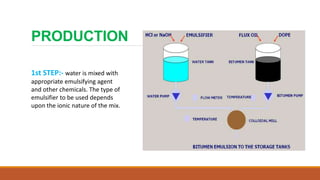
1st STEP:- water is mixed with
appropriate emulsifying agent
and other chemicals. The type of
emulsifier to be used depends
upon the ionic nature of the mix.
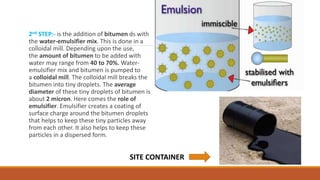
2nd STEP:- is the addition of bitumen ds with
the water-emulsifier mix. This is done in a
colloidal mill. Depending upon the use,
the amount of bitumen to be added with
water may range from 40 to 70%. Water-
emulsifier mix and bitumen is pumped to
a colloidal mill. The colloidal mill breaks the
bitumen into tiny droplets. The average
diameter of these tiny droplets of bitumen is
about 2 micron. Here comes the role of
emulsifier. Emulsifier creates a coating of
surface charge around the bitumen droplets
that helps to keep these tiny particles away
from each other. It also helps to keep these
particles in a dispersed form.
SITE CONTAINER
SITE:-
Bitumen Emulsion Sprayer with dust
remover
Bitumen Emulsion Spray in road construction
CLASSIFICATION:-
BASED ON SURFACE CHARGE
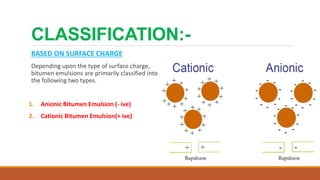
Depending upon the type of surface charge,
bitumen emulsions are primarily classified into
the following two types.
1. Anionic Bitumen Emulsion (- ive)
2. Cationic Bitumen Emulsion(+ ive)
BASED ON SETTING TIME
Depending upon the speed at which water evaporates and bitumen particles separate from
water, it is classified into following 3 types.
1. Rapid Setting Emulsion (RS)
2. Medium Setting Emulsion (MS)
3. Slow Setting Emulsion (SS)
Note: Here the word “setting” should not mean attainment of strength; rather it means the time
taken by the bitumen to separate from water.
APPLICATIONS:-
1) Emulsions are used in bituminous road construction work. They are especially helpful for
maintenance and patch repair works.
2) Emulsion can be used in wet weather even when it is raining.
3) Also emulsions have been used in soil stabilization, particularly for stabilization of sands in
desert areas.
4) A rapid setting type emulsion is suitable for surface dressing and penetration macadam type
of construction.
5) Medium setting type is used for premixing with coarse aggregates.
6) In case of fine aggregates, the surface area of aggregate is more and as a result long duration
of time is required to mix the emulsion. Therefore slow setting emulsion is preferred which gives
sufficient time for uniform blending of the mix.
FACTORS AFFECTING SETTING OF EMULSIONS
Water absorption of aggregate
Surface texture of aggregate
Amount of mineral dust in aggregate
Aggregate gradation
Intensity of charge on aggregate surface
Type of emulsifier used & its quantity
Atmospheric condition, climatic conditions
Wind velocity & altitude
Drainage conditions at construction site
ADVANTAGES:-
 The strength properties of bitumen are preserved in emulsion mixes since emulsions do not
need hot mixing. Generally cold mixing or just slightly warming the ingredients of the emulsion
mix are done for construction of pavements.
 Emulsion can be used in wet weather even when it is raining.
 Emulsions with lower viscosity or thinner consistency improve spreadability and allows better
coating of the bitumen on the surface of aggregate.
 There is no wastage during laying and storage.
 Since emulsions are water based, there is less effect on the environment.
 It is the least energy intensive of all construction material: there is no need to heat.
LIMITATIONS :-
 No one type of emulsion is suitable for every work. it depends upon whether the aggregate is
acidic or basic in nature..
 The setting time may vary depending on the air temperature, wind velocity and type of
emulsion.
 There is a wide range of curing time; a suitable emulsion mix needs to be designed for a
particular need, i.e. we need to determine for each case, the optimum quantity of emulsion
based on zone, type of emulsion, mix grade and desired mechanical properties
 It has limited storage time (few days to six months)
REFERENCES :-
1) Google
2) Wikipedia
3) Debashish’s sir CLASS NOTES
bitumen emulsion in bitumen pavement

bitumen emulsion in bitumen pavement

  • 1.
    EMULSION NAME : AMITSAIN FACULTY : MR. DEBASHISH KARMAKAR
  • 2.
    INTRODUCTION 1) DEFINITION –WHAT IS BITUMEN EMULSION ? 2) PRODUCTION – HOW IS IT MANUFACTURED ? 3) CLASSIFICATION – HOW TO CLASSIFY BITUMEN EMULSION ? 4) FACTORS AFFECTING SETTING OF EMULSIONS 5) APPLICATIONS – WHAT ARE THE USES OF BITUMEN EMULSIONS ? 6) WHAT ARE THE ADVANTAGES & LIMITATIONS OF BITUMEN EMULSION ? 7) REFERENCES
  • 3.
    DEFINITION:- Bitumen emulsion isa mixture of water & bitumen. Hey wait, we know that bitumen is a oil product and it cannot be mixed with water. That is why we add an emulsifier (a surface active agent) with water before adding bitumen. Addition of emulsifier with water facilitates breaking of bitumen into minute particles and keeps it dispersed in suspension. MICROSCOPIC VIEW Therefore we can say that a bitumen emulsion is a liquid product consisting of three things, (i.e. water + Emulsion + Bitumen) where droplets of bitumen are suspended in water
  • 4.
    PRODUCTION 1st STEP:- wateris mixed with appropriate emulsifying agent and other chemicals. The type of emulsifier to be used depends upon the ionic nature of the mix.
  • 5.
    2nd STEP:- isthe addition of bitumen ds with the water-emulsifier mix. This is done in a colloidal mill. Depending upon the use, the amount of bitumen to be added with water may range from 40 to 70%. Water- emulsifier mix and bitumen is pumped to a colloidal mill. The colloidal mill breaks the bitumen into tiny droplets. The average diameter of these tiny droplets of bitumen is about 2 micron. Here comes the role of emulsifier. Emulsifier creates a coating of surface charge around the bitumen droplets that helps to keep these tiny particles away from each other. It also helps to keep these particles in a dispersed form. SITE CONTAINER
  • 6.
    SITE:- Bitumen Emulsion Sprayerwith dust remover Bitumen Emulsion Spray in road construction
  • 7.
    CLASSIFICATION:- BASED ON SURFACECHARGE Depending upon the type of surface charge, bitumen emulsions are primarily classified into the following two types. 1. Anionic Bitumen Emulsion (- ive) 2. Cationic Bitumen Emulsion(+ ive)
  • 8.
    BASED ON SETTINGTIME Depending upon the speed at which water evaporates and bitumen particles separate from water, it is classified into following 3 types. 1. Rapid Setting Emulsion (RS) 2. Medium Setting Emulsion (MS) 3. Slow Setting Emulsion (SS) Note: Here the word “setting” should not mean attainment of strength; rather it means the time taken by the bitumen to separate from water.
  • 9.
    APPLICATIONS:- 1) Emulsions areused in bituminous road construction work. They are especially helpful for maintenance and patch repair works. 2) Emulsion can be used in wet weather even when it is raining. 3) Also emulsions have been used in soil stabilization, particularly for stabilization of sands in desert areas. 4) A rapid setting type emulsion is suitable for surface dressing and penetration macadam type of construction. 5) Medium setting type is used for premixing with coarse aggregates. 6) In case of fine aggregates, the surface area of aggregate is more and as a result long duration of time is required to mix the emulsion. Therefore slow setting emulsion is preferred which gives sufficient time for uniform blending of the mix.
  • 10.
    FACTORS AFFECTING SETTINGOF EMULSIONS Water absorption of aggregate Surface texture of aggregate Amount of mineral dust in aggregate Aggregate gradation Intensity of charge on aggregate surface Type of emulsifier used & its quantity Atmospheric condition, climatic conditions Wind velocity & altitude Drainage conditions at construction site
  • 11.
    ADVANTAGES:-  The strengthproperties of bitumen are preserved in emulsion mixes since emulsions do not need hot mixing. Generally cold mixing or just slightly warming the ingredients of the emulsion mix are done for construction of pavements.  Emulsion can be used in wet weather even when it is raining.  Emulsions with lower viscosity or thinner consistency improve spreadability and allows better coating of the bitumen on the surface of aggregate.  There is no wastage during laying and storage.  Since emulsions are water based, there is less effect on the environment.  It is the least energy intensive of all construction material: there is no need to heat.
  • 12.
    LIMITATIONS :-  Noone type of emulsion is suitable for every work. it depends upon whether the aggregate is acidic or basic in nature..  The setting time may vary depending on the air temperature, wind velocity and type of emulsion.  There is a wide range of curing time; a suitable emulsion mix needs to be designed for a particular need, i.e. we need to determine for each case, the optimum quantity of emulsion based on zone, type of emulsion, mix grade and desired mechanical properties  It has limited storage time (few days to six months)
  • 13.
    REFERENCES :- 1) Google 2)Wikipedia 3) Debashish’s sir CLASS NOTES