Pavement Materials
Module 2
C
i
v
i
l
E
n
g
i
n
e
e
r
i
n
g
D
e
p
a
r
t
m
e
n
t
Bituminous Emulsion and Cutback
Bituminous emulsion and Cutbacks- Preparation, Characteristics, uses and test. Adhesion of bitumen binders
to road aggregates, Adhesion failure, Mechanism of stripping, tests and methods of improving adhesion
Nisarga P, Assistant Professor
C
i
v
i
l
E
n
g
i
n
e
e
r
i
n
g
D
e
p
a
r
t
m
e
n
t
Types of Bituminous Material
Nisarga P, Assistant Professor
C
i
v
i
l
E
n
g
i
n
e
e
r
i
n
g
D
e
p
a
r
t
m
e
n
t
Bitumen Emulsion
What are the Main Components of a Bitumen Emulsion?
1. Asphalt cement,
2. Water,
3. Emulsifying agent.
What is Bitumen Emulsion?
An emulsion is a two-phase system consisting of two immiscible
liquids (unmixable or unbendable).
It is a mixture of bitumen, water and emulsifying agents
Average size of bitumen droplet is about 2 Micron
Nisarga P, Assistant Professor
C
i
v
i
l
E
n
g
i
n
e
e
r
i
n
g
D
e
p
a
r
t
m
e
n
t
Breaking of Bituminous Emulsion
The “breaking” of bituminous emulsions, is the process in which water separates from bitumen and
develops binding property after the bituminous emulsion is applied or mixed.
For example, emulsions break:
• upon contact with aggregates (sand, filler, stones, etc.…) when mixing, or
• when sprayed onto a surface.
Also, bitumen emulsions can break in 3 different ways:
• by chemical destabilization of the emulsifying agent
• simple evaporation of water
• a combination of both above-mentioned options
After the asphalt emulsion breaks and cures, the bitumen residue has the same durability, adhesion, and
water-resistance properties of the original base asphalt
Nisarga P, Assistant Professor
C
i
v
i
l
E
n
g
i
n
e
e
r
i
n
g
D
e
p
a
r
t
m
e
n
t
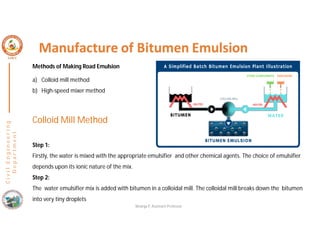
Methods of Making Road Emulsion
a) Colloid mill method
b) High-speed mixer method
Colloid Mill Method
Step 1:
Firstly, the water is mixed with the appropriate emulsifier and other chemical agents. The choice of emulsifier
depends upon its ionic nature of the mix.
Step 2:
The water emulsifier mix is added with bitumen in a colloidal mill. The colloidal mill breaks down the bitumen
into very tiny droplets
Nisarga P, Assistant Professor
C
i
v
i
l
E
n
g
i
n
e
e
r
i
n
g
D
e
p
a
r
t
m
e
n
t
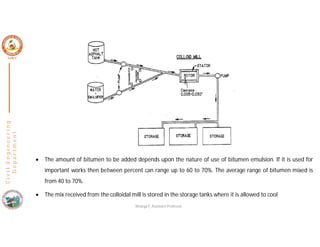
 The amount of bitumen to be added depends upon the nature of use of bitumen emulsion. If it is used for
important works then between percent can range up to 60 to 70%. The average range of bitumen mixed is
from 40 to 70%.
 The mix received from the colloidal mill is stored in the storage tanks where it is allowed to cool
Nisarga P, Assistant Professor
C
i
v
i
l
E
n
g
i
n
e
e
r
i
n
g
D
e
p
a
r
t
m
e
n
t
High-Speed Mixer Method
 This method is not widely used because it is a batch process
and therefore more labor are required.
 Appropriate amount of water at just below boiling point fed
into a 200 or 300 gallon mixer, the diameter of which is
equal to depth of liquid it is proposed to mix.
 The mixer is fitted with a high-speed propeller. Stirrer
mounted off-center to avoid the production of a vortex.
 Alkali is added to the water in the mixer and bitumen at
about 100°C is slowly run in with continuous stirring.
 Dispersions obtained by this method are not so uniform as
those obtained in a colloidal mill.
 Prepared Emulsion is pumped into storage tanks where it is
allowed to cool. Nisarga P, Assistant Professor
C
i
v
i
l
E
n
g
i
n
e
e
r
i
n
g
D
e
p
a
r
t
m
e
n
t
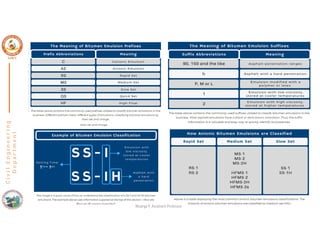
CLASSIFICATION OF BITUMEN EMULSION
There are two different ways to classify bitumen emulsion, as given below.
• Based on surface charge
• Based on setting time
BASED ON SURFACE CHARGE
Depending upon the type of surface charge, bitumen emulsions are classified into two types.
A. Anionic Bitumen Emulsion
B. Cationic Bitumen Emulsion
BASED ON SETTING TOME
Depending upon the type of setting time, bitumen emulsions are classified into three types.
A. Rapid Setting
B. Medium Setting
C. Slow Setting
Nisarga P, Assistant Professor
C
i
v
i
l
E
n
g
i
n
e
e
r
i
n
g
D
e
p
a
r
t
m
e
n
t
Based on Surface Charge
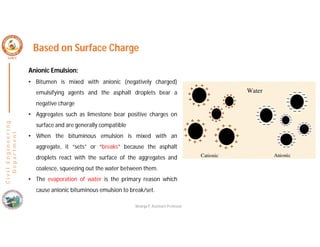
Anionic Emulsion:
• Bitumen is mixed with anionic (negatively charged)
emulsifying agents and the asphalt droplets bear a
negative charge
• Aggregates such as limestone bear positive charges on
surface and are generally compatible
• When the bituminous emulsion is mixed with an
aggregate, it “sets” or “breaks” because the asphalt
droplets react with the surface of the aggregates and
coalesce, squeezing out the water between them.
• The evaporation of water is the primary reason which
cause anionic bituminous emulsion to break/set.
Nisarga P, Assistant Professor
C
i
v
i
l
E
n
g
i
n
e
e
r
i
n
g
D
e
p
a
r
t
m
e
n
t
Cationic Emulsion:
• Bitumen is mixed with anionic cationic (positively
charged) emulsifying agents, the asphalt droplets bear a
positive charge
• Most of siliceous aggregates such as sand stone, quarts
and gravel, are negatively charged and are compatible
• Cationic emulsified asphalts break primarily by electro-
chemical process
Nisarga P, Assistant Professor
C
i
v
i
l
E
n
g
i
n
e
e
r
i
n
g
D
e
p
a
r
t
m
e
n
t
Based on Setting Time
• Rapid setting: bitumen emulsion breaks down rapidly as it comes with contact with aggregate helping in fast
setting and rapid curing. This category has little to no stability. Thus, RS bitumen emulsions are rarely used
to mix aggregates.
Uses: spray applications like sand and chip seals are the main utility for this type of asphalt emulsion.
• Medium setting: MS emulsions are the mixing grade emulsions. By design, medium set bitumen emulsions
are formulated not to break immediately upon contact with graded aggregates. MS emulsion will continue to
retain its workability for a few minutes to several months
Uses: cold recycling, patch mixes, both cold and warm aggregate mixes
• Slow setting: In this type of emulsion, a special type of emulsifier is used to slow the process of water
evaporation. This type of emulsifier are relatively stable. SS emulsions mix well with fine aggregates while
still allowing for extended workability and maximum mixing time.
Uses: Tack coat, base stabilization, soil stabilization, dust control and dust palliatives, slurry seals and fog seal
Nisarga P, Assistant Professor
C
i
v
i
l
E
n
g
i
n
e
e
r
i
n
g
D
e
p
a
r
t
m
e
n
t
Nisarga P, Assistant Professor
C
i
v
i
l
E
n
g
i
n
e
e
r
i
n
g
D
e
p
a
r
t
m
e
n
t
Factors Affecting Setting of Emulsions
The following factors affect the setting & curing of bitumen emulsion mixes.
• Water absorption of aggregate
• Surface texture of aggregate
• Amount of mineral dust in aggregate
• Aggregate gradation
• Mineral composition of aggregate
• Intensity of charge on aggregate surface
• Type of emulsifier used & its quantity
• Atmospheric condition, climatic conditions
• Wind velocity & altitude
• Drainage conditions at construction site
Nisarga P, Assistant Professor
C
i
v
i
l
E
n
g
i
n
e
e
r
i
n
g
D
e
p
a
r
t
m
e
n
t
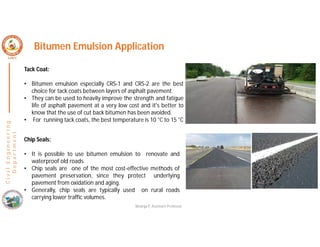
Bitumen Emulsion Application
Tack Coat:
• Bitumen emulsion especially CRS-1 and CRS-2 are the best
choice for tack coats between layers of asphalt pavement.
• They can be used to heavily improve the strength and fatigue
life of asphalt pavement at a very low cost and it's better to
know that the use of cut back bitumen has been avoided.
• For running tack coats, the best temperature is 10 °C to 15 °C
Chip Seals:
• It is possible to use bitumen emulsion to renovate and
waterproof old roads.
• Chip seals are one of the most cost-effective methods of
pavement preservation, since they protect underlying
pavement from oxidation and aging.
• Generally, chip seals are typically used on rural roads
carrying lower traffic volumes.
Nisarga P, Assistant Professor
C
i
v
i
l
E
n
g
i
n
e
e
r
i
n
g
D
e
p
a
r
t
m
e
n
t
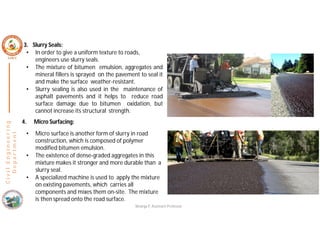
3. Slurry Seals:
• In order to give a uniform texture to roads,
engineers use slurry seals.
• The mixture of bitumen emulsion, aggregates and
mineral fillers is sprayed on the pavement to seal it
and make the surface weather-resistant.
• Slurry sealing is also used in the maintenance of
asphalt pavements and it helps to reduce road
surface damage due to bitumen oxidation, but
cannot increase its structural strength.
• Micro surface is another form of slurry in road
construction, which is composed of polymer
modified bitumen emulsion.
• The existence of dense-graded aggregates in this
mixture makes it stronger and more durable than a
slurry seal.
• A specialized machine is used to apply the mixture
on existing pavements, which carries all
components and mixes them on-site. The mixture
is then spread onto the road surface.
4. Micro Surfacing:
Nisarga P, Assistant Professor
C
i
v
i
l
E
n
g
i
n
e
e
r
i
n
g
D
e
p
a
r
t
m
e
n
t
Properties of Bituminous Emulsion
The following are the properties pertaining largely to the constitution of emulsion before use.
a) Residue on sieving
b) Stability to mixing with coarse-graded aggregate
c) Stability to mixing with cement
d) Water content
e) Viscosity
f) Coagulation at low temperature
g) Sedimentation
h) Stability on long-period storage
Nisarga P, Assistant Professor
C
i
v
i
l
E
n
g
i
n
e
e
r
i
n
g
D
e
p
a
r
t
m
e
n
t
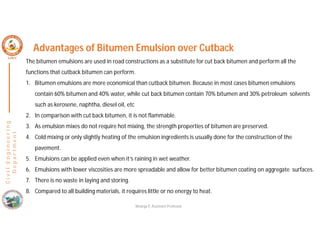
1. Residue on sieving: Practically all road bitumen and tars are slightly heavier than water and the globules of
binder will tend to sediment in emulsion; the rate at which it sediments depends on the size of the particle.
Hence percentage of large particles should be controlled and hence is to ensure that, not more than 0.25% by
weight of emulsion consists of particles greater than 0.006 inch in diameter.
2. Stability to mixing with coarse-graded aggregate: When mixing bitumen emulsions with coarse aggregates,
breakdown of the emulsion and coating off the aggregates with bitumen should not take place too early in the
mixing cycle.
3. Stability to mixing with cement: Stable emulsions should have sufficient mechanical and chemical stability
for all purposes involving mixing with aggregates including those containing large proportions of fines. Cement
is used as a standard fine aggregate
4. Sedimentation: Some sedimentation may occur when a drum of emulsion is left standing before use;
provided however the sediment re-disperses on agitation, the emulsion can be used satisfactory.
Nisarga P, Assistant Professor
C
i
v
i
l
E
n
g
i
n
e
e
r
i
n
g
D
e
p
a
r
t
m
e
n
t
5. Water content: Road emulsions may contain up to 65% of water. It is essential to know this percentage if the
quantity of bituminous binder actually used in the surfacing is to be measured accurately. The water content of
an emulsion is often varied to suit particular forms of application.
6. Viscosity: It is determined by the proportion of bitumen or tar in the emulsion and by the particle-size
distribution. The viscosity of the emulsion should be low enough to spray through conventional jets or to coat
stone. It is measured by Engler out flow viscometer.
7. Coagulation at Low Temperature: All emulsions contain water they are affected by extremes of heat and cold.
Exposure to temperatures below 0°C will result in freezing and the degree of recovery on thawing depends on
type of emulsion.
8. Stability on Long-Period Storage: When stored in drums under normal atmospheric conditions, the emulsion
should not separate in a form which cannot be re-dispersed by agitation.
Nisarga P, Assistant Professor
C
i
v
i
l
E
n
g
i
n
e
e
r
i
n
g
D
e
p
a
r
t
m
e
n
t
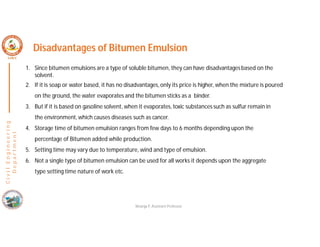
Advantages of Bitumen Emulsion over Cutback
The bitumen emulsions are used in road constructions as a substitute for cut back bitumen and perform all the
functions that cutback bitumen can perform.
1. Bitumen emulsions are more economical than cutback bitumen. Because in most cases bitumen emulsions
contain 60% bitumen and 40% water, while cut back bitumen contain 70% bitumen and 30% petroleum solvents
such as kerosene, naphtha, diesel oil, etc
2. In comparison with cut back bitumen, it is not flammable.
3. As emulsion mixes do not require hot mixing, the strength properties of bitumen are preserved.
4. Cold mixing or only slightly heating of the emulsion ingredients is usually done for the construction of the
pavement.
5. Emulsions can be applied even when it’s raining in wet weather.
6. Emulsions with lower viscosities are more spreadable and allow for better bitumen coating on aggregate surfaces.
7. There is no waste in laying and storing.
8. Compared to all building materials, it requires little or no energy to heat.
Nisarga P, Assistant Professor
C
i
v
i
l
E
n
g
i
n
e
e
r
i
n
g
D
e
p
a
r
t
m
e
n
t
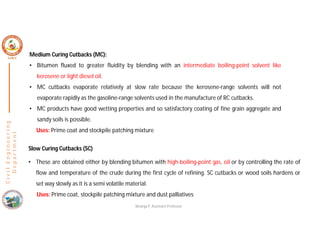
Disadvantages of Bitumen Emulsion
1. Since bitumen emulsions are a type of soluble bitumen, they can have disadvantagesbased on the
solvent.
2. If it is soap or water based, it has no disadvantages,only its price is higher, when the mixture is poured
on the ground, the water evaporates and the bitumen sticks as a binder.
3. But if it is based on gasoline solvent, when it evaporates,toxic substances such as sulfur remain in
the environment, which causes diseases such as cancer.
4. Storage time of bitumen emulsion ranges from few days to 6 months depending upon the
percentage of Bitumen added while production.
5. Setting time may vary due to temperature, wind and type of emulsion.
6. Not a single type of bitumen emulsion can be used for all works it depends upon the aggregate
type setting time nature of work etc.
Nisarga P, Assistant Professor
C
i
v
i
l
E
n
g
i
n
e
e
r
i
n
g
D
e
p
a
r
t
m
e
n
t
Cutback Bitumen
• Cutback bitumen are liquid asphalts which are manufactured by adding
petroleum solvents (diluents) to bitumen. They are made to reduce
viscosity of bitumen for lower application temperature.
• Application of cutback mix in construction work, causes the
solvents/volatile gets evaporated thus leaving the bitumen residue on
the surface which later develops the binding properties.
• The viscosity of cutback and rate of which it hardens on the road
depend on the characteristics and quantity of both bitumen and volatile
oil used as the diluents.
Nisarga P, Assistant Professor
C
i
v
i
l
E
n
g
i
n
e
e
r
i
n
g
D
e
p
a
r
t
m
e
n
t
Types of Cutback Bitumen
Rapid Curing Cutbacks (RC):
• Bitumen, fluxed or cutbacks with a petroleum distillate such as naphtha or gasoline, which will rapidly
evaporate after using in construction, leaving the bitumen binder.
• The grade of the RC cutback is governed by the proportion of the solvent used.
• The penetration value of RC cutback bitumen is 80 to 120.
Uses: Tack coat and surface treatment
Cutback bitumen is available in three types, namely:
a) Rapid Curing (RC)
b) Medium Curing (MC)
c) Slow Curing (SC)
Nisarga P, Assistant Professor
C
i
v
i
l
E
n
g
i
n
e
e
r
i
n
g
D
e
p
a
r
t
m
e
n
t
Slow Curing Cutbacks (SC)
• These are obtained either by blending bitumen with high-boiling-point gas, oil or by controlling the rate of
flow and temperature of the crude during the first cycle of refining. SC cutbacks or wood soils hardens or
set way slowly as it is a semi volatile material.
Uses: Prime coat, stockpile patching mixture and dust palliatives
Medium Curing Cutbacks (MC):
• Bitumen fluxed to greater fluidity by blending with an intermediate boiling-point solvent like
kerosene or light diesel oil.
• MC cutbacks evaporate relatively at slow rate because the kerosene-range solvents will not
evaporate rapidly as the gasoline-range solvents used in the manufacture of RC cutbacks.
• MC products have good wetting properties and so satisfactory coating of fine grain aggregate and
sandy soils is possible.
Uses: Prime coat and stockpile patching mixture
Nisarga P, Assistant Professor
C
i
v
i
l
E
n
g
i
n
e
e
r
i
n
g
D
e
p
a
r
t
m
e
n
t
Nisarga P, Assistant Professor
C
i
v
i
l
E
n
g
i
n
e
e
r
i
n
g
D
e
p
a
r
t
m
e
n
t
Tests on Cutback Bitumen
Various tests carried out on cutback bitumen are:
a) Viscosity test: Same as bitumen at specified temperature using specified size orifice.
b) Penetration test, ductility test and test for matter soluble in carbon-di-sulphide on residue from
distillation up to 360°C.
c) Flash point test on cutback using Pensky Martens’s closed type apparatus.
d) Distillation test to find distillation fractions, up to specified temperature and to find the residue from
distillation up to 360° C
Nisarga P, Assistant Professor
C
i
v
i
l
E
n
g
i
n
e
e
r
i
n
g
D
e
p
a
r
t
m
e
n
t
BITUMEN-AGGREGATE ADHESION
The adhesive property of bitumen binds together all the components without bringing about any positive or
negative changes in their properties. Bitumen has the ability to adhere to a solid surface in a fluid state
depending on the nature of the surface. The presence of water on the surface will prevent adhesion.
The adhesion between mineral aggregates and bitumen is an important criterion which describes the quality of
the asphalt mixture, asphalt pavement performance and resistance to distress. The lack of bonding can lead to
a significant asphalt pavement damage.
When the road stones are wetted can lead to difficulties, either in the initial coating of damp roads stone in
maintaining an adequate bond between the binder and stone. The problems with water mixing in two ways,
firstly due to aggregates being wet before laying, secondly due to effect of rain after it has been laid.
Nisarga P, Assistant Professor
C
i
v
i
l
E
n
g
i
n
e
e
r
i
n
g
D
e
p
a
r
t
m
e
n
t
Stripping
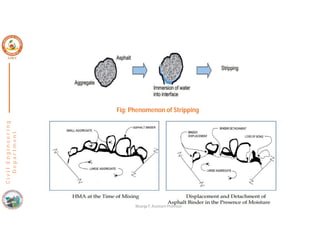
Stripping is generally defined as “the breaking of the adhesive bond between the aggregate surface and the
bitumen”.
Several mechanisms have been suggested to explain the occurrence of stripping. It appears that these
mechanisms may act individually or together to cause adhesion failure in bituminous mixtures.
The water induced damage in bituminous layers may be associated with two reasons:
1. Loss of adhesion: the water gets between the bitumen and aggregate and strips the bitumen film away,
leaving aggregate without bitumen film coverage. This is because the aggregates have a greater affinity
for water than bitumen binder
2. Loss of cohesion: Stripping mechanism includes the interaction of water with the bitumen that reduces
the cohesion within the bitumen
Nisarga P, Assistant Professor
C
i
v
i
l
E
n
g
i
n
e
e
r
i
n
g
D
e
p
a
r
t
m
e
n
t
Fig: Phenomenon of Stripping
Nisarga P, Assistant Professor
C
i
v
i
l
E
n
g
i
n
e
e
r
i
n
g
D
e
p
a
r
t
m
e
n
t
Stripping Mechanism
Detachment:
• Detachment is separation of bitumen film from an aggregate surface by a thin layer of water, with no
obvious break in the bituminous film.
• Where stripping by detachment has occurred, the bitumen film can be peeled cleanly from the
aggregate, indicating a complete loss of adhesion.
Displacement:
• Stripping by displacement results from the penetration of water to the aggregate surface through a break
in the bitumen film.
• The break can be caused by incomplete coating of the aggregate initially or by film rupture. Because the
bitumen film at these locations is generally thinner and under tension, rupture of the bitumen film is
probably at the sharp edges and corners of angular aggregate pieces as a result of traffic loading.
Nisarga P, Assistant Professor
C
i
v
i
l
E
n
g
i
n
e
e
r
i
n
g
D
e
p
a
r
t
m
e
n
t
Spontaneous Emulsification:
• In spontaneous emulsification, water and bitumen combine to form an inverted emulsion, where
bitumen represents the continuous phase and water represent the discontinuous phase.
• The formation of such an emulsion leads to stripping and is further aggravated by the presence
of emulsifiers such as mineral clays and some bitumen additive.
Pore Pressure:
• Pore pressure has been suggested as a mechanism of stripping in high void mixes where water
may circulate freely through interconnected voids.
• Upon densification of the mix from traffic loading, water may trap in impermeable voids that
previously permitted water circulation.
• Further traffic may induce high excess pore pressure in the trapped water causing stripping of
the bitumen film from the aggregate.
Nisarga P, Assistant Professor
C
i
v
i
l
E
n
g
i
n
e
e
r
i
n
g
D
e
p
a
r
t
m
e
n
t
Hydraulic Scouring:
• Hydraulic scouring is a mechanism of stripping that is applicable only to surface courses.
• Stripping due to hydraulic scouring results from the action of vehicle tires on a saturated pavement
surface. This causes water to be pressed down into the pavement in front of the tire and immediately
sucked away from the pavement behind the tire.
• This compression-tension cycle is believed to contribute to the stripping of the bitumen film from the
aggregate.
Nisarga P, Assistant Professor
C
i
v
i
l
E
n
g
i
n
e
e
r
i
n
g
D
e
p
a
r
t
m
e
n
t
ADHESION TESTS
a) Static Immersion Test
 In this type of test, aggregate coated with binder is immersed in water and the degree of stripping is
estimated.
 Single-sized chippings are coated with a constant quantity of binder under controlled conditions
 Coated stone is immersed in distilled water for 48 hours.
 The percentage of stripped surface is estimated visually.
 One more approach is to measure the quantity of light reflected by sample of coated aggregate before
and after immersion in water.
b) Dynamic Immersion Test
 It is similar to static immersion test but the sample is agitated mechanically by shaking or kneading.
 Coated aggregates are shaken in water for a known time and then the amount of stripping is
estimated visually.
Nisarga P, Assistant Professor
C
i
v
i
l
E
n
g
i
n
e
e
r
i
n
g
D
e
p
a
r
t
m
e
n
t
c) Chemical Immersion Test
 Stone coated with binder is boiled in distilled water and if necessary, a solution of sodium carbonate is
added.
 The strength of the solution of sodium carbonate in which stripping is first observed is used as a
measure of the adhesivity.
 Attempts have been made to improve this test, for example by reducing the temperature and using
larger stone or by measuring the amount off uncoated aggregate which separates from coated mass.
d) Coating Test
 In this test an attempt is made to obtain adhesion between an aggregate and binder when water is also
present.
 Test involves immersion of tray of binder in water and then the application of chippings to the surface
of the binder. It is known as Immersion tray test.
 No adhesion is obtained under these conditions with normal road stones and binders but the test is
helpful for examining how surface-active agents improve adhesion between binder sand aggregates in
surface dressing under wet conditions.
Nisarga P, Assistant Professor
C
i
v
i
l
E
n
g
i
n
e
e
r
i
n
g
D
e
p
a
r
t
m
e
n
t
e) Immersion Mechanical Test
 Degree of stripping of the binder from aggregate is observed indirectly by measuring the change in a
specified mechanical property of a bituminous material after it has been immersed in water.
 In this test, a number of identical cylindrical specimens of the bituminous mixture to be tested are
prepared.
 After few hours ‘curing’ some are used to determine the compressive strength under constant rate of
strain.
 The remainder are immersed in water for some days and then tested similarly.
 The reduction in strength gives an indication of the extent of any damage by water that has occurred.
Nisarga P, Assistant Professor
C
i
v
i
l
E
n
g
i
n
e
e
r
i
n
g
D
e
p
a
r
t
m
e
n
t
Nisarga P, Assistant Professor
C
i
v
i
l
E
n
g
i
n
e
e
r
i
n
g
D
e
p
a
r
t
m
e
n
t
Nisarga P, Assistant Professor
C
i
v
i
l
E
n
g
i
n
e
e
r
i
n
g
D
e
p
a
r
t
m
e
n
t
Nisarga P, Assistant Professor
C
i
v
i
l
E
n
g
i
n
e
e
r
i
n
g
D
e
p
a
r
t
m
e
n
t
Nisarga P, Assistant Professor

PMC_Module 2_PPT.pdf

  • 1.
    Pavement Materials Module 2 C i v i l E n g i n e e r i n g D e p a r t m e n t BituminousEmulsion and Cutback Bituminous emulsion and Cutbacks- Preparation, Characteristics, uses and test. Adhesion of bitumen binders to road aggregates, Adhesion failure, Mechanism of stripping, tests and methods of improving adhesion Nisarga P, Assistant Professor
  • 2.
  • 3.
    C i v i l E n g i n e e r i n g D e p a r t m e n t Bitumen Emulsion What arethe Main Components of a Bitumen Emulsion? 1. Asphalt cement, 2. Water, 3. Emulsifying agent. What is Bitumen Emulsion? An emulsion is a two-phase system consisting of two immiscible liquids (unmixable or unbendable). It is a mixture of bitumen, water and emulsifying agents Average size of bitumen droplet is about 2 Micron Nisarga P, Assistant Professor
  • 4.
    C i v i l E n g i n e e r i n g D e p a r t m e n t Breaking of BituminousEmulsion The “breaking” of bituminous emulsions, is the process in which water separates from bitumen and develops binding property after the bituminous emulsion is applied or mixed. For example, emulsions break: • upon contact with aggregates (sand, filler, stones, etc.…) when mixing, or • when sprayed onto a surface. Also, bitumen emulsions can break in 3 different ways: • by chemical destabilization of the emulsifying agent • simple evaporation of water • a combination of both above-mentioned options After the asphalt emulsion breaks and cures, the bitumen residue has the same durability, adhesion, and water-resistance properties of the original base asphalt Nisarga P, Assistant Professor
  • 5.
    C i v i l E n g i n e e r i n g D e p a r t m e n t Methods of MakingRoad Emulsion a) Colloid mill method b) High-speed mixer method Colloid Mill Method Step 1: Firstly, the water is mixed with the appropriate emulsifier and other chemical agents. The choice of emulsifier depends upon its ionic nature of the mix. Step 2: The water emulsifier mix is added with bitumen in a colloidal mill. The colloidal mill breaks down the bitumen into very tiny droplets Nisarga P, Assistant Professor
  • 6.
    C i v i l E n g i n e e r i n g D e p a r t m e n t  The amountof bitumen to be added depends upon the nature of use of bitumen emulsion. If it is used for important works then between percent can range up to 60 to 70%. The average range of bitumen mixed is from 40 to 70%.  The mix received from the colloidal mill is stored in the storage tanks where it is allowed to cool Nisarga P, Assistant Professor
  • 7.
    C i v i l E n g i n e e r i n g D e p a r t m e n t High-Speed Mixer Method This method is not widely used because it is a batch process and therefore more labor are required.  Appropriate amount of water at just below boiling point fed into a 200 or 300 gallon mixer, the diameter of which is equal to depth of liquid it is proposed to mix.  The mixer is fitted with a high-speed propeller. Stirrer mounted off-center to avoid the production of a vortex.  Alkali is added to the water in the mixer and bitumen at about 100°C is slowly run in with continuous stirring.  Dispersions obtained by this method are not so uniform as those obtained in a colloidal mill.  Prepared Emulsion is pumped into storage tanks where it is allowed to cool. Nisarga P, Assistant Professor
  • 8.
    C i v i l E n g i n e e r i n g D e p a r t m e n t CLASSIFICATION OF BITUMENEMULSION There are two different ways to classify bitumen emulsion, as given below. • Based on surface charge • Based on setting time BASED ON SURFACE CHARGE Depending upon the type of surface charge, bitumen emulsions are classified into two types. A. Anionic Bitumen Emulsion B. Cationic Bitumen Emulsion BASED ON SETTING TOME Depending upon the type of setting time, bitumen emulsions are classified into three types. A. Rapid Setting B. Medium Setting C. Slow Setting Nisarga P, Assistant Professor
  • 9.
    C i v i l E n g i n e e r i n g D e p a r t m e n t Based on SurfaceCharge Anionic Emulsion: • Bitumen is mixed with anionic (negatively charged) emulsifying agents and the asphalt droplets bear a negative charge • Aggregates such as limestone bear positive charges on surface and are generally compatible • When the bituminous emulsion is mixed with an aggregate, it “sets” or “breaks” because the asphalt droplets react with the surface of the aggregates and coalesce, squeezing out the water between them. • The evaporation of water is the primary reason which cause anionic bituminous emulsion to break/set. Nisarga P, Assistant Professor
  • 10.
    C i v i l E n g i n e e r i n g D e p a r t m e n t Cationic Emulsion: • Bitumenis mixed with anionic cationic (positively charged) emulsifying agents, the asphalt droplets bear a positive charge • Most of siliceous aggregates such as sand stone, quarts and gravel, are negatively charged and are compatible • Cationic emulsified asphalts break primarily by electro- chemical process Nisarga P, Assistant Professor
  • 11.
    C i v i l E n g i n e e r i n g D e p a r t m e n t Based on SettingTime • Rapid setting: bitumen emulsion breaks down rapidly as it comes with contact with aggregate helping in fast setting and rapid curing. This category has little to no stability. Thus, RS bitumen emulsions are rarely used to mix aggregates. Uses: spray applications like sand and chip seals are the main utility for this type of asphalt emulsion. • Medium setting: MS emulsions are the mixing grade emulsions. By design, medium set bitumen emulsions are formulated not to break immediately upon contact with graded aggregates. MS emulsion will continue to retain its workability for a few minutes to several months Uses: cold recycling, patch mixes, both cold and warm aggregate mixes • Slow setting: In this type of emulsion, a special type of emulsifier is used to slow the process of water evaporation. This type of emulsifier are relatively stable. SS emulsions mix well with fine aggregates while still allowing for extended workability and maximum mixing time. Uses: Tack coat, base stabilization, soil stabilization, dust control and dust palliatives, slurry seals and fog seal Nisarga P, Assistant Professor
  • 12.
  • 13.
    C i v i l E n g i n e e r i n g D e p a r t m e n t Factors Affecting Settingof Emulsions The following factors affect the setting & curing of bitumen emulsion mixes. • Water absorption of aggregate • Surface texture of aggregate • Amount of mineral dust in aggregate • Aggregate gradation • Mineral composition of aggregate • Intensity of charge on aggregate surface • Type of emulsifier used & its quantity • Atmospheric condition, climatic conditions • Wind velocity & altitude • Drainage conditions at construction site Nisarga P, Assistant Professor
  • 14.
    C i v i l E n g i n e e r i n g D e p a r t m e n t Bitumen Emulsion Application TackCoat: • Bitumen emulsion especially CRS-1 and CRS-2 are the best choice for tack coats between layers of asphalt pavement. • They can be used to heavily improve the strength and fatigue life of asphalt pavement at a very low cost and it's better to know that the use of cut back bitumen has been avoided. • For running tack coats, the best temperature is 10 °C to 15 °C Chip Seals: • It is possible to use bitumen emulsion to renovate and waterproof old roads. • Chip seals are one of the most cost-effective methods of pavement preservation, since they protect underlying pavement from oxidation and aging. • Generally, chip seals are typically used on rural roads carrying lower traffic volumes. Nisarga P, Assistant Professor
  • 15.
    C i v i l E n g i n e e r i n g D e p a r t m e n t 3. Slurry Seals: •In order to give a uniform texture to roads, engineers use slurry seals. • The mixture of bitumen emulsion, aggregates and mineral fillers is sprayed on the pavement to seal it and make the surface weather-resistant. • Slurry sealing is also used in the maintenance of asphalt pavements and it helps to reduce road surface damage due to bitumen oxidation, but cannot increase its structural strength. • Micro surface is another form of slurry in road construction, which is composed of polymer modified bitumen emulsion. • The existence of dense-graded aggregates in this mixture makes it stronger and more durable than a slurry seal. • A specialized machine is used to apply the mixture on existing pavements, which carries all components and mixes them on-site. The mixture is then spread onto the road surface. 4. Micro Surfacing: Nisarga P, Assistant Professor
  • 16.
    C i v i l E n g i n e e r i n g D e p a r t m e n t Properties of BituminousEmulsion The following are the properties pertaining largely to the constitution of emulsion before use. a) Residue on sieving b) Stability to mixing with coarse-graded aggregate c) Stability to mixing with cement d) Water content e) Viscosity f) Coagulation at low temperature g) Sedimentation h) Stability on long-period storage Nisarga P, Assistant Professor
  • 17.
    C i v i l E n g i n e e r i n g D e p a r t m e n t 1. Residue onsieving: Practically all road bitumen and tars are slightly heavier than water and the globules of binder will tend to sediment in emulsion; the rate at which it sediments depends on the size of the particle. Hence percentage of large particles should be controlled and hence is to ensure that, not more than 0.25% by weight of emulsion consists of particles greater than 0.006 inch in diameter. 2. Stability to mixing with coarse-graded aggregate: When mixing bitumen emulsions with coarse aggregates, breakdown of the emulsion and coating off the aggregates with bitumen should not take place too early in the mixing cycle. 3. Stability to mixing with cement: Stable emulsions should have sufficient mechanical and chemical stability for all purposes involving mixing with aggregates including those containing large proportions of fines. Cement is used as a standard fine aggregate 4. Sedimentation: Some sedimentation may occur when a drum of emulsion is left standing before use; provided however the sediment re-disperses on agitation, the emulsion can be used satisfactory. Nisarga P, Assistant Professor
  • 18.
    C i v i l E n g i n e e r i n g D e p a r t m e n t 5. Water content:Road emulsions may contain up to 65% of water. It is essential to know this percentage if the quantity of bituminous binder actually used in the surfacing is to be measured accurately. The water content of an emulsion is often varied to suit particular forms of application. 6. Viscosity: It is determined by the proportion of bitumen or tar in the emulsion and by the particle-size distribution. The viscosity of the emulsion should be low enough to spray through conventional jets or to coat stone. It is measured by Engler out flow viscometer. 7. Coagulation at Low Temperature: All emulsions contain water they are affected by extremes of heat and cold. Exposure to temperatures below 0°C will result in freezing and the degree of recovery on thawing depends on type of emulsion. 8. Stability on Long-Period Storage: When stored in drums under normal atmospheric conditions, the emulsion should not separate in a form which cannot be re-dispersed by agitation. Nisarga P, Assistant Professor
  • 19.
    C i v i l E n g i n e e r i n g D e p a r t m e n t Advantages of BitumenEmulsion over Cutback The bitumen emulsions are used in road constructions as a substitute for cut back bitumen and perform all the functions that cutback bitumen can perform. 1. Bitumen emulsions are more economical than cutback bitumen. Because in most cases bitumen emulsions contain 60% bitumen and 40% water, while cut back bitumen contain 70% bitumen and 30% petroleum solvents such as kerosene, naphtha, diesel oil, etc 2. In comparison with cut back bitumen, it is not flammable. 3. As emulsion mixes do not require hot mixing, the strength properties of bitumen are preserved. 4. Cold mixing or only slightly heating of the emulsion ingredients is usually done for the construction of the pavement. 5. Emulsions can be applied even when it’s raining in wet weather. 6. Emulsions with lower viscosities are more spreadable and allow for better bitumen coating on aggregate surfaces. 7. There is no waste in laying and storing. 8. Compared to all building materials, it requires little or no energy to heat. Nisarga P, Assistant Professor
  • 20.
    C i v i l E n g i n e e r i n g D e p a r t m e n t Disadvantages of BitumenEmulsion 1. Since bitumen emulsions are a type of soluble bitumen, they can have disadvantagesbased on the solvent. 2. If it is soap or water based, it has no disadvantages,only its price is higher, when the mixture is poured on the ground, the water evaporates and the bitumen sticks as a binder. 3. But if it is based on gasoline solvent, when it evaporates,toxic substances such as sulfur remain in the environment, which causes diseases such as cancer. 4. Storage time of bitumen emulsion ranges from few days to 6 months depending upon the percentage of Bitumen added while production. 5. Setting time may vary due to temperature, wind and type of emulsion. 6. Not a single type of bitumen emulsion can be used for all works it depends upon the aggregate type setting time nature of work etc. Nisarga P, Assistant Professor
  • 21.
    C i v i l E n g i n e e r i n g D e p a r t m e n t Cutback Bitumen • Cutbackbitumen are liquid asphalts which are manufactured by adding petroleum solvents (diluents) to bitumen. They are made to reduce viscosity of bitumen for lower application temperature. • Application of cutback mix in construction work, causes the solvents/volatile gets evaporated thus leaving the bitumen residue on the surface which later develops the binding properties. • The viscosity of cutback and rate of which it hardens on the road depend on the characteristics and quantity of both bitumen and volatile oil used as the diluents. Nisarga P, Assistant Professor
  • 22.
    C i v i l E n g i n e e r i n g D e p a r t m e n t Types of CutbackBitumen Rapid Curing Cutbacks (RC): • Bitumen, fluxed or cutbacks with a petroleum distillate such as naphtha or gasoline, which will rapidly evaporate after using in construction, leaving the bitumen binder. • The grade of the RC cutback is governed by the proportion of the solvent used. • The penetration value of RC cutback bitumen is 80 to 120. Uses: Tack coat and surface treatment Cutback bitumen is available in three types, namely: a) Rapid Curing (RC) b) Medium Curing (MC) c) Slow Curing (SC) Nisarga P, Assistant Professor
  • 23.
    C i v i l E n g i n e e r i n g D e p a r t m e n t Slow Curing Cutbacks(SC) • These are obtained either by blending bitumen with high-boiling-point gas, oil or by controlling the rate of flow and temperature of the crude during the first cycle of refining. SC cutbacks or wood soils hardens or set way slowly as it is a semi volatile material. Uses: Prime coat, stockpile patching mixture and dust palliatives Medium Curing Cutbacks (MC): • Bitumen fluxed to greater fluidity by blending with an intermediate boiling-point solvent like kerosene or light diesel oil. • MC cutbacks evaporate relatively at slow rate because the kerosene-range solvents will not evaporate rapidly as the gasoline-range solvents used in the manufacture of RC cutbacks. • MC products have good wetting properties and so satisfactory coating of fine grain aggregate and sandy soils is possible. Uses: Prime coat and stockpile patching mixture Nisarga P, Assistant Professor
  • 24.
  • 25.
    C i v i l E n g i n e e r i n g D e p a r t m e n t Tests on CutbackBitumen Various tests carried out on cutback bitumen are: a) Viscosity test: Same as bitumen at specified temperature using specified size orifice. b) Penetration test, ductility test and test for matter soluble in carbon-di-sulphide on residue from distillation up to 360°C. c) Flash point test on cutback using Pensky Martens’s closed type apparatus. d) Distillation test to find distillation fractions, up to specified temperature and to find the residue from distillation up to 360° C Nisarga P, Assistant Professor
  • 26.
    C i v i l E n g i n e e r i n g D e p a r t m e n t BITUMEN-AGGREGATE ADHESION The adhesiveproperty of bitumen binds together all the components without bringing about any positive or negative changes in their properties. Bitumen has the ability to adhere to a solid surface in a fluid state depending on the nature of the surface. The presence of water on the surface will prevent adhesion. The adhesion between mineral aggregates and bitumen is an important criterion which describes the quality of the asphalt mixture, asphalt pavement performance and resistance to distress. The lack of bonding can lead to a significant asphalt pavement damage. When the road stones are wetted can lead to difficulties, either in the initial coating of damp roads stone in maintaining an adequate bond between the binder and stone. The problems with water mixing in two ways, firstly due to aggregates being wet before laying, secondly due to effect of rain after it has been laid. Nisarga P, Assistant Professor
  • 27.
    C i v i l E n g i n e e r i n g D e p a r t m e n t Stripping Stripping is generallydefined as “the breaking of the adhesive bond between the aggregate surface and the bitumen”. Several mechanisms have been suggested to explain the occurrence of stripping. It appears that these mechanisms may act individually or together to cause adhesion failure in bituminous mixtures. The water induced damage in bituminous layers may be associated with two reasons: 1. Loss of adhesion: the water gets between the bitumen and aggregate and strips the bitumen film away, leaving aggregate without bitumen film coverage. This is because the aggregates have a greater affinity for water than bitumen binder 2. Loss of cohesion: Stripping mechanism includes the interaction of water with the bitumen that reduces the cohesion within the bitumen Nisarga P, Assistant Professor
  • 28.
  • 29.
    C i v i l E n g i n e e r i n g D e p a r t m e n t Stripping Mechanism Detachment: • Detachmentis separation of bitumen film from an aggregate surface by a thin layer of water, with no obvious break in the bituminous film. • Where stripping by detachment has occurred, the bitumen film can be peeled cleanly from the aggregate, indicating a complete loss of adhesion. Displacement: • Stripping by displacement results from the penetration of water to the aggregate surface through a break in the bitumen film. • The break can be caused by incomplete coating of the aggregate initially or by film rupture. Because the bitumen film at these locations is generally thinner and under tension, rupture of the bitumen film is probably at the sharp edges and corners of angular aggregate pieces as a result of traffic loading. Nisarga P, Assistant Professor
  • 30.
    C i v i l E n g i n e e r i n g D e p a r t m e n t Spontaneous Emulsification: • Inspontaneous emulsification, water and bitumen combine to form an inverted emulsion, where bitumen represents the continuous phase and water represent the discontinuous phase. • The formation of such an emulsion leads to stripping and is further aggravated by the presence of emulsifiers such as mineral clays and some bitumen additive. Pore Pressure: • Pore pressure has been suggested as a mechanism of stripping in high void mixes where water may circulate freely through interconnected voids. • Upon densification of the mix from traffic loading, water may trap in impermeable voids that previously permitted water circulation. • Further traffic may induce high excess pore pressure in the trapped water causing stripping of the bitumen film from the aggregate. Nisarga P, Assistant Professor
  • 31.
    C i v i l E n g i n e e r i n g D e p a r t m e n t Hydraulic Scouring: • Hydraulicscouring is a mechanism of stripping that is applicable only to surface courses. • Stripping due to hydraulic scouring results from the action of vehicle tires on a saturated pavement surface. This causes water to be pressed down into the pavement in front of the tire and immediately sucked away from the pavement behind the tire. • This compression-tension cycle is believed to contribute to the stripping of the bitumen film from the aggregate. Nisarga P, Assistant Professor
  • 32.
    C i v i l E n g i n e e r i n g D e p a r t m e n t ADHESION TESTS a) StaticImmersion Test  In this type of test, aggregate coated with binder is immersed in water and the degree of stripping is estimated.  Single-sized chippings are coated with a constant quantity of binder under controlled conditions  Coated stone is immersed in distilled water for 48 hours.  The percentage of stripped surface is estimated visually.  One more approach is to measure the quantity of light reflected by sample of coated aggregate before and after immersion in water. b) Dynamic Immersion Test  It is similar to static immersion test but the sample is agitated mechanically by shaking or kneading.  Coated aggregates are shaken in water for a known time and then the amount of stripping is estimated visually. Nisarga P, Assistant Professor
  • 33.
    C i v i l E n g i n e e r i n g D e p a r t m e n t c) Chemical ImmersionTest  Stone coated with binder is boiled in distilled water and if necessary, a solution of sodium carbonate is added.  The strength of the solution of sodium carbonate in which stripping is first observed is used as a measure of the adhesivity.  Attempts have been made to improve this test, for example by reducing the temperature and using larger stone or by measuring the amount off uncoated aggregate which separates from coated mass. d) Coating Test  In this test an attempt is made to obtain adhesion between an aggregate and binder when water is also present.  Test involves immersion of tray of binder in water and then the application of chippings to the surface of the binder. It is known as Immersion tray test.  No adhesion is obtained under these conditions with normal road stones and binders but the test is helpful for examining how surface-active agents improve adhesion between binder sand aggregates in surface dressing under wet conditions. Nisarga P, Assistant Professor
  • 34.
    C i v i l E n g i n e e r i n g D e p a r t m e n t e) Immersion MechanicalTest  Degree of stripping of the binder from aggregate is observed indirectly by measuring the change in a specified mechanical property of a bituminous material after it has been immersed in water.  In this test, a number of identical cylindrical specimens of the bituminous mixture to be tested are prepared.  After few hours ‘curing’ some are used to determine the compressive strength under constant rate of strain.  The remainder are immersed in water for some days and then tested similarly.  The reduction in strength gives an indication of the extent of any damage by water that has occurred. Nisarga P, Assistant Professor
  • 35.
  • 36.
  • 37.
  • 38.