Department Of Civil Engineering
Walchand College of Engineering
Sangli-416415 (Maharashtra)
1
5 August 2023
Highway Materials and
Testing
Highway Materials and Testing
Materials used for Road Construction
Soil : earth, gravel, murum
Aggregates : Sand, Gravel, Stone chips, Bricks
Binders : Water, Lime, Cement, Bitumen
Necessity and Importance
o Before using the materials in construction it is
necessary to check the properties of to know:
o Quality
o Suitability
o To prevent the faults in the construction like
o Cracking, Waves, Corrugations, Potholes
o To maintain the road in good, serviceable and
working condition
Soils
o Unconsolidated mineral matter of earths surface
o Types and properties are studied in Soil Mechanics
o Importance
o Gives adequate support to road structure
o Give stability to road surface
o Provide for drainage of rainwater
Desirable Properties w. r. t. Roads
o Stability: Resistance to deformation (More)
o Incompressibility: Change in volume with Load (
minimum)
o Durability: Resistance to Weathering (more)
o Permeability: Drainage of rain water (Quick)
o Ease of Compaction: Should get easily compacted.
Important Tests:
o Shear Test, Bearing Test, Permeability Test
Aggregates
Inert mineral fragments
o Crushed stone aggregates: Derived from rocks like
basalt, granite, lime stone, sand stone.. Quarried,
crushed to different sizes
o Gravel: rounded smooth particles above 4.75 mm
size found in water stream bed
o Sand : Angular, irregular or rounded loose grains of
Silica < 4.75 mm
o Slag: blast furnace product
Importance and Tests
Major constituent of road structure, Desired
Properties
o Hardness: resist to abrasion
o Toughness: resistance to dynamic loads
o Durability: resistance to weathering
o Strength: resistance to static load
o Cementation: capacity to bind with themselves
o Adhesiveness: Capacity to stick to binders
o Water absorption: moisture absorption
o Specific Gravity: Adequate
o Size and shape: angular, irregular not flakey
Important Laboratory Tests
o Abrasion Test : Hardness
o Impact Test : Toughness
o Crushing Test : Strength
o Bitumen Adhesion Test
Binders
Materials used to bind aggregates together
o Cement
o Lime
o Bitumen
o Cement Fills the gaps between aggregate particles
and binds them together into a solid, strong and
impermeable mass.
o Important tests are:
Fineness Test, Setting Time Test, Compressive
strength test, Soundness Test
Bitumen
o Basically it is a hydrocarbon material which is completely
soluble in carbon-di-sulphide CS2
o It is a binding constituent in natural asphalt hence also
known as asphalt bitumen
o It is also obtained from the simple or fractional distillation
of crude petroleum
o It is solid / semisolid, black or browinish black, gets softened
by heat, has adhesiveness
o After melting, distinct odour, soluble in CCl4
o Bitumen with inert material or minerals - asphalt.
o Paving Grade and Industrial grade (water proofing)
Types of Bituminous Materials
o Asphalt:
o Natural: Obtained as Native Asphalt or Rock Asphalt
o Native – occurs in Pure state in nature
o Rock – Native asphalt with mineral matters
o Artificial: Obtained from fractional distilln of Petroleum
o Tar: Obtained from destructive distillation of organic matter
like wood or coal. Viscous, jet-black, cheaper
o Cutback: Solution of asphalt or tar in volatile solvent like flux
oil, gasoline, kerosene, creosote oils. Requires little or no
heating.
o Emulsion: Mixture of bitumen and water in presence of
emulsifying agent like soap or resin
Refining Processes
o Fractional distillation:
The fractional distillation processes involve the
separation of the different materials in the crude
petroleum without significant changes in the chemical
composition of each material.
The fractional distillation process removes the
different volatile materials in the crude oil at
successively higher temperatures until the petroleum
asphalt is obtained as residue. Steam or a vacuum is
used to gradually increase the temperature.
Refining Processes
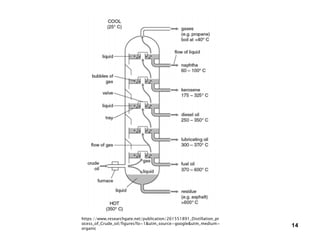
o Fractional distillation:
 The lighter fractions of the evaporated materials collect on the
top tray, and the heavier fractions collect in successive trays,
with the heaviest residue containing asphalt remaining at the
bottom of the distillation tower.
 The products obtained during this first phase of separation are
gasoline, kerosene distillate; diesel fuel, lubricating oils, and
the heavy residual material that contains the asphalt.
 The various fractions collected are stored and refined further
into specific grades of petroleum products.
 Note that a desired consistency of residue can be obtained by
continuing the distillation process.
14
https://www.researchgate.net/publication/261551891_Distillation_pr
ocess_of_Crude_oil/figures?lo=1&utm_source=google&utm_medium=
organic
Refining Processes
o Destructive distillation :
The destructive distillation processes involve the
application of high temperature and pressure,
resulting in chemical changes.
The asphalt obtained from cracking is not used widely
in paving, because it is more susceptible to weather
changes than that produced from fractional
Modified Bitumen
o Certain additives or blend of additives called as
bitumen modifiers can improve properties of
Bitumen and bituminous mixes. Bitumen treated
with these modifiers is known as modified bitumen.
o Polymer modified bitumen (PMB)/ crumb rubber
modified bitumen (CRMB) should be used only in
wearing course depending upon the requirements of
extreme climatic variations.
o The detailed specifications for modified bitumen
have been issued by IRC: SP: 53-1999.
Modified Bitumen
o It must be noted that the performance of PMB and CRMB is
dependent on strict control on temperature during construction.
The advantages of using modified bitumen are as follows
o Lower susceptibility to daily and seasonal temperature
variations
o Higher resistance to deformation at high pavement
temperature
o Better age resistance properties
o Higher fatigue life for mixes
o Better adhesion between aggregates and binder
o Prevention of cracking and reflective cracking
Advantage of Cutback and Emulsions
o Heating eliminated, saving in cost of labour, fuel,
time of construction
o Sets early so road can be opened for traffic
o Emulsion can be applied to wet surface also
o Disadvantage: Extra cost, bitumen % less, quality
and durability affected. Used for emergency and
repair work
o Tar Grades: RT1, RT2, RT3. RT4, RT5
o Cutback grades: Light, Medium, heavy
Cutback and Emulsions
o RT1 used for extreme cold weather, RT2 for normal
climate, RT3 for renewal of surface, RT4 for bituminous
concrete, RT5 for Penetration mix
o RC is recommended for surface dressing and
patchwork. MC is recommended for premix with less
quantity of fine aggregates. SC is used for premix with
appreciable quantity of fine aggregates.
o Bitumen emulsions are ideal binders for hill road
construction. Where heating of bitumen or aggregates
are difficult. Slow setting emulsions are preferred in
rainy season.
Cutback
o Slow-Curing Asphalts
 Slow-curing (SC) asphalts can be obtained directly as
slow-curing straight run asphalts through the
distillation of crude petroleum or as slow-curing
cutback asphalts by “cutting back” asphalt cement
with a heavy distillate, such as diesel oil.
 They have lower viscosities than asphalt cement and
are very slow to harden.
Cutback
o Medium-Curing Cutback Asphalts
 Medium-curing (MC) asphalts are produced by
fluxing, or cutting back, the residual asphalt (usually
120 to 150 penetration) with light fuel oil or
kerosene.
 The term medium refers to the medium volatility of
the kerosene-type diluter used.
 Medium- curing cutback asphalts harden faster than
slow-curing liquid asphalts.
Cutback
o Rapid-Curing Cutback Asphalts
 Rapid-curing (RC) cutback asphalts are produced by
blending asphalt cement with a petroleum distillate
that will evaporate easily
 facilitating a quick change from the liquid form at
the time of application to the consistency of the
original asphalt cement.
 Gasoline or naphtha generally is used as the solvent
for this series of asphalts.
Emulsions
o Emulsified asphalts are produced by breaking asphalt,
usually of 100 to 250 penetration range, into minute
particles and dispersing them in water with an emulsifier.
o These minute particles have like-electrical charges and
therefore do not coalesce. They remain in suspension in
the liquid phase as long as the water does not evaporate
or the emulsifier does not break.
o Asphalt emulsions therefore consist of asphalt, which
makes up about 55 to 70 percent by weight, water, and
an emulsifying agent, which in some cases also may
contain a stabilizer.
Emulsions
o Emulsified asphalts are used in cold-laid plant mixes and
road mixes (mixed-in-place) for several purposes,
including the construction of highway pavement surfaces
and bases and in surface treatments.
Tar
o Tar Grades: RT1, RT2, RT3. RT4, RT5
o RT-1 has the lightest consistency and can be used
effectively at normal temperatures for prime or tack coat.
The viscosity of each grade increases as the number
designation increases to RT-5, which is the most viscous.
Tests on Bitumen
o Penetration Test: to know the grade
o Softening Point Test: decide suitability
o Flash / Fire Point: control heating
o Viscosity Test: Coating, mixing properties
o Ductility Test: binding power, cohesion, shock
o Specific Gravity: Identification, mix design
o Water % Test: Foaming, loss in strength
o Loss on heating: Composition, purity
o Solubility Test: Impurities, identification
Bituminous Mixes
o Similar to concrete mix, mixture of aggregate and
binder
o Properties depend on friction of aggregate, type
and proportion of binder, type and grading of
aggregate, mixing and compaction
o Desirable Properties are:
Stability, Durability, Skid resistance, Flexibility,
Workability, Economy
o Marshall or Hubbard Test used to design mix
Department Of Civil Engineering
Walchand College of Engineering
Sangli-416415 (Maharashtra)
28

1A_Highway_Material1.pdf

  • 1.
    Department Of CivilEngineering Walchand College of Engineering Sangli-416415 (Maharashtra) 1 5 August 2023 Highway Materials and Testing
  • 2.
    Highway Materials andTesting Materials used for Road Construction Soil : earth, gravel, murum Aggregates : Sand, Gravel, Stone chips, Bricks Binders : Water, Lime, Cement, Bitumen
  • 3.
    Necessity and Importance oBefore using the materials in construction it is necessary to check the properties of to know: o Quality o Suitability o To prevent the faults in the construction like o Cracking, Waves, Corrugations, Potholes o To maintain the road in good, serviceable and working condition
  • 4.
    Soils o Unconsolidated mineralmatter of earths surface o Types and properties are studied in Soil Mechanics o Importance o Gives adequate support to road structure o Give stability to road surface o Provide for drainage of rainwater
  • 5.
    Desirable Properties w.r. t. Roads o Stability: Resistance to deformation (More) o Incompressibility: Change in volume with Load ( minimum) o Durability: Resistance to Weathering (more) o Permeability: Drainage of rain water (Quick) o Ease of Compaction: Should get easily compacted. Important Tests: o Shear Test, Bearing Test, Permeability Test
  • 6.
    Aggregates Inert mineral fragments oCrushed stone aggregates: Derived from rocks like basalt, granite, lime stone, sand stone.. Quarried, crushed to different sizes o Gravel: rounded smooth particles above 4.75 mm size found in water stream bed o Sand : Angular, irregular or rounded loose grains of Silica < 4.75 mm o Slag: blast furnace product
  • 7.
    Importance and Tests Majorconstituent of road structure, Desired Properties o Hardness: resist to abrasion o Toughness: resistance to dynamic loads o Durability: resistance to weathering o Strength: resistance to static load o Cementation: capacity to bind with themselves o Adhesiveness: Capacity to stick to binders o Water absorption: moisture absorption o Specific Gravity: Adequate o Size and shape: angular, irregular not flakey
  • 8.
    Important Laboratory Tests oAbrasion Test : Hardness o Impact Test : Toughness o Crushing Test : Strength o Bitumen Adhesion Test
  • 9.
    Binders Materials used tobind aggregates together o Cement o Lime o Bitumen o Cement Fills the gaps between aggregate particles and binds them together into a solid, strong and impermeable mass. o Important tests are: Fineness Test, Setting Time Test, Compressive strength test, Soundness Test
  • 10.
    Bitumen o Basically itis a hydrocarbon material which is completely soluble in carbon-di-sulphide CS2 o It is a binding constituent in natural asphalt hence also known as asphalt bitumen o It is also obtained from the simple or fractional distillation of crude petroleum o It is solid / semisolid, black or browinish black, gets softened by heat, has adhesiveness o After melting, distinct odour, soluble in CCl4 o Bitumen with inert material or minerals - asphalt. o Paving Grade and Industrial grade (water proofing)
  • 11.
    Types of BituminousMaterials o Asphalt: o Natural: Obtained as Native Asphalt or Rock Asphalt o Native – occurs in Pure state in nature o Rock – Native asphalt with mineral matters o Artificial: Obtained from fractional distilln of Petroleum o Tar: Obtained from destructive distillation of organic matter like wood or coal. Viscous, jet-black, cheaper o Cutback: Solution of asphalt or tar in volatile solvent like flux oil, gasoline, kerosene, creosote oils. Requires little or no heating. o Emulsion: Mixture of bitumen and water in presence of emulsifying agent like soap or resin
  • 12.
    Refining Processes o Fractionaldistillation: The fractional distillation processes involve the separation of the different materials in the crude petroleum without significant changes in the chemical composition of each material. The fractional distillation process removes the different volatile materials in the crude oil at successively higher temperatures until the petroleum asphalt is obtained as residue. Steam or a vacuum is used to gradually increase the temperature.
  • 13.
    Refining Processes o Fractionaldistillation:  The lighter fractions of the evaporated materials collect on the top tray, and the heavier fractions collect in successive trays, with the heaviest residue containing asphalt remaining at the bottom of the distillation tower.  The products obtained during this first phase of separation are gasoline, kerosene distillate; diesel fuel, lubricating oils, and the heavy residual material that contains the asphalt.  The various fractions collected are stored and refined further into specific grades of petroleum products.  Note that a desired consistency of residue can be obtained by continuing the distillation process.
  • 14.
  • 15.
    Refining Processes o Destructivedistillation : The destructive distillation processes involve the application of high temperature and pressure, resulting in chemical changes. The asphalt obtained from cracking is not used widely in paving, because it is more susceptible to weather changes than that produced from fractional
  • 16.
    Modified Bitumen o Certainadditives or blend of additives called as bitumen modifiers can improve properties of Bitumen and bituminous mixes. Bitumen treated with these modifiers is known as modified bitumen. o Polymer modified bitumen (PMB)/ crumb rubber modified bitumen (CRMB) should be used only in wearing course depending upon the requirements of extreme climatic variations. o The detailed specifications for modified bitumen have been issued by IRC: SP: 53-1999.
  • 17.
    Modified Bitumen o Itmust be noted that the performance of PMB and CRMB is dependent on strict control on temperature during construction. The advantages of using modified bitumen are as follows o Lower susceptibility to daily and seasonal temperature variations o Higher resistance to deformation at high pavement temperature o Better age resistance properties o Higher fatigue life for mixes o Better adhesion between aggregates and binder o Prevention of cracking and reflective cracking
  • 18.
    Advantage of Cutbackand Emulsions o Heating eliminated, saving in cost of labour, fuel, time of construction o Sets early so road can be opened for traffic o Emulsion can be applied to wet surface also o Disadvantage: Extra cost, bitumen % less, quality and durability affected. Used for emergency and repair work o Tar Grades: RT1, RT2, RT3. RT4, RT5 o Cutback grades: Light, Medium, heavy
  • 19.
    Cutback and Emulsions oRT1 used for extreme cold weather, RT2 for normal climate, RT3 for renewal of surface, RT4 for bituminous concrete, RT5 for Penetration mix o RC is recommended for surface dressing and patchwork. MC is recommended for premix with less quantity of fine aggregates. SC is used for premix with appreciable quantity of fine aggregates. o Bitumen emulsions are ideal binders for hill road construction. Where heating of bitumen or aggregates are difficult. Slow setting emulsions are preferred in rainy season.
  • 20.
    Cutback o Slow-Curing Asphalts Slow-curing (SC) asphalts can be obtained directly as slow-curing straight run asphalts through the distillation of crude petroleum or as slow-curing cutback asphalts by “cutting back” asphalt cement with a heavy distillate, such as diesel oil.  They have lower viscosities than asphalt cement and are very slow to harden.
  • 21.
    Cutback o Medium-Curing CutbackAsphalts  Medium-curing (MC) asphalts are produced by fluxing, or cutting back, the residual asphalt (usually 120 to 150 penetration) with light fuel oil or kerosene.  The term medium refers to the medium volatility of the kerosene-type diluter used.  Medium- curing cutback asphalts harden faster than slow-curing liquid asphalts.
  • 22.
    Cutback o Rapid-Curing CutbackAsphalts  Rapid-curing (RC) cutback asphalts are produced by blending asphalt cement with a petroleum distillate that will evaporate easily  facilitating a quick change from the liquid form at the time of application to the consistency of the original asphalt cement.  Gasoline or naphtha generally is used as the solvent for this series of asphalts.
  • 23.
    Emulsions o Emulsified asphaltsare produced by breaking asphalt, usually of 100 to 250 penetration range, into minute particles and dispersing them in water with an emulsifier. o These minute particles have like-electrical charges and therefore do not coalesce. They remain in suspension in the liquid phase as long as the water does not evaporate or the emulsifier does not break. o Asphalt emulsions therefore consist of asphalt, which makes up about 55 to 70 percent by weight, water, and an emulsifying agent, which in some cases also may contain a stabilizer.
  • 24.
    Emulsions o Emulsified asphaltsare used in cold-laid plant mixes and road mixes (mixed-in-place) for several purposes, including the construction of highway pavement surfaces and bases and in surface treatments.
  • 25.
    Tar o Tar Grades:RT1, RT2, RT3. RT4, RT5 o RT-1 has the lightest consistency and can be used effectively at normal temperatures for prime or tack coat. The viscosity of each grade increases as the number designation increases to RT-5, which is the most viscous.
  • 26.
    Tests on Bitumen oPenetration Test: to know the grade o Softening Point Test: decide suitability o Flash / Fire Point: control heating o Viscosity Test: Coating, mixing properties o Ductility Test: binding power, cohesion, shock o Specific Gravity: Identification, mix design o Water % Test: Foaming, loss in strength o Loss on heating: Composition, purity o Solubility Test: Impurities, identification
  • 27.
    Bituminous Mixes o Similarto concrete mix, mixture of aggregate and binder o Properties depend on friction of aggregate, type and proportion of binder, type and grading of aggregate, mixing and compaction o Desirable Properties are: Stability, Durability, Skid resistance, Flexibility, Workability, Economy o Marshall or Hubbard Test used to design mix
  • 28.
    Department Of CivilEngineering Walchand College of Engineering Sangli-416415 (Maharashtra) 28