BIRLA VISHVAKARMA MAHAVIDYALAYA
ENGINEERING COLLEGE, VALLABH VIDYANAGAR
Highway Material and Testing
Crumb Rubber Modified Bitumen
Submitted By:
Shah Bhavik Ashokbhai
(Id No. : 17TS809)
1st Sem M.Tech -
Transportation Engineering
Guided by:
Prof. Amit A. Amin
1
Crumb Rubber Modified Bitumen
2
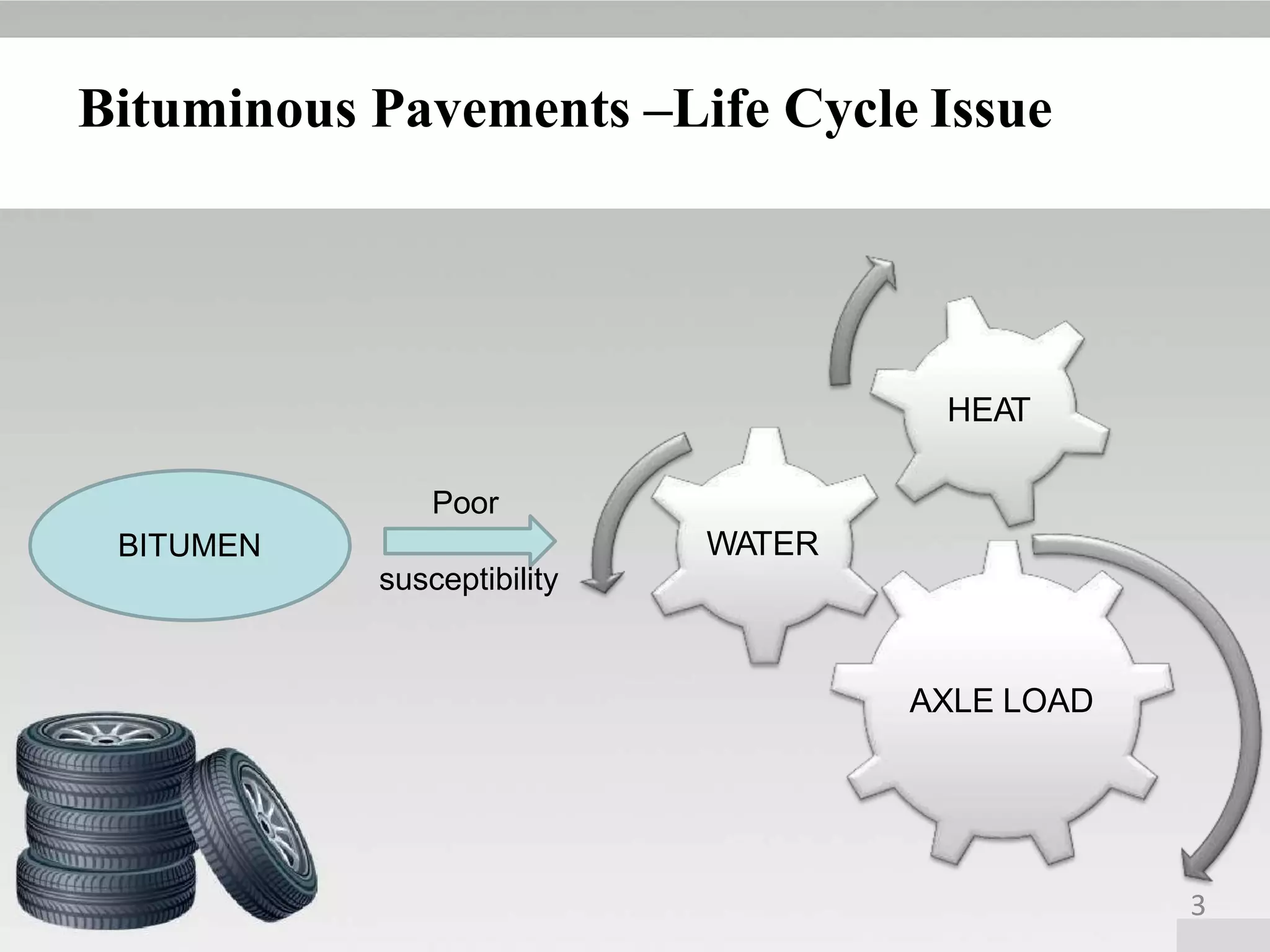
Bituminous Pavements –Life Cycle Issue
AXLE LOAD
WATER
HEAT
BITUMEN
Poor
susceptibility
3
Solution is
MODIFIED BITUMEN
MODIFIER BITUMEN
4
MODIFIERS
• Crumb rubber
The scrap tyre is shredded into small pieces
by the help of mechanical blades up to sizes
of 1mm-75µm.
5
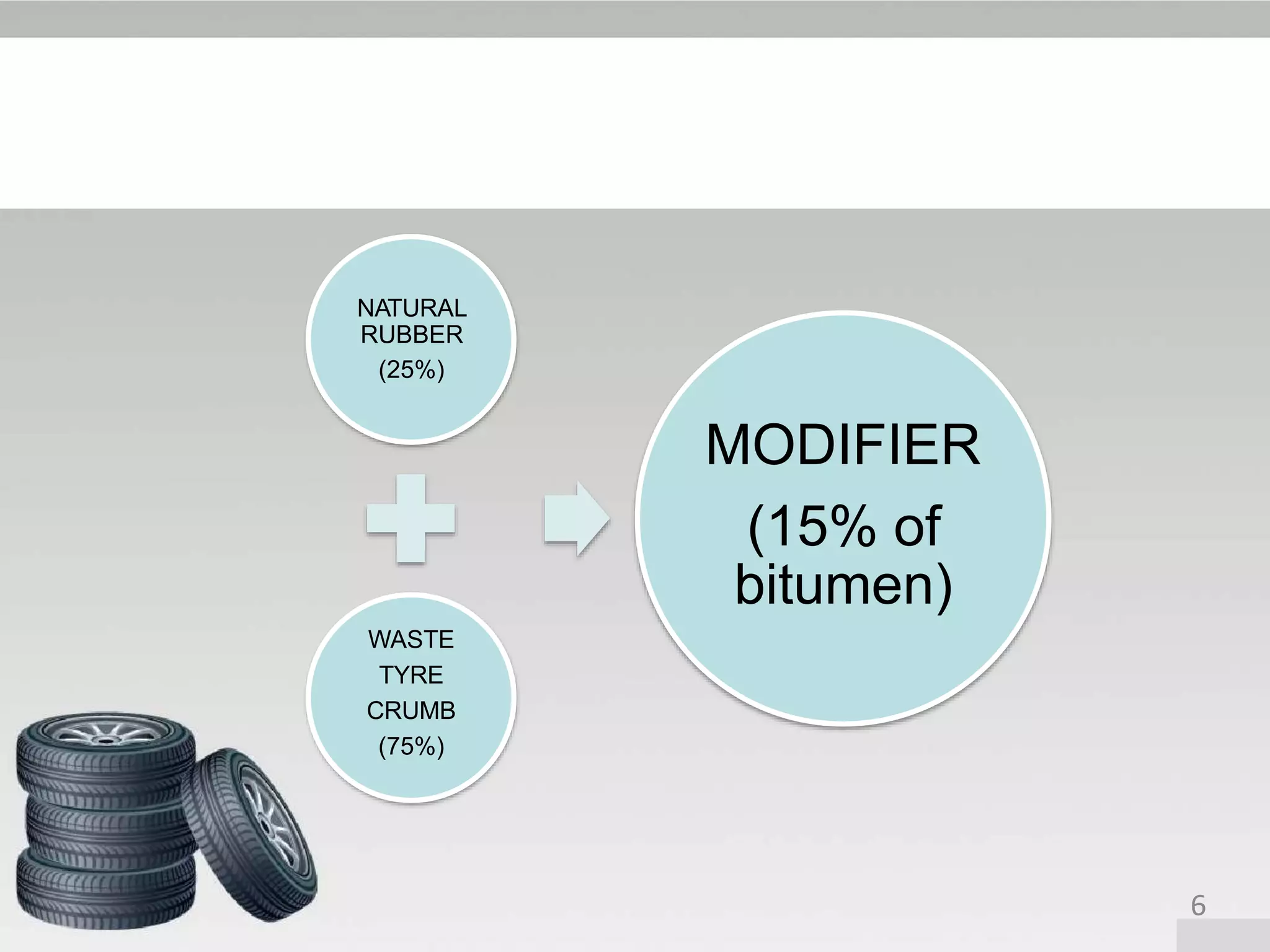
NATURAL
RUBBER
(25%)
WASTE
TYRE
CRUMB
(75%)
MODIFIER
(15% of
bitumen)
6
CRMB Development
• Charles McDonald ,an engineer with City of Phoenix,
Arizona, US developed in 1960s.
7
Source of Crumb Rubber
• Crumb rubber is obtained from truck or automobile tyres .
• Whole truck tyres contain 18 % natural rubber compared to 9
percent in automobile tyre.
8
Production method
• It is produced from discarded rubber by two methods:-
a) Ambient grinding
b) Cryogenic grinding
9
Ambient Grinding
• Processed at or above ordinary room temperature
• Produces irregularly shaped ,torn particles with relatively large
surface area
10
Cryogenic Grinding
• This process uses liquid Nitrogen to freeze CR.
• It has relatively lower surface area.
11
Method of mixing of CR in Bitumen
a) Dry process
b) Wet process
12
Dry Process
• Introduced by two Swedish company
a part of mineral• Crumb rubber as a substitute for
aggregate
13
Wet Process
• Thoroughly mixing crumbs of CR with bitumen and allowing
it to react for a period of 45min-1 hour.
• High temperature should be maintained.
14
15
CR-interaction Process
16
Comparison
Characteristic VG 10 VG 30 VG 40 CRMB-50 CRMB-55 CRMB-60
Penetration at 25º C,
(0.1 mm, 100g, 5
Sec.)
80-100 50-70 40-60 < 70 < 60 < 50
Softening Point, ºC
(R&B), Minimum 40 47 50 50 55 60
Flash Point, COC
ºC, Min 220 220 220 220 220 220
17
Waste tyre crumb for roads
• Globally over 15 million tones of waste tyres are
generated, annually.
• India also contributes approx. 1 million tyres annually.
• If Waste tyre crumb is to be used with bitumen for wearing
course, an approx. 250 no's of tyre waste can be consumed
in roads every day or 100,000 no's of waste tyre annually .
18
Advantages
• Lower susceptibility to daily & seasonal temperature
variations.
• Higher resistance to deformation at elevated pavement
temperature.
• Better adhesion between aggregates & binder.
• Prevention of cracking & reflective cracking.
• Overall improved performance under heavy traffic conditions.
19
Disadvantages
• The bitumen-rubber materials must be properly selected ,
designed & produced .
• Construction is more challenging as temperature requirement
are more critical.
• It is not possible to store CR-MB at elevated temperature
without equipping storage tanks with augurs.
20
Quality control requirements
• CRMB producer must obtain the viscosity curve for mix if the
source of bitumen and/or crumb rubber changes.
• It should be agitated continuously.
• Compaction of asphalt mix containing CRMB should begin
promptly to adequate compaction of pavement.
• Pneumatic- tyred rollers tend to pick up the asphalt mix
containing CRMB and therefore , should not be used.
21
References
• “A Study on the Performance of Crumb Rubber Modified Bitumen
by Varying the Sizes of Crumb Rubber” by Nabin Rana Magar.
• “Quality control requirement for using crumb rubber modified
bitumen(CRMB) in bituminous mixtures” by Prithvi Singh kandhal.
• “Recycled tyre rubber modified bitumens for road asphalt mixtures
:A literature review” by Davide Lo Presti.
• “Laboratory comparison of the crumb-rubber and SBS modified
bitumen and hot mix asphalt” by Baha Vural Köka , Hakan Çolak.
22
23

Crumb rubber modified bitumen

  • 1.
    BIRLA VISHVAKARMA MAHAVIDYALAYA ENGINEERINGCOLLEGE, VALLABH VIDYANAGAR Highway Material and Testing Crumb Rubber Modified Bitumen Submitted By: Shah Bhavik Ashokbhai (Id No. : 17TS809) 1st Sem M.Tech - Transportation Engineering Guided by: Prof. Amit A. Amin 1
  • 2.
  • 3.
    Bituminous Pavements –LifeCycle Issue AXLE LOAD WATER HEAT BITUMEN Poor susceptibility 3
  • 4.
  • 5.
    MODIFIERS • Crumb rubber Thescrap tyre is shredded into small pieces by the help of mechanical blades up to sizes of 1mm-75µm. 5
  • 6.
  • 7.
    CRMB Development • CharlesMcDonald ,an engineer with City of Phoenix, Arizona, US developed in 1960s. 7
  • 8.
    Source of CrumbRubber • Crumb rubber is obtained from truck or automobile tyres . • Whole truck tyres contain 18 % natural rubber compared to 9 percent in automobile tyre. 8
  • 9.
    Production method • Itis produced from discarded rubber by two methods:- a) Ambient grinding b) Cryogenic grinding 9
  • 10.
    Ambient Grinding • Processedat or above ordinary room temperature • Produces irregularly shaped ,torn particles with relatively large surface area 10
  • 11.
    Cryogenic Grinding • Thisprocess uses liquid Nitrogen to freeze CR. • It has relatively lower surface area. 11
  • 12.
    Method of mixingof CR in Bitumen a) Dry process b) Wet process 12
  • 13.
    Dry Process • Introducedby two Swedish company a part of mineral• Crumb rubber as a substitute for aggregate 13
  • 14.
    Wet Process • Thoroughlymixing crumbs of CR with bitumen and allowing it to react for a period of 45min-1 hour. • High temperature should be maintained. 14
  • 15.
  • 16.
  • 17.
    Comparison Characteristic VG 10VG 30 VG 40 CRMB-50 CRMB-55 CRMB-60 Penetration at 25º C, (0.1 mm, 100g, 5 Sec.) 80-100 50-70 40-60 < 70 < 60 < 50 Softening Point, ºC (R&B), Minimum 40 47 50 50 55 60 Flash Point, COC ºC, Min 220 220 220 220 220 220 17
  • 18.
    Waste tyre crumbfor roads • Globally over 15 million tones of waste tyres are generated, annually. • India also contributes approx. 1 million tyres annually. • If Waste tyre crumb is to be used with bitumen for wearing course, an approx. 250 no's of tyre waste can be consumed in roads every day or 100,000 no's of waste tyre annually . 18
  • 19.
    Advantages • Lower susceptibilityto daily & seasonal temperature variations. • Higher resistance to deformation at elevated pavement temperature. • Better adhesion between aggregates & binder. • Prevention of cracking & reflective cracking. • Overall improved performance under heavy traffic conditions. 19
  • 20.
    Disadvantages • The bitumen-rubbermaterials must be properly selected , designed & produced . • Construction is more challenging as temperature requirement are more critical. • It is not possible to store CR-MB at elevated temperature without equipping storage tanks with augurs. 20
  • 21.
    Quality control requirements •CRMB producer must obtain the viscosity curve for mix if the source of bitumen and/or crumb rubber changes. • It should be agitated continuously. • Compaction of asphalt mix containing CRMB should begin promptly to adequate compaction of pavement. • Pneumatic- tyred rollers tend to pick up the asphalt mix containing CRMB and therefore , should not be used. 21
  • 22.
    References • “A Studyon the Performance of Crumb Rubber Modified Bitumen by Varying the Sizes of Crumb Rubber” by Nabin Rana Magar. • “Quality control requirement for using crumb rubber modified bitumen(CRMB) in bituminous mixtures” by Prithvi Singh kandhal. • “Recycled tyre rubber modified bitumens for road asphalt mixtures :A literature review” by Davide Lo Presti. • “Laboratory comparison of the crumb-rubber and SBS modified bitumen and hot mix asphalt” by Baha Vural Köka , Hakan Çolak. 22
  • 23.