 NAME – KAPTAN SAGAR R
 ENROLLMENT NO. – 130140106021
 SUB. – HIGHWAY ENGINEERING
 TOPIC – SUBGRADE SOIL STRENGTH AND
ITS EVALUTION
SUBGRADE SOIL STRENGTH
AND ITS EVALUTION
SUBGRADE SOIL STRENGTH
The factors on which the strength characteristics
of soil depend are :
1. Type of soil
2. Moisture content
3. Dry density
4. Internal structure of the soil
5. The type and mode of stress application
it is very difficult to predict the stress-strain
relationship of soil, because of the diversity in the soil
types and non–homogenous nature of the soil. Generally ,
the highway engineer is interested in the stability or the
deformation of the soil under the stress applications.
In a soil mass, the deformation is largely due to
slippage between soil particles. Hence the shearing
resistance in soil represents the strength. The sliding
mechanism in soils is complicated as the shear
deformation cause reorientation of the particles resulting
in change in volume. Valence bond between particles,
thickness and other properties of adsorbed layer of water.
Shearing resistance in soil mass is commonly
attributed to internal friction and cohesion parameters of
the soil. Coulomb (1776), in his investigations observed
that one component of the shearing strength called
apparent cohesion is constant for given soil and is
independent of the applied stress. The other component
namely, the frictional resistance, varies directly as the
magnitude of the normal stress on the plane of rupture.
The shear strength (S) of a soil at a point on a
particular plane was expressed by coulomb as liner
function of the normal stress on that plane as
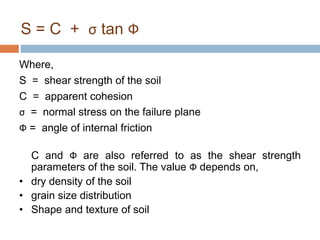
S = C + σ tan Ф ........ Coulomb’s equation
Where,
S = shear strength of the soil
C = apparent cohesion
σ = normal stress on the failure plane
Ф = angle of internal friction
S = C + σ tan Ф
C and Ф are also referred to as the shear strength
parameters of the soil. The value Ф depends on,
• dry density of the soil
• grain size distribution
• Shape and texture of soil
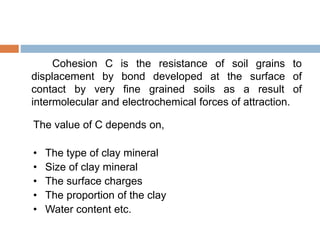
Cohesion C is the resistance of soil grains to
displacement by bond developed at the surface of
contact by very fine grained soils as a result of
intermolecular and electrochemical forces of attraction.
The value of C depends on,
• The type of clay mineral
• Size of clay mineral
• The surface charges
• The proportion of the clay
• Water content etc.
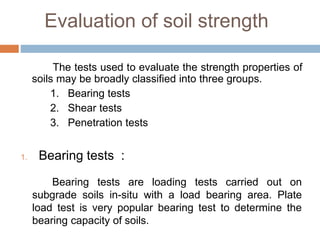
Evaluation of soil strength
The tests used to evaluate the strength properties of
soils may be broadly classified into three groups.
1. Bearing tests
2. Shear tests
3. Penetration tests
1. Bearing tests :
Bearing tests are loading tests carried out on
subgrade soils in-situ with a load bearing area. Plate
load test is very popular bearing test to determine the
bearing capacity of soils.
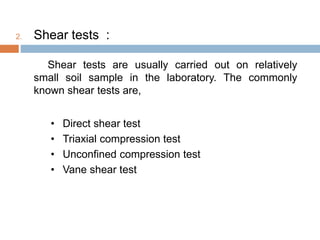
2. Shear tests :
Shear tests are usually carried out on relatively
small soil sample in the laboratory. The commonly
known shear tests are,
• Direct shear test
• Triaxial compression test
• Unconfined compression test
• Vane shear test
3. Penetration tests :
Penetration test may be considered as small scale
bearing tests in which the size of the loaded area is
relatively small. These tests are carried out in the field
or in the laboratory.
The commonly known penetration tests are,
• The California bearing ratio test
• Cone penetration tests.
SUBGRADE SOIL STRENGTH AND ITS EVALUTION

SUBGRADE SOIL STRENGTH AND ITS EVALUTION

  • 1.
     NAME –KAPTAN SAGAR R  ENROLLMENT NO. – 130140106021  SUB. – HIGHWAY ENGINEERING  TOPIC – SUBGRADE SOIL STRENGTH AND ITS EVALUTION
  • 2.
  • 3.
    SUBGRADE SOIL STRENGTH Thefactors on which the strength characteristics of soil depend are : 1. Type of soil 2. Moisture content 3. Dry density 4. Internal structure of the soil 5. The type and mode of stress application
  • 4.
    it is verydifficult to predict the stress-strain relationship of soil, because of the diversity in the soil types and non–homogenous nature of the soil. Generally , the highway engineer is interested in the stability or the deformation of the soil under the stress applications. In a soil mass, the deformation is largely due to slippage between soil particles. Hence the shearing resistance in soil represents the strength. The sliding mechanism in soils is complicated as the shear deformation cause reorientation of the particles resulting in change in volume. Valence bond between particles, thickness and other properties of adsorbed layer of water.
  • 5.
    Shearing resistance insoil mass is commonly attributed to internal friction and cohesion parameters of the soil. Coulomb (1776), in his investigations observed that one component of the shearing strength called apparent cohesion is constant for given soil and is independent of the applied stress. The other component namely, the frictional resistance, varies directly as the magnitude of the normal stress on the plane of rupture. The shear strength (S) of a soil at a point on a particular plane was expressed by coulomb as liner function of the normal stress on that plane as S = C + σ tan Ф ........ Coulomb’s equation
  • 6.
    Where, S = shearstrength of the soil C = apparent cohesion σ = normal stress on the failure plane Ф = angle of internal friction S = C + σ tan Ф C and Ф are also referred to as the shear strength parameters of the soil. The value Ф depends on, • dry density of the soil • grain size distribution • Shape and texture of soil
  • 7.
    Cohesion C isthe resistance of soil grains to displacement by bond developed at the surface of contact by very fine grained soils as a result of intermolecular and electrochemical forces of attraction. The value of C depends on, • The type of clay mineral • Size of clay mineral • The surface charges • The proportion of the clay • Water content etc.
  • 8.
    Evaluation of soilstrength The tests used to evaluate the strength properties of soils may be broadly classified into three groups. 1. Bearing tests 2. Shear tests 3. Penetration tests 1. Bearing tests : Bearing tests are loading tests carried out on subgrade soils in-situ with a load bearing area. Plate load test is very popular bearing test to determine the bearing capacity of soils.
  • 9.
    2. Shear tests: Shear tests are usually carried out on relatively small soil sample in the laboratory. The commonly known shear tests are, • Direct shear test • Triaxial compression test • Unconfined compression test • Vane shear test
  • 10.
    3. Penetration tests: Penetration test may be considered as small scale bearing tests in which the size of the loaded area is relatively small. These tests are carried out in the field or in the laboratory. The commonly known penetration tests are, • The California bearing ratio test • Cone penetration tests.