DIAZEPAM POISONING 
Dr.Renju S Ravi
Diazepam overdose describes the ingestion of diazepam in 
quantities greater than are recommended or generally 
practiced. 
Death as a result of taking an excessive dose of diazepam alone 
is uncommon (vs Combined drug intoxicaton). 
Combinations of high doses of benzodiazepines with 
alcohol, barbiturates, opioids or tricyclic antidepressants are 
particularly dangerous, and may lead to severe complications 
such as coma or death.
 SIGNS AND SYMPTOMS 
 rapid with most developing symptoms within 4 hours. 
 Patients initially present with mild to moderate impairment of CNS function. 
 Initial signs and symptoms include somnolence, diplopia, impaired balance, 
impaired motor function, anterograde amnesia, ataxia, and 
slurred speech. 
 Paradoxical reactions such as anxiety, delirium, hallucinations, and 
aggression .
 GI symptoms such as nausea and vomiting have also been occasionally 
reported. 
 Severe overdose can lead to prolonged deep coma , apnea, respiratory 
depression, hypothermia, hypotension, bradycardia, cardiac arrest, 
and pulmonary aspiration. 
 Symptoms such as sleepiness, agitation and ataxia occur much more 
frequently and severely in children. Hypotonia may also occur.
 TOXICITY 
 Benzodiazepines have a wide therapeutic index and taken alone 
in overdose rarely cause severe complications or fatalities. Taken in overdose 
in combination with alcohol, barbiturates, opioids, tricyclic antidepressants, 
etc are particularly dangerous. 
 In the case of alcohol and barbiturates, not only do they have an additive 
effect but they also increase the binding affinity of benzodiazepines to the 
benzodiazepine binding site, which results in a very significant potentiation of 
the CNS and respiratory depressant effects. 
 Elderly and those with chronic illnesses are much more vulnerable to lethal 
overdose with benzodiazepines.
 PATHOPHYSIOLOGY 
 Benzodiazepines bind to a specific benzodiazepine receptor, 
thereby enhancing the effect of the neurotransmitter gamma-aminobutyric 
acid (GABA) and causing CNS depression. 
In overdose situations this pharmacological effect is extended leading to a 
more severe CNS depression and potentially coma or cardiac arrest.
Benzodiazepine overdose related coma may be characterised by an alpha 
pattern with the central somatosensory conduction time (CCT). 
Brain-stem auditory evoked potentials demonstrate delayed interpeak latencies 
(IPLs) I-III, III-V and I-V. 
Toxic overdoses therefore of benzodiazepines cause prolonged CCT and IPLs.
 DIAGNOSIS 
 Diagnosis is based on the clinical presentation of the patient along with a 
history of overdose. 
 Obtaining a laboratory test for Diazepam blood concentrations can be useful 
in patients presenting with CNS depression or coma of unknown origin. 
 Techniques available to measure blood concentrations include: 
thin layer chromatography 
gas liquid chromatography 
radioimmunoassay.
TREATMENT 
Medical observation and supportive care are the mainstay of treatment of 
Diazepam overdose. 
Although benzodiazepines are absorbed by activated charcoal, It is 
recommended only if the drug has been taken in combination with other 
drugs that may benefit from decontamination. 
Gastric lavage or whole bowel irrigation are also not recommended. 
Enhancing elimination of the drug with hemodialysis, hemoperfusion, 
or forced diuresis is unlikely to be beneficial due to their large Vd and lipid 
solubility .
 SUPPORTIVE MEASURES 
 Supportive measures include observation of vital signs, especially Glasgow 
Coma Scale and airway patency. 
 Supportive measures should be put in place prior to administration of any 
benzodiazepine antagonist in order to protect the patient from both the 
withdrawal effects and possible complications arising from the 
benzodiazepine.
 IV fluid administration and maintenance of the airway with intubation and 
artificial ventilation may be required if respiratory depression or pulmonary 
aspiration occurs. 
 Hypotension is corrected with fluid replacement, 
although catecholamines such as norepinephrine or dopamine may be 
required to increase BP. 
 Bradycardia is treated with atropine or an infusion of norepinephrine to 
increase coronary blood flow and heart rate.
 FLUMAZENIL 
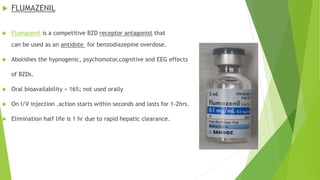
 Flumazenil is a competitive BZD receptor antagonist that 
can be used as an antidote for benzodiazepine overdose. 
 Abolishes the hypnogenic, psychomotor,cognitive and EEG effects 
of BZDs. 
 Oral bioavailability ≈ 16%; not used orally 
 On I/V injection ,action starts within seconds and lasts for 1-2hrs. 
 Elimination half life is 1 hr due to rapid hepatic clearance.
 A/E – Agitation, confusion ,anxiety, tremor, withdrawal seizures etc.. 
 Dose- 0.2 mg/min injected I/V till the patient regains consciousness. 
 Contraindications : 
-patients who are on long-term benzodiazepines. 
-those who have ingested a substance that lowers the seizure threshold. 
-in patients who have tachycardia. 
-widened QRS complex on ECG. 
-anticholinergic signs. 
-history of seizures.
 Due to these contraindications and the possibility of it causing severe adverse 
effects , in the majority of cases there is no indication for the use of 
flumazenil in the management of benzodiazepine overdose as the risks in 
general outweigh any potential benefit of administration. 
 It also has no role in the management of unknown overdoses. 
 In addition, if full airway protection has been achieved, a good outcome is 
expected, and therefore flumazenil administration is unlikely to be required.
 Flumazenil is very effective at reversing the CNS depression associated with 
benzodiazepines but is less effective at reversing respiratory depression. 
 Studies found that only 10% of the patient population presenting with a 
benzodiazepine overdose are suitable candidates for flumazenil. 
 Due to its short half life, the duration of action of flumazenil is usually less 
than 1 hour, and multiple doses may be needed. 
 When flumazenil is indicated the risks can be reduced or avoided by slow 
dose titration of flumazenil.
Diazepam poisoning

Diazepam poisoning

  • 1.
  • 2.
    Diazepam overdose describesthe ingestion of diazepam in quantities greater than are recommended or generally practiced. Death as a result of taking an excessive dose of diazepam alone is uncommon (vs Combined drug intoxicaton). Combinations of high doses of benzodiazepines with alcohol, barbiturates, opioids or tricyclic antidepressants are particularly dangerous, and may lead to severe complications such as coma or death.
  • 3.
     SIGNS ANDSYMPTOMS  rapid with most developing symptoms within 4 hours.  Patients initially present with mild to moderate impairment of CNS function.  Initial signs and symptoms include somnolence, diplopia, impaired balance, impaired motor function, anterograde amnesia, ataxia, and slurred speech.  Paradoxical reactions such as anxiety, delirium, hallucinations, and aggression .
  • 4.
     GI symptomssuch as nausea and vomiting have also been occasionally reported.  Severe overdose can lead to prolonged deep coma , apnea, respiratory depression, hypothermia, hypotension, bradycardia, cardiac arrest, and pulmonary aspiration.  Symptoms such as sleepiness, agitation and ataxia occur much more frequently and severely in children. Hypotonia may also occur.
  • 5.
     TOXICITY Benzodiazepines have a wide therapeutic index and taken alone in overdose rarely cause severe complications or fatalities. Taken in overdose in combination with alcohol, barbiturates, opioids, tricyclic antidepressants, etc are particularly dangerous.  In the case of alcohol and barbiturates, not only do they have an additive effect but they also increase the binding affinity of benzodiazepines to the benzodiazepine binding site, which results in a very significant potentiation of the CNS and respiratory depressant effects.  Elderly and those with chronic illnesses are much more vulnerable to lethal overdose with benzodiazepines.
  • 6.
     PATHOPHYSIOLOGY Benzodiazepines bind to a specific benzodiazepine receptor, thereby enhancing the effect of the neurotransmitter gamma-aminobutyric acid (GABA) and causing CNS depression. In overdose situations this pharmacological effect is extended leading to a more severe CNS depression and potentially coma or cardiac arrest.
  • 7.
    Benzodiazepine overdose relatedcoma may be characterised by an alpha pattern with the central somatosensory conduction time (CCT). Brain-stem auditory evoked potentials demonstrate delayed interpeak latencies (IPLs) I-III, III-V and I-V. Toxic overdoses therefore of benzodiazepines cause prolonged CCT and IPLs.
  • 8.
     DIAGNOSIS Diagnosis is based on the clinical presentation of the patient along with a history of overdose.  Obtaining a laboratory test for Diazepam blood concentrations can be useful in patients presenting with CNS depression or coma of unknown origin.  Techniques available to measure blood concentrations include: thin layer chromatography gas liquid chromatography radioimmunoassay.
  • 9.
    TREATMENT Medical observationand supportive care are the mainstay of treatment of Diazepam overdose. Although benzodiazepines are absorbed by activated charcoal, It is recommended only if the drug has been taken in combination with other drugs that may benefit from decontamination. Gastric lavage or whole bowel irrigation are also not recommended. Enhancing elimination of the drug with hemodialysis, hemoperfusion, or forced diuresis is unlikely to be beneficial due to their large Vd and lipid solubility .
  • 10.
     SUPPORTIVE MEASURES  Supportive measures include observation of vital signs, especially Glasgow Coma Scale and airway patency.  Supportive measures should be put in place prior to administration of any benzodiazepine antagonist in order to protect the patient from both the withdrawal effects and possible complications arising from the benzodiazepine.
  • 11.
     IV fluidadministration and maintenance of the airway with intubation and artificial ventilation may be required if respiratory depression or pulmonary aspiration occurs.  Hypotension is corrected with fluid replacement, although catecholamines such as norepinephrine or dopamine may be required to increase BP.  Bradycardia is treated with atropine or an infusion of norepinephrine to increase coronary blood flow and heart rate.
  • 12.
     FLUMAZENIL Flumazenil is a competitive BZD receptor antagonist that can be used as an antidote for benzodiazepine overdose.  Abolishes the hypnogenic, psychomotor,cognitive and EEG effects of BZDs.  Oral bioavailability ≈ 16%; not used orally  On I/V injection ,action starts within seconds and lasts for 1-2hrs.  Elimination half life is 1 hr due to rapid hepatic clearance.
  • 13.
     A/E –Agitation, confusion ,anxiety, tremor, withdrawal seizures etc..  Dose- 0.2 mg/min injected I/V till the patient regains consciousness.  Contraindications : -patients who are on long-term benzodiazepines. -those who have ingested a substance that lowers the seizure threshold. -in patients who have tachycardia. -widened QRS complex on ECG. -anticholinergic signs. -history of seizures.
  • 14.
     Due tothese contraindications and the possibility of it causing severe adverse effects , in the majority of cases there is no indication for the use of flumazenil in the management of benzodiazepine overdose as the risks in general outweigh any potential benefit of administration.  It also has no role in the management of unknown overdoses.  In addition, if full airway protection has been achieved, a good outcome is expected, and therefore flumazenil administration is unlikely to be required.
  • 15.
     Flumazenil isvery effective at reversing the CNS depression associated with benzodiazepines but is less effective at reversing respiratory depression.  Studies found that only 10% of the patient population presenting with a benzodiazepine overdose are suitable candidates for flumazenil.  Due to its short half life, the duration of action of flumazenil is usually less than 1 hour, and multiple doses may be needed.  When flumazenil is indicated the risks can be reduced or avoided by slow dose titration of flumazenil.