Biosimilars
Sanju Kaladharan;
Dept of Pharmacology,
KMCH College of Pharmacy,
Coimbatore.
Introduction
 Biological medicines are derived from living
cells or organisms and consist of large,
highly complex molecular entities which
may be difficult to characterise.
 Due to the variability of the biological
system and the manufacturing process,
biological medicines may show a certain
degree of variation, even between batches
of the same product
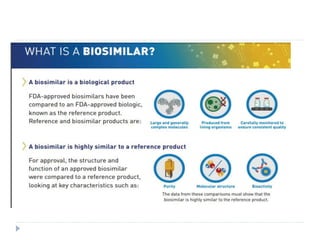
 A biosimilar medicine is a biological medicine that is
developed to be highly similar and clinically equivalent to an
existing biological medicine.
 A biosimilar contains a version of an active substance of an
already approved biological medicine, which is referred to as
the ‘reference medicine’ or ‘originator medicine’.
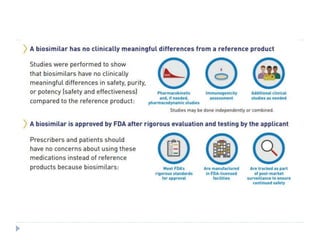
 Similarity to the reference medicine in terms of quality,
structural characteristics, biological activity, safety and efficacy
must be established based on a comprehensive scientific
comparability exercise such that they do not have any
clinically meaningful differences from the reference medicine
in terms of quality, safety and efficacy
Biologic Medicines ?
• Alarge Protein molecule typically derived from livingcells
and used in the treatment or prevention of disease
• Include therapeutic proteins, DNA,monoclonal antibodies
and fusion proteins.
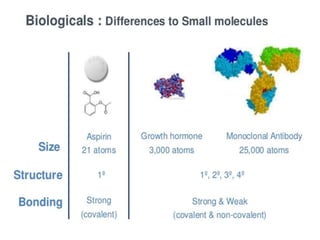
• Often 200 to 1,000 times the size of asmall molecule drug
and far more complexstructurally.
Examples:
 Human Growth hormone
 Humaninsulin
 Erythropoietin
 Vaccines
 Monoclonal antibodies
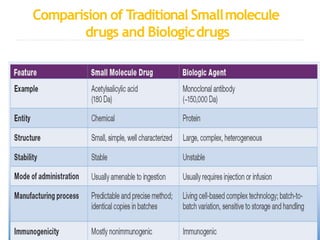
Comparision of Traditional Smallmolecule
drugs and Biologicdrugs
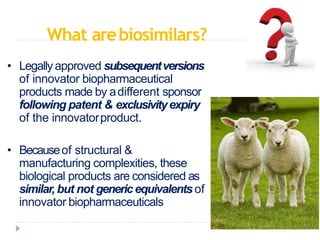
What arebiosimilars?
• Legallyapproved subsequentversions
of innovator biopharmaceutical
products made by adifferent sponsor
following patent & exclusivityexpiry
of the innovatorproduct.
• Becauseof structural &
manufacturing complexities, these
biological products are considered as
similar,but not genericequivalentsof
innovator biopharmaceuticals
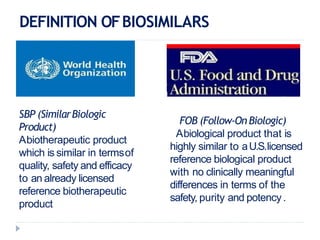
DEFINITION OFBIOSIMILARS
SBP (SimilarBiologic
Product)
Abiotherapeutic product
which is similar in termsof
quality, safety and efficacy
to an already licensed
reference biotherapeutic
product
FOB (Follow-OnBiologic)
Abiological product that is
highly similar to aU.S.licensed
reference biological product
with no clinically meaningful
differences in terms of the
safety, purity and potency.
Basedon these different definitions,
Threedeterminants in definition of
biosimilar product:
1. It should be abiologicproduct
2. Referenceproductshould be an already licensed
biologic product
3. Demonstration of highsimilarity in safety, quality&
efficacy is necessary
 Similarity should be demonstrated using a set of
comprehensive comparability exercises at the quality,
non-clinical & clinicallevel
 Biosimilars
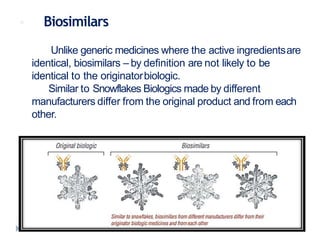
Unlike generic medicines where the active ingredientsare
identical, biosimilars – by definition are not likely to be
identical to the originatorbiologic.
Similar to Snowflakes Biologics made by different
manufacturers differ from the original product and from each
other.
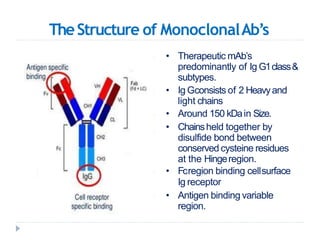
TheStructure of MonoclonalAb’s
• Therapeutic mAb’s
predominantly of Ig G1class&
subtypes.
• Ig Gconsists of 2 Heavyand
light chains
• Around 150 kDain Size.
• Chainsheld together by
disulfide bond between
conserved cysteine residues
at the Hingeregion.
• Fcregion binding cellsurface
Ig receptor
• Antigen binding variable
region.
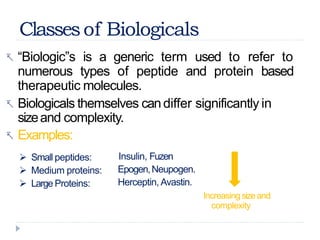
Classesof Biologicals
 “Biologic”s is a generic term used to refer to
numerous types of peptide and protein based
therapeutic molecules.
 Biologicals themselves candiffer significantly in
sizeand complexity.
 Examples:
 Small peptides:
 Medium proteins:
 Large Proteins:
Insulin, Fuzen
Epogen,Neupogen.
Herceptin, Avastin.
Increasing sizeand
complexity
Therapeutic effects of BRMs.
1.Regulation and/or increasedimmune
response.
2.Cytotoxic or cytostatic activity againsttumor
cells.
3.Inhibition of metastasis, or cellmaturation.
4.Stimulation of BM stem cells, required for
recuperation from cytotoxic insult secondaryto
chemotherapy.
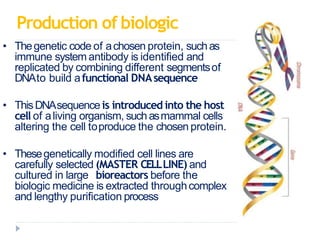
Production of biologic
• Thegenetic code of achosen protein, suchas
immune system antibody is identified and
replicated by combining different segmentsof
DNAto build afunctional DNAsequence
• ThisDNAsequenceis introduced into the host
cell of aliving organism, such asmammal cells
altering the cell toproduce the chosen protein.
• Thesegenetically modified cell lines are
carefully selected (MASTER CELLLINE) and
cultured in large bioreactors before the
biologic medicine is extracted throughcomplex
and lengthy purification process
Keychallenges of biosimilar monoclonalAb
development
Correct amino acidsequence
Similar Glycoform structure
Comparable pre-clinical activity
High-yield master cell bank/working cellbank
Scalablemanufacturing process
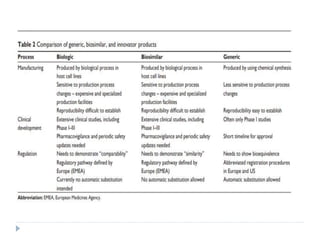
Differences between chemical
generics & biosimilars
1. Heavier
Unlike structurally well-defined, low molecularweight
chemical drugs, biopharmaceuticals are:
 High molecular weight compounds with complex
three-dimensional structure
 For example, the molecular weight of Aspirinis 180 Da
whereas Interferon-β is 19,000 Da
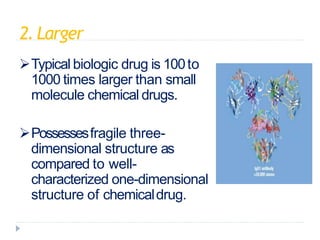
2.Larger
Typical biologic drug is 100to
1000 times larger than small
molecule chemical drugs.
Possessesfragile three-
dimensional structure as
compared to well-
characterized one-dimensional
structure of chemicaldrug.
3. Difficult to definestructure
Small Molecule drugs →easy
to reproduce & specify by
massspectroscopy & other
techniques.
Lackof appropriate
investigative tools to define
composite structure of large
proteins
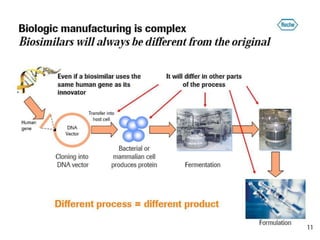
4. Complex manufacturing processes
 Manufacturers of biosimilar products will
not have accessto manufacturing process
of innovator products→ Proprietary
knowledge
 Impossible to accurately duplicateany
protein product
 Different manufacturing processesuse
different cell lines, protein sources &
extraction & purification techniques→
heterogeneity of biopharmaceuticals
continued
• Versatile cell lines used to produce theproteins
havean impact on the grossstructure of the
protein
• Suchalterations may significantly impact:
Receptor binding, Stability, Pharmacokinetics&
Safety
• Immunogenic potential of therapeuticproteins→
Unique safety issue→Not observed with
chemical generics
Benefits ofBiosimilars
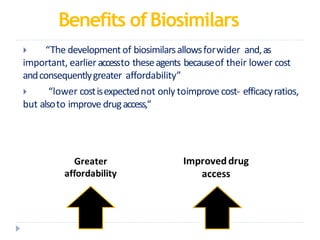
 “The development of biosimilarsallowsforwider and,as
important, earlier accessto theseagents becauseof their lower cost
andconsequentlygreater affordability”
 “lower costisexpectednot only toimprove cost- efficacyratios,
but alsoto improve drugaccess,“
Emerging Role ofBiosimilars
 Countries around the world- growing,aging
population ---> ↑ in chronic disease.
 Expanding demand for good-quality
healthcare ---> challenge of controlling
healthcare expenditure.
 Thesafeand regulated introduction of
biosimilars into the market hasbeen
forecasted to increase accessto muchneeded
biologic medicines and reducecosts.
Concerns withBiosimilars
 Thetwo biosimilar products havedifferentorigin.
 Thetwo biosimilars may havesametherapeutic effect.
 Theymayhavedifferent side effect and toxicology.
Hence Biosimilars require thoroughtesting.
• Similarity between abiosimilar and its reference
biotherapeutic product should be evaluated inall
respects (quality, safety andefficacy).
• Purported copies of biotherapeutic medicines thathave
not undergone head-to-head comparisons with an
appropriate reference product put patient safety at risk
and should not be licensed via biosimilarpathways.
Issues of concern with use ofbiosimilars
1. Efficacy issues
 Differences between the bioactivity of the biosimilars & their
innovator products
Example:
• 11 epoetin alfa products from4 different countries (Korea,
Argentina, China, India)
• Significant diversions from specification for invivo bioactivity
• Rangedfrom 71-226%
2. Safety issues
Concerns regarding immunogenicity
Example:
↑ in no. of casesof Pure RedCellAplasia
associated with specific formulation of epoetinα
Causedby the production of neutralizing
antibodies against endogenous epoetin
3.Pharmacovigilance
 Dueto limited clinical database at the time of
approval→ Vigorous pharmacovigilance required
 Immunogenicity is aunique safety issue
 Adversedrugs reactions monitoring data should
be exhaustive
 Typeof adverse event & data about drug suchas:
Proprietary name, International nonproprietary
name (INN) & dosage
4.Substitution
Allows dispensing of generic drugs in placeof
prescribed IP
Rationale for generics→ Original drugs & their
generics are identical & havethe same
therapeutic effect
 Produce cost savings
Same substitution rules should notbe
applied:
Decreasethe safety of therapy orcause
therapeutic failure
Uncontrolled substitution →confounds accurate
pharmacovigilance
Adverse event emerges after switching from IPto
its biosimilar without documentation →event
will not be associated to aspecific product or it
will be ascribed to awrongproduct
Naming andlabeling
 Generic adaptation of chemical medicines is assignedthe
same name→ identical copies of the referenceproducts
 Biosimilars require unique INNs, asthis wouldfacilitate:
 Prescribing & dispensing of biopharmaceuticals:
 Precise pharmacovigilance
 Need for Comprehensive labeling of biosimilarsincluding
deviations from IP& unique safety &efficacy data
 Assist the physician & pharmacist in making informed
decisions
Regulation ofBiosimilars
WHO regulations forBiosimilars
In 2009 the World HealthOrganization
developed aset of globally accepted
standards to assurethe safety,efficacy
and quality of biosimilarmedicines.
Thesehavebeen developed in the wake
of increased interest in biosimilars by
local regulatory authorities seeking to
develop national standards.
What is biosimilarity?
• “Biosimilarity” is the regulatory term usedto denote
the comparability between abiosimilar and its
reference medicinal product.
• Regulatory bodies across the world including India,
recommends a stepwise approach to demonstrate
biosimilarity between a proposed medicine and the
original biologic
• Theaim is to demonstrate no clinicallymeaningful
difference in terms ofsafety, potency and purity
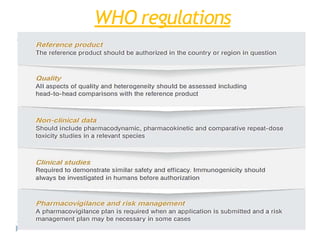
WHO regulations
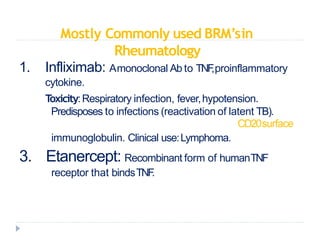
Mostly Commonly used BRM’sin
Rheumatology
1. Infliximab: Amonoclonal Ab to TNF,proinflammatory
cytokine.
Toxicity:Respiratory infection, fever,hypotension.
Predisposes to infections (reactivation of latent TB).
2. Rituximab: Amonoclonal antibody to CD20surface
immunoglobulin. Clinical use:Lymphoma.
3. Etanercept: Recombinant form of humanTNF
receptor that bindsTNF.
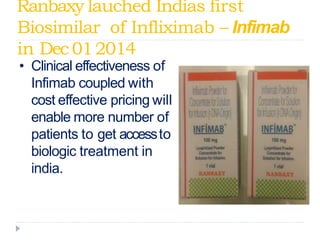
Ranbaxy lauched Indias first
Biosimilar of Infliximab – Infimab
in Dec012014
• Clinical effectiveness of
Infimab coupled with
cost effective pricing will
enable more number of
patients to get accessto
biologic treatment in
india.
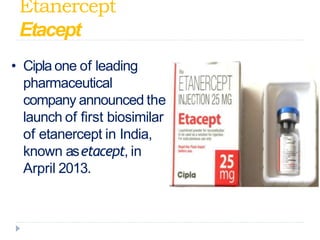
Etanercept -
Etacept
• Cipla one of leading
pharmaceutical
company announced the
launch of first biosimilar
of etanercept in India,
known asetacept, in
Arpril 2013.
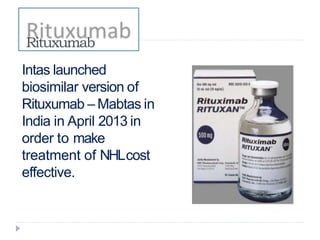
Intas launched
biosimilar version of
Rituxumab – Mabtas in
India in April 2013 in
order to make
treatment of NHLcost
effective.
Rituxumab
limitations of patentBiologics
• Injection-site reactions are the most frequent adverse
events. The severity varies from mild redness to deep
inflammation and necrosis.
• In most cases,the treatment can be continued andthe
severity of reactions will decrease withtime.
• Likeall foreign proteins, monoclonal antibodies may
induce urticaria, angioedema, anaphylacticreactions,
and serum sickness.
• Production of inactivating antibodies to the drug may
occur, classically with infliximab, and may beprevented
by concomitant administration of low-dose
methotrexate.
CONTINUE
D
• Alopecia is acommon complication of IFN-α.
• Anonspecific, highly pruritic “dermatitis” is frequentin
patients receiving IFNand ribavirin for hepatitisC.
• Induction or exacerbation of variousimmune-mediated
disorders, especially lupus erythematosus, hasbeen
reported with interleukin 2, IFN-α, and antitumor
necrosis factor α.
• Granulocyte colony-stimulating factor mayinduce
various neutrophil dermatoses, including Sweet’s
syndrome and pyoderma gangrenosum, and can
exacerbate psoriasis.
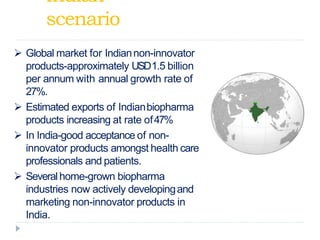
Indian
scenario
 Global market for Indiannon-innovator
products-approximately USD1.5 billion
per annum with annual growth rate of
27%.
 Estimated exports of Indianbiopharma
products increasing at rate of47%
 In India-good acceptance of non-
innovator products amongst health care
professionals and patients.
 Severalhome-grown biopharma
industries now actively developingand
marketing non-innovator products in
India.
Summary
 Biosimilars are highly similar versions ofalready
authorized innovator biologicaltherapies
 They demonstrate no clinically meaningful differences vs
their innovator products in terms of efficacy, safety, quality
characteristics, and biologicalactivity
 Theymust meet strict criteria of quality and
comparability to theirrespective innovator biologic
 Biosimilars have demonstrated growingacceptance and
use
 Biosimilars allow for wider and earlieraccessto
effective biologic therapies
Conclusion
With more and more innovator drugs going off patent,
urgent attention required to regulate increasing
number of copybiotherapeutics.
New non-innovator biotherapeutics should be made
available assoon aspatent protection is over sothat
economically compromised patients have an option to
opt for cheaper copyversions.
Reducing cost of drugs now aglobal priority rather
than just being amajor issue in developingeconomies.
Biosimilars

Biosimilars

  • 1.
    Biosimilars Sanju Kaladharan; Dept ofPharmacology, KMCH College of Pharmacy, Coimbatore.
  • 4.
    Introduction  Biological medicinesare derived from living cells or organisms and consist of large, highly complex molecular entities which may be difficult to characterise.  Due to the variability of the biological system and the manufacturing process, biological medicines may show a certain degree of variation, even between batches of the same product
  • 5.
     A biosimilarmedicine is a biological medicine that is developed to be highly similar and clinically equivalent to an existing biological medicine.  A biosimilar contains a version of an active substance of an already approved biological medicine, which is referred to as the ‘reference medicine’ or ‘originator medicine’.  Similarity to the reference medicine in terms of quality, structural characteristics, biological activity, safety and efficacy must be established based on a comprehensive scientific comparability exercise such that they do not have any clinically meaningful differences from the reference medicine in terms of quality, safety and efficacy
  • 6.
    Biologic Medicines ? •Alarge Protein molecule typically derived from livingcells and used in the treatment or prevention of disease • Include therapeutic proteins, DNA,monoclonal antibodies and fusion proteins. • Often 200 to 1,000 times the size of asmall molecule drug and far more complexstructurally. Examples:  Human Growth hormone  Humaninsulin  Erythropoietin  Vaccines  Monoclonal antibodies
  • 10.
    Comparision of TraditionalSmallmolecule drugs and Biologicdrugs
  • 11.
    What arebiosimilars? • Legallyapprovedsubsequentversions of innovator biopharmaceutical products made by adifferent sponsor following patent & exclusivityexpiry of the innovatorproduct. • Becauseof structural & manufacturing complexities, these biological products are considered as similar,but not genericequivalentsof innovator biopharmaceuticals
  • 12.
    DEFINITION OFBIOSIMILARS SBP (SimilarBiologic Product) Abiotherapeuticproduct which is similar in termsof quality, safety and efficacy to an already licensed reference biotherapeutic product FOB (Follow-OnBiologic) Abiological product that is highly similar to aU.S.licensed reference biological product with no clinically meaningful differences in terms of the safety, purity and potency.
  • 13.
    Basedon these differentdefinitions, Threedeterminants in definition of biosimilar product: 1. It should be abiologicproduct 2. Referenceproductshould be an already licensed biologic product 3. Demonstration of highsimilarity in safety, quality& efficacy is necessary  Similarity should be demonstrated using a set of comprehensive comparability exercises at the quality, non-clinical & clinicallevel
  • 14.
     Biosimilars Unlike genericmedicines where the active ingredientsare identical, biosimilars – by definition are not likely to be identical to the originatorbiologic. Similar to Snowflakes Biologics made by different manufacturers differ from the original product and from each other.
  • 16.
    TheStructure of MonoclonalAb’s •Therapeutic mAb’s predominantly of Ig G1class& subtypes. • Ig Gconsists of 2 Heavyand light chains • Around 150 kDain Size. • Chainsheld together by disulfide bond between conserved cysteine residues at the Hingeregion. • Fcregion binding cellsurface Ig receptor • Antigen binding variable region.
  • 17.
    Classesof Biologicals  “Biologic”sis a generic term used to refer to numerous types of peptide and protein based therapeutic molecules.  Biologicals themselves candiffer significantly in sizeand complexity.  Examples:  Small peptides:  Medium proteins:  Large Proteins: Insulin, Fuzen Epogen,Neupogen. Herceptin, Avastin. Increasing sizeand complexity
  • 21.
    Therapeutic effects ofBRMs. 1.Regulation and/or increasedimmune response. 2.Cytotoxic or cytostatic activity againsttumor cells. 3.Inhibition of metastasis, or cellmaturation. 4.Stimulation of BM stem cells, required for recuperation from cytotoxic insult secondaryto chemotherapy.
  • 22.
    Production of biologic •Thegenetic code of achosen protein, suchas immune system antibody is identified and replicated by combining different segmentsof DNAto build afunctional DNAsequence • ThisDNAsequenceis introduced into the host cell of aliving organism, such asmammal cells altering the cell toproduce the chosen protein. • Thesegenetically modified cell lines are carefully selected (MASTER CELLLINE) and cultured in large bioreactors before the biologic medicine is extracted throughcomplex and lengthy purification process
  • 24.
    Keychallenges of biosimilarmonoclonalAb development Correct amino acidsequence Similar Glycoform structure Comparable pre-clinical activity High-yield master cell bank/working cellbank Scalablemanufacturing process
  • 25.
    Differences between chemical generics& biosimilars 1. Heavier Unlike structurally well-defined, low molecularweight chemical drugs, biopharmaceuticals are:  High molecular weight compounds with complex three-dimensional structure  For example, the molecular weight of Aspirinis 180 Da whereas Interferon-β is 19,000 Da
  • 26.
    2.Larger Typical biologic drugis 100to 1000 times larger than small molecule chemical drugs. Possessesfragile three- dimensional structure as compared to well- characterized one-dimensional structure of chemicaldrug.
  • 27.
    3. Difficult todefinestructure Small Molecule drugs →easy to reproduce & specify by massspectroscopy & other techniques. Lackof appropriate investigative tools to define composite structure of large proteins
  • 28.
    4. Complex manufacturingprocesses  Manufacturers of biosimilar products will not have accessto manufacturing process of innovator products→ Proprietary knowledge  Impossible to accurately duplicateany protein product  Different manufacturing processesuse different cell lines, protein sources & extraction & purification techniques→ heterogeneity of biopharmaceuticals
  • 29.
    continued • Versatile celllines used to produce theproteins havean impact on the grossstructure of the protein • Suchalterations may significantly impact: Receptor binding, Stability, Pharmacokinetics& Safety • Immunogenic potential of therapeuticproteins→ Unique safety issue→Not observed with chemical generics
  • 30.
    Benefits ofBiosimilars  “Thedevelopment of biosimilarsallowsforwider and,as important, earlier accessto theseagents becauseof their lower cost andconsequentlygreater affordability”  “lower costisexpectednot only toimprove cost- efficacyratios, but alsoto improve drugaccess,“
  • 31.
    Emerging Role ofBiosimilars Countries around the world- growing,aging population ---> ↑ in chronic disease.  Expanding demand for good-quality healthcare ---> challenge of controlling healthcare expenditure.  Thesafeand regulated introduction of biosimilars into the market hasbeen forecasted to increase accessto muchneeded biologic medicines and reducecosts.
  • 32.
    Concerns withBiosimilars  Thetwobiosimilar products havedifferentorigin.  Thetwo biosimilars may havesametherapeutic effect.  Theymayhavedifferent side effect and toxicology. Hence Biosimilars require thoroughtesting. • Similarity between abiosimilar and its reference biotherapeutic product should be evaluated inall respects (quality, safety andefficacy). • Purported copies of biotherapeutic medicines thathave not undergone head-to-head comparisons with an appropriate reference product put patient safety at risk and should not be licensed via biosimilarpathways.
  • 33.
    Issues of concernwith use ofbiosimilars 1. Efficacy issues  Differences between the bioactivity of the biosimilars & their innovator products Example: • 11 epoetin alfa products from4 different countries (Korea, Argentina, China, India) • Significant diversions from specification for invivo bioactivity • Rangedfrom 71-226%
  • 34.
    2. Safety issues Concernsregarding immunogenicity Example: ↑ in no. of casesof Pure RedCellAplasia associated with specific formulation of epoetinα Causedby the production of neutralizing antibodies against endogenous epoetin
  • 35.
    3.Pharmacovigilance  Dueto limitedclinical database at the time of approval→ Vigorous pharmacovigilance required  Immunogenicity is aunique safety issue  Adversedrugs reactions monitoring data should be exhaustive  Typeof adverse event & data about drug suchas: Proprietary name, International nonproprietary name (INN) & dosage
  • 36.
    4.Substitution Allows dispensing ofgeneric drugs in placeof prescribed IP Rationale for generics→ Original drugs & their generics are identical & havethe same therapeutic effect  Produce cost savings
  • 37.
    Same substitution rulesshould notbe applied: Decreasethe safety of therapy orcause therapeutic failure Uncontrolled substitution →confounds accurate pharmacovigilance Adverse event emerges after switching from IPto its biosimilar without documentation →event will not be associated to aspecific product or it will be ascribed to awrongproduct
  • 38.
    Naming andlabeling  Genericadaptation of chemical medicines is assignedthe same name→ identical copies of the referenceproducts  Biosimilars require unique INNs, asthis wouldfacilitate:  Prescribing & dispensing of biopharmaceuticals:  Precise pharmacovigilance  Need for Comprehensive labeling of biosimilarsincluding deviations from IP& unique safety &efficacy data  Assist the physician & pharmacist in making informed decisions
  • 39.
  • 40.
    WHO regulations forBiosimilars In2009 the World HealthOrganization developed aset of globally accepted standards to assurethe safety,efficacy and quality of biosimilarmedicines. Thesehavebeen developed in the wake of increased interest in biosimilars by local regulatory authorities seeking to develop national standards.
  • 41.
    What is biosimilarity? •“Biosimilarity” is the regulatory term usedto denote the comparability between abiosimilar and its reference medicinal product. • Regulatory bodies across the world including India, recommends a stepwise approach to demonstrate biosimilarity between a proposed medicine and the original biologic • Theaim is to demonstrate no clinicallymeaningful difference in terms ofsafety, potency and purity
  • 42.
  • 43.
    Mostly Commonly usedBRM’sin Rheumatology 1. Infliximab: Amonoclonal Ab to TNF,proinflammatory cytokine. Toxicity:Respiratory infection, fever,hypotension. Predisposes to infections (reactivation of latent TB). 2. Rituximab: Amonoclonal antibody to CD20surface immunoglobulin. Clinical use:Lymphoma. 3. Etanercept: Recombinant form of humanTNF receptor that bindsTNF.
  • 44.
    Ranbaxy lauched Indiasfirst Biosimilar of Infliximab – Infimab in Dec012014 • Clinical effectiveness of Infimab coupled with cost effective pricing will enable more number of patients to get accessto biologic treatment in india.
  • 45.
    Etanercept - Etacept • Ciplaone of leading pharmaceutical company announced the launch of first biosimilar of etanercept in India, known asetacept, in Arpril 2013.
  • 47.
    Intas launched biosimilar versionof Rituxumab – Mabtas in India in April 2013 in order to make treatment of NHLcost effective. Rituxumab
  • 48.
    limitations of patentBiologics •Injection-site reactions are the most frequent adverse events. The severity varies from mild redness to deep inflammation and necrosis. • In most cases,the treatment can be continued andthe severity of reactions will decrease withtime. • Likeall foreign proteins, monoclonal antibodies may induce urticaria, angioedema, anaphylacticreactions, and serum sickness. • Production of inactivating antibodies to the drug may occur, classically with infliximab, and may beprevented by concomitant administration of low-dose methotrexate.
  • 49.
    CONTINUE D • Alopecia isacommon complication of IFN-α. • Anonspecific, highly pruritic “dermatitis” is frequentin patients receiving IFNand ribavirin for hepatitisC. • Induction or exacerbation of variousimmune-mediated disorders, especially lupus erythematosus, hasbeen reported with interleukin 2, IFN-α, and antitumor necrosis factor α. • Granulocyte colony-stimulating factor mayinduce various neutrophil dermatoses, including Sweet’s syndrome and pyoderma gangrenosum, and can exacerbate psoriasis.
  • 50.
    Indian scenario  Global marketfor Indiannon-innovator products-approximately USD1.5 billion per annum with annual growth rate of 27%.  Estimated exports of Indianbiopharma products increasing at rate of47%  In India-good acceptance of non- innovator products amongst health care professionals and patients.  Severalhome-grown biopharma industries now actively developingand marketing non-innovator products in India.
  • 51.
    Summary  Biosimilars arehighly similar versions ofalready authorized innovator biologicaltherapies  They demonstrate no clinically meaningful differences vs their innovator products in terms of efficacy, safety, quality characteristics, and biologicalactivity  Theymust meet strict criteria of quality and comparability to theirrespective innovator biologic  Biosimilars have demonstrated growingacceptance and use  Biosimilars allow for wider and earlieraccessto effective biologic therapies
  • 52.
    Conclusion With more andmore innovator drugs going off patent, urgent attention required to regulate increasing number of copybiotherapeutics. New non-innovator biotherapeutics should be made available assoon aspatent protection is over sothat economically compromised patients have an option to opt for cheaper copyversions. Reducing cost of drugs now aglobal priority rather than just being amajor issue in developingeconomies.