
Biosensors
Sanju Kaladharan
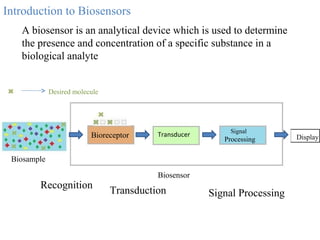
Recognition
Transduction Signal Processing
A biosensor is an analytical device which is used to determine
the presence and concentration of a specific substance in a
biological analyte
Biosensor
DisplayBioreceptor Transducer Signal
Processing
Desired molecule
Introduction to Biosensors
Biosample
Introduction to Biosensors
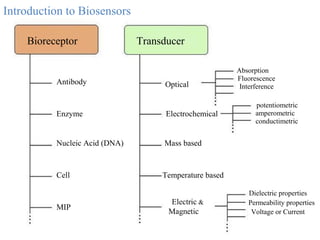
Bioreceptor Transducer
Antibody
Enzyme
Nucleic Acid (DNA)
Cell
MIP
Optical
Electrochemical
Mass based
Temperature based
potentiometric
amperometric
conductimetric
Electric &
Magnetic
Dielectric properties
Permeability properties
Voltage or Current
Fluorescence
Interference
Absorption
Bioreceptor
• In a biosensor, the bioreceptor is designed to
interact with the specific analyte of interest to
produce an effect measurable by the
transducer.
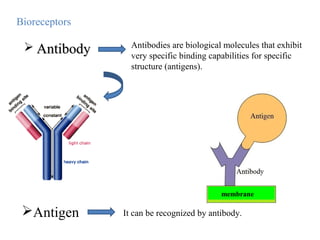
 AntibodyAntibody Antibodies are biological molecules that exhibit
very specific binding capabilities for specific
structure (antigens).
Antigen It can be recognized by antibody.
Bioreceptors
membrane
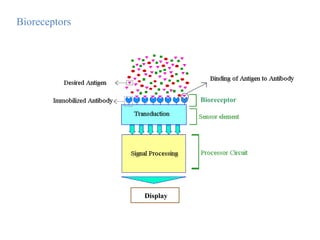
Bioreceptors
Display
Bioreceptor
Antibody/antigen interactions
• The specific nature of the antibody-antigen interaction is analogous to a
lock and key fit in that the antigen will only bind to the antibody if it has
the correct conformation.
• Binding events result in a physicochemical change that in combination
with a tracer, such as a fluorescent molecules, enzymes, or radioisotopes,
can generate a signal.
• There are limitations with using antibodies in sensors:
• 1.The antibody binding capacity is strongly dependent on assay conditions
(e.g. pH and temperature) and
• 2. The antibody-antigen interaction is generally irreversible. However, it
has been shown that binding can be disrupted by chaotropic reagents,
organic solvents, or even ultrasonic radiation.
Artificial binding proteins
• The artificial binding proteins are much smaller than antibodies
(usually less than 100 amino-acid residues), have a strong stability,
lack disulfide bonds and can be expressed in high yield in reducing
cellular environments like the bacterial cytoplasm, contrary to
antibodies and their derivatives
Enzymatic interactions
• The specific binding capabilities and catalytic activity
of enzymes make them popular bioreceptors. Analyte recognition is
enabled through several possible mechanisms:
• 1) the enzyme converting the analyte into a product that is sensor-
detectable
• 2) detecting enzyme inhibition or activation by the analyte, or
• 3) monitoring modification of enzyme properties resulting from
interaction with the analyte.
• The main reasons for the common use of enzymes in
biosensors are:
• 1) ability to catalyze a large number of reactions;
• 2) potential to detect a group of analytes (substrates,
products, inhibitors, and modulators of the catalytic activity);
and
• 3) suitability with several different transduction methods for
detecting the analyte.
Affinity binding
• Antibodies have a high binding constant in excess of 10^8 L/mol,
which stands for a nearly irreversible association once the antigen-
antibody couple has formed.
• For certain analyte molecules like glucose affinity binding proteins
exist that bind their ligand with a high specificity like an antibody,
but with a much smaller binding constant on the order of 10^2 to
10^4 L/mol.
• The association between analyte and receptor then is
of reversible nature and next to the couple between both also their
free molecules occur in a measurable concentration.
• The sensor principle has the advantage that it does not
consume the analyte in a chemical reaction as occurs in
enzymatic assays.
Nucleic acid interactions
• Biosensors that employ nucleic acid interactions can be
referred to as genosensors.
• The recognition process is based on the principle of
complementary base pairing, adenine:thymine and
cytosine:guanine in DNA.
• If the target nucleic acid sequence is known, complementary
sequences can be synthesized, labeled, and then immobilized
on the sensor.
• The hybridization probes can then base pair with the target
sequences, generating an optical signal. The favored
transduction principle employed in this type of sensor has
been optical detection
Epigenetics
• Epigenetics, the study of the chemical modification of
specific genes or gene-associated proteins of an organism.
Epigenetic modifications can define how the information in
genes is expressed and used by cells.
• It has been proposed that properly optimized integrated
optical resonators can be exploited for detecting epigenetic
modifications (e.g. DNA methylation, histone post-
translational modifications) in body fluids from patients
affected by cancer or other diseases.
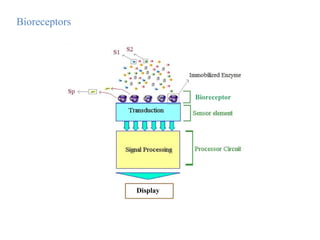
Bioreceptors
Bioreceptor
Display
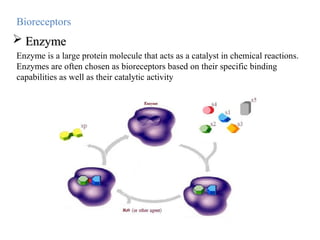
Enzyme is a large protein molecule that acts as a catalyst in chemical reactions.
Enzymes are often chosen as bioreceptors based on their specific binding
capabilities as well as their catalytic activity
Bioreceptors
 EnzymeEnzyme
Organelles
• Different kinds of organelles have various metabolic pathways
and contain enzymes to fulfill its function. Commonly used
organelles include lysosome, chloroplast and mitochondria.
• Eg : Mitochondria actively participate in the metabolism of
calcium ions to control the function and also modulate the
calcium related signaling pathways. Experiments have proved
that mitochondria have the ability to respond to high calcium
concentration generated in the proximity by opening the
calcium channel.
Cells
• Cells are often used in bioreceptors because they are
sensitive to surrounding environment and they can respond
to all kinds of stimulants.
• Cells tend to attach to the surface so they can be easily
immobilized.
• Compared to organelles they remain active for longer period
and the reproducibility makes them reusable.
• They are commonly used to detect global parameter like
stress condition, toxicity and organic derivatives.
• They can also be used to monitor the treatment effect of
drugs.
Biosensor variants
• Alcohol biosensors
• Glucose biosensor
• Urea biosensor
• Inosine biosensor
• Hypoxanthine biosensor etc
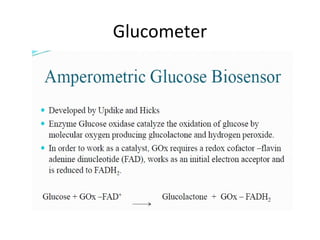
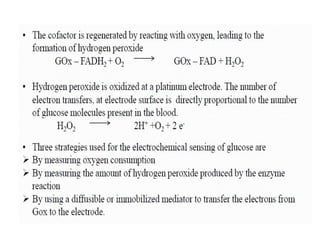
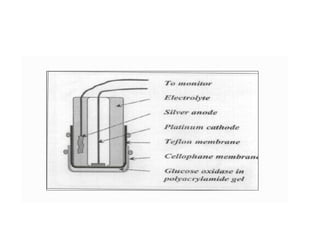
Glucometer
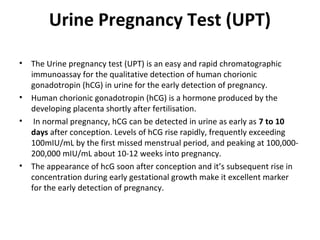
Urine Pregnancy Test (UPT)
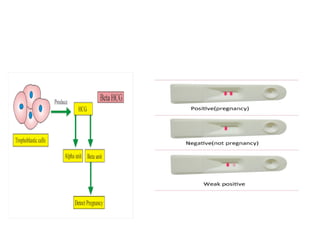
• The Urine pregnancy test (UPT) is an easy and rapid chromatographic
immunoassay for the qualitative detection of human chorionic
gonadotropin (hCG) in urine for the early detection of pregnancy.
• Human chorionic gonadotropin (hCG) is a hormone produced by the
developing placenta shortly after fertilisation.
• In normal pregnancy, hCG can be detected in urine as early as 7 to 10
days after conception. Levels of hCG rise rapidly, frequently exceeding
100mIU/mL by the first missed menstrual period, and peaking at 100,000-
200,000 mIU/mL about 10-12 weeks into pregnancy.
• The appearance of hcG soon after conception and it’s subsequent rise in
concentration during early gestational growth make it excellent marker
for the early detection of pregnancy.
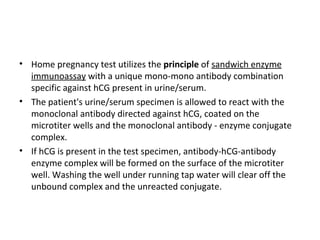
• Home pregnancy test utilizes the principle of sandwich enzyme
immunoassay with a unique mono-mono antibody combination
specific against hCG present in urine/serum.
• The patient's urine/serum specimen is allowed to react with the
monoclonal antibody directed against hCG, coated on the
microtiter wells and the monoclonal antibody - enzyme conjugate
complex.
• If hCG is present in the test specimen, antibody-hCG-antibody
enzyme complex will be formed on the surface of the microtiter
well. Washing the well under running tap water will clear off the
unbound complex and the unreacted conjugate.
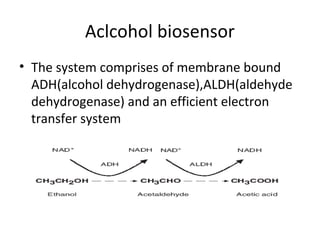
Aclcohol biosensor
• The system comprises of membrane bound
ADH(alcohol dehydrogenase),ALDH(aldehyde
dehydrogenase) and an efficient electron
transfer system
Urea biosensor
• Comprise of an urease immobilised
membrane in addition to pH electrodes
• The urease catalysed reaction gives rise to pH
alterations

BiosensorS

  • 1.
  • 2.
    Recognition Transduction Signal Processing Abiosensor is an analytical device which is used to determine the presence and concentration of a specific substance in a biological analyte Biosensor DisplayBioreceptor Transducer Signal Processing Desired molecule Introduction to Biosensors Biosample
  • 4.
    Introduction to Biosensors BioreceptorTransducer Antibody Enzyme Nucleic Acid (DNA) Cell MIP Optical Electrochemical Mass based Temperature based potentiometric amperometric conductimetric Electric & Magnetic Dielectric properties Permeability properties Voltage or Current Fluorescence Interference Absorption
  • 6.
    Bioreceptor • In abiosensor, the bioreceptor is designed to interact with the specific analyte of interest to produce an effect measurable by the transducer.
  • 7.
     AntibodyAntibody Antibodiesare biological molecules that exhibit very specific binding capabilities for specific structure (antigens). Antigen It can be recognized by antibody. Bioreceptors membrane
  • 8.
  • 9.
    Antibody/antigen interactions • Thespecific nature of the antibody-antigen interaction is analogous to a lock and key fit in that the antigen will only bind to the antibody if it has the correct conformation. • Binding events result in a physicochemical change that in combination with a tracer, such as a fluorescent molecules, enzymes, or radioisotopes, can generate a signal. • There are limitations with using antibodies in sensors: • 1.The antibody binding capacity is strongly dependent on assay conditions (e.g. pH and temperature) and • 2. The antibody-antigen interaction is generally irreversible. However, it has been shown that binding can be disrupted by chaotropic reagents, organic solvents, or even ultrasonic radiation.
  • 10.
    Artificial binding proteins •The artificial binding proteins are much smaller than antibodies (usually less than 100 amino-acid residues), have a strong stability, lack disulfide bonds and can be expressed in high yield in reducing cellular environments like the bacterial cytoplasm, contrary to antibodies and their derivatives
  • 11.
    Enzymatic interactions • Thespecific binding capabilities and catalytic activity of enzymes make them popular bioreceptors. Analyte recognition is enabled through several possible mechanisms: • 1) the enzyme converting the analyte into a product that is sensor- detectable • 2) detecting enzyme inhibition or activation by the analyte, or • 3) monitoring modification of enzyme properties resulting from interaction with the analyte.
  • 12.
    • The mainreasons for the common use of enzymes in biosensors are: • 1) ability to catalyze a large number of reactions; • 2) potential to detect a group of analytes (substrates, products, inhibitors, and modulators of the catalytic activity); and • 3) suitability with several different transduction methods for detecting the analyte.
  • 13.
    Affinity binding • Antibodieshave a high binding constant in excess of 10^8 L/mol, which stands for a nearly irreversible association once the antigen- antibody couple has formed. • For certain analyte molecules like glucose affinity binding proteins exist that bind their ligand with a high specificity like an antibody, but with a much smaller binding constant on the order of 10^2 to 10^4 L/mol. • The association between analyte and receptor then is of reversible nature and next to the couple between both also their free molecules occur in a measurable concentration. • The sensor principle has the advantage that it does not consume the analyte in a chemical reaction as occurs in enzymatic assays.
  • 14.
    Nucleic acid interactions •Biosensors that employ nucleic acid interactions can be referred to as genosensors. • The recognition process is based on the principle of complementary base pairing, adenine:thymine and cytosine:guanine in DNA. • If the target nucleic acid sequence is known, complementary sequences can be synthesized, labeled, and then immobilized on the sensor. • The hybridization probes can then base pair with the target sequences, generating an optical signal. The favored transduction principle employed in this type of sensor has been optical detection
  • 15.
    Epigenetics • Epigenetics, thestudy of the chemical modification of specific genes or gene-associated proteins of an organism. Epigenetic modifications can define how the information in genes is expressed and used by cells. • It has been proposed that properly optimized integrated optical resonators can be exploited for detecting epigenetic modifications (e.g. DNA methylation, histone post- translational modifications) in body fluids from patients affected by cancer or other diseases.
  • 16.
  • 17.
    Enzyme is alarge protein molecule that acts as a catalyst in chemical reactions. Enzymes are often chosen as bioreceptors based on their specific binding capabilities as well as their catalytic activity Bioreceptors  EnzymeEnzyme
  • 18.
    Organelles • Different kindsof organelles have various metabolic pathways and contain enzymes to fulfill its function. Commonly used organelles include lysosome, chloroplast and mitochondria. • Eg : Mitochondria actively participate in the metabolism of calcium ions to control the function and also modulate the calcium related signaling pathways. Experiments have proved that mitochondria have the ability to respond to high calcium concentration generated in the proximity by opening the calcium channel.
  • 19.
    Cells • Cells areoften used in bioreceptors because they are sensitive to surrounding environment and they can respond to all kinds of stimulants. • Cells tend to attach to the surface so they can be easily immobilized. • Compared to organelles they remain active for longer period and the reproducibility makes them reusable. • They are commonly used to detect global parameter like stress condition, toxicity and organic derivatives. • They can also be used to monitor the treatment effect of drugs.
  • 20.
    Biosensor variants • Alcoholbiosensors • Glucose biosensor • Urea biosensor • Inosine biosensor • Hypoxanthine biosensor etc
  • 21.
  • 24.
    Urine Pregnancy Test(UPT) • The Urine pregnancy test (UPT) is an easy and rapid chromatographic immunoassay for the qualitative detection of human chorionic gonadotropin (hCG) in urine for the early detection of pregnancy. • Human chorionic gonadotropin (hCG) is a hormone produced by the developing placenta shortly after fertilisation. • In normal pregnancy, hCG can be detected in urine as early as 7 to 10 days after conception. Levels of hCG rise rapidly, frequently exceeding 100mIU/mL by the first missed menstrual period, and peaking at 100,000- 200,000 mIU/mL about 10-12 weeks into pregnancy. • The appearance of hcG soon after conception and it’s subsequent rise in concentration during early gestational growth make it excellent marker for the early detection of pregnancy.
  • 25.
    • Home pregnancytest utilizes the principle of sandwich enzyme immunoassay with a unique mono-mono antibody combination specific against hCG present in urine/serum. • The patient's urine/serum specimen is allowed to react with the monoclonal antibody directed against hCG, coated on the microtiter wells and the monoclonal antibody - enzyme conjugate complex. • If hCG is present in the test specimen, antibody-hCG-antibody enzyme complex will be formed on the surface of the microtiter well. Washing the well under running tap water will clear off the unbound complex and the unreacted conjugate.
  • 27.
    Aclcohol biosensor • Thesystem comprises of membrane bound ADH(alcohol dehydrogenase),ALDH(aldehyde dehydrogenase) and an efficient electron transfer system
  • 28.
    Urea biosensor • Compriseof an urease immobilised membrane in addition to pH electrodes • The urease catalysed reaction gives rise to pH alterations