1
2
UNDER THE GUIDANCE OF:-
DR. SHASHIKUMAR R
GUEST FACULTY
DEPARTMENT OF BIOTECHNOLOGY SUBMITTED BY:-
MEGHANA S
Dept.of BIOTECHNOLOGY
“BIOSIMILAR”
CONTENTS
 INTRODUCTION
 CURRENT STATUS
 TYPES OF BIOLOGICS USED IN CANCER TREATMENT
 BIOSIMILAR DEVELOPING PROCESS
 DIFFERENCE BETWEEN BIOLOGICS AND CHEMICAL
MEDICINE
 BIOSIMILAR IN CLINICAL PRACTICES
 ADVANTAGES AND LIMITATIONS OF BIOSIMILAR
 FUTURE PERSPECTIVE OF BIOSIMILAR
 CONCLUSION
 REFERENCE
3
INTRODUCTION
Biologics are derived from the natural resources such as human, animal, or
microorganism and manufactured by various biotechnology methods such
as recombinant deoxyribonucleic acid technology, controlled gene
expression, and antibody technology.
Biosimilar is a biologic product, which is very similar to Food and Drug
Administration (FDA)-approved biological product known as reference
product and has no clinically meaningful differences in term of safety and
effectiveness from the reference product.
4
CURRENT STATUS
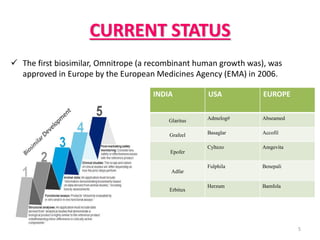
 The first biosimilar, Omnitrope (a recombinant human growth was), was
approved in Europe by the European Medicines Agency (EMA) in 2006.
INDIA USA EUROPE
Glaritus Admelog# Abseamed
Grafeel Basaglar Accofil
Epofer
Cyltezo Amgevita
Adfar
Fulphila Benepali
Erbitux
Herzum Bamfola
5
BIOLOGICS IN CANCER TREATMENT
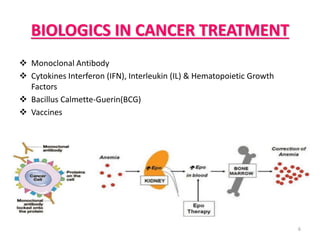
 Monoclonal Antibody
 Cytokines Interferon (IFN), Interleukin (IL) & Hematopoietic Growth
Factors
 Bacillus Calmette-Guerin(BCG)
 Vaccines
6
BIOSIMILAR DEVELOPING PROCESS
7
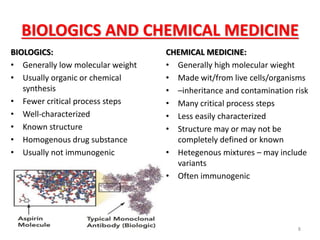
BIOLOGICS AND CHEMICAL MEDICINE
BIOLOGICS:
• Generally low molecular weight
• Usually organic or chemical
synthesis
• Fewer critical process steps
• Well-characterized
• Known structure
• Homogenous drug substance
• Usually not immunogenic
CHEMICAL MEDICINE:
• Generally high molecular wieght
• Made wit/from live cells/organisms
• –inheritance and contamination risk
• Many critical process steps
• Less easily characterized
• Structure may or may not be
completely defined or known
• Hetegenous mixtures – may include
variants
• Often immunogenic
8
BIOSIMILARS IN CLINICAL PRACTICE
 Biosimilars in clinical practice:The use of biosimilars is essentially a
change in clinical management.By taking a leading role in educating
patients and medical professionals about the risks and benefits of
biosimilars.
 The role of hospital pharmacists :It is of utmost importance that the
hospital pharmacist is aware that the innovator products and biosimilars
are not interchangeable, because patients must be carefully monitored if
their treatment is changed between products. Moreover, patient welfare
is foremost and for pharmacists, the knowledge that biosimilars are not
generics, and the possible implications for clinical outcomes when
products are switched, will help ensure patient safety.Additionally,
biosimilars are deemed to contain a new active ingredient, whereas
interchangeable products are not.
 The role of nurses in the use of biosimilars
9
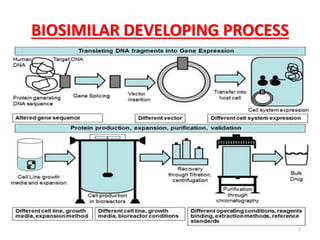
Stages:
1. Producing the master cell line containing the gene that makes the desired
protein.
 The genetic code (a sequence of DNA) of a selected protein (e.g. a
hormone, antibody, blood product) is identified and a functional DNA
sequence created.
 The genetic code is inserted into various host cell lines (e.g. bacteria or
yeast), so that the host cells produce this protein.
 The host cell line that produces the protein the most successfully becomes
the chosen host cell line.
2. Growing large numbers of cells that produce the protein in machines called
bioreactors; this process is called fermentation.
3. Isolating and purifying the protein, separating it out of the bioreactor via a
filtration process.
4. Preparing the biologic for use by patients (stabilizing and processing).
5. More patents on the process than on the drug.
10
1. Producing the master cell line containing the gene that makes the desired
protein.
The genetic code (a sequence of DNA) of a selected protein (e.g. a hormone,
antibody, blood product) is identified and a functional DNA sequence created.
The genetic code is inserted into various host cell lines (e.g. bacteria or yeast),
so that the host cells produce this protein.
The host cell line that produces the protein the most successfully becomes
the chosen host cell line.
2. Growing large numbers of cells that produce the protein in machines called
bioreactors; this process is called fermentation.
3. Isolating and purifying the protein, separating it out of the bioreactor via a
filtration process.
4. Preparing the biologic for use by patients (stabilizing and processing).
5. More patents on the process than on the drug
11
ADVANTAGES AND LIMITATIONS
Advantages:
• Treatment cost with biosimilar is lesser than innovators biological drug.
• Biopharmaceuticals represent one of the fastest-growing segments of
pharmaceuticals industry and by 2011, they are expected to represent 50% of
the market.
• Patent of original product is going to expire and therefore opportunity for
generic versions of biopharmaceutical is very large.
• The operating profit margin of traditional generic drugs is roughly 20%, but
depending on the biosimilar product, profit margins have the potential to be
somewhat higher, as much as 30%.
Limitations:The main concerns raised regarding biosimilar are immunogenicity,
efficacy, adverse effects when switching from a biologic to a biosimilar , and
possible long-term effects. This issue has been well documented in two recent
2017 trials, comparing the implications of switching from an infliximab
innovator to biosimilar , over the span of one year in IBD patients.
12
FUTURE PERSPECTIVE
• Many companies will have their patent expire in the forthcoming year,
which will open the window of opportunity for other biopharmaceutical
companies to explore the possibility of development of biosimilar
products.
• The global market for the biosimilar is expected to grow by US$10 billion
and many companies are anticipated to enter into this lucrative sector.
• Although the biosimilar space is still growing and evolving in the United
States, India is a significantplayer in the world in manufacturing and using
of biosimilars.
• Indian biosimilar market was approximately US$300 million in 2015. The
domestic sales are close to US$250 million and growing at a compound
annual growth rate of 14%. The export of biosimilar or similar biologic
from India stands at a staggering US$51 million.
• India has the potential to become a global player in similar biologics or
biosimilars
13
CONCLUSION
Biosimilars hold promise to improve patient’s accessibility for many
malignant and nonmalignant ailments by reducing the treatment cost.
Since the use of the first biosimilar, the development and uses of
“biosimilars or similar biologics” have witnessed substantial growth. Every
year, regulatory agencies are granting approval of various similar biologics
for the treatment of many cancerous and noncancerous diseases.
India has firmly established itself as a global player as a maker of
similar biologics. It is also a huge market for the similar biologics because
of its burgeoning population. Although the potential is high and
expectation is huge for India, the challenges are also enormous and
daunting to maintain the leadership.
14
REFERENCE
• Dörner T, Kay J Biosimilars in rheumatology: current perspectives and
lessons learnt. Nat Rev Rheumatol 2015;11:713–24.
• GenericsandBiosimilars Initiative (GaBI).
• Sandoz. Sandoz biosimilar pipeline.
• Rushvi P, Charmy K, Nirav C, Narendra C. Biosimilars: an emerging market
opportunities in India. PharmaceutRegAffairs 2016;5:165.
• . Saenger P. Ten years of biosimilar recombinant human growth hormone
in Europe. Drug Des DevelTher 2017;11:1505-7.
15
16

Biosimilars ppt presentation

  • 1.
  • 2.
    2 UNDER THE GUIDANCEOF:- DR. SHASHIKUMAR R GUEST FACULTY DEPARTMENT OF BIOTECHNOLOGY SUBMITTED BY:- MEGHANA S Dept.of BIOTECHNOLOGY “BIOSIMILAR”
  • 3.
    CONTENTS  INTRODUCTION  CURRENTSTATUS  TYPES OF BIOLOGICS USED IN CANCER TREATMENT  BIOSIMILAR DEVELOPING PROCESS  DIFFERENCE BETWEEN BIOLOGICS AND CHEMICAL MEDICINE  BIOSIMILAR IN CLINICAL PRACTICES  ADVANTAGES AND LIMITATIONS OF BIOSIMILAR  FUTURE PERSPECTIVE OF BIOSIMILAR  CONCLUSION  REFERENCE 3
  • 4.
    INTRODUCTION Biologics are derivedfrom the natural resources such as human, animal, or microorganism and manufactured by various biotechnology methods such as recombinant deoxyribonucleic acid technology, controlled gene expression, and antibody technology. Biosimilar is a biologic product, which is very similar to Food and Drug Administration (FDA)-approved biological product known as reference product and has no clinically meaningful differences in term of safety and effectiveness from the reference product. 4
  • 5.
    CURRENT STATUS  Thefirst biosimilar, Omnitrope (a recombinant human growth was), was approved in Europe by the European Medicines Agency (EMA) in 2006. INDIA USA EUROPE Glaritus Admelog# Abseamed Grafeel Basaglar Accofil Epofer Cyltezo Amgevita Adfar Fulphila Benepali Erbitux Herzum Bamfola 5
  • 6.
    BIOLOGICS IN CANCERTREATMENT  Monoclonal Antibody  Cytokines Interferon (IFN), Interleukin (IL) & Hematopoietic Growth Factors  Bacillus Calmette-Guerin(BCG)  Vaccines 6
  • 7.
  • 8.
    BIOLOGICS AND CHEMICALMEDICINE BIOLOGICS: • Generally low molecular weight • Usually organic or chemical synthesis • Fewer critical process steps • Well-characterized • Known structure • Homogenous drug substance • Usually not immunogenic CHEMICAL MEDICINE: • Generally high molecular wieght • Made wit/from live cells/organisms • –inheritance and contamination risk • Many critical process steps • Less easily characterized • Structure may or may not be completely defined or known • Hetegenous mixtures – may include variants • Often immunogenic 8
  • 9.
    BIOSIMILARS IN CLINICALPRACTICE  Biosimilars in clinical practice:The use of biosimilars is essentially a change in clinical management.By taking a leading role in educating patients and medical professionals about the risks and benefits of biosimilars.  The role of hospital pharmacists :It is of utmost importance that the hospital pharmacist is aware that the innovator products and biosimilars are not interchangeable, because patients must be carefully monitored if their treatment is changed between products. Moreover, patient welfare is foremost and for pharmacists, the knowledge that biosimilars are not generics, and the possible implications for clinical outcomes when products are switched, will help ensure patient safety.Additionally, biosimilars are deemed to contain a new active ingredient, whereas interchangeable products are not.  The role of nurses in the use of biosimilars 9
  • 10.
    Stages: 1. Producing themaster cell line containing the gene that makes the desired protein.  The genetic code (a sequence of DNA) of a selected protein (e.g. a hormone, antibody, blood product) is identified and a functional DNA sequence created.  The genetic code is inserted into various host cell lines (e.g. bacteria or yeast), so that the host cells produce this protein.  The host cell line that produces the protein the most successfully becomes the chosen host cell line. 2. Growing large numbers of cells that produce the protein in machines called bioreactors; this process is called fermentation. 3. Isolating and purifying the protein, separating it out of the bioreactor via a filtration process. 4. Preparing the biologic for use by patients (stabilizing and processing). 5. More patents on the process than on the drug. 10
  • 11.
    1. Producing themaster cell line containing the gene that makes the desired protein. The genetic code (a sequence of DNA) of a selected protein (e.g. a hormone, antibody, blood product) is identified and a functional DNA sequence created. The genetic code is inserted into various host cell lines (e.g. bacteria or yeast), so that the host cells produce this protein. The host cell line that produces the protein the most successfully becomes the chosen host cell line. 2. Growing large numbers of cells that produce the protein in machines called bioreactors; this process is called fermentation. 3. Isolating and purifying the protein, separating it out of the bioreactor via a filtration process. 4. Preparing the biologic for use by patients (stabilizing and processing). 5. More patents on the process than on the drug 11
  • 12.
    ADVANTAGES AND LIMITATIONS Advantages: •Treatment cost with biosimilar is lesser than innovators biological drug. • Biopharmaceuticals represent one of the fastest-growing segments of pharmaceuticals industry and by 2011, they are expected to represent 50% of the market. • Patent of original product is going to expire and therefore opportunity for generic versions of biopharmaceutical is very large. • The operating profit margin of traditional generic drugs is roughly 20%, but depending on the biosimilar product, profit margins have the potential to be somewhat higher, as much as 30%. Limitations:The main concerns raised regarding biosimilar are immunogenicity, efficacy, adverse effects when switching from a biologic to a biosimilar , and possible long-term effects. This issue has been well documented in two recent 2017 trials, comparing the implications of switching from an infliximab innovator to biosimilar , over the span of one year in IBD patients. 12
  • 13.
    FUTURE PERSPECTIVE • Manycompanies will have their patent expire in the forthcoming year, which will open the window of opportunity for other biopharmaceutical companies to explore the possibility of development of biosimilar products. • The global market for the biosimilar is expected to grow by US$10 billion and many companies are anticipated to enter into this lucrative sector. • Although the biosimilar space is still growing and evolving in the United States, India is a significantplayer in the world in manufacturing and using of biosimilars. • Indian biosimilar market was approximately US$300 million in 2015. The domestic sales are close to US$250 million and growing at a compound annual growth rate of 14%. The export of biosimilar or similar biologic from India stands at a staggering US$51 million. • India has the potential to become a global player in similar biologics or biosimilars 13
  • 14.
    CONCLUSION Biosimilars hold promiseto improve patient’s accessibility for many malignant and nonmalignant ailments by reducing the treatment cost. Since the use of the first biosimilar, the development and uses of “biosimilars or similar biologics” have witnessed substantial growth. Every year, regulatory agencies are granting approval of various similar biologics for the treatment of many cancerous and noncancerous diseases. India has firmly established itself as a global player as a maker of similar biologics. It is also a huge market for the similar biologics because of its burgeoning population. Although the potential is high and expectation is huge for India, the challenges are also enormous and daunting to maintain the leadership. 14
  • 15.
    REFERENCE • Dörner T,Kay J Biosimilars in rheumatology: current perspectives and lessons learnt. Nat Rev Rheumatol 2015;11:713–24. • GenericsandBiosimilars Initiative (GaBI). • Sandoz. Sandoz biosimilar pipeline. • Rushvi P, Charmy K, Nirav C, Narendra C. Biosimilars: an emerging market opportunities in India. PharmaceutRegAffairs 2016;5:165. • . Saenger P. Ten years of biosimilar recombinant human growth hormone in Europe. Drug Des DevelTher 2017;11:1505-7. 15
  • 16.