Gene mapping
Sanju Kaladharan
Mendel’s law of independent
assortment
• "law of independent assortment" which states
that genes are transmitted from parents to
offspring independently of one another.
• If a person has blood group A (e.g. genotype
AO) and brown eyes (e.g. genotype Bb, where
B is the allele for brown and b is the allele for
blue eyes), the AO alleles are transmitted to
the offspring independently of the Bb alleles.
• not all genes are inherited independently of one another. Genes
that are located on the same chromosome and are described as
linked genes.
• If each chromosome were to be transmitted from parent to
offspring as a whole and unaltered structure, it would be expected
that all the genes located on the same chromosome would be
transmitted together as a block and not independently of one
another as proposed in Mendel's law.
• However, linked genes are not always transmitted en bloc because
of the phenomenon of recombination.
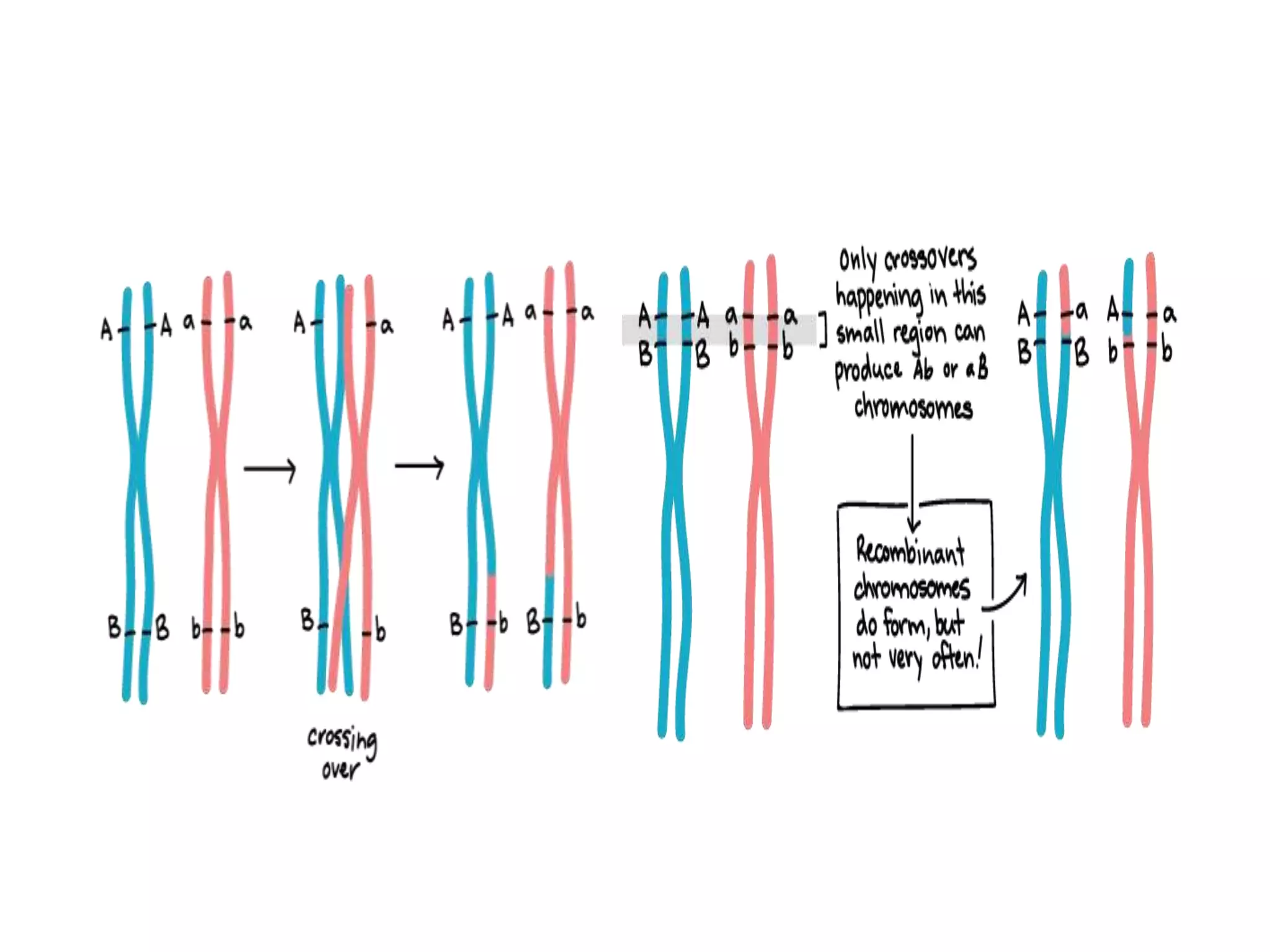
• One of the fundamental events that occur in meiosis is crossing
over in which homologous chromosomes exchange segments
causing a reshuffling of genes.
• If genes are far apart on the same chromosome, it is likely that
recombination occurs. Conversely, if they are very close together,
they are more likely to be transmitted as a block .
Linkage mapping
• Linkage maps
• show the arrangement of genes and genetic
markers along the chromosomes as calculated
by the frequency with which they are
inherited together.
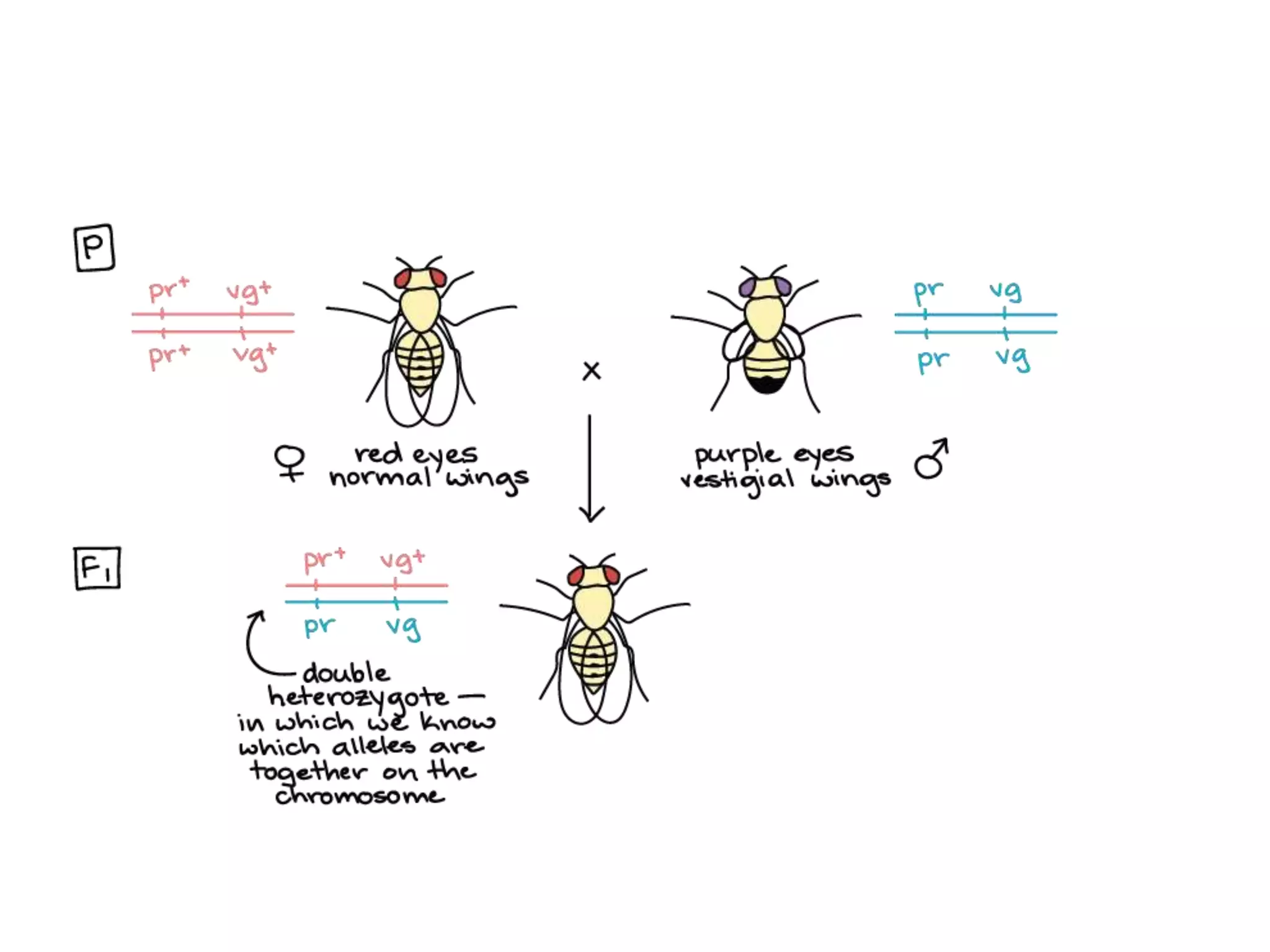
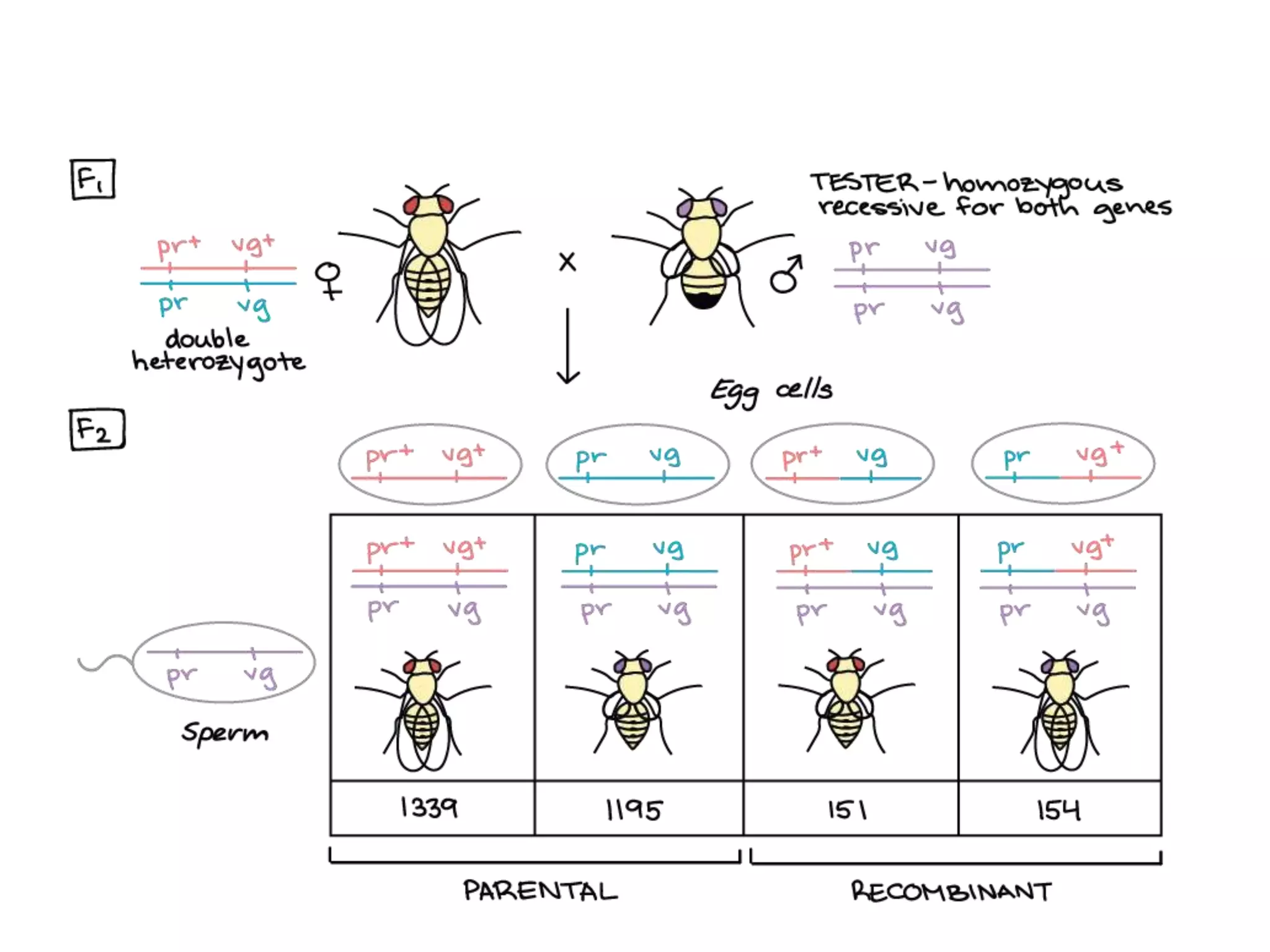
• In our case, the recombinant progeny classes
are the red-eyed, vestigial-winged flies and
the purple-eyed, long-winged flies.
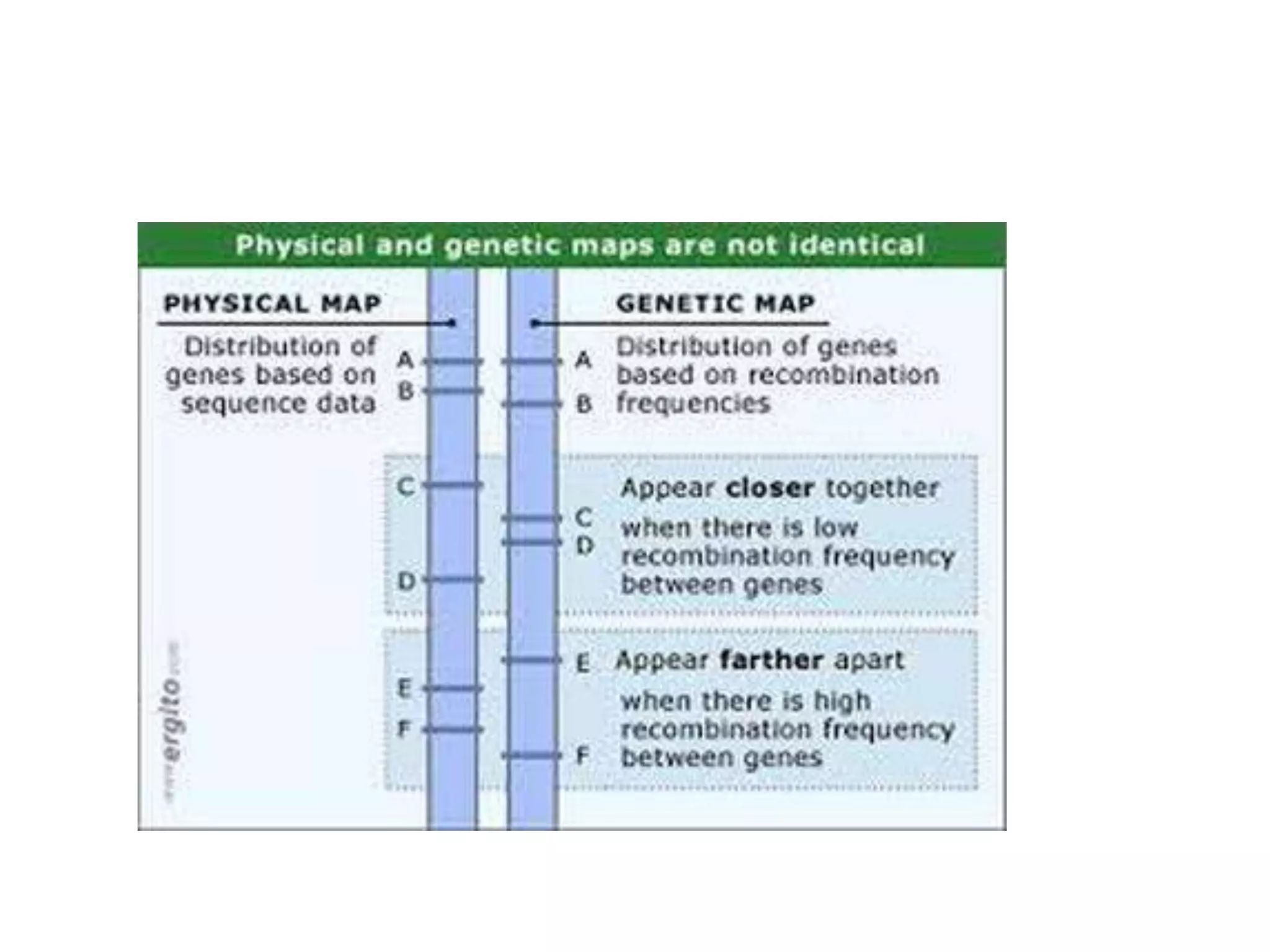
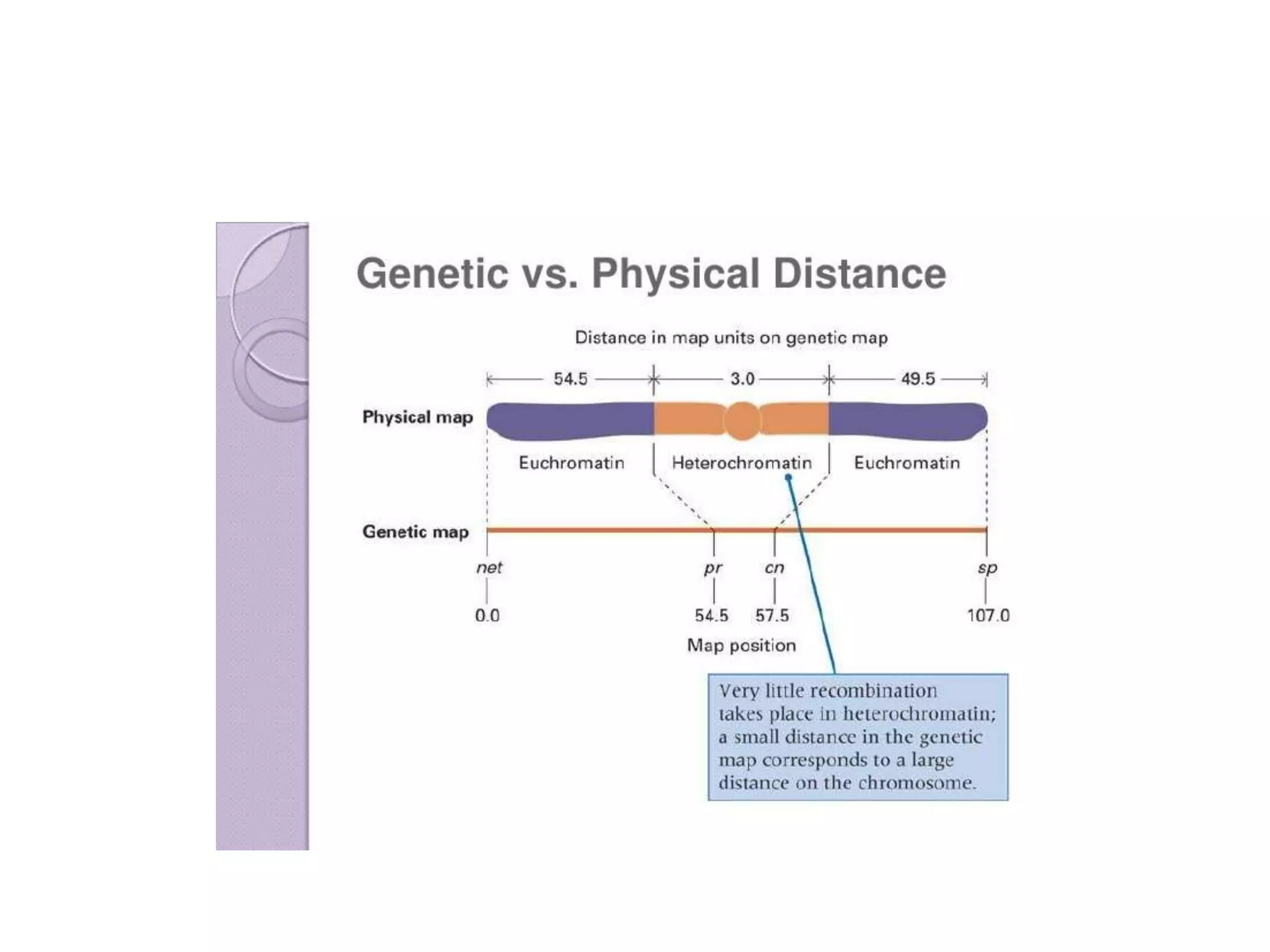
• Recombination frequency is not a direct measure of how physically
far apart genes are on chromosomes.
• However, it provides an estimate or approximation of physical
distance.
• So, we can say that a pair of genes with a larger recombination
frequency are likely farther apart, while a pair with a smaller
recombination frequency are likely closer together.
• Comparison of recombination frequencies can also be used to
figure out the order of genes on a chromosome.
Applications in medicine
• Demonstration of the basic biochemical fault by going directly to
the localization of the genes has been referred to as "reverse
genetics".
• Usually we start from the clinical abnormality and identify an
abnormality in some protein, often an enzyme, and work back to
the gene that encodes that protein or enzyme.
• In all of the conditions listed above it had been impossible to
identify a specific protein that was abnormal -- as stated earlier, the
nature of the fundamental defect was unknown -- but by finding
where in the DNA the gene is located, one can by the reverse
genetics approach determine the normal function of that segment
of DNA, i.e., the protein for which it codes, and proceed from that
point to determine what the gene-determined derangement in that
protein is in the disease and how it exerts its pathological effect.
• This information is critical to the development of methods of
treatment that can correct or ameliorate the disorder at some step
between the mutant gene and the clinical manifestations of the
condition.
• Classically, disease is divided into three categories according to the role
of genetic factors:
• 1. Single gene disorders which show Mendelian pedigree patterns.
Most of these conditions are individually rare, but in the aggregate,
since there are many of them, they represent a substantial body of
disease. (It is these disorders that are cataloged in Mendelian
Inheritance in Man.)
• 2. Multifactorial disorders, i.e., disorders in which multiple
environmental and genetic factors collaborate in causation. Examples
are common conditions such as hypertension, mental illness, coronary
heart disease, and frequent varieties of congenital malformations.
These are discussed in Section C. inasmuch as these are likely to
elucidated greatly by genomic information.
• 3. Abnormalities of chromosome number and structure as in trisomy
of chromosome 21, which leads to Down syndrome.Although in many
ways arbitrary, this classification has usefulness and must now be
• Huntington disease -- chromosome 4;
• Familial adenomatous polyposis of the colon -chromosome 5;
• Cystic fibrosis -- chromosome 7;
• Retinoblastoma -- chromosome 13;
• Polycystic kidney disease -- chromosome 16;
• von Recklinghausen neuro fibromastosis -- chromosome 17;
• Myotonic dystrophy -- chromosome 19;
• Familial Alzheimer disease -- chromosome 21;
• Bilateral acoustic neuroma -- chromosome 22;
• Duchenne muscular dystrophy -- X chromosome;
• Diagnosis of cancer

Gene mapping

  • 1.
  • 2.
    Mendel’s law ofindependent assortment • "law of independent assortment" which states that genes are transmitted from parents to offspring independently of one another. • If a person has blood group A (e.g. genotype AO) and brown eyes (e.g. genotype Bb, where B is the allele for brown and b is the allele for blue eyes), the AO alleles are transmitted to the offspring independently of the Bb alleles.
  • 3.
    • not allgenes are inherited independently of one another. Genes that are located on the same chromosome and are described as linked genes. • If each chromosome were to be transmitted from parent to offspring as a whole and unaltered structure, it would be expected that all the genes located on the same chromosome would be transmitted together as a block and not independently of one another as proposed in Mendel's law. • However, linked genes are not always transmitted en bloc because of the phenomenon of recombination. • One of the fundamental events that occur in meiosis is crossing over in which homologous chromosomes exchange segments causing a reshuffling of genes. • If genes are far apart on the same chromosome, it is likely that recombination occurs. Conversely, if they are very close together, they are more likely to be transmitted as a block .
  • 7.
    Linkage mapping • Linkagemaps • show the arrangement of genes and genetic markers along the chromosomes as calculated by the frequency with which they are inherited together.
  • 12.
    • In ourcase, the recombinant progeny classes are the red-eyed, vestigial-winged flies and the purple-eyed, long-winged flies.
  • 13.
    • Recombination frequencyis not a direct measure of how physically far apart genes are on chromosomes. • However, it provides an estimate or approximation of physical distance. • So, we can say that a pair of genes with a larger recombination frequency are likely farther apart, while a pair with a smaller recombination frequency are likely closer together. • Comparison of recombination frequencies can also be used to figure out the order of genes on a chromosome.
  • 14.
    Applications in medicine •Demonstration of the basic biochemical fault by going directly to the localization of the genes has been referred to as "reverse genetics". • Usually we start from the clinical abnormality and identify an abnormality in some protein, often an enzyme, and work back to the gene that encodes that protein or enzyme. • In all of the conditions listed above it had been impossible to identify a specific protein that was abnormal -- as stated earlier, the nature of the fundamental defect was unknown -- but by finding where in the DNA the gene is located, one can by the reverse genetics approach determine the normal function of that segment of DNA, i.e., the protein for which it codes, and proceed from that point to determine what the gene-determined derangement in that protein is in the disease and how it exerts its pathological effect. • This information is critical to the development of methods of treatment that can correct or ameliorate the disorder at some step between the mutant gene and the clinical manifestations of the condition.
  • 15.
    • Classically, diseaseis divided into three categories according to the role of genetic factors: • 1. Single gene disorders which show Mendelian pedigree patterns. Most of these conditions are individually rare, but in the aggregate, since there are many of them, they represent a substantial body of disease. (It is these disorders that are cataloged in Mendelian Inheritance in Man.) • 2. Multifactorial disorders, i.e., disorders in which multiple environmental and genetic factors collaborate in causation. Examples are common conditions such as hypertension, mental illness, coronary heart disease, and frequent varieties of congenital malformations. These are discussed in Section C. inasmuch as these are likely to elucidated greatly by genomic information. • 3. Abnormalities of chromosome number and structure as in trisomy of chromosome 21, which leads to Down syndrome.Although in many ways arbitrary, this classification has usefulness and must now be
  • 16.
    • Huntington disease-- chromosome 4; • Familial adenomatous polyposis of the colon -chromosome 5; • Cystic fibrosis -- chromosome 7; • Retinoblastoma -- chromosome 13; • Polycystic kidney disease -- chromosome 16; • von Recklinghausen neuro fibromastosis -- chromosome 17; • Myotonic dystrophy -- chromosome 19; • Familial Alzheimer disease -- chromosome 21; • Bilateral acoustic neuroma -- chromosome 22; • Duchenne muscular dystrophy -- X chromosome; • Diagnosis of cancer