Biosensors
Mr. Anirudha Munde
Assistant Professor
SVP College of Pharmacy
 BIOSENSOR
 BIO : Biological Substance/Molecule
 Sensor: Sensitivity / Concentration
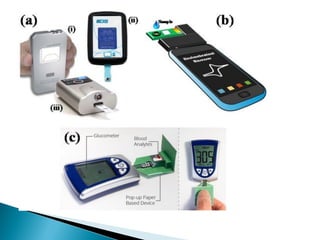
 A biosensor is a device that has the potential to
detect a particular substance or analyte with high
specificity.
 Examples of such analytes include glucose,
lactate, glutamate and glutamine.
 Most biosensors are capable of measuring the
concentration of an analyte in an aqueous
solution, generally producing an electrical signal,
which is considered to be proportional to the
analyte’s concentration in its measuring range.
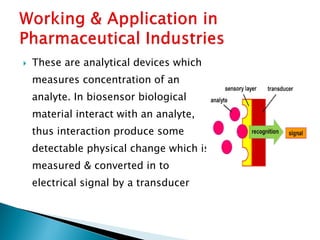
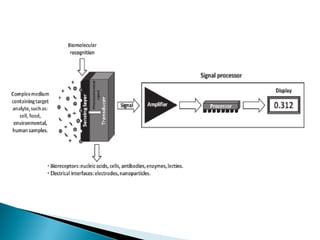
 These are analytical devices which
measures concentration of an
analyte. In biosensor biological
material interact with an analyte,
thus interaction produce some
detectable physical change which is
measured & converted in to
electrical signal by a transducer
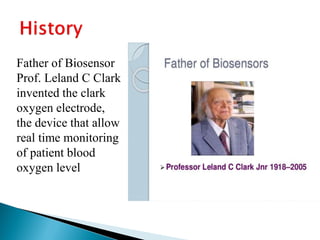
Father of Biosensor
Prof. Leland C Clark
invented the clark
oxygen electrode,
the device that allow
real time monitoring
of patient blood
oxygen level
 A. Analyte : These are the substance which
are measured
 Eg. Molecule, Blood, Urine, Vit. Protein, Gas.
B. Biomolecules: These are the substance which
react with Analyte
Eg. Enzyme, antibody, Cells, Nucleic acid
 C. Transducer : These are the substance
which generate electrical impulses
 It convert the physical changes in to electrical
impulses
 Thermal impulses, Magnetic changes, optical
changes, Chemical, etc .
 1. Heat released or absorbed by reaction
(Calorimetric biosensors )
2. Production of an electrical potential due to
the changes electrons distribution
(potentiometric biosensor )
3. Movement of electrons due to redox
reaction (Amperiometric biosensor )
4.Light Produced or absorbed during reaction
(optical biosensors)
5. Changes in mass of the biological
components as a result of reaction ( acoustic
wave)
 1. calorimetric biosensor : They measures
change in temperature due to release or
absorb of heat
 2. Potentiometric Biosensors : They measures
potential difference arising during a redox
reaction eg. Urea biosensor
 3. Amperiometric biosensor : They measure
current ( flow of electrons) arising duriang a
reaction eg. Glucose biosensor
 4. Conductometric biosensors: They measure
change in electrical conductivity during
reaction eg. Urea biosensors
 5. Acoustic wave biosensors : They measures
Changes in mass of the biological
components as a result of reaction eg. Cocain
biosensor
 6. Optical biosensors: They measures light
arising from the reaction of enzyme luciferase
 Food analyse FDA
 Medical diagnosis
 Study of biomolecules
 Virus analysis
 Pharmaceutical & drug Analysis
 Drug adulteration analysis
 Pollution control & monitoring
 1.Highly specific
 2. Easy to use
 3. Durable
 4. Required small quantity of sample
 5. Less irritating
 In enzyme electrode an enzyme can be combined
with an electrochemical sensor.
 In enzyme electrode is a combination of any
electrochemical probe ( Amperiometric
potentiometric or conductometer ) with a thin layer
(10-200mm) of immobilized enzyme
 The enzyme located in the membrane produce such
as H ions, O2, NH4 ions Co2 or other molecules
which are detected by electrode
 Eg. In Urea electrode Urease Enzyme covert
the urea in to NH4 Ions these ions can be
detected by ions electrode. The ammonia
concentration recorded
 The potential recorded is proportional to the
concentration of urea in to sample solution
 A. Amperiometric :
 B Conductometric :
 C Potentiometric :
 Principle : Based on a thin layer glucose
oxidase on an oxygen electrode
 Glucose + Glucose oxidase Gluconic
acid + Glucose Oxidase (Reduced form)
 Reduced GOD + Surrounding Oxygen +
electrodes H2O2 + Glucose oxidase
* H202 Concentration can be detected by
platinum electrode
THANK YOU

Biosensor Working & Application

  • 1.
    Biosensors Mr. Anirudha Munde AssistantProfessor SVP College of Pharmacy
  • 2.
     BIOSENSOR  BIO: Biological Substance/Molecule  Sensor: Sensitivity / Concentration
  • 3.
     A biosensoris a device that has the potential to detect a particular substance or analyte with high specificity.  Examples of such analytes include glucose, lactate, glutamate and glutamine.  Most biosensors are capable of measuring the concentration of an analyte in an aqueous solution, generally producing an electrical signal, which is considered to be proportional to the analyte’s concentration in its measuring range.
  • 4.
     These areanalytical devices which measures concentration of an analyte. In biosensor biological material interact with an analyte, thus interaction produce some detectable physical change which is measured & converted in to electrical signal by a transducer
  • 7.
    Father of Biosensor Prof.Leland C Clark invented the clark oxygen electrode, the device that allow real time monitoring of patient blood oxygen level
  • 8.
     A. Analyte: These are the substance which are measured  Eg. Molecule, Blood, Urine, Vit. Protein, Gas. B. Biomolecules: These are the substance which react with Analyte Eg. Enzyme, antibody, Cells, Nucleic acid
  • 9.
     C. Transducer: These are the substance which generate electrical impulses  It convert the physical changes in to electrical impulses  Thermal impulses, Magnetic changes, optical changes, Chemical, etc .
  • 10.
     1. Heatreleased or absorbed by reaction (Calorimetric biosensors ) 2. Production of an electrical potential due to the changes electrons distribution (potentiometric biosensor ) 3. Movement of electrons due to redox reaction (Amperiometric biosensor )
  • 11.
    4.Light Produced orabsorbed during reaction (optical biosensors) 5. Changes in mass of the biological components as a result of reaction ( acoustic wave)
  • 12.
     1. calorimetricbiosensor : They measures change in temperature due to release or absorb of heat  2. Potentiometric Biosensors : They measures potential difference arising during a redox reaction eg. Urea biosensor  3. Amperiometric biosensor : They measure current ( flow of electrons) arising duriang a reaction eg. Glucose biosensor
  • 13.
     4. Conductometricbiosensors: They measure change in electrical conductivity during reaction eg. Urea biosensors  5. Acoustic wave biosensors : They measures Changes in mass of the biological components as a result of reaction eg. Cocain biosensor  6. Optical biosensors: They measures light arising from the reaction of enzyme luciferase
  • 14.
     Food analyseFDA  Medical diagnosis  Study of biomolecules  Virus analysis  Pharmaceutical & drug Analysis  Drug adulteration analysis  Pollution control & monitoring
  • 15.
     1.Highly specific 2. Easy to use  3. Durable  4. Required small quantity of sample  5. Less irritating
  • 16.
     In enzymeelectrode an enzyme can be combined with an electrochemical sensor.  In enzyme electrode is a combination of any electrochemical probe ( Amperiometric potentiometric or conductometer ) with a thin layer (10-200mm) of immobilized enzyme  The enzyme located in the membrane produce such as H ions, O2, NH4 ions Co2 or other molecules which are detected by electrode
  • 17.
     Eg. InUrea electrode Urease Enzyme covert the urea in to NH4 Ions these ions can be detected by ions electrode. The ammonia concentration recorded  The potential recorded is proportional to the concentration of urea in to sample solution
  • 18.
     A. Amperiometric:  B Conductometric :  C Potentiometric :
  • 19.
     Principle :Based on a thin layer glucose oxidase on an oxygen electrode  Glucose + Glucose oxidase Gluconic acid + Glucose Oxidase (Reduced form)  Reduced GOD + Surrounding Oxygen + electrodes H2O2 + Glucose oxidase * H202 Concentration can be detected by platinum electrode
  • 20.