COMPUTER- AIDED BIOPHARMACEUTICAL
CHARACTERIZATION:
GASTROINTESTINAL ABSORPTION SIMULATION
 Due to dynamic interpretation of the processes a drug undergoes in
the GI tract, dynamic models are able to predict both the fraction of
dose absorbed and the rate of drug absorption, and can be related to
PK models to evaluate plasma concentration- time profiles
 Such models can be beneficial at different stages of formulation
development.
 For example, taking into account all the relevant biopharmaceutical
properties of the compound of interest, the potential advantage of
various drug properties in terms of improving oral bioavailability
can be in silico assessed, before proceeding to in vivo studies.
 Also, by providing more mechanistic interpretation of PK data,
these models can be utilized to explore mechanistic hypotheses and
to help define a formulation strategy.
 The decisive advantage of in silico simulation tools is that they
require less investment in resources and time in comparison to
in vivo studies.
 Also, they offer a potential to screen virtual compounds. As a
consequence, the number of experiments, and concomitant costs
and time required for compound selection and development, is
considerably reduced.
 In addition, in silico methods can be applied to predict oral
drug absorption when conventional PK analysis is limited,
such as when intravenous data are lacking due to poor drug
solubility and/or if the drug shows nonlinear kinetics.
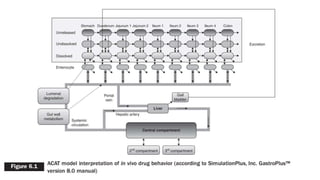
HOW GASTROPLUS WORKS
Movement of the drug between each sub-compartment is described by a
series of differential equations. In general, the rate of change of
dissolved drug concentration in each GI compartment depends on ten
processes:
• transit of drug into the compartment;
• transit of drug out of the compartment;
• release of drug from the formulation into the compartment; IV.
dissolution of drug particles;
• precipitation of drug;
• lumenal degradation of drug;
• absorption of drug into the enterocytes;
• exsorption of drug from the enterocytes back into the lumen;
• absorption of drug into portal vein via paracellular pathway;
• Exsorption of drug from portal vein via paracellular pathway.
MODEL CONSTRUCTION
• Modeling and simulation start from data
collection.
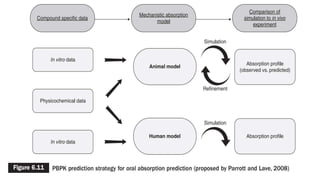
• Mechanistic absorption models require a number
of input parameters, which can either be
experimentally determined or in silico predicted.
• The common approach is to use literature
reported values as initial inputs
VIRTUAL TRIAL
In the later stages of formulation development, it is
especially valuable to anticipate inter- subject
variability that may infl uence oral drug bioavailability.
In this way, the formulator might gain a better insight
on what can be achieved by means of the
formulation.
 In order to in silico simulate the influence of
population variability and/ or the combined effect of
formulation variables that are not precise values,
but for which distributions of values can be
estimated, the Virtual Trial feature in GastroPlus™
can be used.
 This feature allows the user to perform stochastic
simulations on a number of virtual subjects, wherein
the values of the selected variables are randomly
sampled from predetermined distributions (defined
as means with coefficients of variation (CV%) in
absolute or log space).
 CV% values are usually estimated on the basis of
previous knowledge or analysis of literature data.
 The results of the simulations are expressed as means
and coefficients of variation for fraction of drug
absorbed, bioavailability, tmax, Cmax, and AUC
values, as well as absolute minimum and maximum
values for each of these parameters reached during the
trials.
 Also, the average Cp-time curve, 90% confidence
intervals, probability contours (10, 25, 50, 75, 90, 95,
and 100%), and experimental data with possible BE
limits (if available), are displayed.
FED VS. FASTED STATE
The presence of food may affect drug absorption via a
variety of mechanisms; by impacting GI tract
physiology (e.g. food-induced changes in gastric
emptying time, gastric pH, intestinal fluid
composition, hepatic blood flow), drug solubility and
dissolution, and drug permeation
 For example, lipophilic drugs often show
increased systemic exposure with food, and this
phenomenon is attributable to improved
solubilization due to higher bile salt and lipid
concentrations.
 Negative food effects are mostly seen for
hydrophilic drugs, where food impedes
permeation (Gu et al., 2007).
 One of the frequently used approaches to assess
the effect of food on oral drug absorption involves
animal studies (Humberstone et al., 1996; Paulson
et al., 2001; Wu et al., 2004; Xu et al., 2012).
 However, due to the fact that physiological factors are
species dependent, the magnitude of food effect for a given
compound across species is usually different, thus
complicating the prediction of food effects in humans
(Jones et al., 2006b).
 One alternative to animal experiments is to simulate food
effects in humans using physiologically based absorption
models.
 Considering that these models are built based on a prior
knowledge of GI physiology in the fasted and fed states,
they are able to describe the kinetics of drug transit,
dissolution, and absorption on the basis of drug-specific
features such as permeability, biorelevant solubility,
ionization constant(s), dose, metabolism and distribution
data, etc.
Verification of model assumptions was
performed by comparing simulation
results to the food effects measured in
carefully designed in vivo dog studies,
whereas a good match of simulated and
observed plasma concentrations in the
fasted and fed dogs indicated that the
model has captured well the
mechanisms responsible for food effects,
allowing a reliable prediction for humans.
IN VITRO DISSOLUTION AND IN VITRO–IN VIVO
CORRELATION
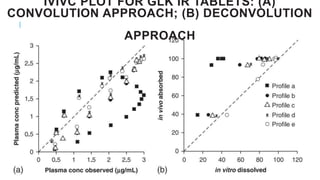
 There are two approaches enabling the GastroPlus™ generated
drugspecific absorption model to be used to assess the
relationship between the in vitro and in vivo data: convolution
to predict the plasma concentration profi le, and deconvolution
to estimate the in vivo dissolution profile.
 Once an IVIVC is developed, an in vitro dissolution test can be
used to identify changes that may affect the efficacy and safety
of the drug product.
 In addition, biowaiver justification could be discussed in terms
of whether dissolution from the dosage form is expected to be
the rate- limiting factor for drug in vivo absorption
IVIVC PLOT FOR GLK IR TABLETS: (A)
CONVOLUTION APPROACH; (B) DECONVOLUTION
APPROACH
BIOWAIVER CONSIDERATIONS
• The role of biowaivers in the drug approval
process has been emphasized since the
introduction of BCS (Amidon et al., 1995)
and the release of FDA guidance on waiver
of in vivo bioavailability and BE studies (US
Food and Drug Adminstration, 2000).
• In this context, the term biowaiver refers to
the situations in which in vivo BE studies can
be substituted with the relevant in vitro data.
BIOWAIVER CONSIDERATIONS
• he most common type of biowaiver adopted by the
regulatory authorities includes the application of the
BCS-based scheme (similar or rapid/very rapid
dissolution profi les of the test and reference product
in pH 1.2, 4.5, and 6.8 media) or the application of
IVIVC.
• According to the FDA, biowaivers for IR drug
products may be requested solely in the cases of
highly soluble and highly permeable substances
(BCS class I) when the drug product is (very) rapidly
dissolving and exhibits similar dissolution profi le to
the reference product, while the IVIVC-based
approach has been narrowed down to applications
for XR products (US Food and Drug Administration,
BIOWAIVER CONSIDERATIONS
• The EMA and WHO issued guidelines widened the eligibility
for biowaiver to some BCS class III (eligible if very rapidly
dissolving) (European Medicines Agency, 2010; WHO
Expert Committee on Specifications for Pharmaceutical
Preparations, 2006) and BCS class II drugs (eligible for
biowaiver if the dose- to-solubility ratio at pH 6.8 is 250 mL
or less and high permeability is at 85% absorbed) (WHO
Expert Committee on Specifications for Pharmaceutical
Preparations, 2006).
• Also, it was pointed out that the biowaiver concept
concerning BCS II and III drugs should be further relaxed
(e.g. BCS class II drugs eligible for biowaiver under the
assumption that the drug dissolves completely during the GI
passage (Yu et al., 2002), and BCS class III compounds
eligible if rapidly dissolving (Tsdume and Amidon, 2010))
CONCLUSION
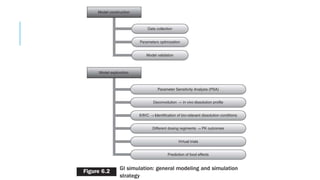
 The various examples presented demonstrate that GI modeling
has become a powerful tool to study oral drug absorption and
pharmacrokinetics.
 This ethod offers a distinctive opportunity to mechanistically
interpret the influence of the underlying processes on the resulting
PK profile.
 Namely, by understanding the complex interplay between drug
physicochemical and PK properties, formulation factors, and
human physiology characteristics, we might gain an insight into
the influence of a particular factor or set of factors on drug
absorption profile, and understand possible reasons for poor oral
bioavailability.
CONCLUSION
 In this context, Parameter Sensitivity Analysis is particularly
useful, since it allows identification of critical factors affecting
the rate and extent of drug absorption prior to formulation
development.
 In addition, PSA can be used to optimize parameter values for
which accurate data are not available.
 Other features, such as the Virtual Trials and PBPK modeling,
enable even more advanced predictions of, for example, inter-
individual variability or factors contributing to variability in
disposition, thus further enhancing the reliability of in silico
absorption modeling
CONCLUSION
 In this context, PSA is particularly useful, since it allows
identification of critical factors affecting the rate and extent
of drug absorption prior to formulation development.
 In addition, PSA can be used to optimize parameter values
for which accurate data are not available.
 Other features, such as the Virtual Trials and PBPK
modeling, enable even more advanced predictions of, for
example, inter-individual variability or factors contributing
to variability in disposition, thus further enhancing the
reliability of in silico absorption modeling
CONCLUSION
 The examples also demonstrate that the in vitro- in silico approach
can be successfully used to identify biorelevant dissolution
specifications for the in vitro assessment of the drug product of
interest, and facilitate the choice of the relevant in vitro test
conditions for the prediction of the drug release process in vivo.
 Finding the in vitro dissolution test conditions that best predict drug
in vivo performance is a substantial part of product development and
quality testing strategy, thus implying that mechanistically based
absorption modeling might facilitate the QbD approach in drug
development.
 In addition, it was illustrated that GI simulation, in conjunction with
IVIVC, might contrive identification of biowaiver candidate drugs.
Computer- aided biopharmaceutical characterization.pptx

Computer- aided biopharmaceutical characterization.pptx

  • 1.
  • 2.
     Due todynamic interpretation of the processes a drug undergoes in the GI tract, dynamic models are able to predict both the fraction of dose absorbed and the rate of drug absorption, and can be related to PK models to evaluate plasma concentration- time profiles  Such models can be beneficial at different stages of formulation development.  For example, taking into account all the relevant biopharmaceutical properties of the compound of interest, the potential advantage of various drug properties in terms of improving oral bioavailability can be in silico assessed, before proceeding to in vivo studies.  Also, by providing more mechanistic interpretation of PK data, these models can be utilized to explore mechanistic hypotheses and to help define a formulation strategy.
  • 3.
     The decisiveadvantage of in silico simulation tools is that they require less investment in resources and time in comparison to in vivo studies.  Also, they offer a potential to screen virtual compounds. As a consequence, the number of experiments, and concomitant costs and time required for compound selection and development, is considerably reduced.  In addition, in silico methods can be applied to predict oral drug absorption when conventional PK analysis is limited, such as when intravenous data are lacking due to poor drug solubility and/or if the drug shows nonlinear kinetics.
  • 4.
    HOW GASTROPLUS WORKS Movementof the drug between each sub-compartment is described by a series of differential equations. In general, the rate of change of dissolved drug concentration in each GI compartment depends on ten processes: • transit of drug into the compartment; • transit of drug out of the compartment; • release of drug from the formulation into the compartment; IV. dissolution of drug particles; • precipitation of drug; • lumenal degradation of drug; • absorption of drug into the enterocytes; • exsorption of drug from the enterocytes back into the lumen; • absorption of drug into portal vein via paracellular pathway; • Exsorption of drug from portal vein via paracellular pathway.
  • 7.
    MODEL CONSTRUCTION • Modelingand simulation start from data collection. • Mechanistic absorption models require a number of input parameters, which can either be experimentally determined or in silico predicted. • The common approach is to use literature reported values as initial inputs
  • 8.
    VIRTUAL TRIAL In thelater stages of formulation development, it is especially valuable to anticipate inter- subject variability that may infl uence oral drug bioavailability. In this way, the formulator might gain a better insight on what can be achieved by means of the formulation.
  • 9.
     In orderto in silico simulate the influence of population variability and/ or the combined effect of formulation variables that are not precise values, but for which distributions of values can be estimated, the Virtual Trial feature in GastroPlus™ can be used.  This feature allows the user to perform stochastic simulations on a number of virtual subjects, wherein the values of the selected variables are randomly sampled from predetermined distributions (defined as means with coefficients of variation (CV%) in absolute or log space).  CV% values are usually estimated on the basis of previous knowledge or analysis of literature data.
  • 10.
     The resultsof the simulations are expressed as means and coefficients of variation for fraction of drug absorbed, bioavailability, tmax, Cmax, and AUC values, as well as absolute minimum and maximum values for each of these parameters reached during the trials.  Also, the average Cp-time curve, 90% confidence intervals, probability contours (10, 25, 50, 75, 90, 95, and 100%), and experimental data with possible BE limits (if available), are displayed.
  • 11.
    FED VS. FASTEDSTATE The presence of food may affect drug absorption via a variety of mechanisms; by impacting GI tract physiology (e.g. food-induced changes in gastric emptying time, gastric pH, intestinal fluid composition, hepatic blood flow), drug solubility and dissolution, and drug permeation
  • 12.
     For example,lipophilic drugs often show increased systemic exposure with food, and this phenomenon is attributable to improved solubilization due to higher bile salt and lipid concentrations.  Negative food effects are mostly seen for hydrophilic drugs, where food impedes permeation (Gu et al., 2007).  One of the frequently used approaches to assess the effect of food on oral drug absorption involves animal studies (Humberstone et al., 1996; Paulson et al., 2001; Wu et al., 2004; Xu et al., 2012).
  • 13.
     However, dueto the fact that physiological factors are species dependent, the magnitude of food effect for a given compound across species is usually different, thus complicating the prediction of food effects in humans (Jones et al., 2006b).  One alternative to animal experiments is to simulate food effects in humans using physiologically based absorption models.  Considering that these models are built based on a prior knowledge of GI physiology in the fasted and fed states, they are able to describe the kinetics of drug transit, dissolution, and absorption on the basis of drug-specific features such as permeability, biorelevant solubility, ionization constant(s), dose, metabolism and distribution data, etc.
  • 15.
    Verification of modelassumptions was performed by comparing simulation results to the food effects measured in carefully designed in vivo dog studies, whereas a good match of simulated and observed plasma concentrations in the fasted and fed dogs indicated that the model has captured well the mechanisms responsible for food effects, allowing a reliable prediction for humans.
  • 16.
    IN VITRO DISSOLUTIONAND IN VITRO–IN VIVO CORRELATION  There are two approaches enabling the GastroPlus™ generated drugspecific absorption model to be used to assess the relationship between the in vitro and in vivo data: convolution to predict the plasma concentration profi le, and deconvolution to estimate the in vivo dissolution profile.  Once an IVIVC is developed, an in vitro dissolution test can be used to identify changes that may affect the efficacy and safety of the drug product.  In addition, biowaiver justification could be discussed in terms of whether dissolution from the dosage form is expected to be the rate- limiting factor for drug in vivo absorption
  • 17.
    IVIVC PLOT FORGLK IR TABLETS: (A) CONVOLUTION APPROACH; (B) DECONVOLUTION APPROACH
  • 18.
    BIOWAIVER CONSIDERATIONS • Therole of biowaivers in the drug approval process has been emphasized since the introduction of BCS (Amidon et al., 1995) and the release of FDA guidance on waiver of in vivo bioavailability and BE studies (US Food and Drug Adminstration, 2000). • In this context, the term biowaiver refers to the situations in which in vivo BE studies can be substituted with the relevant in vitro data.
  • 19.
    BIOWAIVER CONSIDERATIONS • hemost common type of biowaiver adopted by the regulatory authorities includes the application of the BCS-based scheme (similar or rapid/very rapid dissolution profi les of the test and reference product in pH 1.2, 4.5, and 6.8 media) or the application of IVIVC. • According to the FDA, biowaivers for IR drug products may be requested solely in the cases of highly soluble and highly permeable substances (BCS class I) when the drug product is (very) rapidly dissolving and exhibits similar dissolution profi le to the reference product, while the IVIVC-based approach has been narrowed down to applications for XR products (US Food and Drug Administration,
  • 20.
    BIOWAIVER CONSIDERATIONS • TheEMA and WHO issued guidelines widened the eligibility for biowaiver to some BCS class III (eligible if very rapidly dissolving) (European Medicines Agency, 2010; WHO Expert Committee on Specifications for Pharmaceutical Preparations, 2006) and BCS class II drugs (eligible for biowaiver if the dose- to-solubility ratio at pH 6.8 is 250 mL or less and high permeability is at 85% absorbed) (WHO Expert Committee on Specifications for Pharmaceutical Preparations, 2006). • Also, it was pointed out that the biowaiver concept concerning BCS II and III drugs should be further relaxed (e.g. BCS class II drugs eligible for biowaiver under the assumption that the drug dissolves completely during the GI passage (Yu et al., 2002), and BCS class III compounds eligible if rapidly dissolving (Tsdume and Amidon, 2010))
  • 21.
    CONCLUSION  The variousexamples presented demonstrate that GI modeling has become a powerful tool to study oral drug absorption and pharmacrokinetics.  This ethod offers a distinctive opportunity to mechanistically interpret the influence of the underlying processes on the resulting PK profile.  Namely, by understanding the complex interplay between drug physicochemical and PK properties, formulation factors, and human physiology characteristics, we might gain an insight into the influence of a particular factor or set of factors on drug absorption profile, and understand possible reasons for poor oral bioavailability.
  • 22.
    CONCLUSION  In thiscontext, Parameter Sensitivity Analysis is particularly useful, since it allows identification of critical factors affecting the rate and extent of drug absorption prior to formulation development.  In addition, PSA can be used to optimize parameter values for which accurate data are not available.  Other features, such as the Virtual Trials and PBPK modeling, enable even more advanced predictions of, for example, inter- individual variability or factors contributing to variability in disposition, thus further enhancing the reliability of in silico absorption modeling
  • 23.
    CONCLUSION  In thiscontext, PSA is particularly useful, since it allows identification of critical factors affecting the rate and extent of drug absorption prior to formulation development.  In addition, PSA can be used to optimize parameter values for which accurate data are not available.  Other features, such as the Virtual Trials and PBPK modeling, enable even more advanced predictions of, for example, inter-individual variability or factors contributing to variability in disposition, thus further enhancing the reliability of in silico absorption modeling
  • 24.
    CONCLUSION  The examplesalso demonstrate that the in vitro- in silico approach can be successfully used to identify biorelevant dissolution specifications for the in vitro assessment of the drug product of interest, and facilitate the choice of the relevant in vitro test conditions for the prediction of the drug release process in vivo.  Finding the in vitro dissolution test conditions that best predict drug in vivo performance is a substantial part of product development and quality testing strategy, thus implying that mechanistically based absorption modeling might facilitate the QbD approach in drug development.  In addition, it was illustrated that GI simulation, in conjunction with IVIVC, might contrive identification of biowaiver candidate drugs.