Mental health
group assignment
Biopsychosocial Model
•The Biopsychosocial model was first
conceptualised by George Engel in 1977,
suggesting that to understand a person's
medical condition it is not simply the
biological factors to consider, but also the
psychological and social factors
Cont’
•Bio (physiological pathology)
•Psycho (thoughts emotions and behaviours
such as psychological distress, fear/avoidance
beliefs, current coping methods and
attribution)
•Social (socio-economical, socio-environmental,
and cultural factors suchs as work issues, family
circumstances and benefits/economics)
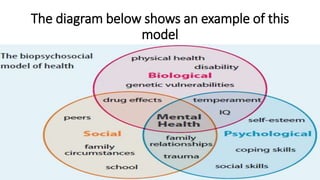
The diagram below shows an example of this
model
Biological factor
• The 'bio' component of this theory examines aspects of
biology that influence health. These might include things
like brain changes, genetics, or functioning of major body
organs, such as the liver, the kidneys, or even the motor
system. For example, let's say a client has an accident that
leaves her with reduced movement in her right arm. This
biological change might influence how she feels about
herself, which could lead to depression or anxiety in certain
situations.
Psychological factor
• The 'psycho' component of the theory examines
psychological components, things like thoughts,
emotions, or behaviors. Client might go through
many different psychological changes. She might
experience decreased self-esteem, fear of judgment,
or feel inadequate in her life or job. These changes in
thoughts might lead to changes in behaviors, like
avoiding certain situations, staying
Social factor
•The 'social' component of the BPS model
examines social factors that might influence the
health of an individual l, things like our
interactions with others, our culture, or our
economic status. A possible social factor for
client could be her role in her household.
Example of diane from congo
•An injured arm might reduce her ability to
care for her new baby. Being unable to fulfill
this social role might trigger problems with
her husband or other family members,
causing diane stress that could lead to
further biological or psychological problems
Cont’
• Physiotherapists must know how biopsychosocial factors
interact in patients with chronic pain to explain the
perpetuation of this condition and use it as a basis for
planning the intervention program. The evidence has
suggested a clinical biopsychosocial assessment for the
physiotherapeutic management of patients with chronic
pain in order to understand and explain the predominant
mechanism of pain and psychosocial factors that may or may
not be modified for the patient to improve their condition
Types Of Pain
•Clinical identification and differentiation of the
dominant pain mechanism:
nociceptive pain
neuropathic pain
non-neuropathic pain of central sensitization.
Factors effect biopsychosocial approach
Somatic and medical factor
• For physical therapist the physical examination is a
very important part of his intervention - essential to:
• Be aware that some findings of clinical examinations
such as mobility, strength, neurodynamics,
coordination, etc. could be altered because there is
greater sensitivity to mechanical stimulation and
modified movement patterns in patients with non-
neuropathic pain of central sensitization.
Cognition and perception factor
•Both influence biologically on hypersensitivity in
the brain by activating neuromatrix pain and also
influence the emotional and behavioral factors. :
•Ask about perceptions: expectations of the
intervention, expectations of the prognosis of
their pain, understanding of their situation and
the strategies
Emotional factor
•Ask if there is fear of specific
movements, avoidance behaviors,
psychological traumatic appearance of pain,
psychological problems at work, family,
finances, society, etc.
Behavior factor
•Can lead to avoid activity or movement due to
fear, which in turn is presented as physical
inactivity or disuse and, finally, disability.
Therefore it is important to evaluate the
behavior and adaptations that the patient has
made due to the pain.
Social factor
• It refers to the social and environmental factors in which the
patient develops, which could be useful and supportive or
harmful and stressful for the improvement of the patient's
health condition. The data collection can be divided as
follows:
• Housing or living situation
• Social environment
• Work
Motivation factor
•Evaluating the motivation in the patient
and his willingness to change is useful to
modify his thoughts regarding the
relationship pain-kinesiophobia, pain-
disability.
REFERENCES
• Engel GL: The need for a new medical model: a challenge for
biomedicine. Science 1977;196:129-136.
• Engel GL: The clinical application of the biopsychosocial model. Am J
Psychiatry 1980;137:535-544.
• Frankel RM, Quill TE, McDaniel SH (Eds.): The Biopsychosocial
Approach: Past, Present,
• Future.University of Rochester Press, Rochester, NY, 2003.

Biopsychoscial Model.pptx

  • 1.
  • 2.
    Biopsychosocial Model •The Biopsychosocialmodel was first conceptualised by George Engel in 1977, suggesting that to understand a person's medical condition it is not simply the biological factors to consider, but also the psychological and social factors
  • 3.
    Cont’ •Bio (physiological pathology) •Psycho(thoughts emotions and behaviours such as psychological distress, fear/avoidance beliefs, current coping methods and attribution) •Social (socio-economical, socio-environmental, and cultural factors suchs as work issues, family circumstances and benefits/economics)
  • 4.
    The diagram belowshows an example of this model
  • 5.
    Biological factor • The'bio' component of this theory examines aspects of biology that influence health. These might include things like brain changes, genetics, or functioning of major body organs, such as the liver, the kidneys, or even the motor system. For example, let's say a client has an accident that leaves her with reduced movement in her right arm. This biological change might influence how she feels about herself, which could lead to depression or anxiety in certain situations.
  • 6.
    Psychological factor • The'psycho' component of the theory examines psychological components, things like thoughts, emotions, or behaviors. Client might go through many different psychological changes. She might experience decreased self-esteem, fear of judgment, or feel inadequate in her life or job. These changes in thoughts might lead to changes in behaviors, like avoiding certain situations, staying
  • 7.
    Social factor •The 'social'component of the BPS model examines social factors that might influence the health of an individual l, things like our interactions with others, our culture, or our economic status. A possible social factor for client could be her role in her household.
  • 8.
    Example of dianefrom congo •An injured arm might reduce her ability to care for her new baby. Being unable to fulfill this social role might trigger problems with her husband or other family members, causing diane stress that could lead to further biological or psychological problems
  • 9.
    Cont’ • Physiotherapists mustknow how biopsychosocial factors interact in patients with chronic pain to explain the perpetuation of this condition and use it as a basis for planning the intervention program. The evidence has suggested a clinical biopsychosocial assessment for the physiotherapeutic management of patients with chronic pain in order to understand and explain the predominant mechanism of pain and psychosocial factors that may or may not be modified for the patient to improve their condition
  • 10.
    Types Of Pain •Clinicalidentification and differentiation of the dominant pain mechanism: nociceptive pain neuropathic pain non-neuropathic pain of central sensitization.
  • 11.
    Factors effect biopsychosocialapproach Somatic and medical factor • For physical therapist the physical examination is a very important part of his intervention - essential to: • Be aware that some findings of clinical examinations such as mobility, strength, neurodynamics, coordination, etc. could be altered because there is greater sensitivity to mechanical stimulation and modified movement patterns in patients with non- neuropathic pain of central sensitization.
  • 12.
    Cognition and perceptionfactor •Both influence biologically on hypersensitivity in the brain by activating neuromatrix pain and also influence the emotional and behavioral factors. : •Ask about perceptions: expectations of the intervention, expectations of the prognosis of their pain, understanding of their situation and the strategies
  • 13.
    Emotional factor •Ask ifthere is fear of specific movements, avoidance behaviors, psychological traumatic appearance of pain, psychological problems at work, family, finances, society, etc.
  • 14.
    Behavior factor •Can leadto avoid activity or movement due to fear, which in turn is presented as physical inactivity or disuse and, finally, disability. Therefore it is important to evaluate the behavior and adaptations that the patient has made due to the pain.
  • 15.
    Social factor • Itrefers to the social and environmental factors in which the patient develops, which could be useful and supportive or harmful and stressful for the improvement of the patient's health condition. The data collection can be divided as follows: • Housing or living situation • Social environment • Work
  • 16.
    Motivation factor •Evaluating themotivation in the patient and his willingness to change is useful to modify his thoughts regarding the relationship pain-kinesiophobia, pain- disability.
  • 17.
    REFERENCES • Engel GL:The need for a new medical model: a challenge for biomedicine. Science 1977;196:129-136. • Engel GL: The clinical application of the biopsychosocial model. Am J Psychiatry 1980;137:535-544. • Frankel RM, Quill TE, McDaniel SH (Eds.): The Biopsychosocial Approach: Past, Present, • Future.University of Rochester Press, Rochester, NY, 2003.